 By Andre Atallah, CEO of EP Advisory
Short answer: Yes. Foreigners are hired in Dubai every day, but you need an employer to sponsor you. The employer gets your MOHRE work permit, your entry permit (usually within 48 hours) and your two-year residence visa, and pays for them. You cannot work on a visit visa. Skilled graduates can enter on a job seeker visa for 60 to 120 days. There is no income tax on salaries.
This guide is for skilled professionals applying to Dubai from abroad, whether from India, Pakistan, Nigeria, the Philippines, Turkey, Latin America, the UK, the US or a Russian-speaking country.
Dubai is used to hiring foreigners. Employers expect to recruit from abroad, the visa is fast, and most private companies work in English. Below are the visa steps with official 2026 timings, the job seeker visa, where to apply, your rights at work, tax-free pay and how to check an offer. For nearly 10 years, we’ve helped more than 5,000 professionals find jobs abroad. Want to know if your CV will pass screening in the UAE? Check your CV for free: a score in 30 seconds, then a fix for each problem.
Can you work in Dubai as a foreigner?
Yes, as long as an employer sponsors you. A foreign employee of a mainland company needs a work permit from the Ministry of Human Resources and Emiratisation (MOHRE), often still called the labour card. In a free zone, the free zone authority sponsors you instead. You also need a residence visa, which comes with your Emirates ID, the identity card every UAE resident carries. Your employer applies for both. For a standard work visa, you cannot apply on your own (UAE government portal, 2026).
Your passport decides how you enter as a visitor, not how you get hired. Here are the routes side by side.
| Route | Who it is for | Salary rule | Who applies | Valid for | Can you work? |
|---|---|---|---|---|---|
| Employment visa, mainland company | Most private-sector hires | No minimum wage for expats. “Skilled” status needs at least AED 4,000 a month, excluding commission | Your employer, through MOHRE | 2 years, renewable | Yes, for that employer |
| Employment visa, free zone company | Staff of companies in zones such as DMCC, DIFC or Dubai Internet City | Set by each free zone | The free zone authority sponsors you | Set by each free zone | Yes, for that employer |
| Job seeker visit visa | Skilled graduates who want to search in person | Financial guarantee, a bachelor’s degree, and MOHRE skill level 1 to 3 or a top-500 degree from the last 2 years | You, no sponsor needed | 60, 90 or 120 days | No |
| Golden Visa, skilled professional | Senior earners already employed in the UAE | AED 30,000 a month, degree, MOHRE level 1 or 2 | You | 10 years | Yes, and it is not tied to one employer |
Mainland or free zone employer
Mainland companies are licensed by the emirate and follow the federal labour law. Free zone companies sit in special economic zones. Their staff are “generally not governed by the UAE Labour Law”, and the free zone authority sponsors your visa (u.ae, free zones). So check which law your contract follows. Both kinds of employer hire foreigners all the time.
Still choosing between Gulf countries? Our guide to jobs in the Gulf compares the region, and our guide to jobs in Qatar for foreigners covers Doha.
The employment visa, step by step
Your employer does almost all of the paperwork and, by law, pays for recruitment. Here is the order.
- Job offer. The employer issues a formal offer in Arabic and English, plus a third language you understand if needed. You sign it, and it goes to MOHRE with the permit request.
- Work permit. MOHRE approves the permit to recruit you from abroad. The company pays the fee of AED 250 to AED 3,450 (u.ae, work permits).
- Entry permit. The approval lets you enter the UAE. For a Dubai job, the General Directorate of Residency and Foreigners Affairs (GDRFA Dubai) issues the work entry permit, usually within 48 hours. It lets you stay 60 days while the rest is done. In the other emirates, the Federal Authority for Identity, Citizenship, Customs and Port Security (ICP) issues it.
- Arrival and contract. Your contract must reach MOHRE within 14 days of arrival.
- Medical fitness test. You take a medical test at an approved centre.
- Emirates ID. You give fingerprints and a photo for your Emirates ID.
- Residence visa. The employer applies for it. It is valid for 2 years and renewable (u.ae, residence visa for work).
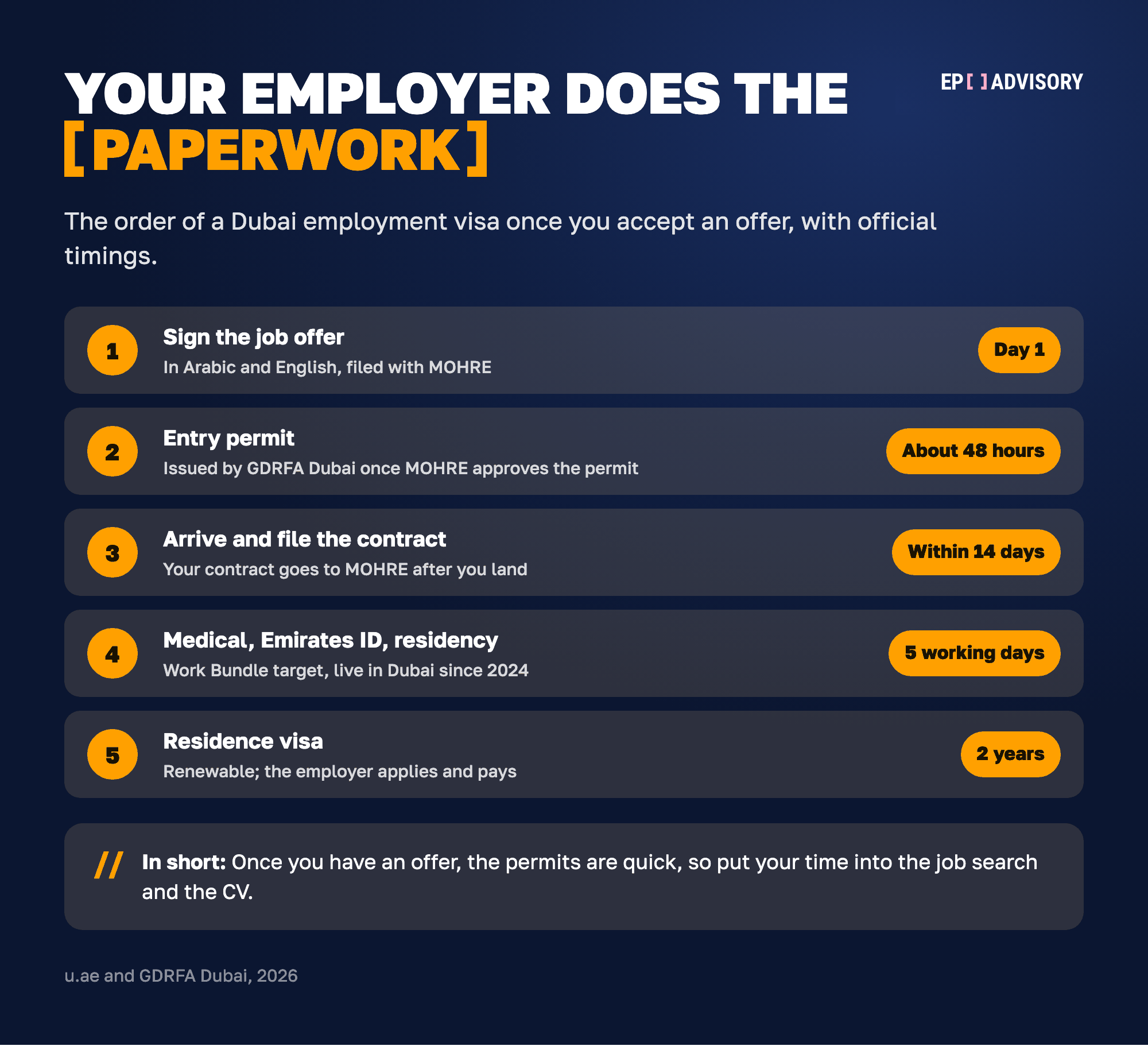
The UAE’s Work Bundle, launched in Dubai in March 2024 on the Invest in Dubai platform (Gulf News, March 2024), combines the work permit, residency, medical test and Emirates ID fingerprints into one process. The government says it cut in-person visits from 7 to 2 and processing time from 30 working days to 5 working days (u.ae, work permits). So once you have an offer, the paperwork is quick. The job search takes longer, and that is where your effort should go.
Prepare your documents early: a passport copy, a photo and your degree certificate. For a skilled job, the degree must be attested, which means officially certified at home and then by the UAE. Start this when interviews begin, because it takes time. Rules and fees change, so check the current rules with the official authority (MOHRE or ICP) before you rely on any figure here.
Can you go to Dubai to look for a job?
Yes. The job seeker visit visa lets you enter without a sponsor or host for 60, 90 or 120 days, on a single entry. To qualify, you need one of two things:
- A skilled profile: a job at MOHRE skill level 1, 2 or 3 and a bachelor’s degree or equivalent.
- A top university degree: graduation from one of the world’s top 500 universities within the last 2 years.
You also need a financial guarantee and an attested copy of your degree certificate. In Dubai, the fees are AED 200 for 60 days, AED 300 for 90 days and AED 400 for 120 days, plus 5% VAT. You also pay a AED 1,000 security deposit and small service fees, and extra fees if you apply from inside the UAE. The visa is usually issued in about 48 hours (GDRFA Dubai).
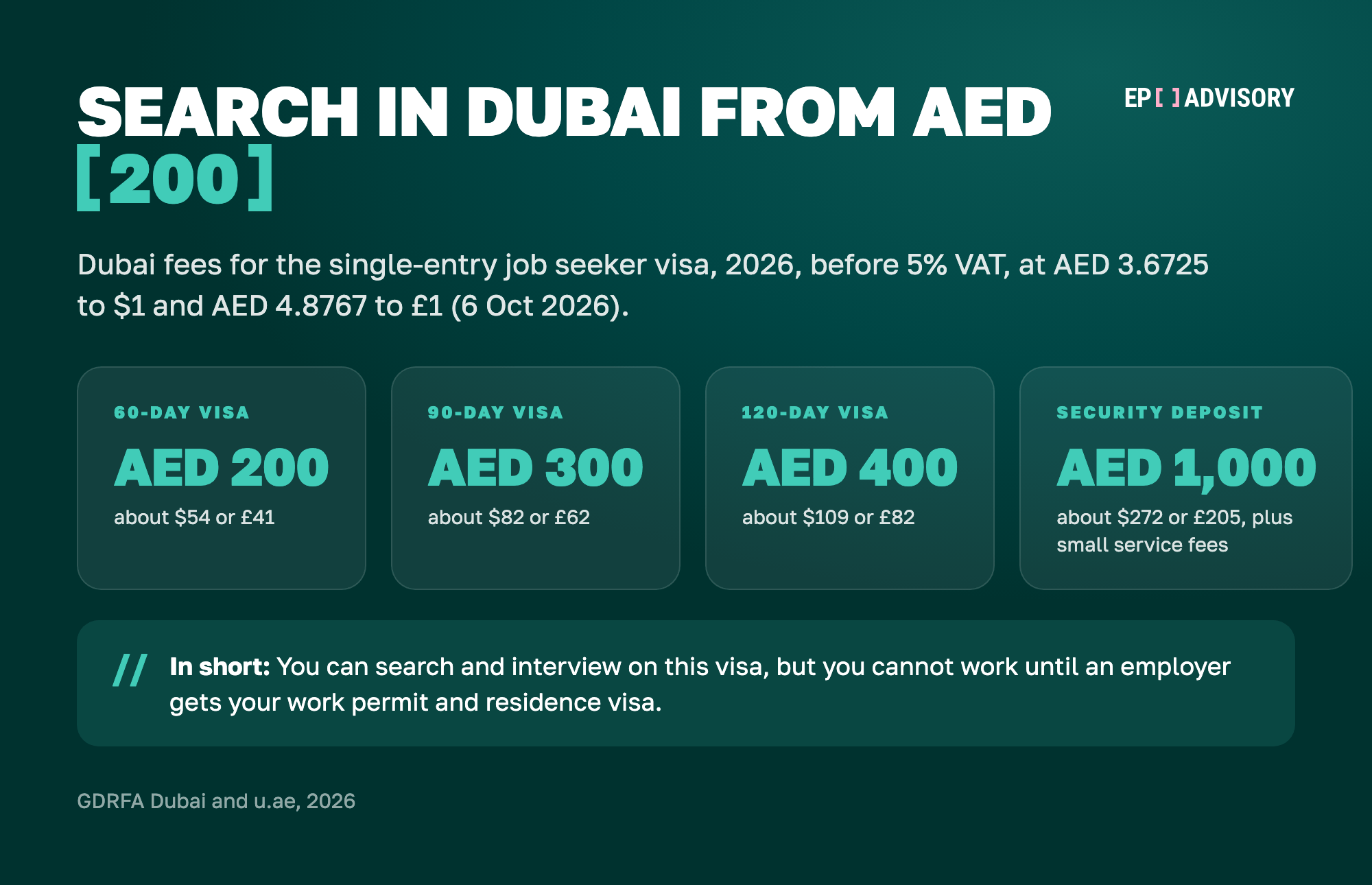
You can search and interview on this visa. You cannot work. “Working under visit or tourist visa will result in fines and legal liability” (u.ae, 2026). Once you have an offer, the employer starts the steps above.
You can run your search from home. For a standard work visa, the employer applies, and the entry permit lets you fly in once MOHRE approves the work permit. A trip means visa fees, a refundable AED 1,000 deposit and the cost of your stay, so time it for when interviews are booked. Then the 60-day option may be enough. Before you book, check your government’s current travel advice for the UAE (for UK citizens, the FCDO page).
Score your CV in 30 seconds, then fix its biggest problems one by one. Both free.
Free, no card. A free account unlocks every fix.

Where to find jobs in Dubai
Search three channels at once: job boards, recruiters and employers’ own career pages. The UAE government lists the main boards on its job search page.
- LinkedIn: the main channel for professional roles. Set up LinkedIn Jobs alerts.
- Gulf job boards: Bayt and NaukriGulf are on the government’s list, with FoundItGulf, Laimoon and Gulf News Careers. GulfTalent is another regional board for professional roles.
- Government jobs: the Dubai Government posts its vacancies on Dubai Careers. Abu Dhabi and the federal government have their own portals.
- Recruitment agencies: use only agencies licensed by MOHRE. You are not required to pay commission to any agency.
- Company career pages: banks, developers, hospital groups and tech firms post roles on their own sites. Make a list of 30 to 50 target employers and check their pages every week.
Your CV should answer two questions fast: can you do the job, and when can you start. If you have applied for months without replies, our guide on why you can’t find a job covers the usual causes.
Jobs in demand in 2026, and what Emiratisation means for you
Michael Page’s UAE Salary Guide 2026 covers more than 500 jobs. Technology, digital, and finance and accounting make up a third of the jobs in its main pay band. Banking and financial services pays the highest average. AI is a fast-rising field, with eight AI-related roles in the 2026 guide against three in 2022 (The National, January 2026).
Regulated professions, such as doctors, nurses and other health workers, need a local professional licence before they can start. Ask the employer at the offer stage who arranges it and how long it takes.
Emiratisation in numbers
Emiratisation is the programme to put more UAE citizens into private-sector jobs. Companies with 50 or more employees must raise the share of Emiratis in skilled jobs by 2% a year. In 2026, that means 1% by 30 June and another 1% by the end of the year. Press reports put the charge for missing the target at AED 10,000 a month for each Emirati position not filled, from 1 July 2026 (Khaleej Times, June 2026). Smaller firms with 20 to 49 workers in the covered sectors were also reported to need at least one Emirati in 2025, while keeping their existing Emirati staff (Gulf News, October 2025). MOHRE sets these rules, so check its current figures.
For a foreign applicant, the effect is narrow. A company with 100 skilled staff needs 2 more Emiratis a year, and the other roles stay open to anyone. Some ads, and programmes such as Nafis, are for UAE nationals only. Skip those and move on.
CV, language and interviews
English is the working language of most private companies in Dubai. Arabic helps in government, legal and some client-facing roles, but most professional jobs do not require it. Your contract comes in Arabic and English.
Dubai recruiters see CVs from dozens of countries. Make yours easy to place:
- Two pages in English: a short profile, then experience with results in numbers. Our CV achievement examples show how to write them.
- Notice period and visa status near the top: for example “Notice period: 30 days”, plus your current visa if you are already in the UAE. Gulf recruiters filter on start dates.
- Your current city and country: recruiters plan interviews and relocation around it.
- Job titles they recognise: if your title is unusual, add the common equivalent in brackets.
Expect questions about your notice period, your salary expectations and your experience with multicultural teams. Give your salary answer as a monthly figure in AED. Our guide on how to pass a job interview covers the rest. Getting ready to apply for jobs in the UAE? Check your CV for free: see it the way a recruiter does, then fix each problem.
Tax-free pay and what to check in an offer
Pay is tax-free: “There is currently no personal income tax in the United Arab Emirates” (PwC tax summaries, 2026). Your home country may still tax you, so check your tax residence before you move.
Published salary figures do not always say whether they include housing and other allowances. So compare basic salary and allowances separately, and negotiate the split. To count as a skilled worker under MOHRE rules, you need at least AED 4,000 a month, excluding commission (u.ae, 2026). This is not a minimum wage.
Next: see pay by job, the rent picture and what your package is worth in our guide to salaries in Dubai.
The Golden Visa: who qualifies by salary
The Golden Visa is a 10-year residence visa that does not need an employer sponsor, so it is not tied to one job. For skilled professionals, the official salary rule is AED 30,000 a month. You also need a bachelor’s degree, a job at MOHRE skill level 1 or 2, a valid employment contract in the UAE and, for jobs such as doctor or teacher, a valid practising licence (Abu Dhabi Government, 2026). The official page does not say whether basic or total pay counts, so check with GDRFA Dubai or ICP before you apply.
There is also a 5-year Green visa that skilled employees can sponsor themselves. Check the current salary rule for it with ICP.
Your contract under the 2022 labour law
The UAE labour law, Federal Decree-Law No. 33 of 2021, has applied since 2 February 2022. It gives you a few fixed numbers to check before you sign.
- Fixed-term contracts: new contracts are fixed-term and can be extended or renewed (u.ae, contracts).
- Probation: 6 months at most. The employer gives 14 days’ notice. You give 1 month to join another UAE employer, or 14 days to leave the UAE.
- Notice period: at least 30 days and at most 90 days, with full pay during notice (u.ae, ending a contract).
- Annual leave: 30 days a year on full pay after one year, and 2 days a month between 6 and 12 months (u.ae, leave).
- End-of-service gratuity: a lump sum the employer pays when you leave. Nothing under one year of service. Then 21 days of basic salary for each of the first 5 years and 30 days for each year after that, up to a total of 2 years’ pay. It must be paid within 14 days (u.ae, gratuity).
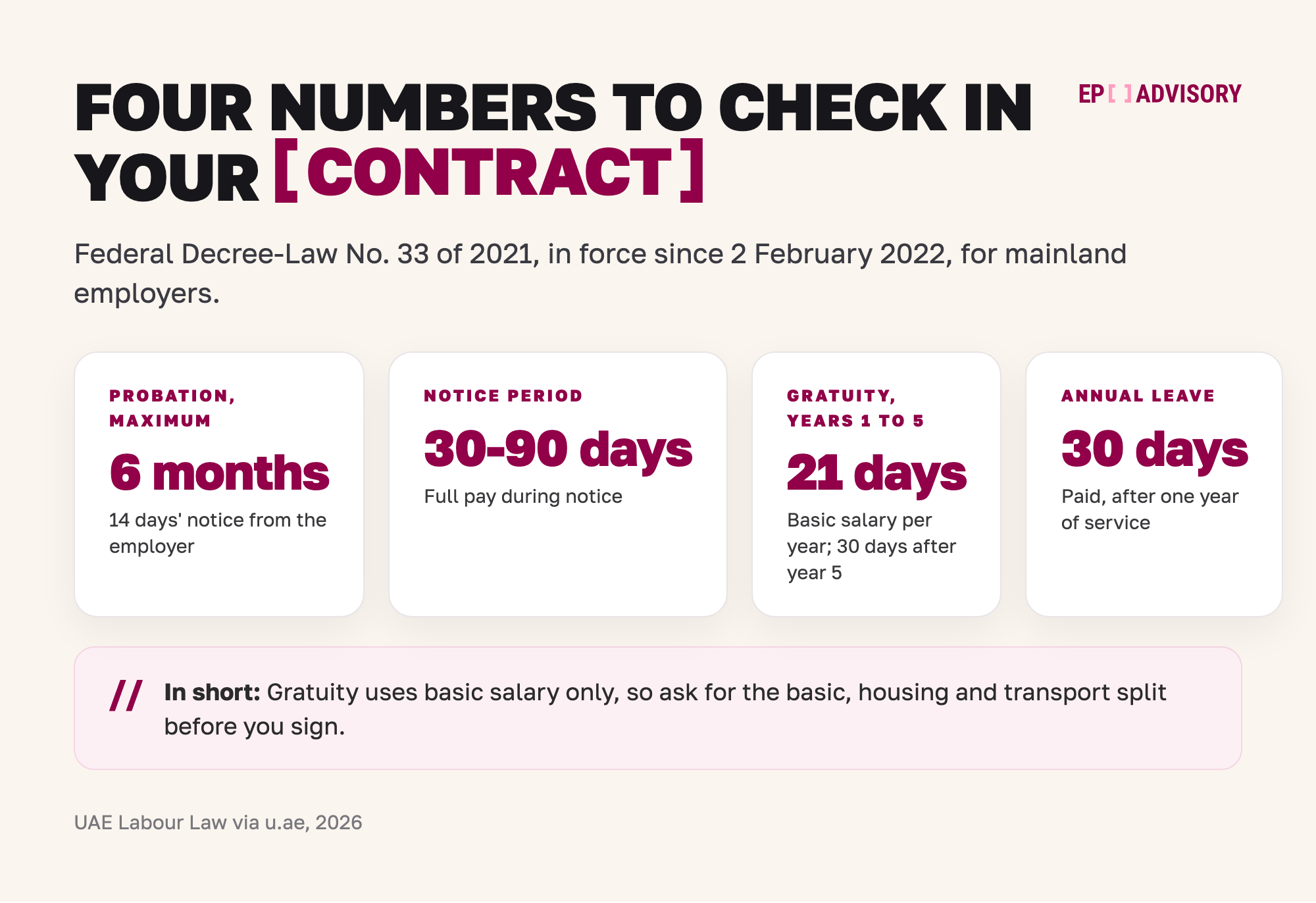
Check one line in particular: the basic salary. Gratuity is calculated on basic salary only. Housing, transport and other allowances do not count. Two offers with the same total can leave you with very different gratuity. Ask for the split in writing, and push for a higher basic if the total is fixed. In a free zone, read that zone’s own employment rules.
Job scams and how to check an offer
Real Dubai employers never ask you to pay for a job. The government’s own wording is plain: “Do not pay. If the hiring company or the agency asks you for money to process the visa or medical test, it is not a genuine company” (u.ae, 2026). Run every offer through these checks.
- Check the offer with MOHRE: a genuine offer letter is issued through MOHRE and has a reference number you can verify with the ministry (u.ae, avoiding visa fraud).
- Check the company: search its name in the National Economic Register, the official list of licensed UAE businesses.
- Check who pays: under the labour law, the employer pays recruitment costs. A request for a “visa fee”, “processing fee” or “training deposit” is a red flag.
- Check the agency: it must hold a MOHRE licence. Never pay an agency commission.
- Check the visa type: you must hold an employment visa before you start work. An offer to “start now on a visit visa and sort the papers later” breaks the law.
A real process is ordinary. You apply, interview, receive an offer in Arabic and English, and the employer handles the permit. If something skips those steps or asks for money, stop and verify.
Key takeaways
- Foreigners can work in Dubai once an employer sponsors them, and the employer pays for the work permit and visa.
- Once you have an offer, the work entry permit usually takes 48 hours, and Dubai’s Work Bundle was designed to issue permit and residency in 5 working days.
- The job seeker visit visa lets skilled graduates search in Dubai for 60, 90 or 120 days from AED 200, but you cannot work on it.
- There is no income tax on salaries in the UAE, but your home country may still tax you.
- Gratuity is 21 days of basic salary per year for the first 5 years, so check the basic salary line before you sign.
- The Golden Visa for skilled professionals starts at AED 30,000 a month and gives 10 years of residence without an employer sponsor.
- Never pay for a job or a visa, and verify every offer with MOHRE before you resign at home.
See what a recruiter sees, then fix it before you apply. An instant score, then the fix for every problem.
Free, no card. A free account unlocks every fix.
Frequently asked questions
Can I go to Dubai to look for a job?
Yes. Skilled graduates can apply for the job seeker visit visa, which allows 60, 90 or 120 days in the UAE without a sponsor. In Dubai it costs AED 200, AED 300 or AED 400 plus 5% VAT, and a AED 1,000 security deposit. You can interview on it, but you cannot work until your employer gets your work permit and residence visa.
Do I have to pay for a Dubai work visa?
No. Under the UAE labour law, the employer pays recruitment costs, including the MOHRE work permit. The UAE government says that a company or agency asking you for money to process a visa or medical test is not genuine.
How long does it take to get a work visa in Dubai?
The paperwork is fast once you have an offer. GDRFA Dubai usually issues the work entry permit within 48 hours, and Dubai’s Work Bundle was designed to issue the work permit and residency in 5 working days. Your contract must reach MOHRE within 14 days of arrival. The job search itself is the longer part.
Do I need to speak Arabic to work in Dubai?
No, not for most private-sector jobs. English is the working language of most companies in Dubai. Arabic helps in government, legal and some client-facing roles. Your offer letter and contract come in Arabic and English.
What salary do you need for a Dubai Golden Visa?
For skilled professionals, the official salary rule is AED 30,000 a month. You also need a bachelor’s degree, a job at MOHRE skill level 1 or 2 and a valid UAE employment contract. The official page does not say whether basic or total pay counts, so check with GDRFA Dubai or ICP.
Is there income tax on salaries in Dubai?
No. There is currently no personal income tax in the UAE, so your gross salary is close to your take-home pay. Your home country may still tax you, so check your tax residence before you move.
How is end-of-service gratuity calculated in the UAE?
You get nothing if you leave before one full year of service. After that, you get 21 days of basic salary for each of the first 5 years and 30 days for each later year, up to 2 years’ pay in total. Allowances such as housing and transport do not count.