 By Andre Atallah, CEO of EP Advisory
Short answer: EU, EEA and Swiss citizens can work in Spain without a permit and register if they stay longer than 3 months. Most other foreigners need a job offer before they move. For skilled roles, the fastest route is the highly qualified permit or the EU Blue Card: a salary of at least €41,356 gross a year in 2026 and a legal decision time of 20 working days. Other permits accept lower pay but can take up to 3 months.
Spain is hiring. In mid-2026 the country had 22.78 million people in work, 510,200 more than a year earlier, and unemployment fell to 9.87% (INE, Q2 2026). Employers reported 151,736 open vacancies in the same quarter (INE, Q2 2026). Madrid and Barcelona host the Spanish and European offices of many international firms, and they recruit abroad for skills they cannot find locally.
This guide is for professionals from outside Spain who want a job there. It shows the salary each work permit requires, how long each one takes, where to find openings and how Spanish hiring works. For nearly 10 years, we’ve helped more than 5,000 professionals find jobs abroad. Want to know if your CV will pass screening in Spain? Check your CV for free: a score in 30 seconds, then a fix for each problem.
Spain work visa minimum salary in 2026, by permit
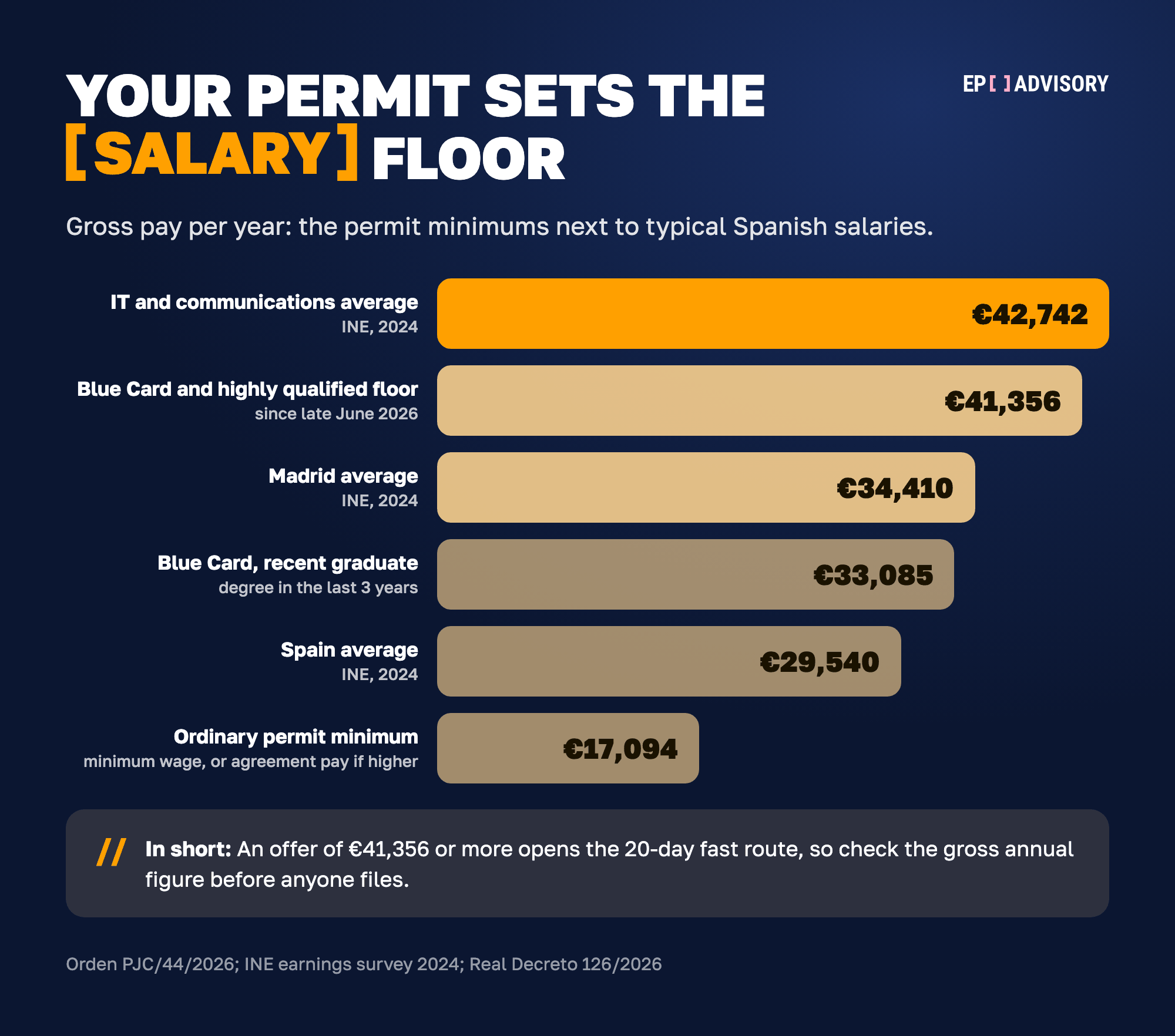
Spain has no single minimum salary for foreign workers. The floor depends on the permit. The two highly qualified permits have the highest bar and the fastest processing. The ordinary work permit has the lowest bar: the pay set by the collective agreement for your job, and never less than the national minimum wage.
| Permit | Minimum pay in 2026 | Who it suits | Legal decision time |
|---|---|---|---|
| EU Blue Card | €41,356.36 gross a year | A degree of at least 3 years, or 5 years of relevant experience (3 years in the last 7 for IT managers and professionals) | 20 working days |
| EU Blue Card, recent graduate | €33,085.09 gross a year | Degree finished in the 3 years before you apply | 20 working days |
| Highly qualified professional (national permit) | €41,356.36 gross a year, no reduced rate | A higher-education qualification, or 3 years of equivalent experience | 20 working days |
| Ordinary work permit | Collective agreement pay for the job, at least €17,094 gross a year | Any job, usually after a labour market test | Up to 3 months |
| Digital nomad (remote work for a foreign employer) | Income of about €2,849 a month | People employed or paid by companies outside Spain | 10 working days for the visa |
| Job-search visa | No salary rule | Only for groups named in the yearly collective-hiring order | Set by the order |
“Gross” means before income tax and social security. The Blue Card figure is 1.4 times Spain’s average annual earnings, as set by Orden PJC/44/2026. The statistics office (INE) published a new average of €29,540.26 on 28 May 2026 (INE, 2024 earnings survey), so the floor rose from €39,269.92 to €41,356.36 in late June 2026. The same €41,356.36 applies to the national highly qualified permit, with no reduced rate (official UGE note, June 2026). If an employer worked out your offer earlier in the year, check it against the new figure before anyone files.
The ordinary floor comes from the national minimum wage, the SMI (salario mínimo interprofesional): €1,221 a month in 14 payments, or €17,094 a year (Real Decreto 126/2026). By law, workers get two extra payments a year: one at Christmas and one in a month set by the collective agreement. So many salaries are paid in 14 instalments, though an agreement can spread them over 12 (Estatuto de los Trabajadores, art. 31). So compare offers by the gross annual figure, not the monthly one. For the thresholds in other countries, see our guide to work visa salary thresholds in Europe.
Who can work in Spain: your route depends on your passport
- EU, EEA and Swiss citizens: you need no permit. Start work, then register in person at the foreigners’ office or the police within 3 months of arrival (Real Decreto 240/2007). You get a registration certificate and an NIE.
- Skilled professionals from outside the EU: the highly qualified permit or the EU Blue Card, with an offer at €41,356.36 or more. These go through the UGE (Unidad de Grandes Empresas y Colectivos Estratégicos), a central office that handles skilled hires fast.
- Everyone else with a job offer: the ordinary work permit, filed by the employer, at collective agreement pay.
- Blue Card holders in another EU country: after 12 months there, you can move to a Spanish employer and start work as soon as the Spanish Blue Card application is complete (Ley 14/2013, art. 71 bis).
- Graduates of Spanish universities: after a bachelor’s degree or higher in Spain, you can stay up to 24 months to look for work or start a business. Apply from 60 days before to 90 days after your student stay ends.
- People already living in Spain: arraigo (“roots”) permits cover people with ties to Spain. There are five types. Most need 2 years of continuous stay. Arraigo familiar needs none. It covers parents and carers of certain citizens of other EU countries, the EEA or Switzerland.
Two terms you will meet early. The NIE (número de identidad de extranjero) is your foreigner identity number, used for your contract, tax and bank account. The TIE (tarjeta de identidad de extranjero) is the residence card. Anyone with a permit of more than 6 months applies for it in person within 1 month of arrival. On the ordinary work permit, the month runs from your Social Security registration.
Score your CV in 30 seconds, then fix its biggest problems one by one. Both free.
Free, no card. A free account unlocks every fix.

How to get a Spanish work permit, step by step
Almost every non-EU route starts with an employer. The offer comes first, then the permit, then the visa. Which office handles your case decides how fast it moves.
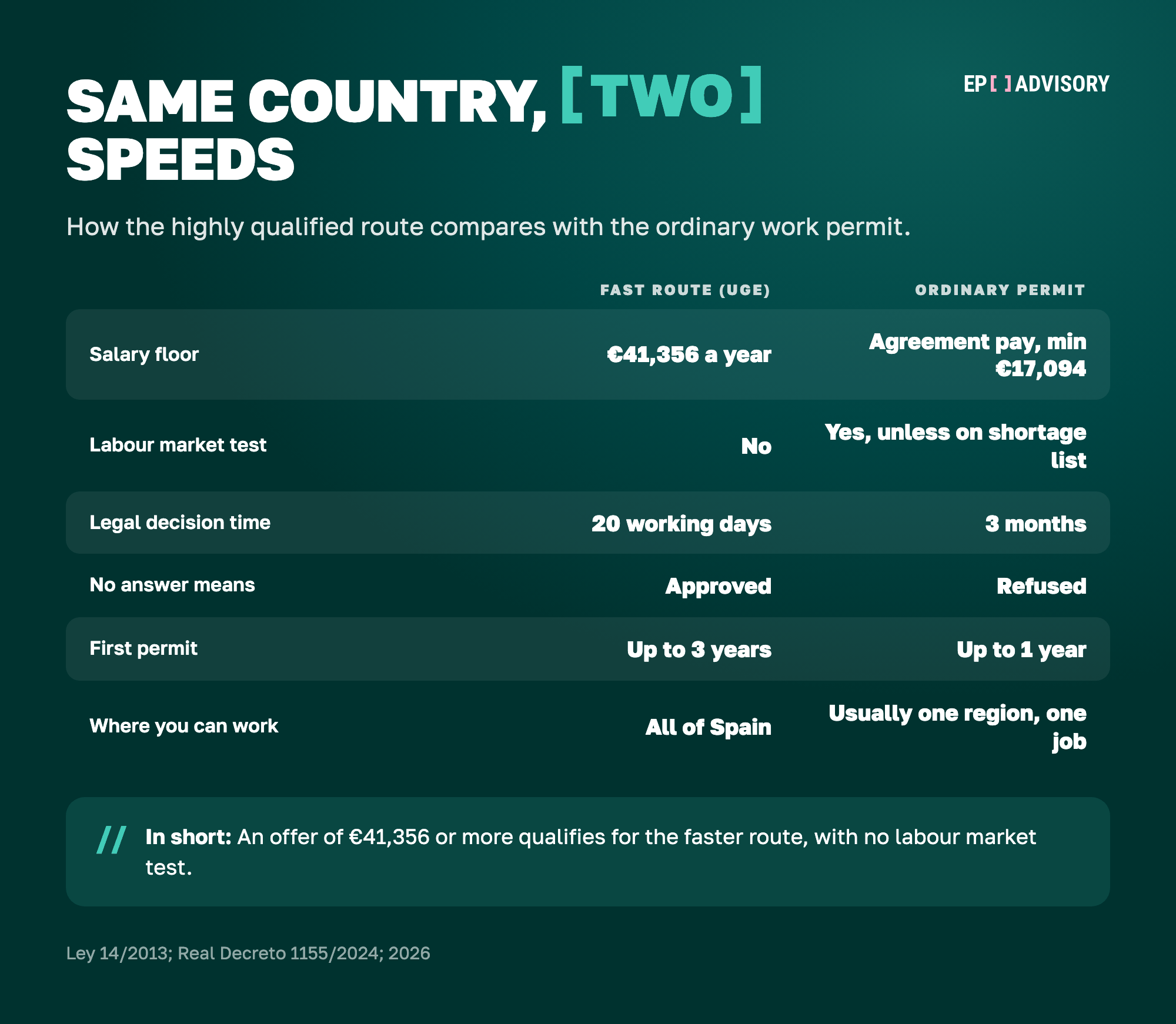
The fast route: highly qualified permit or EU Blue Card
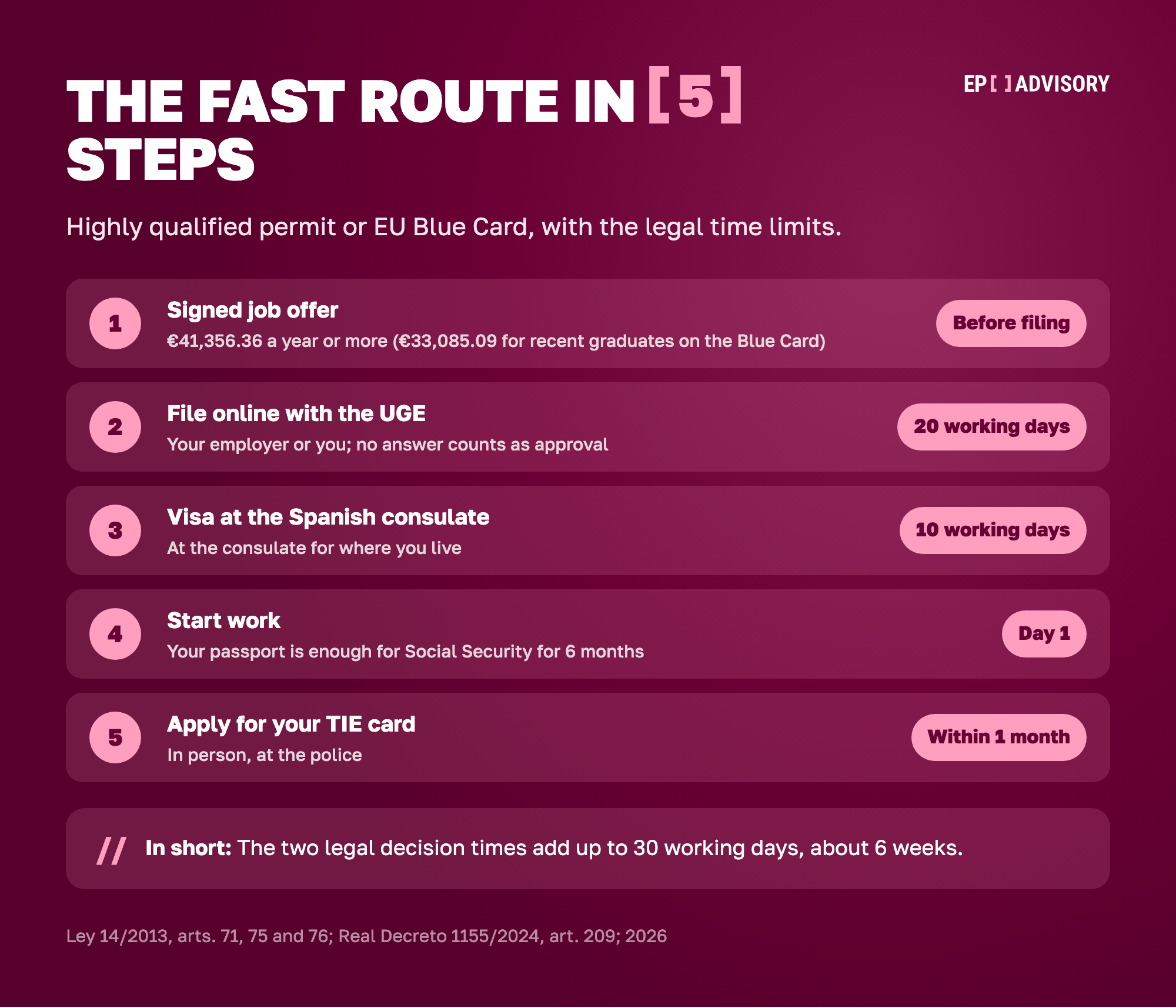
- Get a contract or firm offer at €41,356.36 gross a year or more. For a Blue Card, it must last at least 6 months, and the floor is €33,085.09 if you graduated in the last 3 years.
- File online with the UGE. Your employer or you can file. The legal decision time is 20 working days, and if the UGE has not answered by then, the permit counts as granted (Ley 14/2013, art. 76).
- Collect the visa at the Spanish consulate where you live. It must be decided within 10 working days.
- Start work. For the first 6 months your passport is enough to register with Social Security.
- Apply for your TIE within 1 month of arrival.
The permit lasts up to 3 years, then renews for 2. You can apply for long-term residence after 5 years. If you lose the job, a Blue Card gives you 3 months to find another (6 months once you have held it for 2 years).
The ordinary route: work permit for any job
- The labour market test. Unless the job is on the shortage list, the employer first posts the job with the public employment service, which handles it for 8 days. After the employer reports the result, the service issues a certificate within 3 days.
- The employer files the application. The legal decision time is 3 months. Here, silence counts as a refusal, so follow up (Real Decreto 1155/2024, art. 77).
- Apply for the visa within 1 month of approval. The consulate decides within 1 month.
- Start work and register with Social Security within 3 months of arrival. Then apply for your TIE within 1 month of that registration.
The first ordinary permit lasts up to 1 year. It covers one region and one occupation, unless your job was exempt from the labour market test (Real Decreto 1155/2024, art. 73). The renewal lasts 4 years and lets you work in any job, anywhere in Spain. Immigration rules change. Check your case with the Spanish consulate or the Ministry of Inclusion before you apply.
Does Spain have a job seeker visa?
Yes, but not an open one. Spain’s job-search visa is only for groups named in the yearly collective-hiring order (the GECCO order). It gives 12 months to find work. It has two types: one for children and grandchildren of Spaniards by birth, and one for specific occupations and regions (Real Decreto 1155/2024, arts. 43 to 45). If you find a contract, your employer files from Spain and the decision is due in 10 days.
You may read that it is open to any skilled professional. It is not. If you are not in one of the named groups, plan your search from home and move once you have an offer. First interviews with candidates abroad usually run by video, so you can search from home. The other job-search permit is for graduates of Spanish universities, who get up to 24 months. If you are weighing southern Europe more widely, compare our guide to jobs in Italy for foreigners.
Which jobs are in demand in Spain
Spain publishes an official shortage list every quarter: the catálogo de ocupaciones de difícil cobertura, kept by the public employment service SEPE. A job on the list skips the labour market test. The latest edition, for the third quarter of 2026, has 27 occupations (SEPE catalogue). It changes every quarter, so check the current one. Eighteen are merchant navy roles. The 9 that apply across Spain are professional athletes, sports coaches, aluminium, metal and PVC carpenters and fitters, electricians and crane operators.

There are no IT, health or engineering jobs on the list. For professionals this matters less than it seems: the highly qualified permit and the Blue Card never need a labour market test. If your offer clears €41,356.36 and you meet the qualification rule, the shortage list does not matter for you.
Where foreign professionals get hired in practice:
- Technology: software, data, cloud and cybersecurity. Spain’s information and communications sector paid an average of €42,741.94 gross a year in 2024, above the Blue Card floor.
- Finance and professional services: banks, insurers, consultancies and audit firms in Madrid and Barcelona.
- International companies: regional headquarters and shared service centres hire people who speak other European languages alongside English.
- Tourism and hospitality: a large employer, with average pay of €17,653.42 gross a year in 2024, so hires usually go through the ordinary permit.
- Health: doctors and nurses need their degree recognised (homologación) before they can practise. The ministry has up to 6 months to decide (Real Decreto 889/2022), so start it before you apply.
English-speaking jobs in Spain: where English is enough
Most Spanish job ads expect Spanish. English-only roles exist, and they cluster in a few places. Aim your search there first and keep learning Spanish while you apply.
- Madrid: a major market. International headquarters, consulting, finance and tech. The region’s average pay was €34,410.01 gross a year in 2024, second only to the Basque Country.
- Barcelona: tech companies, start-ups and multilingual service centres. Many teams work in English.
- Málaga: a growing tech hub on the south coast, with international firms and remote-first teams.
- Valencia: start-ups, logistics and a rising number of international employers.
Search in English with the city name and filter by “English” or “inglés” on the job boards. We recommend reaching B1 or B2 Spanish (intermediate) while you search: it opens far more roles, including in English-speaking teams. Put your current level on your CV accurately.
How to find a job in Spain: where to look
Here is the order we recommend for a candidate abroad. Start with the employers that hire internationally, then widen out.
- Company career pages: list 30 to 50 international employers in your field with offices in Spain and apply directly.
- LinkedIn: the main channel for professional and English-language roles. Set your location to the Spanish city you want.
- Spanish job boards: InfoJobs, Infoempleo and Indeed.
- Tech boards: Tecnoempleo, JobFluent and Welcome to the Jungle.
- Recruiters: Hays, Michael Page, Randstad and Adecco recruit for professional roles across Spain.
- Public services: EURES, the EU job portal, and SEPE, Spain’s public employment service.
Spain has no public list of employers that sponsor visas. So say in your first message that you need a work permit and that you meet the salary floor. A real employer never asks you to pay for a job offer or a permit. If anyone does, stop. For a wider plan across countries, see how to find a job in Europe.
Spanish CV and interview norms
Spanish recruiters read fast. Write a CV of one or two pages, with your most recent role first and a short profile at the top. A photo is common in Spain but optional. Show results with numbers, and state your work permit position in one line: “Eligible for the EU Blue Card” or “EU citizen, no permit needed”. Our guide to what makes a strong CV shows how. Getting ready to apply for jobs in Spain? Check your CV for free: see it the way a recruiter does, then fix each problem.
- Interviews: usually two or three rounds, the first by video. Expect questions in Spanish if the role uses it, even when the interview is in English. Prepare with our guide on how to pass a job interview.
- Salary talk: offers are quoted gross a year. Ask how many payments (12 or 14) and check the figure against the permit floor. See how to negotiate salary.
- Trial period: unless the collective agreement says otherwise, up to 6 months for staff with a degree (técnicos titulados) and 2 months for others, or 3 months in firms with fewer than 25 workers.
The digital nomad visa: work for a foreign employer from Spain
If you can keep a job or clients outside Spain, the international telework permit lets you live in Spain while you do it. The income rule is 200% of the minimum wage, about €2,849 a month in 2026, with more for each family member (UGE guidance). Confirm the exact figure with the consulate, as it follows the minimum wage.
- You need a degree or 3 years of experience in your field.
- Your employer or clients must have been operating for at least 1 year, and you must have worked with them for at least 3 months.
- If you are self-employed, up to 20% of your work can come from Spanish clients.
The permit covers remote work for companies outside Spain. A job with a Spanish employer needs its own work permit. For remote options, see remote jobs in Europe.
What jobs in Spain pay
Pay is lower than in Germany or the UK, and so are many living costs. Four figures to plan with, all gross a year (INE, 2024):
- Spain average: €29,540.26, about €2,110 a month over 14 payments.
- Median: €24,497.17. Half of workers earn less than this.
- Information and communications: €42,741.94.
- Madrid average: €34,410.01.
Many people who move for a job can choose the special tax regime known as the Beckham law. It taxes employment income at a flat 24% up to €600,000 for the year you move and the next 5 years, if you were not tax resident in Spain in the previous 5 years (Ley 35/2006, art. 93). Apply within 6 months of starting work.
Next: check what your role pays by sector and region in our guide to salaries in Spain.
Key takeaways
- EU, EEA and Swiss citizens can work in Spain without a permit and register within 3 months of arrival.
- The EU Blue Card and the highly qualified permit need at least €41,356.36 gross a year in 2026, or €33,085.09 for a Blue Card if you graduated in the last 3 years.
- The UGE decides those permits within 20 working days, and no answer by then counts as approval.
- The ordinary work permit pays at least the collective agreement rate and never less than €17,094 a year, but takes up to 3 months.
- Spain’s job-search visa is only for groups named in the yearly collective-hiring order, while graduates of Spanish universities get up to 24 months to look for work.
- The official shortage list has 27 occupations and no IT, health or engineering roles, but the highly qualified permit and the Blue Card skip the labour market test anyway.
- Average pay is €29,540.26 gross a year (INE, 2024), and €34,410.01 in Madrid.
See what a recruiter sees, then fix it before you apply. An instant score, then the fix for every problem.
Free, no card. A free account unlocks every fix.
Frequently asked questions
What is the minimum salary for a Spain work visa in 2026?
It depends on the permit. The EU Blue Card and the highly qualified professional permit need at least €41,356.36 gross a year since late June 2026. A Blue Card applicant who graduated in the last 3 years needs €33,085.09. The ordinary work permit needs the collective agreement pay for the job, and never less than the minimum wage of €17,094 a year.
Does Spain have a job seeker visa?
Only for specific groups. The job-search visa gives 12 months to look for work, but only to people named in the yearly collective-hiring order: children and grandchildren of Spaniards by birth, and certain occupations and regions. Graduates of Spanish universities can stay up to 24 months to look for work. Most other people need a job offer first.
Can I get a job in Spain without speaking Spanish?
Yes, in some sectors. English-language roles cluster in tech, finance, consulting and international companies in Madrid, Barcelona, Málaga and Valencia. Most other jobs expect Spanish, so learning it to an intermediate level widens your options a lot.
How long does a Spanish work permit take?
The highly qualified permit and the EU Blue Card have a legal decision time of 20 working days, and the visa then takes up to 10 working days. The ordinary work permit can take up to 3 months, plus up to 1 month for the visa. Finding the job usually takes longer than the paperwork.
Can EU citizens work in Spain without a visa?
Yes. EU, EEA and Swiss citizens can work in Spain with no permit. If you stay longer than 3 months, register in person at the foreigners’ office or the police within 3 months of arrival to get your registration certificate and NIE.
What is an NIE and do I need one to work?
The NIE is your foreigner identity number. You need it for your contract, tax and bank account. If you come with a work permit, you receive it as part of the process. Non-EU workers staying over 6 months also apply for a residence card, the TIE, within 1 month of arrival, or of Social Security registration on the ordinary work permit.