 By Andre Atallah, CEO of EP Advisory
Short answer: yes, foreigners can get jobs in Italy, and most non-EU professionals need an employer to apply for their work authorisation. Graduates and specialists can use the EU Blue Card, which has no quota and a 30-day decision deadline. Many other jobs go through the decreto flussi quotas, where 2027 applications are pre-filed from 23 October to 7 December 2026. EU citizens can apply and start like locals.
Italy is hiring. Firms planned 565,000 hires in September 2026 and said 44% of them were hard to fill, according to the Excelsior employer survey. Unemployment was 6.2% in August 2026, and 291,000 more people were in work than a year earlier (ISTAT). For a foreign professional, two things shape the plan: which permit your job fits, and when your employer can apply.
Immigration rules change often, so check the current rules with the official authority before you act.
For nearly 10 years, we’ve helped more than 5,000 professionals find jobs abroad. Want to know if your CV will pass screening in Italy? Check your CV for free: a score in 30 seconds, then a fix for each problem.
Can foreigners work in Italy? The main routes
EU, EEA and Swiss citizens can live and work in Italy without a work permit. You apply like a local candidate. Everything below about quotas and permits applies to non-EU citizens.
If you are not an EU citizen, you do not apply for a work visa first. Your employer applies in Italy for a nulla osta, which is the work authorisation that says you may be hired. The employer files it with the Sportello Unico per l’Immigrazione, the immigration desk at each prefecture. With the nulla osta, you apply for a national long-stay visa (visa D) at the Italian consulate in your country. You then enter Italy and request your permesso di soggiorno, the residence permit.
Three main routes lead to a nulla osta: the EU Blue Card, the decreto flussi work quota with its fixed application days (“click days”), and out-of-quota jobs under Article 27 of the immigration law.
| Route | Who it fits | Pay rule | Quota | When the employer applies | Nulla osta deadline |
|---|---|---|---|---|---|
| EU Blue Card | Degree of 3+ years, 5 years of degree-level experience, or 3 years in the last 7 for ICT managers and specialists | At least the CCNL rate and the ISTAT average gross wage | None | Any day | 30 days |
| Decreto flussi (non-seasonal) | Any skill level in the listed sectors; places reserved by nationality | At least the CCNL rate | 76,200 places in 2027 | From the click day, 16 February 2027 | 60 days from quota allocation |
| Out of quota (Article 27) | Managers and specialists of companies in Italy, professors, nurses, staff of Italian firms abroad, remote workers | Set by category | None | Any day | Set by category |
| EU, EEA or Swiss citizen | Any job | Same as locals | None | No permit needed | Not needed |
CCNL means contratto collettivo nazionale di lavoro, the national collective agreement for each sector. Italy has no statutory minimum wage, so the CCNL sets the minimum pay for your job level.
The EU Blue Card: the route for graduates and specialists
For degree-level professionals, the Blue Card is often the quickest legal route. It sits outside the quota system, so there is no click day and no cap to beat. Under Article 27-quater of the immigration law, you qualify with one of these:
- A degree from a course of at least 3 years.
- 5 years of professional experience at a level comparable to a degree.
- 3 years of experience in the last 7, for ICT managers and ICT specialists.
You also need a job contract or binding offer for at least 6 months. The pay must reach two bars: the CCNL rate for your role, and the average gross annual wage measured by ISTAT, Italy’s statistics office. The law gives no euro figure. The last official figure is €33,500 gross a year, for 2024, on the EU Immigration Portal. That is about $37,400 at the European Central Bank rate of $1.1177 per euro on 7 October 2026. Ask the employer which figure they used for your application.
Three rules work in your favour:
- A 30-day deadline. The immigration desk must issue the nulla osta within 30 days. Employers with an Interior Ministry protocol only send a notice.
- You can apply from inside Italy. If you already live in Italy legally, you can use the procedure without going home first. People under temporary protection and asylum seekers are excluded.
- Your degree does not need formal Italian recognition for a job outside the regulated professions. You may be asked to prove its level, for example with a statement from CIMEA, Italy’s academic recognition centre. Regulated professions such as doctors and lawyers need ministry recognition (list of regulated professions).
One limit to know: in the first 12 months, changing employer needs prior authorisation. To compare the salary bar with other countries, see our guide to work visa salary thresholds in Europe.
Score your CV in 30 seconds, then fix its biggest problems one by one. Both free.
Free, no card. A free account unlocks every fix.

Decreto flussi 2027: quotas, dates and click days
The decreto flussi is Italy’s main quota system for foreign workers. One decree now covers three years. It sets 497,550 places for 2026 to 2028. For 2027 there are 165,850: 76,200 non-seasonal jobs (including 14,000 in family care), 89,000 seasonal jobs and 650 self-employed places (joint ministerial circular 7185, 1 October 2026).
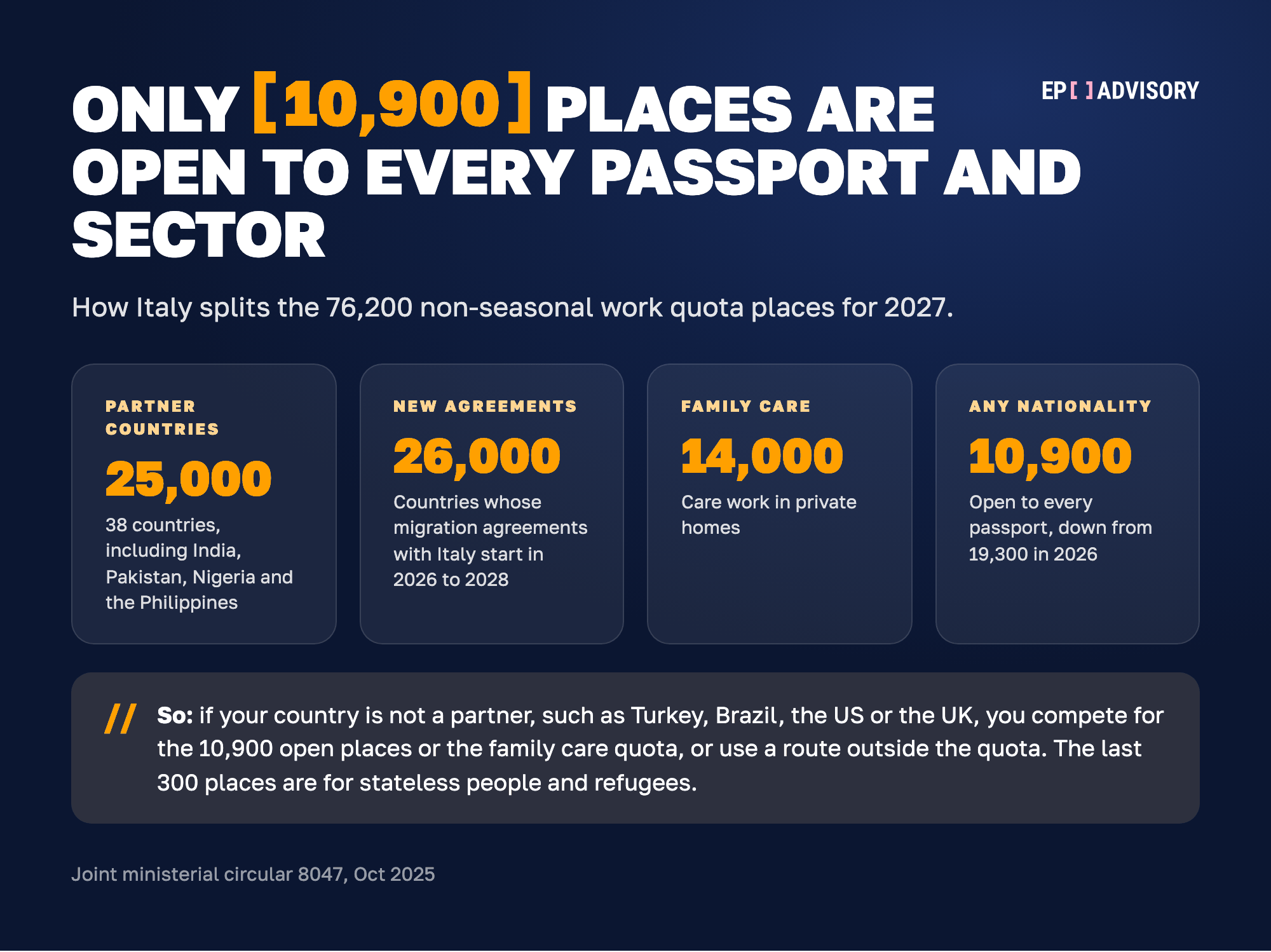
Most non-seasonal places are reserved by nationality (circular 8047):
- 25,000 for 38 partner countries. These include India, Pakistan, Bangladesh, Sri Lanka, Nigeria, Ghana, the Philippines, Egypt, Morocco, Tunisia, Ukraine, Moldova, Georgia, Uzbekistan, Kyrgyzstan, Peru, Ecuador, Japan and South Korea.
- 26,000 for countries whose new migration agreements with Italy take effect in 2026 to 2028.
- 14,000 for family care and 300 for stateless people and recognised refugees.
- 10,900 open to any nationality, down from 19,300 in 2026.
Turkey, Russia, Belarus, Kazakhstan, Brazil, Mexico, Colombia, the US and the UK are not on the partner list. Citizens of these countries compete for the 10,900 open places, the family care quota or a route outside the quota. Seasonal places go only to partner countries and countries with new migration agreements. Kenya joins the origin countries from 2027, after a migration agreement signed in July 2026.
Employers pre-fill applications on the Interior Ministry’s online portal from 09:00 on 23 October 2026 to 20:00 on 7 December 2026 (Ministry announcement). From 9 to 13 December they can only finish drafts already started. The applications are then sent on the click day for each type of job:
- 12 January 2027: seasonal farm work.
- 9 February 2027: seasonal tourism.
- 16 February 2027: non-seasonal jobs.
- 18 February 2027: family care.
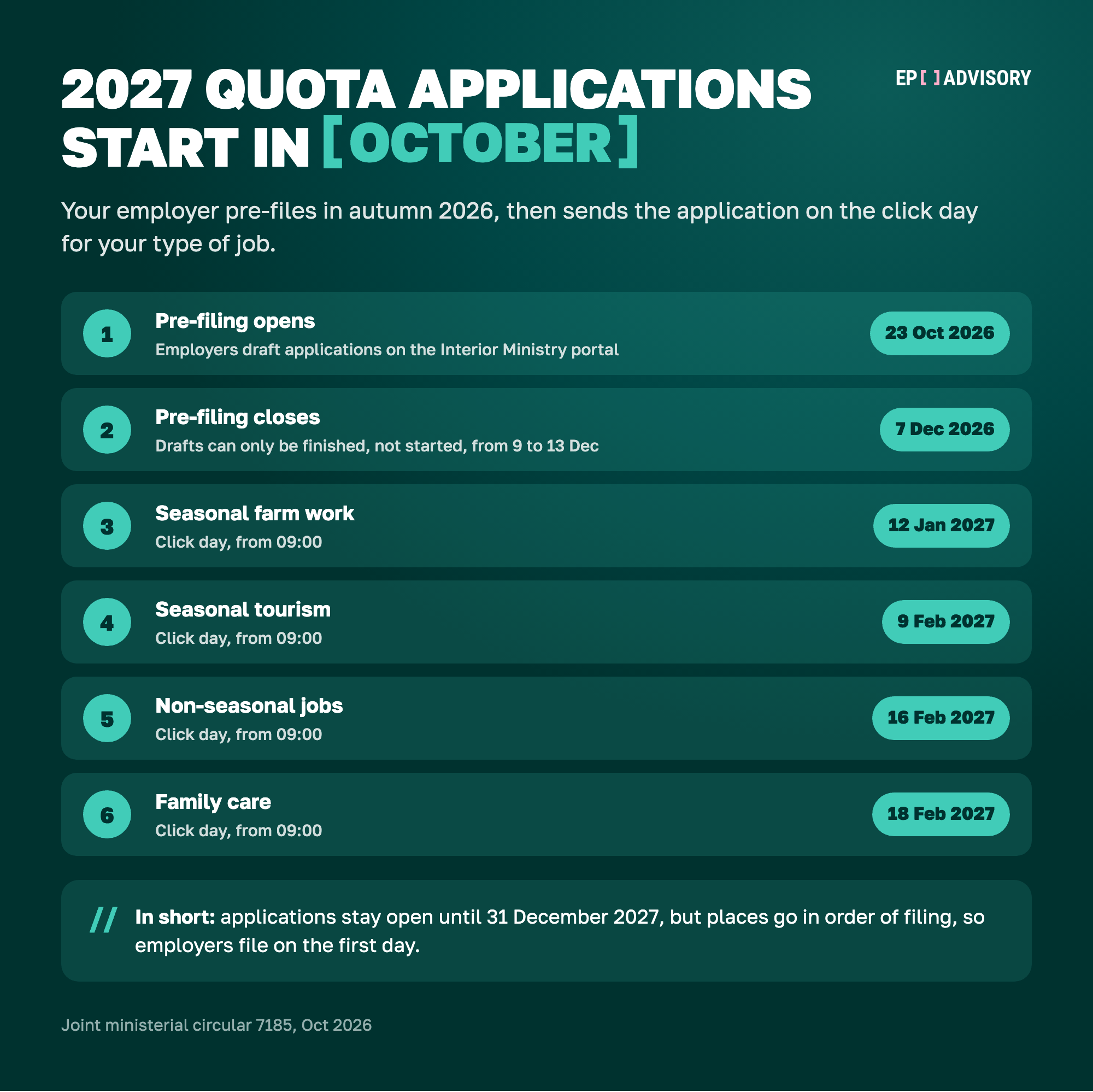
Applications stay open until 31 December 2027, but places go in order of filing. So a 2027 quota job needs a committed employer by early December 2026. Quota sectors include farming, food, metals, construction, retail, hotels, tourism, logistics and health and social care.
After filing, the immigration desk has 60 days from quota allocation to issue the nulla osta (Article 22). An employer filing alone can send up to 3 applications a year. There is no such cap when filing through an employer association or an authorised intermediary, such as a labour consultant.
Never pay for a nulla osta or a quota place. In June 2024 the Italian government told the anti-mafia prosecutor it suspected criminal networks of selling flussi applications, with some sources citing up to €15,000 per file. In Campania, fewer than 3% of people who entered on a nulla osta went on to sign a job contract. The legal costs on your side are the consular visa fee, any visa centre fee and the permit fees in Italy.
Jobs that skip the quota
Several jobs bypass both the quota and the click day. Article 27 of the immigration law lists them. The main ones for professionals:
- Managers and highly specialised staff of companies based in Italy or with an Italian branch.
- University professors and language lecturers.
- Staff of Italian companies abroad who worked for the company or its subsidiary outside the EU for at least 12 of the last 48 months.
- Nurses hired by public or private health facilities.
- Digital nomads and remote workers, under their own rules. Our guide to remote jobs in Europe covers this kind of work.
Health workers trained abroad can also work temporarily in Italian health and social-care facilities without Italian recognition of their qualification, until 31 December 2029 (Decree-Law 34/2023, Article 15). Home care has its own channel too: up to 10,000 carers a year in 2026 to 2028 outside the quota, for people over 80, people with disabilities and children up to age 6. They are hired through authorised job agencies or the employer associations that signed the domestic work CCNL.
Which jobs are in demand in Italy
Skilled trades and technicians are among the hardest roles for Italian firms to fill. Italy has no official shortage list. The best guide is the monthly Excelsior survey of employers’ hiring plans. In September 2026, firms said 23% of their 565,000 planned hires were aimed at foreign workers.
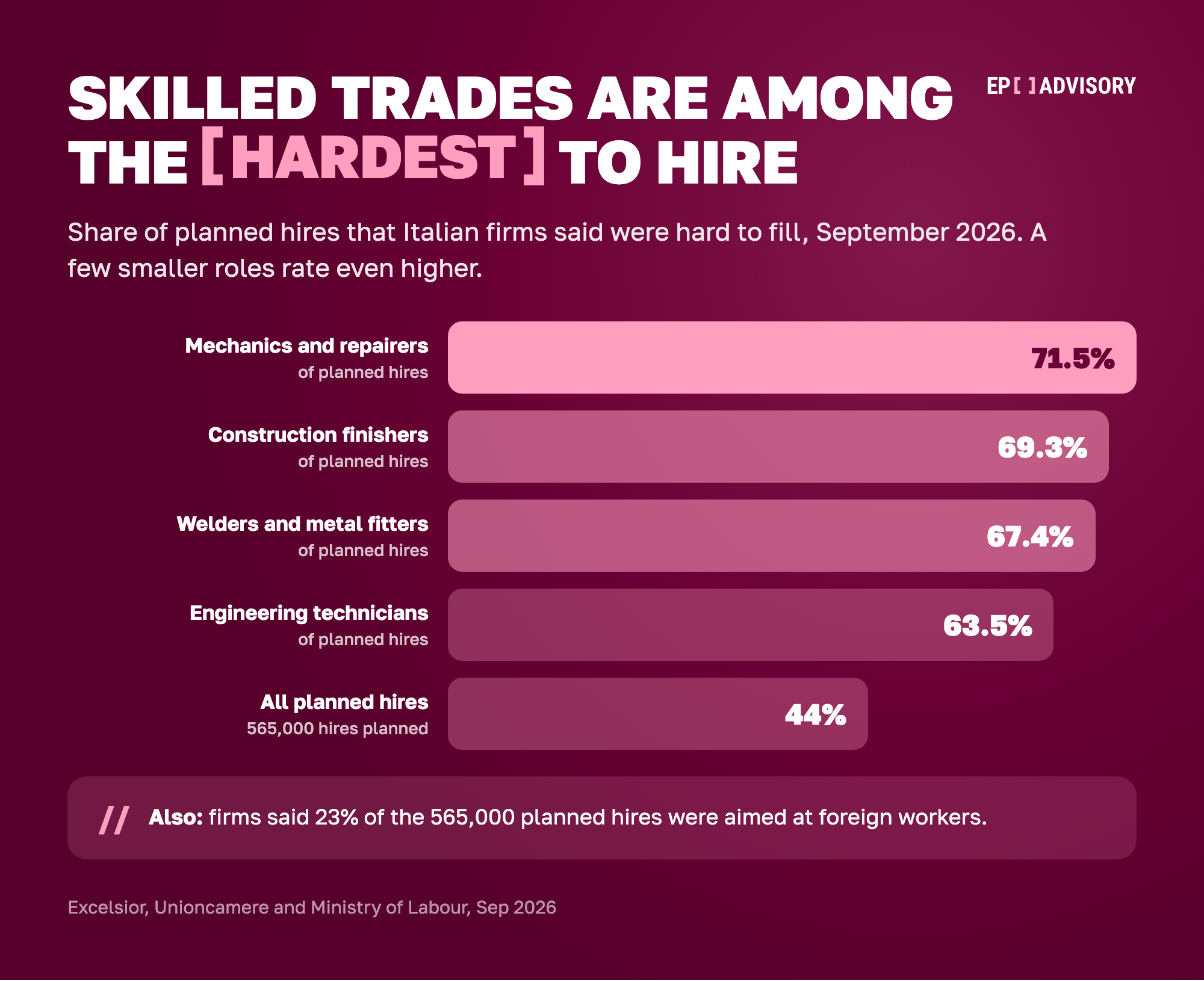
Some degree-level roles are just as hard to fill. In September 2026, firms said 73.3% of planned hires of life-science specialists were hard to fill, as were 67.3% of company directors. But only 18.5% of planned hires were aimed at people with a degree or a higher technical diploma. The biggest volumes are in restaurants, retail, cleaning, goods handling and driving, which rarely need a degree. Only 22% of planned hires in September 2026 were permanent contracts or apprenticeships. This matters for your permit: a first permit lasts up to 1 year on a fixed-term contract and up to 2 years on a permanent one.
In September 2026, the most planned hires were in Lombardy (114,480), Lazio (58,790) and Veneto (51,610). Many international employers, manufacturers and banks are in the north, around Milan. Pay tends to be lower in the south. The Ministry of Labour and Unioncamere publish a dashboard of firms’ needs for foreign workers by sector and region.
Do you need Italian? English-speaking jobs in Italy
The work visa does not test your Italian, but most Italian employers do. A language test only applies later, if you apply for the long-term EU residence permit after 5 years (Article 9).
There is no official count of English-only jobs. In our experience, they are most common in these areas:
- Tech companies and start-ups, mainly in Milan.
- Research and universities, advertised on Euraxess Italy.
- Multinational offices in finance, consulting, pharma and luxury goods.
- English teaching and international schools.
Construction, care, hotels, restaurants, retail and regulated professions usually expect Italian from day one. Start learning now, and show your level on your CV with the European scale (A1 to C2). The Ministry lists free Italian learning resources, and many cities run free courses for migrants.
Where to find jobs in Italy
Use two or three job boards, then go direct to employers. According to EURES, the EU’s job mobility network, medium and large Italian firms search their own CV databases first. So apply on company career pages as well.
| Where | Best for | Language of most ads |
|---|---|---|
| International companies and English-speaking roles | English and Italian | |
| InfoJobs | The broad private-sector market | Italian |
| Indeed Italia | High volume across all sectors | Italian |
| Euraxess | Research and university jobs | English |
| inPA | Public-sector jobs and competitions | Italian |
| SIISL and Cliclavoro | SIISL is the government job platform linked to public job centres (centri per l’impiego). Cliclavoro is the ministry’s jobs news and guides portal. | Italian |
| Recruitment agencies | Randstad, Adecco, Gi Group, Manpower; Hays and Michael Page for managers | Italian and English |
Italy has no public register of employers that sponsor foreign workers. So ask on the first call whether the company has hired through a nulla osta or a Blue Card before. Ask agencies whether they place non-EU candidates. Our step-by-step guide on how to find a job in Europe covers the wider method. If you are weighing neighbouring markets, compare jobs in Spain and jobs in Germany.
Italian CVs, interviews and offers
Italian recruiters usually expect a CV tailored to the job, plus a cover letter. The first three norms below come from EURES. The last two are our own advice:
- Format. The Europass template is widely known. A clean two-page CV works too.
- No photo or diploma copies unless the employer asks for them.
- A data consent line. Add a GDPR consent sentence at the bottom, such as “Autorizzo il trattamento dei dati personali ai sensi del Regolamento UE 2016/679”.
- Your status. State your nationality, where you are based and whether you need a permit.
- Results, not duties. Show numbers for what you achieved. Our CV achievement examples show how.
If your CV was written for another market, rework it for Italy before you apply. Getting ready to apply for jobs in Italy? Check your CV for free: see it the way a recruiter does, then fix each problem.
In interviews, expect questions about your Italian, your notice period and when you could relocate. Our guide on how to pass a job interview covers preparation.
Offers state pay as RAL (retribuzione annua lorda), the gross annual salary. It is paid in 13 or 14 instalments, depending on the CCNL. So divide by 13 or 14, not 12, to get the monthly figure. The written contract names the CCNL, your job level, the probation period and the notice period. Notice on a permanent contract runs from 15 days to 3 or 6 months. Before you sign, read our tips on how to negotiate salary.
From offer to first day: steps and legal deadlines
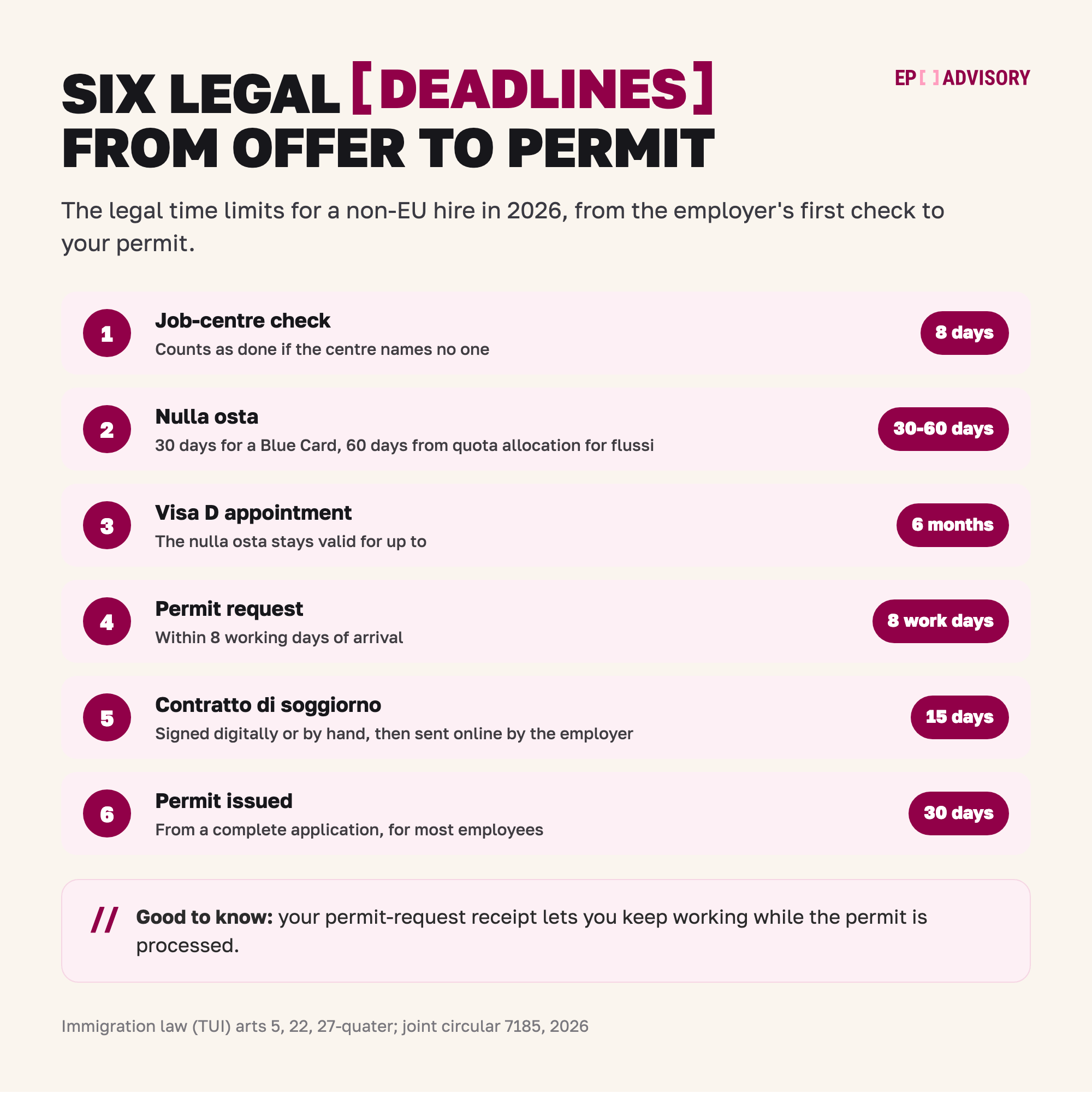
Most steps from offer to permit have a legal deadline. These are the 2026 rules for a non-EU hire.
- Job-centre check. The employer asks the local job centre whether anyone in Italy can fill the role. If the centre names no one within 8 days, the employer can go ahead.
- Application. The employer files with the Sportello Unico: any day for a Blue Card, the click day for a quota job.
- Nulla osta. It is due within 30 days for a Blue Card, or 60 days from quota allocation for flussi. If the employer asks, the desk sends it to the consulate with your codice fiscale, the Italian tax code you need for your contract and payslip (Agenzia delle Entrate).
- Visa. Book your visa D appointment straight away. The nulla osta is valid for up to 6 months. When the consulate finishes its checks, the employer has 15 days to confirm the request, or the nulla osta is revoked.
- Permit request. Within 8 working days of arrival, you must request your residence permit (Article 5). Ask the Sportello Unico how to file it. Fingerprints are taken at the Questura, the police immigration office. Until the contract is signed, the nulla osta lets you work.
- Contratto di soggiorno. Within 15 days of arrival, you and the employer sign this residence contract. It is usually signed digitally, but you may also sign by hand. It confirms the job terms and your housing, and the employer sends it online to the Sportello Unico. Your permit-request receipt then lets you work while the permit is processed.
- Permit. Since 22 May 2026, the single work permit for most employees must be issued within 30 days of a complete application (Ministry news).
What jobs in Italy pay
The average full-time wage in Italy is €34,733 gross a year (OECD, 2025). That is about $38,800 at the ECB rate on 7 October 2026. For example, the main metalworking CCNL (Federmeccanica-Assistal) pays at least €2,211.43 gross a month at level C3 from 1 June 2026.
The Blue Card bar follows the national average wage, so an offer near the average may only just clear it.
Next: check what your role pays by sector and city in our guide to salaries in Italy.
Key takeaways
- Graduates and specialists can use the EU Blue Card, which has no quota and a 30-day deadline for the nulla osta.
- The Blue Card pay bar is the CCNL rate and the ISTAT average wage, last published as €33,500 gross a year for 2024.
- Flussi 2027 applications are pre-filed from 23 October to 7 December 2026, and the non-seasonal click day is 16 February 2027.
- Outside family care, only 10,900 of the 76,200 non-seasonal places for 2027 are open to any nationality.
- You never pay for a nulla osta or a quota place.
- Italian is not tested for the visa, but most jobs outside tech, research and multinationals expect it.
See what a recruiter sees, then fix it before you apply. An instant score, then the fix for every problem.
Free, no card. A free account unlocks every fix.
Frequently asked questions
Can foreigners get a job in Italy in 2026?
Yes. EU citizens apply like locals. Non-EU professionals need an employer to apply for a work authorisation called a nulla osta. Graduates and specialists can use the EU Blue Card, which has no quota. Many other jobs go through the decreto flussi quotas, with 76,200 non-seasonal places in 2027.
How do I get a work visa for Italy?
Your employer applies first, to the immigration desk (Sportello Unico) at the local prefecture, for a nulla osta. With it, you apply for a national visa D at the Italian consulate in your country. After you arrive, you request a residence permit within 8 working days.
When are the decreto flussi 2027 click days?
Employers pre-file from 23 October to 7 December 2026. The click days are 12 January 2027 for seasonal farm work, 9 February for seasonal tourism, 16 February for non-seasonal jobs and 18 February for family care. Applications open at 09:00 and places go in order of filing.
What salary do I need for an EU Blue Card in Italy?
At least the collective agreement (CCNL) rate for the job and the average gross annual wage measured by ISTAT. The law gives no euro figure. The last published official figure is €33,500 gross a year, for 2024.
Can I get a job in Italy without speaking Italian?
Yes, in some sectors. The work visa does not test Italian. English-only roles are most common in tech companies in Milan, research, multinational offices and English teaching. Most other jobs expect Italian.
Which jobs are in demand in Italy?
Skilled trades and technicians are among the hardest roles to fill. In September 2026, firms said 71.5% of planned mechanic hires were hard to fill, as were 69.3% of construction finishers, 67.4% of welders and 63.5% of engineering technicians.