 By Aleksei Gavrilov, Career Consultant at EP Advisory
Europe’s labour market has a paradox at its centre: some of the world’s most desirable employers are here, and many of them cannot fill their roles. Germany is short hundreds of thousands of skilled workers, Norway needs tens of thousands, and the English-speaking tech and pharma hubs of Ireland, the Netherlands and the Nordics compete for the same international talent every year. If you are a qualified professional outside the EU, 2026 is a realistic year to move.
The obstacle is rarely your experience. It is the paperwork logic almost nobody explains up front: to hire you, a European employer usually has to prove your salary clears a legal minimum, and that minimum is different in every country, quoted in six currencies, and was changed twice this summer in Sweden alone. Understand that one mechanism and the whole map gets simpler.
In nearly 10 years we have helped 5,000+ professionals win offers at companies like Google, Amazon and SAP and relocate to Europe. This guide is the map we give them on day one: the routes that actually exist, the 2026 salary bar in each country, where the jobs are, and how to turn an application into an offer that clears immigration.

Start with your profile, not a country list
The most common mistake is to choose a country you like, then discover its salary bar or language rules quietly rule you out. Reverse the order. Write down four facts: your highest degree and the year you earned it, your age, your occupation (and whether it appears on any country’s shortage list), and the gross salary a realistic offer would carry. Those four things decide which countries are open to you far more than where you would enjoy living. Then shortlist two or three and go deep on each.
The 2026 salary bar, at a glance
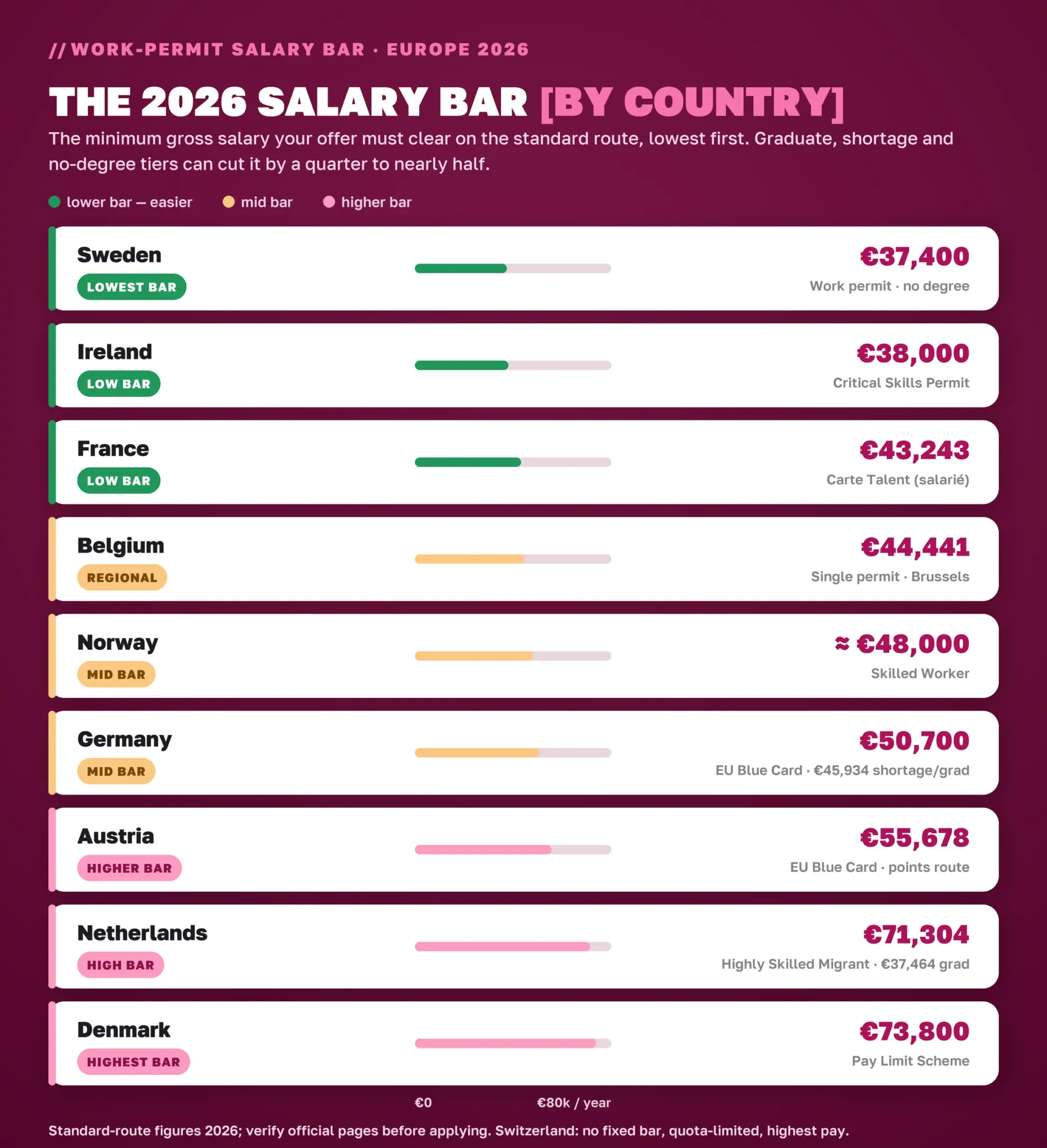
Every European work permit has a price of entry — a minimum gross salary your offer must reach. The chart above shows the main route across nine popular destinations, cheapest bar first. Read it with your own number in hand, not as a “cheapest wins” ranking: a low bar says nothing about how many jobs exist for your profile, or how much rent will take back. For all 16 countries, including how the EU Blue Card is priced in each member state, see our pillar guide to the work visa salary thresholds in Europe.
The three realistic routes into Europe
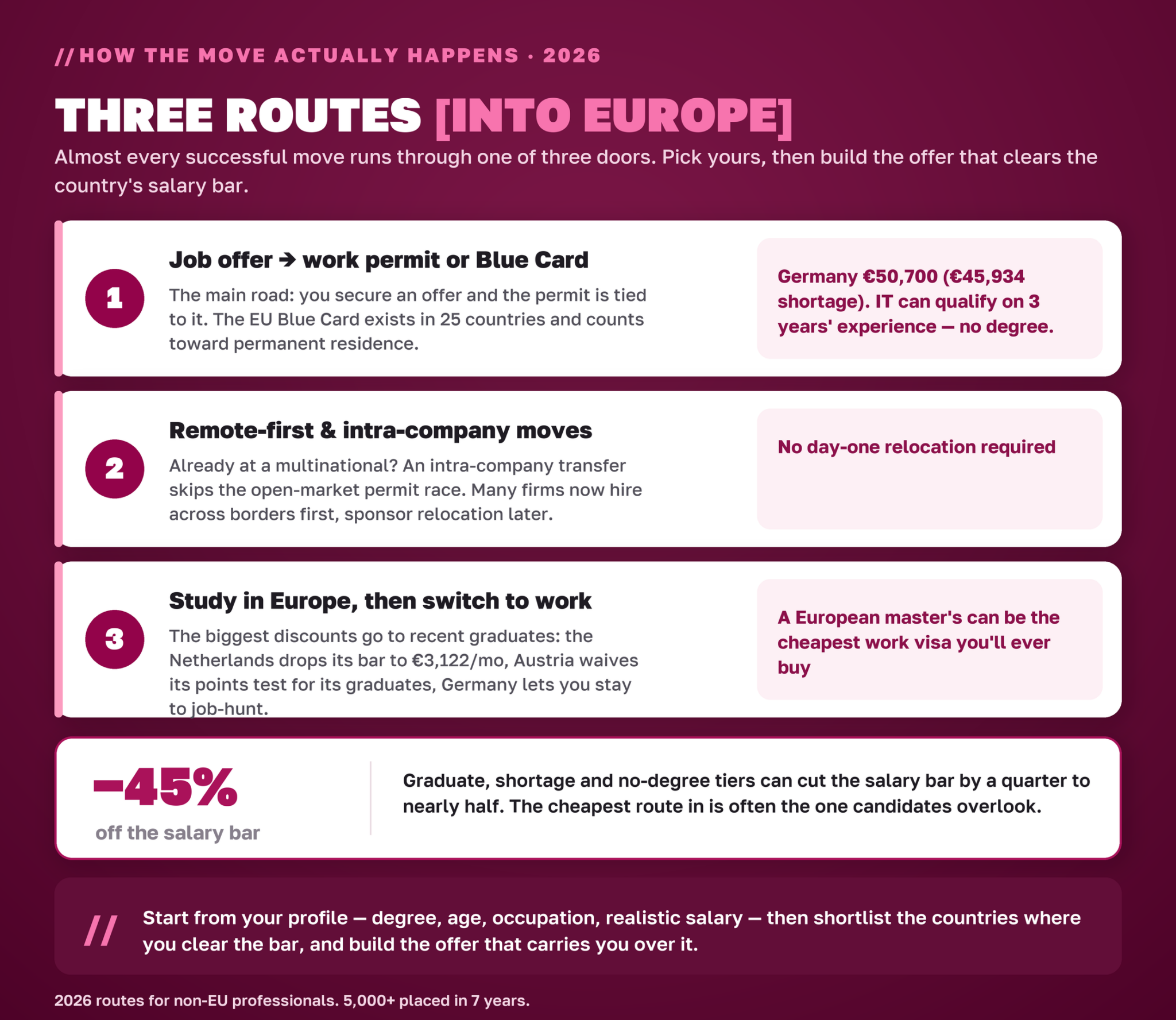
Almost every successful move runs through one of three doors.
1. A job offer, then a work permit or EU Blue Card
This is the main road. You secure an offer, and your employer (or you) applies for a work permit tied to it. For degree-level roles the EU Blue Card is often the best version: it exists in 25 EU countries, counts toward permanent residence, and is easier to carry to another EU country later. Germany prices it at €50,700 a year, dropping to €45,934 for shortage occupations and recent graduates — and IT specialists can qualify on three years’ experience instead of a degree.
2. Remote-first and intra-company moves
If you already work for a multinational, an intra-company transfer can move you to a European office without the open-market permit race. And you do not always have to relocate on day one: thousands of European companies now hire across borders first and sponsor relocation later. Start with our guide to remote work in Europe.
3. Study in Europe, then switch to work
The biggest discounts in the system go to recent graduates. The Netherlands drops its salary bar to €3,122 a month for people within three years of graduating, against €5,942 on the standard route; Austria waives its points test for graduates of Austrian universities; Germany lets graduates stay on to look for work. If you are early in your career, a European master’s can be the cheapest work visa you will ever buy.

Score your CV in 30 seconds, then fix its biggest problems one by one. Both free.
Free, no card. A free account unlocks every fix.

Where the jobs are: a country-by-country map
Here is where the demand and the English-friendly markets are in 2026, each with a full guide:
- Germany — the EU’s biggest market and the widest set of visa doors, strong for engineering, IT and industry. See what roles pay in salaries in Germany.
- The Netherlands — a fast Highly Skilled Migrant route, English spoken almost everywhere, and the 30% ruling that lifts take-home pay. Start with salaries in the Netherlands.
- Switzerland — the highest pay in Europe, quota-limited for non-EU hires. Read how to find a job in Switzerland and what it pays in salaries in Switzerland.
- Ireland — the English-speaking home of EU tech and pharma HQs, on the Critical Skills permit. See salaries in Ireland.
- Sweden — Europe’s lowest mainstream salary bar, and no degree requirement at all. Read how to find a job in Sweden and salaries in Sweden.
- Norway — high wages and a real shortage of engineers and skilled trades. Start with how to find a job in Norway and salaries in Norway.
- Denmark — outstanding work-life balance on the Pay Limit Scheme. See how to find a job in Denmark and salaries in Denmark.
- France — the rebased Carte Talent is one of the cheapest routes into a major economy. Read how to find a job in France.
- Austria — the points-based Red-White-Red Card rewards young, qualified applicants. Start with how to find a job in Austria.
- Belgium — three regional systems and the EU institutions in Brussels. See how to find a job in Belgium.
For southern Europe, read our guides to jobs in Spain for foreigners and jobs in Italy for foreigners.
If you are American and the UK is on your list, read how Americans can find a job in the UK.
What you’ll actually earn — and keep
Headline salaries are not take-home pay. Taxes, social contributions and rent reshape the number completely, and a €70,000 offer lands in very different places in high-tax Denmark and low-tax Switzerland. Before you accept anything, run the real arithmetic for your target country — every salary guide above breaks pay down by sector and shows what is left after tax and typical rent. If you are weighing several countries at once, the fastest overview is our salary thresholds comparison, and for the strongest fast-track programmes worldwide see the best countries with talent visas.
How to land the offer: CV, LinkedIn and interviews
Clearing the salary bar is a positioning problem before it is a paperwork one, because the bar only matters once you have an offer in hand. Three things move the needle:
- An English CV built for the market, not a translated local one. Our guide to an effective CV in English is drawn from 35,000+ successful resumes.
- A LinkedIn profile recruiters can actually find — in English, using the job titles your target country uses.
- Interview and negotiation preparation. Even a strong candidate leaves money, and sometimes the offer itself, on the table without it. See how to negotiate salary, and for the top of the market, how the process really works in our guide to getting a job at Google.

Cost of living: the number that quietly decides it
Zurich and Copenhagen pay beautifully and take much of it back in rent; Lisbon, Warsaw and Valencia stretch a smaller number a long way. A higher gross in the wrong city can leave you with less at the end of the month than a lower one elsewhere. Weigh every offer against local rent, tax and healthcare before you compare it to what you earn today — each salary guide above includes a realistic monthly budget for its country’s main city.
Your next three steps
- Shortlist two or three countries from your profile, using the salary bar and the shortage lists — not where you would most like to live.
- Check the current threshold on the official page before anything else. Figures change mid-year, and the one that counts is in force on the day you apply.
- Build the offer that clears the bar — the right CV, the right job titles, the right employers. That is where a consultant who does this every day saves you months.
See what a recruiter sees, then fix it before you apply. An instant score, then the fix for every problem.
Free, no card. A free account unlocks every fix.
Frequently asked questions about finding a job in Europe
Europe is more open to international professionals than the headlines suggest, once you approach it in the right order. Start from your own profile, pick the countries where you clear the bar, build an offer that carries you over it, and the move stops being a gamble and becomes a plan. Start with your CV: check it for free. You get a score in 30 seconds, then a fix for each problem.