 By Alisa Schlosser, Career Consultant at EP Advisory
The short answer: the average salary in Italy is €34,733 a year gross (OECD, 2025, mean per full-time-equivalent employee). Divide by 12 and you get €2,894 a month, but Italy splits the year into 13 instalments for almost every private-sector employee, so an ordinary payslip reads €2,672. Take-home on the average is roughly €2,000 to €2,200 a month over 12 (our estimate with 2026 rates). Italy has no statutory minimum wage.
| Italy, 2026 | Figure |
|---|---|
| Average salary, gross (OECD 2025, mean) | €34,733 / year |
| On an ordinary payslip (÷ 13, standard) | €2,672 |
| Divided by 12 | €2,894 |
| Divided by 14 (some sectors) | €2,481 |
| Take-home on the average (our estimate) | ≈ €2,000–2,200 / month over 12 |
| Statutory minimum wage | None. CCNL sector floors instead |
| EU Blue Card salary bar | No euro figure in the law. Last official figure €33,500 / year (2024) |
Italy has a payslip problem, and it catches almost every foreigner who moves here. The salary in your contract is an annual gross figure. The salary in a job ad is often a bare monthly one. The salary that arrives in your bank account each month is that figure divided by 13, or in some sectors by 14, not by 12. Nobody tells you this at the offer stage, and it is the difference between budgeting correctly and being short by roughly €200 every ordinary month.
This guide runs the arithmetic properly. It uses the freshest full-year figure Italy has, explains why three different official averages are circulating and which one to trust, sets out the CCNL pay floors that stand in for a minimum wage, and connects all of it to the Blue Card salary bar that decides whether a job can sponsor you at all. Every monthly number on this page states the divisor that produced it.
In nearly 10 years, we’ve helped more than 5,000 professionals find jobs abroad. Want to know if your CV will pass screening in Italy? Check your CV for free: a score in 30 seconds, then a fix for each problem.
What Is the Average Salary in Italy Per Month? (2026)
The average salary in Italy is €34,733 a year gross, according to the OECD’s average annual wages series for 2025 in current prices. It is a mean per full-time-equivalent employee across the whole economy, and the most recent full-year reading available for the country.
What that means per month depends entirely on how many instalments your contract uses:
| Divisor | Per month, gross | Who this applies to |
| ÷ 12 | €2,894 | The arithmetic month. What most salary websites publish |
| ÷ 13 | €2,672 | The standard case: 12 payslips plus the tredicesima in December |
| ÷ 14 | €2,481 | Sectors whose CCNL also pays a quattordicesima in June or July |
All three describe the same annual salary. None of them is wrong. But if you plan your rent around €2,894 and your contract runs on 13 instalments, you will be about €222 short in every ordinary month, and then receive a lump sum before Christmas that you had already spent in your head.
What counts as a good salary in Italy? Anything clearly above €34,733 a year puts you ahead of the national average. In Milan, our rule of thumb is that comfortable single living starts closer to €38,000 to €40,000 a year. That is our working estimate, not an official figure. In the south, €30,000 goes considerably further.
One thing to keep in perspective. Italian pay has not kept up with prices. The OECD Employment Outlook 2026 found that Italian real wages in the first quarter of 2026 were still 6.1% below their level in the first quarter of 2021, the largest gap among the large OECD economies. Nominal salaries have risen, but purchasing power has not recovered, and that is the background to every figure on this page.
If the numbers work for you, the next step is practical: the European work-visa salary thresholds show what an offer must pay before a permit is possible, and salaries in Spain covers a neighbouring market with the same multi-instalment trap, paid across 14 rather than 13.
Italian Salaries at a Glance: The Essentials
- Average gross salary: €34,733/year, which is €2,894 ÷12 or €2,672 ÷13 (OECD average annual wages, 2025, mean per full-time-equivalent employee)
- Pay frequency: 13 instalments is the near-universal private-sector standard; commerce, tourism and food CCNLs typically pay 14
- ISTAT full-time average: €37,302/year, but that is the 2022 reference year published in 2025, and it covers only firms with 10 or more employees, with pay converted to full time
- Average hourly pay: about €16.4, with men at €16.8 and women at €15.9 (ISTAT, reference year 2022)
- Hourly spread: the lowest-paid 10% earn €8.8/hour or less, the top 10% more than €26.6/hour (ISTAT, 2022)
- By contract category: dirigenti €171,800, quadri €75,400, impiegati €38,600, operai €28,700 a year gross for full-time full-year employees (INPS, private sector, 2024)
- Take-home on the average: roughly €2,000 to €2,200 a month, single worker, spread over 12 payments (our estimate with 2026 rates)
- Minimum wage: none. Italy is one of five EU states without one (Eurostat, 2026), and more than 1,000 CCNLs filed at CNEL set sector floors instead
- Gender gap: ISTAT puts men at €39,982 against €33,807 for women on the same 2022 basis
- EU Blue Card threshold: no euro figure in the law. The last official figure is €33,500 gross a year, for 2024, and the bar follows the ISTAT average wage (checked September 2026)
- Real wages: 6.1% below early 2021 in early 2026, the largest gap among large OECD economies (OECD Employment Outlook 2026)
A note on how to read all of this. Italy publishes salary statistics on several different bases, and the gaps between them are large enough to change a relocation decision. The section below sets out which number measures what, because the mislabelling is the single most common error on Italian salary pages.
The 13th-Month Trap: Why Payslips Show Less
This is the most useful thing to understand about Italian pay, and it is where most of the English-language salary pages we checked go wrong.
Italian salaries are agreed and written as an annual gross figure, the retribuzione annua lorda or RAL. That figure is then paid out across 13 instalments rather than 12. The extra payment is the tredicesima, and it lands in December, typically before Christmas. It is not a bonus in the discretionary sense. It is part of your contractual salary: D.P.R. 1070/1960 gave the 1946 interconfederal agreement on the tredicesima the force of law for industry, and every private-sector CCNL now provides for it.
Some sectors go further and pay a fourteenth instalment, the quattordicesima, usually in June or July. This is standard in commerce, tourism and food, and it exists wherever the relevant CCNL provides for it.
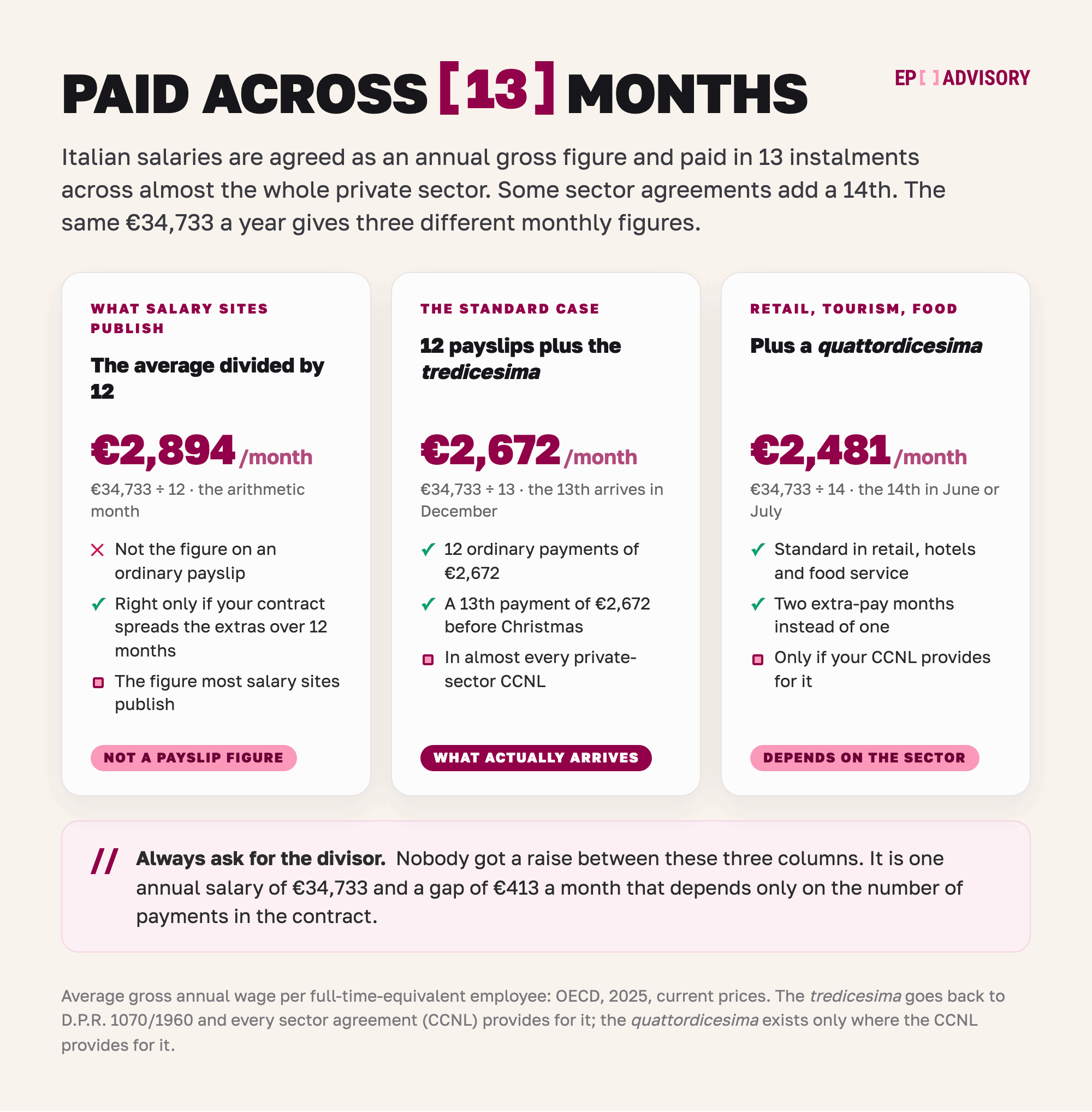
So the same €34,733 average produces three different monthly figures:
- €34,733 ÷ 12 = €2,894. The arithmetic month. Correct only if your contract explicitly spreads the extras across all twelve months.
- €34,733 ÷ 13 = €2,672. What an ordinary payslip shows in the standard case, and also what the December tredicesima is worth.
- €34,733 ÷ 14 = €2,481. What an ordinary payslip shows where a quattordicesima also applies.
The spread between the top and bottom of that list is €413 a month, with no change whatsoever in annual pay.
Job ads run the other way. In our August 2026 sample of 24 Indeed Italy listings with figures, 15 quoted bare monthly numbers (“1.200 € – 1.400 € al mese”) and 7 quoted an annual RAL. Monthly wording dominates hospitality, retail and blue-collar roles; RAL dominates office and engineering ads. The bare monthly figures are gross, and they sit at CCNL levels: Randstad’s Amazon warehouse ad quotes 1.914,90 € al mese, which is Amazon Italy's published gross entry wage from January 2026. So convert in both directions. A “1.500 € al mese” offer is not 1.500 × 12 = €18,000 a year. On the standard 13 instalments it is €19,500, and on 14 it is €21,000. Read it as ×12 and you undervalue the offer by €1,500 or more, enough to misjudge a Blue Card case.
The question to ask before you sign. Ask how many mensilità the salary is paid over: 12, 13 or 14. Then convert every offer back to the annual RAL before comparing it with anything. An offer quoted as a monthly figure without its divisor is not a number you can compare.
One Country, Several Averages: Which Number to Trust
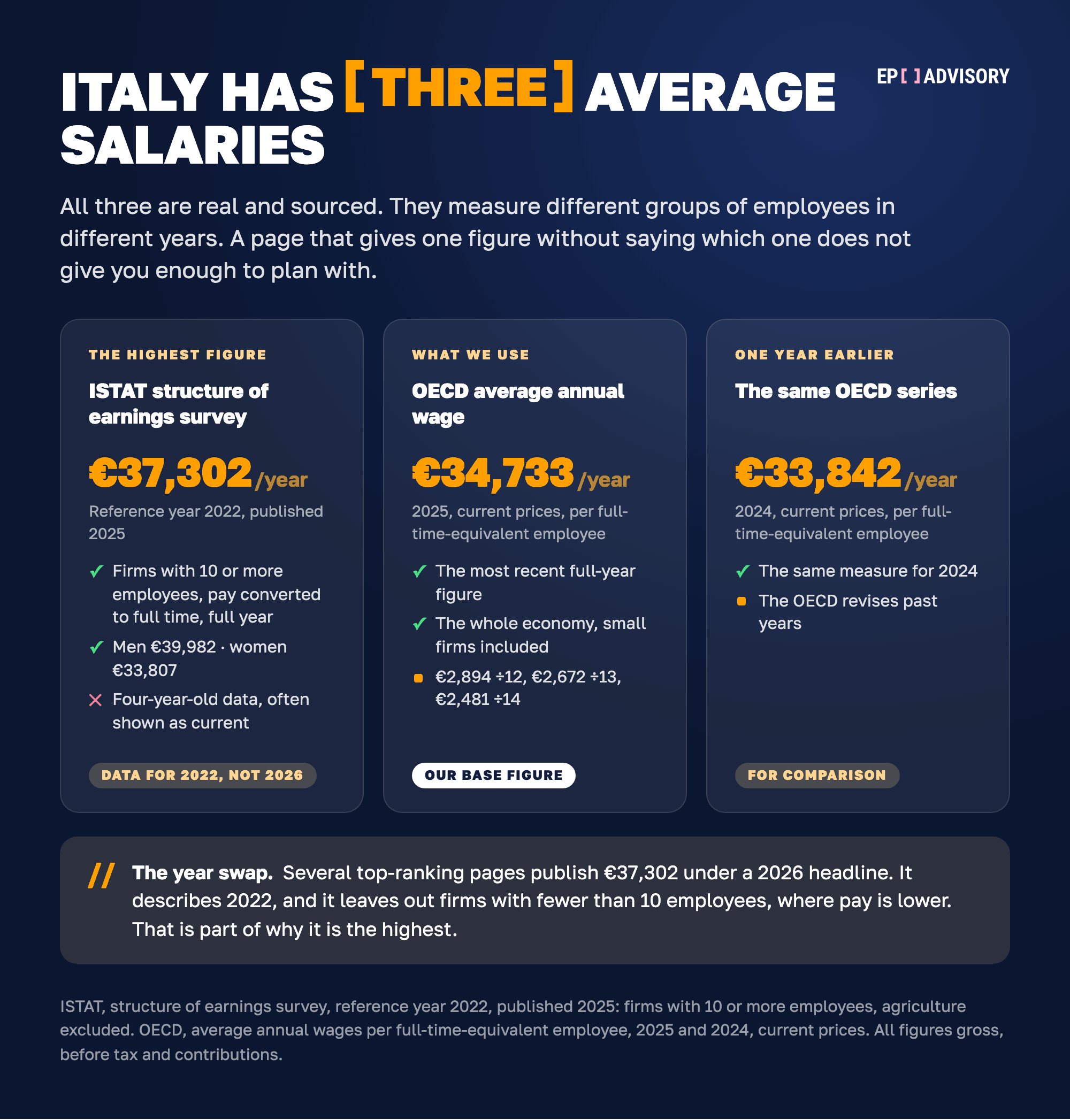
Ask what Italians earn and you get at least three defensible answers. All of them are sourced. They measure different populations in different years, and the difference between the highest and the lowest is almost €3,500 a year.
| Figure | Source and year | What it actually measures |
| €37,302 | ISTAT structural earnings survey, reference year 2022, published 2025 | Firms with 10 or more employees only, pay converted to full time. Men €39,982, women €33,807 |
| €34,733 | OECD average annual wages, 2025, current prices | Mean per full-time-equivalent employee across the whole economy, small firms included |
| €33,842 | OECD, the same series, 2024, current prices | The same measure one year earlier. The OECD revises past years |
We headline the OECD 2025 figure because it is the most recent full-year reading and because it covers the whole economy, small firms included. The ISTAT figure leaves out firms with fewer than 10 employees, where pay is lower. Both figures convert part-time work to full-time equivalents, so neither is the average pay packet of every worker.
The mislabelling to watch for. Several of the top-ranking pages we checked in August 2026 publish the ISTAT €37,302 figure under a 2026 headline. That number has a reference year of 2022. It was published in 2025, which is presumably where the confusion starts, but four-year-old data presented as current is how readers end up with expectations that no employer will meet. If a page quotes a figure without naming both the source and the reference year, treat the number as decorative.
Salaries by Sector and Role
Two things move an Italian salary more than anything else: the contract category you are hired into, and the sector you work in.
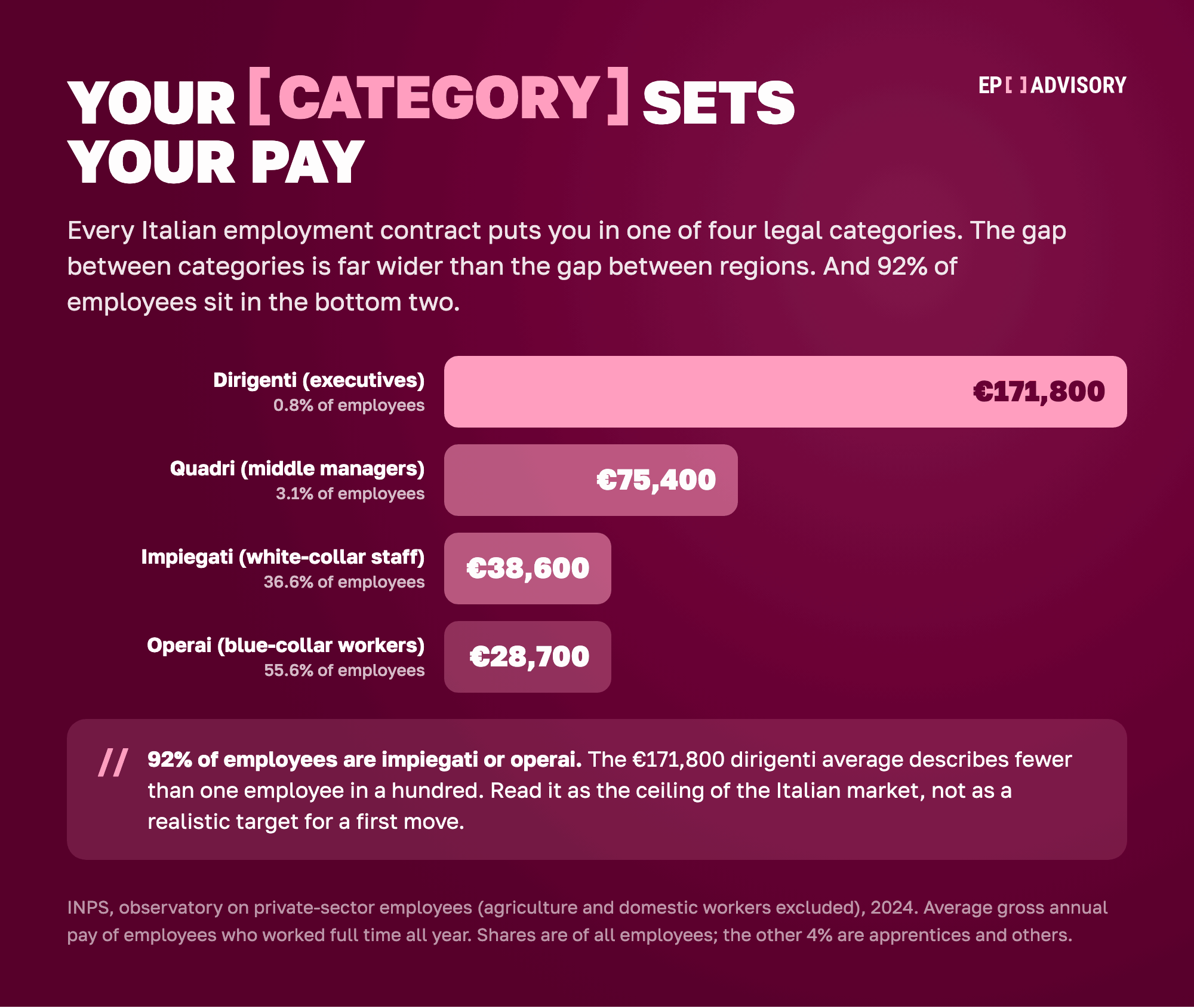
Category first. Italian employment law sorts every employee into one of four legal categories, and your CCNL grade sits inside one of them. The gaps are enormous.
| Contract category | Average gross, per year | Share of employees |
| Dirigenti (executives) | €171,800 | 0.8% |
| Quadri (middle managers) | €75,400 | 3.1% |
| Impiegati (white-collar staff) | €38,600 | 36.6% |
| Operai (blue-collar workers) | €28,700 | 55.6% |
Those are INPS figures for 2024 (INPS observatory on private-sector employees), agriculture and domestic work excluded. The averages cover employees who worked full time all year. The shares are of all employees, and the other 4% are apprentices and others. Read them together and the picture is clear: 92% of private-sector employees are impiegati or operai, and the headline-grabbing dirigenti average describes fewer than one worker in a hundred.
Sector second. ISTAT's hourly data for 2022 shows the gap most clearly. Average hourly pay was about €16.4, but finance paid €25.9 an hour against €10.9 in hospitality. That is a ratio of roughly two and a half to one for the same hour of work.
What this means for a job search. If you need to clear a visa threshold, sector selection does more work than city selection. On a 40-hour week, the finance average works out at about €54,000 a year, well above the last official Blue Card figure of €33,500 (2024). The hospitality average works out at about €23,000, which does not get you there, whatever the vacancy count looks like. That arithmetic is ours, from the ISTAT hourly averages.
Score your CV in 30 seconds, then fix its biggest problems one by one. Both free.
Free, no card.

Is There a Minimum Wage in Italy? The CCNL System
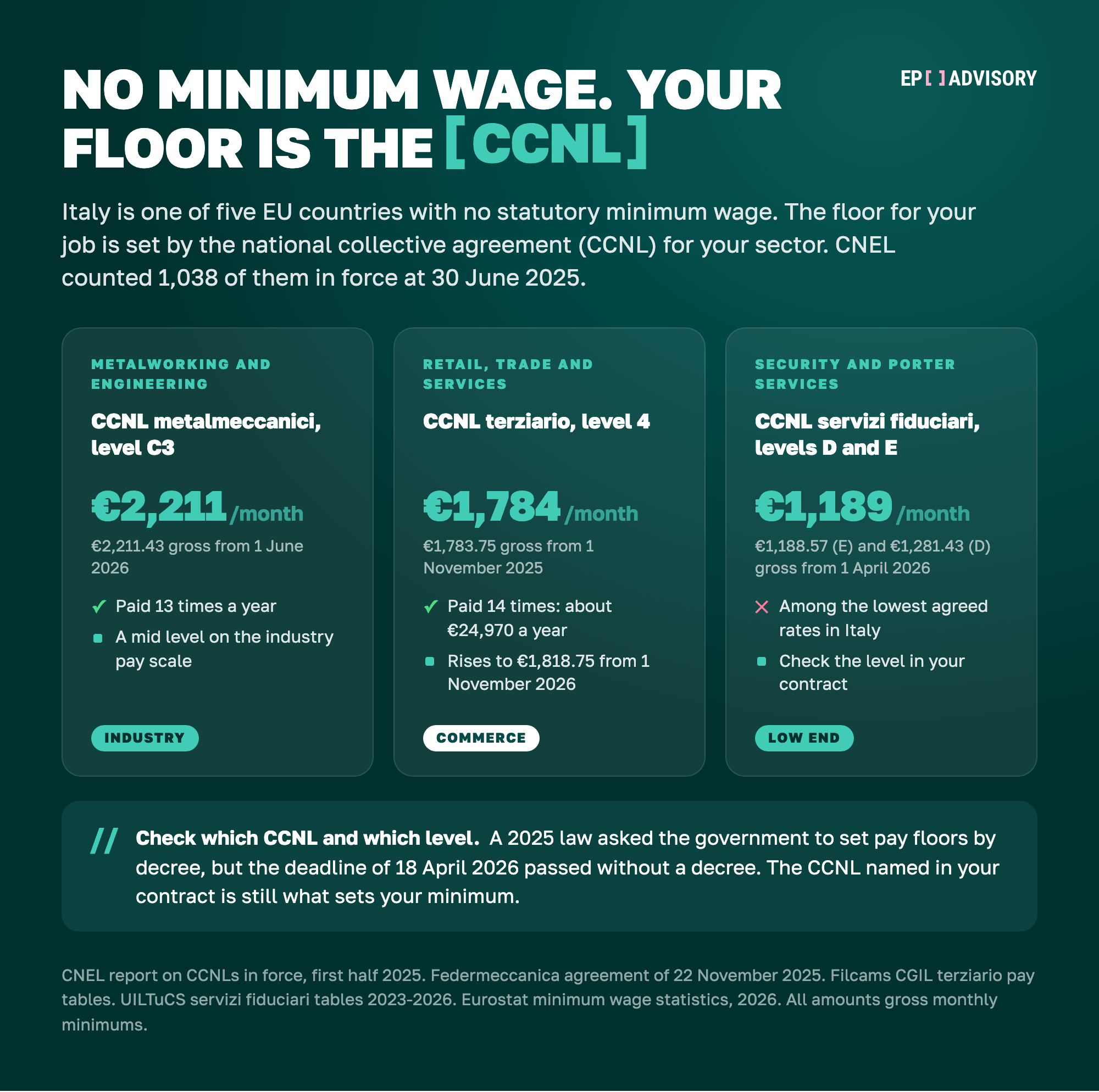
No. Italy has no statutory minimum wage in 2026, and it is not an outlier for it. Five EU member states have none: Italy, Denmark, Austria, Finland and Sweden. All five leave the job to collective bargaining (Eurostat, 2026). A 2025 law (L. 144/2025) asked the government to set pay floors by decree, but the deadline of 18 April 2026 passed without one. The April 2026 salario giusto decree (DL 62/2026, converted by L. 112/2026) sets no national figure and relies on collective agreements.
What Italy has instead is the CCNL system. A contratto collettivo nazionale di lavoro is a national agreement between employer associations and unions covering a whole sector. More than 1,000 of them are filed at CNEL (1,038 in force at 30 June 2025), the national council for economics and labour. Each one sets a minimo contrattuale, a legal pay floor, for every grade in that sector. A CCNL does not automatically bind every employer in the sector. It binds the employers that belong to a signatory association or that adopt it in the employment contract, and in practice most do. For the rest, courts enforce a fair wage through Article 36 of the Constitution, taking CCNL rates as the benchmark. One caution: contratti pirata, lookalike agreements signed by minor unions with lower floors, do exist. Check which CCNL your contract names.
| CCNL floor | Monthly minimum | In force from |
| Metalmeccanici (engineering), level C3 | €2,211.43 | 1 June 2026 |
| Terziario (commerce and services), level 4 | €1,783.75 | 1 November 2025 |
| Servizi fiduciari (security and porter services), levels E and D | €1,188.57 and €1,281.43 | 1 April 2026 |
The terziario level 4 floor works out at roughly €24,970 a year across 14 mensilità, which is the standard in that sector, and it rises to €1,818.75 from 1 November 2026. The metalworkers’ floor is paid over 13. Sources: Federmeccanica agreement of 22 November 2025, Filcams CGIL terziario pay table, UILTuCS servizi fiduciari tables.
The number you should never trust. Any single figure presented online as the Italian minimum wage is wrong. Italy has no statutory minimum wage, so there is no national number to publish.
Where the floor actually bites. ISTAT’s 2022 hourly data shows the lowest-paid 10% of employees earning €8.8 an hour or less. Hospitality averages €10.9 an hour across the whole sector. If you are looking at a role in tourism or catering, the CCNL floor is not a theoretical protection. It is often close to what the job pays.
Live-in carer (badante) pay. Domestic workers have their own agreement, the CCNL lavoro domestico, renewed on 28 October 2025 and valid to 31 October 2028. From 1 January 2026, the minimum for a live-in carer without specific training who looks after a person who cannot manage without help (level CS) is €1,193.84 gross a month. A trained carer for the same kind of person (level DS) gets €1,474.73 plus an allowance of €207.69. A live-in carer for a person who can manage alone (level BS) gets €1,053.39. The family also provides board and lodging, the salary is paid 13 times a year, and a live-in working week is capped at 54 hours. A carer who does not live in earns at least €8.30 an hour at level CS (DOMINA minimum pay table 2026; text of the agreement). These are minimums, and families can pay more.
North vs South: The Regional Gap
Italy’s north to south divide is the oldest feature of its labour market and it has not closed. ISTAT data for 2022 shows it in two ways. Hourly pay is lower in the South (€15.7 an hour) than in the North-east (€15.9) and the Centre (€17.0). And employees in the South and the Islands are paid for fewer hours a year: 1,595 and 1,581, against 1,732 in the North-east and 1,723 in the North-west. Fewer paid hours at a lower rate turns a small hourly gap into a larger annual one.
Two qualifications matter before you use that gap to choose a city.
First, cost of living moves in the same direction. Housing in Milan generally costs much more than in the southern cities. So a lower salary in Bari can leave you with a similar amount at the end of the month as a higher one in Milan.
Second, the job market is not symmetric. The north is where the international employers, the manufacturing base and the finance sector are. If you need visa sponsorship, the practical reality is that the roles which clear the salary threshold are heavily concentrated in Lombardy, Emilia-Romagna, Veneto and Piedmont. The southern discount is real, but so is the shortage of sponsoring employers there.
Where to Look for Work: Official Resources
Italian hiring runs through a mix of international platforms and strong domestic boards. Start here.
- LinkedIn Italy: where multinationals, technology firms and English-speaking roles concentrate, especially in Milan
- Indeed Italy: broad coverage across sectors and seniority levels
- EURES: the EU mobility network, useful for cross-border roles and for employers already used to hiring non-locals
Two practical notes. Most Italian vacancies are written and interviewed in Italian, and outside Milan the English-speaking market thins out quickly. And because sponsorship paperwork sits with the employer rather than with you, it is worth checking whether a company has hired non-EU staff before you invest time in the application. For the visa routes, the quota system and the jobs in demand, read our guide to jobs in Italy for foreigners.
The Arithmetic: What Actually Lands in Your Account
Two things come off an Italian gross salary: INPS social contributions and IRPEF income tax, plus regional and municipal surcharges that vary by where you live.
On the average salary of €34,733, the shape of the calculation is this:
- INPS employee contributions: 9.19% of gross for most private-sector employees
- IRPEF: a three-band national scale, 23% up to €28,000, 33% from €28,000 to €50,000 (cut from 35% by the 2026 budget law, Agenzia delle Entrate), and 43% above €50,000
- Regional and municipal surcharges: set locally, and they move the final figure in both directions
Put together, take-home on the average salary comes to roughly €2,000 to €2,200 a month on our estimate with 2026 rates, for a single worker with no dependants, spread over 12 payments. Across 13 or 14 instalments the ordinary-month figure is proportionally lower, with the balance arriving in December and, where applicable, in June or July.
Read that as a range, not as a payslip. It is deliberately not given to the cent. Italian net pay depends on your region and municipality, on family status and dependants, on which deductions and tax credits apply to you, and on how your CCNL structures the year. Two people on identical gross salaries in Milan and Bari will not take home the same amount. Anyone publishing a single precise net figure for “the average Italian salary” is guessing on your behalf.
What you can rely on is the shape: expect to keep roughly 70 to 75 percent of gross at this salary level (our estimate with 2026 rates).
Salary and the Visa: The Blue Card Bar
This is the part that decides whether a move is possible at all.
For non-EU citizens, the EU Blue Card is the main route into Italy for qualified professionals, and it is salary-gated. The salary test is two-part under Article 27-quater of the immigration law, as amended by d.lgs. 152/2023: pay must be at least the CCNL rate for your role, and never below the average gross annual wage as measured by ISTAT. The law names no euro figure. The last official figure we found is €33,500 gross a year, for 2024 (EU Immigration Portal). We found no official figure for 2026 when we checked in September 2026. Ask the employer which amount they applied to your case. People under temporary protection, such as Ukrainians in the EU, cannot apply for a Blue Card while they hold that status (Article 27-quater, paragraph 3).
Two features of the Italian Blue Card are worth knowing:
- You do not necessarily need a degree. A three-year higher education qualification works, and so does five years of relevant professional experience. For ICT managers and specialists, three years of relevant experience within the last seven years is enough.
- It sits outside the decreto flussi quotas. The Blue Card is not subject to the annual quota system, so there is no click day to survive and no cap to be beaten to.
Now put the two numbers side by side. The average Italian salary is €34,733 (OECD, 2025). The last official Blue Card figure is €33,500 (2024). The average job clears the bar only narrowly: the bar follows the average wage, and the CCNL rate for your role may be higher than both. This is not a small technicality. A search strategy aimed at an average Italian salary is aimed almost exactly at the line that makes the move legal.
The other route, briefly. For roles outside the Blue Card, Italy runs the decreto flussi quota system. The DPCM of 2 October 2025, published in the Gazzetta Ufficiale on 15 October 2025, opens 497,550 work entries for 2026 to 2028, of which 164,850 fall in 2026, allocated by sector and released through a click-day application process.
The full comparison across European countries is in our guide to work visa and Blue Card salary thresholds in Europe.
Related reading: Work visa & Blue Card salary thresholds in Europe 2026 · Salaries in Spain · Salaries in France
See what a recruiter sees, then fix it before you apply. An instant score, then the fix for every problem.
Free, no card.
Key Takeaways
- The average salary is €34,733 a year gross (OECD, 2025, per full-time-equivalent employee). That is €2,894 ÷12, €2,672 ÷13 or €2,481 ÷14. Always state the divisor.
- Thirteen instalments is the private-sector standard, with the tredicesima in December. Commerce, tourism and food usually add a fourteenth in June or July.
- Italy publishes several defensible averages. The ISTAT €37,302 figure is real but its reference year is 2022, and it covers only firms with 10 or more employees.
- Your contract category decides more than your city: dirigenti average €171,800 but are 0.8% of private-sector employees, while 92% are impiegati or operai (INPS, 2024).
- There is no statutory minimum wage. More than 1,000 CCNLs set the floors, from €2,211.43 a month in engineering down to about €1,190 in security services. Live-in carers start from €1,193.84 a month plus board and lodging.
- The south pays less per hour and for fewer hours a year, but housing there also costs less, and sponsoring employers cluster in the north.
- Take-home on the average is roughly €2,000 to €2,200 a month over 12 payments (our estimate), and it varies by region, municipality and family status.
- The law sets no euro figure for the Blue Card. The last official figure, €33,500 (2024), sits just below the national average, so an average offer clears it only narrowly. Target sectors that clear it comfortably.
Frequently Asked Questions
What is the average salary in Italy per month?
The average salary in Italy is €34,733 a year gross, according to the OECD’s 2025 figures (mean per full-time-equivalent employee). Divided by 12 that is €2,894 a month, but Italy pays across 13 instalments for almost all private-sector employees, so an ordinary payslip shows €2,672. In sectors that also pay a fourteenth instalment the ordinary-month figure is €2,481.
What is a good salary in Italy?
Anything clearly above the national average of €34,733 a year puts you ahead of most employees. In Milan, our rule of thumb is that comfortable single living starts nearer €38,000 to €40,000 because of housing costs. If you need sponsorship, also check the EU Blue Card bar: the last official figure is €33,500 a year, for 2024.
Is there a minimum wage in Italy?
No. Italy is one of five EU member states without a statutory minimum wage, alongside Denmark, Austria, Finland and Sweden. More than 1,000 national collective agreements filed at CNEL (1,038 at 30 June 2025) set legal pay floors by sector instead. The Metalmeccanici floor for level C3 is €2,211.43 a month from 1 June 2026, and terziario (commerce) level 4 is €1,783.75 a month from 1 November 2025. Live-in carers under the domestic work agreement start from €1,193.84 a month in 2026, plus board and lodging.
How much is take-home pay on the average Italian salary?
Roughly €2,000 to €2,200 a month (our estimate with 2026 rates) for a single worker on the €34,733 average, spread over 12 payments. Deductions are INPS employee contributions of 9.19% and IRPEF at 23% up to €28,000, 33% up to €50,000 (cut from 35% by the 2026 budget law) and 43% above, plus regional and municipal surcharges that vary by where you live. Treat this as an estimate: your region, family status and CCNL all move the figure.
What salary do you need for an EU Blue Card in Italy?
The law sets no fixed number: pay must be at least your CCNL rate and never below the average annual wage measured by ISTAT, which is why the figure moves. The last official figure is €33,500 gross a year, for 2024; we found no official 2026 figure (checked September 2026). You qualify with a three-year higher education qualification or with five years of relevant professional experience (three years for ICT specialists). The Blue Card sits outside the decreto flussi quota system, so there is no click day. Because the national average of €34,733 is only a little above that figure, an average offer clears it only narrowly.
Getting ready to apply for jobs in Italy? Check your CV for free: see it the way a recruiter does, then fix each problem.