 By Andre Atallah, CEO of EP Advisory

HM Revenue & Customs
Tax Specialist Programme · 14 UK offices · 2027 intake
Submit by 11:30 GMT, Mon 26 OctDeadline was set for 26 Oct 2026Missed it? Your options
Short answer: Apply now on Civil Service Jobs. Submit by 11:30 GMT on Monday 26 October 2026, because HMRC’s guide gives two closing times.This year’s ad has closed. The deadline was set for Monday 26 October 2026. Set a Civil Service Jobs alert for the next campaign. Finish the verbal and numerical tests by 11:30 GMT on 28 October.The verbal and numerical tests were due by 11:30 GMT on 28 October. Stages 2 and 3, in November, are a judgement test and a styles assessment. The final stage is a half-day assessment centre, in person, from 25 January 2027.The final stage, a half-day assessment centre in person, runs until 19 February 2027.The final stage, a half-day assessment centre, ran from 25 January to 19 February 2027. There is no video interview. HMRC cannot sponsor visas.
Where are you now?
Independent guide. EP Advisory is not affiliated with HMRC.
HMRC’s Tax Specialist Programme (TSP) trains graduates as tax specialists over 3 to 4 years, in 14 UK offices. You need a 2:2 in any subject. No tax or finance background is needed.
This playbook covers HMRC’s four stages, the tests, pay and the visa rules. For nearly 10 years, we’ve helped more than 5,000 professionals get hired. Want to know if your CV will pass screening in the UK? Check your CV for free: a score in 30 seconds, then a fix for each problem.
01/10
Your route to an offer
Pick your stage and tick each step when done. Stage numbers and dates are HMRC’s. Prep times are ours.
1. Apply and first tests: submit by 11:30 GMT on 26 October1. Apply and first tests (the deadline was set for 26 October)
The form, then the verbal and numerical tests. Both tests are due by 11:30 GMT on 28 October.Both tests were due by 11:30 GMT on 28 October.
2. Judgement test: 4 November to 10 November
The Civil Service Judgement Test, online. It closes at 11:30 GMT on 10 November.It was due by 11:30 GMT on 10 November. Prep about 1 week.
3. Styles assessment: 18 November to 30 November
276 pairs of statements, 45 minutes to an hour. It closes at 11:30 GMT on 30 November.It was due by 11:30 GMT on 30 November.
4. Assessment centre: 25 January to 19 February 2027
Half a day, in person, three exercises. Prep 1 to 2 weeks.
Your ticks save on this device.
02/10
The programme at a glance
A paid training scheme of 3 to 4 years. You work on real tax cases while you study, then move up to Grade 7.
26 Oct
Closing date. Submit by 11:30 GMTDeadline (now closed)
£37,682
Minimum starting pay, £42,631 in London
£58,541
Minimum at Grade 7, £65,869 in London
2:2
In any subject, by September 2027
14
Offices. You choose one
60%
Of your week in the office, at least
1
First 18 months
Check and Challenge assessments
2
Second 18 months
Formal exams
3
Finish
3 years 3 months to 4 years
4
Senior Tax Specialist
Automatic promotion, Grade 7
Pay as HMRC publishes it on its TSP page, checked 14 October 2026. HMRC does not publish the number of places, the start date or the grade you join at.
More on the programme
- Teams. Later you join teams such as Large Business, Wealthy and Mid-Sized Business, Individual and Small Business, or Counter Avoidance.
- No outside qualification. HMRC says “the programme doesn’t provide external accreditation”.
- Hybrid work. HMRC offers “the opportunity to work remotely 2 days a week”. Part time is possible, at 28 hours a week or more.
- Internal applicants. “In our 2026 campaign, over 45% of successful candidates were internal applicants.”
03/10
What HMRC looks for
HMRC names its traits on the TSP page. Show each one with a real example.
Independent thinker
A view you formed from the evidence yourself.
Strong problem solver
A messy problem you broke down and solved.
Proactive
Something you fixed before anyone asked.
Resilient and adaptable
A setback, and what you changed.
Challenging conversations
A time you gave hard news calmly.
Integrity
A time you did the right thing when it cost you.
HMRC: “independent thinkers, strong problem solvers, proactive, resilient, adaptable and comfortable with having challenging conversations. Integrity, professionalism, and a commitment to our core values are a must.” A trainee adds: “Don’t think that tax is all about numbers”.
04/10Stage 1 · Apply
How to apply
Apply now, and submit by 11:30 GMT on Monday 26 October 2026. HMRC’s guide gives two closing times for that day. Its timeline says “11:55pm”. Its Stage 1 section says “11:30am”. The earlier time is the safe one.This year’s ad has closed. The deadline was set for Monday 26 October 2026. The steps below show how the form worked, for the next campaign.
1
Pick one office
It stays with you to the end
2
Fill the form
Eligibility and location questions
3
Verbal test
Pass it to unlock numerical
4
Numerical test
Due 11:30 GMT, 28 OctoberWas due by 11:30 GMT, 28 October
Two rules to plan around
Late applications and assessments “cannot be accepted”. Report technical problems before the deadline.
Pass marks “may increase” with the number of applicants. Each office is scored separately.
From HMRC’s Candidate Guide, linked from the job advert, 14 October 2026. Apply on Civil Service Jobs.
More on the form and the first tests
- The form. HMRC’s guide lists eligibility questions, your office, the Disability Confident Scheme and adjustments. It lists no written questions.
- Mistakes. HMRC can reopen a form if you email its recruitment team. It “may not be able to” within two working days of the close. To be safe, check yours by Wednesday 21 October.Before the close, HMRC could reopen a form if you emailed its recruitment team.
- Tests. HMRC suggests doing them “within 24 to 48 hours” on a desktop or laptop. The test site will be down for maintenance on Sunday 25 October, 12:00 GMT to 13:00 GMT. The test site is down for maintenance until 13:00 GMT today.
- One go. “You cannot submit more than one application for the same year’s intake.”
Your examples: do and don’t
“Ran our society’s accounts for a year and found £400 paid twice”
Do
One real example with a result. HMRC wants examples “taken directly from your own experience”.
Don’t
“I am a natural problem solver with an eye for detail”
A claim with no proof. The later stages test what you did.
Our CV achievement examples show how to write those lines. Getting ready to apply for jobs in the UK? Check your CV for free: see it the way a recruiter does, then fix each problem.
Save HMRC and over 2,000 other UK schemes to one free calendar. See what closes next and what you have applied to.
Track my schemes freeFree account, no card.
Missed it or not selected? Your options
- A future TSP campaign. HMRC says “you may apply again in a future Tax Specialist Programme campaign”. Set a Civil Service Jobs alert. No 2028 dates were out when we checked on 14 October 2026.Check Civil Service Jobs for the next campaign’s dates.The next campaign has closed too.
- The Fast Stream. The Civil Service Fast Stream closes at 12:00 GMT on 5 November 2026.This year’s Civil Service Fast Stream ad has closed. The deadline was set for 5 November 2026. Most of its 18 schemes accept a 2:2.
- The Summer Internship Programme. The Fast Stream internship closes at 12:00 GMT on 5 November.This year’s Fast Stream internship ad has closed. The deadline was set for 5 November. It is for students in their last two years from a lower socio-economic background. You cannot apply to it and the Fast Stream in the same year.
- Other HMRC tax roles. HMRC may consider strong candidates for “other tax professional opportunities within HMRC at Higher Officer and/or Officer grade”. Search HMRC’s jobs with the Tax Profession filter.
- Tax apprenticeships. HMRC has trained Level 4 tax apprentices. See Civil Service apprenticeships. They suit you less if you already have a degree.
05/10Stages 1 to 3 · Online tests
The Civil Service online tests
Four Civil Service tests, over three stages. All are online and untimed, but each stage has a fixed deadline.
Stage 1: verbal, then numericalDue 11:30 GMT, 28 OctoberWas due by 11:30 GMT, 28 October
Ability · Adaptive · No going back
Stages 2 and 3: judgement, then stylesDue 10 November and 30 NovemberWere due by 10 November and 30 November
Scenarios · Self-rating · 276 pairs
The verbal and numerical tests adapt to your answers. GOV.UK says they “can vary in length”. It does not publish the number of questions (GOV.UK guide).
1 hour
Allow at least this for each test
15%
Of the judgement score is self-rating
9
Behaviours in the styles assessment
Step through the Civil Service tests
Verbal: Stage 1
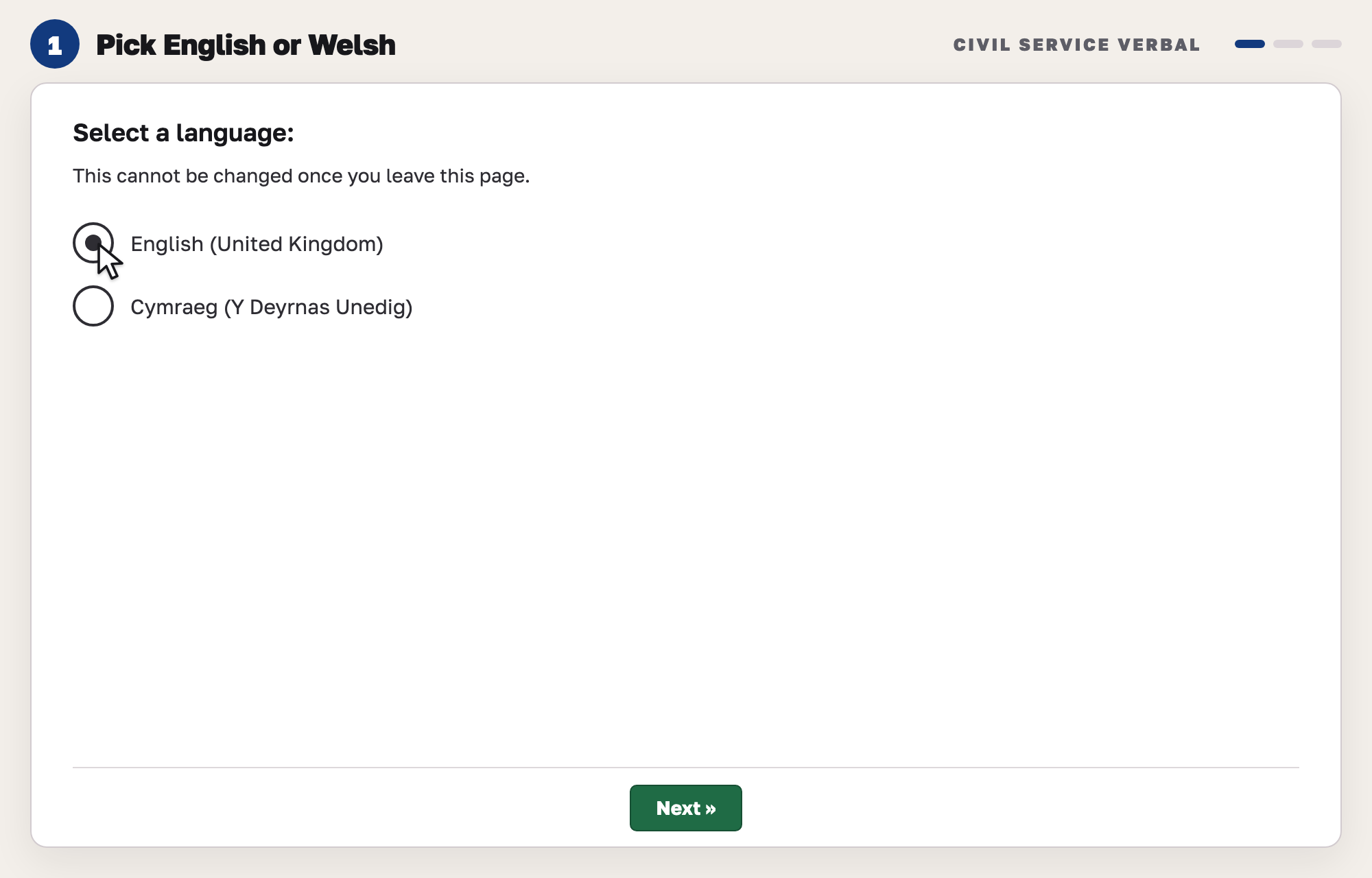
Pick English or Welsh
Choose English or Welsh at the start, because you cannot change the language once you leave this page.
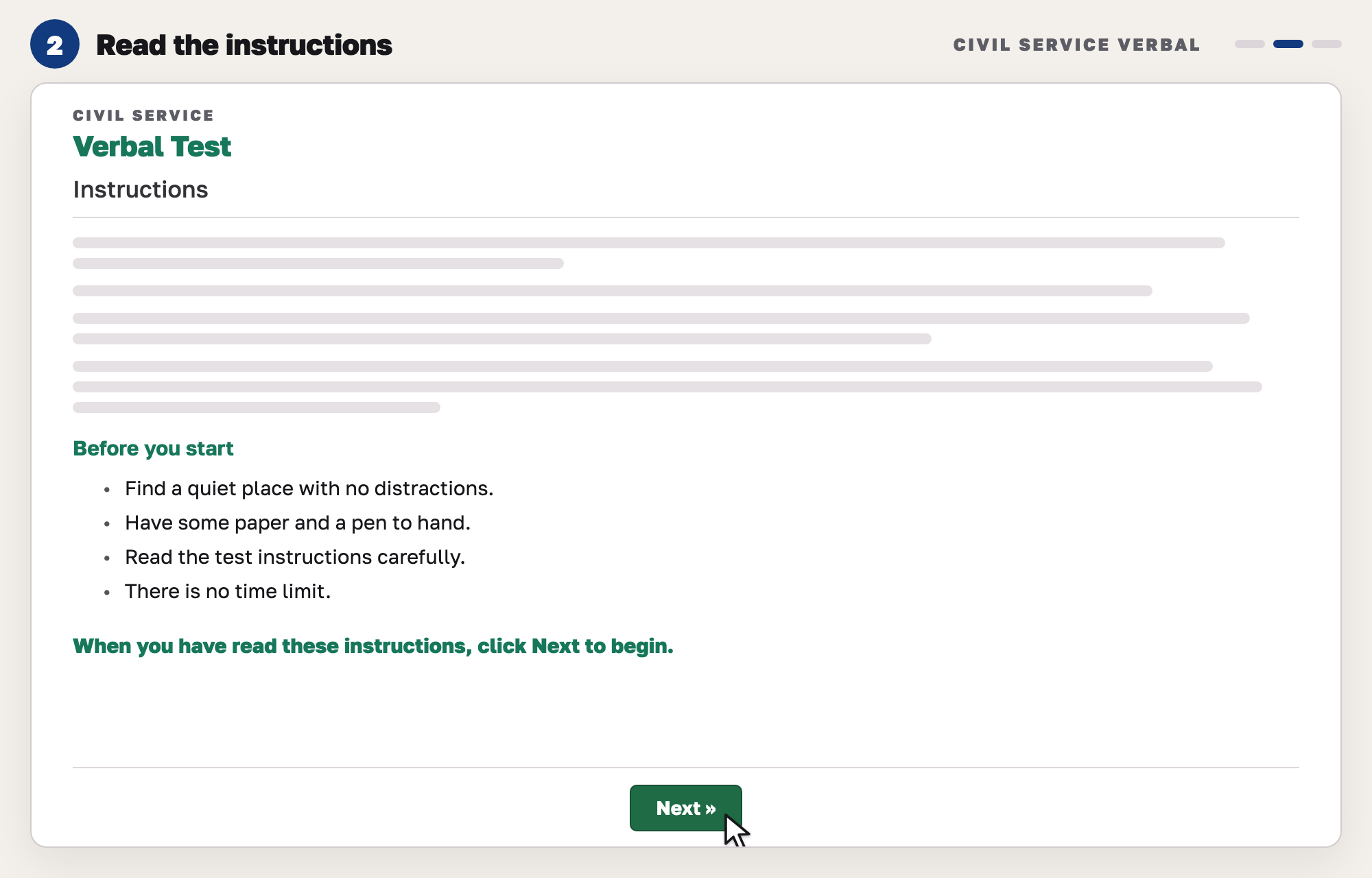
Read the instructions
Read the instructions and the short checklist, then press Next to start the questions.
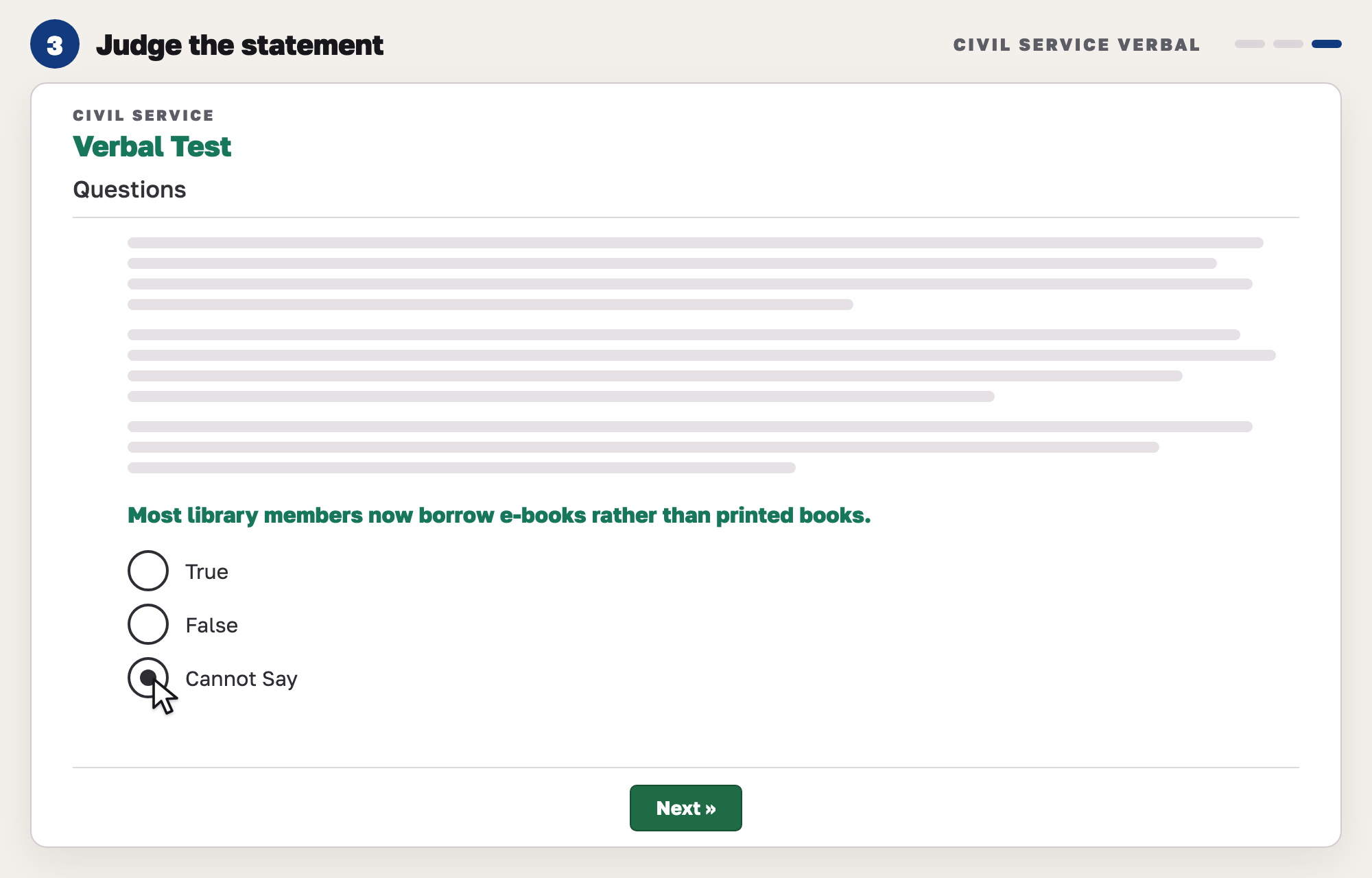
Judge the statement
Read the passage, then decide if the statement is True, False or Cannot Say, using only what the passage tells you.
Your moves
- Ignore what you know. Only the passage counts.
- You cannot skip or go back, so settle each answer first.
Numerical: Stage 1
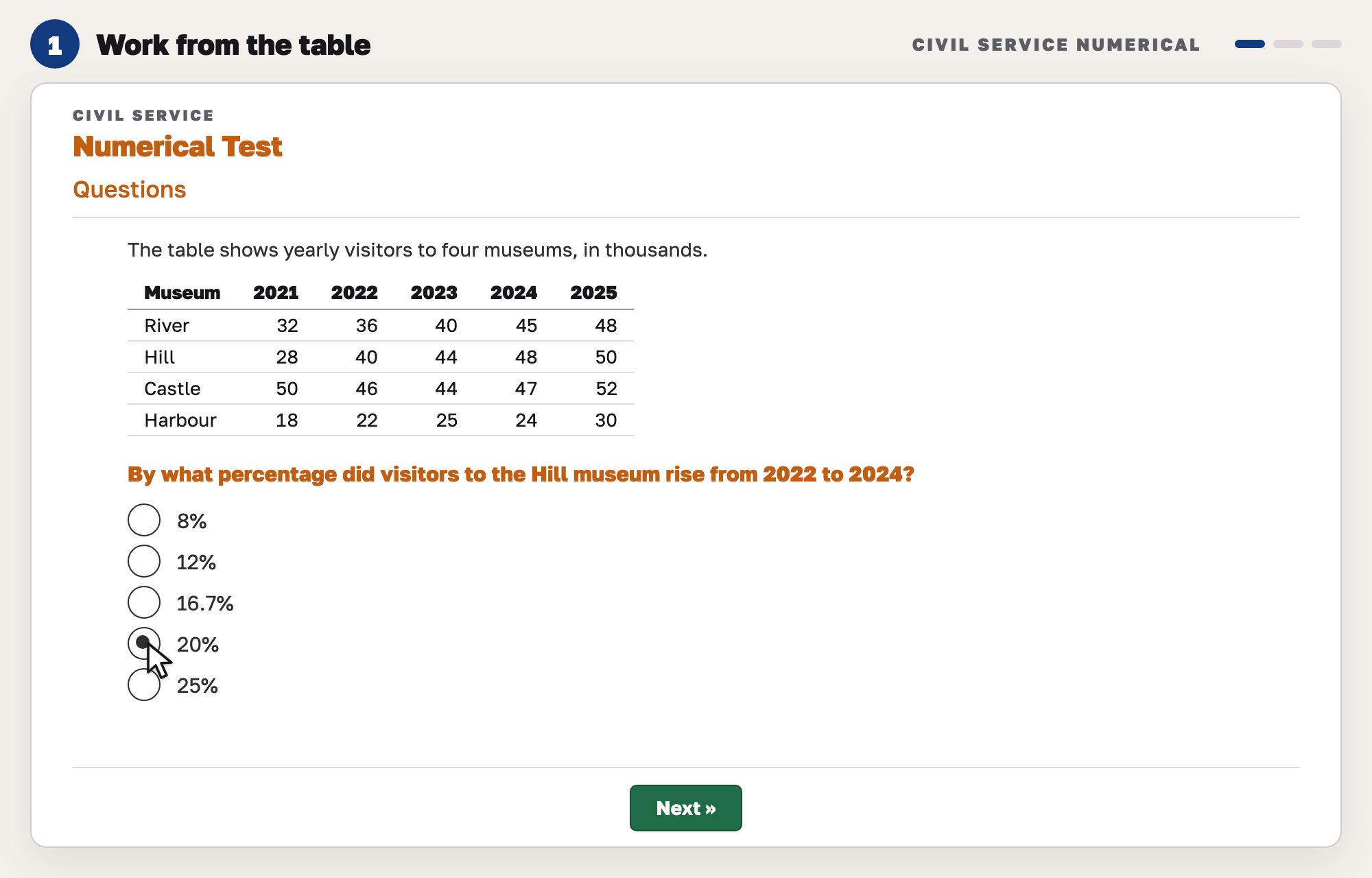
Work from the table
Work out the answer from the table and pick one of five options, with a calculator and rough paper beside you.
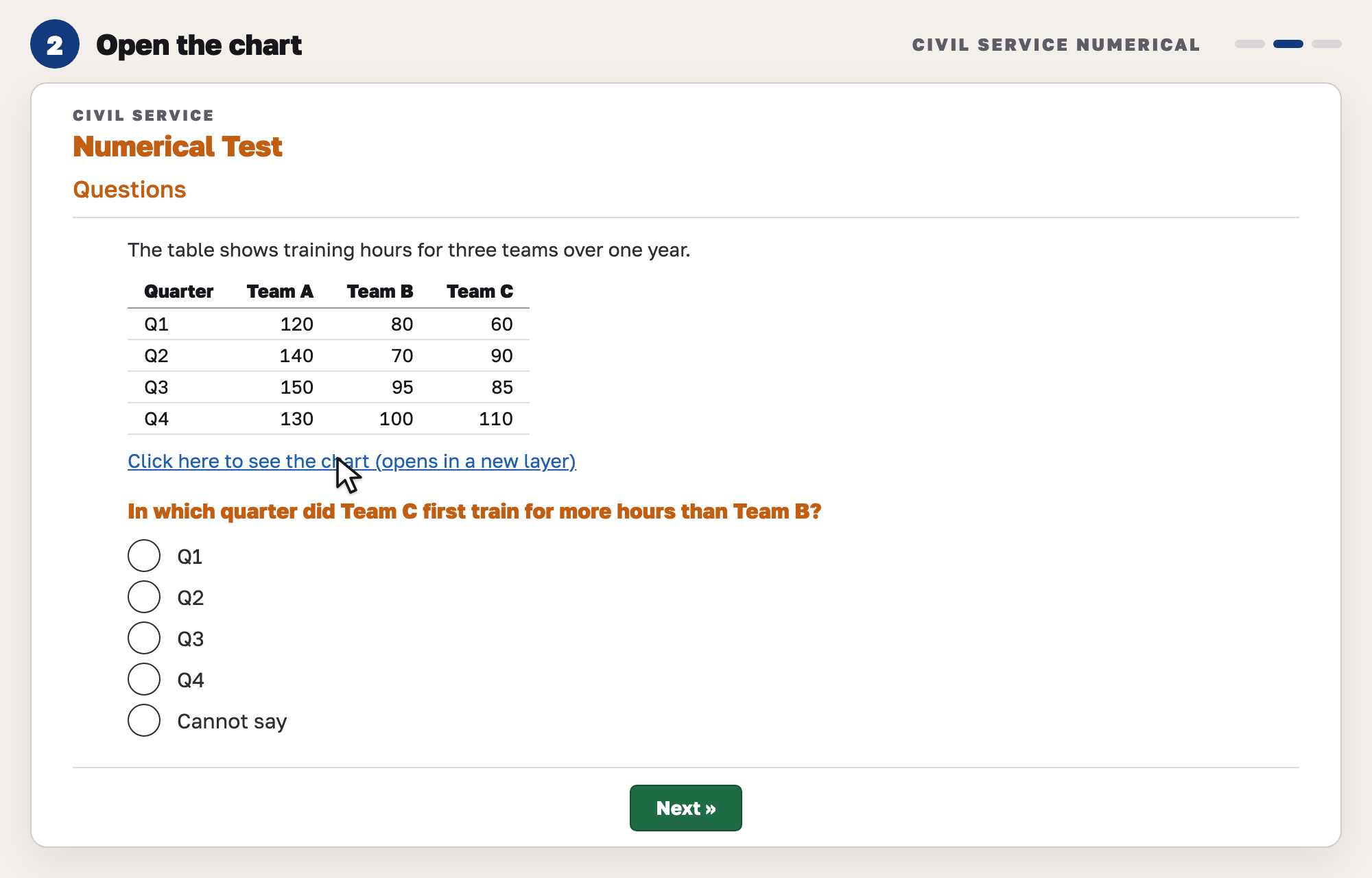
Open the chart
Some questions keep the data in a chart, so click the link under the table to open it.
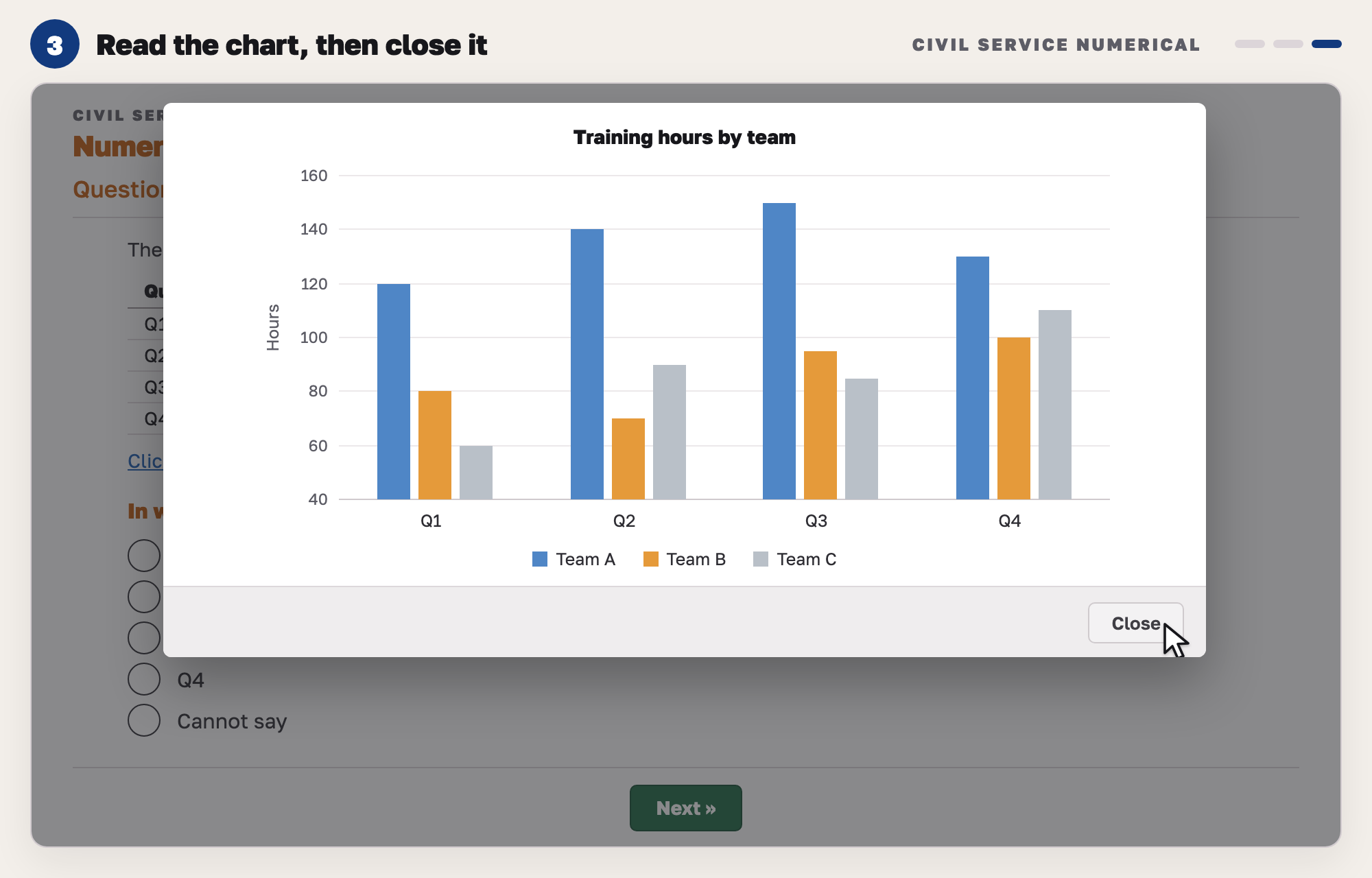
Read the chart, then close it
The chart opens over the question, so check where the axis starts before you press Close and answer.
Your moves
- There is only a Next button. Check each answer before you move on.
- Keep “rough paper, a pen and a calculator” to hand, as GOV.UK suggests.
Judgement: Stage 2
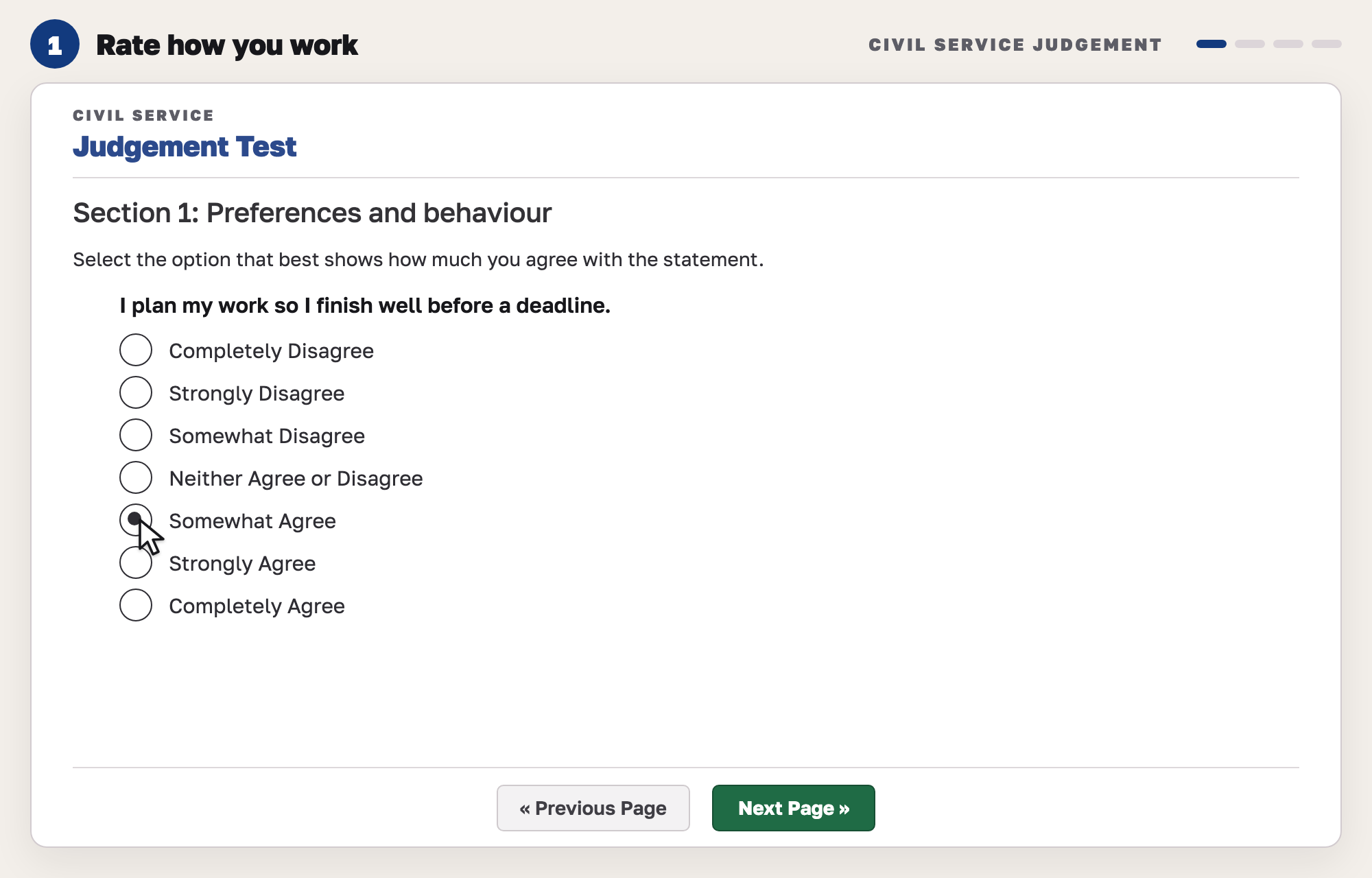
Rate how you work
In part one, rate how much you agree with each statement about how you work, and this part is 15% of your score.
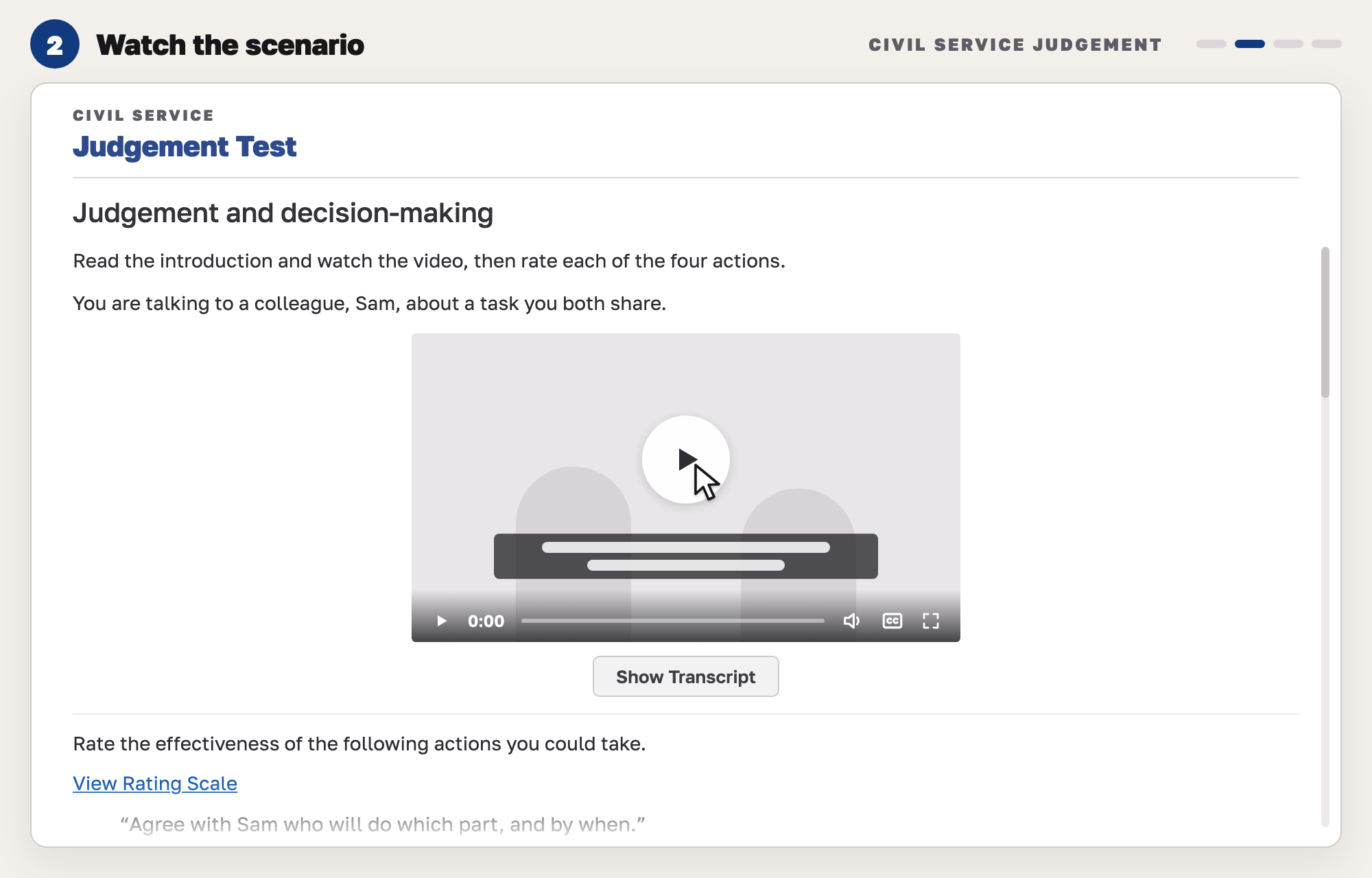
Watch the scenario
Watch the short video, with subtitles or the transcript if you want them, though some jobs use only written scenarios.
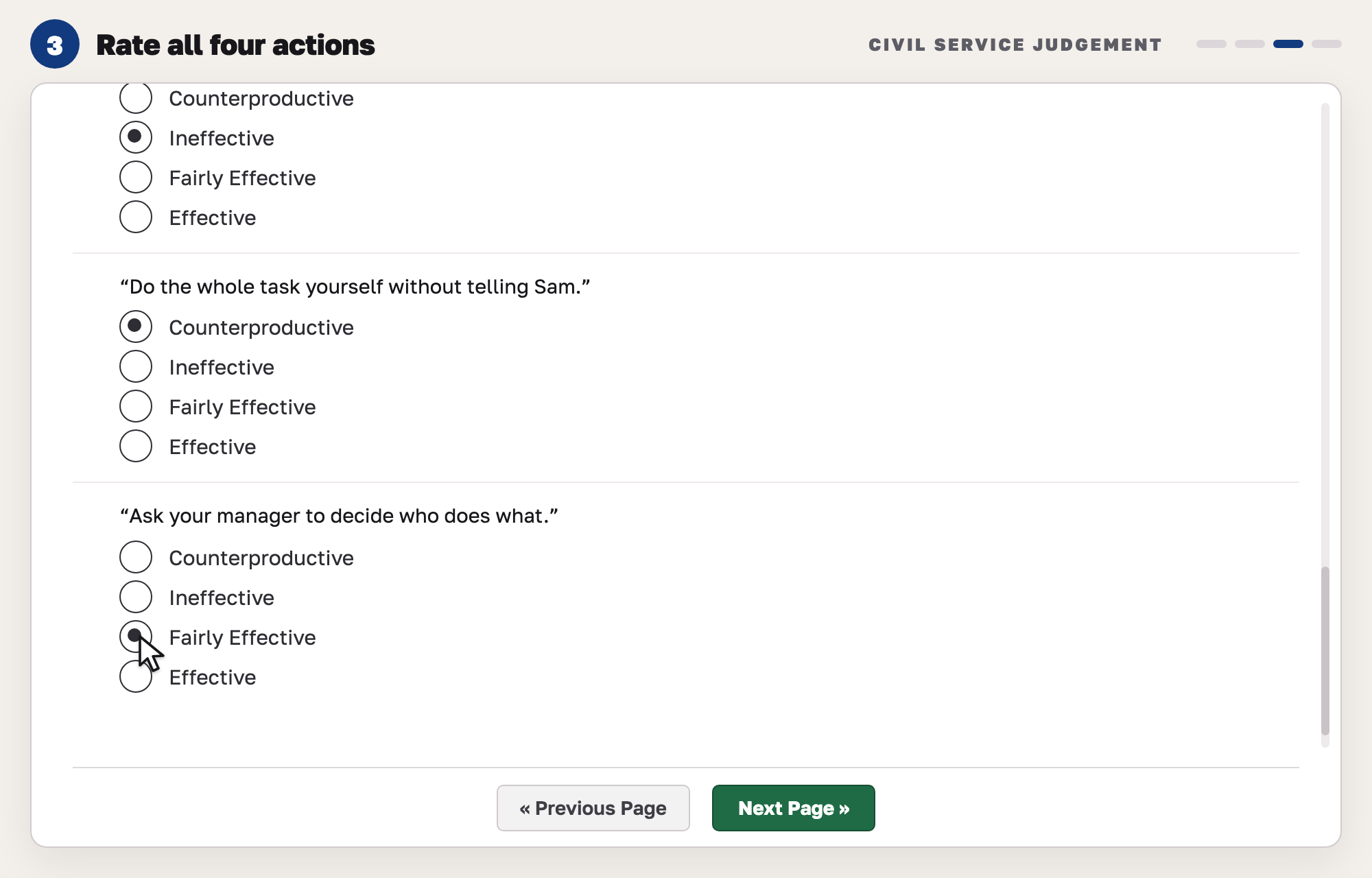
Rate all four actions
Scroll down and rate each action on its own, from Counterproductive to Effective, and two actions can share a rating.
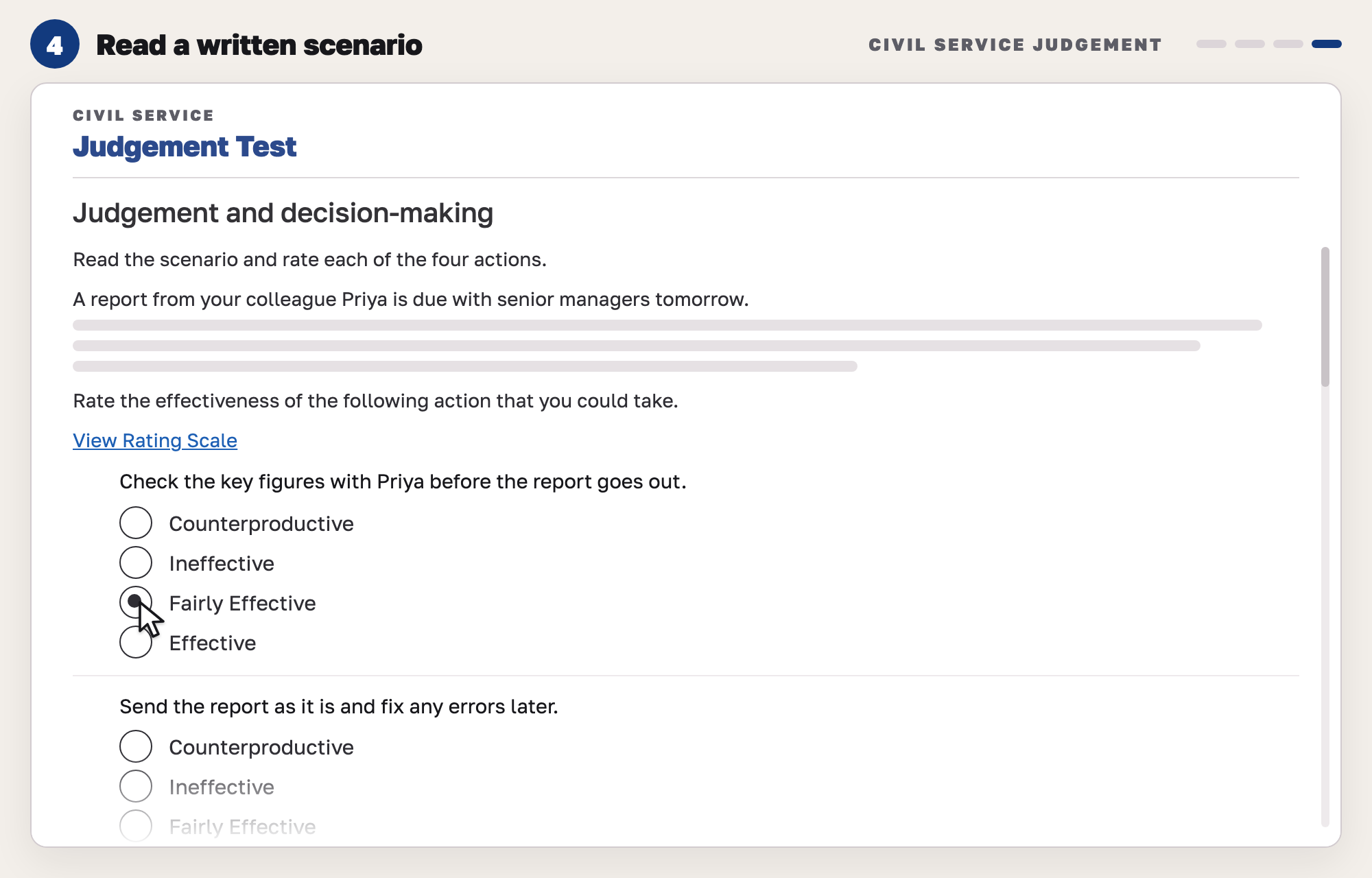
Read a written scenario
Some scenarios are written, not filmed, so read the situation and rate each action the same way.
Your moves
- Learn the four ratings: Counterproductive, Ineffective, Fairly Effective, Effective.
- If you lose access, relaunch it. You get three launches in all.
Styles: Stage 3
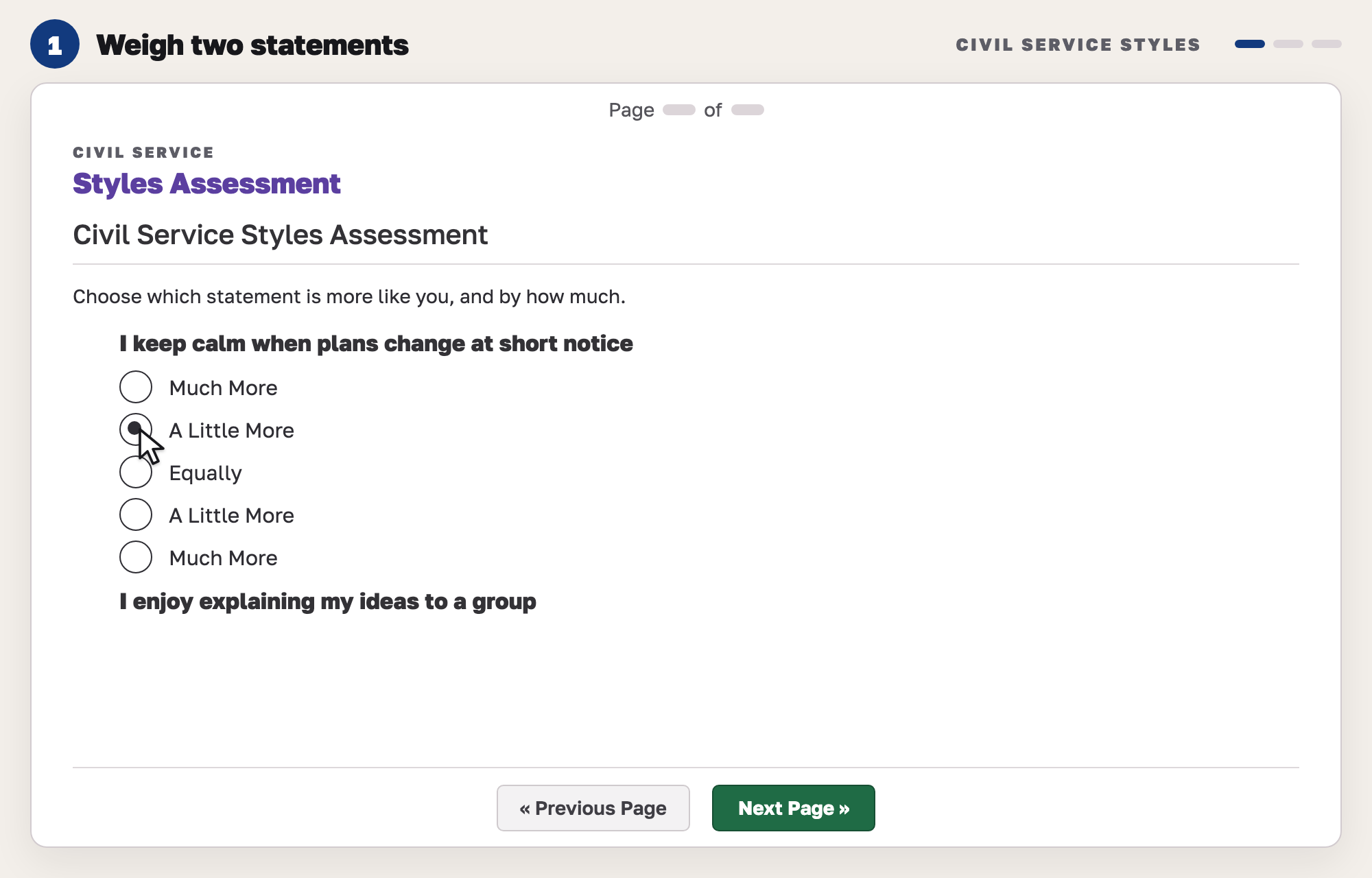
Weigh two statements
Each page shows two statements with a scale between them, so pick which one is more like you, and by how much.
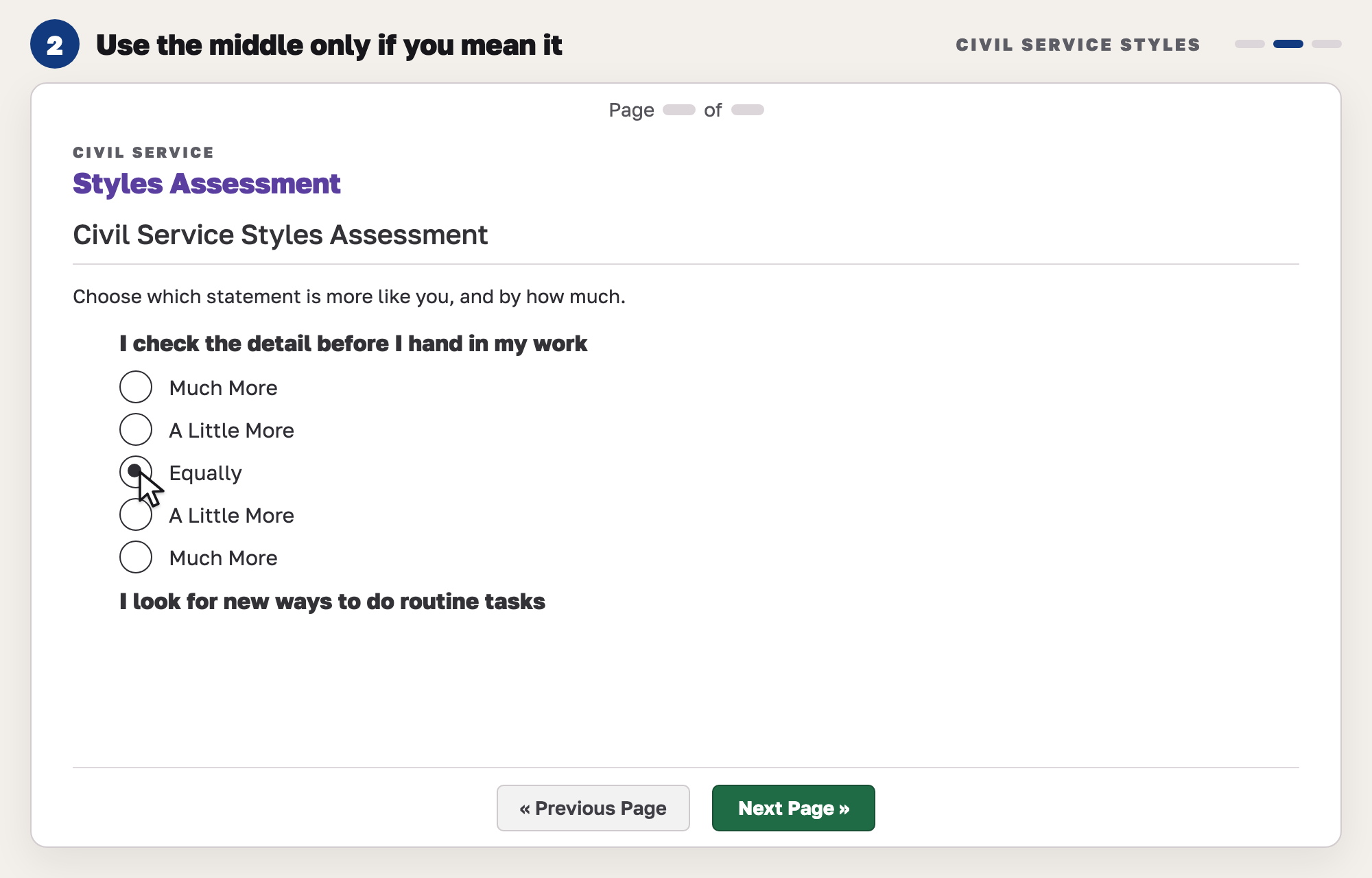
Use the middle only if you mean it
Pick Equally only when both statements fit you the same, because random or all-middle answers can stop your score being produced.
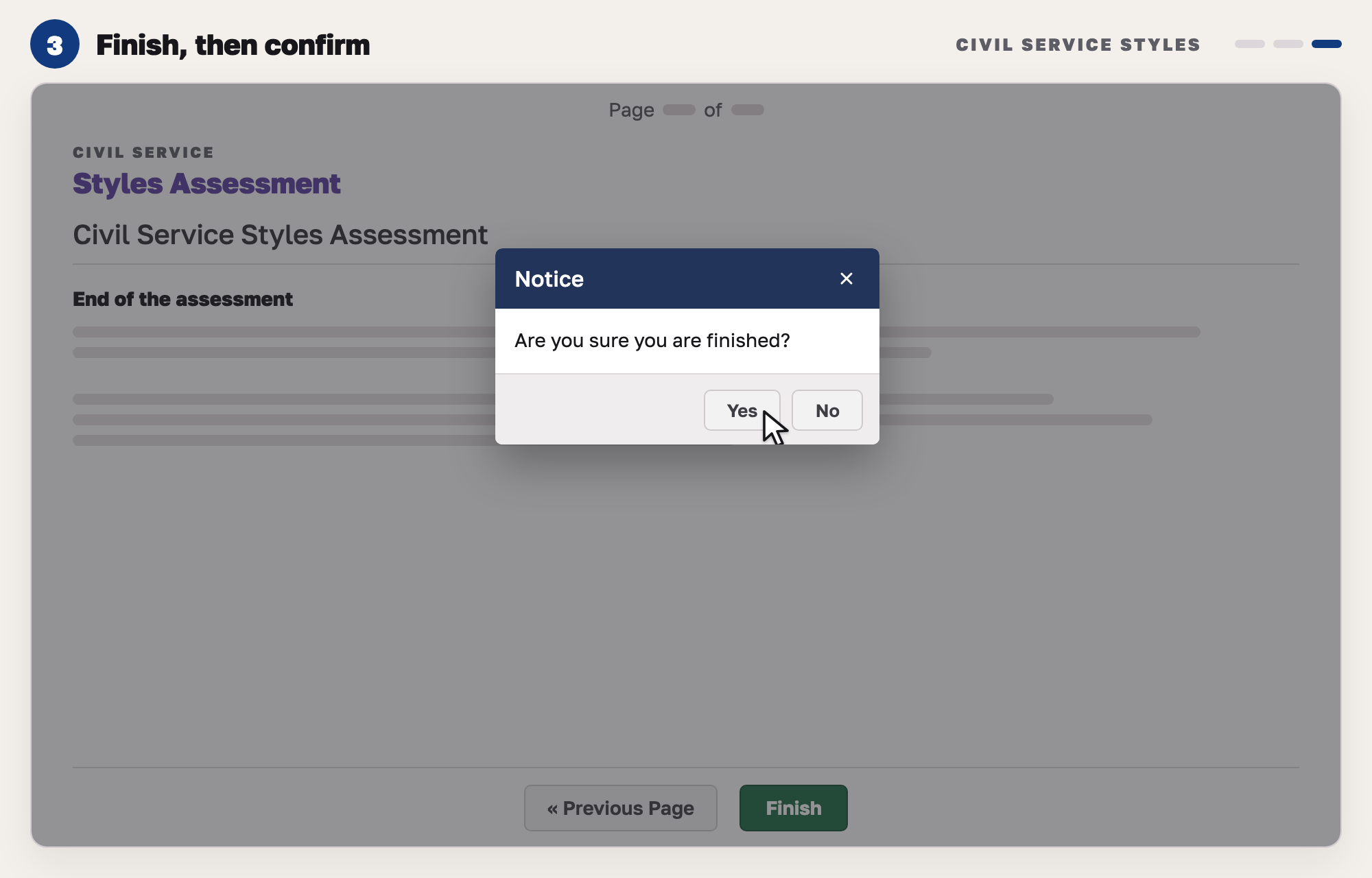
Finish, then confirm
On the last page press Finish, then Yes, because you cannot change your answers once they are submitted.
Your moves
- GOV.UK: “Don’t try to second guess what the “right” answer is”.
- Allow 45 minutes to an hour for all 276 pairs.
Our own simplified drawings of the official practice tests, not screenshots. Numbers on them are examples. The real tests may look a little different.
For more on reasoning questions, see our tips for psychometric tests.
The rules: allowed and banned
Allowed
- Rough paper, a pen and a calculator
- Taking your time, as no test is timed
- The official practice tests
- Adjustments, if you ask in your form
Banned
- AI tools, in any assessment
- Help from anyone else
- Going back in verbal and numerical
- Missing a deadline, even by minutes
From HMRC’s Candidate Guide and GOV.UK. HMRC says “all online and face-to-face assessments must be completed independently”.
Scores, retries and feedback
- Scores. Verbal and numerical scores compare you with other candidates. Some questions are unscored trials (GOV.UK).
- Styles retries. Random or all-middle answers can stop a score. You may then retake it, “up to a maximum of three attempts” (GOV.UK).
- Feedback. You get a report after the judgement test and the styles assessment, and “a full feedback report if you complete your assessment centre”.
- Progress. “Meeting the minimum standard does not automatically guarantee progression”.
Go further: the best outside help
Our own picks, checked on 14 October 2026. We are not linked to any of these sites and earn nothing from them.
From the employer
- Civil Service online testsGOV.UK · updated 27 Jan 2026 · no account neededThe official rules for each test, with links to every practice test.Free
Practise
- Verbal Test practiceCivil Service · 5 questions · no account neededThe real verbal layout, with feedback after each question.Free
- Numerical Test practiceCivil Service · 9 questions · no account neededTable and chart questions, with worked answers.Free
- Judgement Test practiceCivil Service · two sections · no account neededThe self-rating part and a video scenario, before Stage 2.Free
- Styles Assessment practiceCivil Service · 15 pairs · no account neededGet used to choosing between two statements.Free
Watch
- Guide to the Styles Assessment, 2026OTA candidate videos, linked by GOV.UK · Dec 2025 · 6:25The newest test in HMRC’s process, explained step by step.Free
Never use AI in the tests. The Civil Service bans it for “situational judgement and numerical tests” (AI and recruitment).
Next: build your speed and accuracy with our guide to psychometric and logic tests.
06/10Stages 2 to 4 · Behaviours
The behaviours HMRC scores
HMRC scores you on the nine Civil Service Behaviours. The styles assessment covers all nine. The assessment centre tests four of them again.
Online, Stages 2 and 3Judgement test and styles
How you would act · How you prefer to work
In person, Stage 4Three exercises
Four behaviours · Your own examples
HMRC’s 2027 guide lists no video interview. It does not name the four behaviours or the three exercises, so prepare all nine.
How to answer: the Civil Service’s own advice
Choose examples
Examples can come from work, volunteering or “a hobby”. The Civil Service says to pick ones that:
Fit
“clearly demonstrate the behaviour”
Are yours
Show “what you personally did”
Worked
“had positive results”, or taught you a lesson
Tell them
Civil Service Careers names the STAR format as one way to structure your examples.
Situation
Set the scene in one line.
Task
What you had to achieve.
Action
What you did, not the team.
Result
What changed, with a number.
See our guide on how to pass a job interview for more on telling a story well.
Practise: one behaviour at a time
Decisions and delivery
Practice questions written by us, not HMRC’s.
Making effective decisions
Tell me about a decision you made from mixed evidence.
Show a strong answer
- Name the options, the risks you weighed and why you chose. End with the result.
Delivering at pace
Describe a time you met a tight deadline without cutting quality.
Show a strong answer
- Show how you planned and what you dropped. Say how you checked the work.
Managing a quality service
Tell me about a time you helped someone get something right.
Show a strong answer
- Show how you found what they needed. Then how you made it clear and accurate.
Proactive
Tell me about something you fixed before anyone asked.
What they’re testing: HMRC wants people who are “proactive”.
Show a strong answer
- What you spotted, why you acted and the result. Show “what you personally did”.
People
Practice questions written by us, not HMRC’s.
Communicating and influencing
Tell me about a time you persuaded someone who disagreed.
Show a strong answer
- Show you listened first. Then the evidence you used and what changed.
Working together
Describe a time you shared work or information to help another group.
Show a strong answer
- Say who needed what, what you gave and the result for both sides.
Leadership
Tell me about a time you made a group fairer or more inclusive.
Show a strong answer
- Name what was unfair, what you changed and who it helped.
Challenging conversations
Tell me about a time you had to give someone hard news.
What they’re testing: being “comfortable with having challenging conversations”.
Show a strong answer
- Why it mattered, how you prepared, what you said and how they took it.
Change and growth
Practice questions written by us, not HMRC’s.
Changing and improving
Tell me about a process you improved.
Show a strong answer
- Show the before, your idea, the feedback you sought and the after.
Seeing the big picture
Why does tax compliance matter to the public?
Show a strong answer
- Link tax collected to public services. Then say where a tax specialist fits.
Developing self and others
Tell me about a time you learned a hard topic fast.
Show a strong answer
- How you studied, how you tested yourself and how you helped others learn it.
Resilient and adaptable
Tell me about a setback that made you change your plan.
What they’re testing: HMRC wants people who are “resilient, adaptable”.
Show a strong answer
- The setback, what you changed and the result. If it went badly, say what it taught you.
Your story bank: a worksheet to print or copy
Two STAR stories per behaviour.
| Behaviour | Story 1 | Story 2 |
|---|---|---|
| Seeing the big picture | ||
| Changing and improving | ||
| Making effective decisions | ||
| Leadership | ||
| Communicating and influencing | ||
| Working together | ||
| Developing self and others | ||
| Managing a quality service | ||
| Delivering at pace |
Go further: the best outside help
Our own picks, checked on 14 October 2026. We are not linked to any of these sites and earn nothing from them.
From the employer
- Civil Service BehavioursCivil Service Careers · no account neededThe nine behaviours in plain words, and how to pick examples.Free
- Success Profiles: Civil Service behavioursGOV.UK · updated 29 Jan 2025 · no account neededWhat each behaviour looks like at each grade.Free
- TSP trainees’ best adviceHMRC trainees, on Civil Service Careers · no account neededCurrent trainees on how they prepared.Free
Watch
- Stage 1 of the TSP: what to expectHMRC · Jan 2026 · 4:08HMRC’s Stage 1 lead on the real work, for your “why HMRC” answers.Free
Write your own examples. The Civil Service bans using AI to “inflate or invent your skills and experiences”.
07/10Stage 4 · Final
The assessment centre and your offer
A half-day assessment centre, in person, between 25 January and 19 February 2027.
Format
“three exercises and assess four key Civil Service Behaviours”. Details come with your invite.
Venues
Belfast, Cardiff, Leeds, Liverpool, Manchester, Newcastle, Portsmouth, Stirling University and Warwick University.
In person only
“Remote attendance options are not available”, and “alternative dates cannot normally be offered”.
Offers
You are “placed on a merit list and offered positions in order of merit and preferred location”.
A trainee’s advice, and the checks before you start
- Timing. One trainee says: “I remember finding the timings incredibly tight”. He adds: “it’s usually better to get in something complete than chase perfection”.
- Skills. He names “solid analytical skills” and “an ability to think and communicate clearly”.
- Checks. HMRC runs the government’s baseline security checks: identity, right to work, three years of work history and unspent convictions. It adds “a standard (or equivalent) criminal record check”.
Key dates: 2027 intake
9 Oct 2026
Applications opened
26 Oct 2026
Applications close. Submit by 11:30 GMT
26 Oct 2026
Applications were due by 11:30 GMT
28 Oct 2026
Verbal and numerical due, 11:30 GMT
28 Oct 2026
Verbal and numerical were due by 11:30 GMT
4 Nov to 10 Nov
Judgement test, closes 11:30 GMT
4 Nov to 10 Nov
Judgement test, closes 11:30 GMT
4 Nov to 10 Nov
Judgement test, was due by 11:30 GMT
18 Nov to 30 Nov
Styles assessment, closes 11:30 GMT
18 Nov to 30 Nov
Styles assessment, closes 11:30 GMT
18 Nov to 30 Nov
Styles assessment, was due by 11:30 GMT
25 Jan to 19 Feb 2027
Assessment centres, in person
25 Jan to 19 Feb 2027
Assessment centres, in person
Then
Offers by merit and office
Then
Offers by merit and office
08/10
Visa and nationality rules
HMRC cannot sponsor visas for this role. You need the right to work in the UK, and you must meet the Civil Service nationality rules.
Who can apply
UK, Irish and Commonwealth nationals with the right to work. Some EU, Swiss, EEA and Turkish nationals too. The full list is below.
Who cannot
Anyone who needs a work visa. HMRC says the role “is not eligible for Skilled Worker visa sponsorship”.
None
Visa sponsorship for this role
2 years
Graduate visa, if you apply by 31 Dec 2026
18 months
Graduate visa, from 1 Jan 2027
HMRC’s nationality list, and the Graduate visa
- Ireland and the Commonwealth. “nationals of the Republic of Ireland” and “nationals of Commonwealth countries who have the right to work in the UK”.
- EU, Switzerland and the EEA. Nationals and family “with settled or pre-settled status” under the EU Settlement Scheme, or who “have made a valid application” for it.
- Earlier leave. People with limited or indefinite leave “who were eligible to apply for EUSS on or before 31 December 2020”.
- Turkey. “Turkish nationals, and certain family members of Turkish nationals, who have accrued the right to work in the Civil Service”.
- Graduate visa. It lasts “2 years if you apply on or before 31 December 2026” and “18 months if you apply on or after 1 January 2027”. It lets you work, but “You cannot extend your Graduate visa” (GOV.UK). The programme lasts 3 to 4 years, so plan your route first.
See our guides to staying in the UK after studying and jobs in the UK for foreigners. This is general information, so check the nationality rules on GOV.UK.
09/10
Key takeaways
Before you apply
- Submit by 11:30 GMT on Monday 26 October 2026. HMRC’s guide also says 11:55pm, so the earlier time is safe.This year’s ad has closed. The deadline was set for Monday 26 October 2026.
- Finish the verbal and numerical tests by 11:30 GMT on 28 October.The verbal and numerical tests were due by 11:30 GMT on 28 October. Late tests “cannot be accepted”.
- Choose one office you can really work from. The choice stays with you.
- Do the official practice for all four Civil Service tests. They need no account.
- Build two examples for each of the nine Civil Service Behaviours.
- HMRC cannot sponsor visas. You need the right to work in the UK already.
When a scheme gives a close date, we email you a few days before it closes. Save HMRC once and the reminder is set.
Set my reminders freeFree account, no card.

10/10
Frequently asked questions
When does the HMRC Tax Specialist Programme close?
Monday 26 October 2026. HMRC’s guide gives two closing times that day, so submit by the earlier one, 11:30 GMT.This year’s ad has closed. The deadline was set for Monday 26 October 2026. Set a Civil Service Jobs alert for the next campaign. Finish the verbal and numerical tests by 11:30 GMT on 28 October.The verbal and numerical tests were due by 11:30 GMT on 28 October.
Do I need a tax or finance degree for the HMRC Tax Specialist Programme?
No. You need a 2:2 in any subject, or an equivalent Level 6 qualification, by September 2027. Civil servants who have passed probation need no degree.
What tests are in the HMRC Tax Specialist Programme process?
Four Civil Service tests. Verbal and numerical at Stage 1, the judgement test at Stage 2 and the styles assessment at Stage 3. All are online and untimed, with fixed deadlines.
Is there an interview for the HMRC Tax Specialist Programme?
HMRC’s 2027 guide lists no video interview. The final stage is a half-day assessment centre, in person, with three exercises that assess four Civil Service Behaviours.
How much does the HMRC Tax Specialist Programme pay?
HMRC publishes a minimum starting salary of £37,682, or £42,631 in London. When you finish, you move to Grade 7 at a minimum of £58,541, or £65,869 in London.
Does HMRC sponsor visas for the Tax Specialist Programme?
No. HMRC says it is “unable to provide visa sponsorship”. You need the right to work in the UK and must meet the Civil Service nationality rules.
Can I work from home on the HMRC Tax Specialist Programme?
Partly. HMRC offers “the opportunity to work remotely 2 days a week”. At least 60% of your time is in the office, and the role cannot be done entirely from home.