 By Andre Atallah, CEO of EP Advisory

Journalist (Level 6) and Junior Journalist (Level 5) · UK · September 2027 start
Not open yet · opens 3 Nov 2026Opened 3 Nov 2026 · check each ad
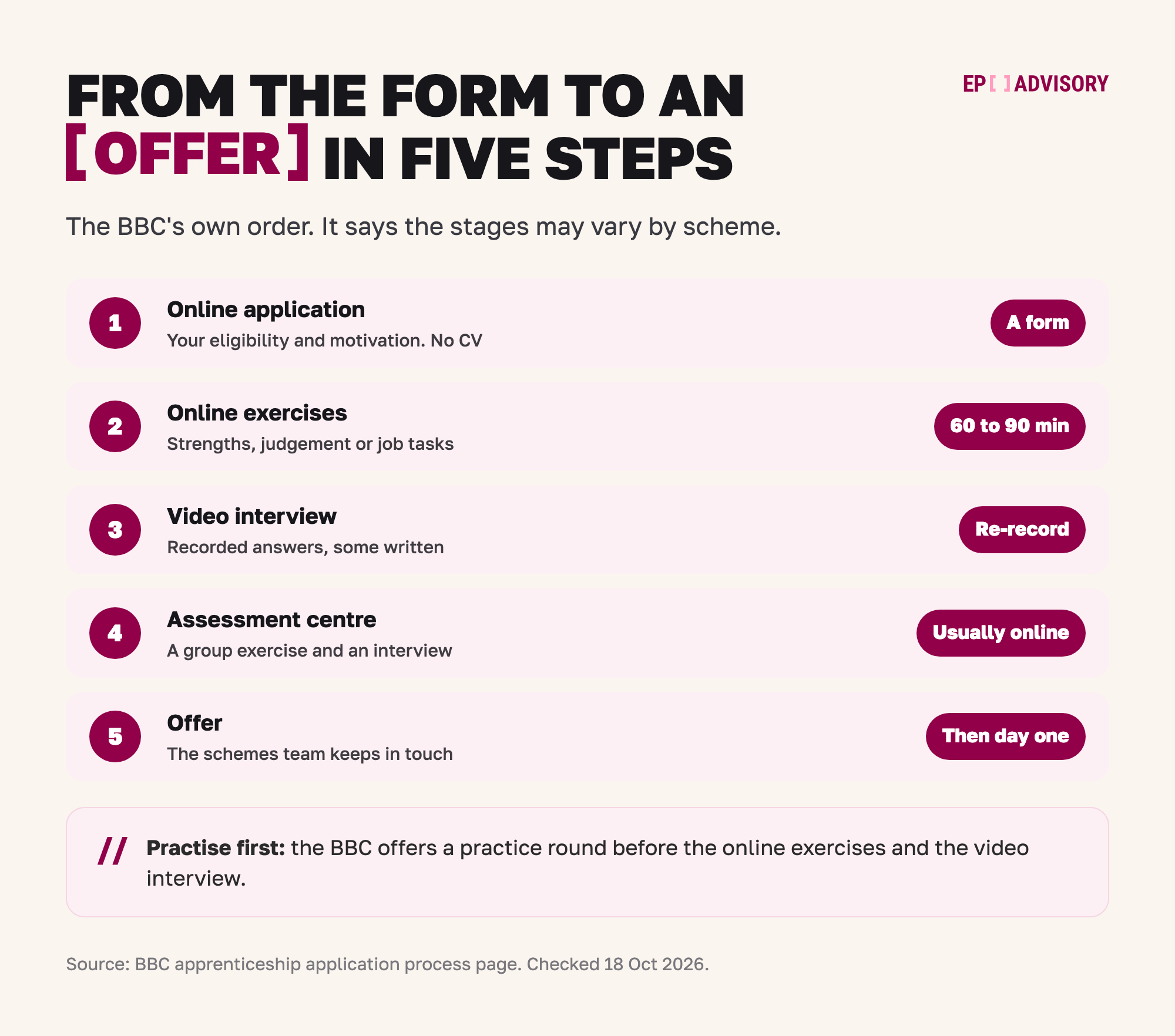
Short answer: Applications are not open yet. The BBC says its apprenticeships starting in September 2027 open on 3 November 2026. Last cycle, the journalism ads closed after about three weeks. Sign up for the BBC’s free alert and get ready now.Applications for apprenticeships starting in September 2027 opened on 3 November 2026. Each scheme’s ad gives its own closing date. Last cycle, the journalism ads closed after about three weeks, so apply early. Graduates apply for Journalist (Level 6). You fill in a form with no CV. Then come online exercises, a recorded video interview and an assessment centre.
Where are you now?
Independent guide. EP Advisory is not affiliated with the BBC.
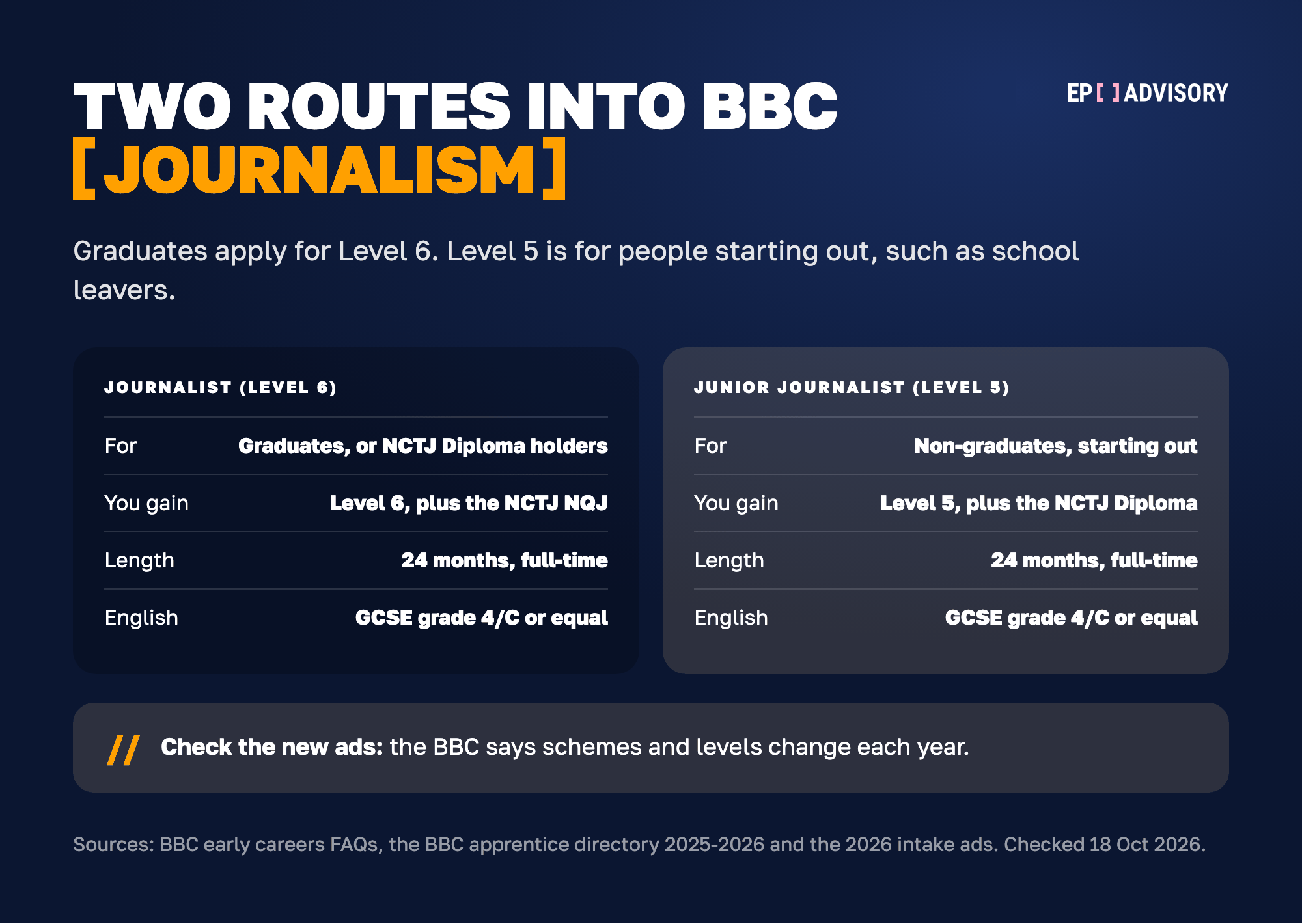
The BBC runs paid apprenticeships at Levels 2 to 7, from journalism to engineering. This page leads with journalism. Graduates apply for Journalist (Level 6). Junior Journalist (Level 5) sits beside it, for people starting out.
Looking for the BBC Journalism Trainee Scheme? That name is retired, and no current BBC page uses it.
This playbook gets you ready before the window opens, then takes you through each stage. For nearly 10 years, we’ve helped more than 5,000 professionals get hired. Want to know if your CV will pass screening in the UK? Check your CV for free: a score in 30 seconds, then a fix for each problem.
01/10
Your route to an offer
Applications are not open yet. The BBC gives 3 November 2026 as the opening date.Applications opened on 3 November 2026. Each scheme’s ad gives its own closing date, so check yours.
“Applications for our apprenticeship opportunities starting in September 2027 will open 3 November 2026.” From the BBC’s early careers page, read on 18 October 2026. Until then, each scheme page says “Applications closed”.Until then, each scheme page said “Applications closed”.
Last cycle’s window: the 2026 intake, from the BBC’s own pages
20 Oct 2025
The BBC’s page said “Applications will open again soon”
21 Oct 2025
It said “Applications are now open!”
13 Nov 2025
Journalism ads closed, after about three weeks
9 Dec 2025
Other schemes were still open
2027 intake
Opens 3 November 2026, the BBC saysOpened 3 November 2026, per the BBC
From the BBC’s early careers page, saved by the Wayback Machine on 20 October, 21 October and 9 December 2025. The close date is from the Journalist (Level 6) and Junior Journalist (Level 5) ads.
Do this now
Sign up for the BBC’s free alert. Its early careers page links a “Get notified” form for the 2027 schemes.Check your scheme’s ad. Each one gives its own closing date.
Be ready to apply in the first days.Apply early. Last cycle, journalism closed about three weeks after opening.
Get ready now
Six things to finish before you apply. Each comes from the BBC’s own pages.
One scheme, one location
You may apply to more than one scheme. But each scheme takes one location, and extra location applications are withdrawn.
Your eligibility
The right to work full-time in the UK for the whole scheme, and usually three years living in the UK. See the visa chapter.
Your English grade
The 2025-26 directory asks for GCSE English at grade 4/C or equivalent for both journalism schemes.
Your journalism, in one list
The BBC names a student paper, a radio station, blogging, vlogging and social media content.
Why the BBC, in your words
The form asks about “your motivation for applying”. Draft it now, in your own voice.
A free BBC course
The BBC links Springpod’s “The BBC and Me”. It gives you real material for your answers.
Before you apply: free help
Our own picks, checked on 18 October 2026. We are not linked to any of these sites and earn nothing from them.
From the employer
- Get notifiedBBC Careers · asks for your contact detailsThe BBC’s own alert for when the 2027 schemes open.The BBC’s own alert page for the 2027 schemes.Free
- Get In Taster DaysBBC Careers · expression of interest formTaster days run through 2026 and 2027. Most are for ages 16 to 18, some for over 18s and career changers.Free
Do
- The BBC and MeSpringpod, the BBC’s partner · free accountA short online course the BBC links itself. You get a certificate and material for your answers.Free
Pick your stage and tick each step when done. Stages are from the BBC’s pages, checked 18 October 2026. Prep times are ours.
1. Get ready and apply: opens 3 November 2026opened 3 November 2026
An online form, with no CV or cover letter. Prep 1 to 2 weeks.
2. Online exercises: about 60 to 90 minutes
Strength-based questions, judgement exercises or job tasks. Prep 2 to 3 days.
3. Video interview: recorded, re-record allowed
Recorded answers on your strengths and motivation. Prep 3 to 5 days.
4. Assessment centre: usually online
A group exercise and an interview, typically between January and April. Prep about 1 week.
Your ticks save on this device.
02/10
The schemes at a glance
Paid, full-time apprenticeships with a qualification built in. Where the BBC is silent, we say so.
3 Nov 2026
Applications open, the BBC saysApplications opened, the BBC says
£24,650+
Starting pay, up to £26,000
24 months
Both journalism schemes
No CV
An application form instead
Jan to Apr
Assessment centres, typically
No visas
No sponsorship for early careers
Journalist (Level 6): the graduate route
For people who “already hold a degree or the NCTJ Diploma in Journalism, or have some experience working in journalism”. You also study for the NCTJ National Qualification in Journalism (NQJ).
Junior Journalist (Level 5)
For people “at the beginning of their journalism journey”, such as school leavers. Last cycle’s ads said it was “aimed at non-graduates”. You study for the NCTJ Diploma.
Where these facts come from
- Pay. The BBC’s FAQs say “current starting salaries ranging from £24,650 to £26,000”. “If your main work base is in London or the Channel Islands, you’ll also receive an additional living allowance.” The BBC does not say which scheme pays which figure. Compare salaries in the UK.
- Length. The 2026 intake journalism ads said “Full-time for 24 months”. The 2025-26 directory says Level 6 journalism is “currently 24 months”.
- Bars. For Level 6, you must not have completed any NQJ elements. For Level 5, you must not hold or be studying for the NCTJ Diploma, or a journalism qualification at that level or higher.
- Benefits. 25 days’ holiday and a defined pension scheme, per the BBC’s 2025-26 apprentice directory. Its cover says it “REFLECTS LAST YEAR’S SCHEMES”.
- Locations. The 2026 intake ads we saw included London, Bristol, Gloucester, Plymouth, Southampton and Shetland. The full 2027 list is not published yet.
The one graduate-only scheme last cycle: Trainee Solicitor (Level 7)
In the 2026 intake ad, this scheme was “aimed at graduates”. The 2027 schemes are listed when applications open on 3 November 2026, so check whether it runs again.Applications for the 2027 schemes opened on 3 November 2026, so check whether it runs again.
- Places. “five graduates”, for 30 months in BBC Legal at Broadcasting House, London.
- Pay. “Salary: £33,000 (+£5,441 London Weighting)”, in the 2026 intake ad.
- Entry. A qualifying law degree, or another degree plus the GDL (the law conversion course). “graduated 2021 or later”, “2:1 or above”, A levels “AAB or above”.
- Study. SQE 1 and 2 (the solicitor exams) with BPP. Four days in the team and one day studying each week.
From the Trainee Solicitor ad, saved by the Wayback Machine on 4 November 2025. It closed on 13 November 2025.
Every other scheme the BBC lists todayEvery other scheme the BBC listed before opening
Each scheme page said “Applications closed” on 18 October 2026. The list looks like last cycle’s.That list looked like last cycle’s, so check the 2027 ads. The BBC says “schemes and levels change each year”.
- Business. Administration Assistant (Level 2), Multi-Channel Marketer (Level 3), Accounting Finance Manager (Level 6).
- Digital. AI and Automation Practitioner (Level 4), Data Analyst (Level 4), Data Scientist (Level 6), Software Engineer (Level 6).
- Engineering. Broadcast and Media Systems Technical Operator (Level 3), Post-Production Technical Operator (Level 4), Broadcast and Media Systems Engineer (Level 6).
- Production. Production Assistant (Level 3), Content Creator (Level 3), Junior Production Coordinator (Level 4).
03/10
What the BBC looks for
The BBC looks for potential, not a long record. Last cycle’s journalism ads said “We’re not focused on your qualifications; instead, we look for potential”.
Curiosity
“Intensely curious about people and about what is going on in the world”. Show it by: a story you chased yourself.
Ideas
“Brimming with creative ideas”. Show it by: two story ideas from your own area.
Writing
“Excited by writing”. Show it by: pieces you wrote, published anywhere.
Flexible and motivated
“Flexible, motivated”. Show it by: a time plans changed and you kept going.
Storytelling in many forms
Level 6 is for those who show “storytelling and journalistic skills in a variety of ways”. Show it by: print, audio, video or social.
Unheard voices
Level 6 wants someone keen “to tell stories from the unheard, or under-represented, voices in our society”. Show it by: one such story.
The first four traits are from the 2026 intake Junior Journalist ad. The fifth is from the BBC’s FAQs, the sixth from its 2025-26 directory. Across all stages, the BBC wants to see “how you demonstrate the BBC’s values and behaviours”.
04/10Stage 1 · Apply
How to apply
Applications open on 3 November 2026, the BBC says. Each scheme’s ad then shows its own closing date.Applications opened on 3 November 2026. Each scheme’s ad shows its own closing date, so check yours.
1
Research the schemes
Find the one that fits your stage
2
Pick one location
One per scheme
3
Fill the form
Eligibility and motivation, no CV
4
Check before it closes
You can update until the close
The BBC’s rules on closing dates, schemes and locations
- Closing dates. “All of our apprenticeship schemes have a closing date”. “Applications are usually open for several weeks”. The BBC “cannot accept applications once the closing date has passed.”
- More than one scheme. Allowed, if you meet each one’s rules and can explain why. But “you can only submit one application per apprenticeship scheme in each recruitment cycle”.
- One location. “You can only apply to one location per apprenticeship”. Extra location applications “will be withdrawn”.
- Updating. If you answered a question wrongly, “you can update your application before the vacancy closing date”.
From the BBC’s early careers FAQs, read on 18 October 2026.
Your form: do and don’t
Do
“I run my student radio’s news bulletin, and I want to learn to verify stories against the clock”
The form asks about your motivation. Tie it to real work you have done.
Don’t
“I have always been passionate about the BBC”
It could come from anyone. The BBC asks that your application “reflects your own voice and tells your story”.
The BBC asks for no CV. It judges “the information you provide within the application form itself”. Our CV achievement examples still help you turn what you did into a clear result. Getting ready to apply for jobs in the UK? Check your CV for free: see it the way a recruiter does, then fix each problem.
Save BBC and over 2,000 other UK schemes to one free calendar. See what closes next and what you have applied to.
Track my schemes freeFree account, no card.
Missed a closing date, or not selected? Your options
- Next year. You can re-apply. The BBC says many apprentices “were successful on their second or even third application”.
- Another scheme. You may apply to more than one scheme, once each per cycle.
- Get In Taster Days. They run “Throughout 2026 and 2027”, with some “for over 18s, career changers and school groups” (Get In). The BBC offers no ad-hoc work experience or shadowing.
- Trainee schemes outside this cycle. In 2026 the BBC ran Future Voices EXTEND at the World Service and the BBC Open Music Trainee. Watch the BBC job board for new ones.
- BBC Extend. Positive-action roles for disabled applicants, through the year (BBC Extend).
- Webinars. “Throughout the year”, the BBC runs webinars on its apprenticeships, with current apprentices.
05/10Stage 2 · Online exercises
The online exercises
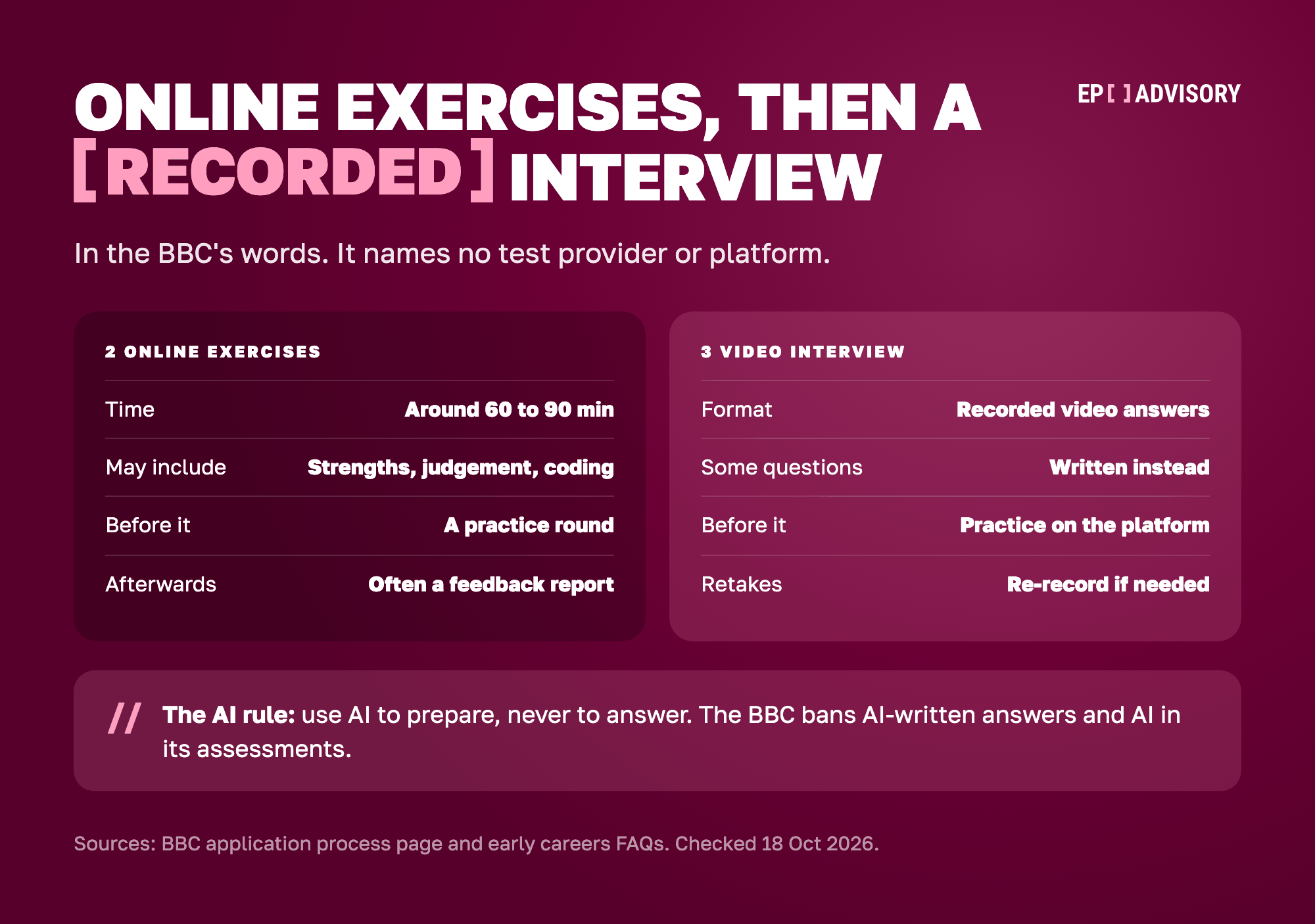
Step 2 is an online interactive assessment of around 60 to 90 minutes. The BBC names no test provider.
60 to 90
Minutes, says the BBC
Practice
A practice round comes first
Report
Feedback for many assessments
“Depending on the role, this may include strength-based questions, situational judgement exercises, or job-specific assessments such as coding tasks.” The BBC adds: “We’re not worried about past experience; we want to hear about your strengths and your skills.” Your results decide who moves on (application process page).
Strength-based questions
These usually ask what you enjoy and do well. Answer as you really are.
Situational judgement
These usually show work situations and ask how you would respond.
Job-specific tasks
The BBC gives “coding tasks” as an example. Your invite says what your scheme uses.
Practice, then feedback
“you’ll be given the opportunity to practise before completing the assessment.”
The AI rules: prepare with it, never answer with it
Allowed
- Proofreading and grammar checks
- Practising common questions
- Explaining terms in the job description
- Researching careers and the industry
Banned
- Submitting AI-written answers
- AI to complete online assessments
- AI to impersonate your voice or image
- AI to invent achievements or experience
From the BBC’s AI rules on its application process page: “Use AI to support your preparation, not to create your application for you.”
Go further: the best outside help
Our own picks, checked on 18 October 2026. We are not linked to any of these sites and earn nothing from them.
From the employer
- Application processBBC Careers · no account neededThe BBC’s own five stages, what the online exercises cover and its rules on using AI.Free
Read
- Psychometric testsProspects · July 2025 · no account neededIts situational judgement section fits the BBC’s judgement exercises.Free
- Strength-based interviewsProspects · July 2025 · no account neededThe BBC asks strength-based questions. This guide shows what they are and how to prepare.Free
Skip paid “BBC test” packs. The BBC names no test provider, so these packs are guessing at the format.
Next: see how judgement and reasoning tests work across employers in our guide to psychometric and logic tests.
06/10Stage 3 · Video interview
The video interview
Step 3 is a recorded video interview for most schemes. You can practise first and re-record your answers.
“you’ll record responses to a series of questions. Some questions may require a written response instead.” The BBC wants to learn about “you, your strengths, and your motivation”. “All responses will be reviewed by members of the team and assessed against the criteria for the role.”
Some schemes “may not require a video interview”. The number of questions, the time per answer and the platform are not published.
How to answer: a strength, then a story
The BBC’s video says it wants to hear what you like doing, what you’re good at, and what drives you. Our frame for each answer:
The strength
Name it in one line.
A real moment
Where you used it, and when.
What you did
Your part, not the team’s.
Why it fits
How it helps in this scheme.
Follow-ups to rehearse
What did you enjoy most?What would you change?Why this scheme?Why this location?
See also our guides on how to pass a job interview and the toughest interview questions.
Practise: prompts built on the BBC’s words
Strengths and motivation
The BBC publishes no question list. These are our own prompts, each built on a line from the BBC’s pages.
Motivation
Why do you want a BBC apprenticeship?
What they’re testing: “your motivation for applying”, which both the form and step 3 ask about.
Show a strong answer
- Start with one real moment that drew you to this work.
- Name what this scheme gives you, such as the NCTJ qualification.
- End with what you would bring to your chosen location.
Strengths
What are you good at, and how do you know?
What they’re testing: your strengths, which the BBC says matter more than “past experience”.
Show a strong answer
- Pick two strengths, not five.
- Prove each with a short, specific example.
- Say what others noticed, or what changed because of you.
Drive
What motivates you, outside your studies?
What they’re testing: what drives you, which the BBC’s video names.
Show a strong answer
- Choose something you do without being asked.
- Show how you kept it going over time.
- Link it to the energy the scheme needs.
Flexibility
Tell us about a time your plans changed at short notice.
What they’re testing: being “Flexible, motivated”, from last cycle’s ads.
Show a strong answer
- Set the scene in one line.
- Say what you changed, and how fast.
- Close with the result and what you learned.
Journalism
Our own prompts for the journalism schemes, built on the traits in the BBC’s ads and directory.
Curiosity
Which news story caught your eye this week, and why?
What they’re testing: being “Intensely curious about people and about what is going on in the world”.
Show a strong answer
- Pick a story you followed beyond the headline.
- Say who it affects and what is still unknown.
- Add the question you would ask next.
Ideas
Give us a story idea for your local BBC station.
What they’re testing: being “Brimming with creative ideas”.
Show a strong answer
- Name the story in one sentence.
- Say why it matters to local people now.
- Say who you would talk to first.
Storytelling
Tell us about something you have written, recorded or posted.
What they’re testing: “storytelling and journalistic skills in a variety of ways”.
Show a strong answer
- Name the piece, where it ran and who it reached.
- Explain one choice you made, and why.
- Say what you would do better now.
Voices
Whose story is not being told where you live?
What they’re testing: stories “from the unheard, or under-represented, voices in our society”.
Show a strong answer
- Name the group and why they go unheard.
- Say how you would earn their trust.
- Keep it respectful and specific.
Your story bank: a worksheet to print or copy
Two stories for each trait the BBC names, each with a strength and a real moment.
| Trait | Story 1 | Story 2 |
|---|---|---|
| Curiosity | ||
| Ideas | ||
| Writing | ||
| Flexible and motivated | ||
| Storytelling in many forms | ||
| Unheard voices |
Go further: the best outside help
Our own picks, checked on 18 October 2026. We are not linked to any of these sites and earn nothing from them.
Read
- Video interview tipsProspects · June 2025 · no account neededThe BBC’s third stage is a recorded video interview. This guide covers the recorded kind.Free
- Assessment centresProspects · June 2025 · no account neededCovers the group exercise and interview the BBC uses. The BBC’s are usually online, not in person.Free
From the employer
- Early careers FAQsBBC Careers · no account neededStraight answers on locations, closing dates, visas and when assessment centres run.Free
07/10Stage 4 · Final
Assessment centre and offer
The final stage is usually a virtual assessment centre. The BBC says these “typically take place between January and April.”
Usually online
“usually a virtual assessment centre”. The BBC’s video says some “could be in person”.
A group exercise and an interview
“a range of activities, such as a group exercise and an interview”.
A task first, or one interview
Some schemes set “a pre-assessment task”. Others use “a standalone virtual interview”.
Meet the BBC
“You’ll also have the chance to meet BBC colleagues and ask any questions”.
The offer
The schemes team keeps in touch until your first day. You can connect with others in your scheme.
From the BBC’s application process page and FAQs, 18 October 2026. Group size, length and interview questions are not published.
What last cycle’s offers depended on
- A skill scan. The 2026 intake ads made offers “subject to you undergoing and meeting the requirements of a skill scan process with the BBC nominated training provider”.
- Checks. References and the right to work, plus safeguarding and social media checks where relevant.
- Moving. Relocation support for “a limited number of apprentices each year”.
When things happen: the September 2027 intake
3 Nov 2026
Opening date, per the BBC
3 Nov 2026
Opening date, per the BBC
Jan to Apr 2027
Assessment centres, typically
Sep 2027
Schemes start
Sep 2027
Schemes started
08/10
Visa sponsorship
The BBC cannot sponsor visas for its apprenticeships. Our reading: if you would need a visa, including a Graduate visa, these schemes are most likely not open to you.
The BBC’s FAQs, read on 18 October 2026, say “the BBC cannot provide visa sponsorship for early careers roles, including apprenticeships.” Student or Graduate visa holders “are unlikely to be eligible for a BBC apprenticeship unless you meet one of the exceptions outlined in the government’s apprenticeship funding rules.”
Residence, right to work and the Graduate visa
- Residence. The BBC says the rules “typically include having lived in the UK continuously for at least three years before the apprenticeship start date”. See the apprenticeship funding rules.
- Right to work. “you must have the legal right to work full-time in the UK for the entire duration of the programme”. See how to prove your right to work.
- Graduate visa. It lasts “2 years if you apply on or before 31 December 2026” and “18 months if you apply on or after 1 January 2027” (GOV.UK). The journalism schemes run 24 months.
Need a sponsor? See our guides to UK jobs for foreigners and staying in the UK after studying. This is general information, so check GOV.UK.
09/10
Key takeaways
Before you apply
- The BBC says its September 2027 apprenticeships open on 3 November 2026.The BBC’s September 2027 apprenticeships opened on 3 November 2026. Check each ad’s closing date.
- Last cycle’s journalism ads closed on 13 November 2025, about three weeks after opening.
- Graduates apply for Journalist (Level 6). Junior Journalist (Level 5) is for people starting out.
- You fill in a form with no CV, for one location per scheme.
- Then come online exercises of 60 to 90 minutes, a recorded video interview and an assessment centre.
- The BBC cannot sponsor visas and usually asks for three years of UK residence.
When a scheme gives a close date, we email you a few days before it closes. Save BBC once and the reminder is set.
Set my reminders freeFree account, no card.

10/10
Frequently asked questions
When do BBC apprenticeships open for 2027?
The BBC says applications for its apprenticeships starting in September 2027 open on 3 November 2026. Each scheme’s ad then gives its own closing date.Applications for BBC apprenticeships starting in September 2027 opened on 3 November 2026. Each scheme’s ad gives its own closing date, so check yours. Last cycle, the journalism ads closed on 13 November 2025.
Is there still a BBC Journalism Trainee Scheme?
No current BBC page uses that name. BBC journalism entry is now two apprenticeships: Journalist (Level 6), the route for graduates, and Junior Journalist (Level 5).
I have a degree. Which BBC journalism scheme should I apply for?
Journalist (Level 6). The BBC says it suits people who already hold a degree or the NCTJ Diploma in Journalism, or have some journalism experience. Last cycle’s Junior Journalist ads said that scheme was aimed at non-graduates.
How much do BBC apprenticeships pay?
The BBC says current starting salaries range from £24,650 to £26,000. If your main work base is in London or the Channel Islands, you also get an additional living allowance.
Do I need a CV or cover letter for a BBC apprenticeship?
No. You fill in an application form on the BBC careers portal. The BBC says a CV or cover letter will not be reviewed.
What are the BBC online exercises?
An online interactive assessment of around 60 to 90 minutes. Depending on the scheme, it may include strength-based questions, situational judgement exercises or job tasks such as coding. You can practise first.
Does the BBC sponsor visas for apprenticeships?
No. The BBC says it cannot provide visa sponsorship for early careers roles. It says Student and Graduate visa holders are unlikely to be eligible. It also asks for three years of UK residence before the start.