 By Andre Atallah, CEO of EP Advisory
Some questions are meant to be uncomfortable. The interviewer knows there is no perfect answer. What they are really testing is whether you can stay composed and tell a compelling story under pressure. Good news: that is a skill, and it is more learnable than the “right answer” you are hunting for.
Below are the techniques we actually coach, which go well beyond the standard “use the STAR method” advice.
Raise the stakes: the move almost nobody makes
The first one or two sentences of any story answer have one job: to make the listener care. You do that by raising the stakes, which really means showing the cost of failure. What would have collapsed if you had not stepped in?
Think of it like buying a car. “I bought a car” gets a shrug. “I bought a brand-new Mercedes” gets interest. Same event, different stakes. So if a project was worth £100,000, lead with what a failure would have cost the business, not just the budget line. If the deadline was tight, make the interviewer feel how tight, and what would have broken if you had missed it. Do not invent facts. Do bring the real stakes to the front and make them vivid. Without that, even a strong story lands flat.
The three levels of every answer
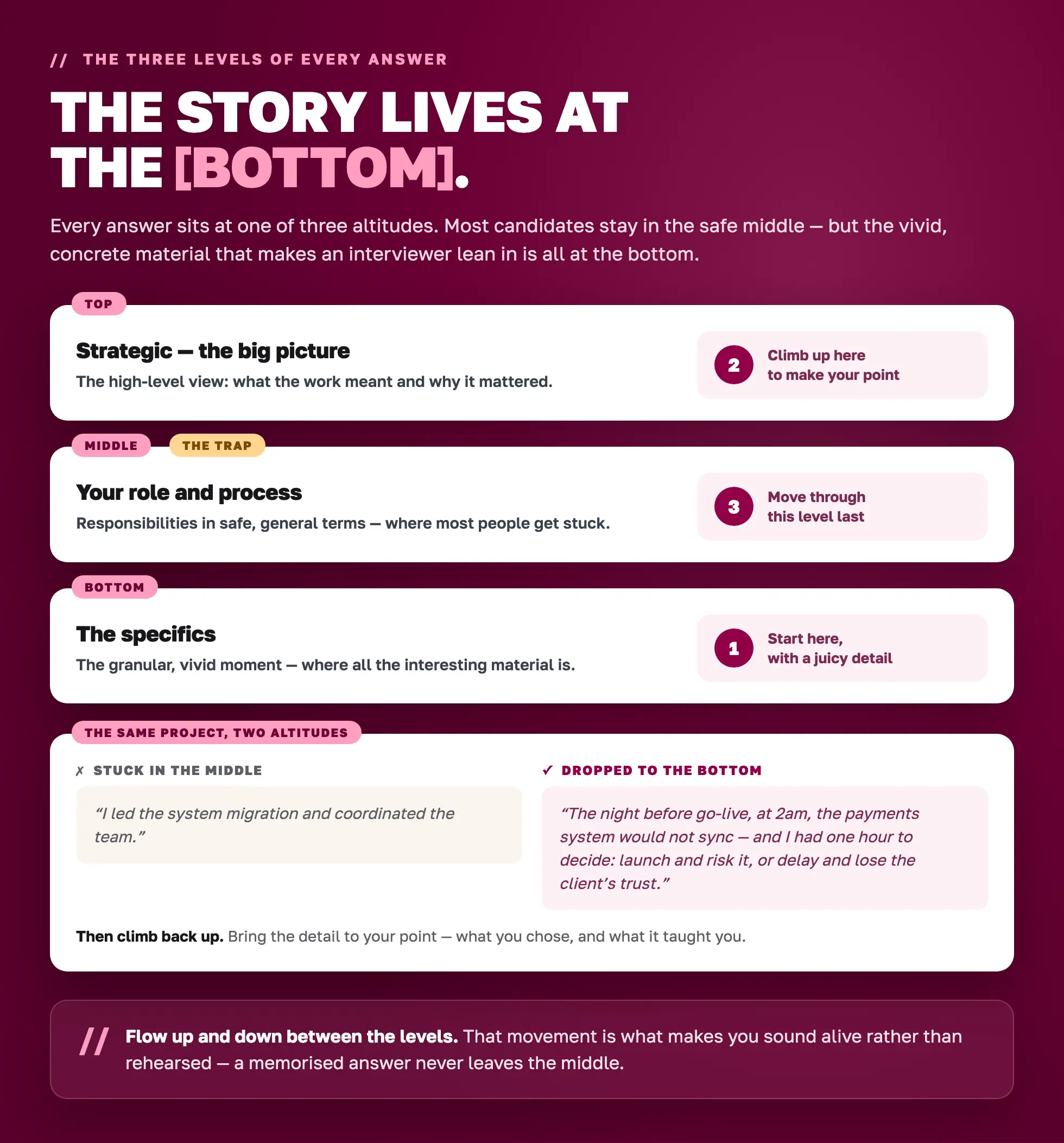
Every answer lives at one of three altitudes. The top is strategic and high-level. The middle is your role and process. The bottom is the granular, specific detail, and that is where all the interesting material is.
Most people get stuck in the middle. They describe their responsibilities in safe, general terms and never drop down to the specifics that make a story real. Do the opposite. Start with a juicy detail at the bottom, bring it back up to the point, then move through the middle. Flowing up and down between the levels is what makes you sound alive rather than rehearsed.
Here is the difference in practice. Middle level: “I led the system migration and coordinated the team.” Bottom level: “The night before go-live, at 2am, the payments system would not sync, and I had one hour to decide: launch and risk it, or delay and lose the client’s trust.” Same project, but the second version has the interviewer leaning in. Then you climb back up to the point: what you chose, and what it taught you.
Build a model, do not memorise a script
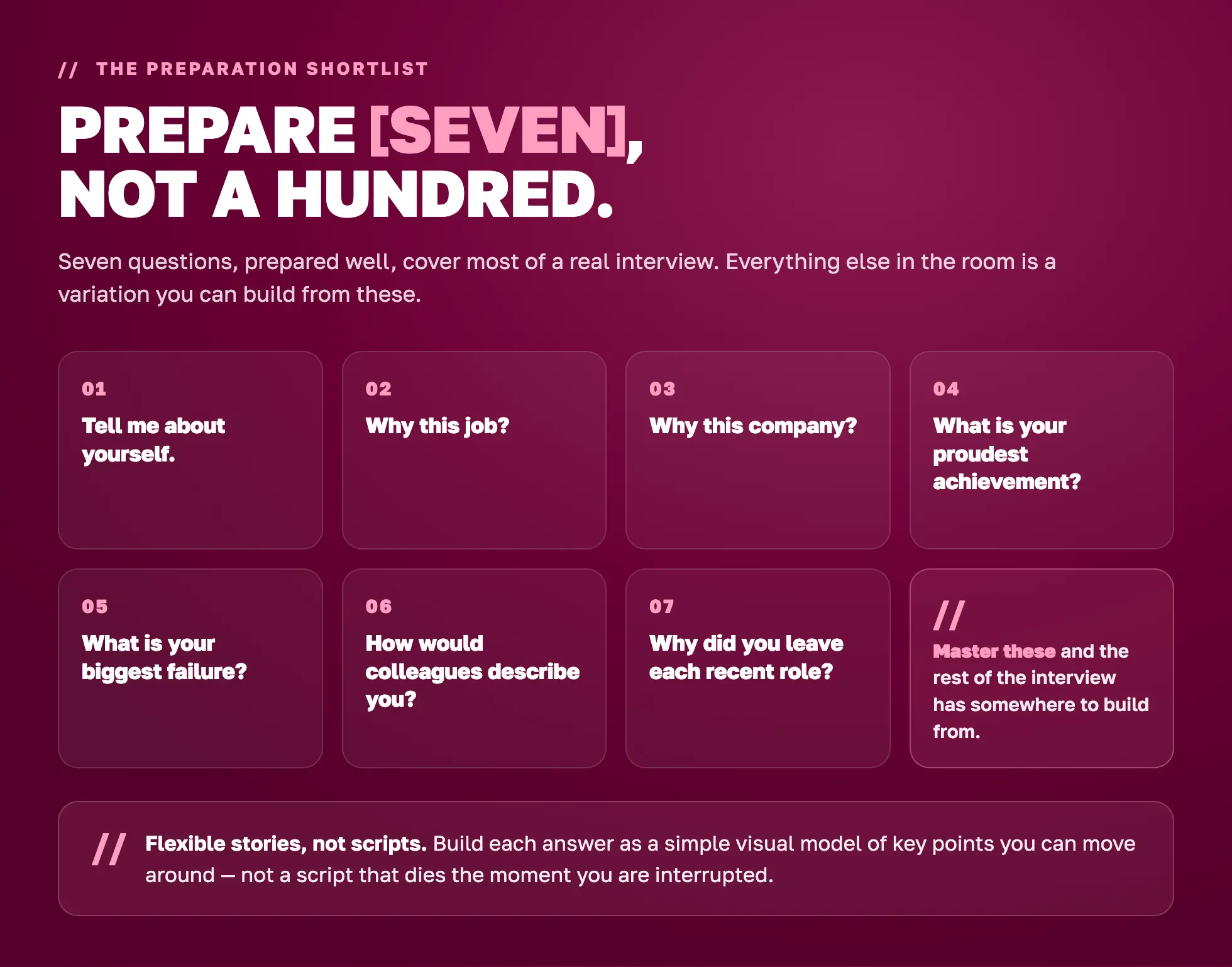
A memorised answer dies the moment you are interrupted, and it sounds flat by the third telling. Instead, build a simple visual map of your key points for each core story, with shapes or colours if it helps. Then you are not reciting; you are moving around a picture.
The payoff is freshness. Every time you tell it, you pull slightly different pieces, so it never sounds stale. And if the interviewer cuts in, you just point yourself at another part of the map and carry on. Recall becomes spatial, not word-for-word.
Finish strong: the ending beats the opening
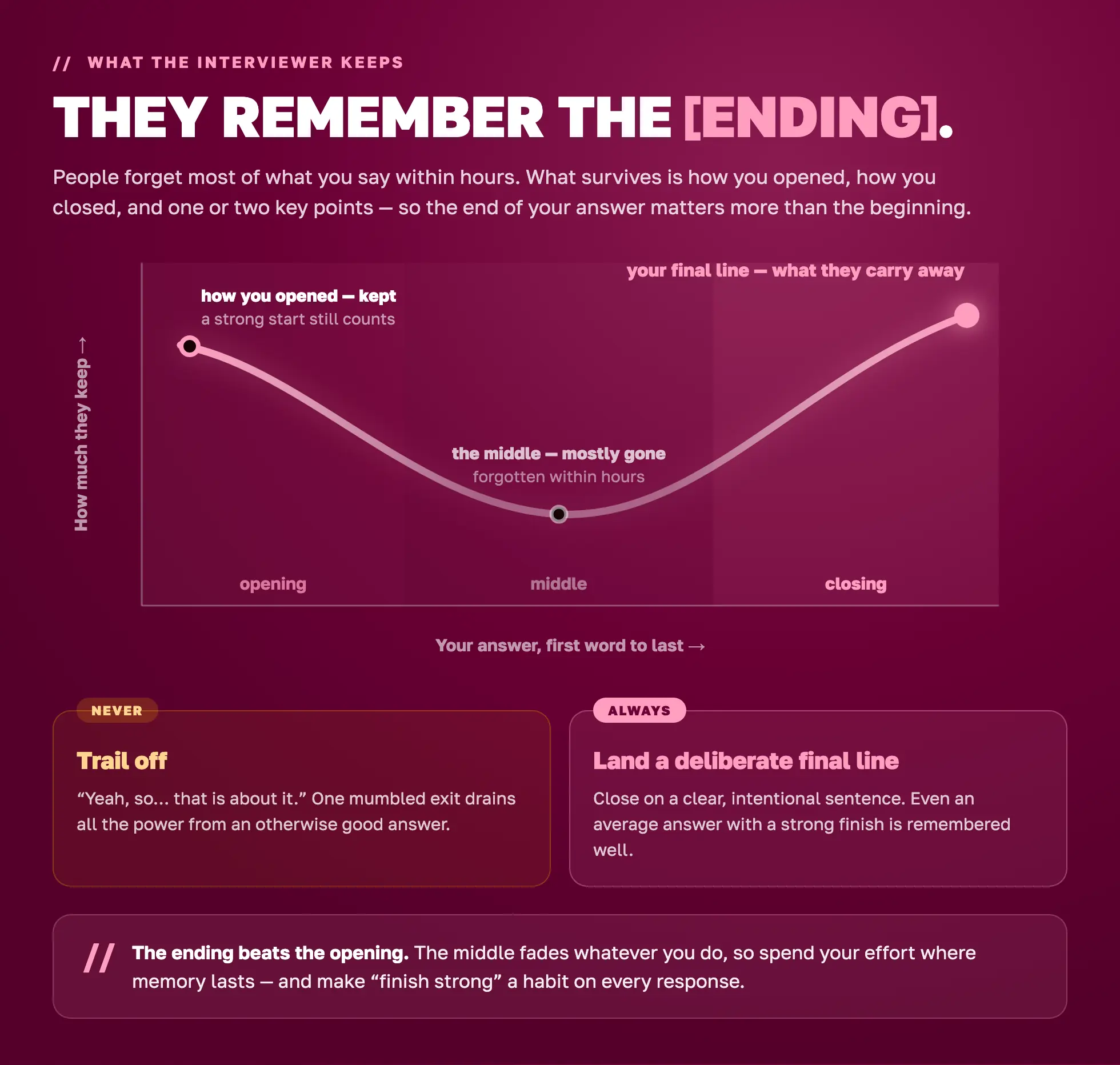
People forget most of what you say within hours. What sticks is how you opened, how you closed, and one or two key points. So the end of your answer matters more than the beginning.
Never trail off with “yeah, so, that is about it.” It drains all the power from a good answer. Land a clear, deliberate final line instead. Even an average answer with a strong finish is remembered well. Make “finish strong” a habit on every response.
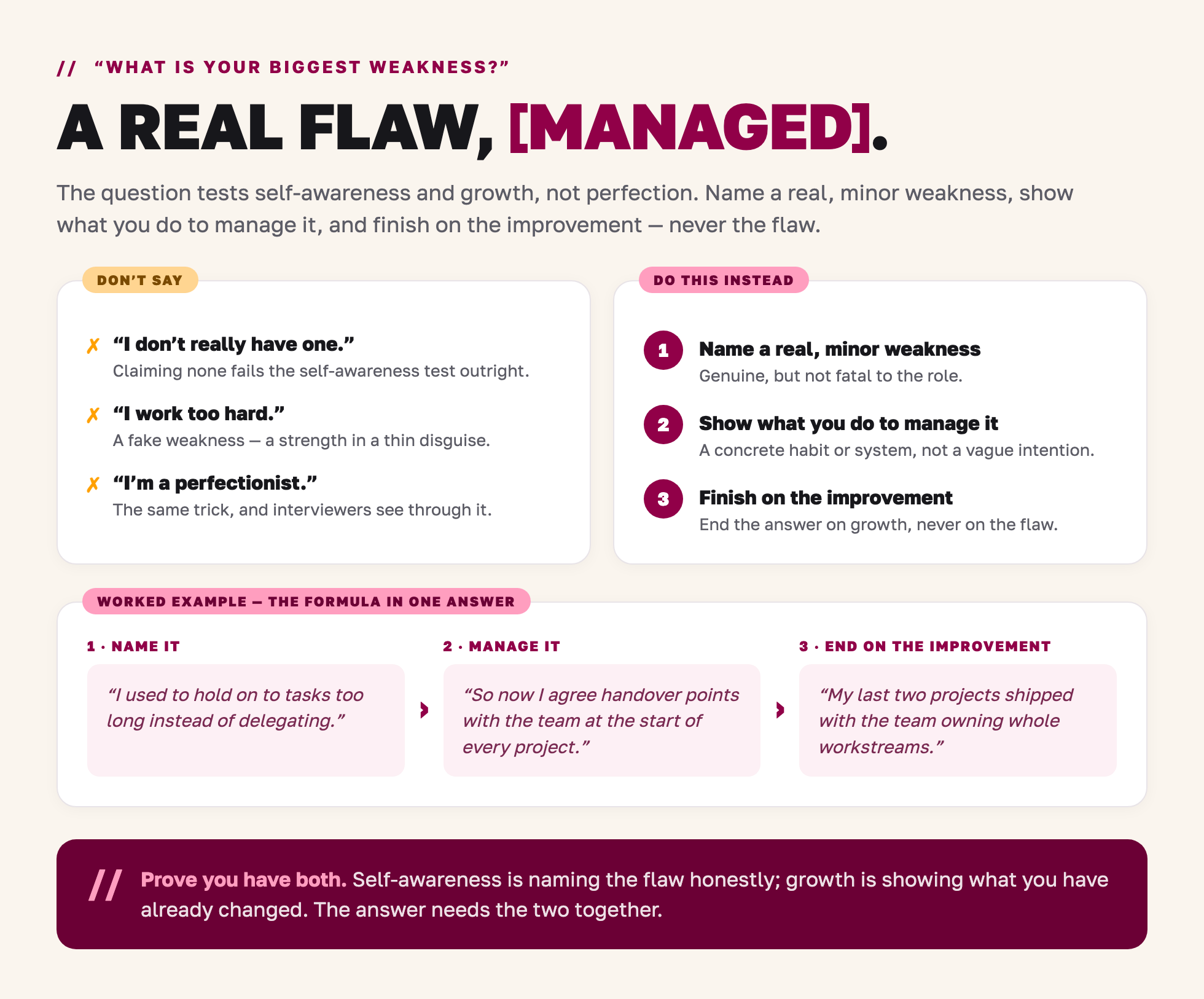
“What is your biggest weakness?”
Do not claim you have none, and do not use a fake weakness like “I work too hard.” Name a real, minor one, then show what you do to manage it. The question tests self-awareness and growth, so prove you have both, and finish on the improvement, not the flaw.
“Why are you leaving your job?”
Picture your career as a car that must keep accelerating: 20, 30, 40, 50 miles per hour. Every move should feel like moving forward, never backward. So give a positive, forward-looking reason. The timeline does not matter as long as the story is strong. The quiet message you want to leave is that opportunities came looking for you.
“Tell me about a time you failed”
They genuinely want a real failure, but it must resolve well. The rule is simple: you can lose the battle, but you must win the war. Own your part, then finish with what you learned and changed. Admitting a total, unresolved failure kills the employer’s interest. Never end with “and that is why I left the role.”
“Why should we hire you?”
This is your pitch. Match two or three strengths directly to what the role needs, each with a quick, specific example. Then close by framing the interview as two-way: you are excited to see if you are right for them, and if they are right for you. That single line signals a serious professional who knows their own worth.
The seven questions worth preparing
You do not need a hundred scripts. Prepare seven questions well and you cover most of a real interview: tell me about yourself, why this job, why this company, your proudest achievement, your biggest failure, how colleagues would describe you, and why you left each recent role. Master these, and the rest of the interview has somewhere to build from.
Your answer-building plan

Do not try to perfect all seven answers at once. Build them in stages, and give each stage a few sessions before moving on.
- Stage 1: build the models. Pick your seven questions. For each, sketch a simple visual map of the key points, with shapes or colours. No scripts, no memorising.
- Stage 2: one rep at a time. Answer one question on camera, watch it back, and reflect before doing another. Resist blasting through all seven. Sit in the silence when you have nothing strong to say, because that discomfort is where the training happens.
- Stage 3: add the technique. Once the answers flow, drill the two moves on each: raise the stakes in the opening, and finish strong at the close.
- Stage 4: handle pressure. Have someone interrupt you mid-answer, so you practise pausing and pointing yourself at another part of the model instead of losing your place.
Summary and FAQs on tough interview questions
Raise the stakes, drop to the specifics, finish strong, and treat the whole thing as a conversation rather than a test. Prepare the seven core questions as flexible stories, not scripts, and the hardest questions become the ones where you pull ahead.
Want to rehearse these under real pressure with someone who will push you? Use our free consultant picker tool for a mock interview. See also calming interview nerves, negotiating salary, and the full guide to passing a job interview abroad.