 By Andre Atallah, CEO of EP Advisory

Short answer: for the same job, US gross pay is usually higher. Across nine professional jobs, the US median is about 1.1 to 2.1 times the UK median. But at the same gross pay, take-home is close. Income tax and National Insurance take 24.4% of £60,000 in London. Federal, payroll, state and city tax take 26.3% of $80,000 in New York City. A UK job also adds 28 days’ paid holiday, an employer pension and NHS care.
In a UK vs US salary comparison, the UK offer letter usually shows the smaller number. That does not have to mean a worse deal. At the same gross salary, London leaves you with about as much as New York City, and UK law adds paid holiday and a pension.
This guide gives you official 2026 figures: nine jobs side by side, London against New York, two take-home calculations and a 5-step method to judge a UK offer.
For nearly 10 years, we’ve helped more than 5,000 professionals find jobs abroad. Want to know if your CV will pass screening in the UK? Check your CV for free: a score in 30 seconds, then a fix for each problem.
UK vs US salary: the gap is real, and smaller than it looks
US gross pay is higher for most professional jobs. Tax and the package close much of the difference.
Three facts shape every comparison on this page:
- The gross gap depends on your field. US secondary teachers earn about 1.1 times their UK peers. US lawyers earn about 2.1 times. Most jobs sit between 1.3 and 1.7.
- Take-home at the same gross is close. In our two worked examples, London deducts slightly less than New York City at both salary levels.
- The package is bigger in the UK. Paid holiday and a workplace pension with an employer contribution are legal minimums. NHS care starts when your visa starts.
Every dollar figure here uses $1.3419 to £1, at ECB rates of 2 November 2026. A 10-cent move in the pound changes the dollar value of £60,000 by $6,000, so convert again on the day you compare.
For UK average pay by region, age and sector, see our guide to salaries in the UK.
UK vs US salary by job: 9 professions compared
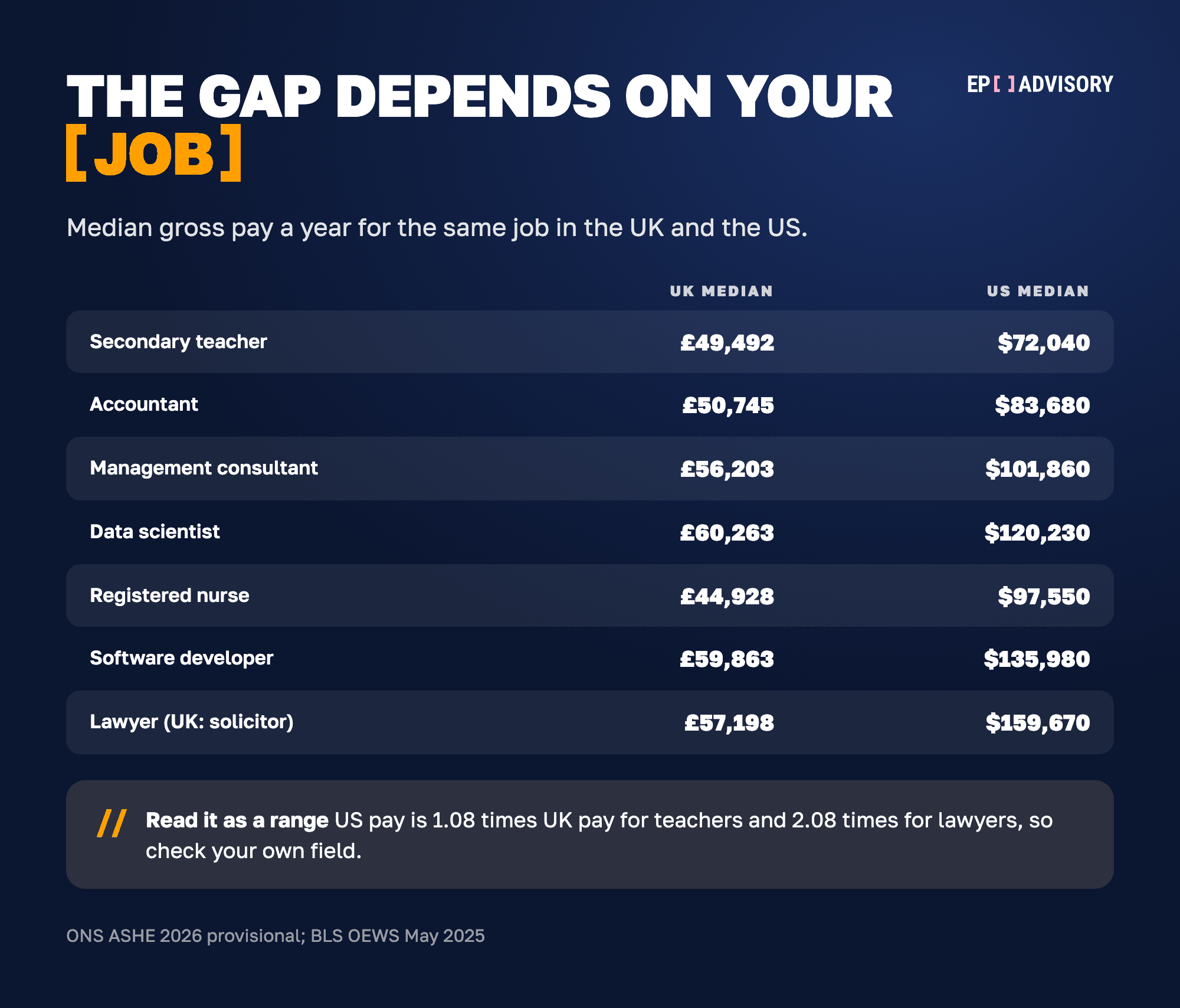
The gap is smallest for teachers and accountants. It is largest for lawyers, software developers and nurses.
UK figures are median gross pay a year for full-time employees, from the ONS Annual Survey of Hours and Earnings for the year to April 2026 (ONS Table 14, 2026 provisional). The median is the middle earner: half earn more, half earn less. US figures are median gross pay a year from the Bureau of Labor Statistics for May 2025 (BLS Occupational Employment and Wage Statistics, released 15 May 2026).
The two surveys count different people over different periods. The UK figures cover full-time staff who have been in the same job for over a year, in the year to April 2026. The US figures include part-time staff, in May 2025. So read the ratio as the size of the gap, not an exact pay cut.
| Job | UK median, gross a year | US median, gross a year | US ÷ UK |
| Secondary school teacher | £49,492 ($66,400) | $72,040 | 1.08 |
| Accountant | £50,745 ($68,100) | $83,680 | 1.23 |
| Management consultant | £56,203 ($75,400) | $101,860 | 1.35 |
| Financial analyst | £53,940 ($72,400) | $102,740 | 1.42 |
| Data scientist | £60,263 ($80,900) | $120,230 | 1.49 |
| Engineer (all types) | £52,130 ($70,000) | $108,620 | 1.55 |
| Registered nurse | £44,928 ($60,300) | $97,550 | 1.62 |
| Software developer | £59,863 ($80,300) | $135,980 | 1.69 |
| Lawyer (UK: solicitor) | £57,198 ($76,800) | $159,670 | 2.08 |
Some job groups are wider on one side. The UK accountant row counts chartered and certified accountants, while the US row includes auditors. The UK data scientist row is the ONS group for actuaries, economists and statisticians. The UK solicitor row leaves out barristers.
If your field has a small gap, the move costs little in gross pay. If the gap is large, the case rests on take-home and the package. Either way, use the London figure as your benchmark. Nurses can check registration, visa and NHS pay in our guide for an American nurse in the UK.
London vs New York salary: the city comparison
London pays well above the UK median, and New York pays well above the US median. For the jobs below, New York pays 1.3 to 1.9 times London.
The median full-time salary in London is £53,132 gross a year (about $71,300). That is 30% above the UK median of £40,911 (about $54,900). The UK figure is from the ONS 2026 earnings bulletin, and the London figure from ONS Table 7. London figures count jobs based in London, wherever the person lives. The London job figures below come from ONS Table 15. New York figures cover the New York-Newark-Jersey City metro area (BLS, May 2025).
| Job | London median, gross a year | New York metro median, gross a year | NY ÷ London |
| Financial analyst | £71,471 ($95,900) | $128,930 | 1.34 |
| Management consultant | £67,279 ($90,300) | $124,390 | 1.38 |
| Secondary school teacher | £54,500 ($73,100) | $100,800 | 1.38 |
| Data scientist | £69,673 ($93,500) | $135,980 | 1.45 |
| Software developer | £78,629 ($105,500) | $166,830 | 1.58 |
| Registered nurse | £51,615 ($69,300) | $119,720 | 1.73 |
| Lawyer (UK: solicitor) | £80,788 ($108,400) | $208,880 | 1.93 |
Finance, consulting and teaching have the closest city gap, at 1.34 to 1.38. If you work in these fields, a London offer can sit much closer to your New York pay than the national figures suggest.
Next: if the London figures work for your field, our guide on how to get a job in the UK as an American sets out the 6-step plan, from sponsor list to visa. Our guide to UK work visas for Americans shows which route fits you.
Score your CV in 30 seconds, then fix its biggest problems one by one. Both free.
Free, no card. A free account unlocks every fix.

Take-home pay: London vs New York City at the same salary
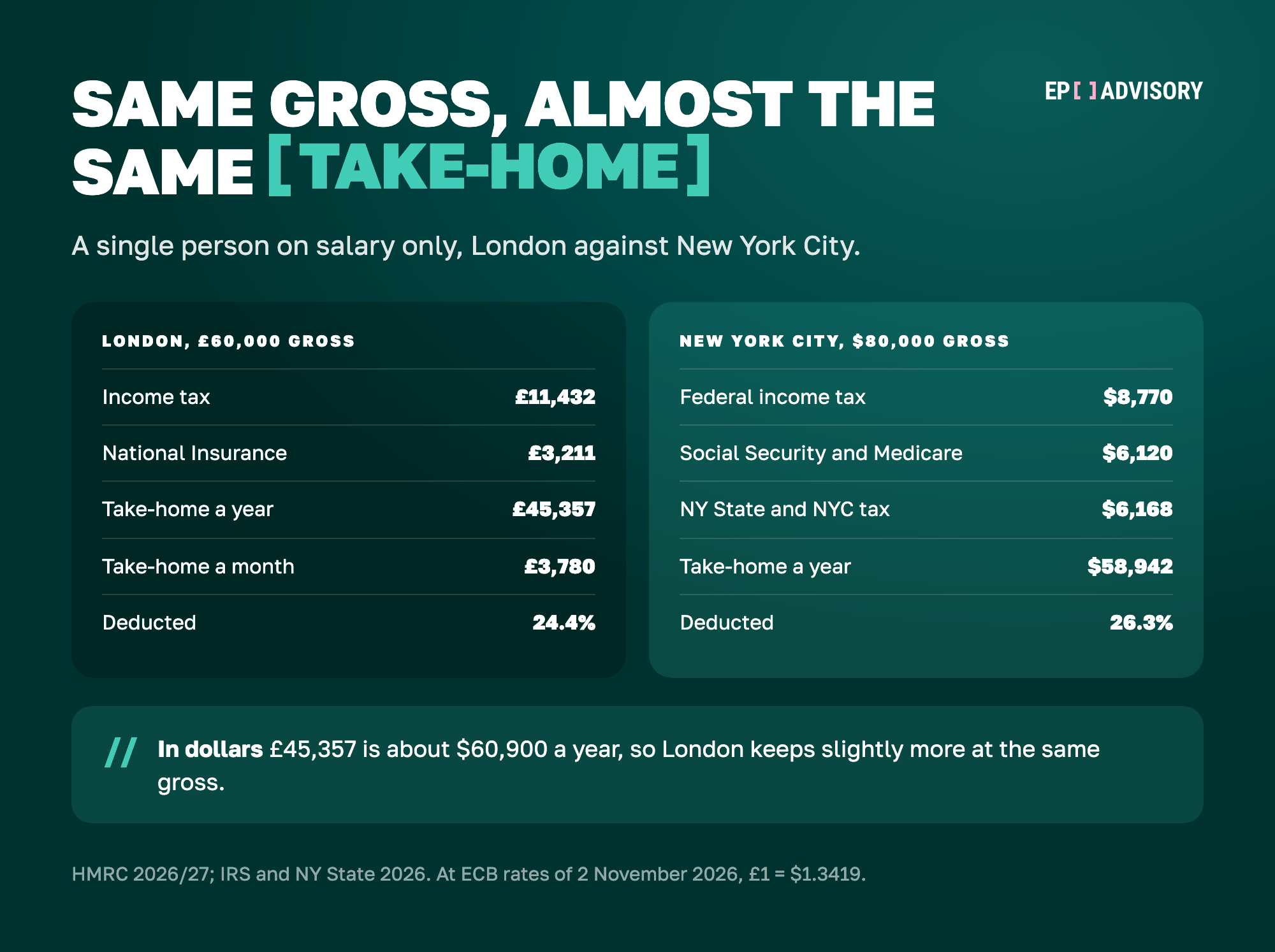
At roughly the same gross pay, London and New York City leave you with almost the same money each month.
In the UK, your employer takes two things from your pay. Income tax is charged in bands after a tax-free personal allowance of £12,570 (GOV.UK income tax rates). National Insurance is the UK’s social security contribution: 8% of pay between £12,570 and £50,270, then 2% above that (HMRC rates for 2026 to 2027). In New York City you pay federal income tax, Social Security and Medicare, New York State tax and New York City tax (NY State and City rates for 2026).
Both examples assume a single person on salary only. The UK side is England, tax year 2026 to 2027, with no pension contribution or student loan. The US side is a full-year New York City resident in 2026, taking the standard deduction, with no 401(k) or health premiums. It also leaves out New York’s small payroll deductions for disability and paid family leave.
| Line | London, £60,000 gross | New York City, $80,000 gross |
| Gross in the other currency | $80,500 | £59,600 |
| Income tax | £11,432 | Federal $8,770 |
| Social security | National Insurance £3,211 | Social Security $4,960 + Medicare $1,160 |
| State and city tax | None | NY State $3,723 + NYC $2,445 |
| Take-home a year | £45,357 ($60,900) | $58,942 (£43,900) |
| Take-home a month | £3,780 ($5,070) | $4,912 (£3,660) |
| Share of gross deducted | 24.4% | 26.3% |
The pattern holds higher up. On £100,000 in London, you keep £68,557 a year, or £5,713 a month (about $92,000 and $7,670). On $135,000 in New York City, you keep $91,851 a year, or $7,654 a month (about £68,400 and £5,700). London deducts 31.4%. New York City deducts 32.0%.
Two things change the result. If you live in New York State outside New York City and Yonkers, you pay no city income tax, so $80,000 leaves $61,387 a year. Scotland has its own income tax bands, so a Scottish offer needs its own calculation. Use these examples as a benchmark, then run your own numbers.
Above £100,000: the UK band to plan around
Between £100,000 and £125,140, each extra pound you earn in England loses about 62% to tax and National Insurance.
The reason is the personal allowance taper. Above £100,000, your tax-free allowance falls by £1 for every £2 you earn, until it reaches zero at £125,140 (GOV.UK). So you pay 40% tax on the extra pay, 20% more because allowance is lost, and 2% National Insurance.
A worked example: at £110,000, your allowance falls to £7,570. Income tax is £33,432 and National Insurance £4,210.60, which leaves £72,357 a year. That is only £3,800 more than at £100,000, or about $5,100. When you negotiate in this band, compare the net gain, not the gross rise. Talk to a cross-border tax adviser about how your offer is structured.
Holiday, pension and health: what the UK package adds
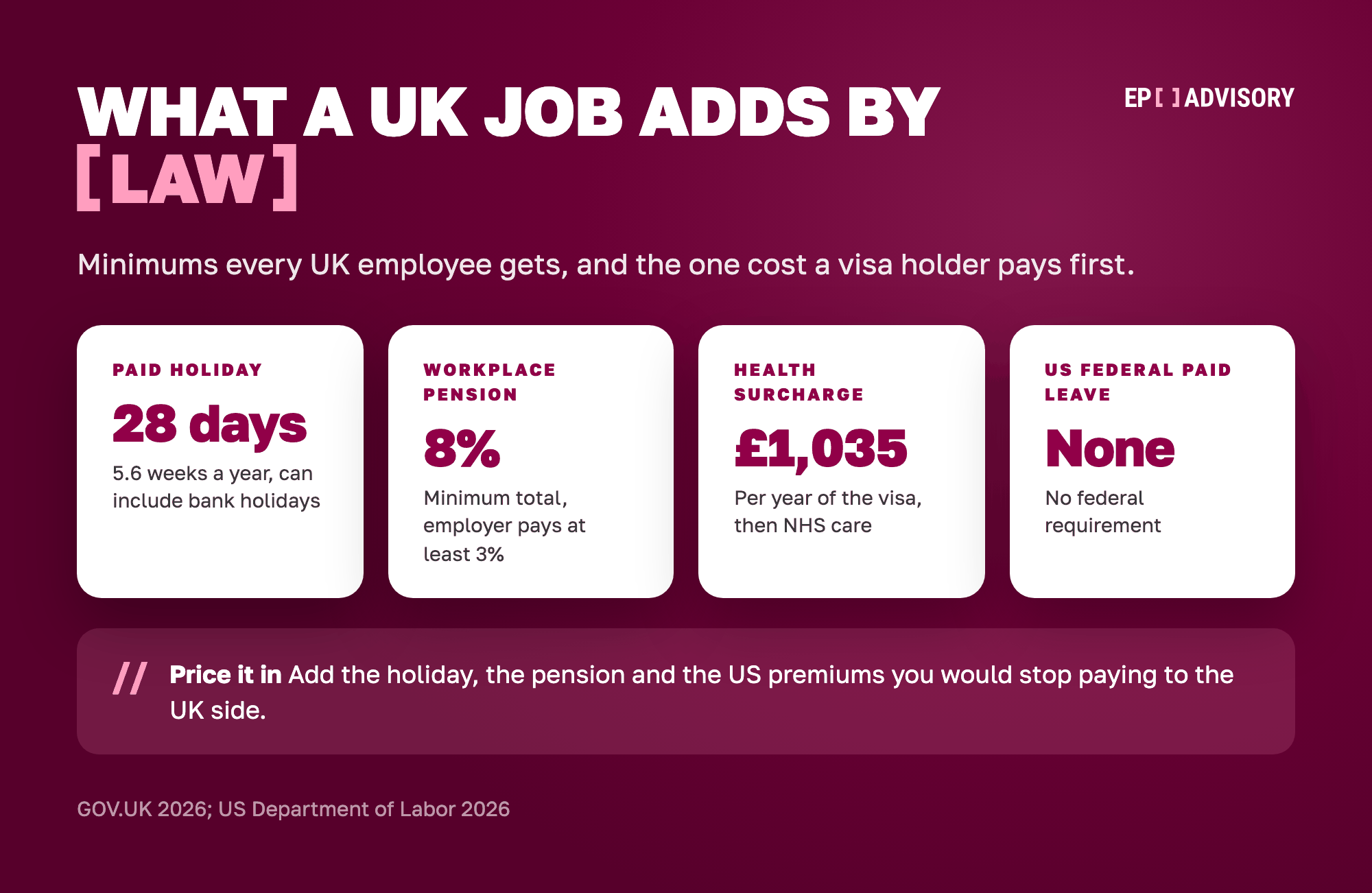
A UK job includes paid holiday, a pension contribution and health care that a US salary often has to pay for.
| Part of the package | UK | US |
| Paid holiday | 5.6 weeks a year by law: 28 days on a 5-day week, which can include bank holidays (GOV.UK) | No federal requirement for paid vacation or holidays (US Department of Labor). Some states, including New York, have their own sick leave laws. |
| Pension | At least 8% of qualifying earnings in total. Your employer pays at least 3%, and you pay 5% (GOV.UK workplace pensions) | A 401(k) and any employer match depend on the employer. |
| Health care | The NHS, free of charge from the date your visa starts. You first pay the Immigration Health Surcharge of £1,035 per year of the visa, upfront (GOV.UK) | If your employer offers health insurance, you usually pay part of the premium from your pay. The amount depends on the plan. |
| Social security | National Insurance. Under the US-UK social security agreement, you usually pay where you work. A US employer posting expected to last up to 5 years can keep you in US Social Security (the agreement). | Social Security 6.2% of wages up to $184,500, and Medicare 1.45% (IRS) |
If you are 22 or over and earn at least £10,000 a year, your UK employer must put you into a workplace pension. The minimum applies to earnings between £6,240 and £50,270 a year, and many employers pay more. Ask for the employer’s percentage in writing. It is part of your pay.
Budget for the health surcharge. For 5 years of visa time, that is £5,175 for one adult, paid with the application. After that, you use the NHS with no premiums. If you pay US premiums today, add the saving to the UK side.
One more cost to plan: US tax does not stop when you move. The IRS taxes US citizens on worldwide income, so you keep filing a US return from London. Talk to a cross-border tax adviser before you accept an offer.
Why UK salaries are lower than US salaries
The gap varies a lot by field, which tells you more than any single average.
- Some fields pay almost the same. Secondary teachers (1.08) and accountants (1.23) earn close to their US peers. In these fields, the UK package can put you ahead.
- Some fields pay far more in the US. Lawyers (2.08), software developers (1.69) and nurses (1.62) see the biggest gaps.
- A US salary has more to cover. US workers often pay health insurance premiums from their pay, and US federal law sets no minimum paid holiday. In the UK, the NHS is funded through tax and paid holiday is a legal minimum.
- The exchange rate moves the gap. The same UK salary is worth more or fewer dollars from one year to the next.
Our view: aim for the roles and places where UK pay is strongest. London pays 30% above the UK median, and finance, consulting and teaching have the closest gaps with New York. If you are weighing other countries too, compare salaries in Ireland and salaries in Switzerland.
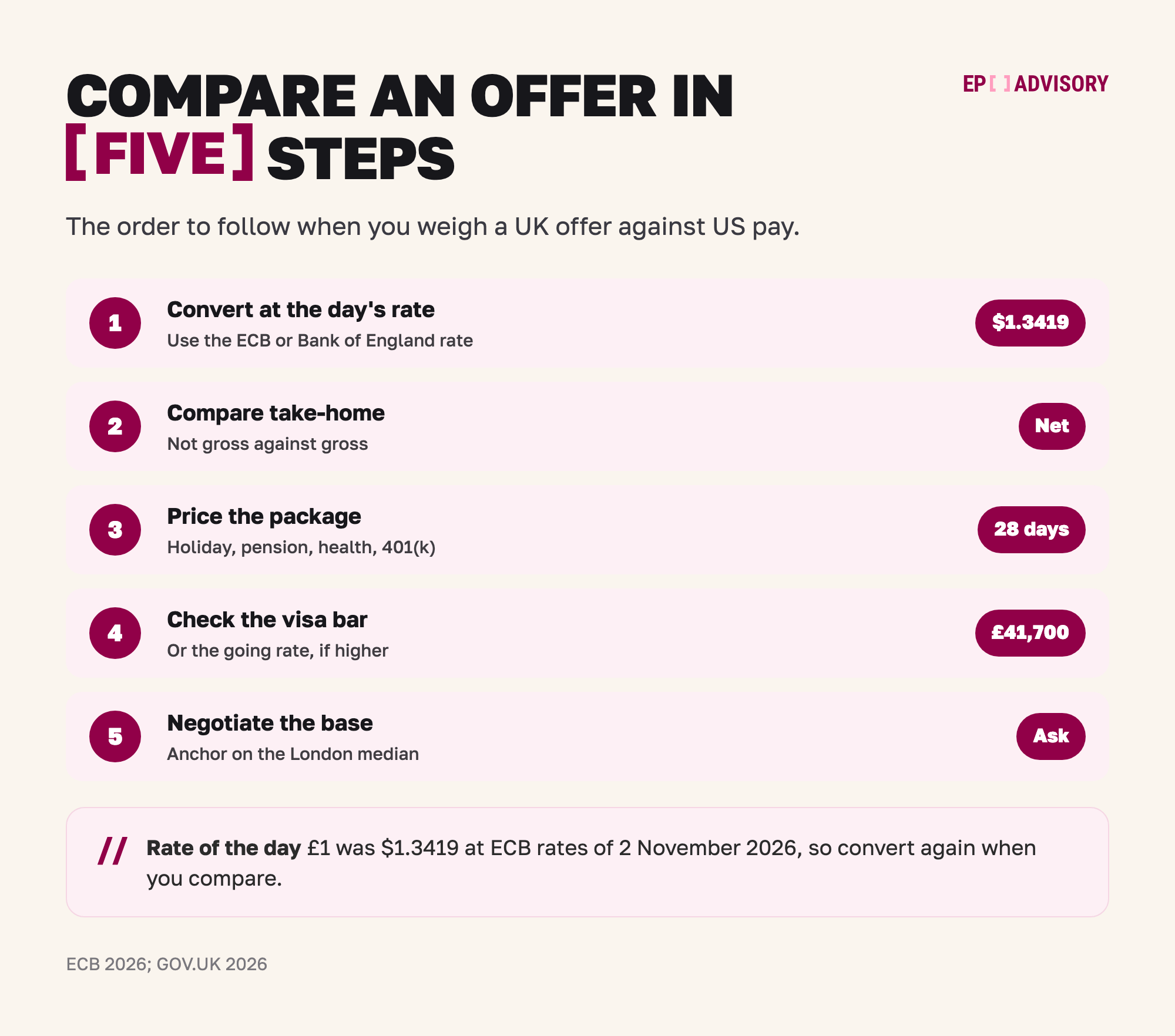
How to compare a UK offer with your US pay: 5 steps
This is the order we use when a client weighs a UK offer against US pay.
- Convert at the day’s rate. Use a published reference rate, such as the ECB or Bank of England rate, on the day you compare. At ECB rates of 2 November 2026, £1 is $1.3419.
- Compare take-home, not gross. Use the two worked examples above as a benchmark. At £60,000 London deducts 24.4%, and at $80,000 New York City deducts 26.3%.
- Price the package. Count the holiday days, the employer pension percentage, the health surcharge and the US premiums you would no longer pay. Then subtract any 401(k) match you would give up. This page does not compare rent or living costs, so price your own rent in both cities.
- Check the visa bar. If you need a Skilled Worker visa, the job usually must pay at least £41,700 a year or the going rate for your occupation, whichever is higher. As of November 2026, the going rate for software developers is £54,700 (GOV.UK). Our guide to the Skilled Worker salary threshold explains every rule. Check the current rules on GOV.UK or with a regulated adviser.
- Negotiate with official numbers. Use the London median for your job as your anchor, and ask for the base salary first. Our guide on how to negotiate salary shows how to make the ask.
Before any of this, you need the interview. UK employers screen fast, and a US-style resume is the most common reason a good American profile gets passed over. Our guide on why UK employers ignore American applications covers the fixes. Getting ready to apply for jobs in the UK? Check your CV for free: see it the way a recruiter does, then fix each problem.
If you are open to routes beyond a single employer, our guide to jobs in the UK for foreigners compares the visa options.
Key takeaways
- For the same job, US median pay is about 1.1 to 2.1 times UK median pay, from teachers (1.08) to lawyers (2.08).
- London’s median full-time salary is £53,132 gross a year (about $71,300), 30% above the UK median of £40,911.
- For the jobs compared, New York metro pay is 1.3 to 1.9 times London pay, with finance, consulting and teaching closest.
- At the same gross pay, take-home is close: £60,000 in London keeps £45,357 a year, and $80,000 in New York City keeps $58,942.
- Between £100,000 and £125,140 in England, each extra pound loses about 62% to tax and National Insurance.
- A UK job adds 28 days’ paid holiday, at least 8% into a pension and NHS care after a £1,035 a year health surcharge.
- All dollar figures use $1.3419 to £1, at ECB rates of 2 November 2026, so convert again on the day you compare.
See what a recruiter sees, then fix it before you apply. An instant score, then the fix for every problem.
Free, no card. A free account unlocks every fix.
Frequently asked questions
Do you earn more in the US or the UK?
For gross pay, usually the US. Across nine professional jobs, the US median is about 1.1 to 2.1 times the UK median. At the same gross pay, take-home in London and New York City is close, and the UK adds 28 days’ paid holiday, an employer pension and NHS care.
How much is £60,000 a year in US dollars?
About $80,500 a year gross, at ECB rates of 2 November 2026. In England you keep about £45,357 a year after income tax and National Insurance. That is about $60,900 a year, or $5,070 a month.
Is $100,000 a good salary in London?
Yes, by UK standards. $100,000 is about £74,500 a year gross, which is 40% above the London median full-time salary of £53,132. For some jobs, such as software developers, the London median is higher, at £78,629.
Do you pay more tax in the UK or the US?
At the same gross pay, it is close. On £60,000 in England, income tax and National Insurance take 24.4%. On $80,000 in New York City, federal, payroll, state and city tax take 26.3%. Between £100,000 and £125,140, the UK takes about 62% of each extra pound.
Why are UK salaries lower than US salaries?
The gap depends on the field. It is small for teachers and accountants, and large for lawyers and software developers. A US salary also has more to cover: US workers often pay health premiums from their pay, and US federal law sets no minimum paid holiday. The exchange rate also moves the gap.