 By Alisa Schlosser, Career Consultant at EP Advisory
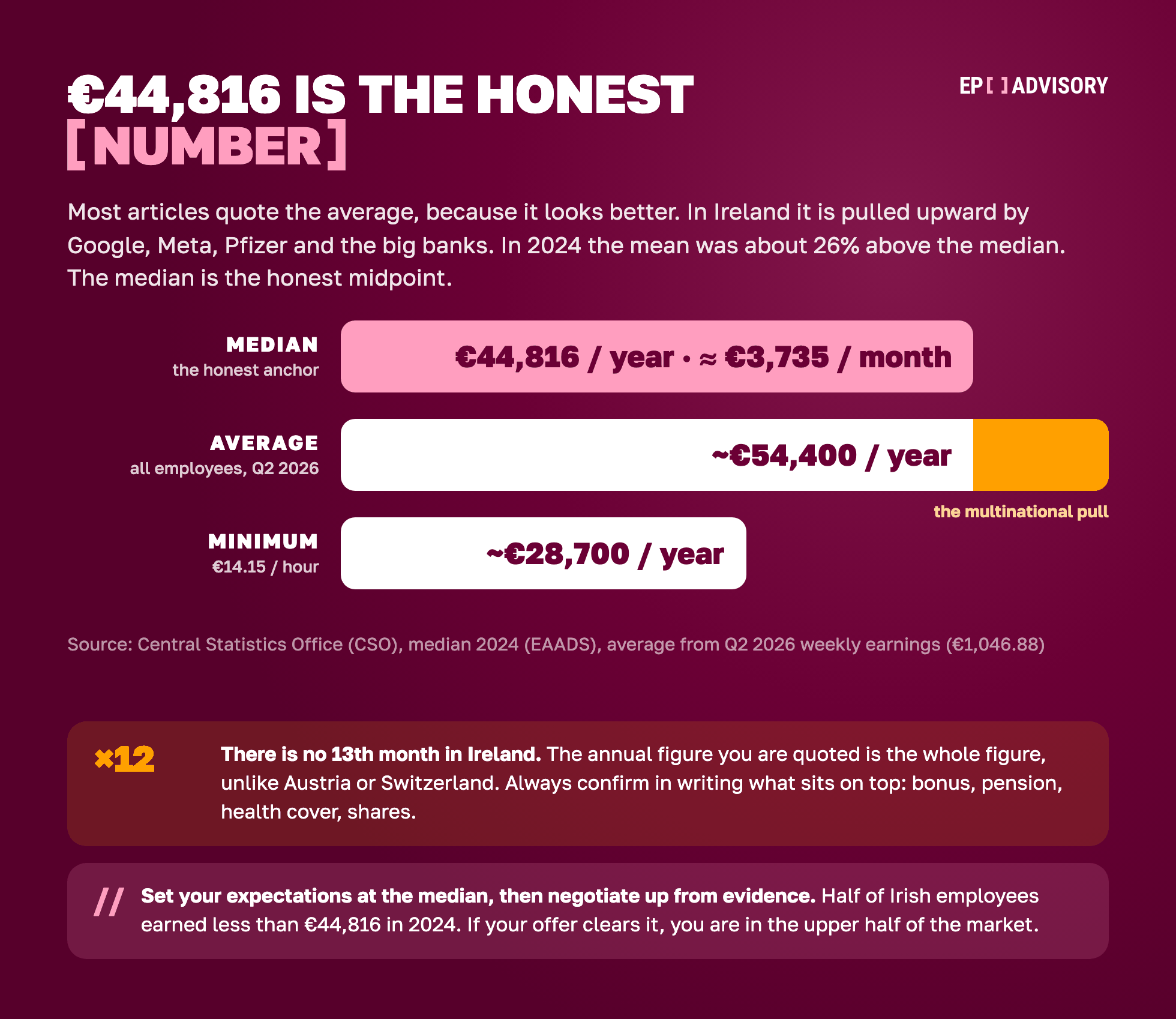
The short answer: The average salary in Ireland in 2026 is about €4,536 a month, €54,400 a year (CSO, Q2 2026, all employees), pulled up by multinationals. The median is €44,816 a year, about €3,735 per month. After PAYE, USC and PRSI, a professional on €75,000 keeps roughly €4,385 a month. The national minimum wage is €14.15 an hour, about €28,700 a year.
| Ireland, 2026 | Amount |
|---|---|
| Median salary | €44,816/yr (~€3,735/mo) |
| Average salary (all employees) | ~€54,400/yr (~€4,536/mo) |
| Typical take-home (€75k salary) | ~€4,385/mo |
| Minimum wage | €14.15/hr (~€28,700/yr) |
Ireland is one of the highest-paying economies in the European Union, and one of the most misread. The headline is a national average of roughly €54,400 a year. What most people actually earn is closer to the median of €44,816. Add Dublin asking rents of about €2,040 a month for a one-bedroom flat (Daft.ie, Q2 2026) and you have a country where a very good salary and a very tight budget can sit on the same payslip.
This article isn’t about the “Celtic Tiger” headlines. It’s about the arithmetic. We break down real salaries by sector, focus on the fields where foreign professionals genuinely get hired, subtract income tax, USC, PRSI and Dublin rent, and show you what’s actually left at the end of the month.
In nearly 10 years, we’ve helped more than 5,000 professionals find jobs abroad. Want to know if your CV will pass screening in Ireland? Check your CV for free: a score in 30 seconds, then a fix for each problem.
What Is the Average Salary in Ireland Per Month? (2026)
The average salary in Ireland in 2026 is about €4,536 per month gross (€54,400 a year), based on average weekly earnings of €1,046.88 for all employees in Q2 2026. After income tax, USC and PRSI that average leaves roughly €3,500 per month net. The median is lower and more honest at €3,735 per month gross (€44,816 a year), because multinational pay in Dublin and Cork pulls the average up. Different CSO series also give different averages: weekly earnings in Q2 2026 imply about €54,400 a year, while the CSO’s annual earnings analysis puts the 2024 mean at €56,356. Whichever you quote, the median is the honest anchor.
| Salary in Ireland (2026) | Per month, gross | Per month, net |
| Average (all employees) | ~€4,536 | ~€3,500 |
| Median (typical worker) | ~€3,735 | ~€3,080 |
| National minimum wage (€14.15/hr) | ~€2,390 | ~€2,100 |
Net figures are approximate and assume a single person on the standard tax credits. See “The Arithmetic” section below for a full Dublin worked example.
Does Ireland have a minimum wage? Yes. The national minimum wage is €14.15 per hour from 1 January 2026, among the highest in the EU. For a full-time 39-hour week that is about €2,390 per month gross, or roughly €28,700 a year, before tax.
What counts as a good salary in Ireland? Anything above the median, so roughly €45,000 a year (€3,735 per month gross), is comfortable for one person outside Dublin. In Dublin, where rent swallows almost half of take-home, €60,000 and up gives real breathing room.
If the numbers work for you, the next step is practical: our guide to finding a job in Ireland covers where the hiring actually happens, and the European work-visa salary thresholds show what an offer must pay before a permit is possible.
Irish Salaries at a Glance: The Essentials
- Median annual earnings: €44,816 (CSO, 2024), the most honest anchor
- Average annual earnings: ~€54,400 (CSO, from average weekly earnings of €1,046.88 for all employees in Q2 2026), pulled up by multinationals
- No 13th month: and most Irish ads state no figure at all: 14 of 15 listings in our August 2026 sample quoted nothing. Salary talk happens at interview, on an annual gross basis
- National minimum wage: €14.15/hour from 1 January 2026 (~€28,700/year full-time), among the highest in the EU (Citizens Information)
- Income tax: 20% up to €44,000, 40% above (single person, 2026, Revenue)
- USC (Universal Social Charge): 0.5%–8% depending on income band (Revenue)
- PRSI: 4.2% employee, rising to 4.35% from 1 October 2026 (Citizens Information)
- Pension auto-enrolment (MyFutureFund): live since 1 January 2026 for employees aged 23–60 earning €20,000 or more with no workplace scheme: employee 1.5% of gross, employer 1.5%, State 0.5%, stepping up to 6%+6%+2% by year 10 (Citizens Information)
- Rent, 1-bed Dublin: about €2,040/month on average in asking rents (Daft.ie, Q2 2026); the RTB average for all new Dublin tenancies was €2,335 in Q1 2026 (RTB Rent Index)
- Health: public HSE system; private insurance is optional (average adult premium €1,960/year, HIA, Q1 2026)
- The big advantage: English-speaking, EU member, common law. No language barrier for most roles
An important caveat about “median” versus “average”. Most of the salary pages we checked in August 2026 lead with the average, because it looks better. In Ireland the 2024 mean (€56,356) sits about 26% above the median (€44,816), because the average is dragged upward by highly paid staff at Google, Meta, Pfizer and the big banks. The median is more honest: half of all workers earn more, half earn less. Anchor your expectations to the median.
Salaries by Sector: Where Foreign Professionals Actually Get Hired
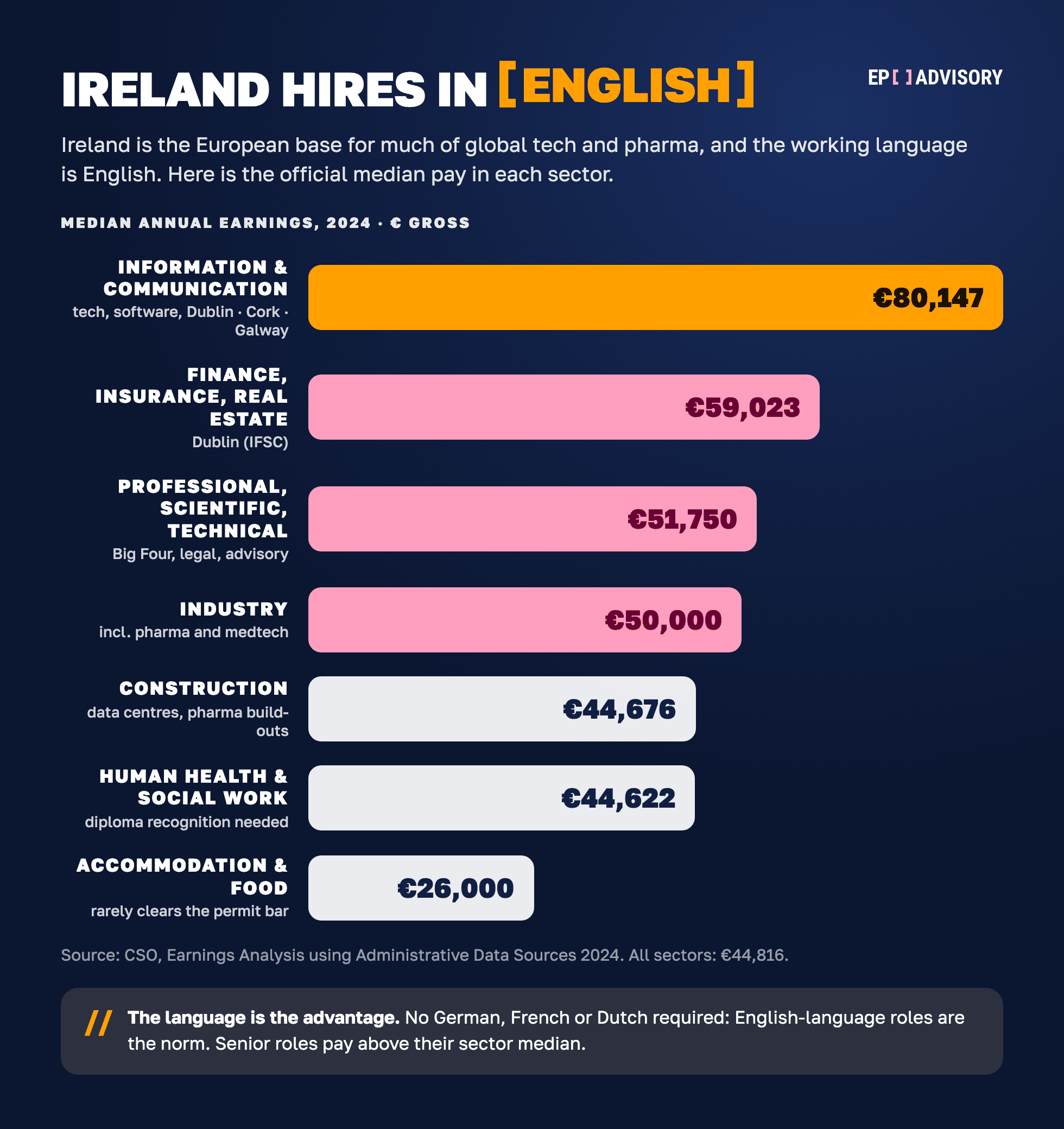
Ireland is the European headquarters for much of global tech and pharma, and it hires in English. That combination makes it one of the most accessible high-wage countries in the EU for non-EU professionals. Your realistic chances are strongest in sectors with genuine skill shortages. Here they are, with the official median annual earnings for each sector (CSO, 2024).
| Sector | Median annual earnings, 2024 (€ gross) | Where the jobs are | Odds for non-EU candidates |
| Tech / Software (ICT) | €80,147 (Information & communication) | Dublin, Cork, Galway | High. Google, Meta, Microsoft, Stripe, Intel, LinkedIn |
| Pharma / MedTech / Life Sciences | €50,000 (Industry, which includes pharma and medtech manufacturing) | Cork, Dublin, Galway, Limerick | High. Pfizer, Eli Lilly, J&J, Regeneron, Medtronic |
| Finance / Fintech | €59,023 (Financial, insurance & real estate) | Dublin (IFSC), Cork | Moderate–High. Banks, funds, payments |
| Engineering / Construction | €44,676 (Construction) | Dublin, Cork, Limerick | High. Data-centre and pharma build-outs |
| Healthcare / Nursing | €44,622 (Human health & social work) | Nationwide | High, but your qualification must be recognised (NMBI/Medical Council) |
| Professional services / Consulting | €51,750 (Professional, scientific & technical) | Dublin | Moderate. Big Four, legal, advisory |
| Accommodation / Food / Retail | €26,000 (Accommodation & food) | Nationwide | Low. Rarely meets the permit salary threshold |
Sector medians above are the official figures from the CSO’s Earnings Analysis using Administrative Data Sources 2024 (employments active for 50 weeks or more). Senior roles pay above their sector median.
A real example. The CSO puts the ICT median at €80,147 in 2024, the highest of any sector, and senior engineers sit above it. A similar profile in a Cork or Galway pharma cluster usually earns less, but rent is lower too: the RTB puts average new rents at €1,678 in Cork and €1,718 in Galway, against €2,335 in Dublin (RTB, Q1 2026, all home sizes). The headline number and the lived result can diverge sharply depending on where in Ireland you land.
Critical when negotiating: Ireland has no 13th-month convention, and most ads state no figure at all: 14 of 15 listings in our August 2026 sample quoted nothing. When a number does come up it is an annual gross with no hidden extra month. The Austrian and Swiss 13th salaries come from collective agreements and contracts, not statute; Ireland simply has no equivalent. Always confirm in writing whether a bonus, pension contribution, health cover or shares (common in tech) sit on top of base.
Score your CV in 30 seconds, then fix its biggest problems one by one. Both free.
Free, no card.

Average Wage in Ireland and the 2026 Minimum Wage
When people search for the average wage in Ireland they usually mean the median, and that is €44,816 a year (CSO, 2024). At the other end sits the legal floor. From 1 January 2026 the national minimum wage rose 65 cents to €14.15 an hour for adults (Workplace Relations Commission):
| Age band | Hourly rate (from 1 Jan 2026) |
|---|---|
| Aged 20 and above | €14.15 |
| Aged 19 | €12.74 |
| Aged 18 | €11.32 |
| Under 18 | €9.91 |
On a 39-hour week the adult rate works out near €28,700 a year, roughly €2,390 a month gross.
Salaries by County: Dublin, Cork, Galway, Limerick and Kildare
Irish pay has a steep geography. The CSO’s earnings analysis for 2024 puts Dublin 12.4% above the national median, and its median weekly pay is 36% higher than in Donegal, the lowest-earning county (€821 against €604). Gross weekly earnings, all employees (CSO, EAADS 2024); multiply by 4.33 for a rough monthly figure:
| County | Median weekly | Mean weekly |
|---|---|---|
| Dublin | €821 | €1,119 |
| Kildare | €798 | €1,022 |
| Cork | €766 | €961 |
| Limerick | €741 | €914 |
| Galway | €728 | €906 |
| State | €731 | €943 |
The Dublin premium is real, but so is Dublin rent. The county rows explain why a Cork or Galway offer that looks smaller can leave more in your account at month-end.
Where to Look for Work: Official Resources
- LinkedIn Jobs: one of the main channels for international and English-language roles in Ireland
- IrishJobs.ie: among the largest home-grown job boards
- Indeed Ireland: high volume of live listings
- JobsIreland.ie: the State’s public employment service, where roles must be advertised for the General Employment Permit’s Labour Market Needs Test (Critical Skills permits need none)
Official sources worth using to verify any figure:
- Central Statistics Office (CSO): official earnings statistics by sector
- Revenue: income tax, USC and PRSI rates and bands
- Department of Enterprise, Trade and Employment (DETE): employment permits and salary thresholds
- Residential Tenancies Board (RTB): the official rent index
The Other Side: What Living Here Actually Costs
Now we subtract. Here is the structure of unavoidable costs for a single person, with Dublin as the worst case.
Rent: the biggest line item (30–45% of your budget)
- Dublin: a 1-bed apartment averages €2,042 in asking rents, from €1,869 in West Dublin to €2,150 in South County Dublin (Daft.ie, Q2 2026). The RTB average for all new Dublin tenancies was €2,335 in Q1 2026
- Cork & Galway: a 1-bed averages €1,781 in Cork city and €1,647 in Galway city, 13–19% below Dublin (Daft.ie, Q2 2026)
- Limerick & Waterford: a 1-bed averages €1,772 in Limerick city and €1,273 in Waterford city (Daft.ie, Q2 2026)
- The catch: supply is very tight. On 1 August 2026 there were 1,123 homes for rent in Dublin, 18% fewer than a year earlier (Daft.ie), so expect queues of applicants per viewing and to move fast
What you need to know: landlords typically ask for one month’s deposit plus one month in advance, references and proof of income. Verify any advertised rent against the official RTB Rent Index and the quarterly Daft.ie Rental Report.

Health: a public system, with optional private cover
This is a key difference from Switzerland: health insurance in Ireland is not compulsory. Everyone ordinarily resident has access to the public health system (HSE), though public charges and waiting lists lead most professionals to buy private cover as well.
- Private health insurance: the average adult premium was €1,960 a year in Q1 2026 (Health Insurance Authority); basic plans cost less (VHI, Laya, Irish Life Health). Often subsidised by tech and pharma employers
- GP visit: you pay each visit unless you hold a medical card or GP visit card; each practice sets its own fee
- Compare providers on the State’s Health Insurance Authority comparison tool before you buy
Everything else you have to pay
The figures below are rough guides from our own budgets, not official statistics.
- Groceries: €350–500/month (Tesco, Dunnes; Aldi and Lidl are usually cheaper)
- Public transport: Leap Card daily and weekly fare caps limit what Dublin commuters pay (check the current caps with Transport for Ireland); the TaxSaver scheme cuts it further pre-tax
- Utilities + broadband: €150–250/month combined (household electricity in Ireland was the dearest in the EU in the second half of 2025, Eurostat)
The Arithmetic: What Actually Lands in Your Account
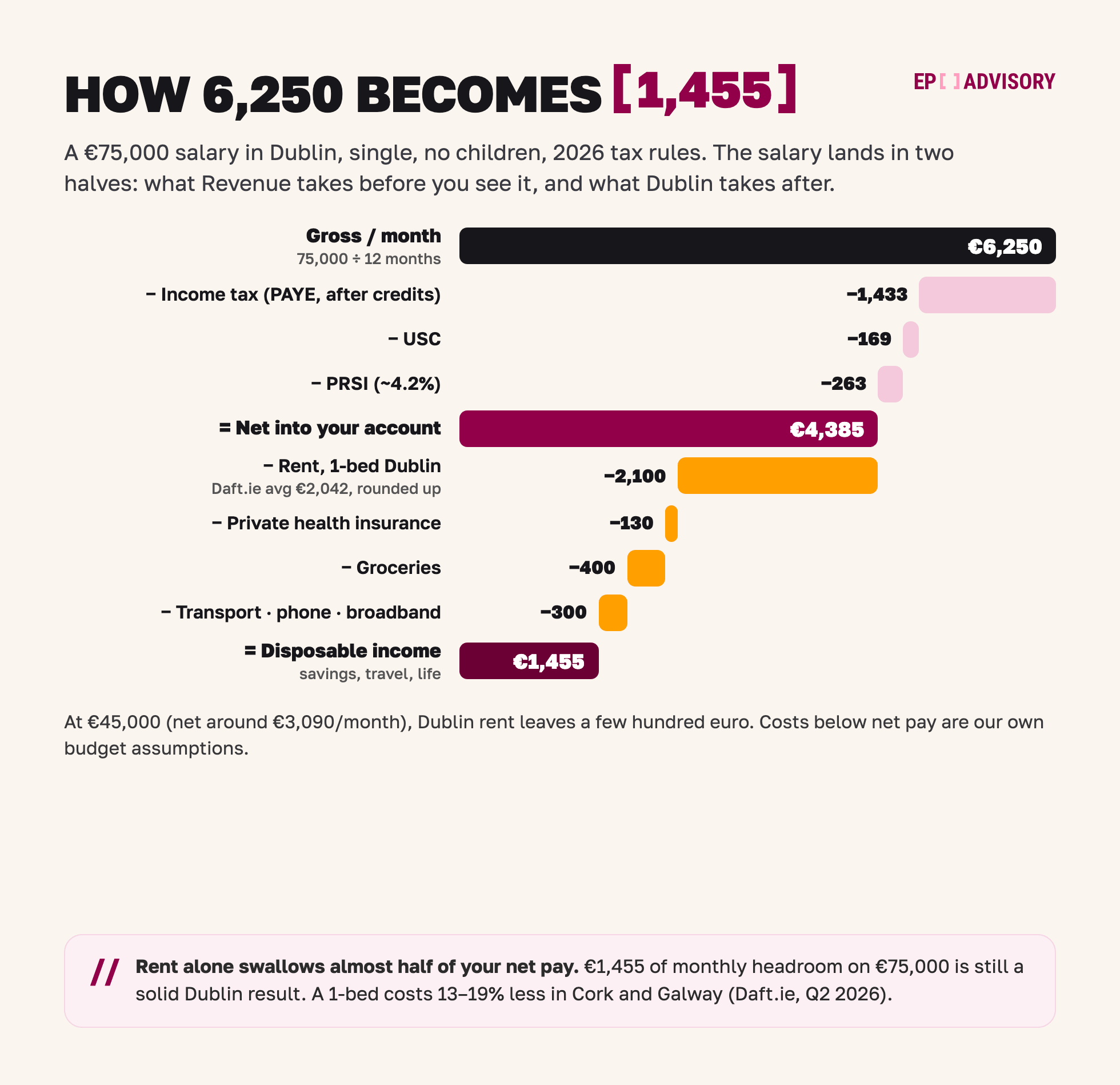
Let’s put it together. Take a realistic scenario: a Senior Software Engineer in Dublin on €75,000 a year (single, no children).
| Line item | €/month |
| Gross (75,000 ÷ 12) | 6,250 |
| − Income tax (PAYE, after tax credits) | −1,433 |
| − USC | −169 |
| − PRSI (~4.2%) | −263 |
| = Net into your account | ~4,385 |
| − Rent, 1-bed Dublin | −2,100 |
| − Private health insurance (optional) | −130 |
| − Groceries | −400 |
| − Transport, phone, utilities, broadband | −300 |
| = Disposable income | ~1,455 |
Rent here is rounded up from the Daft.ie Q2 2026 average for a Dublin 1-bed (€2,042). Health, groceries and transport are our own budget assumptions, not official figures. Roughly €1,450 a month of genuine disposable income on a €75,000 salary is a solid result. But notice that rent alone swallows almost half of your net pay. One line the table leaves out: pension. Since 1 January 2026 Ireland auto-enrols employees aged 23–60 earning €20,000 or more who have no workplace scheme into MyFutureFund, at 1.5% of gross for the first three years (about €94 a month on this salary, matched by the employer plus a State top-up). If your employer runs an occupational scheme instead, your rate is set by that scheme. The table also leaves out the Rent Tax Credit: a renter can claim up to €1,000 a year (Revenue). Run your own number through a Revenue-based take-home calculator before you sign anything.
And on a lower salary? At €45,000 in Dublin (net around €3,090/month), after Dublin rent and bills you’re left with a few hundred euro. Liveable with flatmates, but the comfort threshold for single living in Dublin realistically starts around €55,000–60,000 gross. Outside Dublin, that threshold drops sharply.
See what a recruiter sees, then fix it before you apply. An instant score, then the fix for every problem.
Free, no card.
The Work Permit: Your Route In

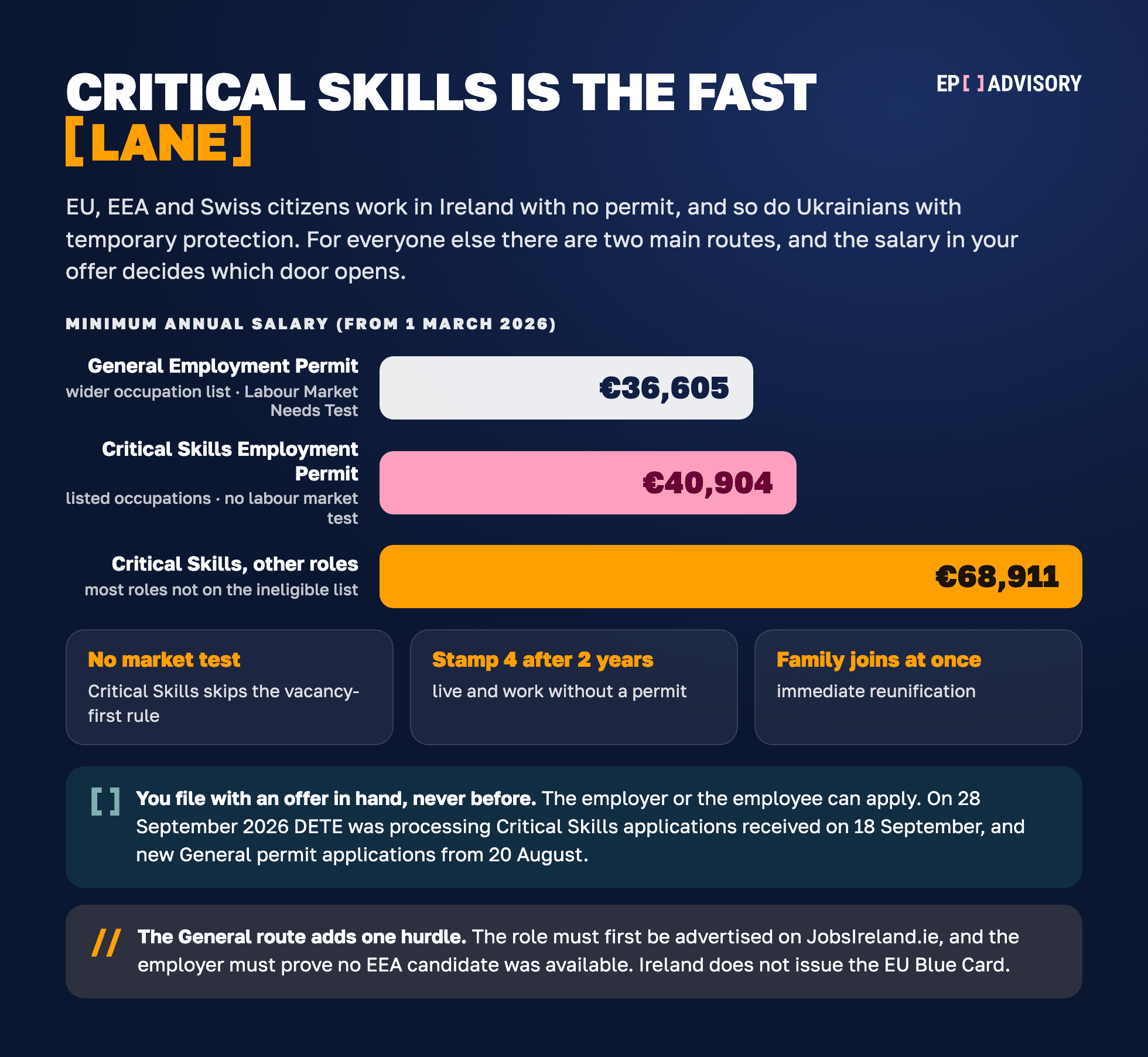
EU/EEA and Swiss citizens can work in Ireland with no permit. For everyone else, there are two main routes, and the salary thresholds rose on 1 March 2026.
- Critical Skills Employment Permit (CSEP): minimum salary €40,904 (up from €38,000) for roles on the Critical Skills Occupations List, which covers most ICT, engineering and many science and finance roles. Any eligible job paying over €68,911 also qualifies. No labour market test and immediate family reunification. After two years you can apply for Stamp 4, which lets you live and work in Ireland without an employment permit (DETE)
- General Employment Permit (GEP): minimum salary €36,605 (up from €34,000). Covers a wider list of occupations but requires a Labour Market Needs Test: the employer must first advertise the role on JobsIreland.ie and prove no EEA candidate was available
- No EU Blue Card: Ireland is one of only two EU states (with Denmark) that opted out of the EU Blue Card, so it does not issue one. Your routes are the Critical Skills and General Employment Permits above
- Who applies: the employer or the employee can apply, but you must hold a concrete job offer first. On 28 September 2026 DETE was processing Critical Skills applications received on 18 September and new General permit applications received on 20 August (current processing dates)
- Ukrainians with temporary protection need no employment permit: temporary protection gives direct access to work. Irish temporary protection permissions run to 4 March 2027 (Immigration Service Delivery), and the EU has extended protection to 4 March 2028 (Council decision 2026/1912). Since 5 August 2026 new applicants must show they left Ukraine lawfully (ISD). New arrivals get State accommodation for 30 days at most (gov.ie)
Current rules, the occupations lists and the phased threshold increases through 2030 are published by the Department of Enterprise, Trade and Employment.
Related reading: How to find a job in Ireland in 2026 · Work visa & Blue Card salary thresholds in Europe 2026 · UK salaries in 2026: what you take home
Key Takeaways
- Anchor on the median (€44,816), not the average (~€54,400): Ireland’s average is skewed by multinational pay.
- The strongest openings for non-EU professionals are in tech, pharma/medtech, engineering, finance and healthcare, and the working language is English.
- There is no 13th-month salary, and most ads state no figure at all; offers are discussed as annual gross. Check what sits on top: bonus, pension, shares.
- On €75,000 in Dublin you keep about €4,385/month net and roughly €1,450 as true disposable income after rent and bills.
- Dublin rent is the decisive cost: about €2,040/month in asking rents for a 1-bed (Daft.ie, Q2 2026), and supply is scarce. Cork, Galway and Limerick are materially cheaper.
- From 1 March 2026 the permit thresholds are €40,904 (Critical Skills) and €36,605 (General); roles over €68,911 qualify for Critical Skills automatically.
Frequently Asked Questions
What is the average salary in Ireland in 2026?
Average annual earnings are around €54,400, based on average weekly earnings of €1,046.88 for all employees in Q2 2026 (CSO). The median is lower, at €44,816 (CSO, 2024), and is a better guide to what a typical worker actually earns.
What is the average take-home (net) salary in Ireland?
On the average gross of about €4,536 a month you keep around €3,500 after income tax, USC and PRSI. On the median salary of €3,735 gross the take-home is roughly €3,080 per month. Since 1 January 2026, pension auto-enrolment also takes 1.5% of gross for employees aged 23–60 without a workplace scheme, which these figures do not include.
Does Ireland have a minimum wage?
Yes. The national minimum wage is €14.15 per hour from 1 January 2026, among the highest in the EU. For a full-time 39-hour week that works out to about €2,390 per month gross, or roughly €28,700 a year.
How much do you need to earn to live comfortably in Dublin?
With 1-bed asking rents averaging about €2,040/month (Daft.ie, Q2 2026), comfortable single living in Dublin realistically starts around €55,000–60,000 gross. On €75,000 you keep roughly €4,385/month net and about €1,450 in disposable income after rent and bills. Outside Dublin the threshold is much lower.
What salary do you need for a Critical Skills Employment Permit?
From 1 March 2026 the minimum is €40,904 per year for roles on the Critical Skills Occupations List. Any other eligible role paying over €68,911 also qualifies. The General Employment Permit minimum is €36,605.
Is Ireland a good place for foreign professionals?
Yes: it is English-speaking, an EU member, and the European base for much of global tech and pharma, so English-language roles are the norm rather than the exception. After two years on a Critical Skills permit you can apply for Stamp 4, which lets you live and work without an employment permit.
Getting ready to apply for jobs in Ireland? Check your CV for free: see it the way a recruiter does, then fix each problem.