 By Andre Atallah, CEO of EP Advisory

Short answer: there is no single European CV format. Europass is the EU’s free CV template. Send it when the ad asks for it, mostly in public-sector calls and EU bodies. For most private employers, send a custom CV: two A4 pages at most, newest job first, language levels on the CEFR scale (A1 to C2). Photo and date of birth depend on the country. Austria, Switzerland and Denmark expect a photo. The UK and Ireland expect neither.
Most people who search for the European CV format expect one official template. There isn’t one, and that works in your favour. European employers agree on more than they disagree on, and the parts that change from country to country fit on one table.
This guide is for anyone applying for a job in another European country, from inside or outside the EU. You get a straight answer on Europass, a country table for 18 markets, a CV template you can copy, five before-and-after fixes and a checklist to run on your own CV. For nearly 10 years, we’ve helped more than 5,000 professionals find jobs abroad. Want to know if your CV will pass screening in Europe? Check your CV for free: a score in 30 seconds, then a fix for each problem.
What the European CV format really means in 2026
People use “European CV” for three different things. Knowing which one an employer means saves you a rewrite.
- The Europass CV. The European Commission’s free online template. It is one format among many, and no private employer is obliged to want it.
- The shared European conventions. A4 paper, reverse chronological order (newest first), a short profile, and language skills with a level. These hold almost everywhere from Lisbon to Helsinki.
- The country format. The German Lebenslauf, the French CV with its accroche (a one-line pitch under your job title), the Italian CV with a data-consent line. This is what a local recruiter compares you with.
So “European CV format” in practice means the shared conventions, adjusted for one country. Here is what stays the same across Europe:
- Length: two A4 pages at most for experienced people, one page for juniors in many markets. Three pages read as too long in many countries.
- Order: contact details, profile, work experience, education, skills and languages, certifications. Graduates may put education first.
- Dates: month and year, in one format throughout, for example “03/2021 – 06/2024”.
- Profile: two to four lines aimed at the role. Drop any “Objective” line.
- Languages: a level for each one, usually on the CEFR scale.
- Format: one clean text PDF, not a scan or a photo of a page.
What changes is the personal part: photo, date of birth, nationality, the language you write in and a few local extras. The table further down covers all of it.
If you are coming from the US, the biggest shift is the same as for the UK: a CV, not a resume, and no one-page rule for experienced people. Our guide to the UK CV vs the US resume covers that switch line by line.
Europass CV: what it is and when to send it
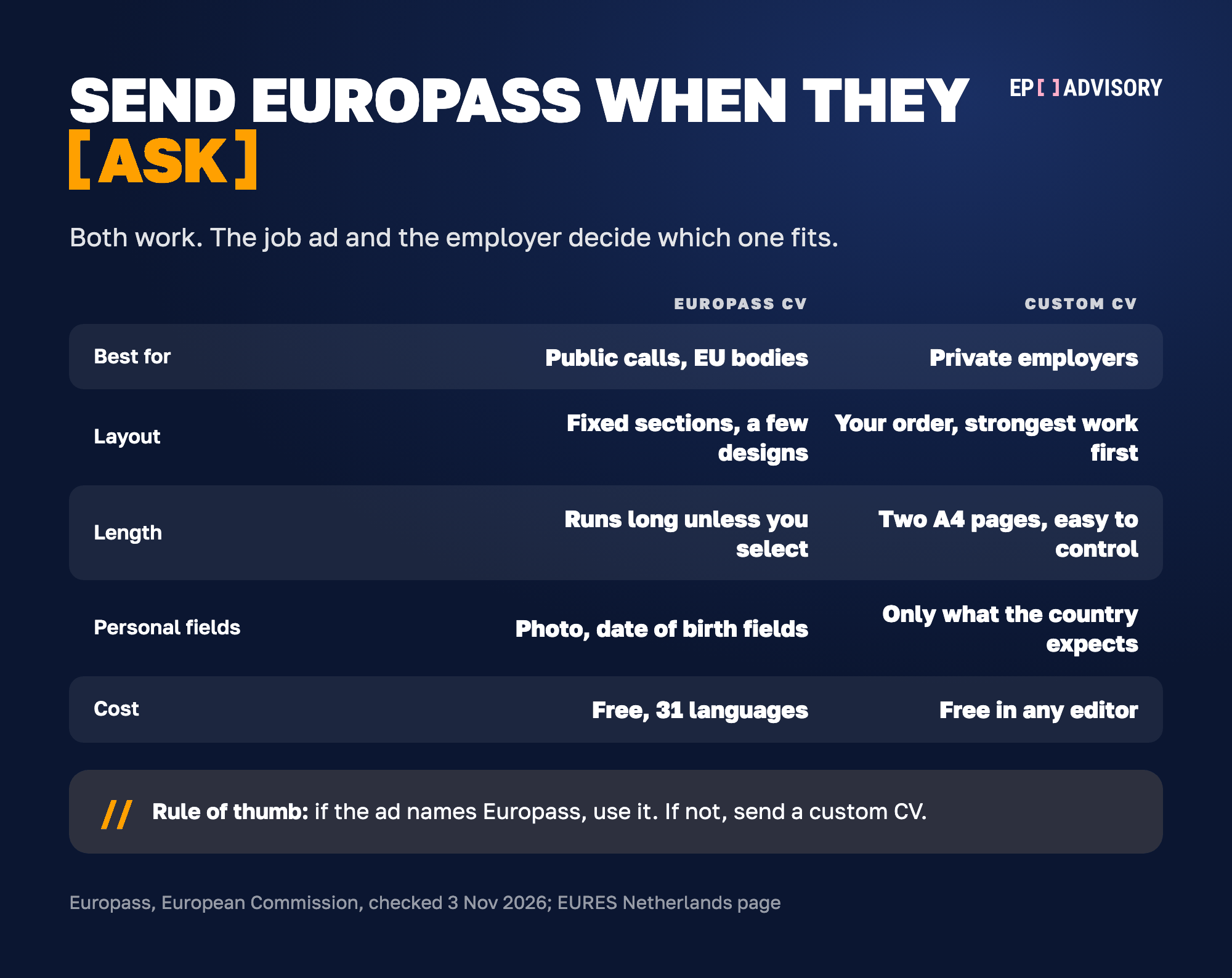
Europass is a good tool and an optional format. Send it when the employer asks for it. Otherwise, send a custom CV.
Europass is a set of free online tools run by the European Commission. It rests on an EU law, Decision (EU) 2018/646 of 18 April 2018. That law sets up the tools. It does not tell employers which CV to accept. Europass says the service is “free of any charge and in 31 different languages”. It works in two steps:
- Build a Europass profile. You enter your education, training, work experience and skills once.
- Create CVs from it. You pick the entries for each job and a design, then download the CV or share it. The Europass CV builder lets you make as many CVs as you want from one profile.
Europass also offers a cover letter editor and a language self-assessment grid based on the CEFR. It calls its CV “one of the best-known CV formats in Europe”. Being known is not the same as being preferred, and that is where most advice online gets vague.
When to send a Europass CV
- The ad or call asks for it. This is the only firm rule. Public-sector calls and EU bodies are where you see Europass named most. Follow the instruction exactly.
- Austria, when the firm asks. Some Austrian employers ask for the Europass format in their online forms.
- Italy and Portugal, for public calls. Europass is well known there and fine for public competitions. Private firms in both prefer a shorter custom CV. In Spain, Europass is increasingly known but not required.
When to send a custom CV instead
- Private employers that don’t mention Europass. That is most of the market. A custom CV lets you put your strongest work first and keep it to two pages.
- The Netherlands. EURES, the EU’s job mobility network, says on its Netherlands page that the Europass CV “is not yet widely known and/or well established amongst employers in the Netherlands”. For unsolicited applications it recommends the standard Dutch CV instead.
- The UK and Ireland. Recruiters there expect a plain two-page CV with no photo and no date of birth.
- Competitive roles in any country. Consulting, finance, tech and marketing recruiters compare you with local candidates who send tailored CVs. Match them.
How to make Europass work if you must use it
A Europass CV can look as sharp as any other. These are the settings we recommend:
- Select, don’t dump. Your profile can hold everything. Each CV should carry only the entries that match the job. Europass itself says: “Do not include a full detailed history.”
- Write “About me” as a profile. Two to four lines on what you do, for whom, and your strongest result. Europass tells you to tailor this section for each job.
- Fill the personal fields only where the country wants them. Europass’s current tips suggest adding a professional photo. Its older CV instructions mark the photo (“if requested”), date of birth, nationality and gender as optional. We add a photo or date of birth only where the country table says include or common.
- Check the page count of the PDF. Aim for two pages. If the PDF runs to four, cut old roles to one line each.
- Keep the profile as your master record. Even if you never send a Europass CV, the profile is a tidy place to keep every role and course with dates.
Score your CV in 30 seconds, then fix its biggest problems one by one. Both free.
Free, no card. A free account unlocks every fix.

European CV format by country: photo, date of birth, length
The shared conventions above apply everywhere. This table shows what changes in 18 markets.
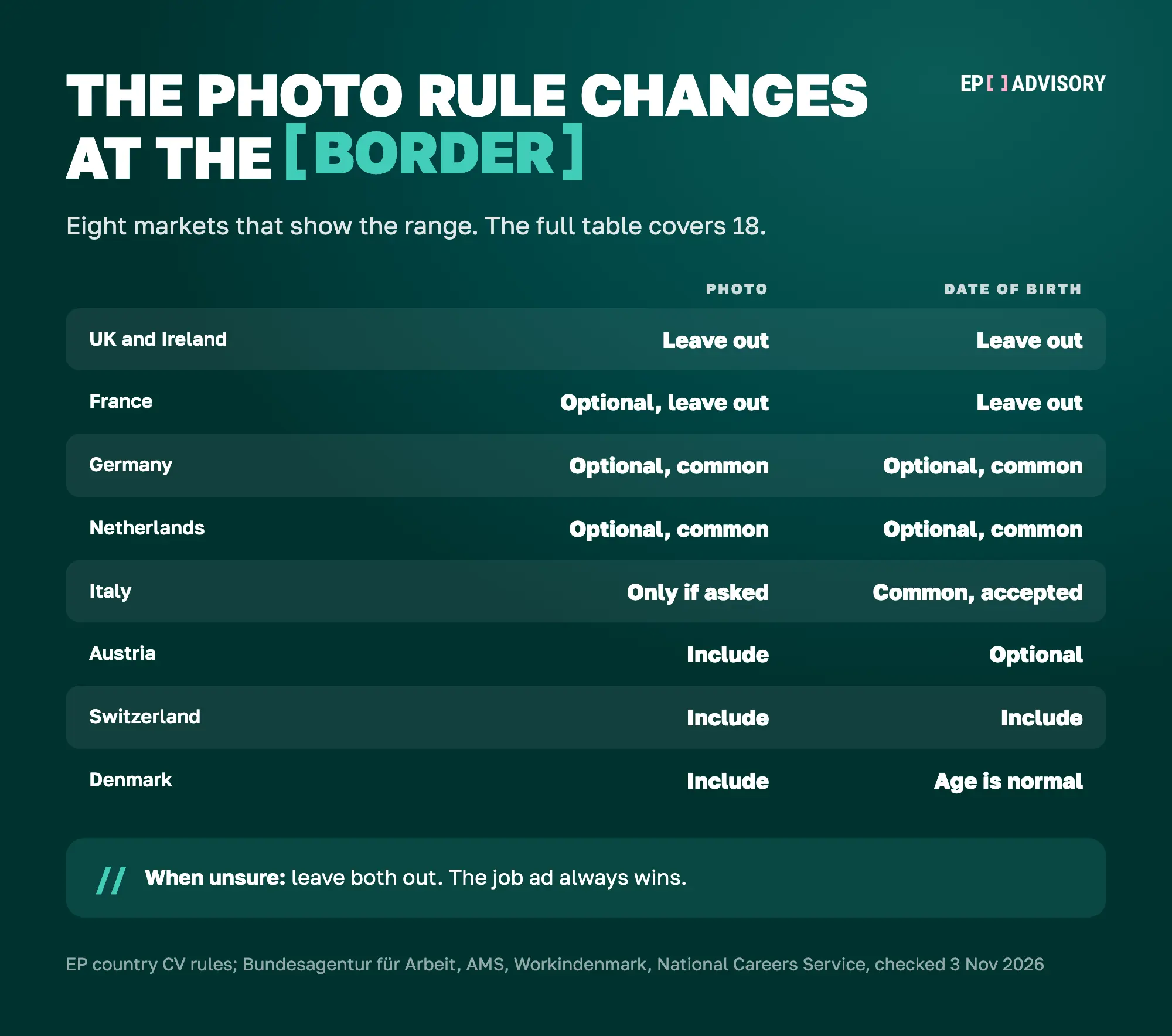
It follows the country rules we use in our own CV checks, which are built from each country’s official job service and university careers guidance. “Optional” means it neither helps nor hurts on its own. When the job ad gives an instruction, the ad wins.
| Country | Photo | Date of birth | Length | Watch for |
| UK | Leave out | Leave out | 2 A4 pages, graduates 1 | No age, nationality or marital status either |
| Ireland | Leave out | Leave out | 2 A4 pages, graduates 1 | No PPS number, religion or nationality |
| Germany | Optional, still common | Optional, still common | 1–2 A4 pages, 2 is the maximum | Tabular layout; explain gaps over 2 months |
| Austria | Include, top right | Optional | 1–2 A4 pages, juniors 1 | Keep academic titles; attach reference letters |
| Switzerland | Include, top right | Include, with nationality | 2 A4 pages, 3 for senior or academic roles | State your permit status; work certificates |
| Netherlands | Optional, common | Optional, common | 2 A4 pages maximum | No citizen service number (BSN) |
| Belgium | Only if asked | Optional | 1–2 A4 pages | Write in the language of the region |
| Luxembourg | Optional, common | Optional | 1 page juniors, 2 seniors | Languages in their own section, with CEFR levels |
| France | Optional, leave out by default | Leave out (age optional) | 1 page juniors, 2 maximum | Job title and a one-line pitch at the top |
| Spain | Optional, common | Not needed | 1 page, 2 for long careers | No ID or social security numbers; CEFR for each language |
| Italy | Only if asked | Common and accepted | 1 page graduates, 2 maximum | Data-consent line at the end (expected, not a legal requirement) |
| Portugal | Optional, often appreciated | Optional | 1–2 pages | City and country, not your full address |
| Poland | Optional, common | Leave out | 1 page juniors, 2 maximum | Consent clause at the bottom (common practice) |
| Czechia | Optional, about half add one | Leave out | 1 page ideal, 2 maximum | Give CEFR levels for every language |
| Denmark | Include, friendly | Age is normal | 2 A4 pages maximum | A short “About me” with family and hobbies |
| Sweden | Optional, natural | Leave out | 1–2 A4 pages | Never send a machine-translated Swedish CV |
| Norway | Optional | Common and accepted | 2 A4 pages, juniors 1 | Norwegian by default unless the ad is in English |
| Finland | Optional, common | Leave out | 1–2 A4 pages | Language levels in words, not codes |
A few lines in the table need a word of explanation:
- Germany: the federal employment agency, the Bundesagentur für Arbeit, says a photo “is no longer a must” and asks for a tabular CV of one to a maximum of two A4 pages. It also asks you to list breaks of more than two months. A photo is still common in Germany, so a good professional one is a safe choice.
- Austria: the public employment service AMS places the photo on the first page, top right or top left. In our CV checks, a missing photo counts as a gap for Austria, because a CV without one can look incomplete there.
- Denmark: Workindenmark says it is normal to include your age, whether you are married and have children, and your hobbies, often in a final “About me” section.
- Netherlands: EURES lists education before work experience. We put experience first for anyone with a year or more of work, because that is what Dutch recruiters screen for. Graduates can lead with education.
- Italy and Poland: the consent lines are a habit, not a legal duty. Italy’s privacy code says consent is not needed for the data in a CV you send to apply (art. 111-bis of D.Lgs. 196/2003). Poland’s data protection office, UODO, says in its guide for employers that a recruitment consent in a CV is not the right practice. Many recruiters in both countries still expect the line, so we keep it. Both versions are in the template below, ready to paste.
CV format: Germany vs UK
These two are the most common pair people ask about, and they sit at opposite ends of the table.
- Photo: Germany optional and common; UK never, except acting and modelling.
- Date of birth: Germany optional, still common with place of birth; UK leave out.
- Layout: Germany tabular, dates in a left column; UK free text with bullets.
- Profile: Germany optional and short, because German CVs are fact-led; UK expected, three to four lines.
- Language: Germany in German by default, English when the ad is in English; UK in English.
- Signature: Germany optional (place, date and a scanned signature for a traditional application); UK none.
Next: if Germany is your target, our guide to jobs in Germany for foreigners covers where to apply and what employers look for. For the wider plan across countries, see how to find a job in Europe.
Photo and personal details: the safe default
When you are not sure, give less. Add a photo or date of birth only where the country table says it is expected or common.
European data protection law points the same way. Under the GDPR, the European Data Protection Board explains that an organisation “can only process personal data that is necessary and proportionate” for its purpose. A recruiter does not need your marital status to judge your work. In the UK, the National Careers Service says plainly: “You should not include your age, your date of birth, whether you’re married or your nationality.”
Put these at the top of every European CV:
- Name and target job title. “Senior Financial Analyst” under your name tells the recruiter what to read for.
- City and country. Not your full street address, except in Germany, Austria, Switzerland, Luxembourg and Norway, where an address is usual.
- Phone with country code. “+49 151 2345 6789”, not a local format.
- Professional email and LinkedIn URL.
- Right to work, when it helps. One line, good news only: “EU citizen”, “EU Blue Card holder” or “EU long-term resident”. If you will need a permit, say so on the application form, not on the CV.
Leave these out by default: marital status and children (normal in Denmark, optional but never needed in Austria, Switzerland, Luxembourg, France and Portugal), religion, health, political views, parents’ names, ID and social security numbers.
If you add a photo, use a recent head-and-shoulders shot on a plain background, in what you would wear to the interview. Place it top right. Never a selfie, a holiday crop or a group photo cut down to one face.
Language levels on the CEFR scale
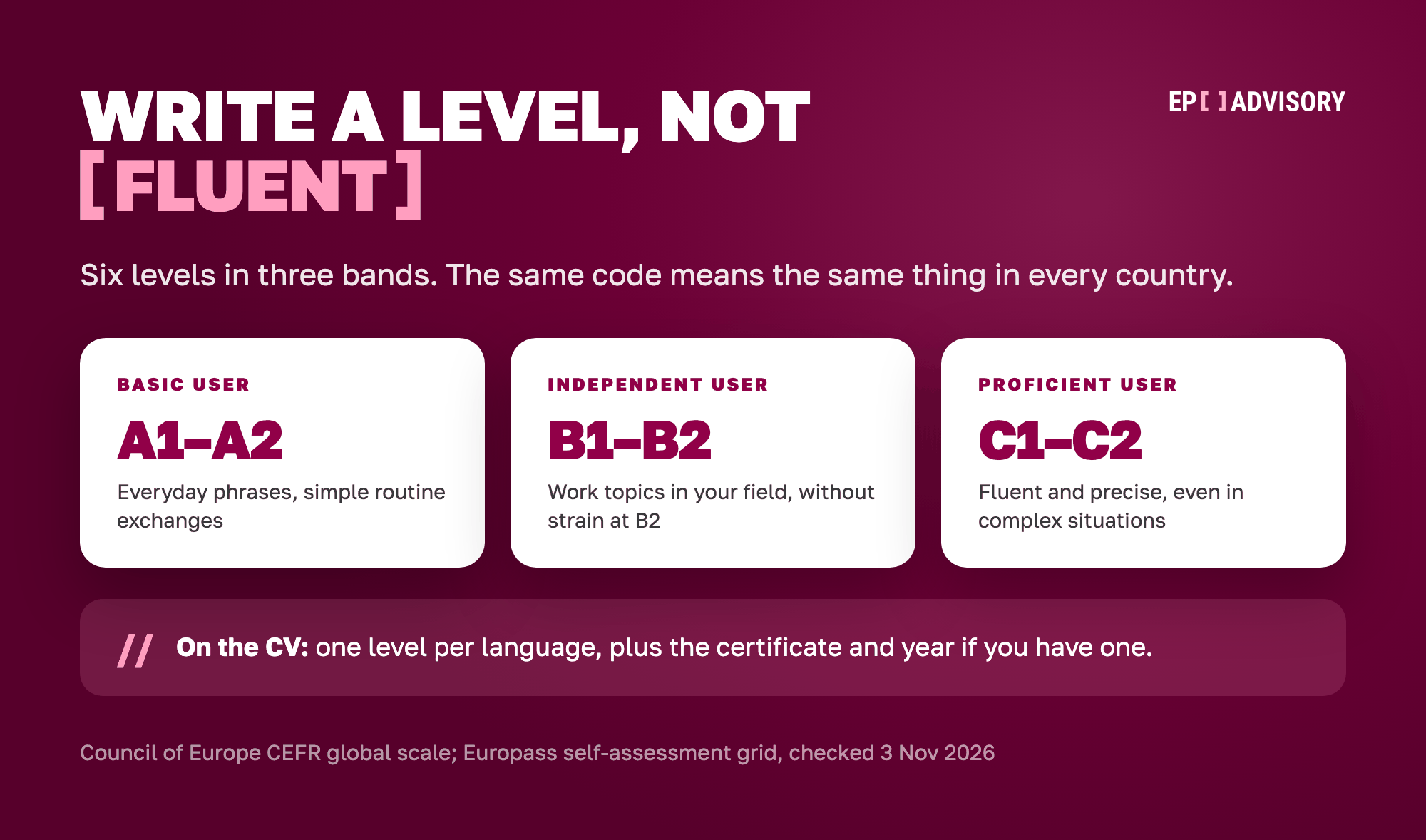
Give every language a level from A1 to C2. “Fluent” means different things to different people. “C1” means the same thing in every country.
The CEFR, the Common European Framework of Reference for Languages, is the Council of Europe’s six-level scale. It groups the levels into three bands. Europass uses the same scale in its self-assessment grid, which splits each language into listening, reading, spoken interaction, spoken production and writing.
| Level | Band | What it means at work (Council of Europe global scale, paraphrased) |
| A1, A2 | Basic user | Everyday phrases and simple, routine exchanges on familiar topics. |
| B1 | Independent user | Understands the main points on familiar matters, such as work; writes simple connected text on familiar topics. |
| B2 | Independent user | Follows complex text and technical discussion in your own field; talks with native speakers without strain. |
| C1 | Proficient user | Reads demanding, long texts and implied meaning; speaks fluently without searching for words. |
| C2 | Proficient user | Understands with ease virtually everything heard or read; expresses fine shades of meaning, even in complex situations. |
How to write it on the CV:
- One level per language. “German: B2”. You don’t need the five-skill grid unless Europass asks for it.
- Add the certificate if you have one. “German: B2 (Goethe-Zertifikat B2, 2025)”. A test result with a year carries more weight than a self-assessment.
- Write “native” for your mother tongue. The Europass CV also lists mother tongues apart from other languages.
- Be accurate, not generous. An interviewer may switch language for a few minutes to check. A true B1 beats a claimed C1.
- Finland is the exception. Finnish recruiters read words more easily than codes. Write “English: fluent, Swedish: good, Finnish: basic”.
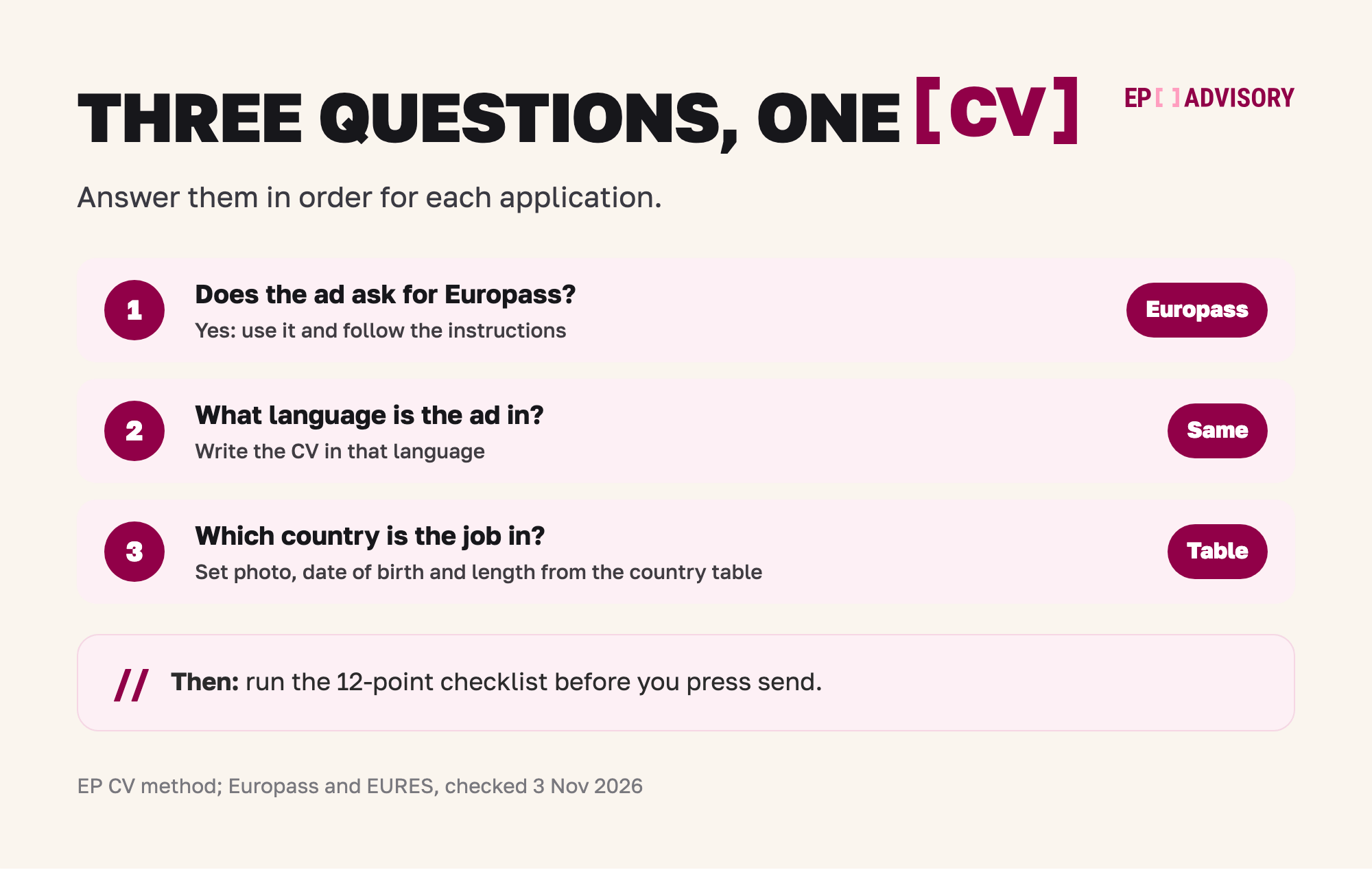
The language you write the CV in matters as much as the level you claim. As a rule, apply in the language of the job ad.
- English ad: English CV, in every country on the table. This is common in IT, engineering, finance and international firms.
- Local-language ad: local-language CV. Germany, Austria, the Netherlands, France, Spain, Italy, Portugal, Poland, Czechia and Norway default to the local language.
- Two-language countries: in Belgium, write Dutch for Flanders, French for Wallonia and either for Brussels. In Switzerland, follow the region: German for Zurich, Basel and Bern, French for Geneva and Lausanne, Italian for Ticino.
European CV template you can copy
This is the two-page layout we use as the base for a European CV. Copy it, fill it in, then adjust it with the country table.
FIRST NAME LAST NAME
Target job title (for example: Senior Financial Analyst)
City, Country · +00 000 000 0000 · [email protected] · linkedin.com/in/yourname
Right to work: [only if it helps, for example "EU citizen" or "EU Blue Card holder"]

PROFILE
Two to four lines. What you do, in which industry, at what scale,
and your strongest result for this kind of role.

WORK EXPERIENCE
Job title · Company · City, Country · MM/YYYY – present
One line on the company or team, if the name is not known in this country.
- Achievement with a number: what you did, how, and the result.
- Achievement with a number.
- Achievement with a number.

Job title · Company · City, Country · MM/YYYY – MM/YYYY
- Achievement with a number.
- Achievement with a number.

Earlier roles (one line each)
Job title · Company · Country · YYYY – YYYY

EDUCATION
Degree, subject · University · Country · YYYY
Thesis or grade only if strong and relevant.

SKILLS
Tools and methods: name the software and methods the ad asks for.

LANGUAGES
English: C1 (certificate, year) · German: B2 · [Mother tongue]: native

CERTIFICATIONS
Name of certificate · Issuing body · YYYY
Country add-ons, in the order they go on the page:
- Germany, Austria, Switzerland: photo top right (in Germany, only if you use one). Use a table layout, with dates in a narrow left column. Switzerland: add date of birth and nationality under your contact details.
- Denmark: photo next to your profile, and a short “About me” at the end: age, family, hobbies, and whether your family will move with you.
- Italy: last line, “Autorizzo il trattamento dei miei dati personali ai sensi del D.Lgs. 196/2003 e del Regolamento UE 2016/679 (GDPR).” It means: I authorise the processing of my personal data under the Italian privacy code and the GDPR.
- Poland: last line, “I consent to the processing of my personal data by [company name] for the purpose of this recruitment, in accordance with Regulation (EU) 2016/679 (GDPR).” In a Polish CV: “Wyrażam zgodę na przetwarzanie moich danych osobowych przez [nazwa firmy] w celu prowadzenia rekrutacji, zgodnie z Rozporządzeniem (UE) 2016/679 (RODO).” If the ad gives its own wording, use that instead.
- France: under your job title, a one-line pitch: your field, years of experience and what you are looking for.
- Graduates, any country: move Education above Work Experience, and keep the CV to one page.
Keep the design plain: one column, a standard font, clear headings, no skill bars or star ratings. Applicant tracking systems (the software that stores and searches applications) read plain text best. If you work in design or media, our guide to creative CVs covers when a visual CV pays off.
Five lines to fix before you send
Most CVs we see from people moving countries need the same five fixes. Each one takes minutes.
1. The header. A header copied from a home-country template often carries too much.
- Before: “Curriculum Vitae. Name: Arjun Mehta. Date of birth: 14.03.1991. Marital status: married. Father’s name: R. Mehta. Address: 12 Park Street, Flat 4B, Pune 411001, India.”
- After: “Arjun Mehta. Senior Financial Analyst. Pune, India · +91 98200 00000 · [email protected] · linkedin.com/in/arjunmehta”
2. The opening line. An objective says what you want. A profile says what you offer.
- Before: “Objective: to obtain a challenging position in a reputed organisation where I can use my skills.”
- After: “Financial analyst with 8 years in FP&A for manufacturing groups. Built the monthly forecast model for a €400M business unit and cut the close from 9 to 5 working days.”
3. The languages line.
- Before: “Languages: English (fluent), German (intermediate).”
- After: “English: C1 · German: B1 (Goethe-Zertifikat B1, 2025) · Hindi: native”
4. A duty that should be a result.
- Before: “Responsible for monthly reporting.”
- After: “Rebuilt monthly reporting in Power BI for 6 plants, so plant managers got numbers on day 3 instead of day 8.”
For 100 more lines like this, by role, see our CV achievements examples.
5. The dates.
- Before: “2019–2022”, “Jan 2022 – now”, “01.03.2018 – 31.12.2018”.
- After: “03/2019 – 06/2022”, “01/2022 – present”, “03/2018 – 12/2018”. Month and year, one format, every role.
The examples above are illustrations, not real people. For the general rules of a strong CV in English, our guide to an impressive CV based on 30,000 successful resumes goes deeper.
Checklist: 12 checks to run on your European CV
Open your CV next to this list. Each check is a yes or no.
- Format: Europass only if the ad asks for it; a custom CV otherwise.
- Language: the CV is in the language of the job ad.
- Length: two A4 pages at most, one if you are a graduate or junior.
- Paper: A4, not US Letter.
- Header: name, job title, city and country, phone with country code, email, LinkedIn.
- Photo: included only where the table says include or common, and a professional one.
- Date of birth and nationality: only where the table says include, common or optional, and only if you want them there.
- Nothing extra: no marital status, children, religion, health, parents’ names or ID numbers (Denmark’s “About me” is the one exception).
- Order: profile, experience, education, skills, languages. Education first only if you are a graduate.
- Dates: month and year, one format, newest first, gaps over a few months explained in one line.
- Languages: a CEFR level for each, certificate and year where you have one (words in Finland).
- Local extras: consent line for Italy or Poland, permit status for Switzerland, academic titles for Austria.
If you tick all 12, your CV matches what a European recruiter expects to see. The next question is how it reads. Getting ready to apply for jobs in Europe? Check your CV for free: see it the way a recruiter does, then fix each problem.
Your cover letter follows the same country rules. Our guide to a cover letter for a job abroad shows how to write one. Once the CV and letter get you a call, read how to pass a job interview. If you would like us to rewrite both documents with you, see our CV and LinkedIn service.
Key takeaways
- There is no single European CV format: use the shared European conventions, adjusted for one country.
- Europass is free, run by the European Commission and available in 31 languages; send it when the ad or call asks for it.
- For private employers, send a custom CV of two A4 pages at most, newest job first.
- Austria, Switzerland and Denmark expect a photo; the UK and Ireland leave it out; Belgium and Italy add one only if asked; most others treat it as optional.
- Leave out date of birth in the UK, Ireland, France, Poland, Czechia, Sweden and Finland, and skip it in Spain; it is optional or common in most of the rest.
- Give every language a CEFR level from A1 to C2, with a certificate and year where you have one.
- Write the CV in the language of the job ad.
See what a recruiter sees, then fix it before you apply. An instant score, then the fix for every problem.
Free, no card. A free account unlocks every fix.
Frequently asked questions
What is the European CV format?
There is no single official format. In practice it means a CV of two A4 pages at most, in reverse chronological order, with a short profile and a level for each language. Photo, date of birth and the language you write in change by country.
Should I use a Europass CV?
Use Europass when the job ad or call asks for it, which happens most in public-sector calls and EU bodies. For private employers, a custom two-page CV in the country’s style usually serves you better. EURES says Europass is not well established among Dutch employers.
Do European CVs need a photo?
It depends on the country. Austria, Switzerland and Denmark expect one. Germany, the Netherlands, Spain and several others treat it as optional and common. The UK and Ireland leave it out, and Belgium and Italy only add one if the employer asks.
Should I put my date of birth on a European CV?
Only where it is usual. Switzerland expects it, and in Germany, Italy, the Netherlands and Norway it is common or optional. Leave it out in the UK, Ireland, France, Poland, Czechia, Sweden and Finland, and Spain does not need it. When unsure, leave it out.
How long should a European CV be?
Two A4 pages at most for experienced candidates, and one page for graduates and juniors in many countries. Switzerland accepts a third page for senior or academic profiles. Three pages read as too long in many European countries.