 By Andre Atallah, CEO of EP Advisory

Short answer: a cover letter for a job abroad has to answer three questions a local applicant never faces. Why you, why this country, and can you start? Keep it to one page. Open with who you are and the role you want. Give one result with a number, then a real reason for the move. End with one factual line on your right to work, your notice period and a start date. Write it in the language of the advert.
A common mistake is to send your home letter with “I am willing to relocate” at the end. The employer then has to guess whether you can work there, when you could arrive and whether you will stay. A good cover letter for a job abroad answers all of that in one page, in the order the reader worries about it.
This guide is for anyone applying across a border, with or without a visa. You get the letter method we teach, the right-to-work line for each situation, a table of letter conventions for 15 markets, three full example letters, a template to copy and a checklist to run before you send. For nearly 10 years, we’ve helped more than 5,000 professionals find jobs abroad. Want to know if your CV will pass screening in another country? Check your CV for free: a score in 30 seconds, then a fix for each problem.
What changes in a cover letter for a job abroad
A local applicant only has to prove they can do the job. You also have to prove the move is real and simple.
When a hiring manager opens an application from another country, three questions come up before your skills. Why you, rather than a local applicant? Why here, and will you stay? Can you start, legally and on a date they can plan around? Each question has a short, factual answer.
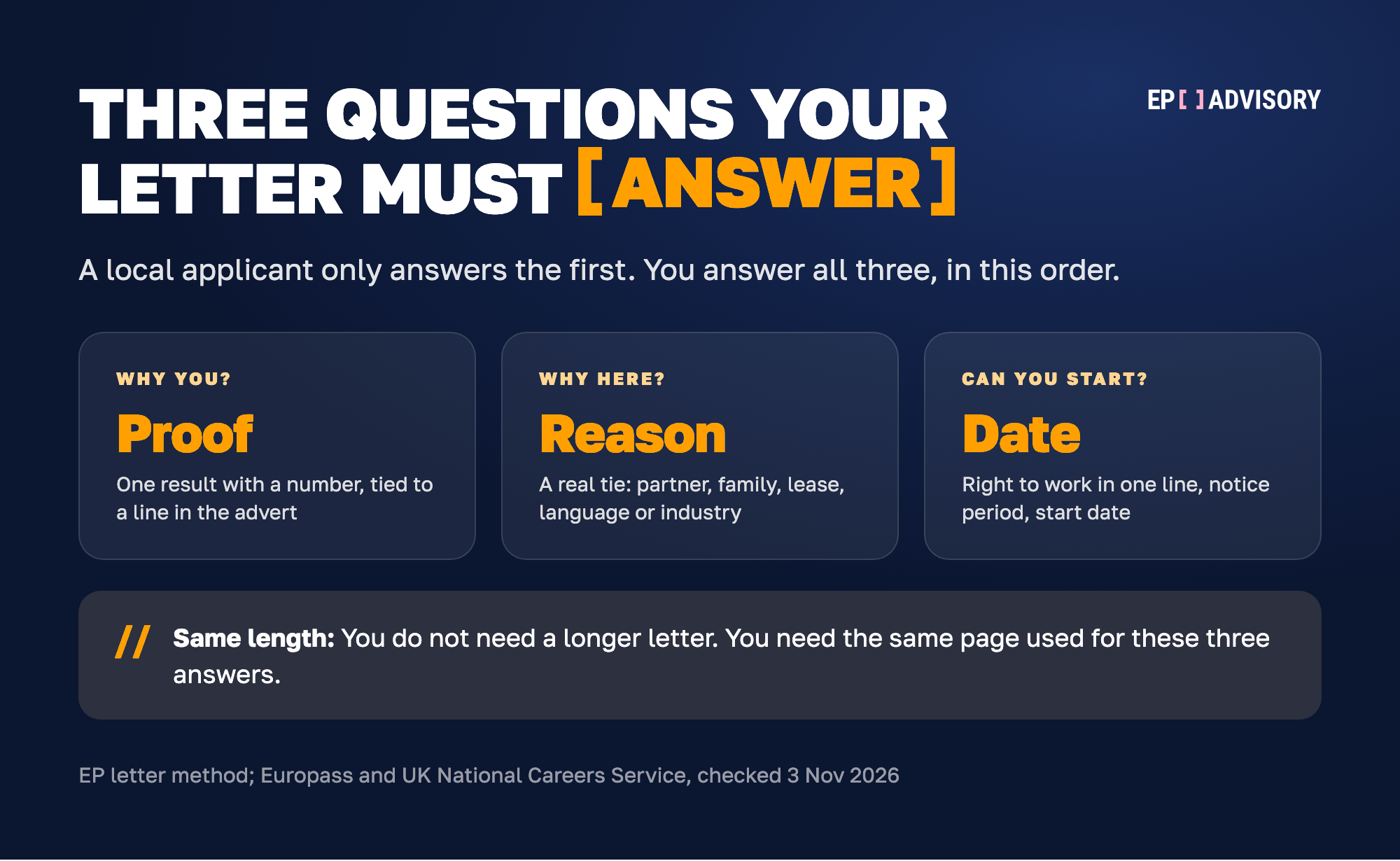
- Why you: one result with a number, tied to a line in the advert.
- Why here: a real tie to the country or city, such as a partner, family, a lease or a language you are learning.
- Can you start: your right to work in one sentence, your notice period and a start date.
Everything else stays the same as a good letter at home.
The letter method we teach: one story, sentence by sentence
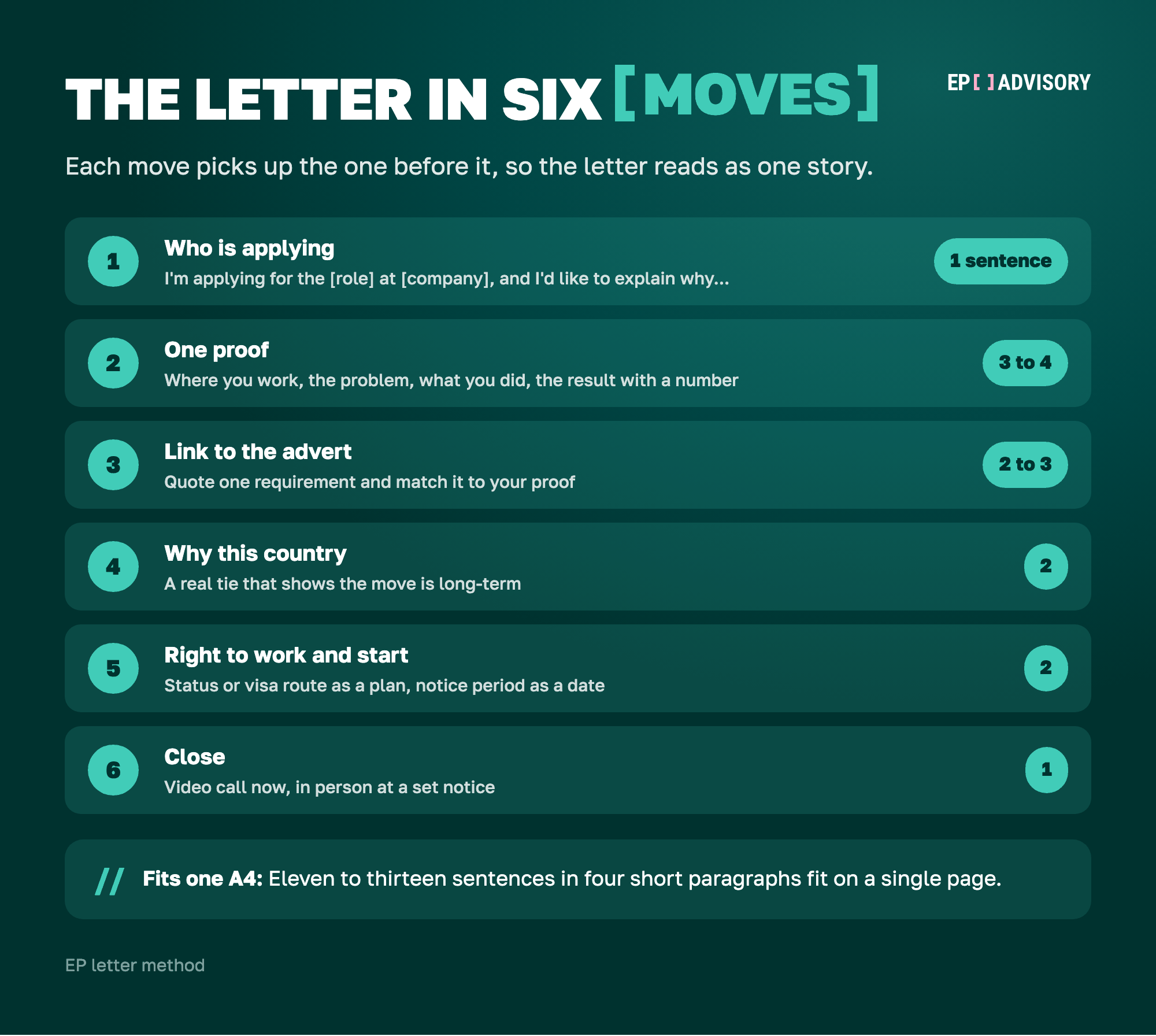
A strong letter reads as one story. Each sentence picks up the one before it.
Start with who is applying
The first sentence introduces you and the role. We teach one opening: “I’m applying for the [role] at [company], and I’d like to explain why…” The second half of that sentence tells the reader what the rest of the letter is about: your experience, your move, or a skill they asked for.
Do not open with a statement about the company. The reader already knows their company. They need to know who you are.
Let each sentence lead to the next
After the opening, every sentence picks up a word or idea from the sentence before it. “In those four years…” follows a sentence about four years.
What to cut
- Slogan sentences. “I am a passionate, results-driven professional.” It could be anyone.
- A colon followed by a list of skills. “I bring: leadership, communication, Excel.” The letter proves one skill with a story instead.
- General truths. “Data is the key to modern logistics.”
- Apologies. “I know I am not local, but…” or “Please excuse my English.” State the facts and move on.
Before and after: the opening
| Before | After |
| I am writing to express my enthusiastic interest in the position of Data Engineer at your esteemed company. | I’m applying for the Senior Data Engineer role at Fernweg Logistics, and I’d like to explain why my last four years match it closely. |
| Fernweg Logistics is one of Europe’s most innovative freight companies, and I have long admired your work. | In those four years I built the data pipelines behind delivery forecasts at a freight software company in Bengaluru with 220 staff. |
| I am a dynamic, passionate engineer with skills in: Kafka, Spark, Snowflake, dbt. | I rebuilt the ingestion layer in Kafka and dbt, and the average forecast error fell from nine hours to three within two quarters. |
The “after” column is three sentences of one story. Each starts from the sentence before it.
Score your CV in 30 seconds, then fix its biggest problems one by one. Both free.
Free, no card. A free account unlocks every fix.

How to write the right-to-work line
One factual sentence, in the paragraph about your move. Never an apology, never a question.
If you hide your visa situation, the employer guesses, usually the worst. If you open with it, the visa is the first thing they read about you. So we split it across three documents:
- On the CV: good news only. One line under your contact details when it helps, for example “Right to work: EU citizen” or, in Ireland, “Stamp 4” (the permission stamp you already hold). Never write that you need sponsorship on the CV. The UAE is the exception, where visa status is a normal CV line.
- On the application form: answer the sponsorship question honestly. That is where the employer expects it.
- In the letter: one sentence that states your status or route, framed as a plan, next to your start date.
Pick the line that matches your situation. These are wording examples, not advice on which permit fits your case:
| Your situation | A line that works |
| EU citizen applying in another EU country | “As a Spanish citizen, I can work in the Netherlands without a permit.” Your Europe confirms EU nationals generally need no permit. |
| You already hold a permit | “I hold a UK Graduate visa until July 2027, so I can start without sponsorship.” Name the permit exactly as it appears on your card. |
| Partner of a UK Skilled Worker | “I am applying as a dependant partner on my wife’s Skilled Worker visa, which will let me work for any employer.” GOV.UK says partners can work, except as a sportsperson or coach. |
| You plan to apply for a German EU Blue Card | “I would apply for an EU Blue Card with your offer. The salary range in your advert is above the 2026 minimum of €50,700 gross a year.” The figure is from Make it in Germany. |
| You plan to apply for a UK Skilled Worker visa | “I would apply for a Skilled Worker visa with your offer, and I have checked that the role’s salary meets the visa rules.” Check first that the employer is on the GOV.UK register of licensed sponsors. |
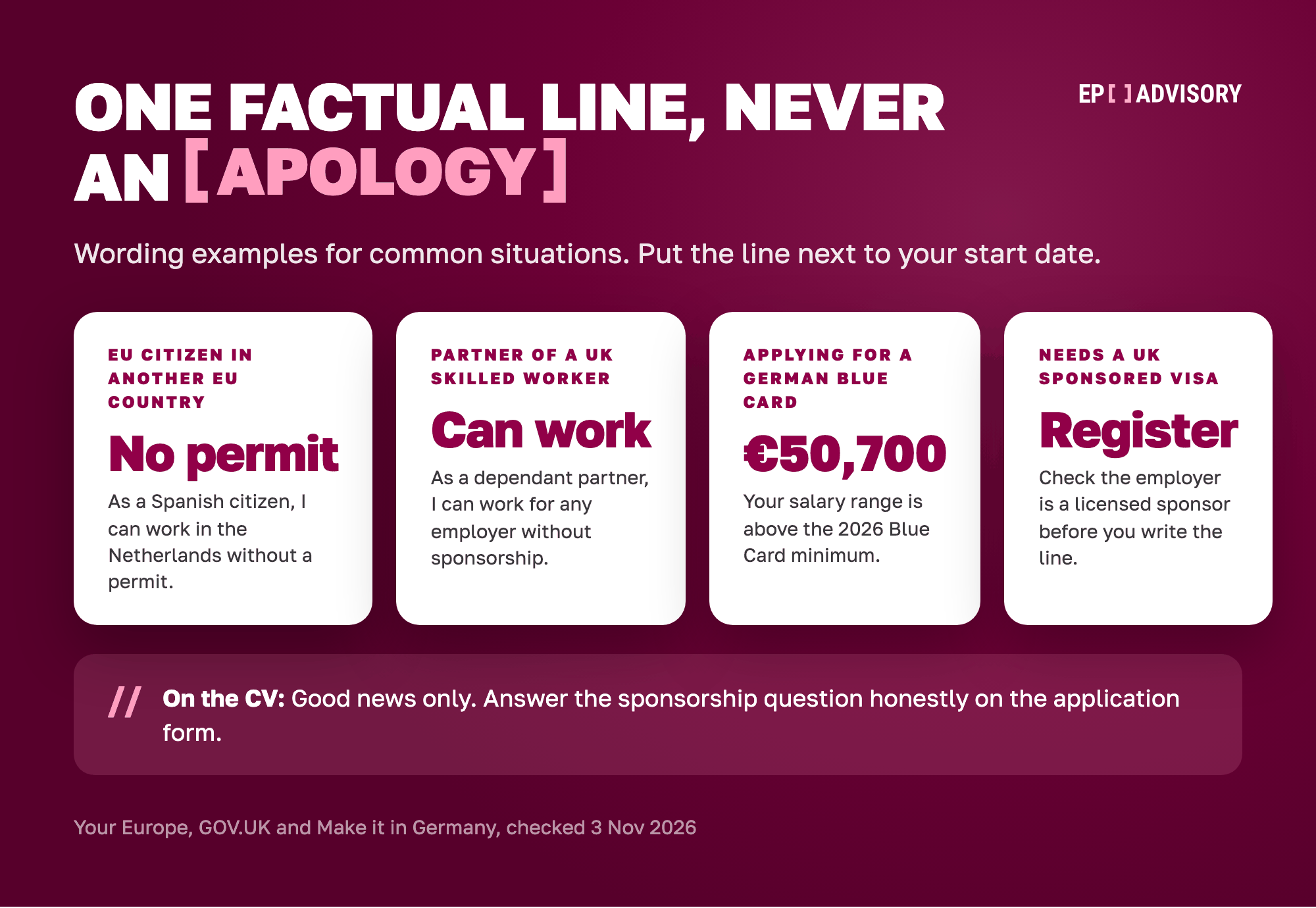
The Germany line answers a real worry. The Make it in Germany Blue Card overview says the Federal Employment Agency normally approves the job during the visa process, except for Blue Cards at €50,700 a year or more. So at or above that salary, the employer has one step fewer. In shortage jobs and for graduates within three years of their degree, the 2026 minimum is €45,934.20, but that route needs the agency’s approval as a rule. For the UK salary rules, see our guide to the UK Skilled Worker visa salary threshold.
In the Netherlands, employers who hire highly skilled migrants must be recognised sponsors. You can check the IND public register before you write the line. Visa rules change often, so check the current rules with the official site or a regulated adviser before you rely on any line above.
Two lines to avoid:
- “I would require visa sponsorship, which I hope will not be a problem.” It invites a “no”.
- “I am willing to relocate anywhere.” It says you have no tie to their city.
Why this country, relocation and notice: the lines that settle the move
Give a real reason, a date and a plan. The employer wants to know the move will happen and will last.
| Before | After |
| I am willing to relocate. | I move to Lyon in March 2027, and I have a lease from 1 March. |
| I have always dreamed of living in Spain. | My partner is from Valencia, and we have spent every summer there for six years, so we are settling there for good. |
| I can start whenever suits you. | My notice period is three months, so I can start on 1 April 2027. |
| I am open to discussing a relocation package. | (Leave it out. Ask about relocation support once they make an offer.) |
| Please excuse my English. | I have worked in English every day for three years with our London office. |
Why this country
The best reasons are concrete and personal, such as a partner’s job, family, a place you know or a language you are learning. One or two sentences are enough. If your reason is the job market, say what you know about it. If you are still choosing a country, our guide on how to find a job in Europe compares markets.
Notice period and start date
Give your notice period as a fact and turn it into a date. If you need a visa, allow time for it before the date. The German job service tells applicants to name a possible start date when the employer asks for one. From abroad, give it even when they do not ask. Then offer a video call for early rounds and a date when you can be there in person. When the interviews come, our guide on how to pass a job interview covers preparation.
Cover letter conventions by country
The page is one A4 almost everywhere. Language, salary format and the sign-off change by country.
This table follows the country guides behind our CV check. “Only if asked” means leave salary out unless the advert or form asks.
| Country | Local name | Length | Language | Salary | Close and local habits |
| UK | Cover letter | 1 A4, 3 to 5 paragraphs | English | Only if asked | “Yours sincerely” to a name; “Yours faithfully” to “Sir or Madam” |
| Ireland | Cover letter | 1 page, 3 to 4 paragraphs | English | Only if asked | Subject line with the job title or reference; ask for an interview |
| Germany | Anschreiben | 1 A4 max | German, or English if the advert is in English | If asked, gross per year, next to your start date | “Mit freundlichen Grüßen”; for a traditional application, place, date and scanned signature |
| Austria | Anschreiben | 1 page | German unless the advert is in English | If asked, above the minimum the advert must state | Named contact with correct title; place, date and signature |
| Switzerland | Motivationsschreiben or lettre de motivation | 1 A4 max, typed | Language of the advert and region | Often asked: gross per year in CHF | One PDF with the CV, work certificates and key diplomas |
| Netherlands | Sollicitatiebrief | 1 A4, short and direct | Dutch unless the advert is in English | If asked, a gross monthly range | Ask for an interview |
| France | Lettre de motivation | 1 page, about 4 paragraphs | French unless the advert is in English | If asked (“prétentions salariales”), a gross yearly range | Formal formula, “Veuillez agréer…” |
| Spain | Carta de presentación | 1 page max | Spanish unless the advert says otherwise | Leave for the interview unless the advert asks | Full name; by email, a shorter letter in the body |
| Italy | Lettera di presentazione | 1 page, recommended but optional | Italian unless the advert is in English | If asked, an expected gross yearly figure (RAL) | Formal tone; place and date |
| Denmark | Ansøgning | 1 A4; weighed as much as the CV | Language of the advert | Only if asked | Hard skills first; what the company gains |
| Sweden | Personligt brev | Half to 1 A4 | Language of the advert | If the advert asks for “löneanspråk”, a range | Concrete examples, no clichés |
| Poland | List motywacyjny | 1 A4 | Language of the advert | Only if the advert asks | Formal tone |
| UAE | Cover letter | Half a page, 3 paragraphs; optional unless asked | English | If asked, a monthly all-in package in AED | Visa status and notice period are fine to state |
| USA | Cover letter | 1 page, 3 to 4 paragraphs | English | Range only if asked | No signature needed |
| Canada | Cover letter (lettre de présentation in Quebec) | 1 page, 3 to 4 paragraphs | English; French in Quebec unless the advert is in English | Only if asked | No signature needed |
Official sources agree. The UK National Careers Service describes “a short letter, usually 3 to 5 paragraphs long”. The Bundesagentur für Arbeit asks for no more than one A4 page and says to raise salary only when it is requested. France Travail recommends a three-part “vous, moi, nous” structure on a single page. Workindenmark says a cover letter is often just as important as a CV in Denmark.
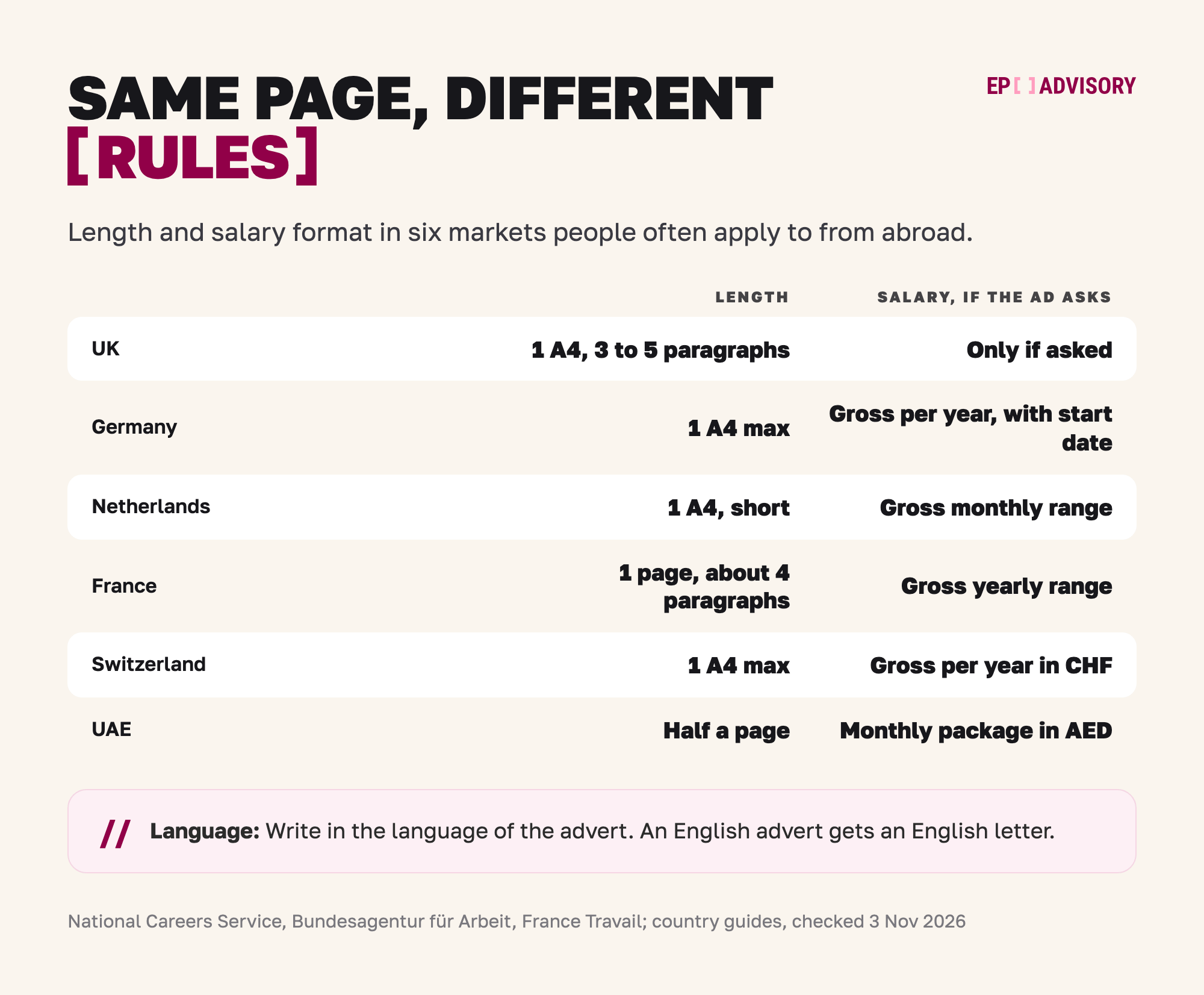
Three rules that hold across the table
- Language follows the advert. An English advert gets an English letter, even in Germany or France. If the advert is in a language you are not fluent in, write in English and give your level, for example “German B1”.
- Salary stays out unless asked. When it is asked, use the local format from the table. In the EU, the Pay Transparency Directive (EU) 2023/970 gives applicants a right to pay information before employment and bans questions about salary history once it is in national law. Countries had to transpose it by 7 June 2026, and many were late, so check how your country applies it.
- No photo on the letter. A photo belongs on the CV, if anywhere. Our country guides treat it as expected in Austria, Switzerland and Denmark, and optional in Germany.
For Germany in more depth, see our guide to jobs in Germany for foreigners. For Switzerland’s full application dossier, see how to find a job in Switzerland as a foreigner.
Three full example letters for real cross-border cases
Each letter follows the same method: who is applying, one proof, the link to the advert, the move, the right to work and the start date.
The people and companies are invented. The situations are the three we see most often: a visa is needed, no visa is needed, and the move follows a partner.
Example 1: visa needed (India to Germany, advert in English)
Kavya is a data engineer in Bengaluru. The advert is in English, with a range of €68,000 to €78,000 a year gross. She is not an EU citizen, so the employer’s biggest question is the visa.
Kavya Raghunathan
Bengaluru, India · +91 90000 00000 · [email protected] · linkedin.com/in/kavyaraghunathan

12 November 2026

Ms Julia Hartmann
Head of Data Platform, Fernweg Logistics GmbH, Munich

Subject: Senior Data Engineer, ref. DE-2291

Dear Ms Hartmann,

I'm applying for the Senior Data Engineer role at Fernweg Logistics, and I'd like to explain why my last four years match it closely. In those four years I built the data pipelines behind delivery forecasts at Kargo Route, a freight software company in Bengaluru with 220 staff. When I joined, the forecasts were wrong by an average of nine hours, mostly because GPS pings from trucks arrived late and out of order. I rebuilt the ingestion layer in Kafka and dbt so that late pings were put back in order before the model saw them, and the average error fell to three hours within two quarters.

That project is why your advert stood out to me, since it asks for someone to clean up event data from European carriers before it reaches your planning tools. Your carriers would be new to me, but I have fixed this kind of late, messy data before, in Spark and Snowflake, the two tools your advert names. Beyond the tools, I have worked in English with teams in Singapore and Rotterdam for three years, and I passed my German A2 exam in September, with B1 as my goal for the first year.

That first year would be in Munich because my partner and I have chosen it. We have visited twice, and we want to live in a city where logistics is a major employer, so this move is a long-term plan. I would apply for an EU Blue Card with your offer, and since your salary range is above the 2026 minimum of €50,700 gross a year, the Federal Employment Agency would not need to approve the job. Once the offer is signed, my notice period at Kargo Route is 60 days, so I could start on 1 March 2027 if we agree terms by the end of December.

Until then, I would be glad to talk on a video call at any time that suits your team, and I can travel to Munich for a final interview at two weeks' notice.

Kind regards,
Kavya Raghunathan
Why it works:
- The proof comes before the visa. By the time she reads “Blue Card”, the reader already wants the person.
- The visa line answers the employer’s real worry. It says the salary clears the 2026 minimum, so there is one step fewer for them.
- The start date is a date. It allows for the notice period and the visa.
Example 2: no visa needed (Spain to the Netherlands, salary asked)
Lucía is a Spanish citizen in Madrid, so she needs no permit in the Netherlands. The advert asks for salary expectations.
Lucía Vidal
Madrid, Spain (moving to Amsterdam in January 2027) · +34 600 000 000 · [email protected]

Dear Mr de Vries,

I'm applying for the CRM Marketing Lead role at Versbox, and I'd like to explain why I think I can help your customers order again. For the past five years I have run email and app marketing at Mercafresco, an online grocery in Madrid with 400,000 active customers. In 2025 our data showed that most customers who stopped ordering did so after their third delivery, not their first. So I built a three-message series in Braze for customers between their second and fourth order, and the share who placed a fifth order rose from 41% to 52% in six months.

Your advert asks for someone to "turn first orders into habits", which is the same problem in a new market. To learn that market, I have spent the past two months ordering from Versbox and three other Dutch grocers and reading every email they sent, in the Dutch I am learning (now A2). The first test I would run is whether delivery-slot reminders work as well in Amsterdam as they did in Madrid, where they were the main reason customers came back.

Amsterdam is where I want to do that work for the long term. My sister has lived in Utrecht for six years, I have spent long stays with her, and I have signed a lease in Amsterdam from 15 January. As a Spanish citizen, I can work in the Netherlands without a permit, and my notice period is one month, so I can start on 1 February 2027. You asked for my salary expectation, which is €4,600 to €5,000 gross a month.

I will be in Amsterdam from 24 to 28 November and would be glad to meet that week, or to talk on a video call before then.

Kind regards,
Lucía Vidal
Why it works:
- The right-to-work line is one clause. With no visa needed, it takes no more space than that.
- The salary is in the Dutch format. Gross per month, as a range, only because the advert asked.
- The research is shown, not claimed. She ordered from them and read their emails.
Example 3: moving with a partner (Brazil to the UK)
Rafael is a supply chain planner in São Paulo. His wife has a Skilled Worker visa for a job in Manchester. As her dependant partner he can work for almost any UK employer, once his own visa is granted. A hiring manager seeing a Brazilian address will not know that, so his letter settles it first.
Rafael Souza
São Paulo, Brazil (Manchester, UK from January 2027) · +55 11 90000 0000 · [email protected]

20 November 2026

Mr Anil Patel
Head of Planning, Holmfield Foods Ltd, Salford

Subject: Supply Chain Planner, ref. SCP-114

Dear Mr Patel,

I'm applying for the Supply Chain Planner role at Holmfield Foods, and I'd like to explain why I am applying from São Paulo for a job in Salford. My wife has accepted a structural engineering job in Manchester, and we move there in January 2027. I am applying as her dependant partner on her Skilled Worker visa, which will let me work for any employer without sponsorship, and I can show it for your right-to-work check before I start.

That leaves the question of whether my experience fits your planning team. For six years I have planned production for Frio Bom, a frozen-food maker with three factories near São Paulo. When I started, our forecasts lived in 14 spreadsheets, and forecast accuracy for our top 50 products was 68%. I moved planning into SAP IBP and set up a weekly demand review with sales, and within a year accuracy rose to 81% and write-offs of expired stock fell by a third.

Your advert asks for SAP IBP experience and for someone to run the weekly sales and operations meeting, which is the work I described above. Your chilled range has a much shorter shelf life than frozen food, so I would need to learn shorter planning windows, and I have already started by studying how chilled planning is done at two of our customers. I have worked in English with our UK and US buyers for four years, mostly on weekly service-level calls.

Those calls can continue until I leave Frio Bom at the end of December, so I can start on 1 February 2027. Before then I would be glad to talk on a video call, and from mid-January I can meet in Salford at a day's notice.

Yours sincerely,
Rafael Souza
Why it works:
- The worry is answered in the first paragraph. A Brazilian address raises the visa question at once, so the letter settles it at once.
- The line uses GOV.UK’s own terms. UK employers must check every new hire’s right to work, so offering it helps them.
- The gap is named and handled. Chilled food is new to him, and he says what he is doing about it.
Each letter points back to results on the CV. If yours are still duties, our list of CV achievements examples shows how to rewrite them. Applying to the UK from the US? Our UK CV vs US resume guide shows what changes on the CV, and our page on why UK employers ignore American applications covers the rest. Getting ready to apply for jobs in another country? Check your CV for free: see it the way a recruiter does, then fix each problem.
A cover letter template you can copy
Fill each bracket with one fact. Then read it aloud and check that every sentence leads to the next.
[Your full name]
[City, country] ([moving to City in Month Year], only if true) · [phone with country code] · [email] · [LinkedIn]

[Date]

[Name of the hiring manager]
[Their job title], [company], [city]

Subject: [job title], ref. [reference from the advert]

Dear [Ms / Mr Surname],   (or the local formula, see the country table)

I'm applying for the [job title] at [company], and I'd like to explain why [the one thing the letter will show: my experience matches it / I am applying from another country / I can solve the problem in your advert]. [A sentence that picks up that point: where you work, how long, the size of the team or company.] [A sentence on the problem you faced there.] [A sentence on what you did and the result, with one number.]

That [project / result] is why your advert stood out to me, since it asks for [a requirement in the advert's own words]. [A sentence that matches one more requirement to one more piece of proof.] [A sentence on the working language and your level, for example "I have worked in English every day for three years".]

[A sentence on why this country and city: a partner, family, a lease, an industry, a language.] [A sentence that shows the move is long-term.] [Your right-to-work sentence, from the right-to-work table.] [Notice period turned into a date: "My notice period is X, so I can start on [date]".] [Only if asked: "You asked for my salary expectation, which is [range in the local format]".]

[Close: "I would be glad to talk on a video call at any time that suits you, and I can be in [city] for a final interview at [X] notice."]

[Local sign-off],
[Your full name]
Save the letter as a PDF with your name in the file name. If you apply by email, as is common in Spain, put a shorter version in the email body. The Europass cover letter editor builds letters in 31 languages. Use your own text in it, not its default phrases.
Checklist: 12 checks before you send
Run these on your own letter. If one fails, fix it before you apply.
- The first sentence introduces you and the role. Not the company.
- Every sentence picks up the one before. If a sentence could go anywhere, cut it.
- There is one result with a number. It is tied to a line in the advert.
- No slogans, no general truths, no colon lists. Search for “passionate”, “results-driven” and “:”.
- The reason for the move is real. Not a dream.
- The right to work is one factual sentence. No apology, no question.
- Your status or route is correct today. Checked on the official site, and the sponsor register if you need one.
- There is a start date. Notice and visa time are turned into a date.
- Salary is in only if they asked. Then in the local format and currency.
- The language matches the advert. Levels are stated honestly.
- It fits on one page. Half a page is fine in the UAE and Sweden.
- The close and contact details are local. Local sign-off, phone with country code, a named reader, the job reference.
Next: make sure the CV behind the letter follows local rules. Our European CV format guide has the country table for photos, personal details and length.
Key takeaways
- A cover letter for a job abroad answers three questions: why you, why this country, and can you start.
- Open with “I’m applying for the [role] at [company], and I’d like to explain why…”, and let each sentence pick up the one before.
- Put one result with a number before any mention of your move or visa.
- Write the right to work as one factual sentence. In Germany, a salary at or above the 2026 Blue Card minimum of €50,700 gross a year means one step fewer for the employer.
- Turn your notice period into a start date, and offer a video call now and an in-person date later.
- Keep it to one A4 page almost everywhere, and the UK National Careers Service suggests 3 to 5 paragraphs.
- Write in the language of the advert, and give salary only if asked, in the local format.
See what a recruiter sees, then fix it before you apply. An instant score, then the fix for every problem.
Free, no card. A free account unlocks every fix.
Frequently asked questions
Should I mention visa sponsorship in a cover letter?
Yes, in one factual sentence near your start date, after you have shown your results. Say your status or route as a plan, for example that you would apply for an EU Blue Card with the offer. Do not apologise or ask whether it is a problem. Keep the CV to good news only, and answer the sponsorship question honestly on the application form.
How long should a cover letter for a job abroad be?
One A4 page in almost every market. The UK National Careers Service suggests 3 to 5 paragraphs, and the German and French job services both ask for no more than one page. In the UAE and Sweden, half a page is normal.
Should I write my cover letter in English or the local language?
Write in the language of the advert. If the advert is in English, an English letter is right even in Germany, France or the Netherlands. If the advert is in the local language and you are not fluent, write in English and state your level honestly, for example German B1. Never send a machine translation you could not defend in an interview.
Do I put my salary expectations in a cover letter for a job abroad?
Only if the advert or form asks. Then use the local format: a gross yearly figure in Germany, France and Switzerland, a gross monthly range in the Netherlands, and a monthly package in the UAE. Put it near the end, next to your start date. In the EU, employers may not ask about your salary history where the Pay Transparency Directive is in national law.
Do I need a photo or a signature on a cover letter abroad?
No photo on the letter. Where a CV photo is expected, as in Austria, Switzerland or Denmark, it goes on the CV. In Germany a CV photo is optional. A signature depends on the country. A scanned signature suits a traditional German application, and Spain expects your full name at the end. In the UK and the US, a typed name after the sign-off is enough.