 By Alisa Schlosser, Career Consultant at EP Advisory
The average salary in Norway in 2026 is NOK 62,070 per month gross (about €5,600); the median is NOK 55,800 (SSB, November 2025), and someone on the average wage keeps roughly NOK 46,000 after tax. Norway pays among the highest wages in Europe, in a country where healthcare is essentially free and paid holiday runs to five weeks for most workers (the law guarantees 25 working days; the fifth week comes from collective agreements). In oil, energy, tech and offshore the numbers climb well beyond the average. But behind those figures sits the other half of the equation: income tax and national insurance that take roughly a quarter to a third of a professional salary (47.4% is only the top marginal rate), the third-priciest groceries in Europe (after Switzerland and Iceland), NOK 16,000 a month for a one-bedroom flat in Oslo, and a beer that costs about NOK 110 in a bar (Numbeo, September 2026).
So here is the arithmetic behind the headlines. We break down real salaries by sector, focus on the fields where foreign professionals actually get hired, subtract every mandatory cost, and show you what’s genuinely left at the end of the month.
In nearly 10 years, we’ve helped more than 5,000 professionals find jobs abroad. Want to know if your CV will pass screening in Norway? Check your CV for free: a score in 30 seconds, then a fix for each problem.
A quick word on the currency. Norway uses the krone (NOK) and, unlike the Danish krone, it floats freely, so the rate moves with oil prices and interest rates rather than sitting on a peg. In mid-2026 it trades at roughly €1 ≈ NOK 11 (Norges Bank). An easy shortcut: divide any krone figure by about 11 to read it in euros. So NOK 62,000/month is about €5,600, NOK 780,000/year around €71,000, and the NOK 624,700 work-permit threshold roughly €57,000.
What Is the Average Salary in Norway Per Month? (2026)
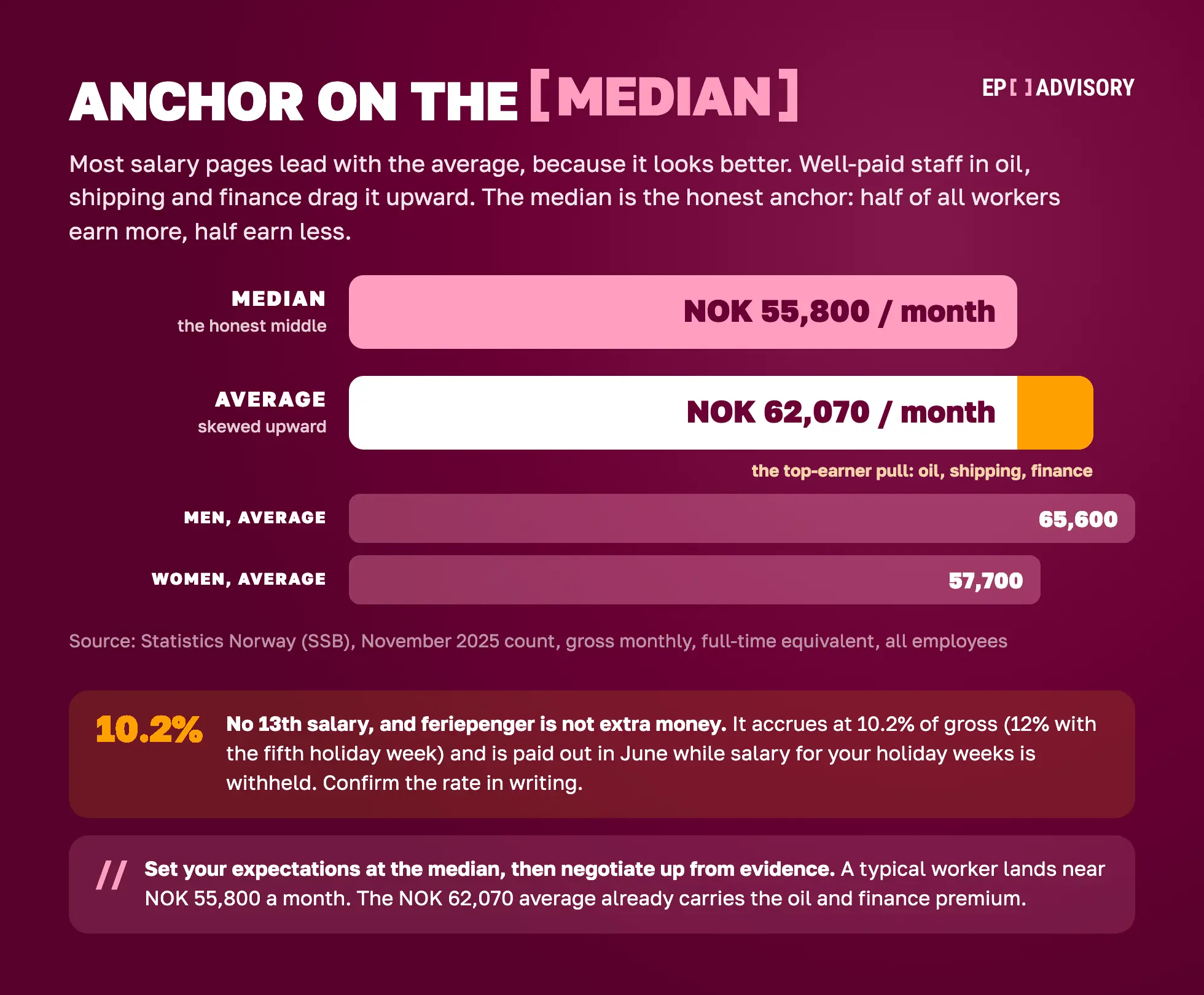
The average salary in Norway in 2026 is about NOK 62,070 per month before tax (around €5,600), per Statistics Norway’s November 2025 count. That figure covers all employees, with part-timers converted to full-time equivalents, and includes bonuses but not overtime. After income tax and national insurance someone on that average wage keeps roughly NOK 46,000 per month net. The median is lower, at NOK 55,800 gross (about NOK 41,800 net), and it is the more honest guide to what an ordinary worker earns. Oil, energy and tech salaries pull the average well above the median.
| Salary in Norway (2026) | Per month, gross | Per month, net |
| Average (full-time equivalent) | NOK 62,070 | ~NOK 46,000 |
| Median (typical worker) | NOK 55,800 | ~NOK 41,800 |
| Skilled-worker permit floor (bachelor) | ~NOK 45,450 | ~NOK 35,000 |
Net figures are approximate and assume Oslo tax levels. See “The Arithmetic” section below for the full gross-to-net calculation.
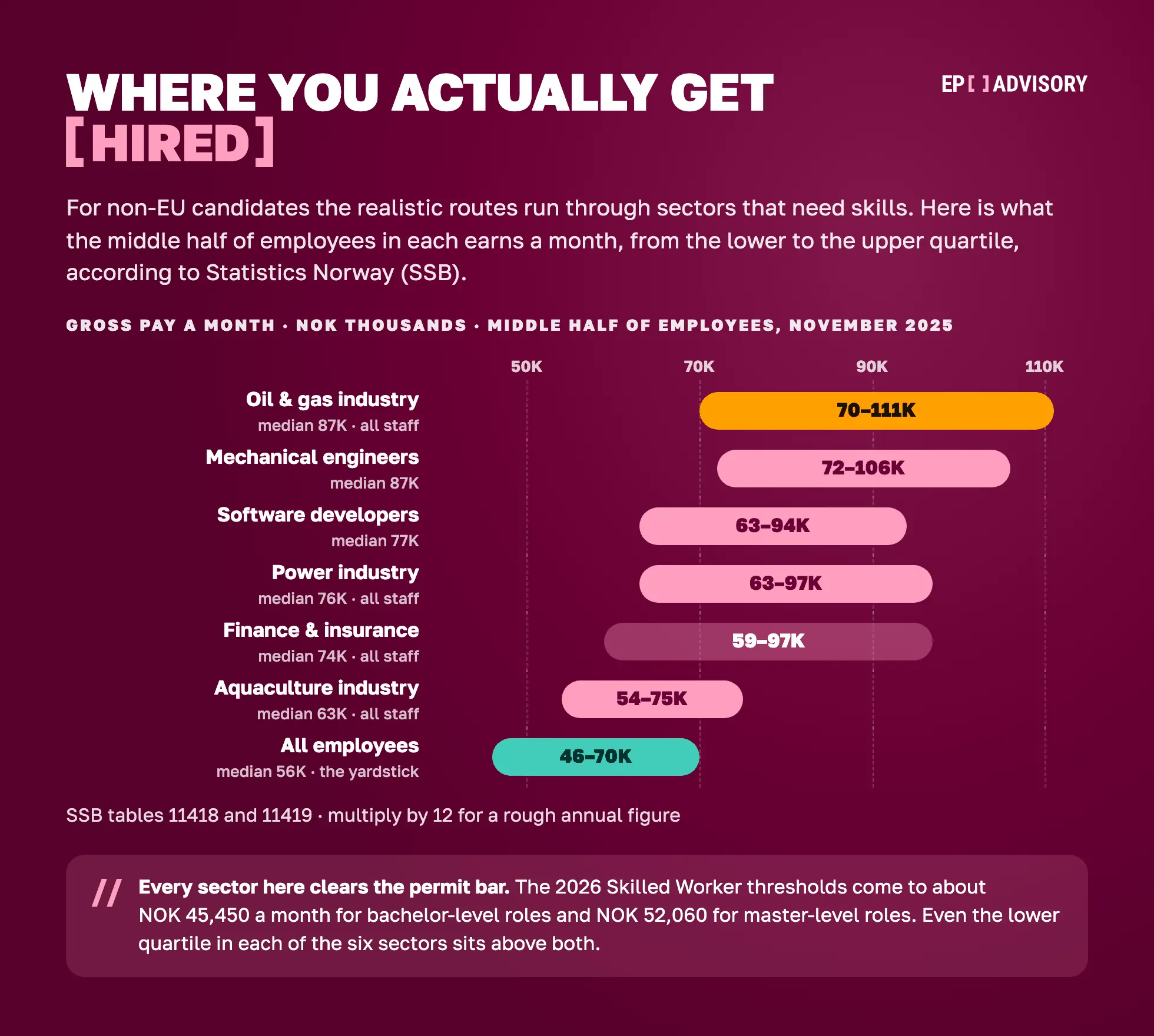
Does Norway have a minimum wage? No. There is no national minimum wage. Binding pay floors exist only in ten regulated sectors such as construction, cleaning and hospitality, set through general application of collective agreements (allmenngjøring). For a foreign professional the real floor is the Skilled Worker permit: NOK 545,400 per year (bachelor-level) or NOK 624,700 per year (master-level).
What counts as a good salary in Norway? Anything above the median, so roughly NOK 56,000 per month gross, is comfortable for one person outside Oslo. Around NOK 65,000 and up absorbs Oslo rents with room to spare.
If the numbers work for you, the next step is practical: our guide to jobs in Norway for foreigners covers where the hiring actually happens, and the European work-visa salary thresholds show what an offer must pay before a permit is possible.
Norwegian Salaries at a Glance: The Essentials
- Average earnings: ~NOK 62,000/month gross, full-time equivalent (about €5,600), up 4.5% on 2024 (Statistics Norway / SSB)
- Median salary: NOK 55,800/month (SSB, November 2025), the more honest anchor for a typical worker
- Men vs women: average monthly earnings are about NOK 65,600 for men and NOK 57,700 for women (SSB)
- No statutory minimum wage: none nationally. Pay floors exist only in sectors with a “general application” order (allmenngjøring), construction, cleaning, hospitality, freight and a few others (Arbeidstilsynet)
- National insurance (trygdeavgift): 7.6% of gross wage in 2026, taken before income tax (Skatteetaten)
- Income tax: a flat 22% on ordinary income (after generous deductions), plus a progressive bracket tax (trinnskatt)
- Bracket tax (trinnskatt) 2026: 1.7% from NOK 226,100, 4.0% from 318,300, 13.7% from 725,050, 16.8% from 980,100, 17.8% above 1,467,200 (Skatteetaten)
- Top marginal rate: about 47.4% on wage income, reached only in the highest band
- Holiday pay (feriepenger): 10.2% of last year’s gross (12% where a collective agreement gives the fifth holiday week), paid out in June while ordinary salary for your holiday weeks is withheld: it replaces pay during vacation rather than adding to the year (ferieloven)
- Occupational pension (OTP): employers must pay at least 2% of salary into a pension scheme, on top of pay. That is the legal minimum, and many employers pay more
- Healthcare: public, funded through national insurance; only small capped co-pays (frikort ceiling NOK 3,278 for 2026), then free
- Wealth tax (formuesskatt): ~1.0% on net wealth above ~NOK 1.9M, a genuine factor for anyone with assets
- Rent, 1-bed Oslo: ~NOK 14,000–18,000/month (cheaper in Bergen, Trondheim and Stavanger)
- Work permit (non-EU): Skilled Worker threshold NOK 545,400 (bachelor-level) or NOK 624,700 (master-level) per year at 2026 rates (UDI)
An important caveat about “median” versus “average”. Most of the salary pages we checked in August 2026 lead with the average, because it looks better. But it’s dragged upward by well-paid staff in oil, shipping and finance. The median is more honest: half of all workers earn more, half earn less. Anchor your expectations to the median.
Salaries by Sector: Where Foreign Professionals Actually Get Hired
This calls for honesty. Norway does not open its doors freely to non-EU nationals: you need a qualified job offer that clears a salary threshold, or a role covered by a collective agreement. Its advantage is a chronic shortage of engineers, developers and health workers, and in energy, tech and maritime the working language is very often English.
Your realistic chances lie in sectors with genuine skill shortages. Here they are, with gross monthly pay from Statistics Norway (SSB) for November 2025 (table 11418 by occupation, table 11419 by industry). The median is the middle earner. The middle half runs from the lower to the upper quartile. Multiply by 12 for a rough annual figure.
| Sector | Monthly pay, NOK gross (SSB, Nov 2025) | Where the jobs are | Odds for non-EU candidates (our view) |
| Oil, Gas & Energy | All staff in oil and gas extraction: median 87,080 (middle half 70,420–111,010) · Petroleum and mining engineers: median 98,500 | Stavanger, Bergen, Oslo | Very high. Equinor, Aker BP, Aker Solutions, Vår Energi |
| IT / Software development | Software developers: median 77,420 (middle half 63,330–93,820) | Oslo, Trondheim, Bergen | High. Developers are in demand across the economy |
| Engineering / Maritime / Offshore | Mechanical engineers: median 87,200 (middle half 71,870–105,820) · Ships’ engineers: median 81,310 | Stavanger, Ålesund, Kongsberg | High. Kongsberg, Aker, Ulstein, DNV |
| Renewable energy / Power / Hydro | All staff in power supply: median 75,920 (middle half 63,430–96,500) · Electrical engineers: median 84,580 | Oslo, Trondheim, west coast | High. Statkraft, Equinor Renewables, Hydro |
| Seafood / Aquaculture | All staff in aquaculture: median 62,980 (middle half 53,960–75,300) · Biologists: median 68,640 | Bergen, Trøndelag, northern Norway | Moderate–high. Mowi, SalMar, Lerøy, biology & tech roles |
| Finance / Fintech | All staff in finance and insurance: median 73,580 (middle half 58,770–96,770) · Financial analysts: median 75,360 | Oslo | Moderate. DNB, Nordea, Storebrand, Vipps |
| Healthcare / Nursing | Nurses: median 57,830 · Specialist doctors: median 107,160 | Nationwide | Moderate. Norwegian authorisation and language required |
| Skilled trades (allmenngjøring) | Electricians: median 54,930 · Plumbers: median 53,750 · Carpenters: median 47,900 | Nationwide | Moderate. Legally binding minimum rates in listed sectors |
A real example. Software developers in Norway earn a median of NOK 77,420 a month, about NOK 930,000 a year or €84,000. The best-paid quarter earn over NOK 93,820 a month, about NOK 1.13 million a year (SSB, November 2025). SSB does not split this job by city. Across all jobs, average pay in Vestland (Bergen) and Trøndelag (Trondheim) is 14–16% below Oslo, while one-bedroom rents there are about 22% lower (SSB tables 11422 and 09895, 2025). The headline number and what you keep can diverge sharply depending on where you land.
Critical when negotiating: Norway has no 13th-month salary, and feriepenger is not extra money either: the 10.2–12% accrued on last year’s earnings is paid out in June while salary for your holiday weeks is withheld, so it covers otherwise unpaid vacation. In your first Norwegian year, with nothing accrued, taking holiday leaves a hole in your pay. On top of that sits the occupational pension (OTP), at least 2% of salary and often more. Always confirm in writing the feriepenger rate, the pension contribution, and whether any bonus or offshore/shift supplement is included in or added to base.
Score your CV in 30 seconds, then fix its biggest problems one by one. Both free.
Free, no card.

Average Salary in Norway by Occupation
Sector ranges tell you the market; occupation groups tell you where you personally land. These are Statistics Norway’s official monthly earnings by major occupation group from the November 2025 count (SSB table 11419), in NOK per month, all employees.
| Occupation group | Average (NOK/month) | Median (NOK/month) |
|---|---|---|
| Managers | 90,510 | 78,020 |
| Professionals (engineers, doctors, IT specialists) | 69,650 | 62,920 |
| Technicians and associate professionals | 69,220 | 62,590 |
| Clerical support workers | 52,110 | 49,560 |
| Plant and machine operators | 52,080 | 48,480 |
| Craft and related trades workers | 51,390 | 50,530 |
| Agricultural, forestry and fishery workers | 48,000 | 46,170 |
| Service and sales workers | 44,790 | 43,840 |
| Elementary occupations | 43,700 | 42,000 |
| All occupations | 62,070 | 55,800 |
The pattern worth noting: the professional and technician bands, where most foreign hires land, both clear NOK 69,000 a month on average, comfortably above the national line.
Salaries by City: Oslo, Stavanger, Bergen and Trondheim
Norway’s pay geography follows its industries. Oslo (headquarters, finance, tech) and Rogaland (Stavanger’s oil cluster) sit above the national average, while the north trails it. Official county figures in NOK per month (SSB table 11422, November 2025):
| County (main city) | Average (NOK/month) | Median (NOK/month) |
|---|---|---|
| Oslo | 70,690 | 62,350 |
| Rogaland (Stavanger) | 64,930 | 57,240 |
| Vestland (Bergen) | 60,800 | 55,430 |
| Trøndelag (Trondheim) | 59,700 | 54,970 |
| Troms (Tromsø) | 58,180 | 54,030 |
| Whole country | 62,070 | 55,800 |
Oslo pays about 14% above the national average, but remember the rent side of the ledger: the NOK 16,000 one-bedroom eats most of that premium. Stavanger’s oil-cluster pay with mid-size-city rents is often the better arithmetic.
Minimum Wage in Norway 2026: No National Rate, Sector Floors from About NOK 200 per Hour
Norway has no statutory minimum wage. Instead, collective agreements in ten sectors are made generally applicable (allmenngjøring), which turns their lowest rate into a legal floor for everyone in that sector, foreigners included. As of September 2026 the floors run from roughly NOK 205 per hour in hospitality and about NOK 237 in cleaning to about NOK 264 for skilled construction workers; agriculture, fish processing, shipyards, electrical work, road freight and (since June 2026) vehicle workshops have their own rates, and Arbeidstilsynet publishes the current figures. Per month that is about NOK 33,000–43,000 gross (≈€3,000–3,900) on a full-time 37.5-hour week, and roughly NOK 27,000–33,000 net. Oslo has no separate minimum wage: the same sector floors apply, and every job outside those sectors must be paid the normal rate for the occupation and region, which is what UDI checks when it issues a work permit.
Where to Look for Work: Official Resources
- Arbeidsplassen (NAV): the official public job portal, run by the labour and welfare service
- Finn.no: Norway’s best-known marketplace, where a large share of private vacancies are posted
- LinkedIn Jobs: one of the main channels for international and English-language roles
- EURAXESS Norway: research and academic positions for international candidates
- NAV / EURES: EU/EEA mobility and public vacancy listings
Official sources worth using to verify any figure:
- Statistics Norway (SSB): official salary and earnings statistics
- Skatteetaten: tax rates, brackets and the official take-home calculator
- UDI: work and residence permits, and the Skilled Worker thresholds
- Norges Bank: the official NOK exchange rate
The Other Side: What Living Here Actually Costs
Now we subtract. Here is the structure of unavoidable costs for a single person, with Oslo as the worst case.
Rent, the biggest line item (30–40% of your budget)
- Oslo: a one-bedroom in the centre runs NOK 14,000–18,000; slightly out from the centre NOK 12,000–15,000
- Bergen, Trondheim & Stavanger: NOK 11,000–15,000, roughly 20–30% below Oslo
- Smaller towns: NOK 8,000–12,000
- Deposit: the law allows a deposit of up to six months’ rent, paid into a locked deposit account (depositumskonto) in your name (Tenancy Act, section 3-5)
What you need to know: the Oslo rental market is tight and moves fast, and most listings run through Finn.no. Expect to show proof of income and to compete for viewings.
Healthcare, public, and that changes the maths
Healthcare in Norway is funded through national insurance and effectively free at the point of use. Once you’re registered and assigned a regular GP (fastlege), you pay only a small co-pay per visit, and those co-pays are capped: once you hit the annual ceiling (NOK 3,278 in 2026) you receive an exemption card (frikort) and pay nothing more for the rest of the year (Helsenorge).
- No monthly premium: unlike Switzerland’s compulsory insurance, there is no separate health-insurance bill
- Prescriptions: partly subsidised, and counted towards the same annual cap
- Dental care for adults is mostly not covered, and prices vary by clinic, so ask for the price list before you book
- Optional private cover is offered by some employers as a perk to skip waiting lists
Everything else you have to pay
- Groceries: NOK 4,280–4,760/month for one adult eating at home, on the 2026 SIFO reference budget (women 4,280, men 4,760). Food prices are the third-highest in Europe, after Switzerland and Iceland (Eurostat, 2024). Discounters (Rema 1000, Kiwi, Extra) are noticeably cheaper
- Public transport: a 30-day Oslo (Ruter) zone 1 pass costs NOK 655 from May 2026 to May 2027, a state-subsidised cut from NOK 805; in Trondheim an AtB 30-day ticket for one zone costs NOK 649, and in the Stavanger region a Kolumbus 30-day ticket starts at NOK 550 (September 2026)
- Utilities + internet: check whether electricity is included in the rent. If not, the bill swings hard with winter and the power market. Broadband costs about NOK 530/month (Numbeo, Oslo, September 2026)
- Beer / eating out: a half-litre of local draught beer costs about NOK 110 and a meal at an inexpensive restaurant about NOK 200 (Numbeo, Oslo, September 2026). Wine, spirits and beer over 4.7% are sold only through the state Vinmonopolet, and alcohol is taxed heavily. The 25% VAT (15% on food) is baked into every price
The Arithmetic: What Actually Lands in Your Account
Let’s put it together. Take a realistic scenario: a mid-level software engineer in Oslo on NOK 780,000 a year, NOK 65,000/month gross, about €5,900 (single, no children).
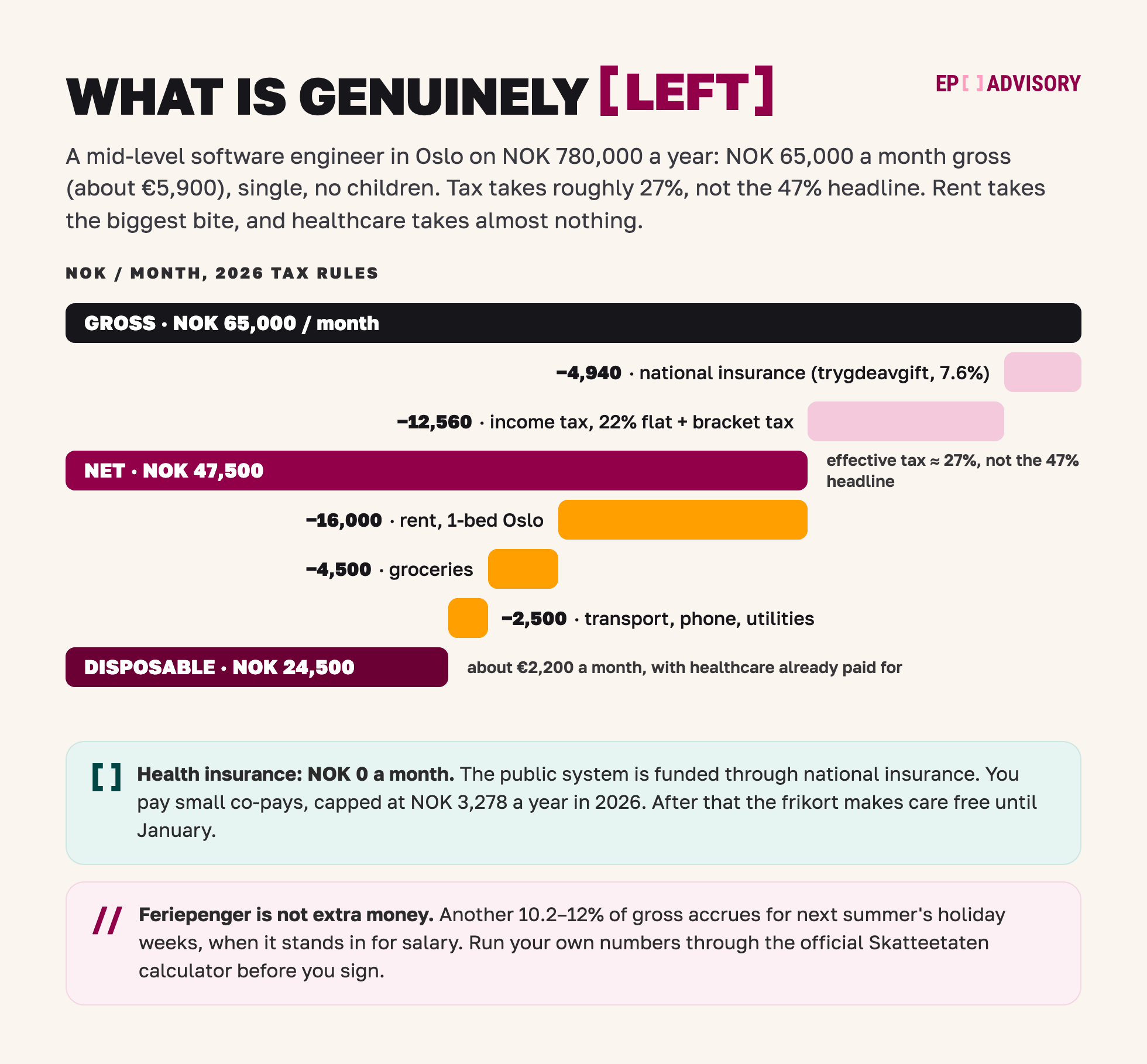
| Line item | NOK/month |
| Gross (780,000 ÷ 12) | 65,000 |
| − National insurance (trygdeavgift, 7.6%) | −4,940 |
| − Income tax (22% flat + bracket tax, after deductions) | −12,560 |
| = Net into your account | ~47,500 |
| − Rent, 1-bed Oslo | −16,000 |
| − Health insurance | ~0 (public, small capped co-pays) |
| − Groceries | −4,500 |
| − Transport, phone, internet, utilities | −2,500 |
| = Disposable income | ~24,500 |
Roughly NOK 24,500 a month of disposable income (about €2,200) on a NOK 780,000 salary is a strong result, and remember, healthcare is already paid for through your national insurance, and feriepenger of 10.2–12% is accruing for next summer’s holiday weeks, when it stands in for salary. The effective tax on this salary is around 27%, not the 47% headline: that top marginal rate only bites in the highest bracket. Cross NOK 725,050 and each extra krone is taxed harder, but you’re still far from the ceiling. Always run your own number through the official Skatteetaten calculator before you sign. If you are new to Norway and earn under NOK 725,050 in 2026, you are usually placed on the PAYE scheme automatically: a flat 25% that includes national insurance, with no deductions and no tax return. It covers short work stays and your first year as a tax resident, and you can opt out (Skatteetaten lists who qualifies).
And on a lower salary? At NOK 600,000 a year in Oslo (net around NOK 38,000/month), after rent and bills you’re left with roughly NOK 14,000–15,000. Liveable, especially with a cheaper flat or a flatmate, but saving is slower. Note too that NOK 600,000 clears the bachelor-level work-permit threshold but sits below the master-level one, which matters if your route in depends on your qualifications.
See what a recruiter sees, then fix it before you apply. An instant score, then the fix for every problem.
Free, no card.
The Work Permit: Your Route In

Norway is in the EEA and Schengen but not the EU. EU/EEA and Swiss citizens can work freely and simply register after arrival. For everyone else, including citizens of Russia, Kazakhstan, Belarus and Ukraine, the main route is the Skilled Worker permit, and UDI raised the salary thresholds in 2026.
- Skilled Worker permit (faglært): you need a concrete full-time job offer, relevant qualifications (a degree, a vocational qualification or special skills), and pay that meets the threshold. Where no collective agreement applies, the 2026 minimums are NOK 545,400/year for bachelor-level roles and NOK 624,700/year for master-level roles (UDI)
- Collective-agreement roles: if the job is covered by a tariff agreement, you must be paid the agreed rate; otherwise the salary must match what is normal for the occupation and region
- Job seeker permit: a six-month permit to look for work exists, but only for skilled workers who can visit Norway without a visa (so not, for example, citizens of Russia, Belarus, Kazakhstan or India). You must show about NOK 27,100 a month of your own funds, and you cannot work on it
- Early start: in many cases you can start work before the final decision, but only after you have applied and the police have confirmed an early start
- Who applies: you apply yourself through UDI once you hold the job offer; the employer provides the offer documentation
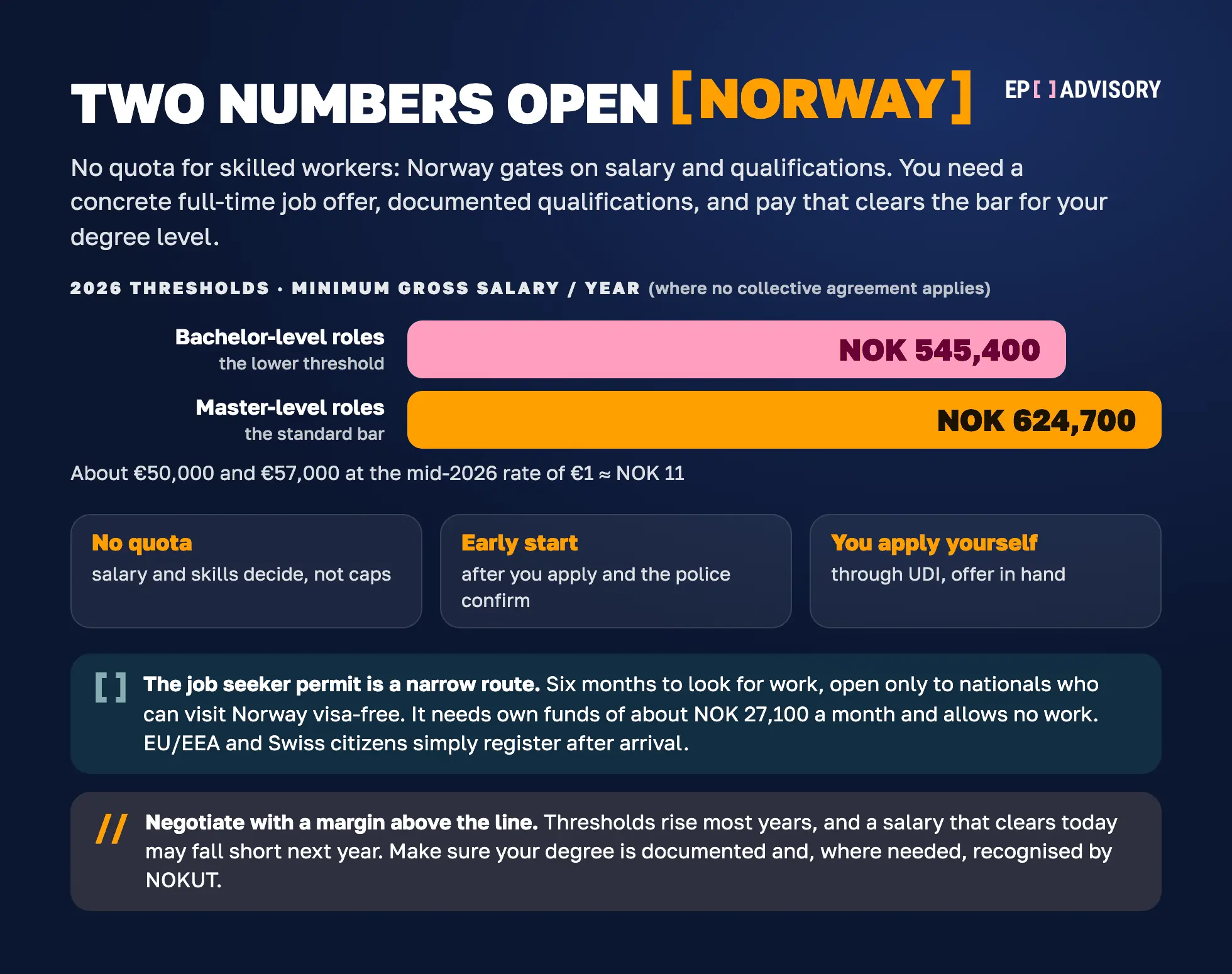
A practical detail: the thresholds rise most years, so a salary that qualifies today may not next year. Negotiate with a margin above the line. And because “skilled” is assessed on your qualifications, make sure your degree or trade certificate is documented and, where needed, recognised (NOKUT).
Current rules, thresholds and application steps are published by UDI.
Related reading: Work visa & Blue Card salary thresholds in Europe 2026 · UK salaries in 2026 and the Skilled Worker threshold · Salaries in Finland
Key Takeaways
- Anchor on the median (NOK 55,800/month), not the average, the latter is skewed by oil, shipping and finance pay.
- The strongest openings for non-EU professionals are in oil & energy, IT, engineering/maritime, renewables and seafood, and much of it works in English.
- Healthcare is public and effectively free: only small capped co-pays, no compulsory insurance premium as in Switzerland. That materially changes your monthly budget.
- There is no 13th-month salary. Feriepenger (10.2–12%) arrives the following June in place of salary for your holiday weeks, and the OTP pension (min 2%) sits on top; confirm both in writing.
- On NOK 780,000 in Oslo you keep about NOK 47,500/month net (≈€4,300) and roughly NOK 24,500 in disposable income after rent and bills.
- The 47% top marginal rate only bites in the highest band; a NOK 780,000 salary is taxed nearer 27% effective.
- For 2026 the Skilled Worker threshold is NOK 545,400 (bachelor-level) or NOK 624,700 (master-level); collective-agreement roles follow the agreed rate instead.
Frequently Asked Questions
What is the average salary in Norway in 2026?
Average monthly earnings are around NOK 62,000 gross, full-time equivalent (about €5,600) according to Statistics Norway, up 4.5% on 2024. The median is NOK 55,800/month (SSB, November 2025), a better guide to what a typical worker actually earns.
What is the median salary in Norway?
The median monthly salary is NOK 55,800 gross as of Statistics Norway’s November 2025 count, about NOK 41,800 after typical deductions. Half of Norwegian employees earn less than this, half earn more. The average (NOK 62,070) sits higher because oil, shipping and finance pay pulls it up.
What is the average take-home (net) salary in Norway?
Someone on the average wage keeps around NOK 46,000 per month after income tax and national insurance, from a gross of about NOK 62,000. A median earner keeps about NOK 41,800. The effective deduction is roughly a quarter of an average salary, and the 47% top marginal rate applies only in the highest income band.
Does Norway have a minimum wage?
No. Norway has no national statutory minimum wage. Binding pay floors exist only in ten regulated sectors, such as construction, cleaning, hospitality and freight, set through general application of collective agreements (allmenngjøring). For non-EU graduates the practical floor is the work-permit threshold of NOK 545,400 per year for bachelor-level jobs without a collective agreement.
How much tax do you pay in Norway?
First, national insurance (trygdeavgift) of 7.6% (2026 rate) comes off gross wage. Ordinary income is then taxed at a flat 22% after generous deductions, and a progressive bracket tax (trinnskatt) adds between 1.7% and 17.8% on higher income. On NOK 780,000 a year the effective rate lands near 27%; the top marginal rate of about 47.4% applies only in the highest band.
Do you need a job to get a Norwegian work permit?
Yes. Non-EU nationals need a concrete job offer first, then apply for a Skilled Worker permit. For 2026 the salary must meet NOK 545,400/year (bachelor-level) or NOK 624,700/year (master-level) where no collective agreement applies, or the agreed tariff rate where one does.
Is Norway a good place for foreign professionals?
Yes, wages are among the highest in Europe, English is widely used in energy, tech and maritime, and healthcare is essentially free. The trade-offs are a high cost of living, expensive housing in Oslo and a competitive rental market, but net pay and quality of life remain strong.
Getting ready to apply for jobs in Norway? Check your CV for free: see it the way a recruiter does, then fix each problem.