 By Andre Atallah, CEO of EP Advisory
The short answer: Yes, foreigners get hired in Germany, and the rules favour skilled people. Employers had 660,000 registered vacancies in September 2026. The EU Blue Card needs a job offer of €50,700 a year, or €45,934 in shortage jobs, for recent graduates and for IT specialists. No offer yet? The Opportunity Card lets you search from inside Germany for up to a year.
| Route | What it takes (2026) |
|---|---|
| EU Blue Card | Degree + offer at €50,700 a year, or €45,934 (shortage jobs, degree in the last 3 years, or IT with 3 years’ experience in the last 7, no degree needed) |
| Skilled worker permit | Qualification recognised in Germany + a qualified job; no salary floor under 45 (first permit from age 45: €55,770 or pension proof) |
| Experience route | Qualification recognised at home + 2 years’ experience in the last 5 + offer of €45,630 (IT: experience alone) |
| Opportunity Card | No offer needed: 6 points, German A1 or English B2, €1,091 a month in funds |
Germany is the largest job market in the EU, and it still needs people from abroad. In September 2026, employers had 660,000 vacancies registered with the Federal Employment Agency, 30,000 more than a year earlier. Unemployment stands at 6.4%, so employers can be choosy. A targeted application beats a mass one.
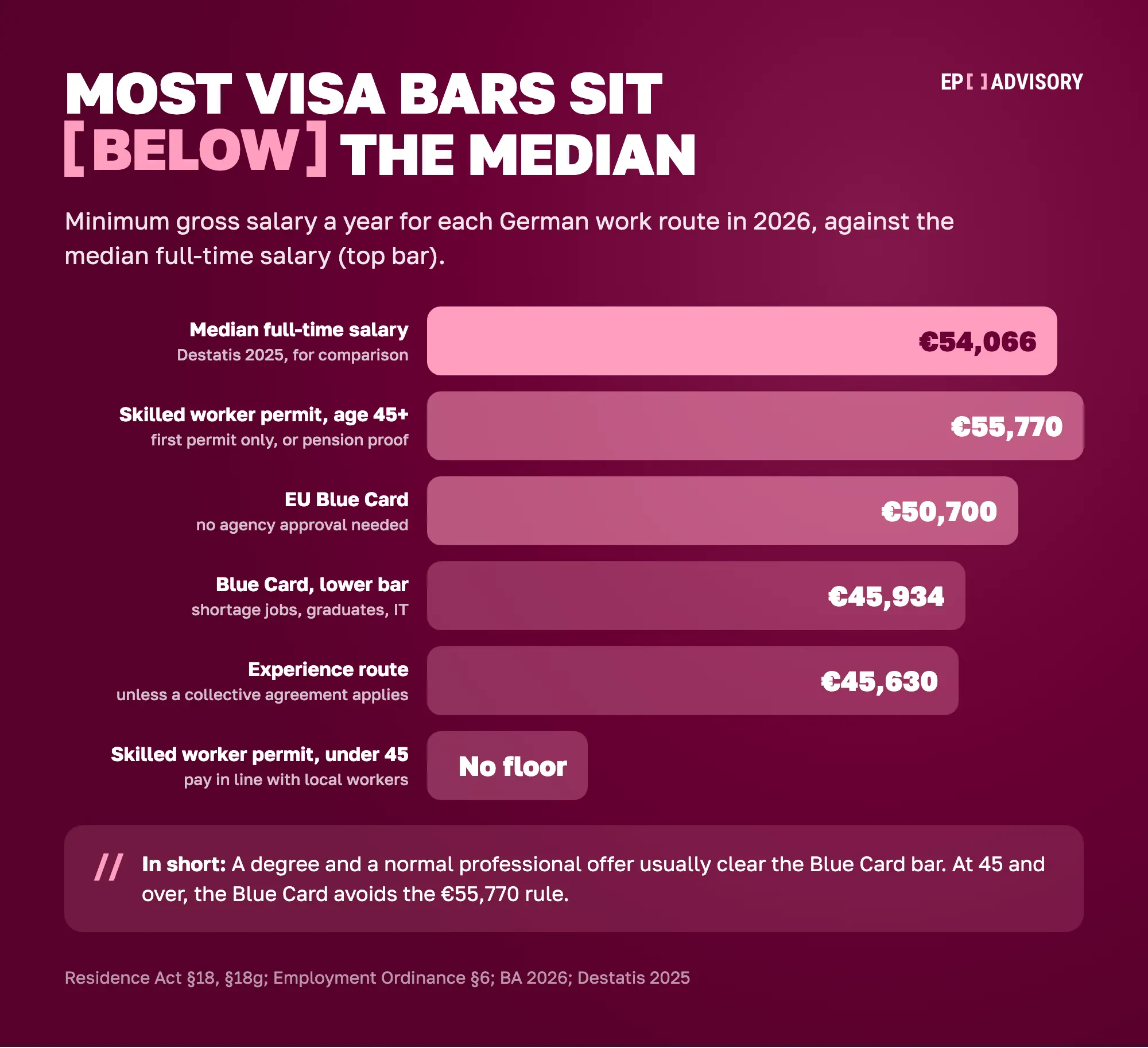
The good news is the visa bar. The standard Blue Card needs €50,700 a year, about €4,225 a month. The median full-time salary is €54,066 a year. So a normal professional offer usually clears the bar.
Below: the jobs in demand, the visa that fits you, the Opportunity Card points, and six steps from search to first day.
In nearly 10 years, we’ve helped more than 5,000 professionals find jobs abroad. Want to know if your CV will pass screening in Germany? Check your CV for free: a score in 30 seconds, then a fix for each problem.
High-Demand Jobs in Germany for Foreigners in 2026: Health, Trades and Tech Lead
Your chances depend most on your field. The Federal Employment Agency’s 2025 shortage analysis found 157 shortage occupations, down from 163 in 2024. The biggest gaps are in nursing and care, medical jobs, construction and skilled trades. Cooks, professional drivers and childcare educators (Erzieher) are also in strong demand. Surveying and social work joined the list in 2025.
One change matters for tech people. Software development and IT sales dropped off the agency’s shortage list in 2025. That does not close the door. IT professionals are still a shortage group under the Blue Card rules, so they qualify at the lower €45,934 bar. Expect more applicants per role, so make your CV specific to each advert.
| Field | Demand in 2026 | Possible route |
|---|---|---|
| Nursing and elderly care | Shortage (BA 2025) | Recognition and a licence first, then a work permit |
| Doctors and other health professions | Medical jobs short (BA 2025); on the Blue Card list | Licence to practise, then Blue Card at €45,934 |
| Construction and skilled trades | Shortage (BA 2025) | Skilled worker permit for vocational training (§18a) |
| Cooks and professional drivers | Shortage (BA 2025) | Skilled worker permit or the experience route |
| Childcare educators (Erzieher) | Shortage (BA 2025) | Regulated job: recognition first |
| IT and software | Software development off the BA list since 2025; IT still on the Blue Card list | Blue Card at €45,934, with or without a degree |
| Engineers and other STEM graduates | On the Blue Card list | Blue Card at €45,934 |
| Teachers | On the Blue Card list | Regulated job: recognition first |
Not on either list? You can still get hired at the standard Blue Card bar, or on a skilled worker permit.
Work Visas for Germany in 2026: Pick the Route That Fits Your Papers
The right route depends on your qualification, your age and whether you have an offer. Amounts are gross a year in 2026. The Blue Card bars are tied to the pension contribution ceiling, so they change every January.
| Route | Offer needed? | 2026 pay floor | Main condition |
|---|---|---|---|
| EU Blue Card (§18g) | Yes, at least 6 months | €50,700 | Degree recognised or comparable in Germany |
| Blue Card, lower bar | Yes | €45,934 | Shortage job, degree in the last 3 years, or IT with 3 years’ experience in the last 7; agency approval |
| Skilled worker permit (§18a, §18b) | Yes | None under 45; €55,770 from 45 on a first permit | Qualification recognised in Germany; pay in line with local workers |
| Experience route | Yes | €45,630, or pay under a collective agreement | Qualification recognised at home + 2 years’ experience in the last 5 |
| Opportunity Card | No | Funds of €1,091 a month | 6 points, or full recognition in Germany |
| Recognition partnership | Yes | No set figure; agency approval | German A2; employer supports your recognition |
The Blue Card is the best choice if you have a degree and a good offer. It is also the fastest path to permanent residence: after 27 months with German A1, or 21 months with B1 (see the agency’s Blue Card summary).
Over 45? Check this first. On a first skilled worker permit, people aged 45 or older need €55,770 a year or proof of a pension. The Blue Card has no such age rule. The agency applies the same €55,770 bar to the experience route below. So at 45 and over, aim for a Blue Card offer.
No German recognition yet? Use the experience route. It needs a qualification your home country recognises, 2 years’ experience in the last 5 and an offer of €45,630 a year. A German body such as ZAB must confirm the qualification. IT specialists can qualify on experience alone. Regulated jobs such as doctor or nurse cannot use it.
Want full German recognition? Try a recognition partnership. You can start recognition after you arrive and finish it while you work. You need a qualification recognised at home, German A2 and an employer who supports the process. The permit runs up to 3 years.
To compare these bars with other countries, see our guide to work visa salary thresholds in Europe.
Score your CV in 30 seconds, then fix its biggest problems one by one. Both free.
Free, no card. A free account unlocks every fix.

The Opportunity Card: Six Points Get You In Without an Offer
The Opportunity Card (Chancenkarte) is a job-search permit for up to one year in Germany. While you search, you may work an average of 20 hours a week. You can also do trial work of up to 2 weeks with an employer.
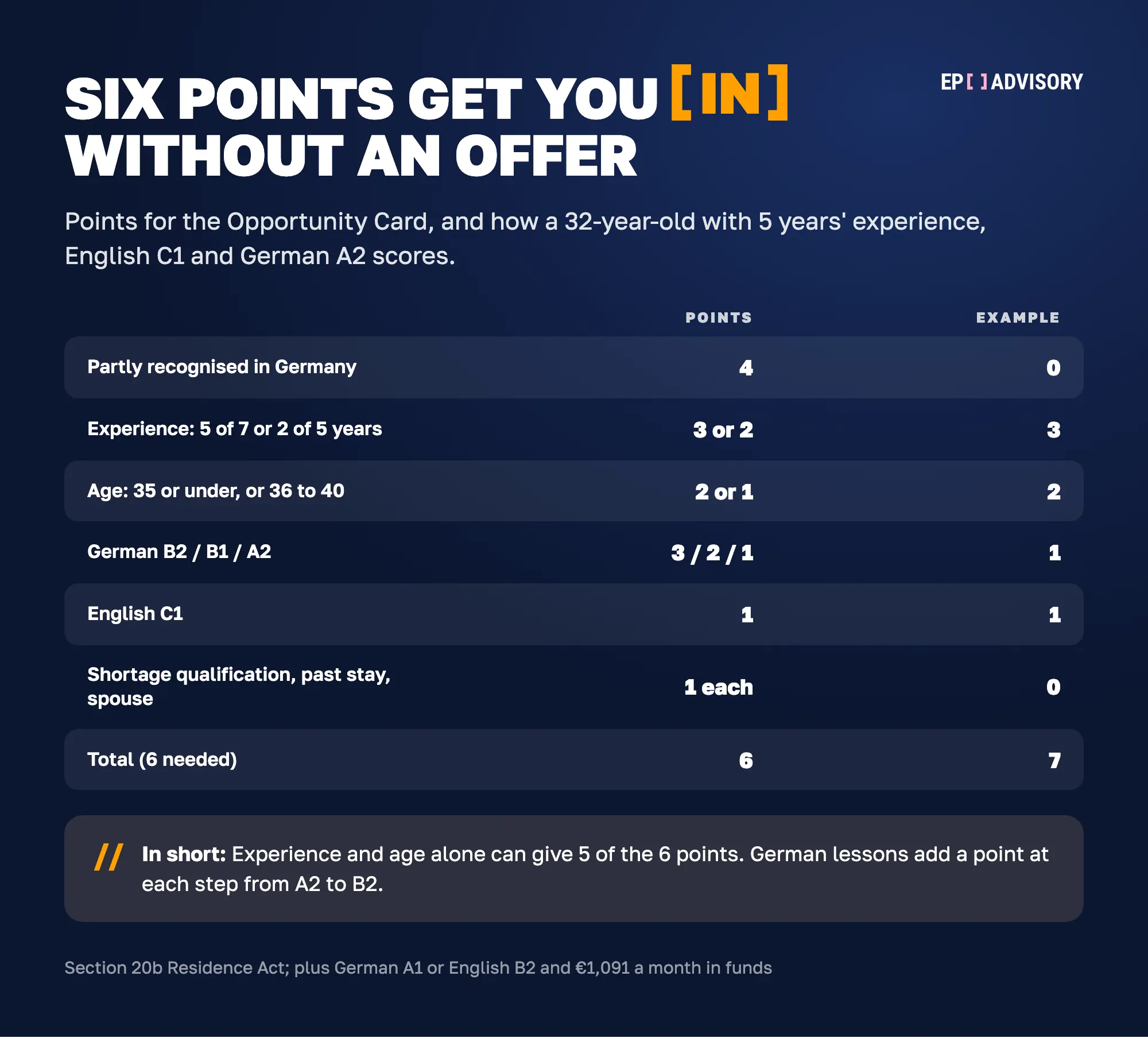
Two basics come first. You need a degree or a vocational qualification of at least 2 years, recognised by the state where you earned it. You also need German at A1 or English at B2. Then you need 6 points:
| What you bring | Points |
|---|---|
| Qualification partly recognised in Germany | 4 |
| Work experience: 5 years in the last 7 | 3 |
| Work experience: 2 years in the last 5 | 2 |
| German B2 / B1 / A2 | 3 / 2 / 1 |
| English C1 | 1 |
| Age 35 or under / 36 to 40 | 2 / 1 |
| Qualification in a Blue Card shortage occupation | 1 |
| Unbroken legal stay in Germany of 6 months or more in the last 5 years | 1 |
| Spouse who also qualifies and applies with you | 1 |
A worked example. A 32-year-old marketing manager has a degree recognised at home and 5 years’ experience in the last 7. She has English C1 and German A2. That is 3 + 2 + 1 + 1 = 7 points, so she can apply without an offer. If your qualification is fully recognised in Germany, you skip the points test.
You must also show money to live on: €1,091 a month, or €13,092 for a full year. A blocked bank account or a formal sponsor declaration both work. The visa fee is €75.
Short of a point? German lessons are the quickest lever: each step from A2 to B2 adds one. Once you find a qualifying job, switch to a work permit, or extend the card by up to 2 years with a contract and the agency’s approval.
How to Get a Job in Germany from Abroad: Six Steps
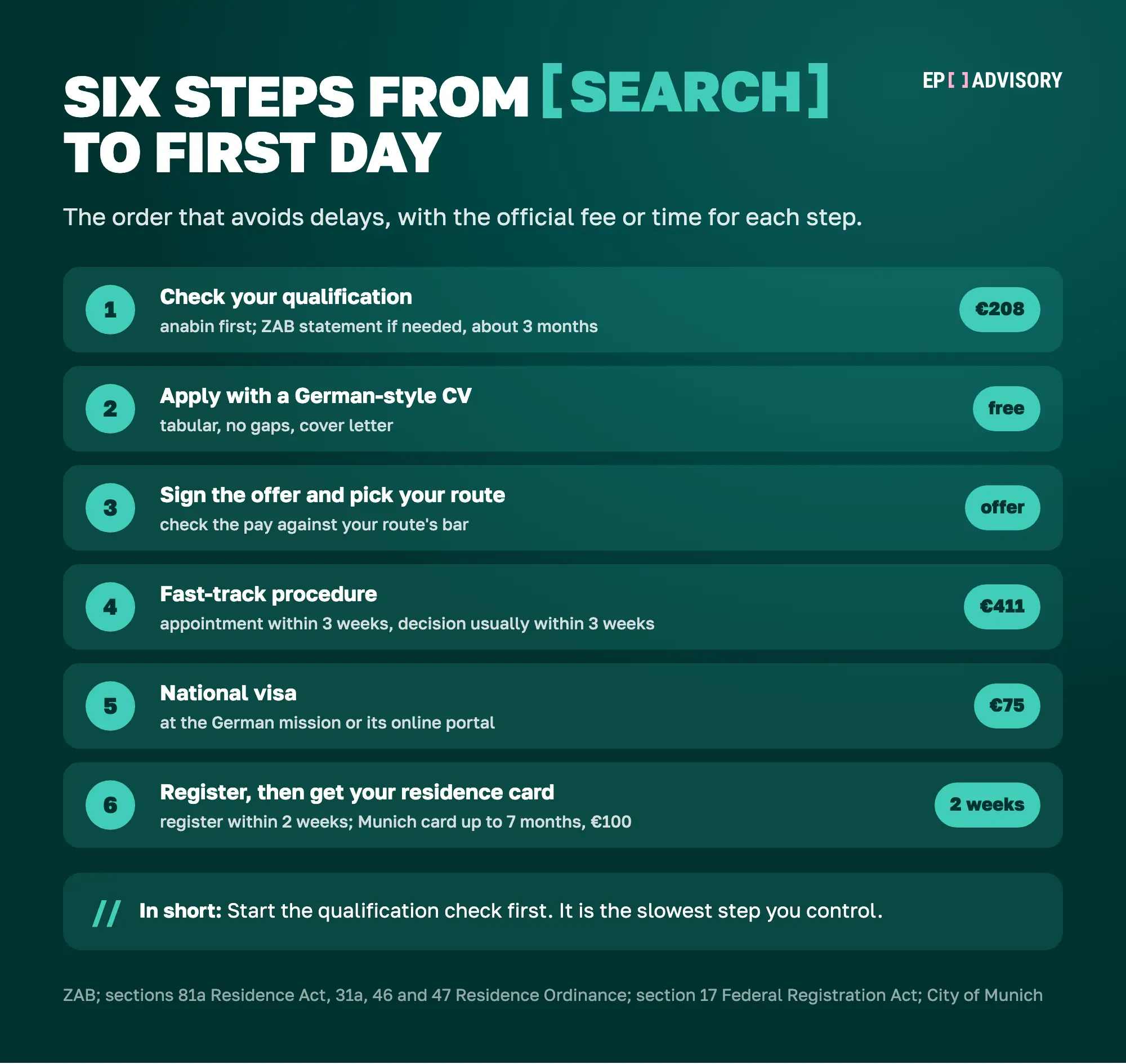
Start the slow steps first.
- Check your qualification. Look up your degree and university in anabin. A university rated “H+” with an equivalent degree may be all you need. If not, order a Statement of Comparability from ZAB. It costs €208 and takes about 3 months, or 2 months in the fast-track procedure. For an EU Blue Card it takes 2 weeks. For regulated jobs, use the Recognition Finder.
- Build a German-style CV and apply. Mirror the language of each advert. The CV section below shows what recruiters expect.
- Sign the offer and pick your route. Check the salary against the bar for your route before you sign.
- Ask your employer for the fast track. Under the accelerated procedure, the employer applies for you at the responsible immigration office, with your written authority. It covers the Blue Card, the skilled worker permits and the recognition partnership. It does not cover the experience route or the Opportunity Card. The fee is €411. After pre-approval, the embassy gives you an appointment within 3 weeks and usually decides within 3 weeks. Without it, the wait depends on the German mission in your country.
- Apply for the national visa. The national (D) visa fee is €75. Many missions take applications online through the Consular Services Portal.
- Register and collect your residence card. Register your address within 2 weeks of moving in. Then apply for your residence card at the local immigration office. In Munich this takes up to 7 months and costs €100. Munich confirms in writing that your current status continues while it decides.
Where to Find Jobs in Germany: Start with the Official Boards
Start where Germany itself points you. These official channels are free:
- Make it in Germany: the federal government’s portal for skilled workers from abroad, in English. Its job listings are what most people mean by Make it in Germany jobs.
- Jobsuche: the Federal Employment Agency’s own job board. Many adverts on it are in German.
- EURES: the EU’s job mobility portal, searchable in English.
- ZAV: the agency’s placement service for people abroad. It runs recruitment programmes for some countries and professions, and its services are free of charge.
- Commercial boards: StepStone, Indeed, LinkedIn and XING. English-language boards such as Arbeitnow and Berlin Startup Jobs list roles in English, many in tech and start-ups.
Germany has no register of licensed visa sponsors. Any employer can hire you if the job and pay meet the rules of your route. So target firms that already hire internationally, and say in your cover letter which route you qualify for.
Many adverts on the agency’s board are written in German. In our experience, even a B1 certificate on your CV helps.
German or English? What Each Field Needs
For the visa itself, German is rarely required. Licensed jobs are different: doctors and nurses need German for their licence, at a level set per profession.
| Field | German required by law? | What to do |
|---|---|---|
| Doctors, nurses and other licensed health jobs | Yes, for the licence | Check the level in the Recognition Finder and start lessons early |
| Teachers and childcare educators | Regulated: recognition first | Check the rules of the state where you want to work |
| IT, engineering, research, finance | No | The employer decides; mirror the advert’s language |
| Trades, construction, hospitality, driving | No, but some trades need recognition | Many adverts are in German; basic German widens your options |
| Opportunity Card | German A1 or English B2 | Either one works |
| Permanent residence | Blue Card: A1 (27 months) or B1 (21); skilled worker permit: B1 | Learn while you work |
German CV Norms: Tabular, Complete and Backed by Papers
German employers expect a full application, not just a CV. The Federal Employment Agency’s CV guide describes a clear, tabular CV tailored to the role, with a cover letter. It suggests two pages at most, with your newest role first.
- Tabular layout: one line per role, with month and year.
- No unexplained gaps: the Opportunity Card application asks for a gap-free CV.
- Photo: optional. Leave it out if you are unsure.
- Cover letter: a short letter on why this role and this company.
- Papers: attach degree certificates and references, translated where needed.
Put your recognition status on the CV, for example “Degree: anabin H+” or “ZAB statement issued”. It answers the employer’s first visa question. For layout ideas, see our guide to writing an impressive CV.
What Jobs in Germany Pay in 2026: Check Your Sector Before You Sign
The median full-time salary in 2025 was €54,066 a year including bonuses, and the average was €64,441. The legal minimum wage is €13.90 an hour in 2026, about €2,409 a month at 40 hours. It rises to €14.60 on 1 January 2027.
Pay depends heavily on the sector. These are average full-time salaries in 2025, gross a year including bonuses:
| Sector | Average a year (2025) |
|---|---|
| Finance and insurance | €91,678 |
| Information and communication | €86,638 |
| Energy | €84,487 |
| Professional, scientific and technical services | €83,847 |
| Manufacturing | €67,520 |
| Education | €66,297 |
| Health and social work | €62,503 |
| Construction | €54,358 |
| Hospitality | €39,749 |
Region matters too. The average is €66,171 in the former West, including Berlin, and €52,926 in the eastern states. An offer at the visa bar gets you the permit, but it may sit below your sector’s rate. Use the German salary guide to check pay by sector, state and age before you negotiate. For study and family routes, see all the ways to move to Germany.
How to Spot a Fake Job Offer in Germany
Scammers target people who want to work in Germany. German missions warn about private agents who promise a job or a study place in return for a large fee. These offers are often fraudulent. Watch for these signs:
- You must pay a fee to get the job or a “guaranteed” visa.
- The offer arrives without an application or an interview.
- The “employer” talks only on messaging apps and gives no company address.
- The visa fee quoted is higher than the official €75 for a national visa.
Protect yourself in three ways. Look the company up in the official company register. Apply for the visa only through the German mission or its official portal. And use free official services such as Make it in Germany and the ZAV.
Key Takeaways
- Germany had 660,000 vacancies in September 2026. The agency’s shortage list is led by care, medical jobs, construction and skilled trades.
- The Blue Card bar is €50,700, or €45,934 in shortage jobs, for recent graduates and for IT. Both sit below the median salary.
- No offer yet? The Opportunity Card needs 6 points, German A1 or English B2, and €1,091 a month in funds.
- Over 45? The skilled worker permit needs €55,770 on a first permit. The Blue Card has no age rule.
- Start recognition first: anabin, then ZAB (€208, about 3 months) if needed.
- Know your sector’s pay before you sign. The salary guide has the official figures.
Getting ready to apply for jobs in Germany? Check your CV for free: see it the way a recruiter does, then fix each problem.
See what a recruiter sees, then fix it before you apply. An instant score, then the fix for every problem.
Free, no card. A free account unlocks every fix.
Frequently Asked Questions
Can I get a job in Germany without speaking German?
Yes, in many fields. The Blue Card has no language rule, and the Opportunity Card accepts English B2. In IT, engineering, research and finance the employer decides, so mirror the advert’s language. Doctors and nurses need German for their licence.
Can I move to Germany without a job offer?
Yes. The Opportunity Card gives you up to one year in Germany to look for work. You need a qualification recognised at home, German A1 or English B2, 6 points and €1,091 a month in funds. You may work 20 hours a week on average while you search.
What salary do I need for a German work visa in 2026?
For the EU Blue Card: €50,700 a year, or €45,934 in shortage jobs, for graduates within 3 years and for IT specialists with 3 years’ experience in the last 7. The skilled worker permit has no floor under 45, and €55,770 from 45 on a first permit. The experience route needs €45,630.
Which jobs are in high demand in Germany for foreigners?
The Federal Employment Agency lists 157 shortage occupations for 2025, led by nursing and care, medical jobs, construction and skilled trades. IT, engineering, medicine and teaching are on the Blue Card shortage list, which lowers the salary bar to €45,934.
Do I need my degree recognised to work in Germany?
For most routes, yes. Check your degree in anabin first, or get a ZAB Statement of Comparability for €208. Doctors, nurses and other regulated jobs need full recognition and a licence. The experience route only needs a qualification recognised at home, confirmed by a German body such as ZAB.
How long does it take to get a German work visa?
With the accelerated procedure, your employer pays €411 and gets a pre-approval from the immigration office. You then get a visa appointment within 3 weeks and usually a decision within 3 more. Without it, the wait depends on the German mission. A ZAB statement adds about 3 months, so start it first.
What is Make it in Germany?
Make it in Germany is the federal government’s official portal for skilled workers from abroad. It explains the visa routes in English and has job listings. The agency’s Jobsuche board and the EU’s EURES portal are the other official places to look.