 By Andre Atallah, CEO of EP Advisory
The short answer: the average salary in Portugal is €1,835 a month gross, annual pay divided by 12 with subsidies included (INE, quarter to June 2026). Portugal pays 14 times a year, so the base salary in a job ad averages €1,342 ×14. Take-home on the average is roughly €1,375 to €1,405 net per payslip. The minimum wage is €920 ×14.
| Portugal, 2026 | Figure |
|---|---|
| Average total gross pay (÷ 12, subsidies included) | €1,835 / month (INE, Q2 2026) |
| Average base salary (the job-ad number, × 14) | €1,342 / month (INE, Q2 2026) |
| Full-year 2025 average, total (÷ 12) | €1,694 / month (INE) |
| Median base salary, full-time (× 14) | €948 / month (Quadros de Pessoal 2024) |
| Take-home on the average (estimate) | ≈ €1,375–1,405 net / payslip |
| Minimum wage 2026 | €920 / month × 14 |
| D3 visa floor / EU Blue Card reference | €1,611.39 / €2,157 a month gross |
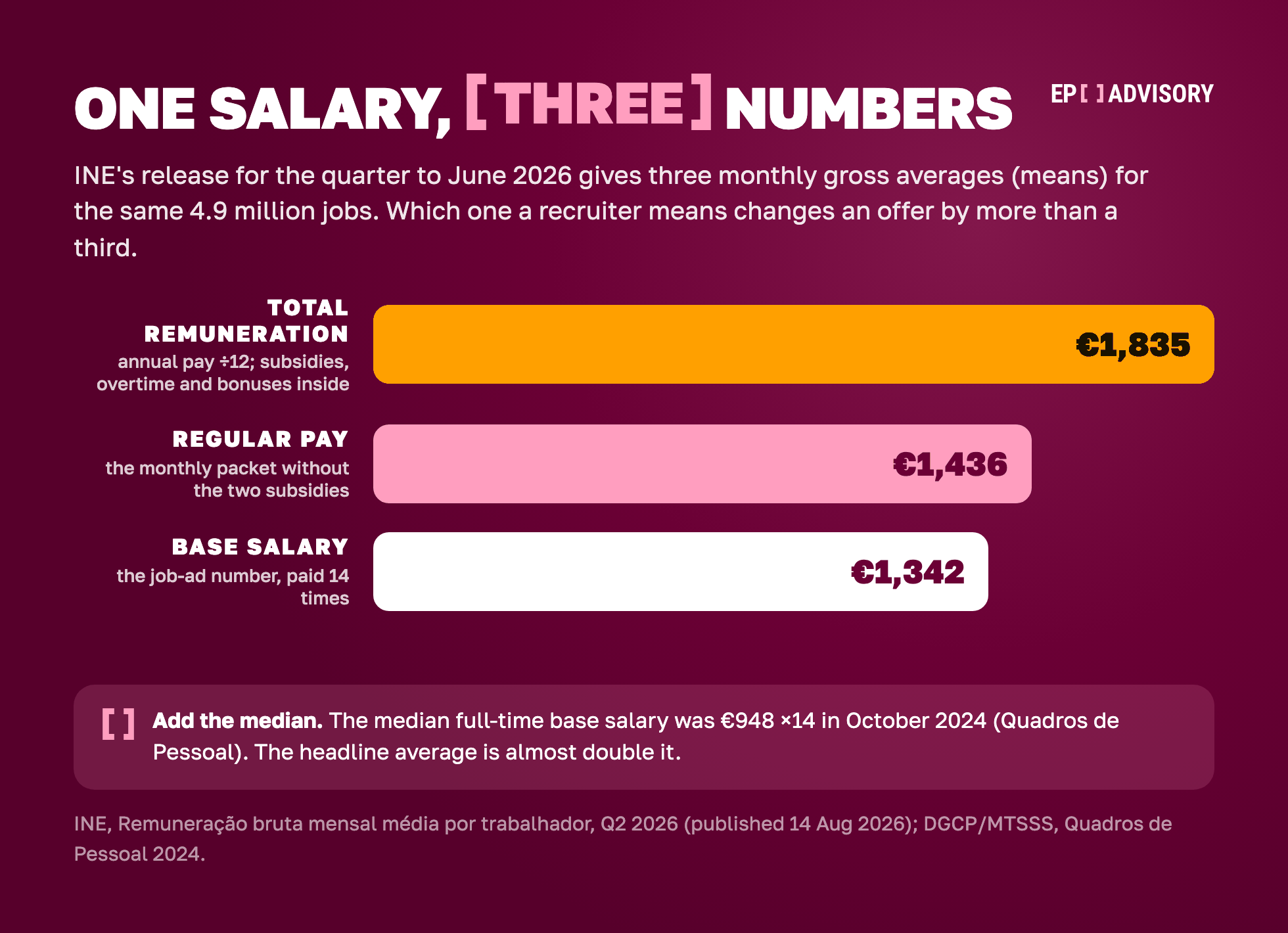
Portugal has a payslip problem, and it is arithmetic. Employees are paid 14 times a year: 12 salaries plus a holiday subsidy and a Christmas subsidy. A job ad quotes the base salary that arrives 14 times; the statistics add up everything paid in the year and divide by 12. The ad says €1,342, INE says €1,835: same workforce, same quarter, a 37% gap.
The second trap is compression. About one worker in five earns the €920 minimum wage, and that minimum is 90% of the median base salary (Banco de Portugal, 2025). Lisbon, IT, finance and the state pull the average up. Every monthly number below states its basis: divided by 12 or paid 14 times, gross or net.
In nearly 10 years, we’ve helped more than 5,000 professionals find jobs abroad. Want to know if your CV will pass screening in Portugal? Check your CV for free: a score in 30 seconds, then a fix for each problem.
What Is the Average Salary in Portugal Per Month? (2026)
The average salary in Portugal is €1,835 a month gross, on INE’s series of average gross monthly remuneration per worker for the quarter ended June 2026, published on 14 August 2026. It is up 5.1% on the year in nominal terms and 1.8% after inflation, and it is built from Social Security and Caixa Geral de Aposentações records covering about 4.9 million jobs.
It is a total, divided by 12: base pay plus the holiday subsidy, the Christmas subsidy, overtime and bonuses, spread over 12 calendar months. Alongside it INE publishes regular pay of €1,436, the monthly packet without the two subsidies, and base pay of €1,342, the salary line alone, the number a job ad quotes, paid 14 times.
The June quarter is a seasonal high. The holiday subsidy lands in June, so the total read €1,611 in the March 2026 quarter and €1,877 in the December 2025 quarter. The full-year 2025 average was €1,694 a month (÷12, subsidies included), up 5.6% nominal and 3.2% real. For planning, €1,694 is the stable number; €1,835 is the latest.
| INE figure | Per month, gross | Basis, and the same money the other way |
| Total remuneration, Q2 2026 | €1,835 | Annual pay ÷ 12. €22,020 a year, or €1,573 per payment over 14 |
| Base salary, Q2 2026 | €1,342 | The job-ad number, × 14. €18,788 a year, or €1,566 ÷ 12 |
| Total remuneration, full year 2025 | €1,694 | Annual pay ÷ 12. €20,328 a year, or €1,452 per payment over 14 |
What counts as a good salary in Portugal? Anything clearly above €1,835 total ÷12, or €1,342 base ×14. From the same INE release: public administration €2,792 total ÷12, IT and telecoms €3,061, finance €2,970. A salary of €2,500 ×14 nets about €1,754 per payslip, just short of a one-bedroom flat plus living costs in Lisbon (about €1,837 on Numbeo, September 2026).
Perspective. Pay is rising faster than prices: the OECD puts 2025 nominal growth at 4.9% and real growth at 2.6%. But the level is low: on Eurostat’s full-time adjusted measure for 2024, Portugal’s €24,818 a year ranks 18th of 27, against €39,800 for the EU and €33,700 in Spain, about €9,000 more.
If the numbers work for you, the next step is practical: the European work-visa salary thresholds show what an offer must pay before a permit is possible, and salaries in Spain covers the neighbouring market, where the Eurostat average is about €9,000 a year higher.
Portuguese Salaries at a Glance: The Essentials
- Average gross salary: €1,835 a month, total ÷12 with subsidies included; regular pay €1,436; base pay €1,342 ×14 (INE, quarter to June 2026)
- Full-year 2025 average: €1,694 a month total ÷12 (INE, February 2026)
- Median base salary: €948 a month ×14, full-time; median monthly earnings with allowances €1,186 (DGCP/MTSSS Quadros de Pessoal, October 2024)
- Annual measures: €25,826 on the OECD’s 2025 series; €24,818 on Eurostat’s 2024 full-time adjusted measure, 18th of 27 (Eurostat, November 2025)
- Pay frequency: 14 payments. Christmas subsidy due by 15 December (Código do Trabalho art. 263), holiday subsidy before the holiday (art. 264)
- Public vs private: €2,792 total ÷12 in public administration against €1,654 in the private sector, which holds 84.1% of jobs (INE, Q2 2026)
- Minimum wage: €920 a month ×14 on the mainland from 1 January 2026; about one worker in five is on it (DGERT; MTSSS, Q2 2025)
- Take-home on the average: roughly €1,375 to €1,405 net on a €1,835 payslip, single worker, mainland; about 25% of gross goes in deductions across the year (2026 tables, EP Advisory estimate)
- Gender gap: 11.9% on base pay, 14.5% on monthly earnings (Quadros de Pessoal 2024)
- Visa floors: €1,611.39 a month gross for the D3 visa (3 × the 2026 IAS); €2,157 a month gross on AIMA’s Blue Card reference, still computed on 2023 data (last checked September 2026)
The 14-Payment Trap: Why the Ad and the Statistics Disagree
The first half is the calendar. The Código do Trabalho makes both extra payments a legal entitlement: article 263 sets a Christmas subsidy equal to one month’s pay, due by 15 December, and article 264 a holiday subsidy on the same scale, paid before the main holiday. They are salary, not bonuses:
- Job ads quote base pay, paid 14 times. “Salário bruto mensal €1,342” means €1,342 × 14 = €18,788 a year gross. The meal allowance is listed separately: it is tax-free up to €6.15 a day in cash or €10.46 on a meal card in 2026.
- INE quotes total pay, divided by 12. €1,835 × 12 = €22,020 a year, which is €1,573 per payment over 14.
The two averages sit €493 a month apart: the headline is 37% above the ad number. Read €1,835 as an ad and multiply by 14, and you overstate the average by €3,670 a year. Spreading the subsidies in twelfths (duodécimos) is possible only at your request and in writing.
The second half is compression. About one worker in five was on the minimum wage in mid-2025 on Social Security data published by the labour ministry; the exact share depends on the measure, so we do not quote one. Banco de Portugal counts 591,000 full-time employees with base pay exactly at the minimum in 2025, 204,000 of them foreign nationals, and puts the minimum at 90% of the median base salary. The median full-time base salary was €948 ×14 in October 2024 (Quadros de Pessoal), almost half the €1,835 average.
Before you sign, ask: base or total, 12 or 14, meal allowance inside or on top. Then convert every offer to annual gross.
One Country, Several Averages: Which Number to Trust
Ask what the Portuguese earn and you get at least five defensible answers, all official or built on official microdata.
| Figure | Source and period | What it actually measures |
| €1,835 / month | INE, quarter to June 2026 | Total gross pay per job, subsidies in, ÷12. Seasonal high |
| €1,694 / month | INE, full year 2025 | Same measure over a whole year, ÷12. €1,452 × 14 |
| €1,342 / month | INE, quarter to June 2026 | Base salary only, the job-ad number, × 14 |
| €1,301 average, €948 median | DGCP Quadros de Pessoal, October 2024 | Base pay of full-time employees, × 14. The only official median |
| €25,826 / year | OECD, 2025 | Per full-time-equivalent employee. €2,152 ÷ 12 or €1,845 × 14 |
| €24,818 / year | Eurostat, 2024 | Full-time adjusted salary. €2,068 ÷ 12 or €1,773 × 14 |
We headline the INE figure because it is the freshest complete reading, built from 4.9 million administrative records rather than a survey, and we show the full-year €1,694 beside it because INE itself flags the June quarter as seasonal. The OECD and Eurostat numbers are higher because both count full-time equivalents and both are annual: right for comparing Portugal with Spain, wrong for reading a job ad.
Salaries by Sector and Role
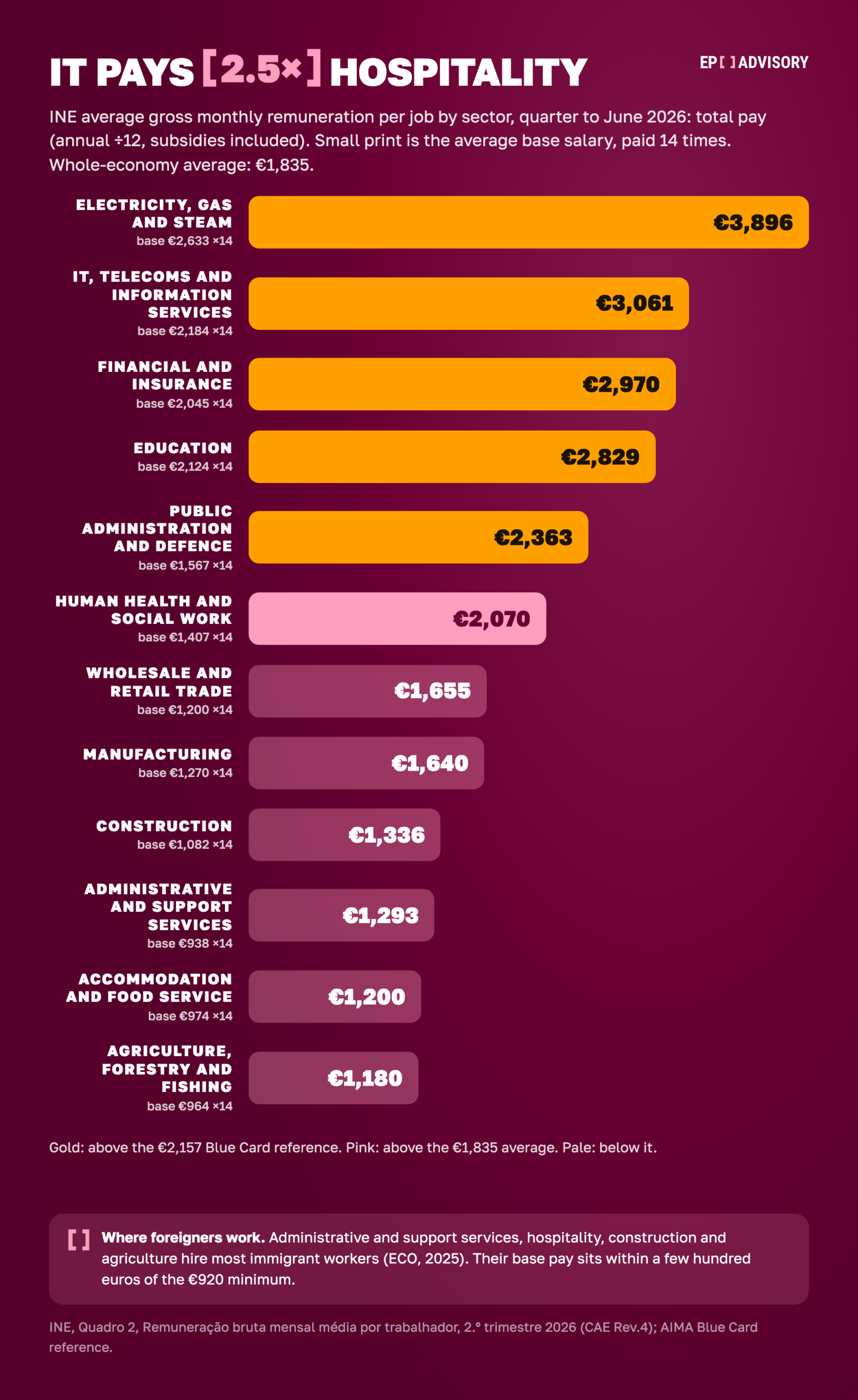
Sector and employer type move a Portuguese salary more than anything else. INE, quarter to June 2026, total remuneration (÷12, subsidies included) and base salary (the job-ad number, ×14):
| Sector (INE, Q2 2026) | Total, ÷12 | Base, ×14 |
| Electricity, gas and steam | €3,896 | €2,633 |
| IT, telecoms and information services | €3,061 | €2,184 |
| Financial and insurance | €2,970 | €2,045 |
| Education | €2,829 | €2,124 |
| Public administration and defence | €2,363 | €1,567 |
| Human health and social work | €2,070 | €1,407 |
| Whole economy | €1,835 | €1,342 |
| Wholesale and retail trade | €1,655 | €1,200 |
| Manufacturing | €1,640 | €1,270 |
| Construction | €1,336 | €1,082 |
| Administrative and support services | €1,293 | €938 |
| Accommodation and food service | €1,200 | €974 |
| Agriculture, forestry and fishing | €1,180 | €964 |
Read the base column against the €920 minimum. Administrative and support services (cleaning, call centres) averages €938 base; hospitality €974; agriculture €964. These are the sectors where foreign workers concentrate: 20.8% of immigrant workers are in administrative and support services, 18.3% in hospitality, 12% in construction and 6.2% in agriculture (ECO, 2025). At the other end, IT pays 2.5 times hospitality, and size matters: firms of 500 or more pay €2,254 total ÷12, firms of one to four €1,174 (INE, Q2 2026).
Nurses and doctors have published 2026 scales in the national health service, base pay ×14 before shift supplements. A nurse starts at €1,657.04 (Tabela Remuneratória Única, index 19), a specialist nurse at €1,920.20, and the top of the nurse scale is €3,481.16 (ASPE transcription of DL 29-A/2026). A specialty intern doctor earns €2,516.53, an entry-grade Assistente €3,654.26 and an Assistente Graduado Sénior €5,442.93 on the SIM agreement’s 40-hour scale, plus 25% under dedicação plena.
Tech, with a caveat. The Landing.Jobs Tech Talent Trends Report 2026 puts the average gross annual tech salary at €53,671: a self-selected survey skewed to senior and remote profiles, far above INE’s IT sector average of €3,061 total ÷12 (€36,732 a year). Indeed’s call-centre agent average is €1,124 a month gross (updated August 2026, basis not stated, so read it as a job-ad figure).
Score your CV in 30 seconds, then fix its biggest problems one by one. Both free.
Free, no card.

Minimum Wage in Portugal 2026: €920 a Month, Paid 14 Times
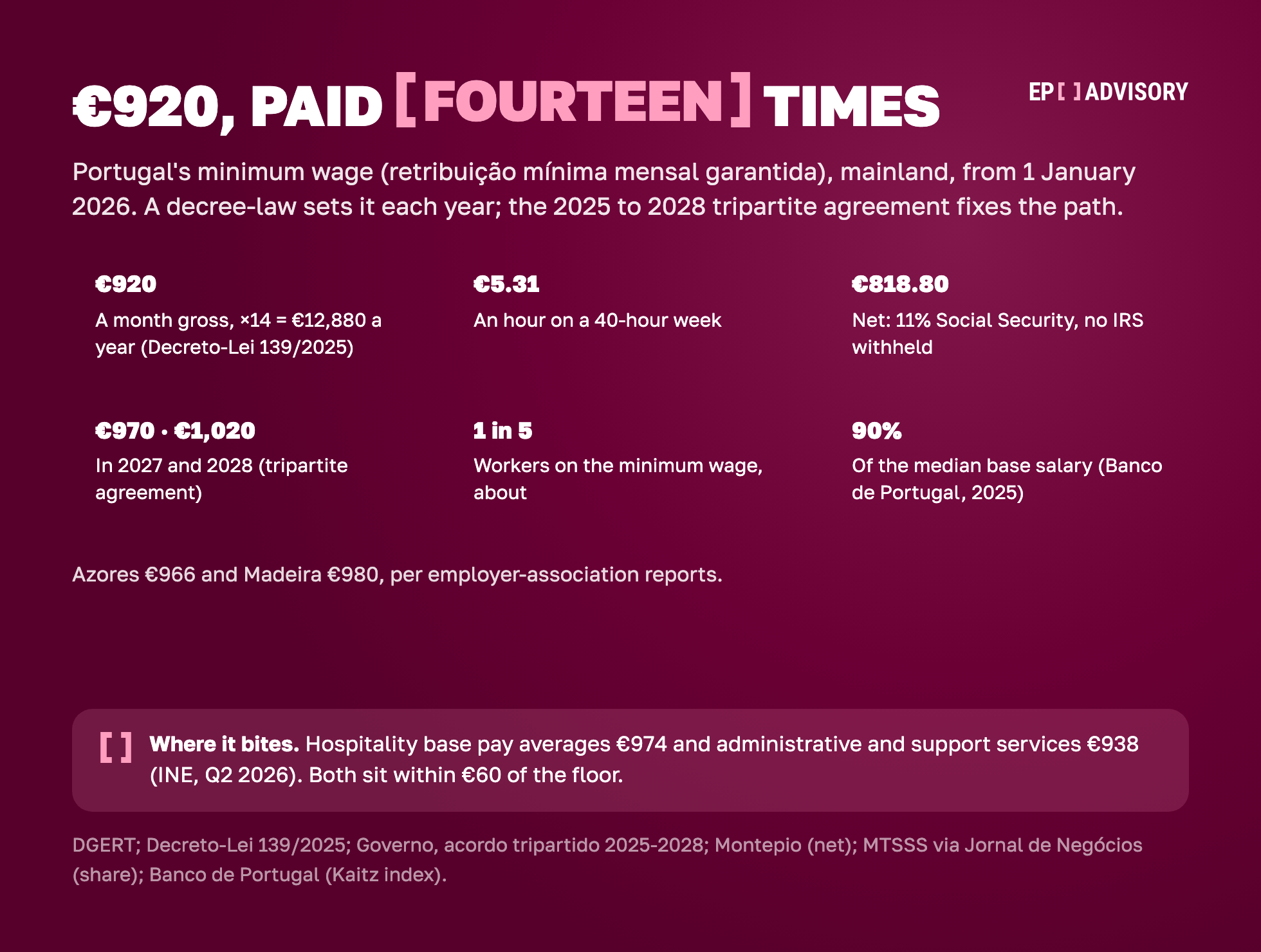
Yes. Portugal’s statutory minimum wage in 2026 is €920 a month gross, paid 14 times, which is €12,880 a year, on the mainland from 1 January 2026 under Decreto-Lei 139/2025, €50 or 5.7% above the 2025 figure of €870. The Azores set €966 and Madeira €980, per employer-association reports of the regional decrees. The 2025–2028 tripartite agreement between the government, four employer confederations and the UGT union fixes €970 for 2027 and €1,020 for 2028, with a target average salary of €1,890 a month by 2028.
| Floor | Gross per month | Basis |
| Minimum wage, mainland, 2026 | €920.00 | × 14 = €12,880 a year |
| Azores / Madeira, 2026 | €966.00 / €980.00 | × 14, per employer-association reports |
| Net minimum wage, mainland | €818.80 | × 14, after 11% Social Security, no IRS withheld |
| Hourly equivalent, 40-hour week | €5.31 | (920 × 12) ÷ (52 × 40), Código do Trabalho art. 271 |
| Agreed minimum, 2027 / 2028 | €970.00 / €1,020.00 | × 14 |
Where the floor bites. About one worker in five is on the minimum, with a much higher incidence among foreign workers, and it equalled 90% of the median base salary in 2025. Hospitality base pay averages €974 and administrative and support services €938, both within €60 of the floor: in tourism, cleaning or agriculture the minimum is roughly what the job pays.
Lisbon vs the Rest: The Regional Gap
INE’s monthly pay series has no regional breakdown, so the picture comes from Social Security declarations. On declared monthly pay in April 2026, compiled by Brighter Future from labour ministry data, the national average was €1,610 gross, the Lisbon district €1,875, Setúbal €1,693 and Porto €1,617; Beja, Portalegre, Vila Real and Guarda were more than 15% below. Lisbon holds 23.9% of workers and Porto 17.3%.
Rent moves faster than pay: Lisbon’s premium is about 16% on those declarations, and the rent gap is far larger. Three sources:
- INE contracted rents (medians per m² on actual new contracts, first quarter of 2026): Portugal €9.46, Greater Lisbon €14.38, Lisbon municipality €17.42, Porto metropolitan area €10.13; Porto municipality €14.29 over the 12 months to March 2026. A 50 m² one-bedroom at these medians is about €871 a month in Lisbon and €715 in Porto.
- idealista asking rents (listings, August 2026): Portugal €18.1 per m², Lisbon €24.5, Porto €18.6. Asking prices run roughly 70% above INE’s contracted medians (Montepio): the same 50 m² flat lists at about €1,225 in Lisbon and €930 in Porto.
- Numbeo one-bedroom rents (crowd-sourced, June to September 2026), centre and outside: Lisbon €1,431 and €1,074; Porto €1,153 and €852; Braga €819 and €661; Coimbra €777 and €573.
The idealista and INE effort-rate study for the second quarter of 2026 puts renting at 82% of net household income nationally, against a recommended ceiling of 33%: Faro 101%, Lisbon 80%, Porto 69%, Braga 51%, Coimbra 44%. For a single person on the average net payslip of about €1,383, a Numbeo one-bedroom outside the centre takes 78% in Lisbon, 62% in Porto, 48% in Braga and 41% in Coimbra. Rent plus living costs in Lisbon comes to about €1,837 a month, more than the average net payslip. The Algarve is the trap: the lowest regional net pay in Randstad’s 2025 study (€1,177 a month) and a Faro effort rate above 100%.
Where to Look for Work: Official Resources
- IEFP iefponline: the public employment service, with a dedicated board for non-resident third-country candidates, where employers accept CVs from abroad and the selected candidate applies for the visa at the consulate
- Net-Empregos and SAPO Emprego: the domestic boards, strong in administrative, sales and technical roles
- Landing.jobs: the tech board, where English-only Lisbon and Porto roles concentrate
- EURES: its Portugal note lists nursing, medical specialists, software developers, construction trades and seasonal agriculture as shortage areas
Two practical notes. Language: English-only hiring exists in IT, shared-service centres, multilingual customer support, tourism front-line roles and higher education; nursing, construction, retail and any public-sector job require working Portuguese. Sponsorship: since 3 June 2024 (Decree-Law 37-A/2024) there is no tourist entry that later converts to a work permit, and the new qualified job-seeker visa is still listed as not available, so you need a contract or a promise of contract before you apply.
The Arithmetic: What Actually Lands in Your Account
Two things come off a Portuguese gross salary: Social Security and IRS income tax.
- Social Security: 11% of gross for the employee, unchanged in 2026. The employer pays a further 23.75%.
- IRS 2026 brackets (Lei 73-A/2025, on taxable income after the standard employment deduction of €4,587.09): 12.5% up to €8,342; 15.7% to €12,587; 21.2% to €17,838; 24.1% to €23,089; 31.1% to €29,397; 34.9% to €43,090; 43.1% to €46,566; 44.6% to €86,634; 48% above. The 2026 budget lifted the limits 3.51% and cut the rates in brackets two to five by 0.3 points.
- No IRS at the bottom: the mínimo de existência means no income tax on wages up to €920 a month, €12,880 a year.
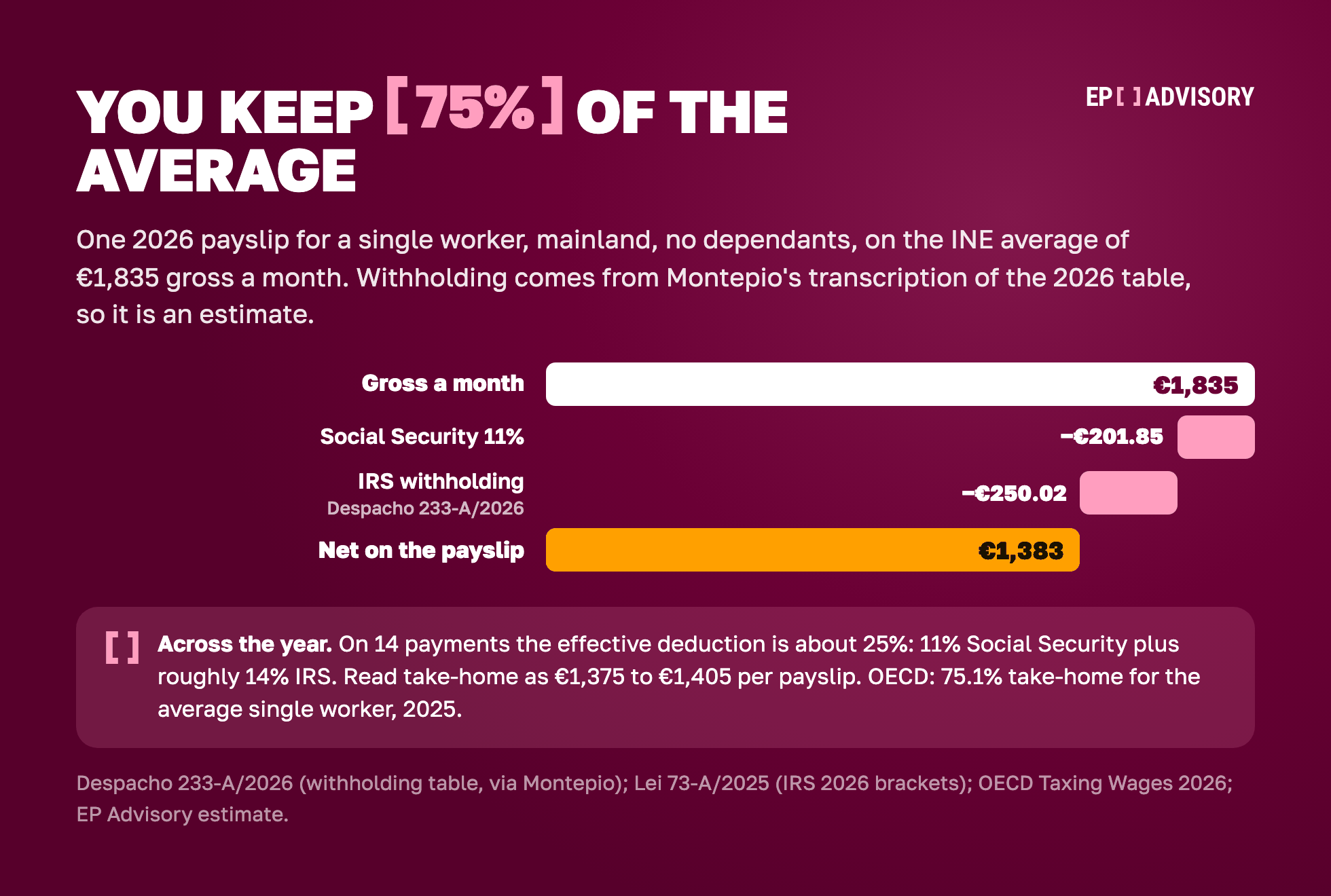
How withholding works. Your employer uses the monthly tables in Despacho 233-A/2026: one marginal rate on the whole month’s pay minus a fixed parcela a abater. For a single mainland worker with no dependants, pay up to €920 is exempt; at €1,835 the table gives 31.1% minus €320.66, which is €250.02. We took the table from Montepio’s transcription rather than the Finanças file, so treat every withholding figure here as an estimate; the annual return settles the difference.
On the average salary of €1,835 gross, the 2026 payslip shows Social Security of €201.85, IRS of €250.02 and a net of about €1,383, or 75.4% of gross. Across a year on 14 payments the effective deduction is about 25%, 11% Social Security plus roughly 14% IRS, giving about €1,375 net per payment; on the ÷12 reading it is about €1,405. Read it as a range, roughly €1,375 to €1,405 net per payslip: the final bill depends on the annual return, dependants and registered expenses. The OECD’s Taxing Wages 2026 puts take-home for a single average Portuguese worker at 75.1% of gross for 2025. If €1,835 were a base salary paid 14 times, the net is about €1,605 a month with the 14 payments spread over 12.
| Gross per payslip | IRS withheld | Social Security 11% | Net per payslip |
| €920 (minimum wage) | €0.00 | €101.20 | €818.80 |
| €1,342 (average base) | €130.09 | €147.62 | €1,064 |
| €1,835 (Q2 2026 average) | €250.02 | €201.85 | €1,383 |
| €2,157 (Blue Card reference) | €351.60 | €237.27 | €1,568 |
| €2,500 | €471.34 | €275.00 | €1,754 |
Single worker, mainland, no dependants, 2026 tables as transcribed by Montepio; EP Advisory estimate, one payslip, 14 times a year.
IFICI, the 20% regime. The successor to NHR taxes employment income from eligible activities at a flat 20% for ten years. Conditions: you become a Portuguese tax resident, were not resident in the previous five years, never used NHR, and apply by 15 January of the year after you arrive. Eligible is narrow: Portaria 352/2024/1 limits it to a closed list of highly qualified professions (directors, ICT and engineering specialists, doctors, university teachers) in exporting companies with an eligible activity code, plus research and teaching, R&D roles in certified entities, certified startups and jobs recognised by AICEP or IAPMEI. On the €53,671 tech survey average, ordinary IRS is about €12,862 (24%) and a flat 20% is €10,734; on the €1,835 average it is worth little.
IRS Jovem. Anyone aged 35 or under who is not a dependant gets a ten-year taper from the first year with work income: 100% exempt in year one, 75% in years two to four, 50% in years five to seven, 25% in years eight to ten, on income up to 55 times the IAS, €29,542.15 in 2026. Former NHR or IFICI beneficiaries are excluded; nothing limits it to Portuguese nationals. A 30-year-old on €1,835 ×14 (€25,690 a year, under the cap) pays no IRS in year one, lifting net pay to about €1,633 per payment.
Salary and the Visa: The €1,611 Floor and the €2,157 Blue Card Bar
What changed in the rules. Decree-Law 37-A/2024 of 3 June 2024 revoked the manifestação de interesse, the route by which people entered as tourists and regularised from inside the country. Lei 61/2025 of 22 October 2025 replaced the generic job-seeker visa with one for specialised technical skills, 120 days plus 60; as of September 2026 the foreign ministry’s visa portal lists it as not yet available, pending the regulation defining the professions. Family reunification now generally requires two years of valid residence, with housing, means and Portuguese-language integration; Blue Card and highly qualified permit holders are exempt from the wait. Citizens of the CPLP Portuguese-speaking countries now need a residence visa first.
You need the job before the visa. Three routes:
- D1, residence visa for employment. A contract, or a promise of contract, or a written expression of interest from the employer (manifestação individualizada de interesse) where your qualifications are recognised. No salary bar beyond the €920 minimum. AIMA then issues a two-year renewable permit.
- D3, highly qualified activity (article 61.º-A). A contract of at least six months paying at least 1.5 times the national average gross annual salary or three times the IAS, whichever you meet. The 2026 IAS is €537.13, so the IAS route is €1,611.39 a month gross, €19,337 a year on a 12-month reading. For listed shortage professions the bar drops to twice the IAS, €1,074.26 a month, never below the minimum wage.
- EU Blue Card (articles 121.º-A onwards). A contract of at least six months paying at least 1.5 times the national average gross annual salary, with no IAS alternative, plus a higher qualification or professional certification for regulated professions. AIMA’s published reference is €2,157 a month gross, or €1,725.60 for shortage professions, explicitly computed on the 2023 average salary and not updated on AIMA’s site. Last checked September 2026; verify it with the consulate before you rely on it. Temporary-protection beneficiaries are excluded.
A figure of €1,567 a month circulates on secondary sites as “the D3 threshold”. It matches neither three times the 2026 IAS nor AIMA’s reference. Ignore it.
Now put the numbers side by side. On the total measure the €1,835 average clears the D3 floor by about €220 and misses the Blue Card reference by about €320. On the base measure, which is what the contract will show, the €1,342 average clears neither. Energy, IT, finance and education clear the Blue Card reference on average; health, transport and consultancy clear the D3 floor. A nurse at the SNS entry grade, €1,657.04 base ×14, clears the D3 floor by €46.
Who can apply. Portugal has published no rule that bars citizens of Russia, Belarus or Kazakhstan from national work visas or the Blue Card; the restrictions in force cover short-stay Schengen visas, and sanctioned individuals are excluded. That is an absence of restrictions in the sources we checked, not a statement by AIMA, so confirm with your consulate. Citizens of Russia, Belarus and Kazakhstan file national visas at the Portuguese embassy in Moscow through the BLS visa centre; an embassy notice of 27 March 2026 said national-visa slots were full until August. Ukrainians displaced by the war hold temporary protection until 4 March 2027 under Council of Ministers Resolution 53-A/2026, with the right to live and work. Portugal issued 66,740 temporary-protection permits from 2022 to 2025 (AIMA, 2025 report). At EU level protection now runs to 4 March 2028 (Council Implementing Decision (EU) 2026/1912), and new applicants from 31 July 2026 must meet their military obligations to Ukraine. Portugal has not yet published its own extension to 2028.
Related reading: Work visa & Blue Card salary thresholds in Europe 2026 · Salaries in Spain · Salaries in France
See what a recruiter sees, then fix it before you apply. An instant score, then the fix for every problem.
Free, no card.
Key Takeaways
- The average salary is €1,835 a month gross (INE, quarter to June 2026): annual pay ÷12, subsidies included. The full-year 2025 figure of €1,694 is the stable number.
- Portugal pays 14 times a year. The job ad quotes base pay ×14, averaging €1,342, 37% below the headline. Convert every offer to annual gross.
- The median full-time base salary is €948 ×14 (Quadros de Pessoal 2024); Lisbon, IT, finance and the state lift the average.
- The minimum wage is €920 ×14, rising to €970 in 2027 and €1,020 in 2028. About one worker in five is on it, and it equals 90% of the median base salary.
- Sector decides more than city: IT €3,061 total ÷12, finance €2,970, education €2,829, against hospitality €1,200 and agriculture €1,180.
- Take-home on the average is roughly €1,375 to €1,405 net per payslip, about 25% below gross across the year. IRS Jovem (35 and under) and IFICI (20%) can cut the IRS slice.
- Rent, not tax, breaks an average salary: 82% of net household income nationally, and a Lisbon one-bedroom plus living costs exceeds the average net payslip.
- In-country regularisation ended in June 2024 and the new job-seeker visa is not open yet, so you need a contract first. D3 floor €1,611.39 a month gross (3 × IAS); AIMA’s Blue Card reference €2,157, dated. Last checked September 2026.
Frequently Asked Questions
What is the average salary in Portugal per month?
The average salary in Portugal is €1,835 a month gross per job in the quarter to June 2026 (INE total remuneration, up 5.1% on the year): annual pay divided by 12, holiday and Christmas subsidies included. The June quarter is a seasonal high; the full-year 2025 average was €1,694. The base salary a job ad quotes, paid 14 times, averages €1,342; the median full-time base salary was €948 ×14 in October 2024 (Quadros de Pessoal).
What is a good salary in Portugal?
Anything clearly above €1,835 total ÷12, or €1,342 base ×14. Benchmarks: the Lisbon district averages €1,875 gross on Social Security declarations (April 2026); public administration €2,792, finance €2,970 and IT €3,061 on INE’s June 2026 total measure, ÷12. A salary of €2,500 ×14 nets about €1,754 per payslip, roughly a one-bedroom flat plus living costs in Lisbon.
What is the minimum wage in Portugal in 2026?
€920 a month gross, paid 14 times (€12,880 a year), on the mainland from 1 January 2026 under Decreto-Lei 139/2025; €966 in the Azores and €980 in Madeira per employer-association reports. That is €5.31 an hour on a 40-hour week and €818.80 net after 11% Social Security, with no IRS withheld. The agreed path is €970 in 2027 and €1,020 in 2028. About one worker in five is on the minimum, which equals 90% of the median base salary.
How much is the average salary in Portugal after tax?
About €1,383 on the 2026 payslip for a single worker on the mainland: 11% Social Security is €201.85 and IRS withholding under Despacho 233-A/2026 is €250.02, an estimate from Montepio’s transcription of the table. Across a year on 14 payments the effective deduction is about 25%, giving about €1,375 net per payment; on the ÷12 reading about €1,405. Read it as €1,375 to €1,405. The OECD puts take-home at 75.1% of gross for the average single worker in 2025.
What salary do you need for a Portuguese work visa or EU Blue Card?
The D1 employment visa has no salary bar beyond the €920 minimum wage. The D3 highly qualified visa requires 1.5 times the average gross annual salary or 3 times the IAS, whichever you meet: with the 2026 IAS at €537.13 that is €1,611.39 a month gross (€1,074.26 for listed shortage professions), on a contract of at least six months. The EU Blue Card requires 1.5 times the average with no IAS alternative; AIMA’s reference is €2,157 a month gross (€1,725.60 for shortage professions), still computed on 2023 data. Last checked September 2026; verify before you rely on it.
Getting ready to apply for jobs in Portugal? Check your CV for free: see it the way a recruiter does, then fix each problem.