 By Andre Atallah, CEO of EP Advisory
Short answer: your US resume already holds what a UK employer wants to see. What changes is the format. A UK CV runs to up to two A4 pages and opens with a short personal statement. It uses British spelling and UK date order, and leaves out your photo, date of birth and GPA. If you need a visa, add one plain line: “Will require Skilled Worker visa sponsorship”. This guide walks you through each change.
American experience reads well in the UK, and with the right CV you can put it in front of British employers. They know US companies and US ways of working, and a strong American candidate usually does well here. The biggest difference is the document. Rewrite a resume made for US readers into a CV made for British ones.
This is how we turn a US resume into a UK CV with our American clients. You get the differences side by side, the length rule, the section order, the visa line, a UK spelling list, and one resume section rewritten for a UK reader. For nearly 10 years, we’ve helped more than 5,000 professionals find jobs abroad. Want to know if your CV will pass screening in the UK? Check your CV for free: a score in 30 seconds, then a fix for each problem.
UK CV vs US resume: the differences at a glance
The content is the same: your work, your results, your education. What changes is length, the opening, the spelling, the personal details and one line about your right to work.
In the UK the document is called a CV (short for curriculum vitae). It is what Americans and Canadians call a résumé. So when a UK job ad asks for your CV, send your resume, rewritten to British norms.
| Item | US resume | UK CV |
| Length | 1 page is common, 2 for senior roles | Up to 2 A4 pages is the norm |
| Opening | Objective or summary, often optional | Personal statement of a few short lines |
| Photo | No | No |
| Date of birth, age, marital status | No | No |
| Spelling | American (organize, center) | British (organise, centre) |
| Dates | 06/2019 | June 2019 (UK reads 06/07 as 6 July) |
| Grades | GPA often listed | UK graduates give a degree class (First, 2:1); leave a US GPA off unless asked |
| References line | Usually left off | Optional: “References available on request”. No names |
| Right to work line | Not needed for US citizens | One line if you need a visa |
| Paper size | US Letter | A4 |
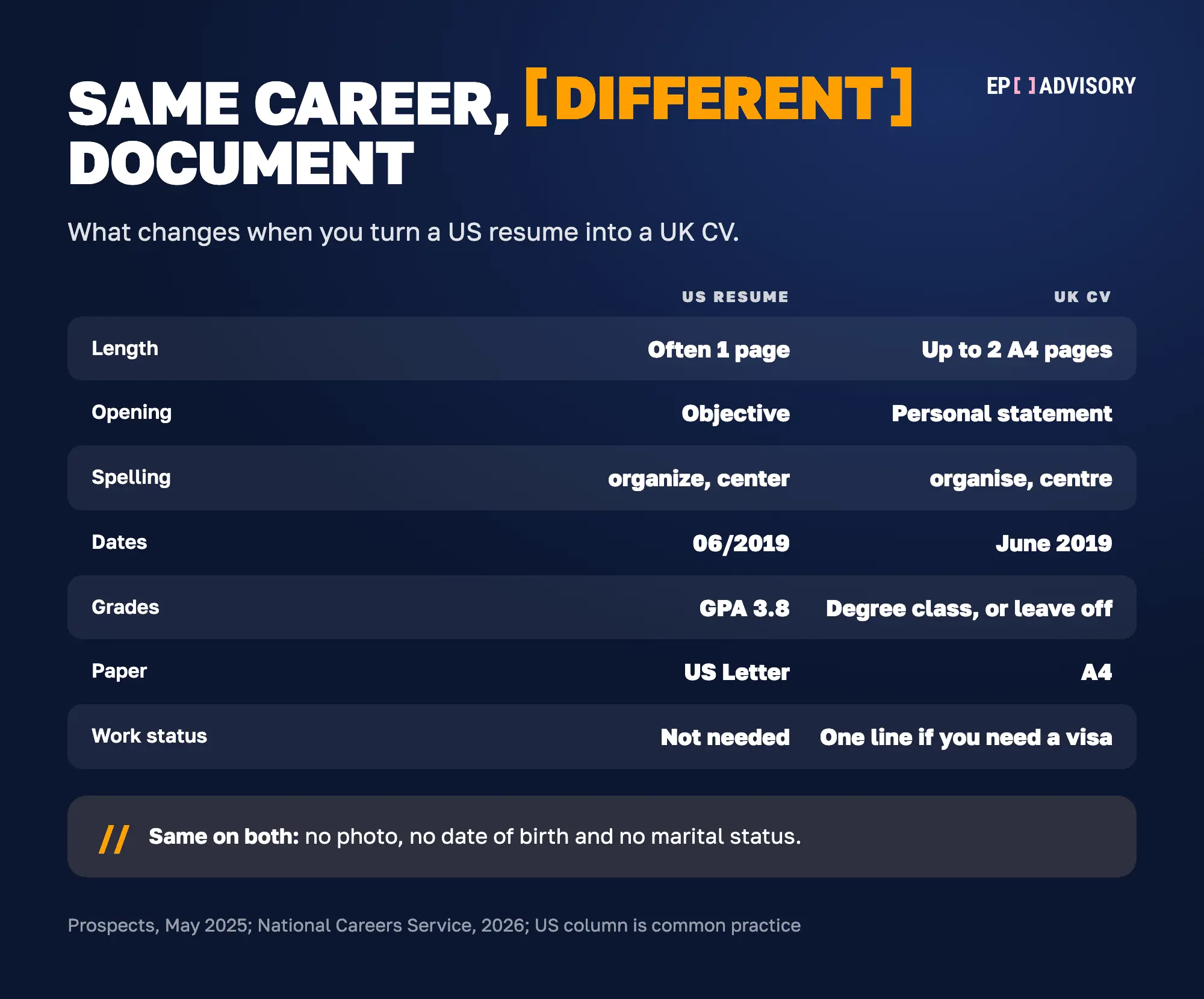
Two rows are already the same: no photo and no date of birth. Keep it that way. European CV templates often include both, so start from a plain UK layout instead.
How long should a UK CV be?
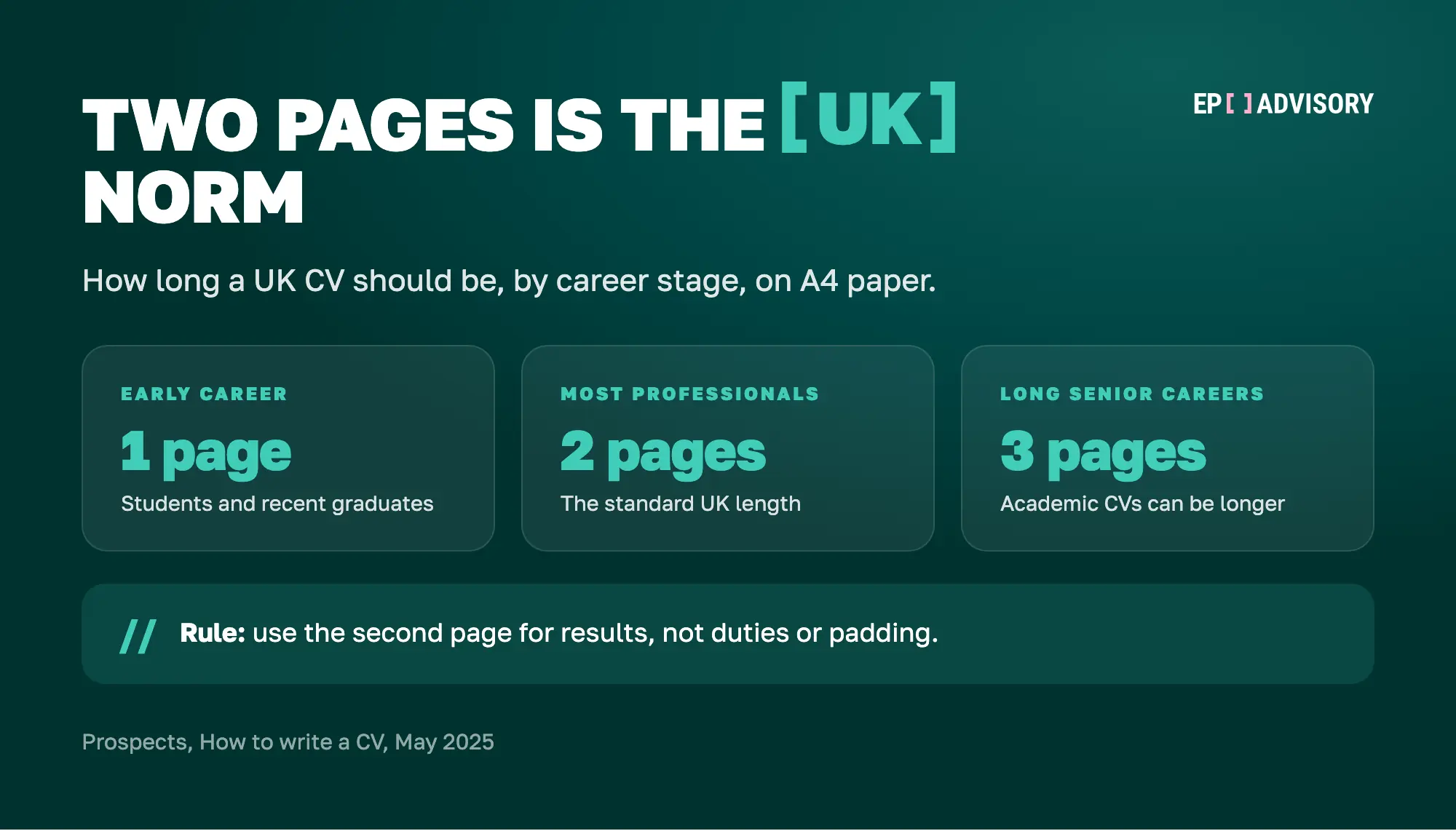
Two A4 pages is the standard for most professionals. One page is fine early in your career. Three pages can suit a long senior career, and academic CVs can run longer.
Use the second page for results, not duties (Prospects, May 2025).
Three practical rules:
- Set the page to A4. US Letter is shorter and wider. A PDF made on Letter prints with odd margins in the UK.
- Use a readable font. Arial, Times New Roman or Calibri, at size 11 or bigger (National Careers Service).
- Let your results set the length. If your last 10 years fit on one and a half pages, stop there.
British CV format: the sections in order
Use reverse date order and six blocks: contact details, personal statement, work experience, education, skills, and an optional extra section.
- Name and contact details. Full name, phone number with the country code (+1), email and a LinkedIn link. Add your city and “USA”, or your UK city if you have already moved. A full street address is not needed.
- Personal statement. Three to four lines about who you are, what you do and the role you want. More on this below.
- Work experience. Most recent job first. Job title, employer, city and country, month and year. Then 3 to 6 bullet points of results.
- Education. Degree, subject, university, year. Drop the GPA unless the employer asks for grades.
- Skills. Tools, languages and certifications that match the job ad. Use the same words as the ad, because some employers screen CVs with software first.
- Optional extras. Publications, memberships or volunteering, if relevant.
Your personal statement replaces an “Objective” line. Leave off hobbies with no link to the job. Keep your referees’ names and phone numbers ready for when the employer asks.
Score your CV in 30 seconds, then fix its biggest problems one by one. Both free.
Free, no card. A free account unlocks every fix.

The personal statement: how to write one that works
A UK personal statement is three or four plain lines written for this job. Write it as plain facts about you, not as an objective or a list of adjectives.
This is the change we make first with American clients. Many US resumes open with an objective or a keyword-heavy summary. A UK recruiter looks for something shorter and more specific. The National Careers Service calls the UK version a personal profile: “a few short lines that sum up who you are and what you hope to do”.
A good statement answers three questions in this order:
- What are you? Your job title and years of experience, in your field.
- What have you done that matters here? One or two results that match the job ad.
- What do you want next? The role and the city, plus your visa status if you need sponsorship.
You can write it with “I” or without it. Pick one style and keep it the same all the way through. Rewrite it for each application.
What to remove: photo, date of birth and other details
Leave off your photo, date of birth, age, marital status and any nationality line. UK recruiters expect them to be missing, and equality law is the reason.
Age, marriage or civil partnership, and race (which includes nationality) are protected characteristics under the Equality Act 2010. Employers must not treat you worse because of them. Employers can only ask for a date of birth on an application form if the job requires a certain age, such as selling alcohol (GOV.UK). No law stops you putting these details on your own CV. But many UK recruiters prefer not to see them, and UK careers advice is to leave them off. Add a photo only if the job is acting or modelling.
Also take off:
- GPA. UK readers think in degree classes (First, 2:1, 2:2). So list a GPA only if the employer asks for grades.
- Abbreviations and US jargon. Spell out YoY (year on year), CPA (cost per acquisition) and state codes like IL. Write “Chicago, USA”.
- Salary history. UK CVs leave it out. If a form asks for expected pay, give a figure in pounds that matches UK pay for the role.
Leaving off nationality does not mean hiding your visa need. The next section shows how to state it.
Your visa status: one plain line does the job
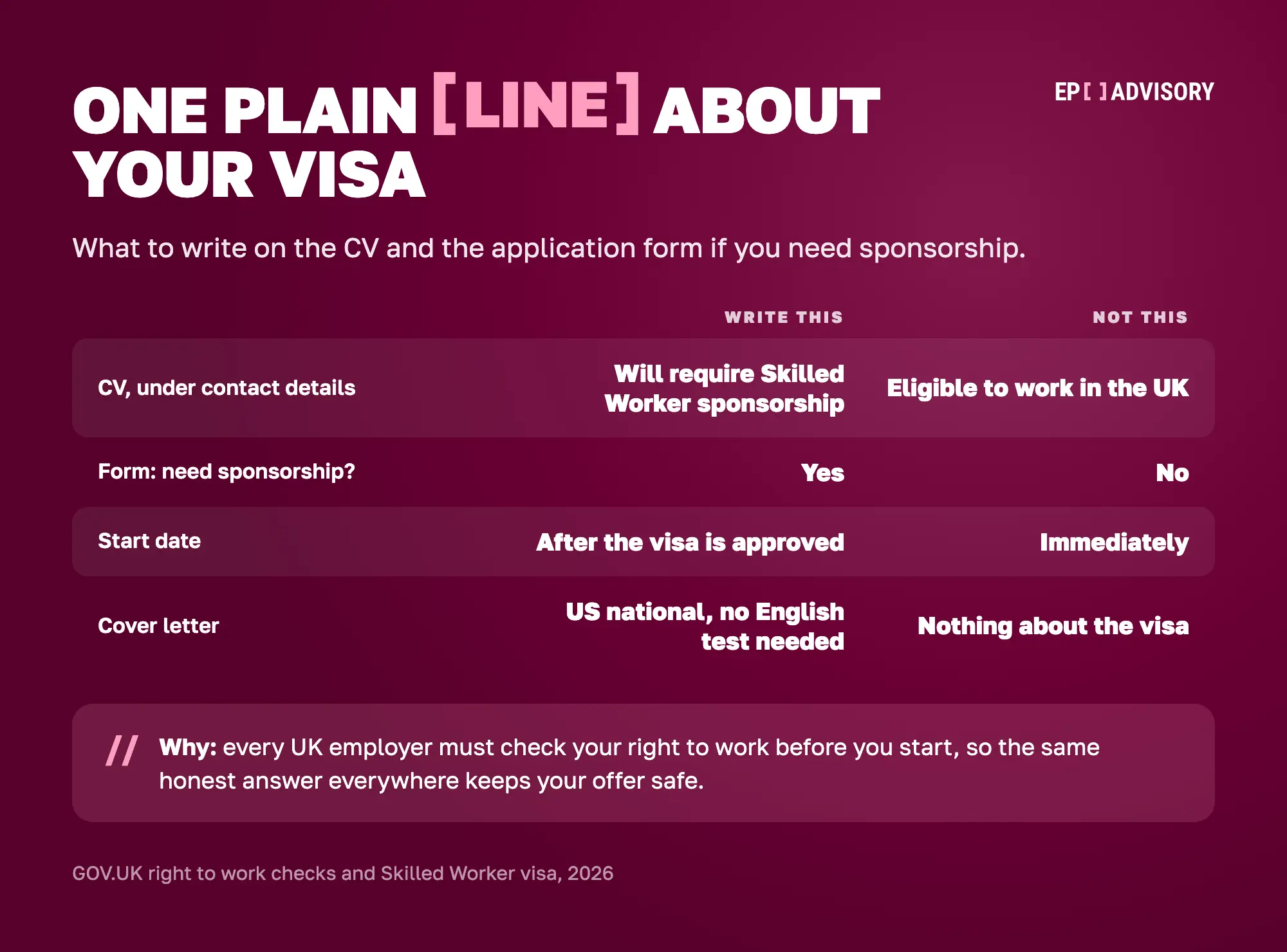
Put one plain line under your contact details: “Will require Skilled Worker visa sponsorship.” Then answer the sponsorship question on the application form the same way.
Stating it up front works in your favour. Every UK employer must check that you are allowed to work in the UK before you start, so the recruiter will find out anyway. Saying it first saves both sides time and shows you know the process.
The Skilled Worker visa is the main sponsored work route for Americans. It needs a job offer from a licensed sponsor for a higher skilled job. In most cases the pay must be at least £41,700 a year gross or the going rate for the job, whichever is higher (September 2026). Some applicants, such as new entrants, can qualify at a lower rate.
Three rules we give every American client:
- Write “eligible to work in the UK” only if you already hold a visa that allows it. An ETA (Electronic Travel Authorisation) lets you visit. It does not let you work for a UK employer. A visitor cannot do paid or unpaid work for a UK company.
- If you need a visa, answer “Yes” to “Will you now or in the future require sponsorship?” Many forms use this question to sort applications. An honest “Yes” keeps your offer safe at the right-to-work check.
- Use your English advantage. US nationals do not need to prove their English for the Skilled Worker visa, because the USA is on the GOV.UK list of exempt countries. A short note in your cover letter can say so.
Sponsoring you is an investment for the employer. A medium or large sponsor pays £525 for the certificate of sponsorship and £1,320 in Immigration Skills Charge for the first 12 months. So send your CV to employers that already hold a sponsor licence. Visa rules change often, so check the current rules on GOV.UK or with a regulated adviser before you rely on them.
Next: send your CV to employers that can sponsor you. Our guide to UK companies that sponsor visas shows how to filter the official register of over 120,000 organisations.
UK spelling: 10 swaps to make
Switch your spell-checker to English (UK), then check these 10 swaps by hand. That catches the ones a spell-checker can miss.
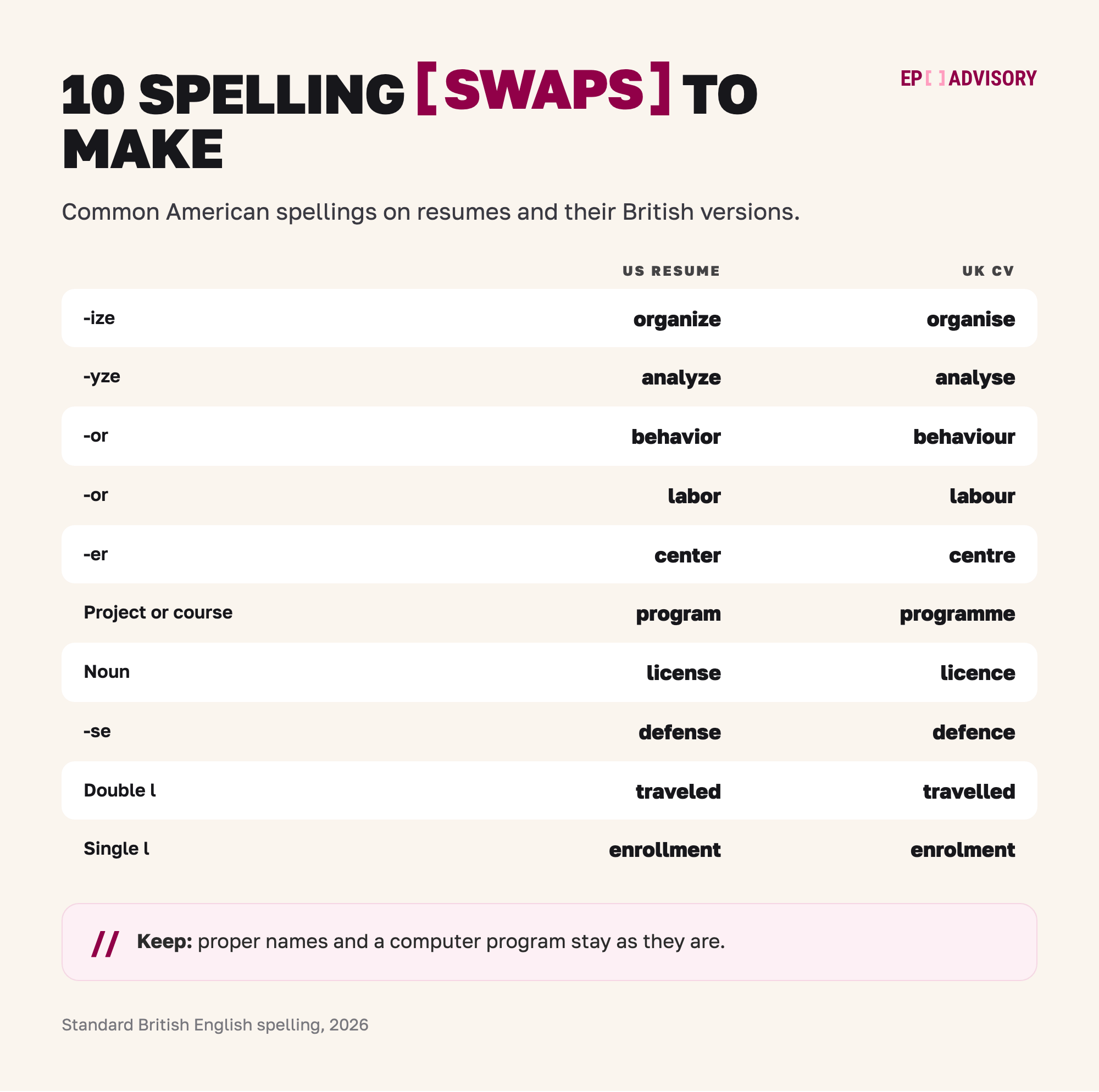
- -ize to -ise: organize to organise, optimize to optimise, prioritize to prioritise.
- -yze to -yse: analyze to analyse.
- -or to -our: behavior to behaviour, labor to labour, color to colour.
- -er to -re: center to centre.
- Program to programme: for a project or a course. A computer program stays “program”.
- License to licence: the noun is “licence” in the UK. The verb stays “license”.
- Defense to defence.
- Traveled to travelled: the UK doubles the l (also modelled, cancelled).
- Enrollment to enrolment.
- Resume to CV: in your cover letter and emails too.
Keep proper names as they are. “World Health Organization” and “Centers for Disease Control and Prevention” keep their own spelling. Keep job titles as the employer wrote them.
Before and after: an American resume section, rewritten for the UK
Here is one made-up American resume section and the same job rewritten for a UK reader. The results stay the same. The wording, the spelling and the dates change, and the rewrite adds context a UK reader needs.
Before (US resume):
- OBJECTIVE: Seeking a challenging role in a dynamic organization where I can leverage my skills.
- Senior Marketing Manager, Acme Health, Chicago, IL, 06/2019 – Present
- Spearheaded omnichannel GTM strategy for 3 product launches, driving $2.4M in incremental revenue.
- Optimized paid search program, lowering CPA 32% YoY.
- Managed 6 direct reports and $1.2M annual budget.
- Collaborated cross-functionally with Sales, Product, and Legal.
- EDUCATION: BA, Communications, University of Illinois, GPA 3.8
After (UK CV):
- PERSONAL STATEMENT: Senior marketing manager with 9 years in health software. Plans and runs product launches across paid search, email and sales channels, and manages budgets up to $1.2 million. Looking for a senior product marketing role in London. Will require Skilled Worker visa sponsorship.
- Senior Marketing Manager, Acme Health (health software company, about 1,200 staff), Chicago, USA. June 2019 to present
- Led the launch plan for 3 new products across paid search, email and sales, adding $2.4 million in revenue in the first year.
- Cut the cost per new customer from paid search by 32% in 12 months by rebuilding the keyword lists and landing pages.
- Managed a team of 6 and an annual budget of $1.2 million.
- Worked with the sales, product and legal teams to get every launch approved on schedule.
- EDUCATION: BA Communications, University of Illinois, 2017
What changed, and why:
- The objective became a personal statement with the role, the city and the visa line.
- The employer got one line of context. Sector and size tell a UK recruiter what the job was, even if they do not know the company.
- Each result got a time frame and a method. Add these only if they are true and you can explain them.
- Jargon went. “Spearheaded”, “omnichannel GTM”, “CPA” and “YoY” became plain words.
- Spelling and dates went British. “Optimized” disappeared, “program” was reworded, and 06/2019 became June 2019.
- The GPA went. The dollar figures stayed in dollars, written out in full, because those are the real figures.
Acme Health and its numbers are made up for this example. Use only results you can prove in an interview. For more ways to turn duties into results, see our CV achievements examples. Once your own version is done, run it through a check before you send it. Getting ready to apply for jobs in the UK? Check your CV for free: see it the way a recruiter does, then fix each problem.
Final checks before you send
Read your CV the way a busy UK recruiter will: fast, and with no knowledge of your US employers.
- Page size and length: A4, two pages at most.
- Top third: name, contact details, the visa line and a personal statement written for this job.
- Every bullet: a result with a number where you have one.
- Spelling: English (UK) spell-check, then the 10 swaps above.
- Nothing personal: no photo, date of birth, age, marital status or GPA.
- The job fits the visa: in most cases the role must be a higher skilled job paying at least £41,700 a year or the going rate, whichever is higher. Our Skilled Worker salary threshold guide shows how to check.
A strong UK CV puts you in a good position with employers that can sponsor you, so send it to them first. To get more replies, read how to get replies from UK employers. For the whole process from target list to visa, see how to get a job in the UK as an American. For interviews, see how to pass a job interview.
If you would rather have an expert rewrite it, our CV and LinkedIn service rewrites both for the market you are targeting.
Key takeaways
- US experience is valued in the UK. A UK CV is your resume rewritten to British norms, not a different set of facts.
- Two A4 pages is the standard length. Three can suit a long senior career, and academic CVs can be longer.
- Open with a personal statement of three or four lines written for the job, not an objective.
- Leave out your photo, date of birth, age, marital status, nationality line and GPA.
- If you need a visa, write “Will require Skilled Worker visa sponsorship” and answer the form the same way.
- In most cases the Skilled Worker job must pay at least £41,700 a year gross or the going rate, whichever is higher, so aim the CV at roles that clear it.
- Switch to UK spelling and UK dates, and explain each US employer in one line.
See what a recruiter sees, then fix it before you apply. An instant score, then the fix for every problem.
Free, no card. A free account unlocks every fix.
Frequently asked questions
What is the difference between a UK CV and a US resume?
They cover the same work history. A UK CV is usually up to two A4 pages, opens with a short personal statement, uses British spelling and UK date order, and leaves out the GPA. Americans who need a visa also add one line saying they will require Skilled Worker sponsorship.
How long should a UK CV be?
Two A4 pages for most professionals. One page is fine early in a career. Three pages can suit a long senior career, and academic CVs can be longer.
Should I put a photo on my UK CV?
No. Add a photo only if the job is acting or modelling. Leave off your date of birth, age and marital status too.
Should I put my visa status on my UK CV?
Yes, if you need a visa. Write one plain line under your contact details, such as “Will require Skilled Worker visa sponsorship.” Say you are eligible to work in the UK only if you hold a visa that allows it. An ETA is for visits.
Should I use British spelling on my CV?
Yes. Set your spell-checker to English (UK) and change words like organize, analyze, center and program to organise, analyse, centre and programme. Keep proper names and the employer’s job titles as they are written.