 By Andre Atallah, CEO of EP Advisory
Short answer: This is very achievable with the right method. Over 120,000 UK organisations hold a licence to sponsor Skilled Worker visas, and the full list is free on GOV.UK. Download the register, filter it by route and town, and build a shortlist of employers that hire your role. Then check that the job pays at least £41,700 a year gross or its going rate, whichever is higher. Target those roles and a licensed employer can hire you from the US.
With the right approach, getting a UK sponsor to hire you from the US is very achievable. American professionals are strong candidates. UK employers know US companies, US job titles and US ways of working, and many London firms have American clients or an American parent. What you need is a way to find the employers that can hire you, and the roles they can sponsor.
This is the method we use with clients moving from the US, from the official register to the first message you send.
For nearly 10 years, we’ve helped more than 5,000 professionals find jobs abroad. Want to know if your CV will pass screening in the UK? Check your CV for free: a score in 30 seconds, then a fix for each problem.
The official list: the register of licensed sponsors
Start with the Home Office’s own list of every employer allowed to sponsor foreign workers. The Register of licensed sponsors is a free CSV file (a plain spreadsheet) on GOV.UK, updated most working days.
The 29 September 2026 file lists over 120,000 organisations on the Skilled Worker route, the main work visa for Americans. About 35,000 of them list their town as London.
A “sponsor” is an employer with a sponsor licence. To hire you, it gives you a certificate of sponsorship (CoS): an electronic reference number you use to apply for your visa.
Once a sponsor offers you the job, the visa itself usually goes smoothly. In the year to June 2026, fewer than 1 in 100 Skilled Worker applications from Americans were refused (Home Office immigration statistics). So the work that matters is finding the right employer and the right role.
The register has five columns:
- Organisation name: the legal company name, which is often not the brand name.
- Town/City and County: where the licence is registered, usually head office.
- Type and rating: for example “Worker (A rating)”.
- Route: which visa it can sponsor, such as “Skilled Worker” or “Global Business Mobility: Senior or Specialist Worker”.
There is no sector, job title or salary column. The 6 steps below fill that gap.
How to find a sponsor in the register: 6 steps
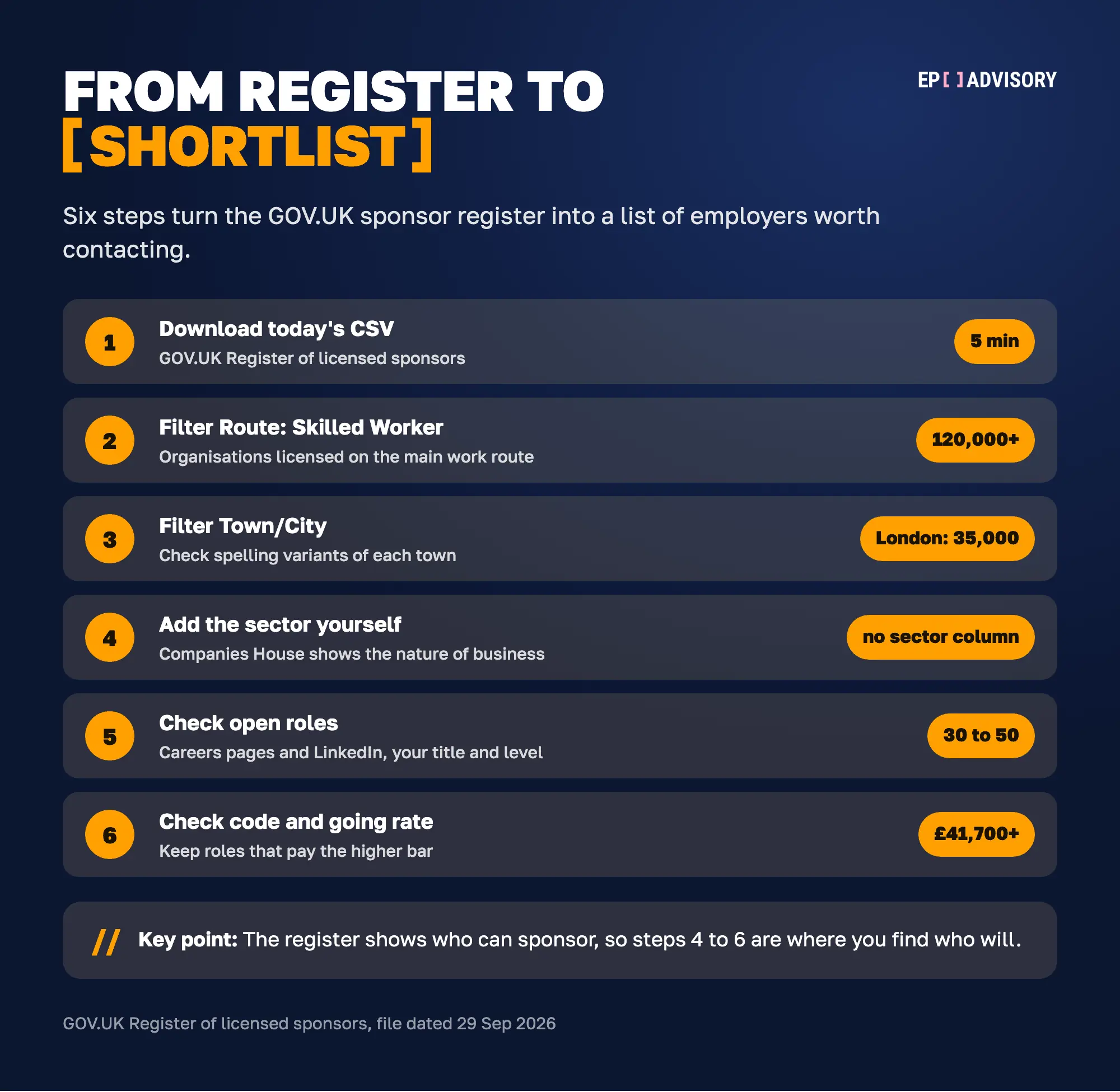
Use the register as a filter, then do the research it cannot do. We ask clients to aim for a shortlist of 30 to 50 real targets.
- Download today’s file. Open the register page on GOV.UK and download the CSV. Use the newest one, because licences are added and removed daily.
- Open it in Excel or Google Sheets and turn on filters. Set Route to “Skilled Worker”. If you hope to transfer with your current employer, also check that it is listed for “Senior or Specialist Worker”.
- Filter Town/City. Pick the cities where your field hires: London, Manchester, Edinburgh, Cambridge, Bristol and so on. Check spelling variants, because the town field is typed by hand.
- Add the sector yourself. For the rest, look up the company on Companies House, the free UK company registry. Its “nature of business” line tells you the industry.
- Cross-check open roles. Visit each target’s careers page and LinkedIn. Keep the ones that hire your job title at your level.
- Check the pay before you apply. Find the job’s 4-digit occupation code and its going rate. Keep the roles that pay the higher of £41,700 or the going rate.
Target A-rated sponsors
An A rating means the employer can issue new certificates of sponsorship today, so these are the employers to target.
Most approved employers start with an A-rated licence. GOV.UK says an A-rated licence “lets you start assigning certificates of sponsorship”.
A B rating is a downgrade. The Home Office gives it when an employer has not kept up its sponsor duties. A B-rated employer cannot issue new certificates of sponsorship until it has made improvements under a Home Office action plan and upgraded back to A. This is rare: 85 employers hold a B-rated Worker licence in the 29 September 2026 file, so almost every sponsor you find is A-rated.
“UK Expansion Worker: Provisional” marks an overseas company setting up its first UK office. While provisional, it can assign one certificate of sponsorship. Put your time into A-rated sponsors instead.
Score your CV in 30 seconds, then fix its biggest problems one by one. Both free.
Free, no card. A free account unlocks every fix.

How to pick a role that qualifies for sponsorship
A licence shows the employer can sponsor. Pick a job that meets the visa rules, and saying yes becomes easy for the employer.
What works is targeting roles that qualify, not any role at a big name on the register. The licence is the first condition. The role is the second.
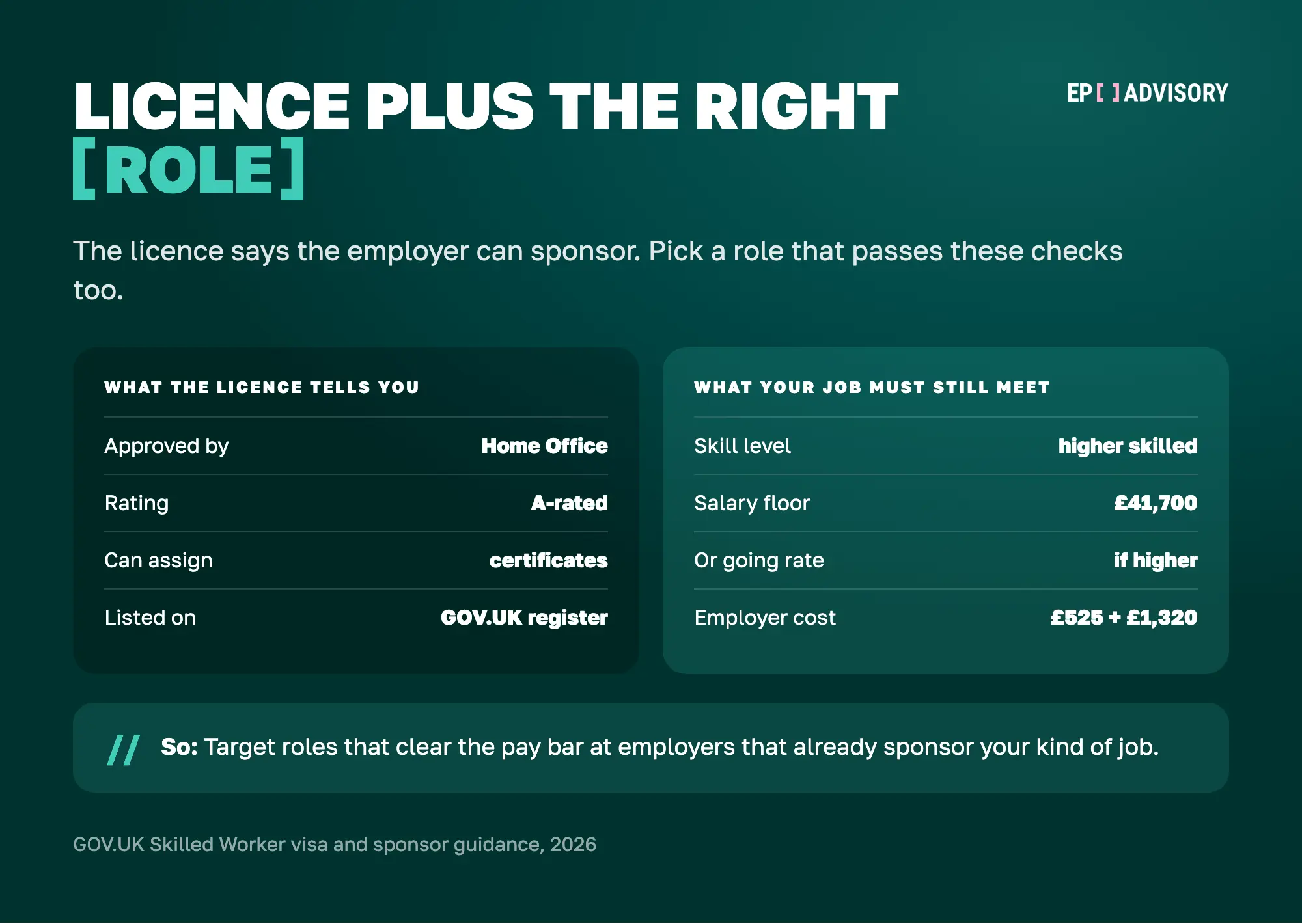
For a Skilled Worker visa, the job itself must meet these GOV.UK rules:
- Skill level: the occupation must be on the eligible list as “higher skilled”, roughly graduate level. Medium-skilled jobs qualify when they are on the Immigration Salary List or the Temporary Shortage List.
- Salary: at least £41,700 gross per year, or the going rate for the occupation code, whichever is higher. Lower floors from £33,400 exist for some new entrants and PhD holders.
- A real job: the employer must have a genuine need for the role. You must work for the sponsor itself, not be hired out to another company.
Employers choose which roles to sponsor. Many focus on senior or hard-to-fill roles. So aim at roles where your experience and the pay clearly clear the bar. For the full detail on the pay rules, read our guide to the Skilled Worker salary threshold.
Check the occupation code and going rate first
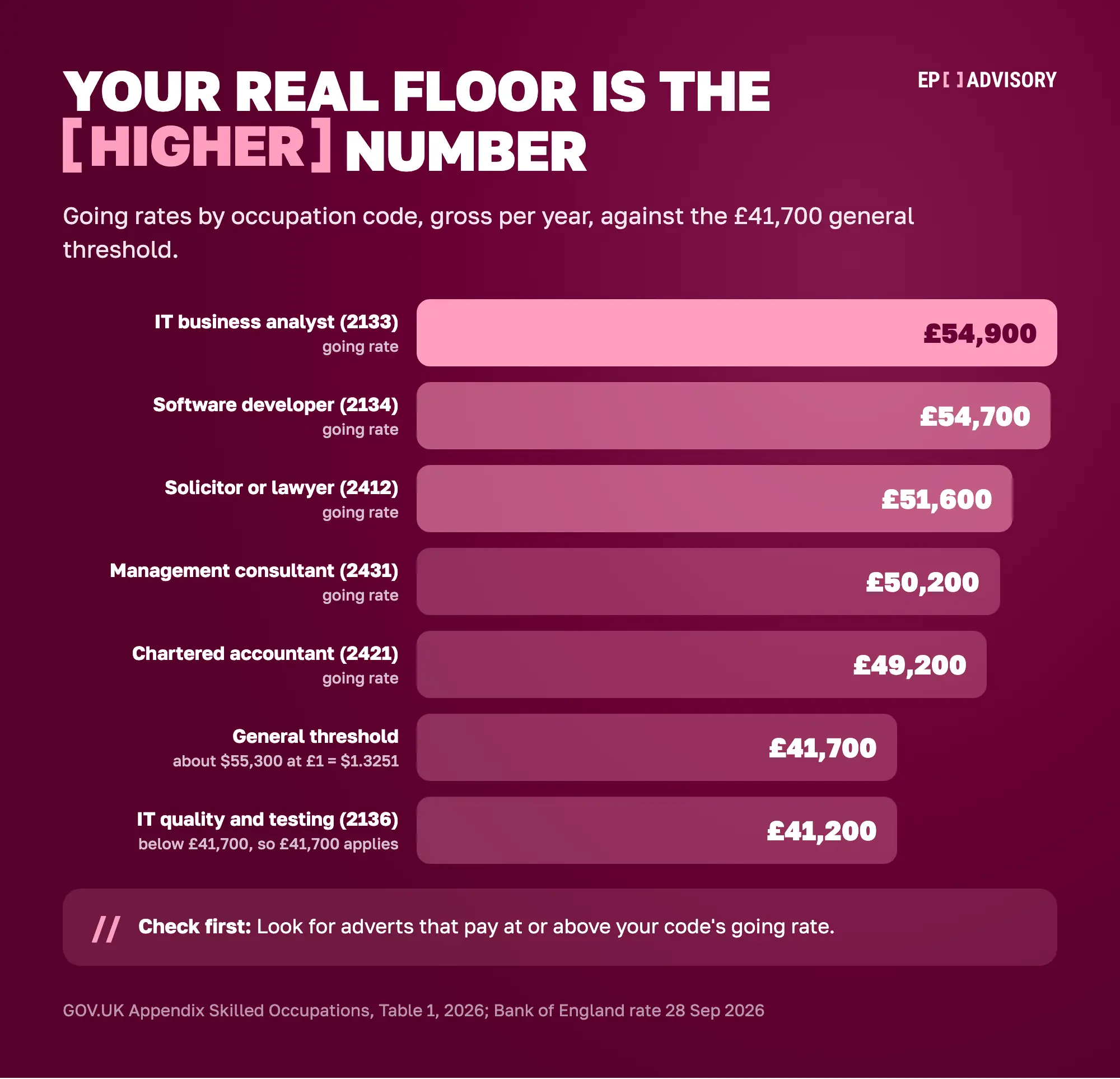
Every eligible job has a 4-digit occupation code, and every code has its own minimum pay called the going rate. Your offer must clear whichever is higher: £41,700 or that going rate.
To find your code, search your job title in the CASCOT coding tool, which GOV.UK links to. Then look up the going rate in Appendix Skilled Occupations (Table 1, August 2026). Going rates are gross per year for a 37.5-hour week.
| Occupation (code) | Going rate, gross per year | Your real minimum |
|---|---|---|
| Software developer (2134) | £54,700 | £54,700 |
| IT business analyst or architect (2133) | £54,900 | £54,900 |
| Solicitor or lawyer (2412) | £51,600 | £51,600 |
| Management consultant or business analyst (2431) | £50,200 | £50,200 |
| Chartered accountant (2421) | £49,200 | £49,200 |
| IT quality and testing (2136) | £41,200 | £41,700 (the general threshold) |
In dollars, £41,700 is about $55,300 and £54,700 is about $72,500 (Bank of England rate of $1.3251 to £1, 28 September 2026).
Use the table as a filter on job ads. A London software role advertised at £45,000 falls short, so look for ads at £54,700 or more. For typical UK pay by sector, see our guide to salaries in the UK.
How to read a job ad for sponsorship
The GOV.UK register tells you who can sponsor. Each job advert tells you which roles they will sponsor, if you read the signals.
Good signs in a UK job advert:
- “Visa sponsorship available” or “we can sponsor”: the clearest signal. Search LinkedIn and job boards with these exact words plus your job title.
- A salary range above your going rate: the role can pay what the visa needs.
- Senior or specialist roles: the pay is more likely to clear the going rate, and the local pool is smaller.
- International teams: companies that already sponsor staff know the process and its costs.
Signs to move on to your next target:
- “You must have the right to work in the UK”: this usually means the employer will not sponsor for this role.
- “No sponsorship available”: take it at its word, even if the company is on the register.
- A salary range below £41,700 or the going rate: the role cannot be sponsored at that pay.
- Recruitment agencies placing you with a client: the agency cannot normally sponsor you to work at another company as routine labour.
Application forms often ask “Will you now or in the future require sponsorship?”. Answer yes. An honest answer protects your offer. How to handle that question well is covered in why UK employers ignore American applications.
Next: for the whole job hunt from shortlist to visa, read how to get a job in the UK as an American.
Why US companies with UK offices are your strongest targets
Start with US companies you already know. Many run large UK offices, hold sponsor licences and value US experience.
Each of these is listed in the 29 September 2026 register as A-rated for both Skilled Worker and Senior or Specialist Worker:
- Amazon UK Services Ltd (London)
- Microsoft Limited (Reading)
- JPMorgan Chase Bank, National Association (London)
- Goldman Sachs International (London)
- Salesforce UK Limited (London)
- Bloomberg LP (London)
- McKinsey & Company Inc. United Kingdom (London)
These are examples of licensed employers, not a list of current vacancies. The UK entity often has a different legal name from the US parent. Search the parent brand, then the “UK Limited” or “International” version.
If you already work for a US company with a UK office, ask about an internal transfer first. Hundreds of Americans move this way each year. The UK route for this is the Senior or Specialist Worker visa, part of Global Business Mobility. It needs at least £52,500 or the going rate, whichever is higher. You must have worked for the company outside the UK for at least 12 months, unless you are paid £73,900 or more. The maximum stay is 5 years in any 6, or 9 in 10 at £73,900 or more. It does not lead to settlement (permanent residence). Skilled Worker can lead to settlement after 5 years under the current rules. The government has consulted on raising this to 10 years, so check GOV.UK for the latest position.
Visa rules change and each case is different, so check the current rules on GOV.UK or with a regulated adviser before you choose a route. GOV.UK lists them on its find an immigration adviser page.
The five-line message we teach for approaching a sponsor
Answer the sponsorship question before they ask it, and show that the numbers work.
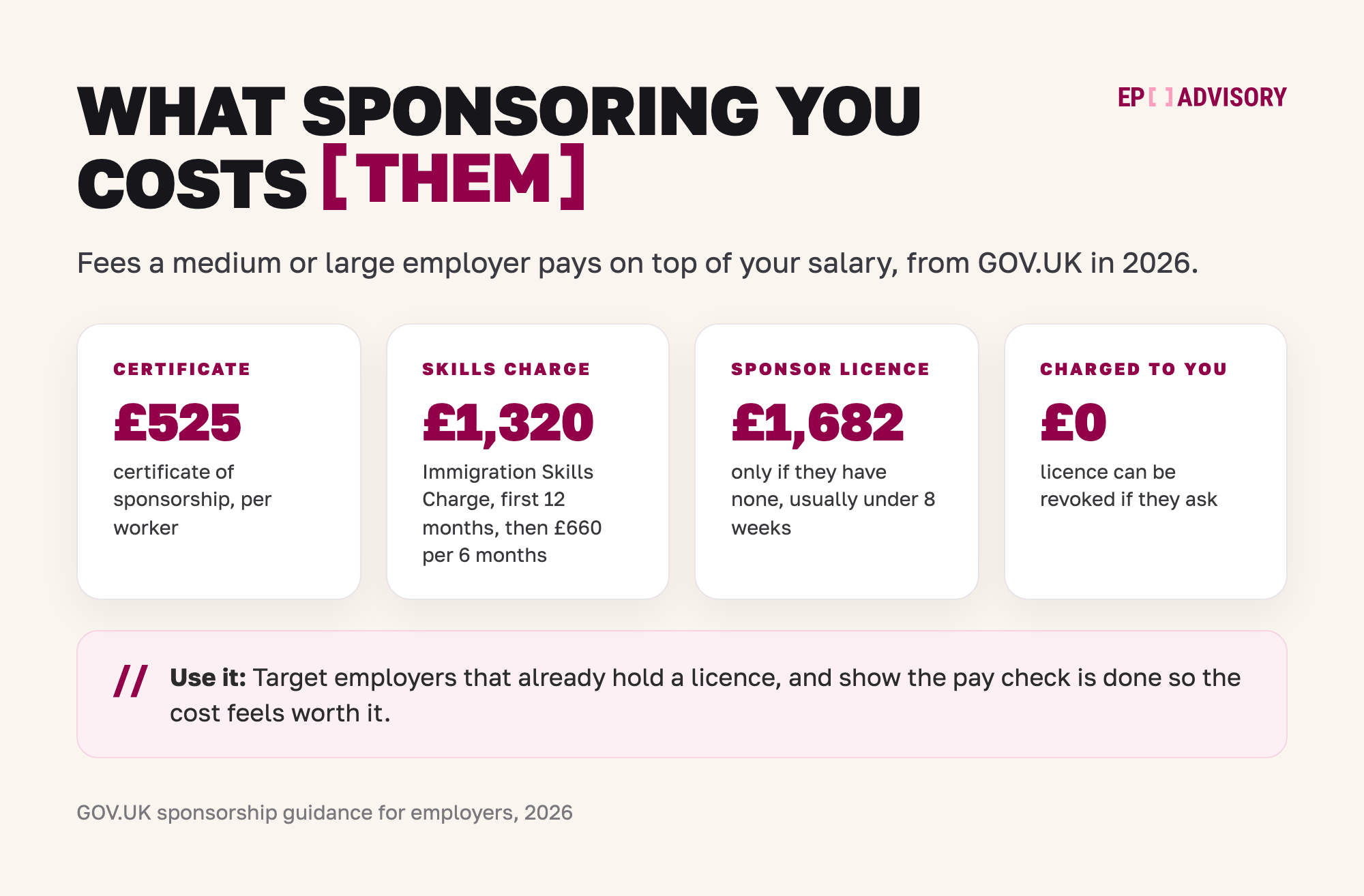
It helps to know what sponsoring you costs a medium or large employer on top of your salary (GOV.UK sponsorship guidance, 2026):
- Certificate of sponsorship: £525 per worker.
- Immigration Skills Charge: £1,320 for the first 12 months, then £660 for each extra 6 months. Small employers and charities pay £480, then £240.
- Sponsor licence, if they do not have one: £1,682 (£611 for small employers and charities). Most applications are decided in under 8 weeks. That is why you target employers that are already licensed.
For an employer hiring at your level, these are modest sums. You pay your own visa fee (£819 for up to 3 years from outside the UK) and the Immigration Health Surcharge (£1,035 a year). Americans are exempt from the English test.
In our experience, a short message to a hiring manager or team lead on LinkedIn works better than a cold application to a large inbox. This is the five-line structure we give clients:
- Line 1: the role or team, and one result from your work that fits it, with a number.
- Line 2: “I’m a US citizen and would need Skilled Worker sponsorship. I see [company] is a licensed sponsor.”
- Line 3: “The role’s occupation code is [code], and the going rate is [£X], which is within your advertised range.”
- Line 4: your notice period and when you could start. A visa decision from outside the UK usually takes about 3 weeks.
- Line 5: a clear ask: a 15-minute call, or the right person to speak to.
Line 3 shows the employer you have already done the compliance check. That makes you an easy hire to say yes to. Before you send anything, make sure the document you attach reads like a UK CV, not a US resume. Our guide to the UK CV vs US resume shows the changes. Getting ready to apply for jobs in the UK? Check your CV for free: see it the way a recruiter does, then fix each problem.
For the conversation about pay and relocation once they are interested, see how to negotiate salary.
How to spot a sponsorship scam
A genuine employer never charges you for your certificate of sponsorship or its sponsorship costs.
GOV.UK tells employers: “Your licence may be revoked if you ask the sponsored worker to pay the fee or any costs linked to your application.” You only pay your own visa fee and health surcharge, and you pay those to the Home Office, not to the employer or an agent.
Warning signs:
- Someone sells a “CoS” or a “sponsored job package”. Certificates are electronic records that only a licensed employer can assign.
- The employer is not on the register, or the name on your offer does not match the licence holder.
- An offer arrives without a real interview, or pay is far above the market for the role.
- You are told to start work on an ETA or visitor visa. The ETA (Electronic Travel Authorisation) is for visits only. You cannot work in the UK until your work visa is granted.
If you are asked to pay, stop. You can report suspected immigration fraud to the Home Office through GOV.UK.
Key takeaways
- Over 120,000 organisations on the GOV.UK register can sponsor Skilled Worker visas, about 35,000 of them in London.
- Filter the register by route and town, then add the sector and pay research yourself.
- Target A-rated sponsors, because they can issue new certificates of sponsorship today.
- Pick roles that are higher skilled and pay at least £41,700 (about $55,300) or their going rate, whichever is higher.
- US companies with UK offices are strong targets, and an internal transfer needs £52,500 or the going rate, whichever is higher.
- Answer the sponsorship question up front, with the occupation code and going rate.
- Your certificate of sponsorship is free to you. An employer that charges for it can lose its licence.
See what a recruiter sees, then fix it before you apply. An instant score, then the fix for every problem.
Free, no card. A free account unlocks every fix.
Frequently asked questions
How many UK companies sponsor visas?
Over 120,000 organisations are licensed to sponsor Skilled Worker visas on the Home Office register dated 29 September 2026. The full file has 143,102 rows because many employers hold licences for several routes.
Where is the official list of UK visa sponsors?
It is the Register of licensed sponsors on GOV.UK. It is a free CSV file, updated most working days, listing each employer’s name, town, rating and the visa routes it can sponsor.
What is the best website to find visa sponsorship jobs in the UK?
The best source is the GOV.UK register itself, used with LinkedIn. The method we use with clients is to shortlist employers from the GOV.UK register, then search LinkedIn and company careers pages for your job title with the words visa sponsorship.
Does a sponsor licence mean the company will sponsor me?
It means the company can sponsor you. Your job must also be higher skilled and pay at least £41,700 or the going rate for its occupation code, and the employer chooses to cover the sponsorship costs. Target roles that meet both checks.
Do I have to pay for my certificate of sponsorship?
No. GOV.UK says an employer’s licence may be revoked if it asks the worker to pay the fee or any costs linked to sponsorship. You pay only your own visa fee and health surcharge to the Home Office.