 By Andre Atallah, CEO of EP Advisory
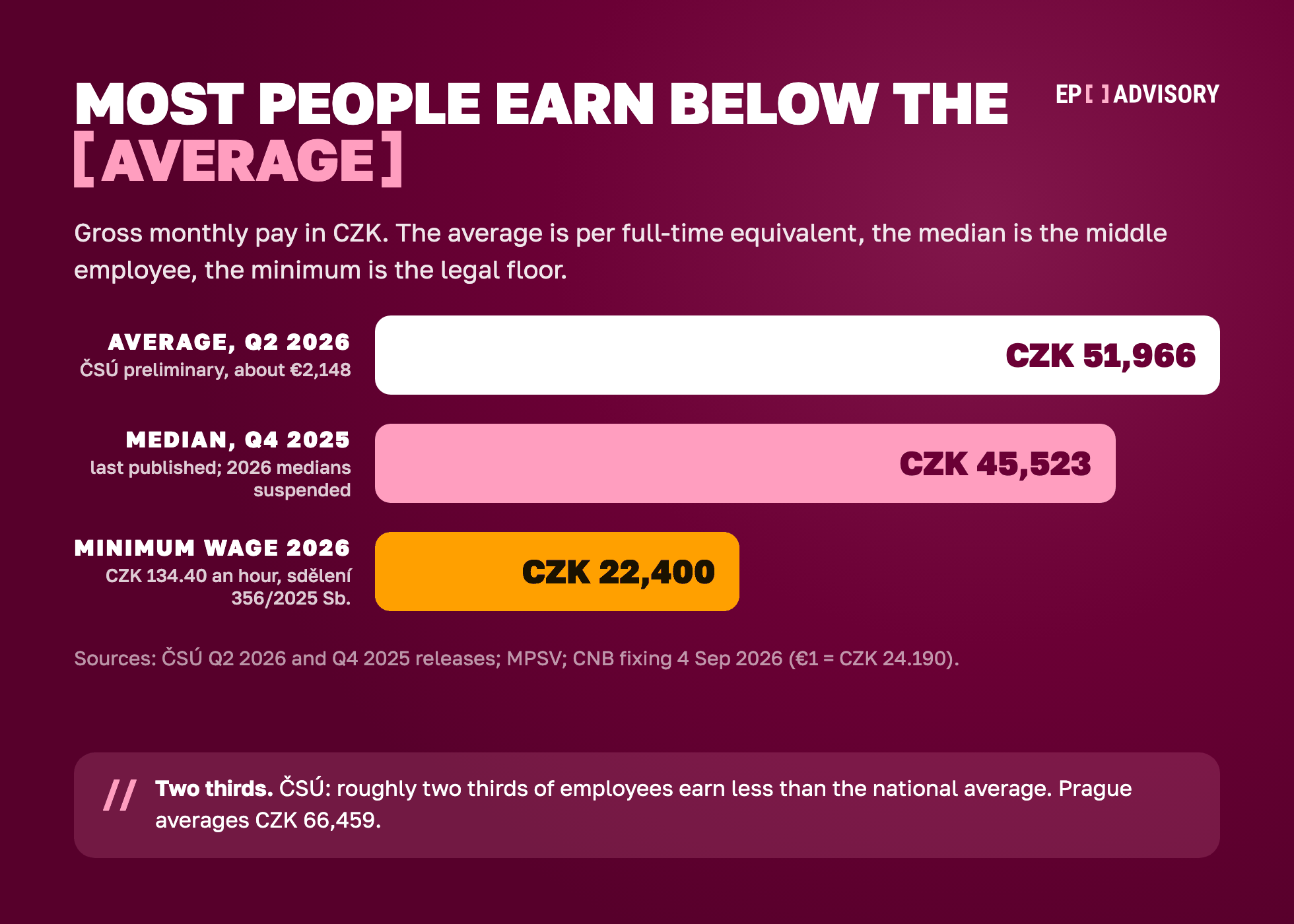
The short answer: the average salary in the Czech Republic is CZK 51,966 a month gross, about €2,148 (ČSÚ, Q2 2026). The last published median is CZK 45,523, so two thirds of employees earn less than the average. Take-home on the average is about CZK 40,700, roughly 78% of gross. The 2026 minimum wage is CZK 22,400 a month.
| Czech Republic, 2026 | Figure |
|---|---|
| Average salary, gross (ČSÚ, Q2 2026) | CZK 51,966 / month |
| In euros (CNB rate, 4 September 2026) | €2,148 / month |
| Full-year 2025 average, gross (ČSÚ) | CZK 49,215 / month |
| Median, gross (ČSÚ, Q4 2025, last published) | CZK 45,523 / month |
| Take-home on the average (single, estimate) | ≈ CZK 40,700 / month, about 78% |
| Statutory minimum wage 2026 | CZK 22,400 / month, CZK 134.40 / hour |
| Prague average, gross (ČSÚ, Q2 2026) | CZK 66,459 / month |
| EU Blue Card salary bar (from 1 May 2026) | CZK 73,823 / month |
The Czech Republic has a headline problem. The average wage is a real figure: CZK 51,966 a month gross in the second quarter of 2026. But the statistics office adds a line most salary pages leave out: roughly two thirds of employees earn less than that. The median was CZK 45,523 at the last count. And the national number hides a second split. Prague pays CZK 66,459, 28% above the country, while twelve of the thirteen other regions sit below the average.
This guide starts from the freshest ČSÚ quarterly figure, reconciles it with the annual, median, survey and OECD numbers, runs the 2026 payroll arithmetic, sets out the CZK 22,400 minimum wage, and connects all of it to the CZK 73,823 Blue Card bar.
In nearly 10 years, we’ve helped more than 5,000 professionals find jobs abroad. Want to know if your CV will pass screening in the Czech Republic? Check your CV for free: a score in 30 seconds, then a fix for each problem.
What Is the Average Salary in the Czech Republic Per Month? (2026)
The average salary in the Czech Republic is CZK 51,966 a month gross, according to the Czech Statistical Office (ČSÚ) preliminary figure for the second quarter of 2026, published on 3 September 2026. It is the average gross monthly wage per full-time-equivalent employee across the national economy, up 6.4% on a year earlier in nominal terms and 4.3% in real terms after inflation of 2.0%. At the Czech National Bank fixing of 4 September 2026 (€1 = CZK 24.190) it is about €2,148.
Czech salaries are quoted and paid monthly, twelve times a year, with no statutory 13th month. The monthly figure is the basis, and the annual figure is simply twelve times it:
| Figure | Per month, gross | Per year (× 12) | In euros |
| ČSÚ average, Q2 2026 (preliminary) | CZK 51,966 | CZK 623,592 | €2,148 |
| ČSÚ average, full year 2025 | CZK 49,215 | CZK 590,580 | €2,035 |
| ČSÚ median, Q4 2025 (last published) | CZK 45,523 | CZK 546,276 | €1,882 |
| Net on the Q2 2026 average, single, no children | ≈ CZK 40,700 | ≈ CZK 488,500 | ≈ €1,683 |
What counts as a good salary in the Czech Republic? Anything above CZK 51,966 a month puts you in the top third of employees. The top 10% started at CZK 89,006 a month in Q4 2025 (ČSÚ). In Prague the average is CZK 66,459, so a good Prague salary starts higher.
One thing to keep in perspective. Czech pay is growing faster than prices. Real wages rose 4.6% across 2025 and 4.3% in the second quarter of 2026 (ČSÚ).
If the numbers work for you, the next step is practical: the European work-visa salary thresholds show what an offer must pay before a permit is possible, and salaries in Poland covers the neighbouring market that competes with Czechia for the same manufacturing, logistics and shared-service roles.
Salaries in the Czech Republic at a Glance: The Essentials
- Average gross salary: CZK 51,966 a month, about €2,148, per full-time equivalent (ČSÚ, Průměrné mzdy, Q2 2026, preliminary)
- Earlier readings: CZK 50,282 in Q1 2026, CZK 52,283 in Q4 2025, CZK 49,215 for the full year 2025 (ČSÚ)
- Median: CZK 45,523 a month in Q4 2025, the last one published. ČSÚ has suspended medians for 2026 while it changes data source (ČSÚ, Q4 2025 release)
- Spread: 80% of employees earned between CZK 23,282 and CZK 89,006 a month in Q4 2025 (ČSÚ)
- Pay frequency: 12 monthly payments. A 13th salary is not required by law; 27% of employees received one regularly in the most recent survey we found (Platy.cz, December 2023)
- Minimum wage 2026: CZK 22,400 a month, CZK 134.40 an hour, from 1 January 2026 (MPSV, sdělení č. 356/2025 Sb.)
- Take-home on the average: about CZK 40,700 a month for a single employee, roughly 78% of gross, at 2026 rates
- Gender gap: median CZK 48,342 for men against CZK 42,692 for women in Q4 2025 (ČSÚ)
- Prague: CZK 66,459 a month, 27.9% above the national average (ČSÚ Praha, Q2 2026)
- EU Blue Card threshold: CZK 73,823 a month gross from 1 May 2026 to 30 April 2027 (sdělení MPSV č. 44/2026 Sb., last checked September 2026)
Two Thirds Earn Less Than the Average: The Median Gap and the Prague Effect
The statistics office says it in plain words. The ČSÚ release for the fourth quarter of 2025 states that roughly two thirds of employees have a wage below the national average, and analysts were still repeating the sentence on 3 September 2026.
In Q4 2025 the average gross monthly wage was CZK 52,283 and the median, the employee exactly in the middle, was CZK 45,523: 87.1% of the average, a gap of CZK 6,760 a month. The men’s median was CZK 48,342 and the women’s CZK 42,692. Eight employees in ten earned between CZK 23,282 and CZK 89,006.
Why the average runs so far ahead. A small number of large salaries pull it up. Information and communication averages CZK 90,948 a month and finance CZK 90,808 (ČSÚ, Q2 2026), while shop sales assistants, one of the largest occupations in the ISPV private-sector survey with 122,200 people, had a 2025 median of CZK 31,802.
The Prague effect is the second half of the story. Prague averaged CZK 66,459 a month in Q2 2026, 27.9% above the national figure. Central Bohemia, which surrounds the capital, was the only other region above the average, at CZK 55,218. The remaining twelve sat below CZK 51,966, down to CZK 44,476 in Karlovy Vary, which Prague beats by 49%.
One wrinkle for 2026. ČSÚ has temporarily stopped publishing medians and deciles while it switches data source. There is no official 2026 median, and any page that prints one has invented it.
One Country, Several Averages: Which Number to Trust
Ask what people in the Czech Republic earn and you get at least eight defensible answers, all sourced, all measuring different populations by different methods. The top and bottom of this table are about CZK 10,000 a month apart.
| Figure | Source and period | What it actually measures |
| CZK 51,966 | ČSÚ quarterly average, Q2 2026 (preliminary) | Per full-time equivalent, whole economy. Our headline |
| CZK 50,282 | ČSÚ quarterly average, Q1 2026 | Same series, one quarter earlier |
| CZK 49,215 | ČSÚ annual average, 2025 | Same series over twelve months. The basis of the 2026 Blue Card bar |
| CZK 45,523 | ČSÚ median, Q4 2025 | The middle employee. Last published |
| CZK 52,202 / CZK 44,337 | ČSÚ structural earnings survey 2025, average / median | Per person over the whole year |
| CZK 52,239 / CZK 43,241 | ISPV private “wage sphere” 2025, average / median | Private-sector employers only |
| CZK 48,967 | Statutory “average wage” 2026, nařízení vlády č. 365/2025 Sb. | A lagged formula for tax thresholds, not a measured wage |
| CZK 53,265 | OECD average annual wages 2025, CZK 639,181 ÷ 12 | National-accounts wage bill per full-time equivalent. International comparison only |
We headline the ČSÚ quarterly figure because it is the official series and the freshest. The OECD number runs about 8% above it because it divides the national-accounts wage bill by full-time-equivalent employees, a different exercise from a business survey. The statutory CZK 48,967 is lower because it is built from older data by formula. Neither is what a Czech payslip looks like.
Salaries by Sector and Role
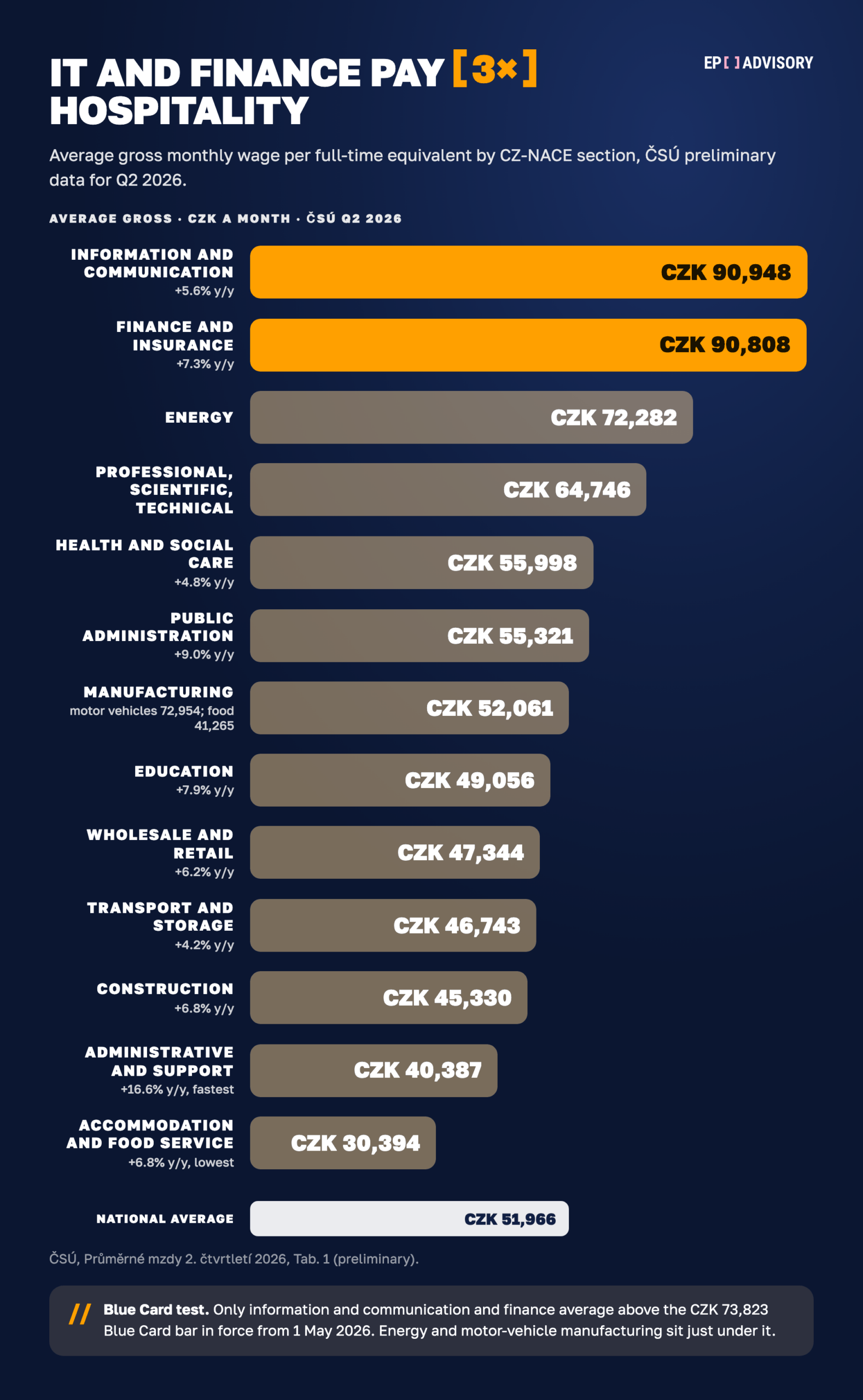
Sector first. ČSÚ preliminary averages per full-time equivalent, second quarter of 2026, by CZ-NACE section:
| Sector (ČSÚ, Q2 2026) | Average gross, per month | Against the average |
| Information and communication | CZK 90,948 | +75% |
| Finance and insurance | CZK 90,808 | +75% |
| Energy | CZK 72,282 | +39% |
| Professional, scientific and technical | CZK 64,746 | +25% |
| Health and social care | CZK 55,998 | +8% |
| Manufacturing (motor vehicles CZK 72,954; food CZK 41,265) | CZK 52,061 | +0.2% |
| National average | CZK 51,966 | |
| Education | CZK 49,056 | −6% |
| Wholesale and retail | CZK 47,344 | −9% |
| Transport and storage | CZK 46,743 | −10% |
| Construction | CZK 45,330 | −13% |
| Administrative and support services | CZK 40,387 | −22% |
| Accommodation and food service | CZK 30,394 | −42% |
Information and communication and finance pay three times what accommodation and food service pays. Manufacturing sits on the national average, but inside it motor vehicles average CZK 72,954 and food production CZK 41,265.
Role second. The ISPV survey for the Ministry of Labour gives 2025 medians and averages by occupation for private-sector employers. Medians are the better guide to a typical hire.
| Occupation (ISPV 2025, private sector) | Median, gross per month | Average, gross per month |
| ICT managers | CZK 147,726 | CZK 172,856 |
| Software developers | CZK 101,103 | CZK 113,300 |
| Medical specialists | CZK 96,701 | CZK 103,415 |
| Specialised general nurses | CZK 64,072 | CZK 65,320 |
| Sales representatives | CZK 49,593 | CZK 56,219 |
| Mechanical assembly workers | CZK 43,915 | CZK 49,111 |
| Lorry drivers | CZK 38,167 | CZK 39,305 |
| Shop sales assistants | CZK 31,802 | CZK 32,668 |
| Waiters | CZK 23,993 | CZK 27,166 |
These are private-sector figures, so the doctor line does not describe a public hospital. And the software developer line spans CZK 53,342 at the bottom tenth to CZK 184,858 at the top.
What this means for a job search. Only two sectors, information and communication and finance, average above the CZK 73,823 Blue Card bar. Energy and motor-vehicle manufacturing sit just under it, so senior roles there clear it and junior roles do not.
Score your CV in 30 seconds, then fix its biggest problems one by one. Both free.
Free, no card.

Minimum Wage in the Czech Republic 2026: CZK 22,400 a Month, CZK 134.40 an Hour
Yes. The Czech Republic has a statutory minimum wage, and from 1 January 2026 it is CZK 22,400 a month or CZK 134.40 an hour for a 40-hour week (sdělení MPSV č. 356/2025 Sb.), up CZK 1,600 from the CZK 20,800 of 2025 and about €926 at the CNB rate used on this page. It applies to every employee, Czech or foreign, and it is the wage floor for an Employee Card.
The formula. Since 2025 the minimum has been set by a formula in the Labour Code: the Ministry of Finance forecast of the average gross monthly wage, times a coefficient the government sets every two years, rounded up to the nearest hundred crowns. For 2026 the forecast was CZK 51,497 (sdělení MF č. 312/2025 Sb.) and the coefficient 0.434 (nařízení vlády č. 285/2024 Sb.): 51,497 × 0.434 = 22,349.70, rounded up to CZK 22,400. The 2025 coefficient was 0.422, and the target is 47% of the average by 2029. The 2027 and 2028 coefficients were due during 2026; we found no confirmation of their values.
| Floor | Per month | Per hour | Who it covers |
| Minimum wage 2026 | CZK 22,400 | CZK 134.40 | All employees, statutory |
| Guaranteed pay, groups 2 to 4 | 1.2, 1.4 and 1.6 × the minimum | same multiples | Public sector only (MPSV) |
| Employee Card wage floor | CZK 22,400 | CZK 134.40 | Third-country nationals, no higher bar |
| EU Blue Card bar, from 1 May 2026 | CZK 73,823 | Degree-level jobs; last checked September 2026 |
We have not verified the crown amounts of guaranteed pay in the sdělení text, so we give the multiples only. Private employers have one floor: CZK 22,400.
How the Czech floor compares. Eurostat’s January 2026 comparison puts it at €924 a month, in the group of EU states below €1,000, against €2,704 in Luxembourg and €620 in Bulgaria. Net on CZK 22,400 is about CZK 19,000 at 2026 rates, close to 85% of gross, because the CZK 2,570 monthly taxpayer credit wipes out most of the tax.
Where the floor actually bites. Accommodation and food service averaged CZK 30,394 a month in Q2 2026, and the ISPV 2025 median for waiters was CZK 23,993.
Prague vs the Regions: The 28% Premium
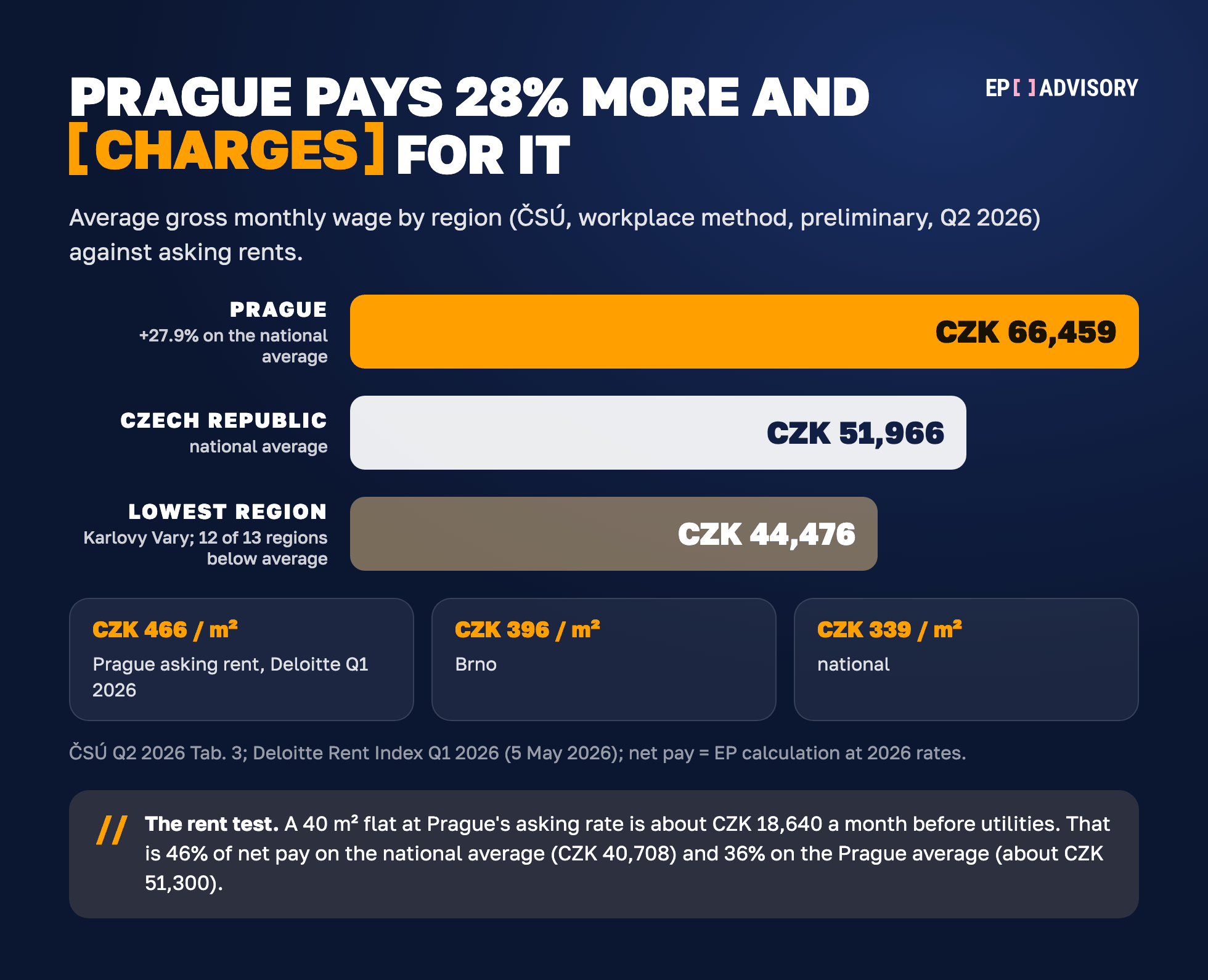
Prague is the outlier of the Czech labour market. In the second quarter of 2026 the capital averaged CZK 66,459 a month gross, 27.9% above the national average and up 4.1% in real terms year on year (ČSÚ Praha, workplace method, preliminary).
| Region (ČSÚ, Q2 2026) | Average gross, per month | Against the national average |
| Prague | CZK 66,459 | +27.9% |
| Central Bohemia | CZK 55,218 | +6% |
| Czech Republic | CZK 51,966 | |
| South Moravia (Brno) | CZK 50,588 | −3% |
| Hradec Králové | CZK 49,313 | −5% |
| Plzeň | CZK 48,360 | −7% |
| Ústí nad Labem | CZK 47,250 | −9% |
| South Bohemia | CZK 46,877 | −10% |
| Vysočina | CZK 46,805 | −10% |
| Liberec | CZK 46,609 | −10% |
| Moravia-Silesia (Ostrava) | CZK 46,543 | −10% |
| Olomouc | CZK 45,825 | −12% |
| Pardubice | CZK 45,768 | −12% |
| Zlín | CZK 45,615 | −12% |
| Karlovy Vary | CZK 44,476 | −14% |
First, rents move the same way, and faster. The Deloitte Rent Index for the first quarter of 2026 (published 5 May 2026) put asking rents at CZK 466 per square metre in Prague against CZK 339 nationally, CZK 396 in Brno and CZK 249 in Ostrava. At those asking rates a 40 m² flat costs about CZK 18,640 a month in Prague and CZK 15,840 in Brno, before utilities (our calculation).
Second, the rent test. Net pay on the national average is CZK 40,708, so a 40 m² Prague flat takes about 46% of it before utilities. On the Prague average, net pay is about CZK 51,300 and the same flat takes about 36%. For the neighbouring markets, see salaries in Germany and salaries in Austria.
Where to Look for Work: Official Resources
- Úřad práce ČR: the public employment service. Its database is the central vacancy register. On 27 September 2026 it listed 101,955 positions, 65,395 of them open to Employee Card holders and 872 flagged for the Blue Card
- Jobs.cz and Prace.cz: the two largest domestic boards, both run by Alma Career
- Expats.cz jobs: English-language roles, mostly in Prague and Brno
- LinkedIn: where multinationals, technology firms and shared-service centres post
- EURES: the EU mobility network, for EU and EEA citizens who need no permit
Two practical notes. On language: English-only hiring is realistic in IT, the business-services centres and multinational head offices in Prague and Brno. Manufacturing, logistics and healthcare hire foreigners in volume but expect Czech. On sponsorship: ČSÚ counted 845,468 employment relationships of foreign nationals on 31 December 2024. Most Employee Card vacancies in the register are warehouse, construction, driving, assembly and kitchen jobs at or near the minimum wage.
The Arithmetic: What Actually Lands in Your Account
Three things come off a Czech gross salary: social insurance, health insurance and income tax. The “super-gross wage” that used to inflate the tax base was abolished in 2021, so the arithmetic is simple.
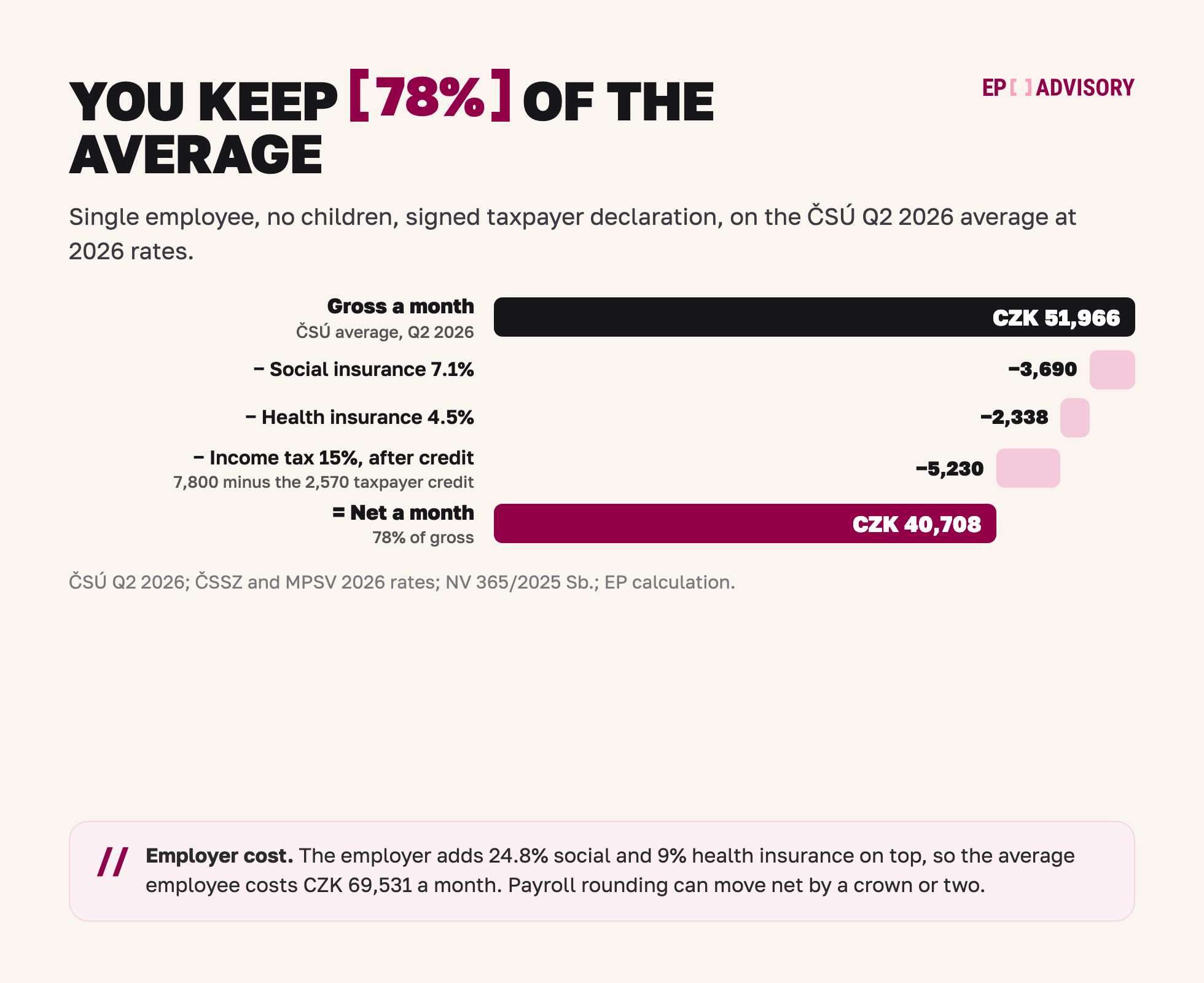
On the Q2 2026 average of CZK 51,966, at 2026 rates, for a single employee with no children who has signed the taxpayer declaration:
- Social insurance, employee share: 7.1% of gross (6.5% pension plus 0.6% sickness insurance) = CZK 3,690
- Health insurance, employee share: 4.5% of gross = CZK 2,338
- Income tax: 15% on the gross wage rounded up to the nearest hundred, so 15% of CZK 52,000 = CZK 7,800
- Basic taxpayer credit: CZK 2,570 a month (CZK 30,840 a year, unchanged since 2022), deducted from the tax, leaving CZK 5,230
Put together, take-home on the average comes to about CZK 40,700 a month, roughly 78% of gross. Our line-by-line arithmetic lands on CZK 40,708, about €1,683; payroll rounding can move that by a crown or two, and no other credits are assumed.
The 23% rate almost never applies. It starts at 36 times the statutory average wage a year, CZK 1,762,812, which is CZK 146,901 a month in 2026 (nařízení vlády č. 365/2025 Sb.), and only on income above that line.
Net at other points, same method: about CZK 36,000 on the CZK 45,523 median (79%) and CZK 56,700 on the CZK 73,823 Blue Card minimum (77%).
What your employer pays. On top of your gross, 24.8% social insurance and 9% health insurance, 33.8% in all. The average employee costs CZK 69,531 a month, the old “super-gross” of gross times 1.338. These rates apply to everyone on a Czech payroll; we found no separate expatriate tax regime in the 2026 parameters.
Salary and the Visa: The CZK 73,823 Blue Card Bar and the Employee Card
In the Czech Republic the visa question is decided twice: by salary and by passport.
The Employee Card is the workhorse. The zaměstnanecká karta is a dual permit for residence and work, valid up to two years and renewable. There is no salary multiple: the job must be in the central register of vacancies open to Employee Card holders, give at least 15 hours a week and pay at least the CZK 22,400 minimum wage. You apply at the Czech embassy for your country of citizenship, or for a country where you have lived legally for at least two years; the decision takes 60 days (90 in complex cases) and the consular fee is CZK 5,000.
The Blue Card is salary-gated. It is for jobs requiring a university degree of at least three years or comparable experience, at a salary of at least 1.5 times the average gross annual wage announced by the Ministry of Labour. From 1 May 2026 to 30 April 2027 that is CZK 73,823 a month gross, about €3,052 (sdělení MPSV č. 44/2026 Sb.); the previous bar was CZK 69,247. We checked this threshold against the published text in September 2026. It is internally consistent: 1.5 times the ČSÚ 2025 average of CZK 49,215, to the crown.
Now put the two numbers side by side. The average salary is CZK 51,966. The bar is CZK 73,823, 42% higher. The average job does not qualify, and it misses by almost CZK 22,000 a month. On sector averages only information and communication and finance clear it; on ISPV 2025 private-sector medians, software developers (CZK 101,103) do and specialised nurses (CZK 64,072) do not.
The faster lane. The Ministry of Industry and Trade’s Key and Research Staff Programme, for technology companies, research organisations and start-ups hiring into CZ-ISCO classes 1 to 3, promises visa processing within 30 days. It is open to all third countries by design, but applications from citizens of Russia and Belarus are suspended (MPO).
Citizens of Russia and Belarus: the position in 2026. Since 2022 Czech embassies have not accepted visa or residence-permit applications from citizens of Russia and Belarus. The legal basis is zákon č. 175/2022 Sb. with nařízení vlády č. 55/2024 Sb.; on 21 February 2024 the government made the measure indefinite, and the Ministry of Foreign Affairs page confirming it was last updated on 9 February 2026 with the words “until revoked”. Dual nationals holding a Russian or Belarusian passport alongside another citizenship are refused as well, and there is no general exception for holders of another EU state’s residence permit. The exceptions listed by the ministry are: family members of EU citizens, Belarusian scholarship students, family reunification, family members of persons with subsidiary protection, people at risk of political persecution by the Russian or Belarusian authorities, participants in the Občanská společnost programme, holders of Czech compatriot (krajan) certification, and cases of special state interest. Existing Czech permit holders are unaffected and can extend, change purpose or apply for permanent residence inside the country. In practice, neither an Employee Card nor a Blue Card is available to a citizen of Russia or Belarus applying from abroad in 2026 unless one of those exceptions applies; check your own case with the Ministry of Foreign Affairs. Citizens of Ukraine are in a different position: EU temporary protection now runs to 4 March 2028 (Council decision (EU) 2026/1912). Czechia has extended its own protection to 31 March 2028: holders register online, then collect a new visa sticker. Temporary-protection holders have free access to the labour market.
Related reading: Work visa & Blue Card salary thresholds in Europe 2026 · Salaries in Poland · Salaries in Germany
See what a recruiter sees, then fix it before you apply. An instant score, then the fix for every problem.
Free, no card.
Key Takeaways
- The average salary is CZK 51,966 a month gross (ČSÚ, Q2 2026, preliminary), about €2,148. The full-year 2025 average was CZK 49,215. Pay is monthly, twelve times a year, with no statutory 13th month.
- Two thirds of employees earn less than the average. The last published median is CZK 45,523 (Q4 2025), and ČSÚ has suspended medians for 2026.
- Several averages circulate. The ČSÚ quarterly series is the headline; the OECD figure (CZK 53,265) and the statutory parameter (CZK 48,967) measure other things and belong in footnotes.
- Sector decides more than city: information and communication and finance average about CZK 90,900, accommodation and food service CZK 30,394. Inside manufacturing, motor vehicles pay CZK 72,954 and food CZK 41,265.
- The minimum wage is CZK 22,400 a month or CZK 134.40 an hour in 2026, set by formula with a 0.434 coefficient on the forecast average, rising towards 47% by 2029.
- Prague averages CZK 66,459, 28% above the country and 49% above Karlovy Vary. At Prague asking rents, a 40 m² flat takes about 46% of net pay on the national average.
- Take-home on the average is about CZK 40,700, roughly 78% of gross: 7.1% social, 4.5% health, 15% tax less the CZK 2,570 credit. The 23% rate starts at CZK 146,901 a month.
- The Blue Card bar is CZK 73,823 a month from 1 May 2026, 42% above the average. For citizens of Russia and Belarus the salary is theoretical: Czech embassies have not accepted their applications since 2022, indefinitely.
Frequently Asked Questions
What is the average salary in the Czech Republic per month?
The average salary in the Czech Republic is CZK 51,966 a month gross, about €2,148, according to the ČSÚ preliminary figure for the second quarter of 2026, paid twelve times a year. The full-year 2025 average was CZK 49,215, and the last published median, for Q4 2025, was CZK 45,523. Two thirds of employees earn less than the average.
What is a good salary in the Czech Republic?
Anything above the CZK 51,966 average puts you in the top third of employees. The top 10% started at CZK 89,006 a month in Q4 2025 (ČSÚ). In Prague the average is CZK 66,459, so a good Prague salary starts higher. The Blue Card bar of CZK 73,823 from May 2026 is the practical benchmark for a high-skill salary.
What is the minimum wage in the Czech Republic in 2026?
CZK 22,400 a month or CZK 134.40 an hour for a 40-hour week, from 1 January 2026, up from CZK 20,800 in 2025. It is set by formula: the Ministry of Finance forecast average wage of CZK 51,497 times a coefficient of 0.434, rounded up. Eurostat puts it at about €924. Net on the minimum is roughly CZK 19,000, about 85% of gross.
How much is take-home pay on the average Czech salary?
About CZK 40,700 a month for a single employee with no children on the CZK 51,966 average, roughly 78% of gross. Deductions are 7.1% social insurance, 4.5% health insurance and 15% income tax, less the basic taxpayer credit of CZK 2,570 a month. The 23% rate only applies above CZK 146,901 a month. Payroll rounding can shift the result by a crown or two.
What salary do you need for a Blue Card or Employee Card in the Czech Republic?
A Blue Card needs at least 1.5 times the average gross annual wage: CZK 73,823 a month gross from 1 May 2026 to 30 April 2027 (last checked September 2026), plus a job requiring a degree-level qualification. An Employee Card has no salary multiple: the wage must be at least the CZK 22,400 minimum and the job must be in the central vacancy register. Citizens of Russia and Belarus cannot currently apply for either from abroad.
Getting ready to apply for jobs in the Czech Republic? Check your CV for free: see it the way a recruiter does, then fix each problem.