 By Andre Atallah, CEO of EP Advisory

Audit and Assurance graduate · UK · September 2027 start
Rolling: last checked 14 October 2026This year’s audit listings have closedCheck each listing for its closing date
Short answer: Applications are rolling, so apply early. Fourteen audit offices were open when we checked on 14 October 2026.This year’s audit listings have closed. PwC filled roles on a rolling basis.Check each office listing for its closing date. We last checked on 14 October 2026. You apply online with one form, then take SHL’s online tests: a values activity, an untimed behavioural test and a timed reasoning test. Next come a recorded video interview, a virtual assessment centre, a recruiter call and an in-person interview with a senior leader.
Where are you now?
Independent guide. EP Advisory is not affiliated with PwC.
PwC’s Audit and Assurance graduate scheme trains you as a chartered accountant in a UK office, for a September 2027 start.
This playbook covers the UK offices hiring audit graduates, including for international students. For nearly 10 years, we’ve helped more than 5,000 professionals get hired. Want to know if your CV will pass screening in the UK? Check your CV for free: a score in 30 seconds, then a fix for each problem.
01/10
Your route to an offer
Pick your stage and tick each step when done. Rules and dates are PwC’s, checked on 14 October 2026. Prep times are our suggestions.
1. Apply: rolling, so apply early1. Apply (this year’s listings have closed)1. Apply: check each listing’s closing date
One online form, with your office and business area preferences. Prep 1 to 2 days.
2. Online tests: usually 7 days per invite
A values activity, a behavioural test and a reasoning test, all on SHL. Prep 1 to 2 weeks. Only the reasoning test is timed.
3. Video and assessment centre: usually 7 days per invite
A recorded video interview, then a virtual assessment centre. Prep 1 to 2 weeks.
4. Final interview: in person, in your office
Matching, a recruiter call, then an interview with a senior leader. Prep about 1 week. An outcome can take up to a month.
Your ticks save on this device.
02/10
The programme at a glance
A graduate job that trains you as a chartered accountant. Where PwC is silent, we say so.
RollingClosedCheck ads
No fixed closing dateThis year’s audit listingsFor each office’s closing date
Sep 2027
Start date
14 offices
Listed for audit, checked 14 Oct 2026
ACA or ICAS
Qualification, in your first 3 years
Any subject
Degree, passed or on track
3 days
A week, at least, in office or on site
Audit, with a qualification
You train for the ACA in England and Wales, or ICAS in Scotland. Your first exams come within a few months of joining.
Digital Audit, no qualification
Listed as “No PQ”. Offered in Watford, Reading, Birmingham, Glasgow and Edinburgh when we checked on 14 October 2026.
Where these facts come from
- The programme. PwC’s audit and accounting page, checked on 14 October 2026. ACA or ICAS comes “depending on where you’re based”. PwC says “Digital Audit roles don’t involve working towards a professional qualification”.
- The degree. Any subject, judged on “the grades you achieved in your last completed year”. No minimum class or UCAS score is named.
- Salary. Not published. Your recruiter can tell you more (PwC FAQs).
03/10
What PwC looks for
PwC scores six behaviours at every stage. It calls them the PwC Professional. Show each one with a real example.
Inspire
“I understand my impact and people want to work with me.” Show it by: a team that chose to follow your lead.
Empower
“I coach and work side by side with others.” Show it by: someone you helped improve.
Evolve
“I grow as a person and guide us into the future.” Show it by: feedback you acted on.
Champion
“I commit to quality, integrity and inclusive behaviour.” Show it by: a time you checked the detail or spoke up.
Build
“I apply a business mindset to my work to increase PwC’s success.” Show it by: a result in money, time or customers.
Deliver
“I collaborate across PwC to deliver quality and distinctive client experiences.” Show it by: a project you finished with others for someone else.
What PwC says, in its own words
- Two groups. Inspire, Empower and Evolve make up “Trusted Leadership”. Champion, Build and Deliver make up “Distinctive Outcomes” (PwC’s behaviours page).
- Every stage. “The behaviours are considered throughout the selection process, including assessments and interviews.” Examples can come from study, work, volunteering or other activities.
- The fit. “You are comfortable and enjoy working with numbers and technology. You build strong relationships and thrive in a team.”
04/10Stage 1 · Apply
How to apply
Applications are rolling, and PwC may close early on high volume. So apply early.This year’s audit listings have closed. PwC filled roles on a rolling basis.Check each listing for its closing date. PwC may close early on high volume. Each office has its own listing.
1
Pick a listing
One per office, on PwC’s job site
2
Set preferences
Business area and office
3
Fill the form
Exact grades and visa details
4
Online tests
Invite usually open 7 days
England and Wales: ACA
Watford, Reading, Birmingham, Bristol, Cambridge, Cardiff, East Midlands (Castle Donington), Leeds, Manchester, Newcastle and Southampton.
Scotland: ICAS
Glasgow, Edinburgh and Aberdeen.
Of the offices above, only Watford and Reading sponsor visas. Belfast’s listing has no audit route. When we checked on 14 October 2026, London was not publicly listed. All the offices above were open on PwC’s job site that day.This year’s listings on PwC’s job site have closed.Check each listing on PwC’s job site for its closing date.
More on the form and the one-application rule
- One application. PwC says: “We’ll only consider one application for our 2027 programmes.” Its FAQ adds that withdrawing before the online assessment still counts.
- Grades. Do not convert overseas grades. Do not “be vague or lie about your results”, because PwC checks them later.
- Your circumstances. The form has an extenuating circumstances section. Ask for adjustments when you apply.
- AI. No AI tools, “unless explicitly authorised by PwC”.
Your CV: do and don’t
Do
“Reconciled a society’s £8,000 budget each month, with no errors at year end”
Show care with numbers. Give each role a result.
Don’t
“Excellent attention to detail”
A claim with no proof. Show the work instead.
Our CV achievement examples show how to write those lines. Getting ready to apply for jobs in the UK? Check your CV for free: see it the way a recruiter does, then fix each problem.
Save PwC and over 2,000 other UK schemes to one free calendar. See what closes next and what you have applied to.
Track my schemes freeFree account, no card.
Office closed or not selected? Your options
- Another office or area. Your one application carries your office and area preferences. They “are considered but not guaranteed”.
- The 2028 programmes. “If you’re unsuccessful or withdraw”, PwC says to “wait to re-apply for one of our programmes starting in 2028”.
- Summer Internship 2027. A paid 4 to 8 weeks for penultimate-year students. It can lead to a graduate offer, “subject to performance, availability and eligibility” (PwC). PwC does not sponsor visas for internships.
05/10Stage 2 · Online tests
The PwC online tests
PwC’s online stage runs on SHL, in three parts. Only the last part is timed.
Not assessed
1. Values activity
Untimed
2. Behavioural test
Timed
3. Reasoning test
From PwC’s selection page. The timed test is “an ability test including numerical, inductive and deductive reasoning”. PwC uses no situational judgement test and names no verbal test.
Likely format: SHL Verify Interactive G+. PwC does not name the product, but SHL’s factsheet describes one timed test of the same three abilities. SHL gives it 36 minutes and up to 24 questions. PwC publishes no timing, so check your invite.
Step through the reasoning test
Numerical: timed
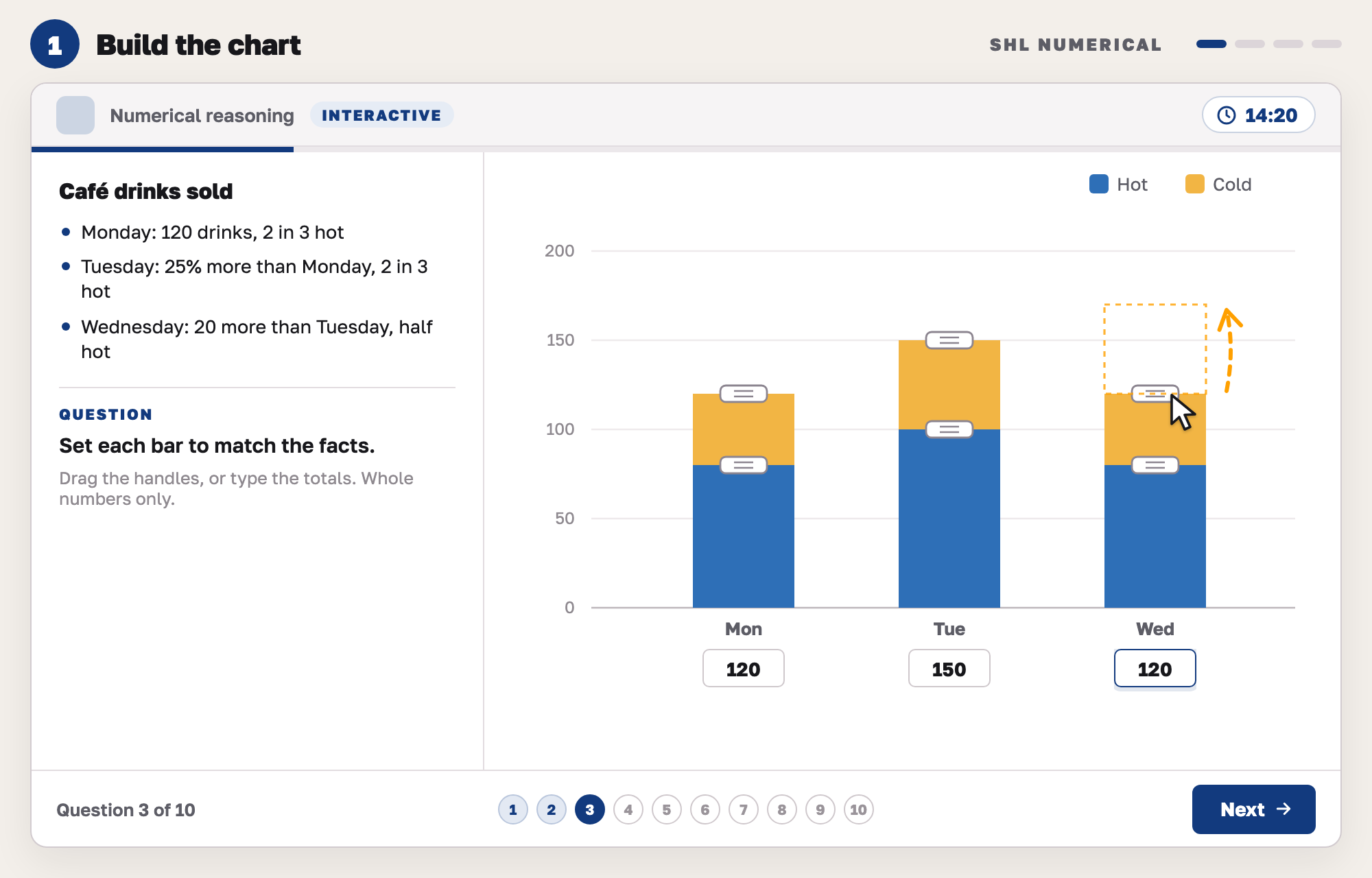
Build the chart
Read the facts on the left, then drag each bar to the right height or type the total under it. Employers set their own version, so yours may differ.
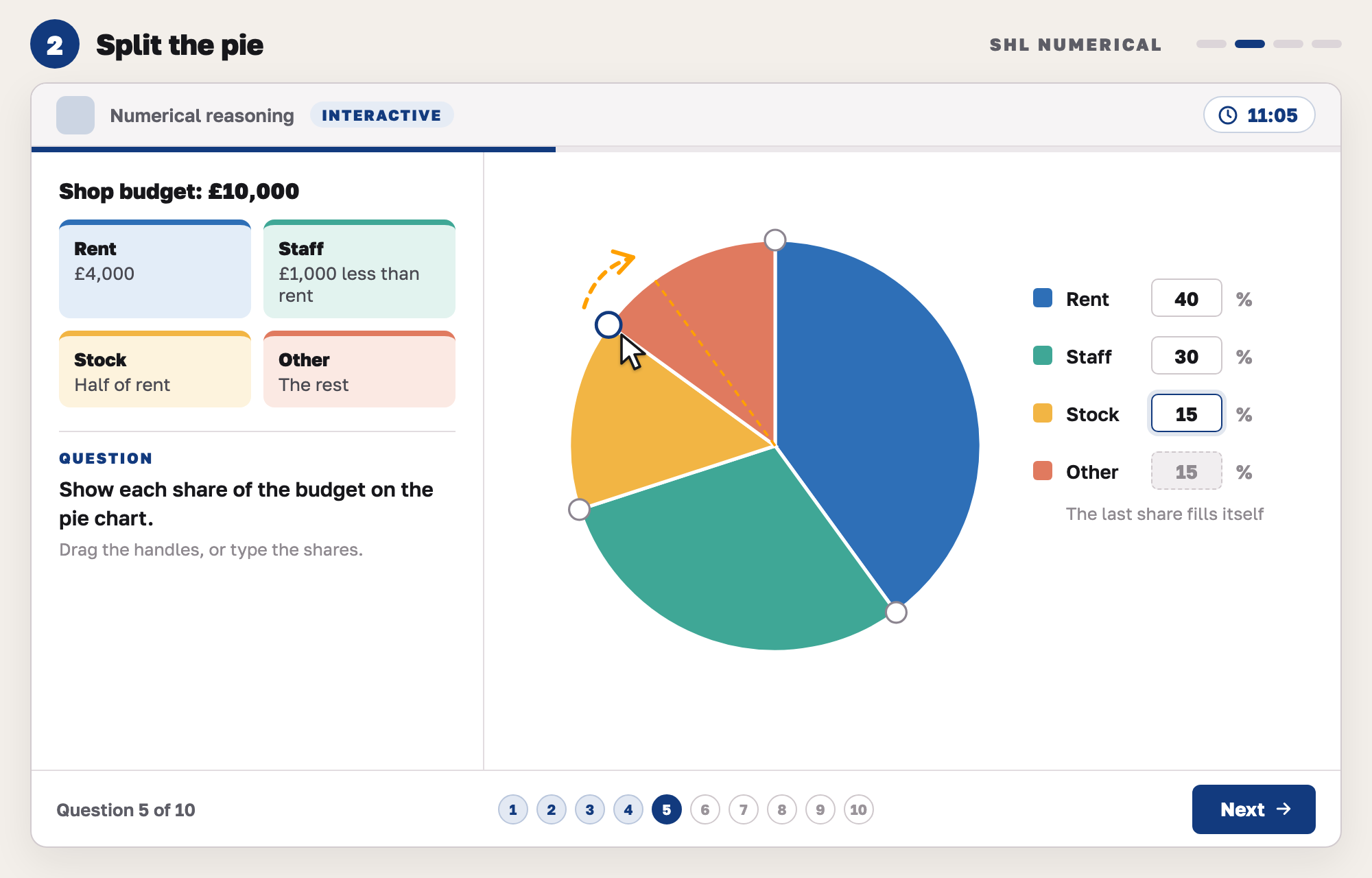
Split the pie
Work out each share of the budget, then drag the handles round the pie or type the percentages.
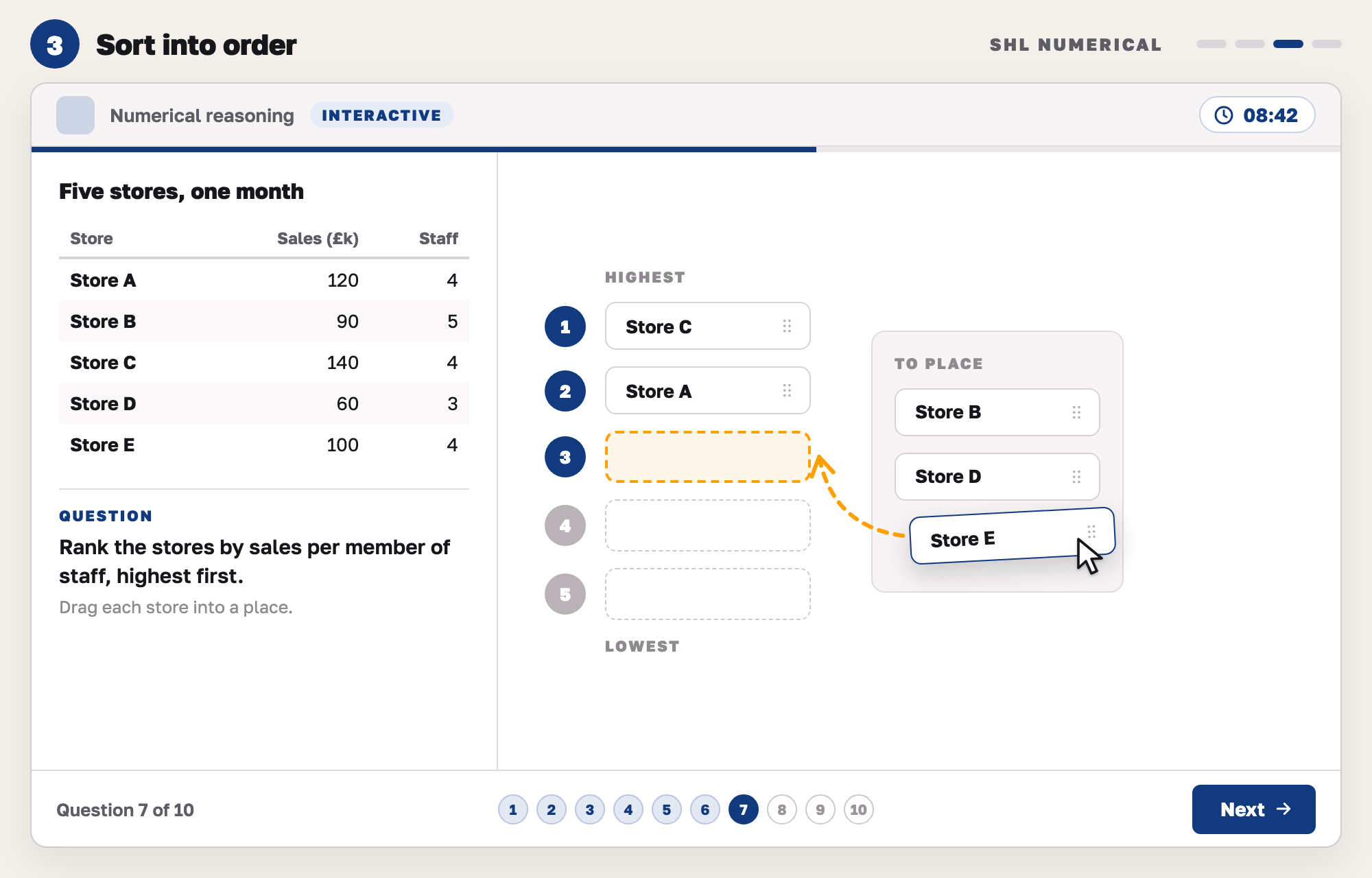
Sort into order
Work out a value for each row of the table, then drag the items into order from highest to lowest.
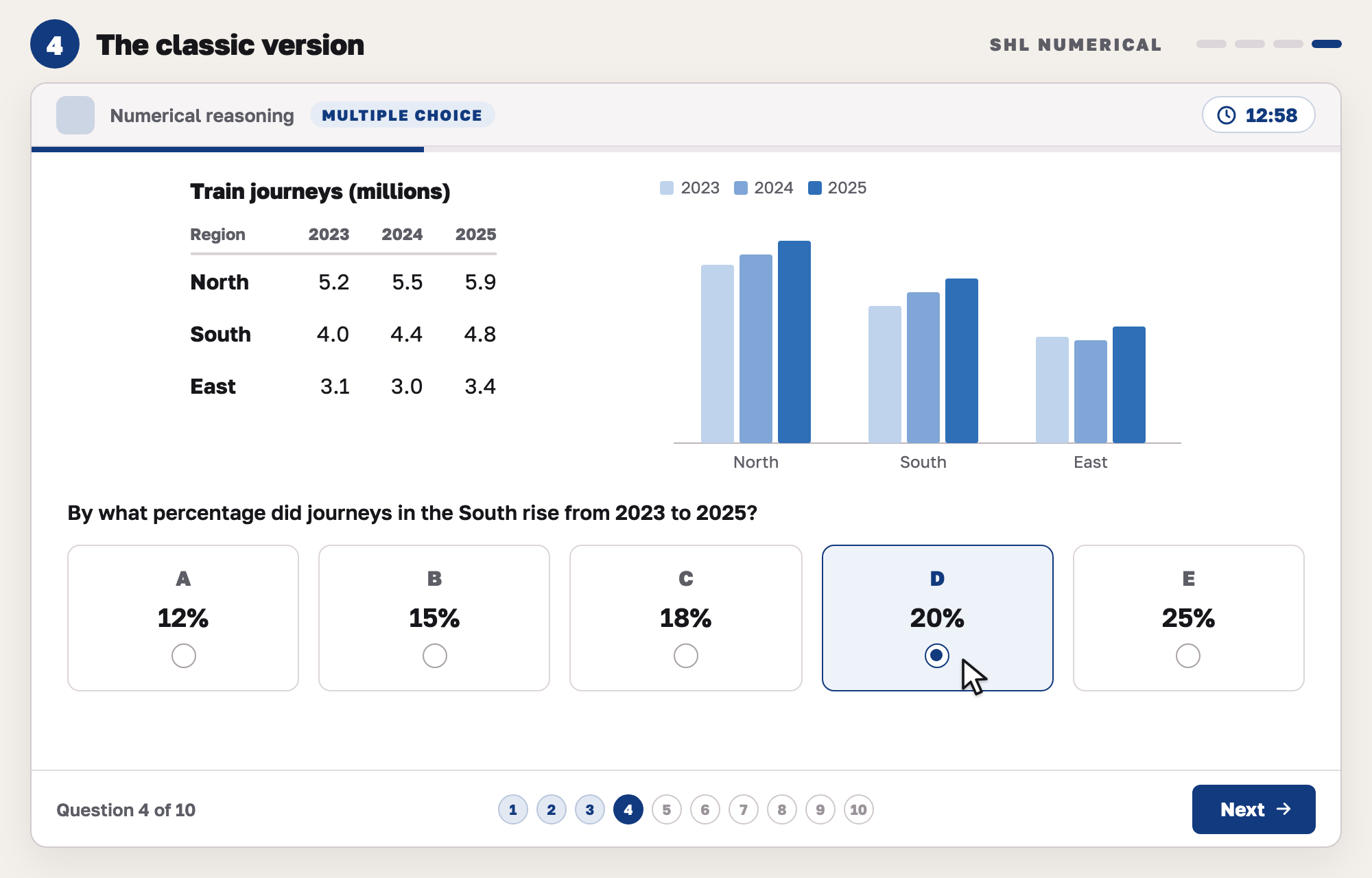
The classic version
SHL also offers a multiple-choice version. Read the table and chart, then pick one of five answers.
Your moves
- Drill percentage change and ratios from tables.
- Read the units and the axis before you drag a bar.
- Keep paper and a pen for working, as PwC’s practice suggests.
Inductive: timed
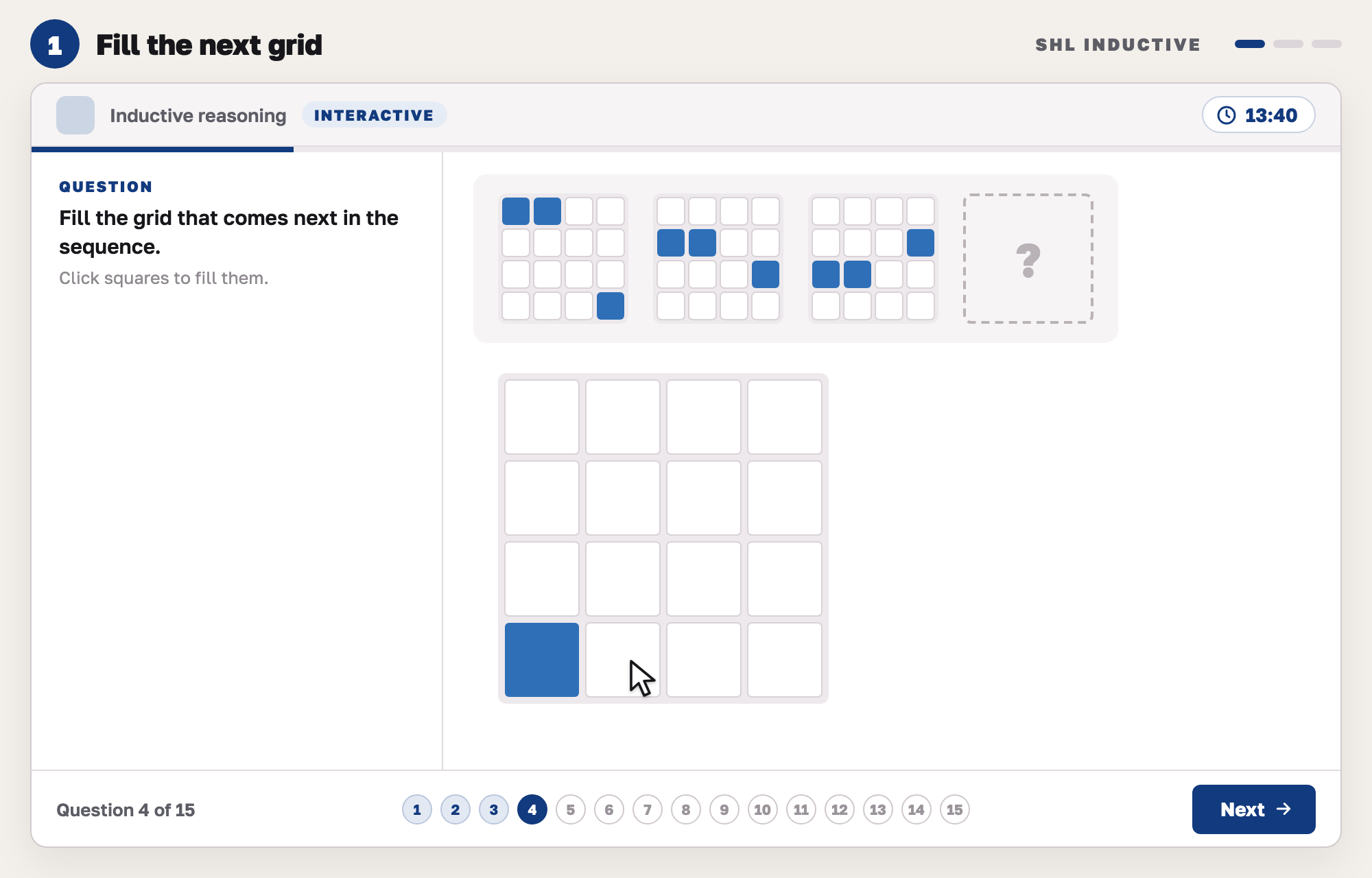
Fill the next grid
Spot how the pattern moves from grid to grid, then click squares in the big grid to draw the one that comes next. Employers set their own version, so yours may differ.
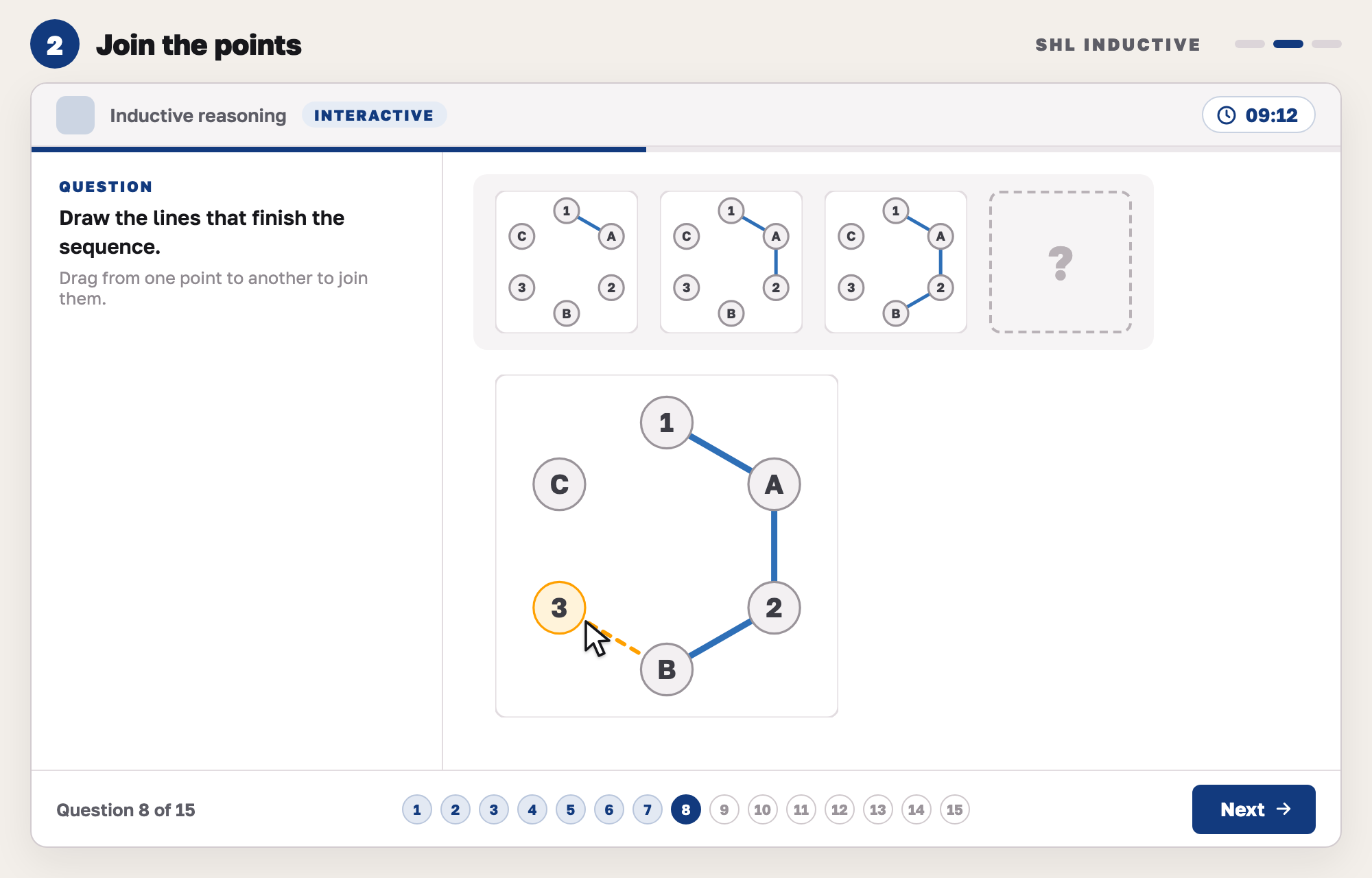
Join the points
Each step adds a line. Find the rule, then drag from point to point to draw the lines that finish the sequence.
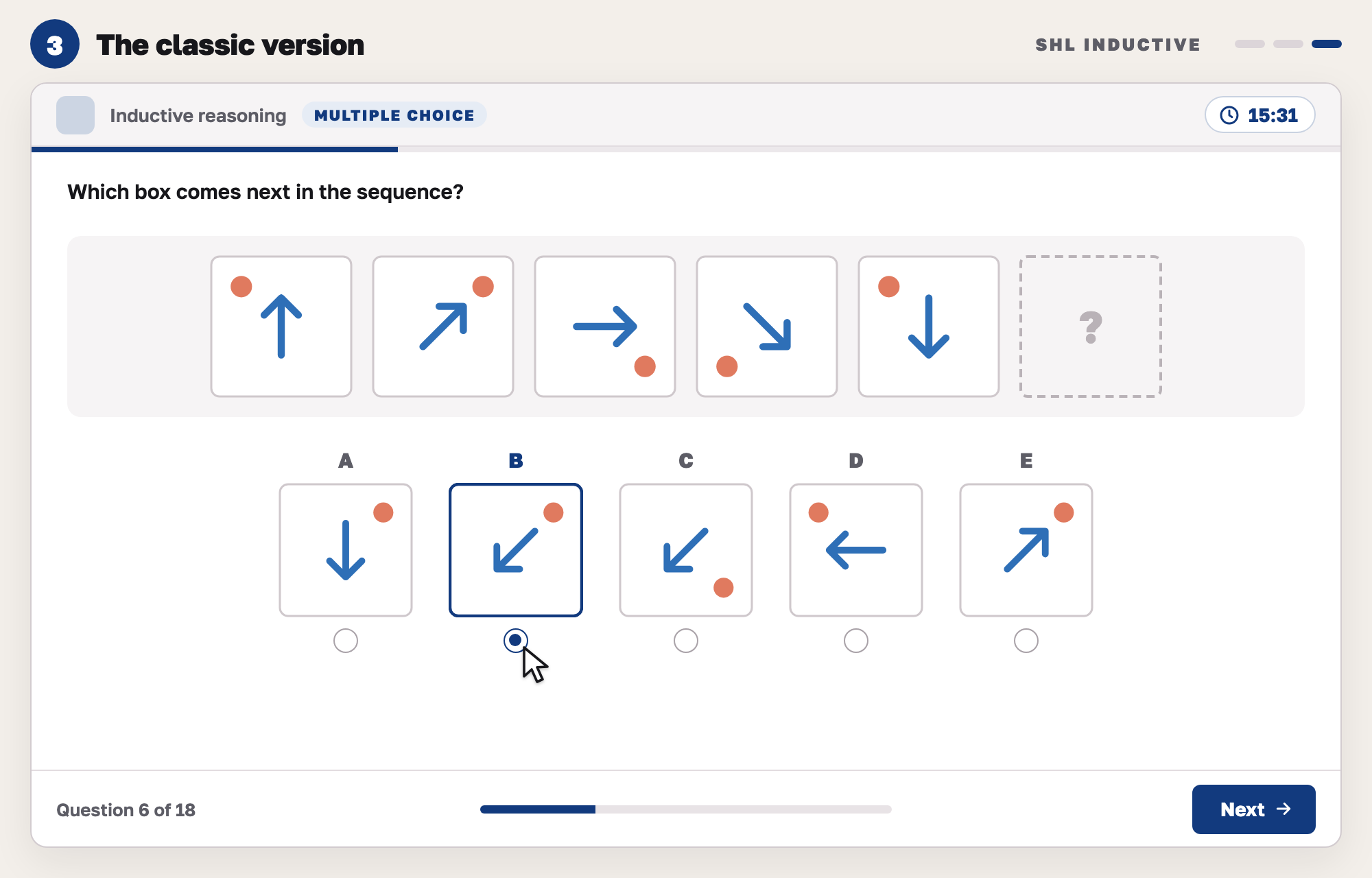
The classic version
In the multiple-choice version you see a row of figures and pick the one that comes next from five options.
Your moves
- Check one change at a time: shape, position, then count.
- Say the rule in words before you answer.
- Try SHL’s free example questions first.
Deductive: timed
PwC publishes no deductive example. SHL’s sample gives you facts and asks which statement must be true. Prep sites report interactive tasks too, such as planning a week so every rule holds.
Your moves
- Write each rule as a short note.
- Start with the item that has the most rules.
- Check every rule again before you move on.
Behavioural: untimed
PwC’s practice asks “Which statement best describes you?” and shows three statements. You pick one. These are from PwC’s practice:
- “I do not reveal other people’s private information”
- “I accept direction from my manager”
- “I always try to find ways my organisation can build stronger ties with the community”
PwC’s advice is “Go with your instincts”. It says “there’s no such thing as a right or wrong personality”.
Your moves
- Answer as you are, not as you think PwC wants.
- Take your time, since there is no timer.
Our own simplified drawings of SHL’s screens, not screenshots. Numbers on them are examples. PwC’s version may differ.
For more on reasoning items, see our tips for psychometric tests.
The rules: allowed and banned
Allowed
- Practice tests sent with your invite
- Adjustments, if you ask when you apply
- A laptop or tablet, as PwC recommends
- A calculator in PwC’s practice. Check your invite for the real test.
Banned
- AI tools, unless PwC authorises them
- Help from anyone else
- Duplicate accounts
- Copied answers
From PwC’s selection page. PwC checks for “highly similar responses” and signs of AI-assisted support. If it finds the process compromised, it withdraws the application. It may also tell universities, professional bodies and regulators.
On the day: practice, deadline and scoring
- Practice. PwC says you can “take some practice tests before you start”. Its own guide warns its samples are “slightly different to the actual tests that we use”.
- Deadline. Usually seven days from the invite.
- Scoring. PwC publishes no pass mark.
- No AI marking. PwC says “we do not use AI to assess candidate performance within the Early Careers selection process”.
Go further: the best outside help
Our own picks, checked on 14 October 2026. We are not linked to any of these sites and earn nothing from them.
From PwC
- PwC’s own guide to the online testsPwC Careers · up to 45 min · no account neededPwC’s practice questions for each test, with its own tips.Free
Practise
- SHL’s free practice testsSHL, the test maker · free SHL account neededThe test maker’s own practice. PwC links to it.Free
- SHL’s example questionsSHL · no account neededSee the formats before you sign up. Skip verbal and SJT.Free
Watch
- 15 SHL reasoning questions solved, step by stepAptitude-Test-Prep on YouTube · Mar 2025 · 54 min · the host is a JobTestPrep affiliateInteractive numerical, inductive and deductive items, worked through.Free
Skip leaked PwC questions and AI helpers. PwC checks for copied answers and AI help, and withdraws applications it flags.
Next: build your speed on numbers and logic with our guide to psychometric and logic tests.
06/10Stage 3 · Interviews
The video interview and assessment centre
Two stages: a recorded video interview, then a virtual assessment centre. Both test the six behaviours.
Video interviewSHL, on demand
Questions on screen · Recorded · Reviewed by PwC
Assessment centreVirtual
Human and technical skills · Exercises not published
PwC says: “we do not use AI to assess candidate performance”.
PwC: “Instead of having an interviewer, your answers will be recorded and reviewed afterwards by one of our assessors” (selection page). PwC does not publish the questions or timings.
The assessment centre and your video set-up
- The centre. PwC calls it “a virtual immersive assessment centre”. It assesses “your human and technical skills”. PwC does not publish the exercises, their order or their length.
- General prep. PwC’s assessment centre guide covers common exercises and virtual tips.
- Video set-up. SHL asks for a laptop, a webcam and a wired headset with a microphone. Switching windows can lock the interview.
How to answer: PwC’s STAR method
PwC’s interview guide recommends STAR. Build each story in four parts:
Situation
Set the scene in one or two lines.
Task
What you had to achieve.
Action
What you did, not the team.
Result
What changed, with a number.
Follow-ups to rehearse
What would you do differently?Which PwC behaviour does this show?Why audit?
PwC’s tip: “you can use notes as prompts, but don’t read from them”. The follow-ups are ours.
See our guides on how to pass a job interview and the toughest interview questions.
Practise: one question at a time
Motivation questions
The first two come from PwC. The others are our prompts, and the answers are ours.
Motivation
“Why do you want to join your preferred employer?”
PwC’s own practice question, with two minutes to answer
Show a strong answer
- One reason about the work, one about PwC and one about you. Record it, then watch it back.
Why PwC
Why are you interested in joining PwC?
PwC says its final interview covers this
Show a strong answer
- Name something specific: a PwC behaviour that fits you, or what you learned from its people.
Why audit
Why audit?
What they’re testing: that you know what auditors do.
Show a strong answer
- PwC says you work with clients “from the warehouse to the boardroom”. Link that to a time you used communication, teamwork or organisation.
Your choices
Why this office and business area?
What they’re testing: that your preferences are thought through.
Show a strong answer
- Give one reason for the office and one for audit. Show you would be glad to be matched there.
Behaviour questions
PwC publishes no audit interview questions. These are our prompts, one per PwC behaviour. The answers are ours.
Inspire
Tell me about a time people chose to work with you.
What they’re testing: influence.
Show a strong answer
- A role you earned, how you earned it, and what the group achieved.
Empower
Tell me about a time you helped someone else improve.
What they’re testing: coaching.
Show a strong answer
- Who needed help, what you showed them, and what they could do afterwards.
Evolve
Tell me about feedback that changed how you work.
What they’re testing: whether you grow.
Show a strong answer
- The feedback in a sentence, what you changed, and the proof it worked.
Champion
Tell me about a time you protected quality under pressure.
What they’re testing: quality and integrity.
Show a strong answer
- A deadline, a shortcut you refused, and what checking the detail saved.
Build
Tell me about a time you saved money or time.
What they’re testing: a business mindset.
Show a strong answer
- The old way, your change, and the saving in numbers.
Deliver
Tell me about a time you worked across groups to finish something.
What they’re testing: teamwork.
Show a strong answer
- Who was involved, how you kept them aligned, and what the end user got.
Your story bank: a worksheet to print or copy
Two STAR stories for each PwC behaviour.
| Behaviour | Story 1 | Story 2 |
|---|---|---|
| Inspire | ||
| Empower | ||
| Evolve | ||
| Champion | ||
| Build | ||
| Deliver |
Go further: the best outside help
Our own picks, checked on 14 October 2026. We are not linked to any of these sites and earn nothing from them.
From PwC
- The six behaviours PwC scoresPwC Careers · no account neededMatch one story to each behaviour.Free
- PwC’s interview guide, with a 2-minute practicePwC Careers · no account neededFilm a two-minute answer, then review it with PwC’s checklist.Free
- PwC’s guide to assessment centresPwC Careers · no account neededCommon exercises and tips for a virtual centre.Free
Watch
- PwC recruiters answer the top questionsPwC UK Careers on YouTube · Oct 2026 · 5 minAnswers on AI, one application and practice tests.Free
- Three skills auditors need, from PwC auditorsPwC UK Careers on YouTube · Jul 2026 · 1 minUse their words to shape your “why audit” answer.Free
07/10Stage 4 · Final
Matching and the final interview
The final interview is in person, with a senior leader from the business area. It takes place in the office you are matched to.
Matching
After the assessment centre, PwC matches you to a business area and office. Preferences “are considered but not guaranteed”.
Recruiter call
You book a call with a recruiter. It includes a recap of your feedback so far.
Senior leader interview
In person, in your matched office. PwC wants to hear “why you are interested in joining PwC”.
Outcome
The PwC UK Careers team gives you feedback and the result. It could be up to a month.
Offer checks and joining
- Checks. Fit & Proper and Independence assessments, background and criminal record checks, and Right to Work. PwC also checks “your grades and job history”.
- No deferrals. PwC does not offer deferred starts.
- Travel. PwC pays overseas travel to its in-person offer holder event only if agreed first. Then it pays economy only.
- Joining. You get an onboarding portal and a pre-joining event.
Key dates: September 2027 intake
14 and 16 Sep 2026
Audit listings posted
17 Sep 2026
PwC’s stated opening date for graduates
14 October 2026
Open and rolling, so apply early
By 14 October 2026
This year’s audit listings closed
14 October 2026
Our last check. See each listing for its closing date
Each stage
Invite usually open 7 days
Each stage
Invite usually open 7 days
1 Jun 2027
Last day to apply if you need a visaVisa applications were due by this date
Sep 2027
The programme startsThe programme started
08/10
Visa sponsorship
PwC sponsors audit graduates in London, Reading and Watford. Reading and Watford were open when we checked on 14 October 2026.This year’s audit listings have closed.Check the Reading and Watford listings for a closing date.
1 Jun 2027
Last day to apply if you need a visaVisa cut-off was set for this date
Listed
Audit, on PwC’s October 2026 visa list
18 months
Graduate visa, if you apply from 2027
Our reading: if you need a visa, apply only to London, Reading or Watford. The other Audit offices do not sponsor.
More on PwC’s visa rules
- PwC’s list. PwC’s immigration page, “correct as of October 2026”, names “Graduate – Audit and Assurance – London, Reading and Watford”. London was not publicly listed when we checked on 14 October 2026.
- The cut-off. PwC sets 1 June 2027. It adds: “If you do apply after this date, we will withdraw your application.”
- Graduate visa. It lasts “2 years if you apply on or before 31 December 2026” and “18 months if you apply on or after 1 January 2027” (GOV.UK). PhD graduates get 3 years.
See our guides to staying in the UK after studying and UK companies that sponsor visas. This is general information, so check GOV.UK.
09/10
Key takeaways
Before you apply
- Applications are rolling, so apply early. Fourteen audit offices were open when we checked on 14 October 2026.This year’s audit listings have closed. PwC fills roles on a rolling basis, so apply early next time.Check each office listing for its closing date. PwC may close early on high volume.
- PwC will only consider one application for its 2027 programmes.
- The SHL online stage has a values activity, an untimed behavioural test and a timed reasoning test.
- A PwC assessor, not AI, reviews your recorded video interview.
- The final interview is in person, with a senior leader from the business area.
- Need a visa? Choose Reading or Watford. PwC’s visa cut-off is 1 June 2027.The cut-off for this intake was set for 1 June 2027.
When a scheme gives a close date, we email you a few days before it closes. Save PwC once and the reminder is set.
Set my reminders freeFree account, no card.

10/10
Frequently asked questions
Is the PwC audit graduate scheme open now?
Yes. Fourteen UK offices were open for the September 2027 intake when we checked on 14 October 2026. There is no fixed closing date. PwC fills roles on an ongoing basis and may close early on high volume, so apply early.No. This year’s audit listings for the September 2027 intake have closed. PwC fills roles on an ongoing basis and may close early on high volume. Use this guide to prepare for the next round.Check each office listing for its closing date. We last checked on 14 October 2026. PwC may close early on high volume, so apply early.
What online tests does PwC use for graduate audit?
PwC’s online assessment runs on SHL. You start with a values activity that is not assessed. Then you take an untimed behavioural test and a timed cognitive test with numerical, inductive and deductive reasoning. PwC says it uses no situational judgement test.
Does PwC use AI to assess the video interview?
No. PwC says it does not use AI to assess candidates in its early careers selection. One of its assessors reviews your recorded answers. You must not use AI tools either, unless PwC authorises them.
Can I apply to more than one PwC office or business area?
PwC will only consider one application for its 2027 programmes. Inside that application you give your business area and office preferences. PwC matches you after the assessment centre. Preferences are considered but not guaranteed.
What degree do I need for the PwC audit graduate scheme?
Any subject. You must have achieved, or be on track to pass, an undergraduate degree or above. PwC judges you on the grades from your last completed year. Its pages name no minimum class or UCAS score.
Does PwC sponsor visas for the audit graduate scheme?
PwC sponsors Audit and Assurance graduates in London, Reading and Watford. Reading and Watford were open when we checked on 14 October 2026.This year’s audit listings have closed.Check the Reading and Watford listings for a closing date. PwC’s visa cut-off is 1 June 2027. It withdraws later applications.PwC’s visa cut-off for this intake was set for 1 June 2027. It withdraws later applications.
How long does PwC take to reply after each stage?
PwC says it could be up to a month before you hear an outcome. Each stage invite usually gives you seven days to complete it.