 By Andre Atallah, CEO of EP Advisory

Business Analyst · London · 2026-27 cycle
Apply by 12 Oct 2026Closed. Deadline was set for 12 OctMissed it? Your options
Short answer: You apply online with a CV and ranked office choices, and no cover letter. McKinsey reviews your application, then invites most consulting applicants to McKinsey Solve, an online problem-solving game. Coaches say two interview rounds usually follow. McKinsey says each interview pairs a personal experience question with a case. The UK deadline is 12 October 2026, so apply early.This year’s UK round has closed. The deadline was set for 12 October 2026. Applied? Prepare for Solve. Still studying? The intern deadline is 14 January 2027.The intern round has closed too.
Where are you now?
Independent guide. EP Advisory is not affiliated with McKinsey & Company.
The Business Analyst role is McKinsey’s main way in from university. McKinsey publishes its interview themes, practice cases and game rules, so you can prepare for every stage.
This playbook covers London, including for international students. For nearly 10 years, we’ve helped more than 5,000 professionals get hired. Want to know if your CV will pass screening in the UK? Check your CV for free: a score in 30 seconds, then a fix for each problem.
01/10
Your route to an offer
Pick your stage and tick each step when done. Dates are from London’s 2025-26 cycle, the latest full one. Prep times are our suggestions.
1. Apply: closes 12 Oct 20261. Apply: this year’s UK round has closed
CV and ranked offices, no cover letter. Prep 1 to 2 days. McKinsey reviews your application first, then invites most consulting applicants to Solve.
2. Solve: invites by 10 Sep in 2025-26
CV screen, then an online game. Length is in your invite. Prep 1 to 2 weeks. McKinsey weighs your result with the rest of your application.
3. Round 1: from 27 Oct in 2025-26
A personal experience interview (PEI) and a case. Prep 2 to 3 weeks.
4. Final round: date not published
Usually round 2: more PEI and case. Prep about 1 week. McKinsey publishes no round count. Coaches describe two rounds of two interviews, the second being the final. One London process in 2024-25 had a third round.
Then the offer. “Your recruiter will share details”, and the timing is not published. After a rejection at interview, a recruiter may call. Some candidates join a Keep in Touch programme to apply later.
Your ticks save on this device.
02/10
The role at a glance
Everything you need to decide, on one screen. If McKinsey has not published something, we say so.
12 Oct 2026
UK deadlineUK applications were due by this date
London
The one UK office
AAB + 2.1
Minimum grades
14 Jan 2027
Intern deadlineIntern applications were due by this date
Not published
Salary
Not stated
Visa sponsorship for BAs
Where these facts come from
- Deadline. In McKinsey’s deadline tool on 8 October 2026, and gone from it on 13 October.
- London. Per the UK careers page. The BA is a generalist consultant on client teams (careers FAQ).
- Salary. McKinsey offers “a competitive salary”. As a rough guide, self-reported figures in October 2026 put UK BA base pay at about £50,000 to £55,000 before tax, plus a bonus.
New for 2026-27
A 95-minute Solve is reported in invites from late August 2026, with a rebuilt Sustainable Futures Lab.
McKinsey’s interview advice changed in autumn 2026. It now asks you to “lead with reasoning, not actions” and lists six practice cases.
03/10
What McKinsey looks for
Grades are the one hard bar. Then McKinsey looks for proof of how you work.
Grades
Show it by: grades at the top of your CV.
A recent degree, any subject
Show it by: one result from your field, with a number.
Ownership
Show it by: a project you ran end to end.
Resilience
Show it by: a setback you recovered from.
What McKinsey says about each
- Grades. “An AAB minimum for A level or equivalent”, and “on track for a 2.1 degree” (McKinsey UK).
- Degree. An undergraduate degree from the past four years, including people who “have completed or are pursuing a non-business master’s degree”. McKinsey wants “smart, driven problem-solvers” from fields such as law, medicine and engineering. The BA job ad asks for under 4 years of work.
- Ownership. A BA takes “ownership of a workstream” and builds PowerPoint decks and Excel models. Expect late hours and site visits to factories, hospitals or mines.
- Resilience. The ad describes “a high performance/high reward culture” and asks you to bounce back from setbacks.
Business Analyst or Junior Associate?
BAs usually stay two to three years. Some are invited into an Associate role. London also hires Junior Associates:
Business Analyst
A degree from the past four years, including a non-business master’s.
Junior Associate
PhD or medical students.
04/10Stage 1 · Apply
How to apply
Your CV carries the first screen alone.
1
Apply online
A CV, no cover letter
2
Choose offices
Up to three or four
3
Split 60 points
Across those offices
4
Sit Solve
If you are invited
60 points to share between your offices
London only
Example: two offices
More points mean a stronger preference and “less consideration for other options”. You interview for one location only.
More on offices, deadlines and questions
- How many offices. McKinsey’s global pages say up to three, its UK page up to four. Use what the portal allows.
- London only? Put all your points on London. Add an office only if you would happily work there.
- Several offices? Follow the deadline of “the office you’re most excited about”.
- Solve. McKinsey uses it “for most of our consulting roles”.
- Written questions. McKinsey’s pages list none, and no word limits.
- 2025-26 workshop. A UK case workshop asked for a CV, a survey and Solve. If you see a survey, answer it as carefully as your CV.
Your CV: do and don’t
Do
“Led a team of five that cut event costs by 20%”
Lead with grades. Give each role a numbered result: money raised, time saved, people led.
Don’t
“Responsible for events”
A duty with no result tells McKinsey little.
Our CV achievement examples show how to write those lines. Getting ready to apply for jobs in the UK? Check your CV for free: see it the way a recruiter does, then fix each problem.
Save McKinsey & Company and over 2,000 other UK schemes to one free calendar. See what closes next and what you have applied to.
Track my schemes freeFree account, no card.
Missed the deadline? Your options
- Next cycle. McKinsey says a late application is “considered in the next cycle”, or you are invited to reapply.
- Still studying? Apply for the UK Business Analyst Intern role by 14 January 2027.This year’s UK Business Analyst Intern ad has closed. The deadline was set for 14 January 2027. Not picked? You can apply for full-time roles in a later round.
- PhD or medical student? London was hiring Junior Associates on a rolling basis when we checked on 13 October 2026.Check McKinsey’s UK careers page for Junior Associate roles.
- Other offices. UK graduates “follow the UK process” for any office. The deadline tool showed no later deadline when we checked on 13 October 2026.
- Events. McKinsey runs virtual and in-person events (UK careers page), such as a 2025-26 case workshop in the North and Midlands.
- Other firms. See our BCG Associate and Bain Associate Consultant guides.
05/10Stage 2 · Solve
McKinsey Solve
Solve is McKinsey’s own “gamified assessment”. It says there is “no need to prepare”. Every game is timed, so know each screen.
Which version you get
Reported
65 min
85 min
95 min
Your invite states the length. Reported: 65 minutes means two games, 85 or 95 minutes means three. McKinsey publishes no versions, game list or office split. London’s 2025-26 version was reported as Redrock and Sea Wolf. SFL is the Sustainable Futures Lab.
Step through each game
Redrock: about 35 minutes
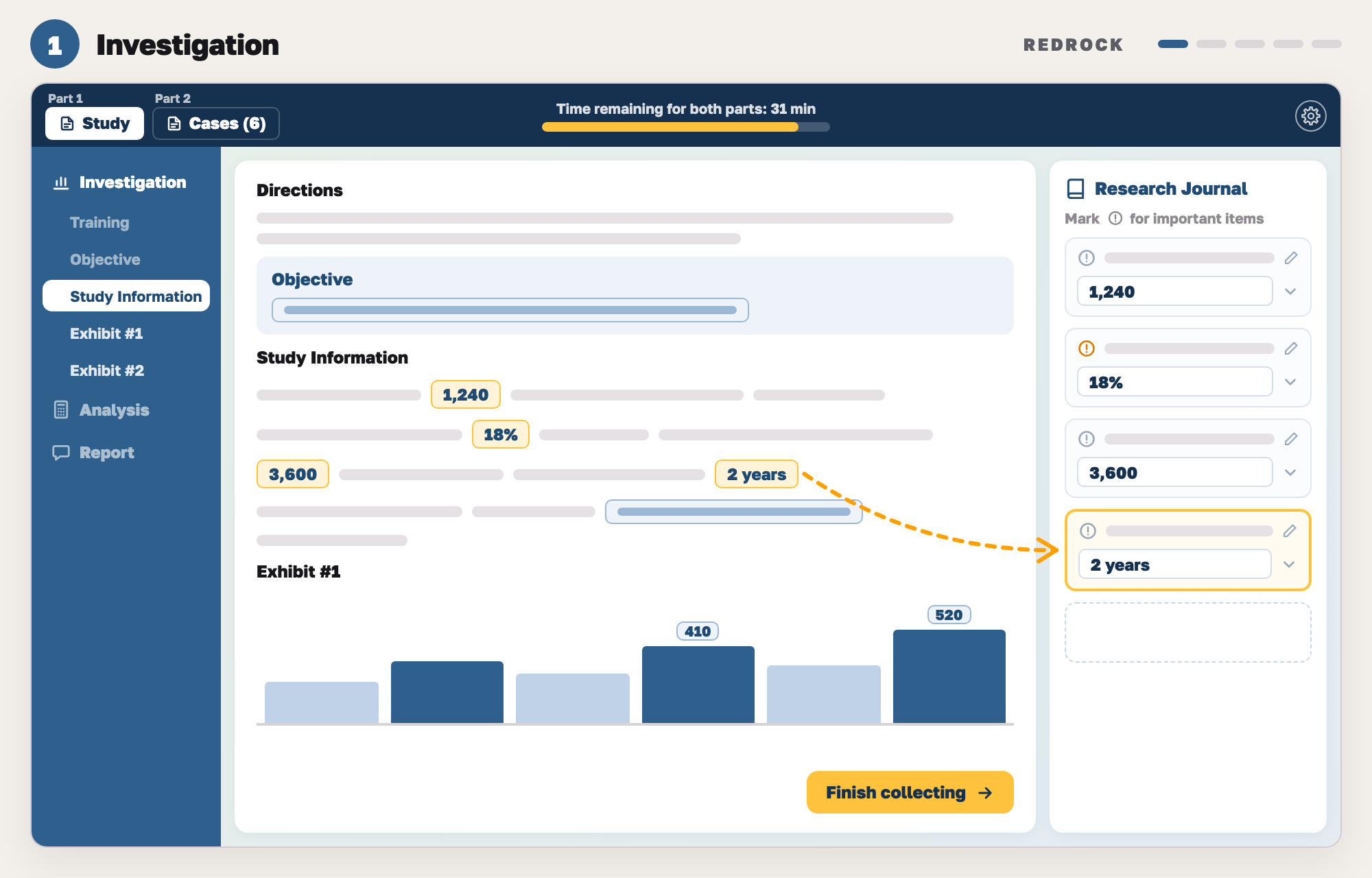
Investigation
Read the study and drag the facts and numbers you need into your research journal. Mark the important ones.
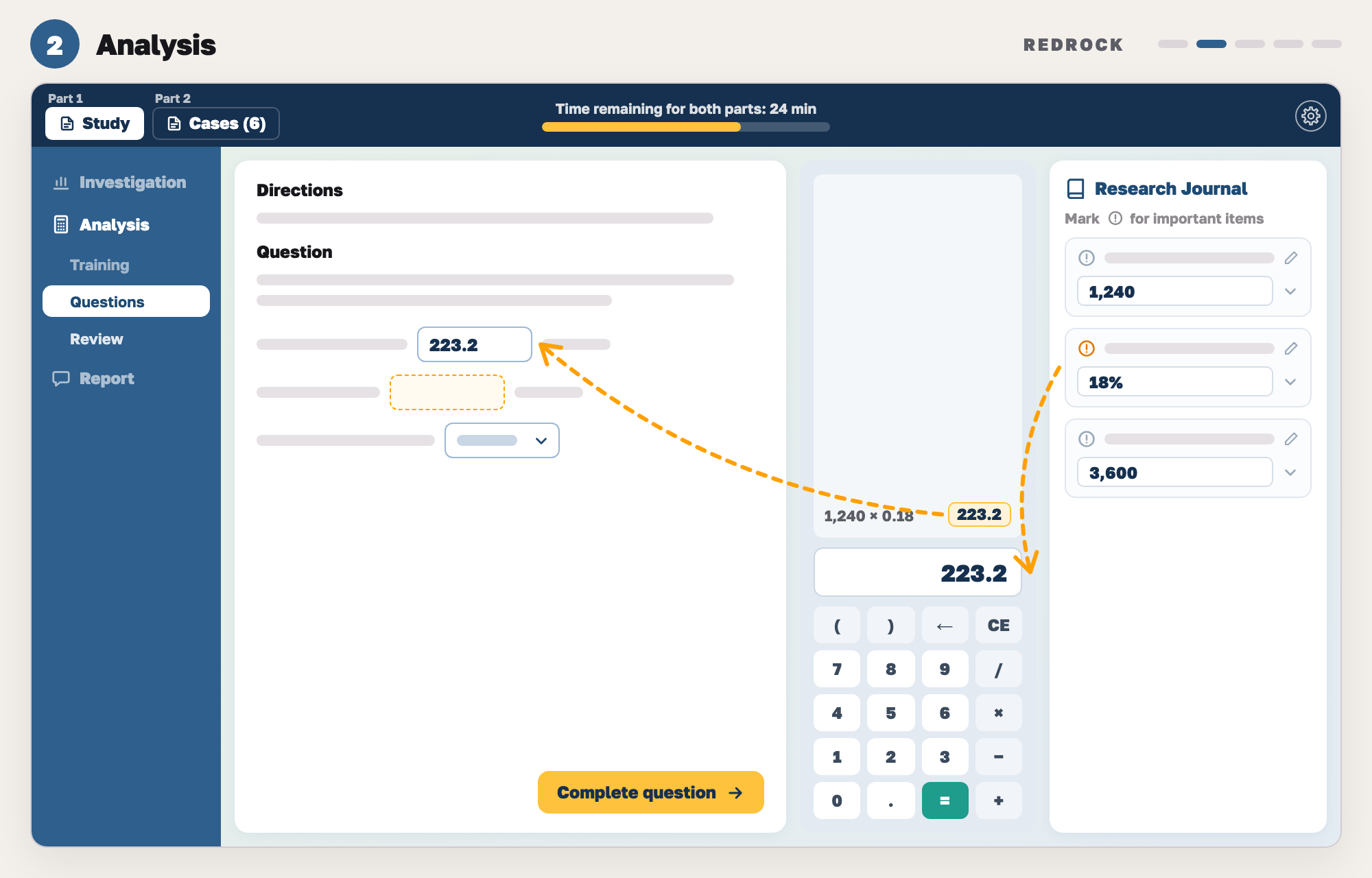
Analysis
Answer two to four maths questions. Drag numbers from your journal into the game’s calculator, then drag the result into the answer box.
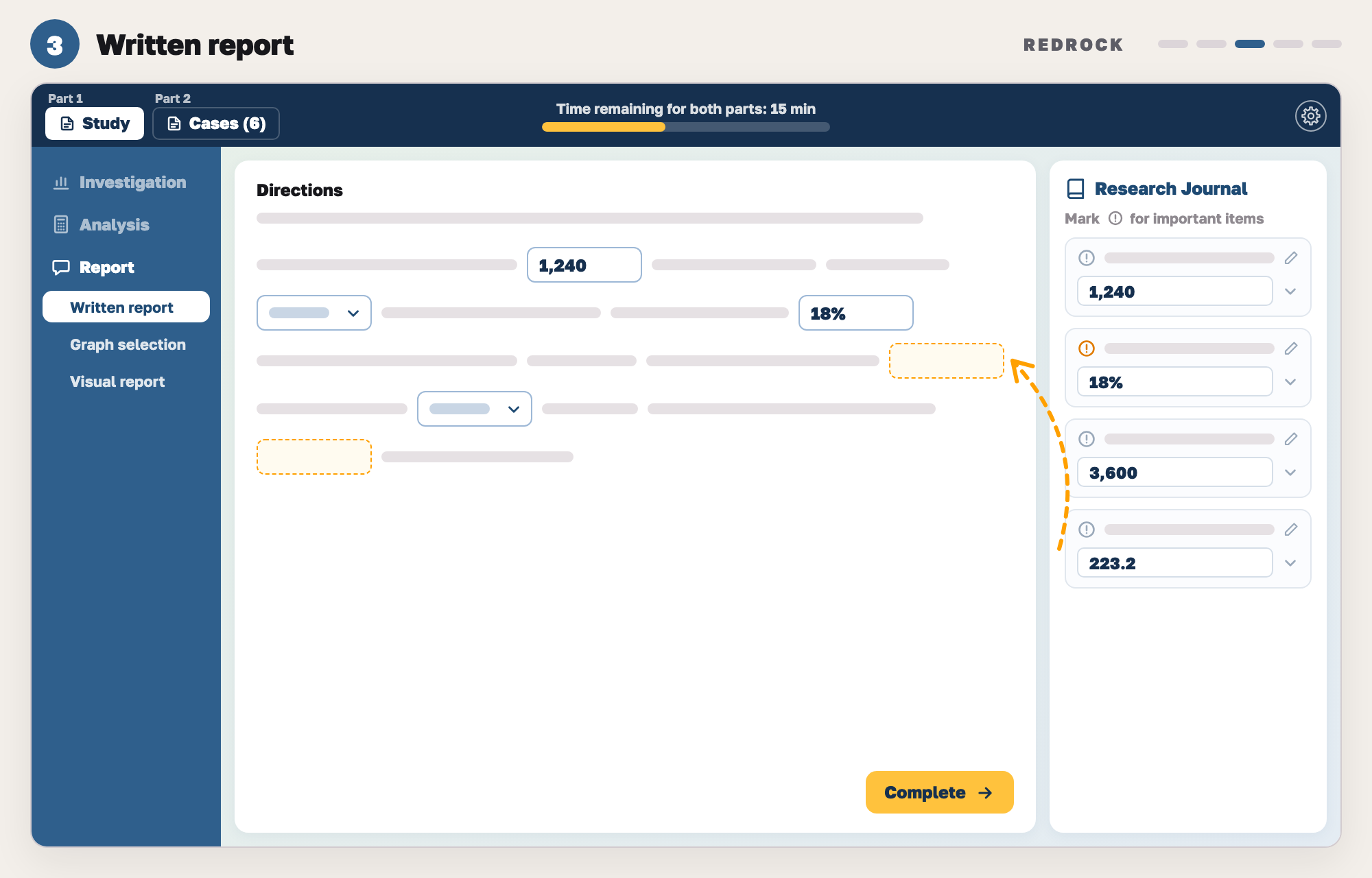
Written report
Fill the blanks in a short written report. Type, drag a number from your journal or pick from a list.
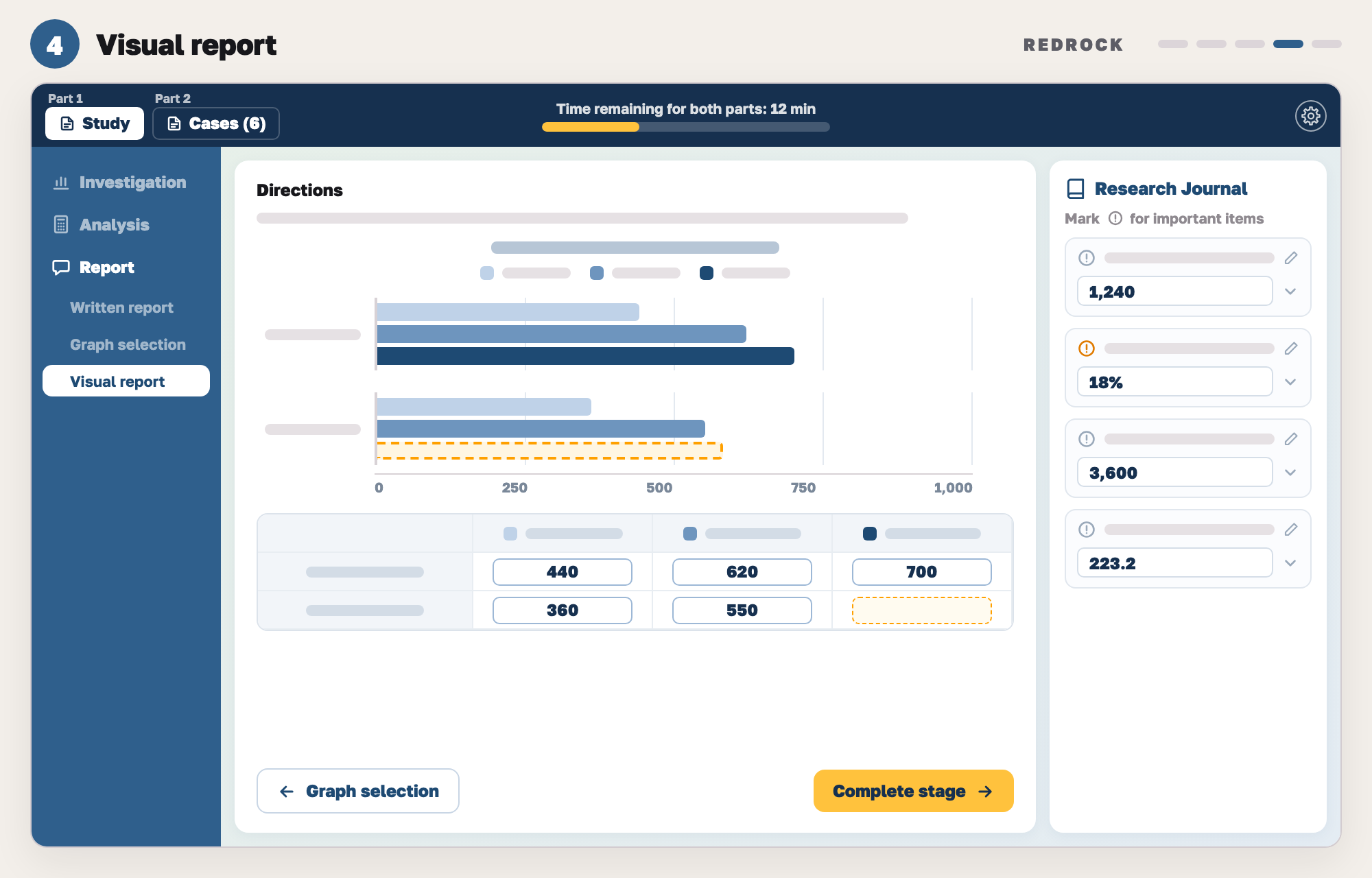
Visual report
Pick a chart type, then fill in the table that draws the chart. You can go back to change the chart type, but not to earlier phases.
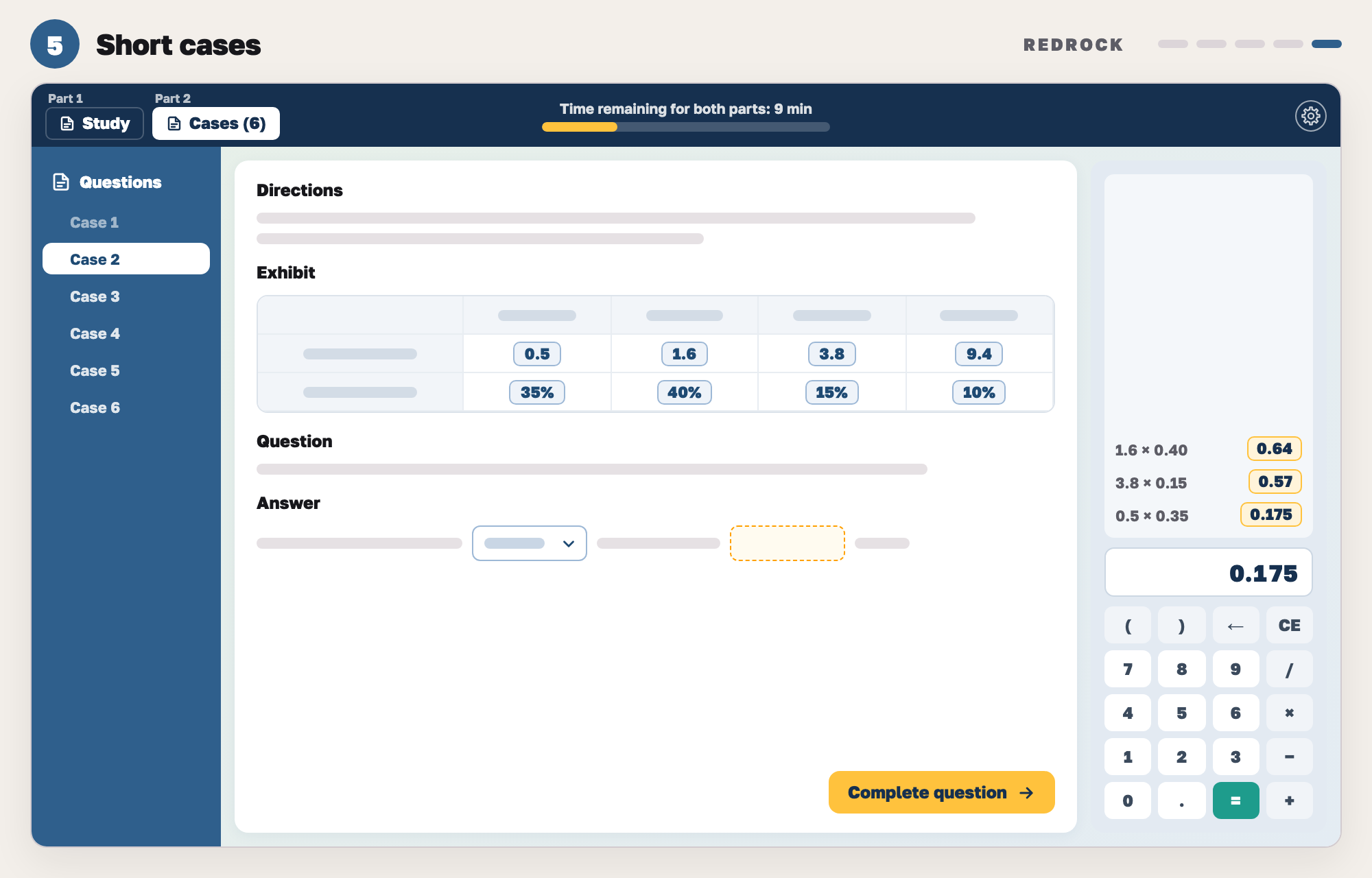
Short cases
About six short cases follow, each with new data and its own questions. The timer covers the study and the cases.
Your moves
- Drill percentages, growth rates and ratios.
- Check your journal before moving on.
Sea Wolf: about 30 minutes
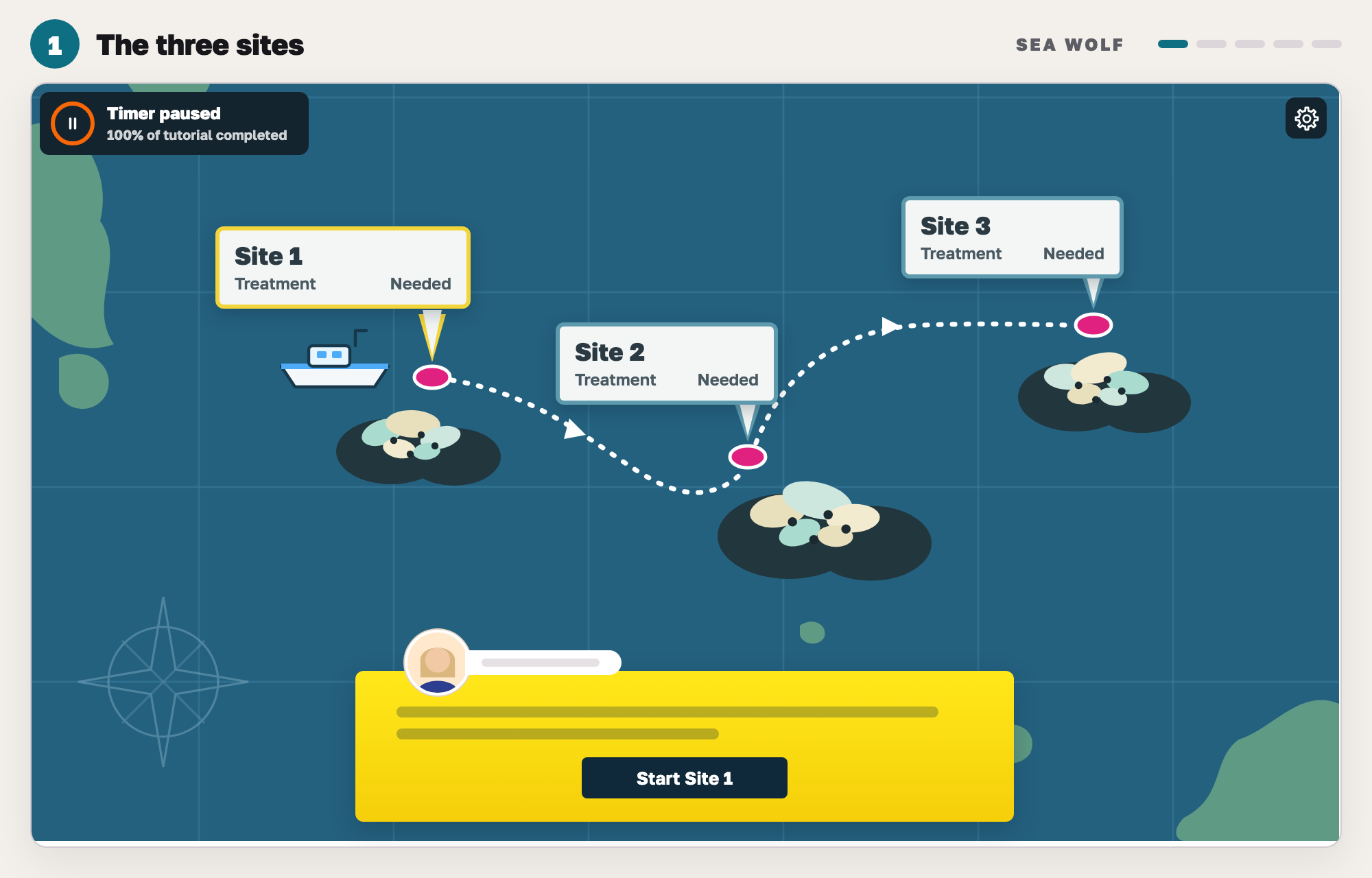
The three sites
Three polluted ocean sites on one map. One timer covers all three, so budget your time.
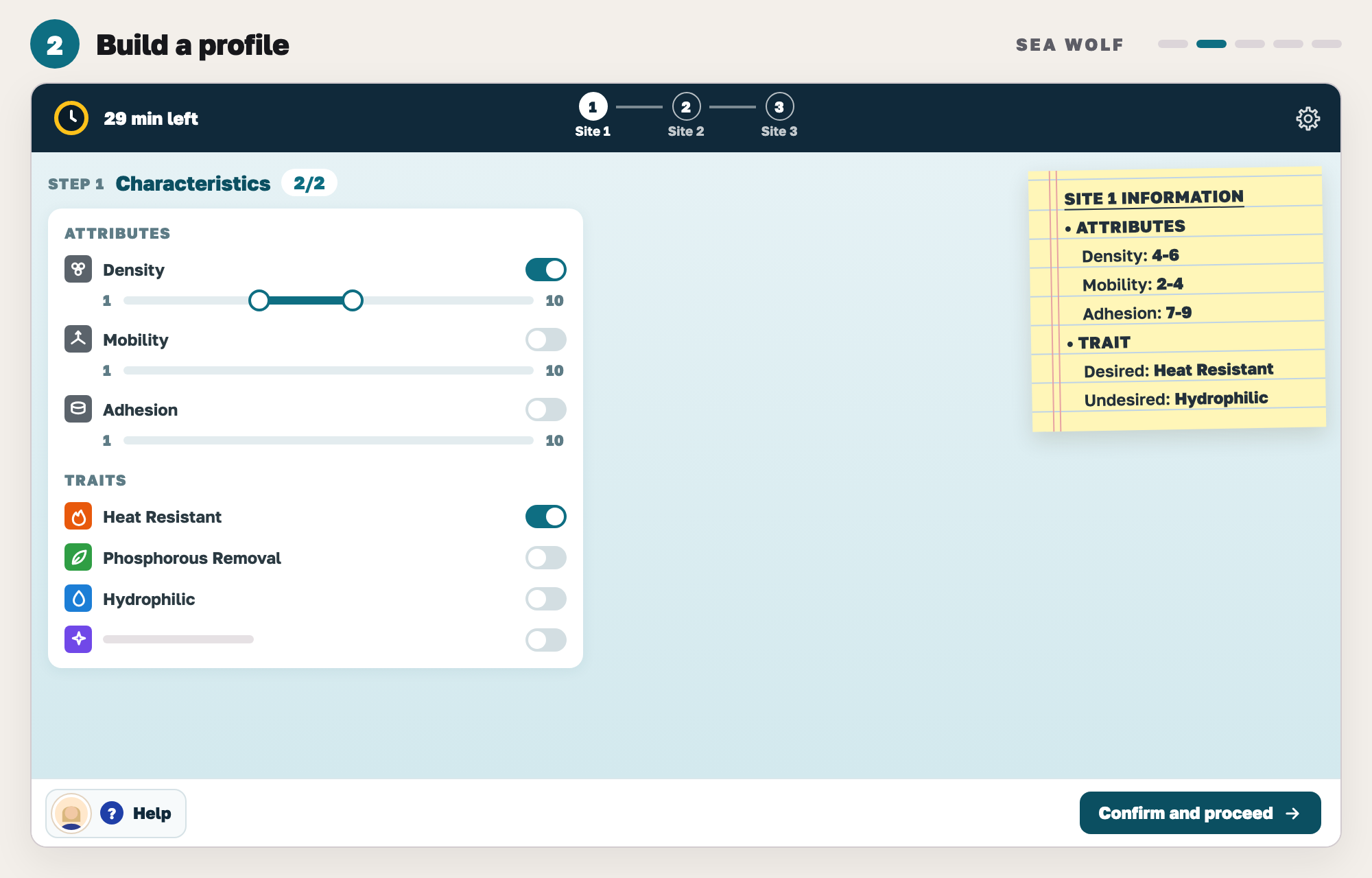
Build a profile
Step 1: read the site’s target ranges and traits, then pick two characteristics to screen microbes for.
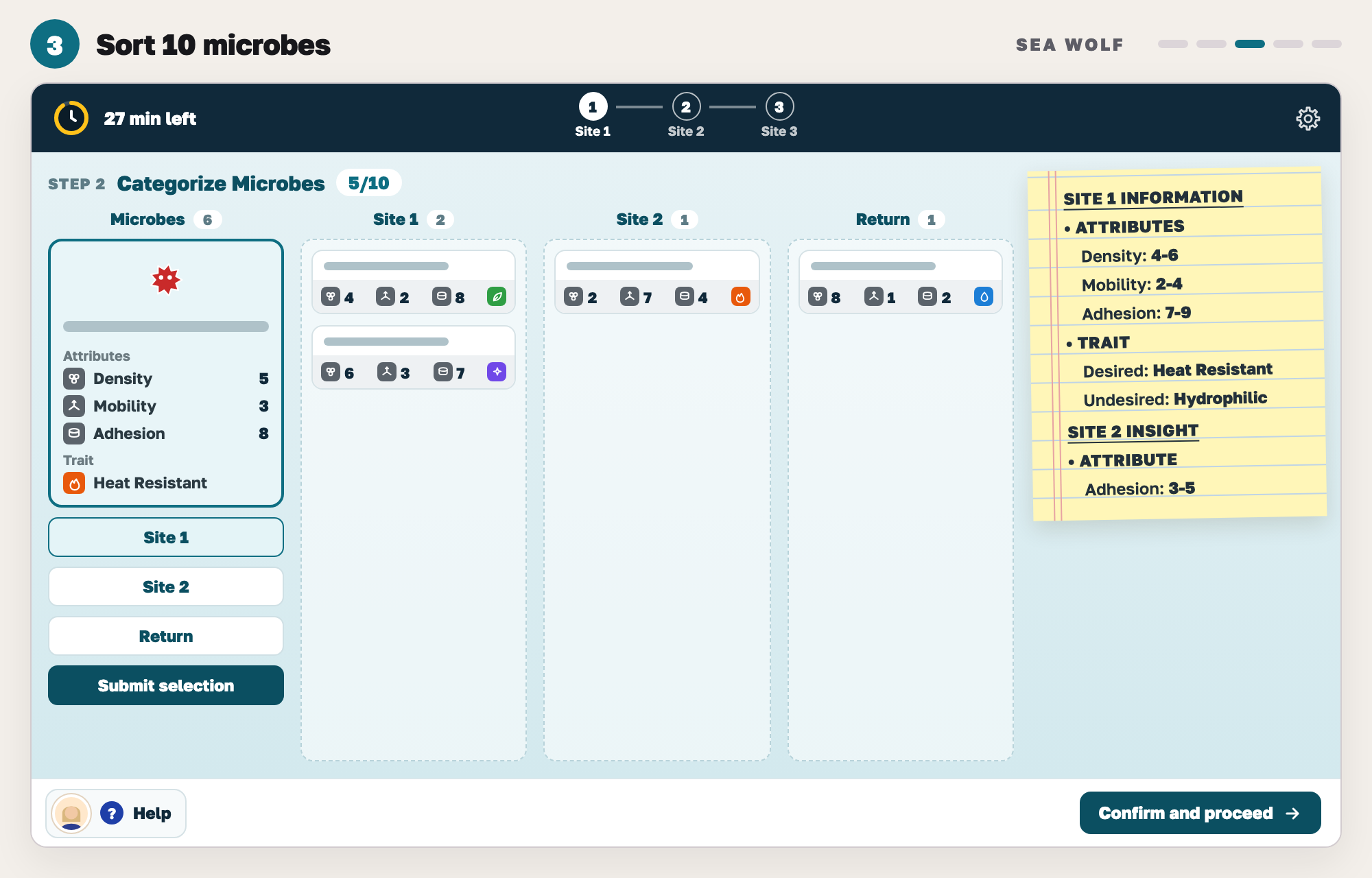
Sort 10 microbes
Step 2: send each of 10 microbes to this site, the next site, or return it as unsuitable. Sites 2 and 3 start by reviewing the ones sent ahead.
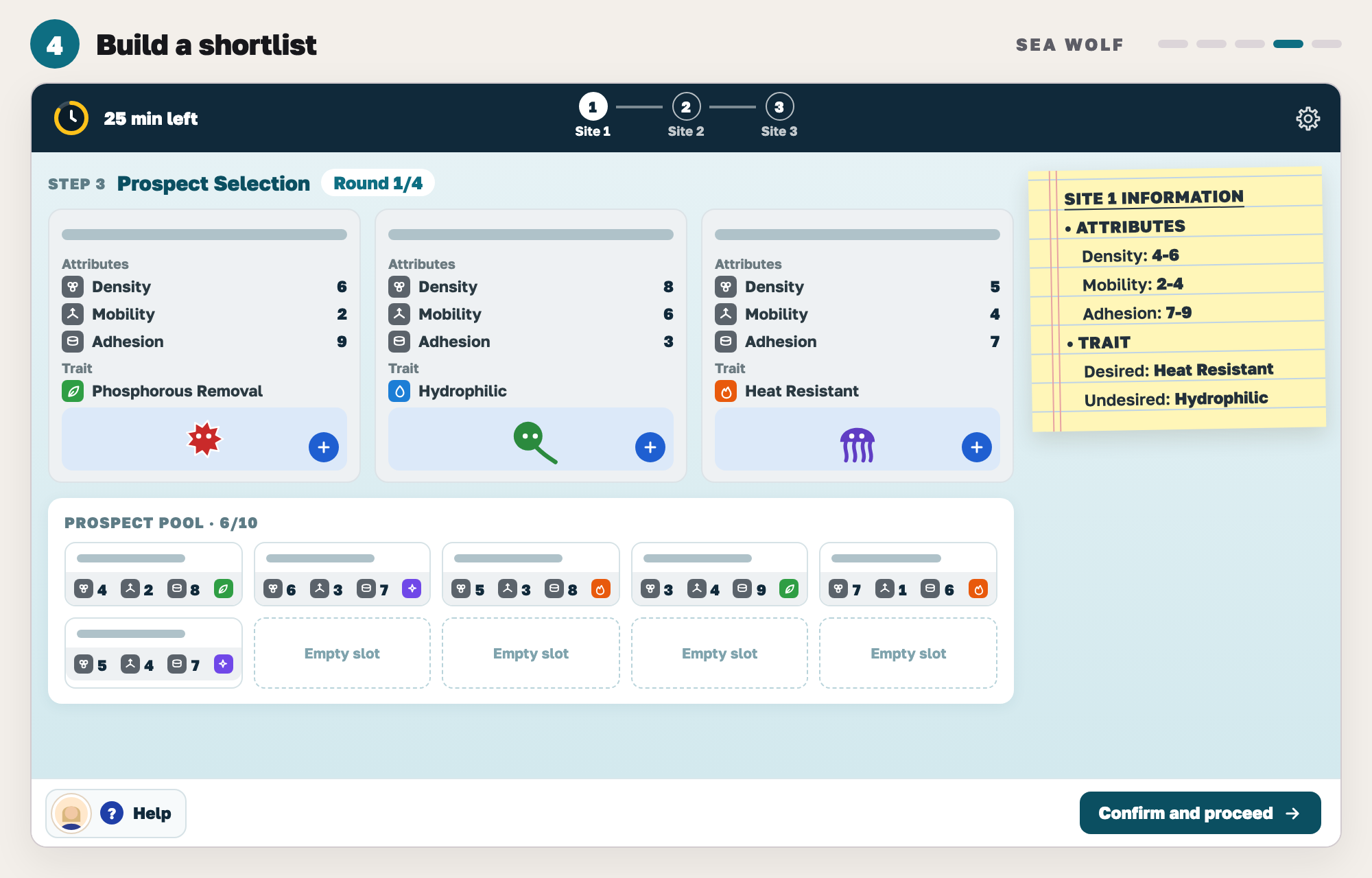
Build a shortlist
Step 3: you start with an initial pool of six microbes. Over four rounds, add one of three new microbes each time, to reach ten.
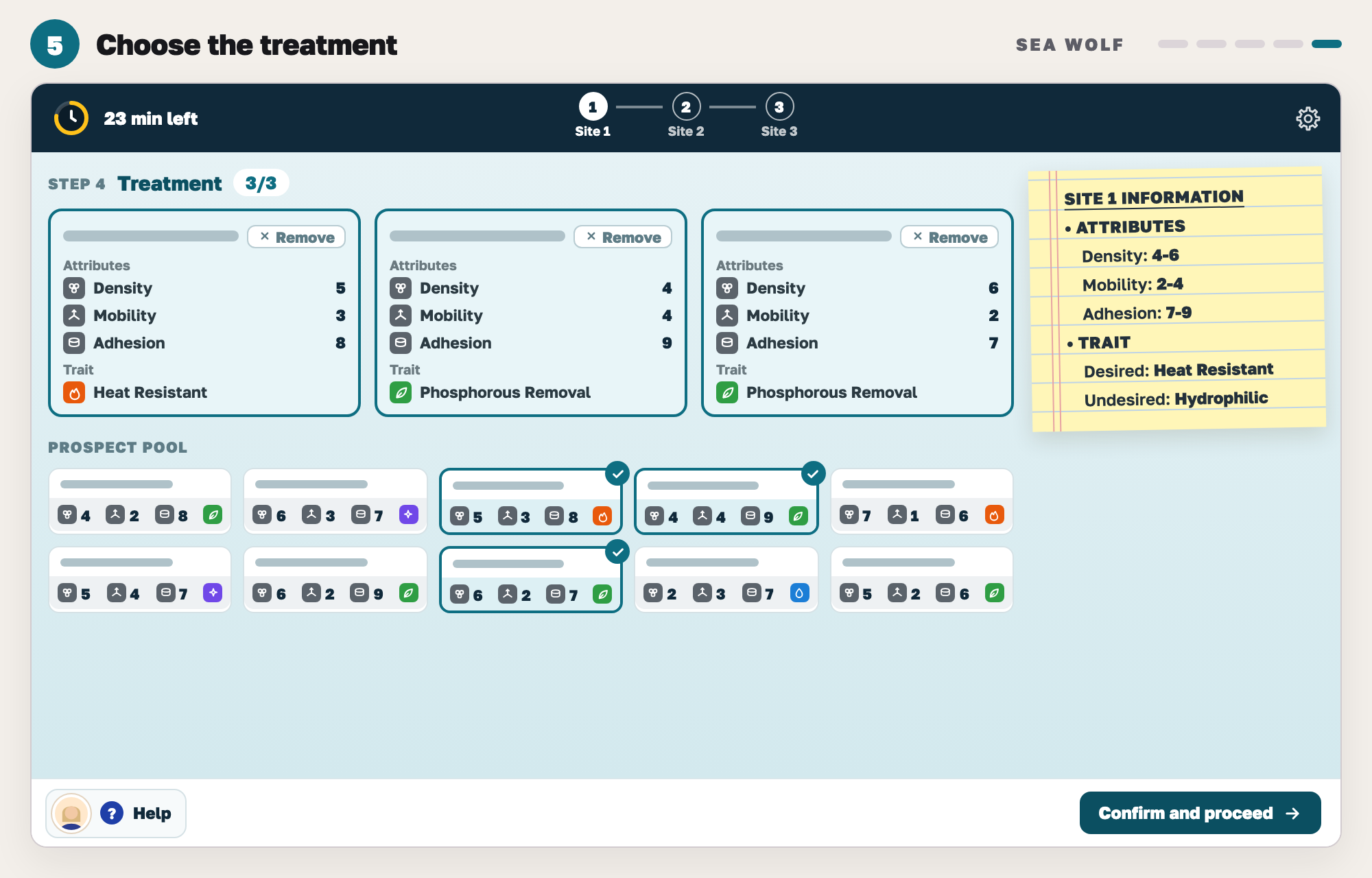
Choose the treatment
Step 4: pick three microbes from your ten. Aim for an average inside each target range, a desired trait and no undesired trait.
Your moves
- Get all three sites close, not one perfect.
- Read each site’s traits first.
- Track ranges on paper.
Sustainable Futures Lab
Original · 20 minutes
Thirteen text questions on a team scenario: one ranking task, then multiple choice.
Rebuilt · about 30 minutes
You lead four researchers over three days. Each day you explore, assign, support and reflect.
Our own simplified drawings of each screen, not screenshots.
The rules: allowed and banned
Allowed
- Pen and paper
- One screen, no overlays
Banned
- Your own calculator
- A second screen
- Generative AI
- Prepared notes
- Other apps and websites
- Recording or sharing
Read McKinsey’s assessment integrity rules before you start. They also ask you to discard your notes afterwards.
On the day: tech, checks and your score
- PC or Mac only. A tech check comes first. Each game starts with an untimed tutorial. If something breaks, contact support at the time.
- A random check. McKinsey may ask you to do an extra task in person or explain your logic (Solve FAQ, August 2025).
- Your score. McKinsey’s recruiters say Solve has no pass mark. It is “one data point”. In 2026, some applicants reported seeing a score and a decile.
- Integrity. Spreadsheets and solver tools break the rules. Every candidate gets different data, so leaked answers do not help. Penalties include disqualification and limits on future applications.
- Old guides may still cover Ecosystem, a game removed in mid-2025.
Go further: the best outside help
Our own picks, checked on 14 October 2026. We are not linked to any of these sites and earn nothing from them. McKinsey’s recruiters say you do not need to pay for prep.
Watch
- Redrock and Sea Wolf, played start to finishPrepmatter on YouTube · Nov 2025 · 62 minMade before the third game. Save only the facts you need, not all of them as it does.Free
- A full Sustainable Futures Lab run, with the reasoningPrepmatter on YouTube · May 2026 · 35 minShows the 20-minute version. No video yet covers the newer 30-minute one.Free
Practise
- Free demo: the opening minutes of Sea WolfPrepmatter · no account neededPlay the tutorial and classify three microbes. You get a new scenario each time.Free
Avoid any site selling a “solver” or “real past questions”. Some big prep sites add a solver to their packs. Using one in the test breaks McKinsey’s rules. Every candidate gets different data, so leaked answers do not work.
Next: build the speed with numbers and logic that Solve rewards with our guide to psychometric and logic tests.
06/10Stage 3 · Interviews
McKinsey interviews
Each interview pairs one of your stories with a business problem. McKinsey’s recruiters say both parts count equally.
Personal experienceYour story
Leadership · Drive · Connection · Growth
CaseClient problem
Clarify · Structure · Maths · Exhibits
Coaches say: usually 2 rounds × 2 interviews.
McKinsey: “you will participate in personal experience interviews and problem-solving interviews”. “Your recruiter will confirm your interview details in advance” (McKinsey interviewing). In video interviews, keep your hands and upper body on camera while you write (integrity rules). McKinsey is testing AI inside some cases, and says it will tell you first.
How to answer
A case
The interviewer leads. Five habits from the hints in McKinsey’s Diconsa practice case:
1
Note and clarify
Write down key facts. Ask questions.
2
Structure first
“Develop an overall approach before diving into details.”
3
Maths on paper
No calculator. Talk through each step.
4
Read the exhibit
Note what you see, then the trend that is not obvious.
5
Group your ideas
Sort them by issue, then answer.
A PEI question
McKinsey asks you to “talk about your specific role and lead with reasoning, not actions”. It wants “a conversation”, not “a rehearsed story”. Build each story in four parts:
Your role
What you owned, not the team.
The challenge
Why it mattered to you, and what made it hard.
Your reasoning
Why you chose each step, then what you did.
The change
The result, with a number if you can.
Follow-ups to rehearse
What exactly was your role?What made it hard?What did you do first, and why?What changed because of you?
Our list, built on McKinsey’s wording.
Build each story with our guide on how to pass a job interview, then rehearse the toughest interview questions.
Practise: one question at a time
PEI questions
Prompts and theme notes quoted from McKinsey’s PEI practice module. McKinsey suggests two examples per theme.
Leadership
“Share an example where you worked effectively with people with different backgrounds despite challenges.”
What they’re testing: “empowering and motivating people to be at their best”.
Show a strong answer
- People who differed in views or skills. One candidate reported that, in a 2025-26 mock PEI, McKinsey’s HR team called a nationality story “too cliché”.
Drive
“Talk about a time when you worked hard to achieve excellence in particularly tough circumstances.”
What they’re testing: the “resilience, creativity, and judgement” to reach a hard goal.
Show a strong answer
- A high standard kept in tough conditions, and the actions you took.
Connection
“Explain a challenging situation you encountered when working with someone with an opposing opinion.”
What they’re testing: “respectful debate supported by trust-based relationships”.
Show a strong answer
- The opposing view, and how you listened and built trust.
Growth
“Revisit a time when you had to rapidly learn something new to tackle a challenging situation.”
What they’re testing: “constant learning and openness to feedback and change”.
Show a strong answer
- What you learned fast, and how. Keep it apart from Drive, which is about a high standard.
Case questions
Two reported from 2025-26 rounds, and one from McKinsey’s own practice cases.
Taipei · May 2026
An acquisition case, then a market sizing
30-minute partner round, summer BA, 2025-26.
What it’s testing: structure, then fast estimates.
Show a strong answer
- The goal clarified, then a sizing said aloud.
New York · May 2026
A personal part, then a case with the maths at the very end
Third interview of a final round, 2025-26.
What it’s testing: staying accurate late.
Show a strong answer
- A tight story, so the maths has time.
McKinsey practice case
How many schools close if Loravia matches a neighbour’s school size?
McKinsey’s national education case, with a worked answer.
What it’s testing: maths in steps, from a chart.
Show a strong answer
- Say each step: pupils, schools now, schools at the new size.
McKinsey’s official practice cases, with suggested answers
- BeautifyVirtual beauty sales
- DiconsaRural finance, Mexico
- Electro-LightLow-sugar sports drink
- LoraviaNational education system
- Talbot TrucksElectric trucks, Europe
Your story bank: a worksheet to print or copy
Two stories per theme, each in four parts.
| Theme | Story 1 | Story 2 |
|---|---|---|
| Leadership | ||
| Drive | ||
| Connection | ||
| Growth |
Go further: the best outside help
Our own picks, checked on 14 October 2026. We earn nothing from these links.
From McKinsey
- McKinsey’s own AI interview prep toolMcKinsey Q&A on YouTube · Jul 2026 · at 44:00McKinsey says you get access once you are invited to interview.Free
- McKinsey’s recruiters on the personal interviewMcKinsey on YouTube · Aug 2026 · watch 24:00 to 41:00Open with a short summary of your story, then expect interruptions. Do not learn it word for word.Free
Watch a full case
- A live case, then marked by an ex-McKinsey interviewerManagement Consulted on YouTube · Sep 2026 · 49 minThe case starts at 7:00 and the marking at 33:00. It includes ads for paid coaching.Free
- A profitability case with exhibits and mathsPrepmatter on YouTube · Jul 2025 · 35 minFeedback after each step shows what a strong answer sounds like.Free
Practise out loud
- Free mock interviews with other candidatesPrepLounge · free account neededBook a partner and practise cases out loud. The free plan includes 10 meetings. Skip its Solve pack, which comes with a solver.Free
07/10Stage 4 · Final round
Final round and offers
The final round is more interviews. Bring fresh stories.
No assessment centre
A BA final is PEI and case interviews.
In person or virtual
Some London interviews were at the office in March 2026.
Virtual set-up
Camera on, no virtual background or blur, AI software off.
More on the format and virtual rules
- Format. McKinsey says “Your recruiter will confirm your interview details in advance”.
- Virtual rules. Use only pen and paper. McKinsey “may ask to review your notes”. It bans using AI “to generate real-time responses during an interview”.
When you hear back: London, 2025-26
By 10 Sep 2025
Solve invites going out
13 Oct 2025
Deadline for campus graduate roles
From 27 Oct 2025
First-round invites, in waves. If others hear first, it is not a rejection.
After Solve
A month or more with “in progress” in the portal
2026-27
The UK round closes 12 October 2026.UK applications were due by 12 October 2026. The intern deadline is 14 January 2027.Intern applications were due by 14 January 2027.
08/10
Visa sponsorship
Our reading: McKinsey does not say whether it sponsors visas for Business Analyst hires. If you need a visa, ask your recruiter before you apply.
McKinsey says “most of our offices require” candidates to “have work authorization for their country” (deadline tool).
The Graduate visa
- Graduate visa. It lasts “2 years if you apply on or before 31 December 2026” and “18 months if you apply on or after 1 January 2027” (GOV.UK). It needs no sponsor.
Need sponsorship? See our guides to UK companies that sponsor visas and staying in the UK after studying. This is general information, so check GOV.UK.
09/10
Key takeaways
Before you apply
- You need AAB at A level or equivalent and a 2.1 track, in any degree subject.
- You apply with a CV and ranked offices, with 60 points to split and no cover letter.
- The UK deadline is 12 October 2026.This year’s UK round has closed. The deadline was set for 12 October 2026. Still studying? The intern deadline is 14 January 2027.The intern ad has closed too. Its deadline was set for 14 January 2027.
- Your Solve invite states the total time, which tells you your games.
- Prepare two stories per PEI theme, plus McKinsey’s official practice cases.
- McKinsey does not say if it sponsors BA hires. If you need a visa, ask your recruiter early.
When a scheme gives a close date, we email you a few days before it closes. Save McKinsey & Company once and the reminder is set.
Set my reminders freeFree account, no card.

10/10
Frequently asked questions
How does the McKinsey Business Analyst application process work?
You apply online with a CV and ranked offices, with no cover letter. Most consulting applicants then sit McKinsey Solve, an online game. Coaches say two interview rounds follow, each with a personal experience interview and a case.
When is the McKinsey London deadline for 2026-27?
The UK Business Analyst deadline is 12 October 2026.This year’s UK Business Analyst round has closed. The deadline was set for 12 October 2026. Still studying? The intern deadline is 14 January 2027.The intern ad has closed too. Its deadline was set for 14 January 2027. McKinsey says a late application is considered in the next cycle. Last cycle, London closed on 13 October 2025.
Do you need to prepare for McKinsey Solve?
McKinsey says there is no need to prepare, and each game starts with an untimed tutorial. Knowing the format still helps, because every game is timed. Learn how each game works, practise quick maths and follow the rules: one screen, no calculator, no notes.
What grades do you need for McKinsey London?
McKinsey UK asks for AAB at A level or equivalent, and for you to be on track for a 2.1. Any degree subject is welcome. The role is for people with a degree from the past four years.
Does McKinsey sponsor visas for graduates in London?
Our reading: McKinsey does not say whether it sponsors visas for Business Analyst hires. Most of its offices ask for work authorization for their country. Ask your recruiter before you apply. UK graduates can also use the Graduate visa, which needs no sponsor.
Can you reapply to McKinsey after a rejection?
Yes. McKinsey UK recommends reapplying after 12 to 18 months. It publishes no separate rule on retaking Solve, so ask your recruiter before you sit it again.