 By Andre Atallah, CEO of EP Advisory

Training Programme · Secondary · England · 2027 start
Open when checked on 17 October 2026 · no closing dateSecondary has closed for this intakeClosing date published · see the apply page
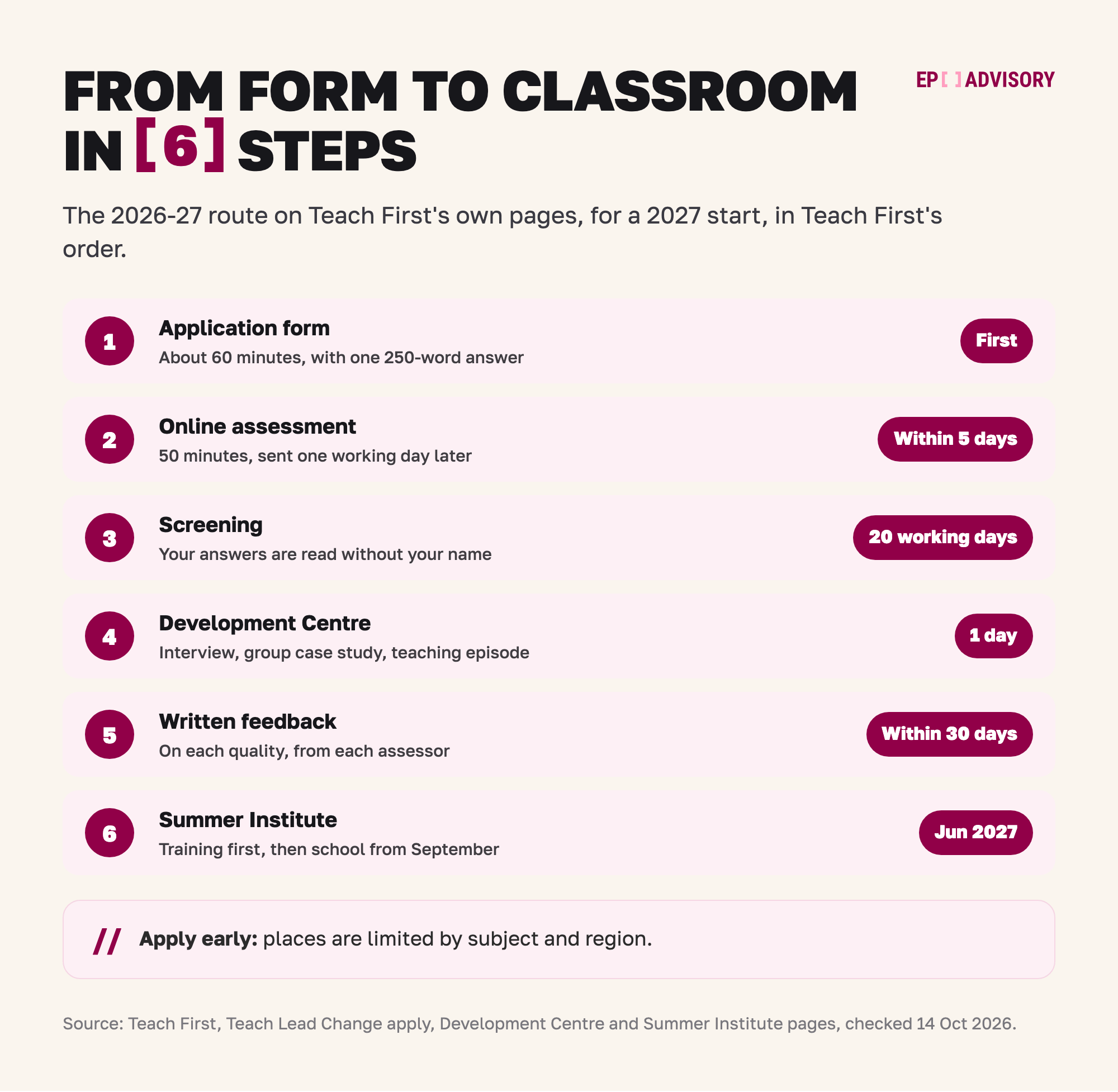
Short answer: Apply now. Secondary applications for the 2027 Teach First Training Programme were open when we checked on 17 October 2026, with no closing date published.Secondary applications for the 2027 Teach First Training Programme have closed.Teach First has published a closing date for 2027 secondary applications, so check its apply page. You fill in a 60-minute form with one 250-word answer. A 50-minute online assessment follows within five days. Then comes a one-day Development Centre: an interview, a group case study and a five-minute teaching episode. Teach First does not sponsor visas.
Applying now?
Secondary was open for all subjects when we checked on 17 October 2026. Places are limited by subject and region, so apply early.Secondary applications have closed for this intake. Use this guide to prepare for the next one.Teach First has published a closing date for secondary, so check its apply page. Places are limited, so apply early. How to apply
Primary, or not eligible?
Teach First says primary opens in early 2027.Teach First said primary opens in early 2027, so check its portal.Teach First said primary would open in early 2027, so check its portal. When we checked on 17 October 2026, Teach First said other graduate programmes in leadership and social impact were still accepting applications.Teach First also points you to other routes into teaching.Teach First also points you to other routes into teaching. Your options
Where are you now?
Independent guide. EP Advisory is not affiliated with Teach First.
Teach First is an education charity. Its Training Programme places graduates in schools across England as salaried trainee teachers for two years. From the 2027 intake, the programme is renamed Teach Lead Change. Teach First still runs it. Every date and rule here comes from Teach First’s own pages.
This playbook covers the secondary route for a 2027 start, including what it means for international applicants. For nearly 10 years, we’ve helped more than 5,000 professionals get hired. Want to know if your CV will pass screening in the UK? Check your CV for free: a score in 30 seconds, then a fix for each problem.
01/10
Your route to an offer
Pick your stage and tick each step when done. Steps and times are from Teach First’s pages. Prep times are our suggestions.
1. Application: no closing date published1. Application: closed for this intake1. Application: closing date published
A 60-minute form with one 250-word answer. No CV or cover letter is listed. You can save and come back.
2. Online assessment: 50 minutes, within five days
Competency questions on motivation, leadership and adaptability. It arrives one working day after you apply, so prep first.
3. Development Centre: one day, online or in London
An interview, a group case study and a five-minute teaching episode. Pre-work arrives seven days before. Prep 2 to 3 weeks.
4. Offer and training: Summer Institute from June 2027
A written feedback report comes within 30 days. Offers depend on references, certificates and your right to work.
Your ticks save on this device.
02/10
The programme at a glance
Everything you need to decide, on one screen. If Teach First has not published something, we say so.
Open
Secondary, checked 17 October 2026
Closed
Secondary, for this intake
Set
Closing date, see the apply page
2 years
In one school, paid from day one
50 min
Online assessment, within 5 days
QTS
Qualified teacher status after year 1
£23,732+
Year 1 salary, by subject and area
No
Visa sponsorship
Where these facts come from
- Status. When we checked on 17 October 2026, the application portal said: “Applications for all secondary subjects are open now!” No page gave a closing date (apply page).
- Status. Secondary applications have closed for this intake. When we checked on 17 October 2026, the portal said: “Applications for all secondary subjects are open now!”
- Status. Teach First has published a closing date, so check its apply page. When we checked on 17 October 2026, the portal said: “Applications for all secondary subjects are open now!”
- The programme. “You’ll be placed in one school for the whole two-year programme” (locations page). You start on 80% of a full timetable.
- Scale. A government contract to “bring 1,000 new teachers into the profession every year” (press release, June 2026).
Trainee salaries by year, subject and area
- Year 1, primary. £23,732 in most of England, up to £29,336 in inner London.
- Year 1, secondary maths, science and modern languages. £28,758, up to £34,702 in inner London.
- Year 1, other secondary subjects. £26,075, up to £32,018 in inner London.
- Year 2, all subjects. At least £34,069, or at least £41,729 in inner London.
From Teach First’s salary page, updated August 2026. Compare with our guide to salaries in the UK.
New this cycle
Three qualities replace nine competencies. Last cycle listed nine (archived page). This cycle has three “Change Maker qualities”.
No test provider was named on 14 October 2026. See the online assessment.
03/10
What Teach First looks for
Teach First assesses three Change Maker qualities. It says: “You do not need to demonstrate prior work experience in an education setting”.
Purposeful commitment and moral imperative
Commitment to “leading change and creating positive impact in education”. Show it by: a clear, personal reason for the mission in your 250-word answer.
Leadership: collective contribution and professional agency
“An effective leader is proactive, takes personal responsibility and works towards ambitious targets.” Show it by: a time you took ownership of a hard situation.
Learning and reflective practice
Being “open to feedback, able to implement expert advice and willing to adapt your approach”. Show it by: feedback you acted on, and what changed.
From Teach First’s qualities page. Examples “from any work, academic or personal experience are welcome”.
What to know before the Development Centre
- The values and the three qualities, with an example of each from your own life.
- The role of a teacher, and what a typical day looks like.
- Safeguarding, which Teach First calls “safeguarding and child protection”, and “the whole child approach”.
- Teach First’s wider work, including its 22,000-plus ambassadors.
From Teach First’s Development Centre page.
04/10Stage 1 · Apply
How to apply
One 60-minute form, then the online assessment the next working day. Teach First says “you are only able to complete one application per recruitment window”.
1
Check you qualify
Degree, GCSEs, subject rules
2
Choose preferences
Subject and region
3
Write 250 words
Why you want to join
4
Submit
Assessment the next working day
Places are limited by subject and region. The form shows “how your choices align with current availability”. So apply early.
Who can apply
- Degree. A UK honours degree at 2:1 or above. “We’ll consider 2:2 degrees for secondary teaching only.”
- GCSEs. Grade 4 (C) in English and maths. Primary also needs a science.
- Your subject. Most subjects need a related degree or A-levels at grade B. History needs a related degree. See the eligibility page for yours.
- Subjects. Business, Computing, Design and Technology, English, Geography, History, Maths, Modern Foreign Languages, Music, RE and Science.
- No teaching qualification yet. You cannot already hold a PGCE or QTS, or have accepted a PGCE place this year.
- Right to work. Proved by April 2027, through to August 2029. See visa sponsorship.
What the form asks, and Teach First’s rules
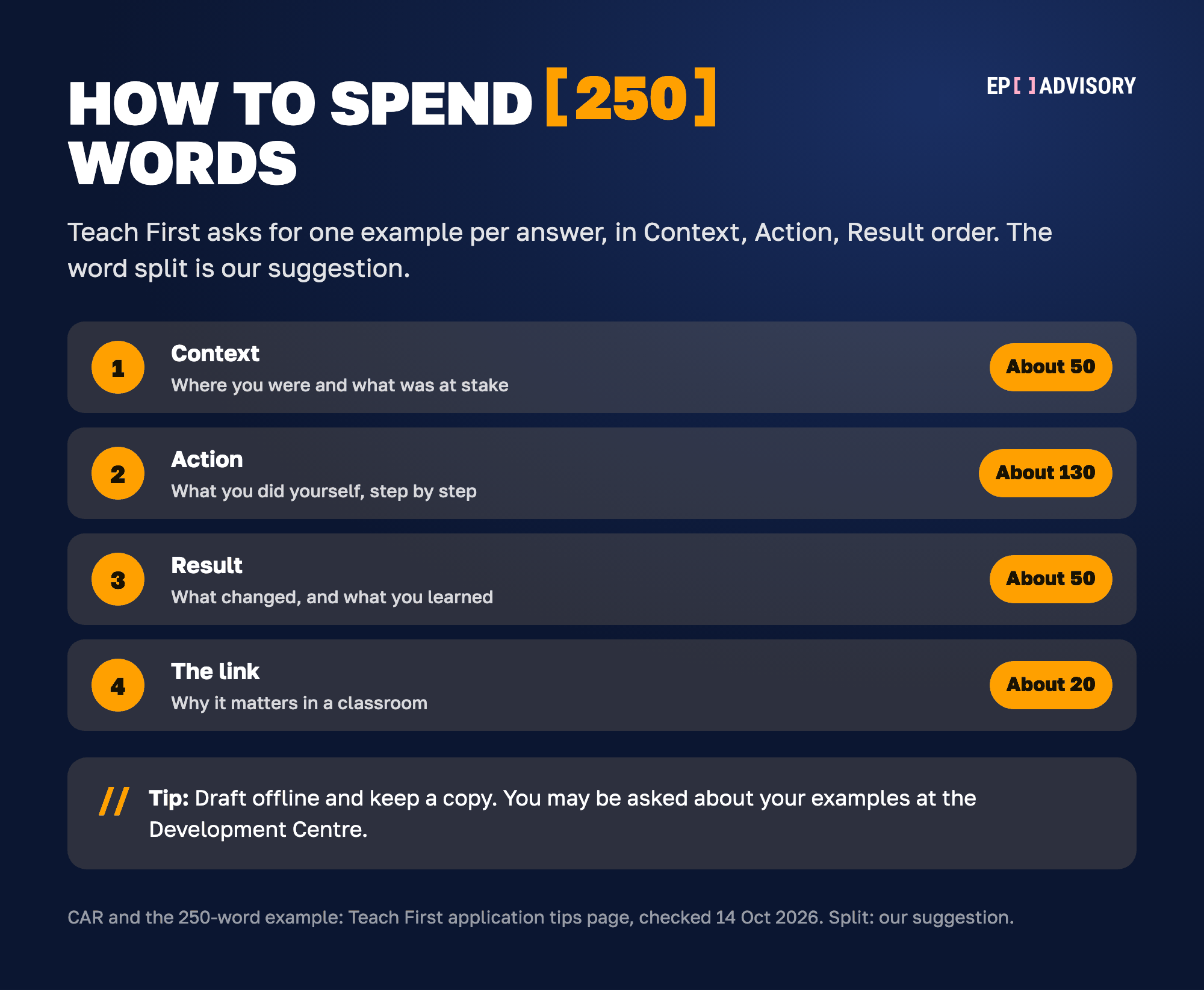
- What you need. Degree details, GCSE grades, a 250-word answer on why you want to join and your fit with Teach First’s mission, and your right-to-work status.
- Read without your name. Before screening, “all personal data will be removed”.
- Errors. “Applications with five or more spelling and/or grammar errors will be failed.”
Your 250-word answer: do and don’t
Do
“Running a youth club quiz, I saw how fast a shy 13-year-old grew when someone expected more of her.”
One personal reason, one real moment, then a link to Teach First’s mission in your own words.
Don’t
“I have always been passionate about education.”
A claim with no example. Teach First says it “cannot infer or assume”.
Teach First’s form asks for no CV or cover letter. Applying to other graduate programmes too? Our CV achievement examples show how to turn duties into results. Our guide to an impressive CV covers the layout. Getting ready to apply for jobs in the UK? Check your CV for free: see it the way a recruiter does, then fix each problem.
Save Teach First and over 2,000 other UK schemes to one free calendar. See what closes next and what you have applied to.
Track my schemes freeFree account, no card.
Last year’s date, for context only. The 2025-26 cycle closed at 23:59 on 27 November 2025 (archived page). Teach First has published no date for this cycle.This cycle’s secondary applications have closed.Teach First has now published a date for this cycle, so check its apply page.
Primary, not eligible or not ready? Your options
- Primary. Teach First says it opens in early 2027. Its entry rules were “under review” when we checked on 14 October 2026.Teach First said it opens in early 2027, so check its portal. Its entry rules were “under review” when we checked.Teach First said it would open in early 2027, so check its portal. Register interest on the primary interest form.
- Other Teach First routes. School-centred training (SCITT) near you, or the Postgraduate Teaching Apprenticeship.
- Every route in England. Get Into Teaching is the government’s service for all routes. Its teacher training advisers give free one-to-one help “by phone, text, or email”. You sign up first.
- Changing career? Teach First points career changers to Now Teach.
- Other leadership programmes. Teach First’s alternative opportunities page names the Civil Service Fast Stream, Police Now and Tiney. Its international page adds Unlocked Graduates.
05/10Stage 2 · Online assessment
The online assessment
A 50-minute online assessment arrives one working day after you apply. You must finish it within five days. Teach First then screens your application within 20 working days.
What Teach First says
“Competency-based questions about your motivation, leadership and adaptability”. You can also add other relevant experiences.
Not published
The provider, the number of questions and any practice test.
Last cycle, Teach First used a task-based assessment from Arctic Shores (archived page). This cycle’s pages name no provider, so do not expect the same format.
The two published prompts
Prompt 1: leadership
“describe a time that you demonstrated leadership by taking ownership of a challenging situation and lead either yourself or others to a successful outcome”
What they’re testing: that you own a problem and see it through.
Your moves
- Say what you decided and did yourself.
- Leading yourself counts, so a solo example works.
- End with the outcome, with a number if you can.
Prompt 2: feedback
“describe a time when you have received feedback on your approach and used it to enact positive change that led to a successful outcome”
What they’re testing: that you take advice and change what you do.
Your moves
- Sum up the feedback in one line, and say who gave it.
- Show what you changed, step by step.
- End with the better result, and what you still do now.
Prompts quoted from Teach First’s qualities page. What they’re testing and your moves are our own reading.
Teach First’s rules for your answers
Allowed
- AI to organise your ideas
- AI to check spelling and grammar
- Examples from work, study or personal life
Not allowed
- Answers generated by AI
- Five or more spelling or grammar errors
- A second application this window
From Teach First’s application tips. If it suspects AI-written answers, “your application may be withdrawn”.
Go further: the best outside help
Our own picks, checked on 14 October 2026. We are not linked to any of these sites and earn nothing from them.
From Teach First
- Teach First’s rules for your answersTeach First · 2026-27 · no account neededOne example per answer, the CAR shape, the error limit and the AI rule, from the people who score you.Free
- The three qualities and two real promptsTeach First · 2026-27 · no account neededDraft one CAR answer for the leadership prompt and one for the feedback prompt before you apply.Free
Practise
- Shape your answer on why you want to teachGet Into Teaching · Department for Education · general practiceWritten for the national personal statement, so use it as practice for your 250-word answer.Free
Skip game practice and paid question packs. When we checked on 14 October 2026, Teach First had not named a 2026-27 test provider, so last year’s games may not match this year’s questions.
Next: the Development Centre interview tests the same three qualities out loud. Rehearse with our guide to the toughest interview questions.
06/10Stage 3 · Development Centre
The Development Centre
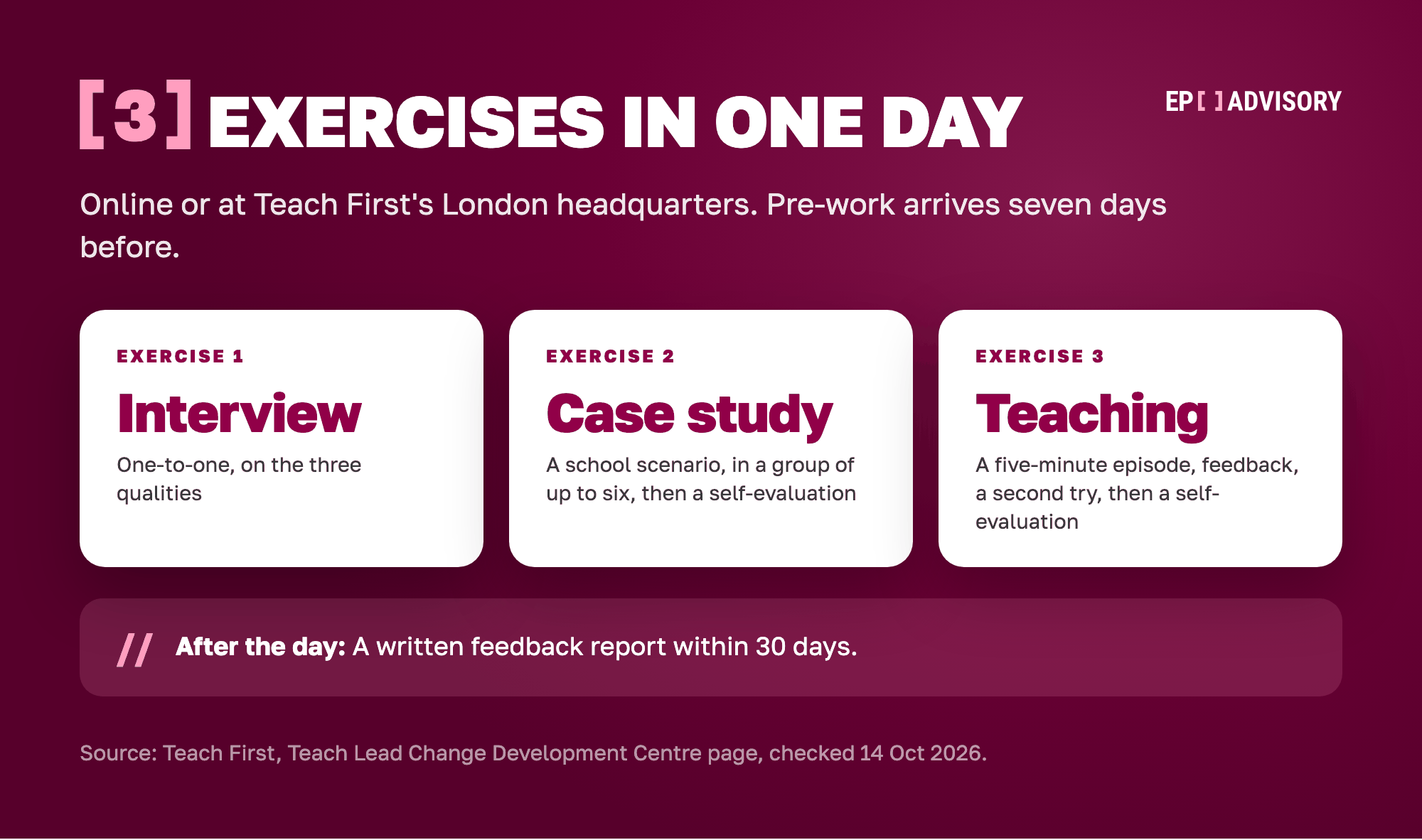
One day, online or at Teach First’s London headquarters. Teach First says it is “not just about the skills you have right now”.
Two official lines go together. The Development Centre page says “your assessors in the Development Centre will not have seen your application”. The tips page says to save your answers, “as you may be asked about these during your Development Centre”. So know your examples well.
Pre-work arrives seven days before, and a recruiter calls you first. In person, “a portion of your travel expenses will be reimbursed”.
How to answer
Interview
A one-to-one interview on the three qualities. You also reflect on a section of your pre-work, and you can ask questions. Build each story in four parts:
Context
Where, when and what was at stake.
Action
Your own steps, not the team’s.
Result
What changed, with a number if you can.
Learning
What you would repeat, or change.
Follow-ups to rehearse
Why teaching, and why now?What exactly was your part?What feedback have you acted on lately?How would that help you in a classroom?
Our list, built on the three qualities.
Build each story with our guide on how to pass a job interview.
Case study
A group of up to six candidates discusses “a realistic school-based scenario”. Your pre-work includes a question to prepare. A self-evaluation follows.
- Prepare the pre-work question, and bring two points.
- Keep pupils at the centre of every suggestion.
- Build on others’ ideas, and bring in quieter people.
- In the self-evaluation, name one thing that went well and one to change.
Our advice. Scoring is not published.
Teaching episode
You teach “a pre-prepared five-minute teaching episode”. Your title and guidance come in the pre-work. After feedback, you deliver it again. Teach First says it is not a presentation, “but a teaching episode to engage and inspire”.
1
Hook
A question or picture in the first 30 seconds
2
One idea
Small enough for five minutes
3
Check
Ask the class a quick question
4
Use the feedback
Change one thing on your second try
Our suggested shape. Teach First says to “practise with friends and family to get an idea of your timings”. The self-evaluation “is just as important for your final result”.
Practise: one question at a time
Interview questions
Cards 1 and 2 shorten Teach First’s prompts. Cards 3 and 4 are from Get Into Teaching. The answers are ours.
Teach First’s prompt
Describe a time you took ownership of a challenging situation and led yourself or others to a good outcome.
What they’re testing: the leadership quality.
Show a strong answer
- Use CAR. Spend most of your time on what you did.
- End with the outcome and what it shows about how you lead.
Teach First’s prompt
Describe a time you received feedback on your approach and used it to make a positive change.
What they’re testing: learning and reflective practice.
Show a strong answer
- Name the feedback and who gave it.
- Show what you changed, then the better result.
Get Into Teaching
“Why do you want to teach?”
What they’re testing: purposeful commitment.
Show a strong answer
- One personal reason and one real moment.
- Then link it to Teach First’s mission, in your own words.
Get Into Teaching
“What are some of the challenges faced by teachers today?”
What they’re testing: that you have done your research.
Show a strong answer
- Name one or two challenges and why they matter for pupils.
- Say how you would respond as a trainee.
Case study prompts
Our own prompts. Teach First publishes no case questions.
School scenario
Year 8 attendance has dropped since Christmas. Your group must suggest what the school does first.
What they’re testing: pupil-centred ideas, built with others.
Show a strong answer
- Ask what the data shows first.
- Suggest one quick step and one longer one, and build on someone else’s idea out loud.
School scenario
A pupil who used to join in now seems withdrawn. Your group must agree what the school does first.
What they’re testing: “the whole child approach” and “safeguarding and child protection”, both on Teach First’s list to know.
Show a strong answer
- Look at the whole pupil, not just their work. Ask what staff already know.
- If anything suggests a risk, say you would follow the school’s safeguarding policy.
Group work
Two people in your group disagree and time is short. What do you do?
What they’re testing: working well with others.
Show a strong answer
- Sum up both views and point to the task’s goal.
- Suggest a quick way to decide.
Self-evaluation
How did you contribute to the group, and what would you change?
What they’re testing: honest reflection.
Show a strong answer
- Name one thing you did well, with an example.
- Name one thing to change, and how you would do it.
Teaching episode prompts
Our own prompts, built on Teach First’s guidance for the teaching episode. The answers are ours.
Open
Your title has arrived in the pre-work. How will you open your five minutes?
What they’re testing: that you teach, not present. Teach First says it “isn’t a ‘presentation'”.
Show a strong answer
- Start with a question or picture for the class in the first 30 seconds.
- Plan it “from a pupil’s perspective”, as Teach First advises.
Timing
How will you fit your lesson into five minutes?
What they’re testing: planning and pace.
Show a strong answer
- Teach one small idea, not a whole topic.
- Teach First says to “practise with friends and family to get an idea of your timings”.
Feedback
The assessor gives you feedback, and you teach it again. What changes?
What they’re testing: that you learn and adapt on the spot.
Show a strong answer
- Pick one point from the feedback and change it so it shows.
- Keep what worked the first time.
Self-evaluation
How did your teaching episode go, and what would you change?
What they’re testing: honest reflection. Teach First says it “is just as important for your final result”.
Show a strong answer
- Name one moment that worked, and what the class did.
- Name one thing to change, and how.
Your story bank: a worksheet to print or copy
Two stories per row. Reuse the examples from your saved answers.
| What Teach First asks for | Story 1 | Story 2 |
|---|---|---|
| Why teaching, and why the mission | ||
| Owning a hard situation | ||
| Feedback you acted on | ||
| Adapting when plans changed | ||
| Working in a group | ||
| Explaining something clearly |
Go further: the best outside help
Our own picks, checked on 14 October 2026. We are not linked to any of these sites and earn nothing from them.
From Teach First
- The Development Centre, step by stepTeach First · 2026-27 · no account neededAll three exercises, plus the list of what to know on the day.Free
- What a trainee’s day looks likeTeach First · three trainee clips · no account neededThe Development Centre asks you to know a teacher’s role and typical day. This is Teach First’s own answer.Free
Watch
- A recruiter on the Development CentreTeach First on YouTube · Jun 2023 · 2 minMaeve says to prepare your examples and practise the lesson out loud. She uses the old word “competencies”.Free
Practise
- Common teacher training interview questionsGet Into Teaching · Department for Education · general practicePractise “why do you want to teach?” and the challenges teachers face today, out loud.Free
- Watch real lessons by subjectOak National Academy · funded by the DfE · no account neededBefore you plan your five-minute episode, see how a lesson opens, checks understanding and ends.Free
Read
- Safeguarding basics for all school staffDepartment for Education · updated Sep 2026 · read part oneTeach First lists safeguarding among the things to know before the day.Free
07/10Stage 4 · Offer
Feedback, offers and training
A written feedback report arrives within 30 days of your Development Centre. It covers each quality, with comments from each assessor. Teach First does not publish when offers go out.Teach First does not publish when offers go out.Teach First has said when offers go out, so check its site.
Conditions
References and original certificates. Overseas qualifications are checked through ENIC first. You must prove your right to work by April 2027.
Your school
One school for two years, somewhere in England. Teach First notes your preferences but says “we cannot automatically guarantee this”.
Your qualification
QTS after year 1. A PGCE from the National Institute of Teaching is expected, “subject to successful validation and approval”.
Support
A Teach First Development Lead and a mentor in your school.
From Teach First’s own pages, including support.
When things happen: secondary, 2027 start
Secondary
Open when we checked on 17 October 2026, with no closing date published
Secondary
Open when we checked on 17 October 2026. Teach First has since published a closing date
Secondary
Applications have closed for this intake
Early 2027
Primary applications open, Teach First says
Early 2027
Primary applications due to open
Early 2027
Primary applications were due to open
Apr 2027
Right to work proved
Apr 2027
Right to work proved
Jun 2027 to Jul 2027
Summer Institute, with time in a host school
Sep 2027
You start teaching in your school
Aug 2029
The programme ends
08/10
Visa sponsorship
Our reading: Teach First does not sponsor visas. It says: “We cannot sponsor visa applications. Programme members are employed by their placement schools during the programme, therefore Teach First cannot provide support with this.”
No
Visa sponsorship
Apr 2027
Right to work proved by
Aug 2029
Able to work full-time until
Teach First also says: “The Graduate visa and the Youth Mobility Scheme visa do not meet our criteria to cover the initial training period and two-year programme.” See its international applicants page.
The details, and other routes
- Graduate visa. It lasts “2 years if you apply on or before 31 December 2026” and “18 months if you apply on or after 1 January 2027” (GOV.UK).
- Other salaried routes. Salaried training elsewhere needs a Skilled Worker visa sponsored by the employer. The government’s visa guide for trainees shows how to find courses that sponsor.
See our guides to staying in the UK after studying, UK companies that sponsor visas and jobs in the UK for foreigners. This is general information, so check GOV.UK.
09/10
Key takeaways
Before your next step
- Apply now. Secondary was open when we checked on 17 October 2026, with no closing date published.
- Secondary has closed for this intake. Next time, apply early, as places are limited.
- Apply before the closing date on Teach First’s apply page.
- You need a 2:1, or a 2:2 for secondary, plus GCSE English and maths.
- Draft your examples before you submit. The 50-minute assessment arrives the next working day.
- Use one example per answer, in CAR order, with no AI drafting.
- Keep a copy of your answers. You may be asked about them at the Development Centre.
- Practise a five-minute teaching episode out loud, then your self-evaluation.
- Teach First does not sponsor visas. You need the right to work by April 2027.
When a scheme gives a close date, we email you a few days before it closes. Save Teach First once and the reminder is set.
Set my reminders freeFree account, no card.

10/10
Frequently asked questions
Is the Teach First Training Programme open for 2027?
Yes, for secondary. When we checked on 17 October 2026, all secondary subjects were open. No closing date is published and places are limited, so apply early.Not for secondary. Secondary applications have closed for this intake.Yes, for secondary, until the closing date on Teach First’s apply page. Places are limited, so apply early. Teach First says primary opens in early 2027.Teach First said primary opens in early 2027, so check its portal.Teach First said primary would open in early 2027, so check its portal.
What grades do I need for Teach First?
A 2:1 degree, or a 2:2 for secondary only. You also need GCSE grade 4 (C) in English and maths, plus a science for primary. Most subjects also need a related degree or A-levels.
What is the Teach First online assessment?
A 50-minute task sent one working day after you apply. You must finish it within five days. It asks competency questions about your motivation, leadership and adaptability. Teach First had not named a test provider for 2026-27 when we checked on 14 October 2026.
What happens at the Teach First Development Centre?
It is one day, online or in London. You do a one-to-one interview on the three qualities, a group case study and a five-minute teaching episode. You evaluate your own case study and lesson. Written feedback follows within 30 days.
Does Teach First sponsor visas?
No. Schools employ the trainees, so Teach First cannot sponsor visas. It says the Graduate visa and the Youth Mobility Scheme visa do not meet its criteria. You need the right to work from April 2027 to August 2029.
How much do Teach First trainees earn?
In year 1, from £23,732 to £34,702, by phase, subject and area. In year 2, at least £34,069 to £41,729. These are Teach First’s published figures.
Do I need teaching experience for Teach First?
No. Teach First says you do not need work experience in an education setting. Examples from any work, study or personal experience count.