 By Andre Atallah, CEO of EP Advisory
Civil Service Fast Stream
18 schemes · Great Britain · 2027 entry
Closes 12:00 GMT, Thu 5 NovDeadline was set for 5 Nov 2026
Short answer: Apply now. The window for 2027 entry closes at 12:00 GMT on Thursday 5 November 2026.The window for 2027 entry has closed. The deadline was set for Thursday 5 November 2026. You register, pick up to 3 of the 18 schemes and answer background questions. Then you take 2 untimed online tests within 7 days. Some schemes then ask extra questions. Next comes a half-day online assessment centre with three exercises. Most schemes end with a final selection board. You start on 6 September or 4 October 2027, by scheme.Start dates are 6 September or 4 October 2027, by scheme.This intake started on 6 September or 4 October 2027, by scheme.
Where are you now?
Independent guide. EP Advisory is not affiliated with the Civil Service Fast Stream.
The Civil Service Fast Stream calls itself “a leadership development programme”. It has 18 specialist schemes, from Government Policy to Digital and Finance. Most schemes accept a 2:2 or above.
This playbook covers every stage, from the form to the final board. For nearly 10 years, we’ve helped more than 5,000 professionals get hired. Want to know if your CV will pass screening in the UK? Check your CV for free: a score in 30 seconds, then a fix for each problem.
01/10
Your route to an offer
Pick your stage and tick each step when done. Stages and dates are the Fast Stream’s own.
1. Apply: closes at 12:00 GMT on 5 November1. Apply (the deadline was set for 5 November)
Register, pick up to 3 schemes and answer background questions. The form lists no CV or cover letter.
2. Online tests: 7 days from your invite
Work-based scenarios and a case study, both untimed. The official video says about 1.5 hours in total.
3. Assessment centre: Nov 2026 to Feb 2027
Half a day, online, three exercises. A different assessor marks each one.
4. Final board, offer and start (6 Sep or 4 Oct 2027)
Most schemes add a final selection board. Your invitation links its guide.
Your ticks save on this device.
02/10
The Fast Stream at a glance
A paid programme of 3 to 5 years, by scheme. You move between postings and train as you go.
5 Nov
Closing date, at 12:00 GMTDeadline (now closed)
£31,554
Starting pay
£45,000
To £55,000, possible after the programme
18
Schemes. You pick up to 3
2:2
Enough for most schemes
3 to 5
Years, by scheme
Pay as published on the Fast Stream home page on 14 October 2026. Scheme pages give their own figures, such as £45,000 to £62,000 after Government Policy.
In the 2026 campaign, 703 of 69,046 first-preference applicants were recommended for appointment, about 1.0% (official recruitment data, published 24 September 2026).
Postings, moving and the two newer options
- Where. The Fast Stream offers “postings across Great Britain and occasionally overseas”. “Fast streamers cannot choose their department or their specific role”, but it tries to meet location preferences.
- Moving. “Relocation support of up to £2,000 is available”, once you have started (locations page).
- Yorkshire and the Humber. “Postings will only be available in the Yorkshire and the Humber Region”, mostly in Leeds, York and Sheffield.
- Houses of Parliament. This scheme “is not part of the Civil Service Fast Stream”. You can still pick it as one of your three choices (all schemes).
03/10
What the Fast Stream looks for
The assessment centre marks you on 4 dimensions: Think, Relate, Adapt and Strive. Show each one with a real example.
Think
“How you gather, process and analyse information.” Show a choice you made from mixed evidence.
Relate
“Your interpersonal skills and emotional intelligence.” Show how you brought someone round.
Adapt
“Your flexibility and learning agility.” Show what you changed when a plan failed.
Strive
“Your drive and values.” Show what you pushed for, and why it mattered to you.
From the Fast Stream’s assessment guide. The written and oral exercises assess all 4. The Personal Development Conversation assesses Relate, Adapt and Strive. Assessors do not see your form or earlier scores.
04/10Stage 1 · Apply
How to apply
Apply now. Applications close at 12:00 GMT on Thursday 5 November 2026. The Fast Stream gives the same deadline on its home page, schemes page and internship page.This year’s window has closed. The deadline was set for Thursday 5 November 2026. The steps below show how the form worked, for the next campaign.
1
Register
One account, a personal email
2
Pick schemes
Up to 3 of the 18
3
Background
Questions, plus any adjustments
4
Submit
By 12:00 GMT, 5 NovemberWas due by 12:00 GMT, 5 November
Three form rules
Use a personal email, “not a work or university email address”.
Register only one account. Duplicate accounts can get your application withdrawn.
Gmail is recommended. If you get a place, onboarding needs a Google account.
From the initial application page, checked 14 October 2026. It lists no CV, cover letter or written questions.
Where the 18 schemes differ
The process is the same for every scheme. Only three things change: extra questions after the tests, a final board and higher security checks.
| Schemes | Extra questions | Final board | Higher vetting |
|---|---|---|---|
| Government Policy | No | No | Not stated |
| Digital | No | No | SC for technical roles |
| Cyber Security | No | Pages disagree | SC before start |
| Yorkshire and the Humber | No | Pages disagree | Not stated |
| Commercial, Finance, HR, Operational Delivery, Property, Science and Engineering | No | Yes | Not stated |
| Economics, Operational Research, Social Research, Statistics, Project Delivery | Yes | Yes | Not stated |
| Risk Management | Yes | Yes | SC before start |
| Diplomatic and Development, and its Economics scheme | Yes | Yes | DV before start |
| Houses of Parliament (not Fast Stream) | Yes | Not stated | Not stated |
From the additional information and final board pages and each scheme page, checked 14 October 2026. For Cyber Security and Yorkshire, two official pages disagree, so check your invitation.
Security checks and degree rules
- Everyone. Every Civil Service post needs the baseline check (BPSS).
- SC and DV. Higher clearances, for frequent and uncontrolled access to SECRET or TOP SECRET assets (UK Security Vetting).
- Degrees. Some schemes, such as Finance, Economics and Statistics, ask for a 2:1 or a set subject.
Your motivation answers: do and don’t
“My dissertation used travel survey data to redesign a bus timetable”
Do
A real reason, linked to the scheme’s work. Our example, not an official answer.
Don’t
“I have always wanted to serve the public”
True for many people, so it says little about you.
Our CV achievement examples show how to turn what you did into one clear line. Getting ready to apply for jobs in the UK? Check your CV for free: see it the way a recruiter does, then fix each problem.
Save Civil Service and over 2,000 other UK schemes to one free calendar. See what closes next and what you have applied to.
Track my schemes freeFree account, no card.
Missed it or not selected? Your options
- Civil Service Jobs. “You can browse and apply for current vacancies anytime” on Civil Service Jobs.
- Apprenticeships. Civil Service apprenticeships run from Level 2 to Level 7.
- Join first, then apply. Civil servants who have passed probation need no degree for 12 schemes, including Policy, Digital and Finance (in-service route).
- The next campaign. Watch the schemes page. No dates for 2028 entry were out when we checked on 14 October 2026.It may list dates for the next campaign.The next campaign has closed too.
- Also consider HMRC. The Tax Specialist Programme closes at 11:30 GMT on Monday 26 October 2026. That is the earlier of the two times in HMRC’s candidate guide.This year’s Tax Specialist Programme ad has closed. The deadline was set for Monday 26 October 2026.
- Same deadline. The Summer Internship Programme and the Houses of Parliament scheme also close at 12:00 GMT on 5 November.This year’s Summer Internship Programme and Houses of Parliament scheme ads have closed. Their deadline was set for 5 November. The internship is for students in their last 2 years from a lower socio-economic background. A good appraisal there can get you “fast-tracked past the initial online selection stages” within 12 months. You cannot apply to both in one year.
05/10Stage 2 · Online tests
The online tests
The tests page lists 2 tests: work-based scenarios and a case study assessment. Both are untimed. You have 7 days from the moment they appear.
Work-based scenarios12 scenarios
Short videos · Rate each action
Case study assessment7 background items, 24 situations
A story that evolves · Most and least
The first measures “interpersonal skills”. The case study assesses “decision-making and your ability to adapt to changing circumstances”.
7 days
To finish both tests
1.5 hours
Roughly, for both, says the official video
Dec 2026
When results should arriveTest results month
Step through the two tests
Work-based scenarios
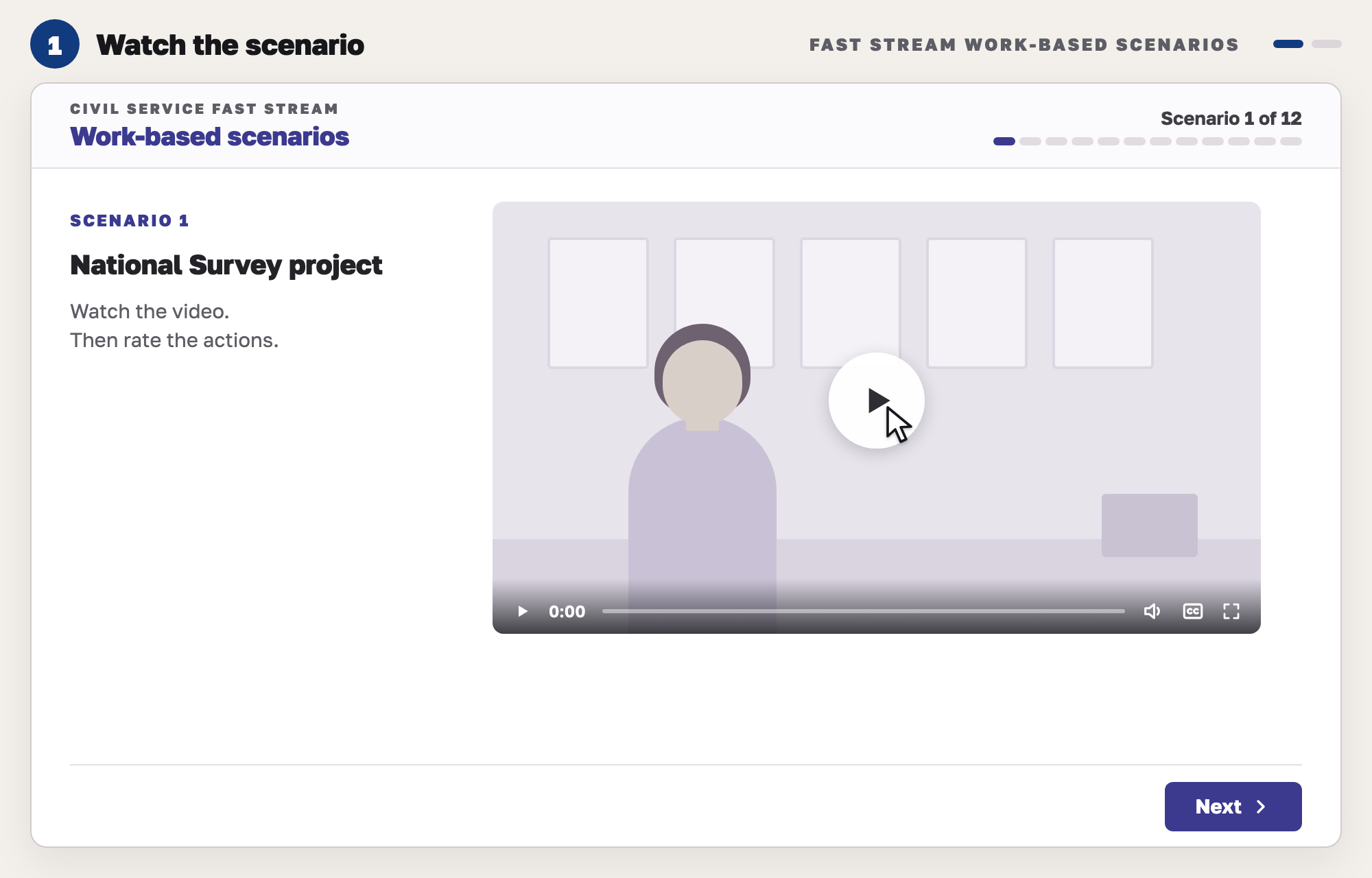
Watch the scenario
Press play to watch a short work scene. There are 12 scenes in this test and no timer. Our drawing of the format the Fast Stream describes. Your screens may look different.
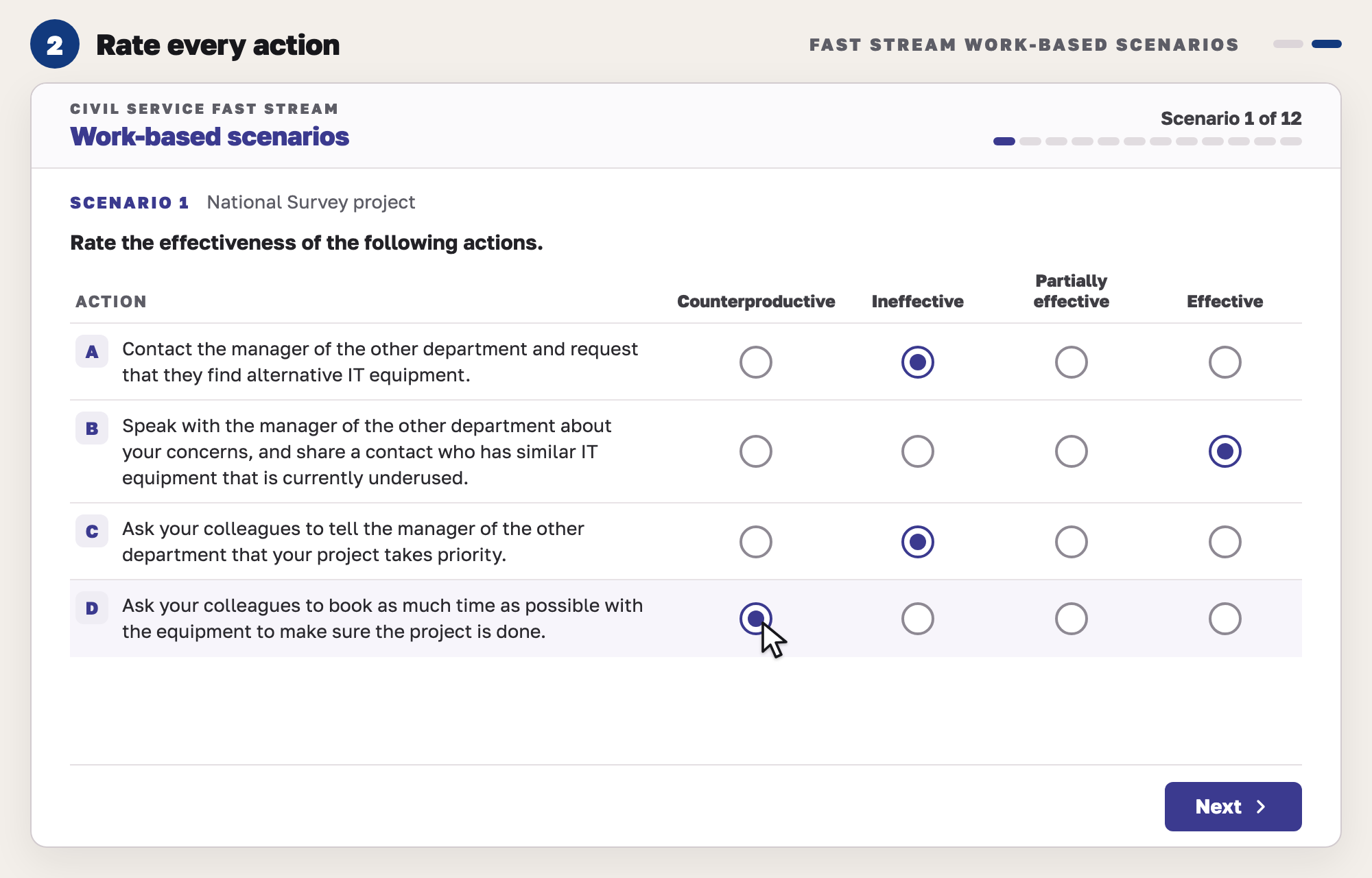
Rate every action
Rate each action from Counterproductive to Effective. Two actions can get the same rating, as in the Fast Stream’s own example.
Your moves
- Learn the four ratings first: Counterproductive, Ineffective, Partially effective, Effective.
- A fast streamer’s tip: “be true to yourself and try to respond to the scenarios like you would in real life.”
Case study
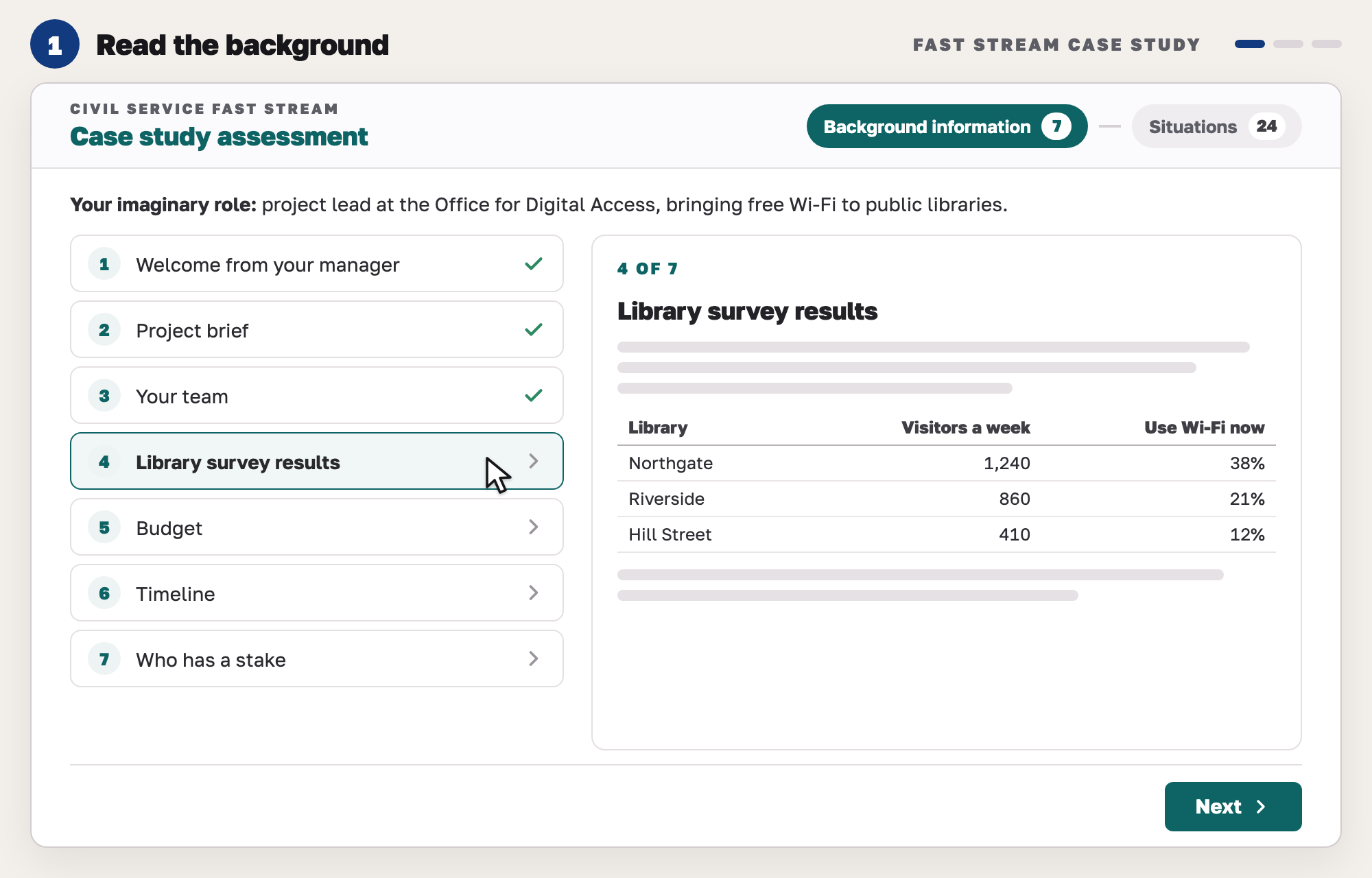
Read the background
Open all 7 pieces of background information. The 24 situations come after them. Our drawing of the format the Fast Stream describes. Your screens may look different.
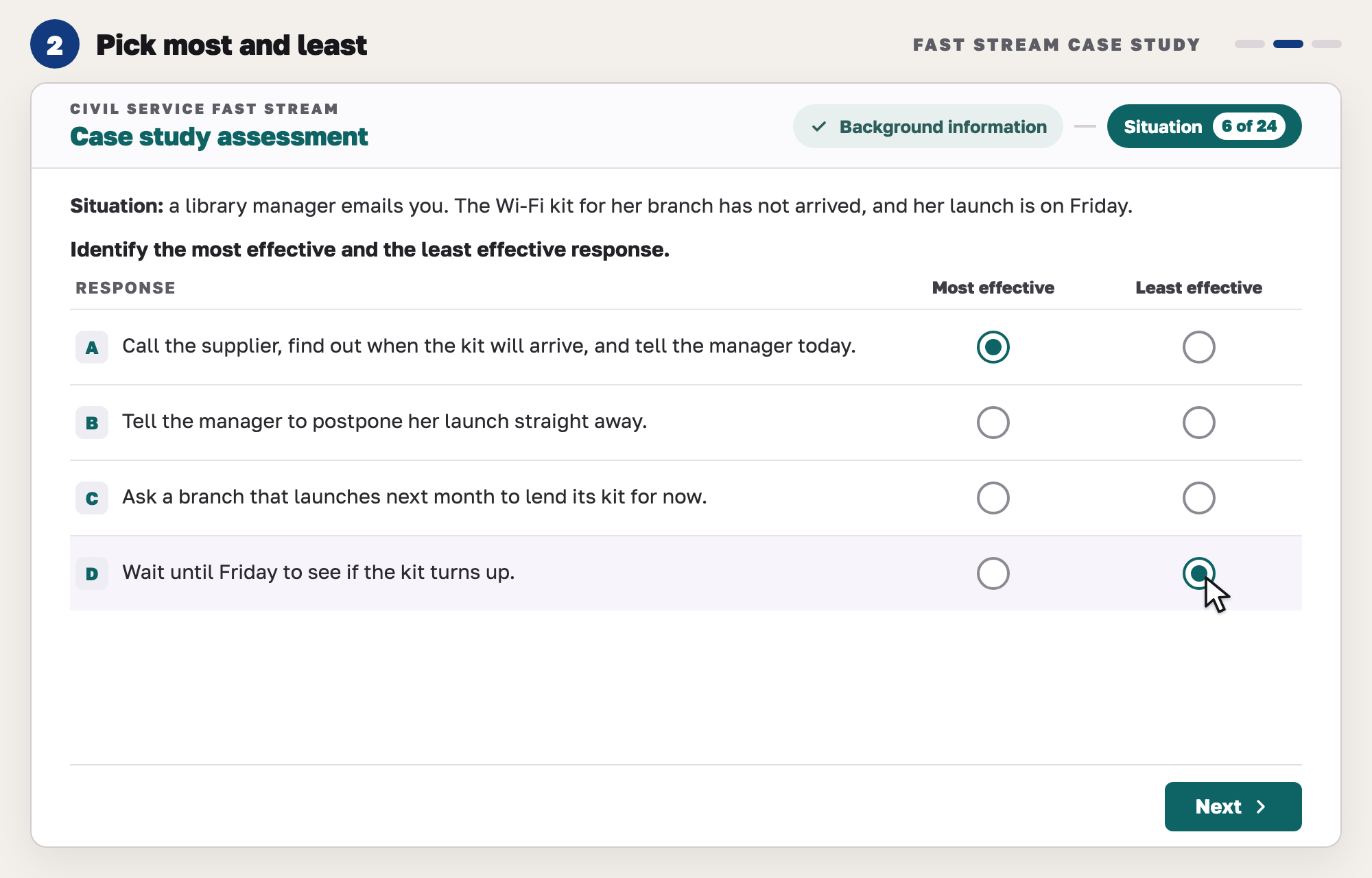
Pick most and least
In some situations, you pick the most effective and the least effective response.
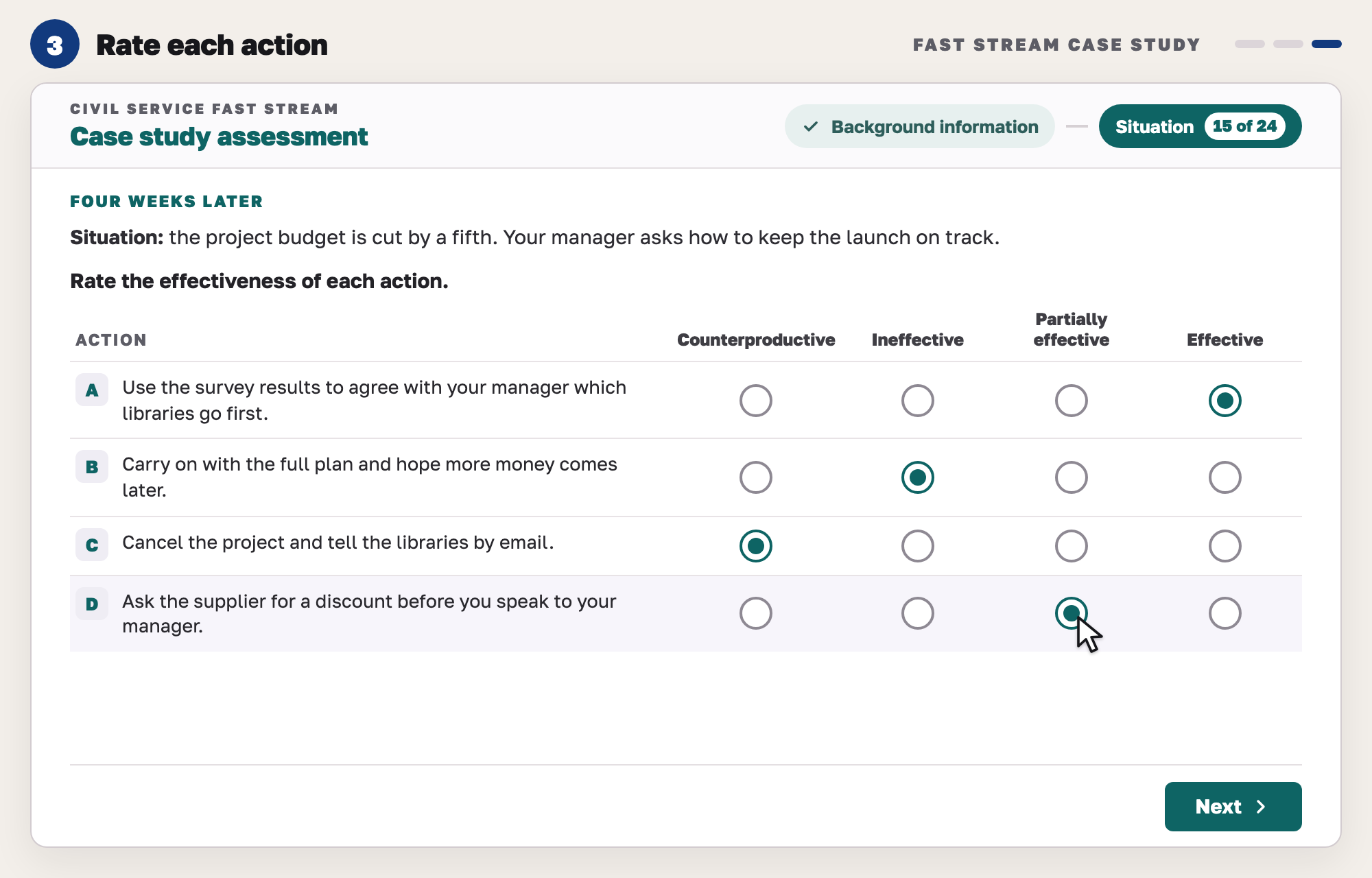
Rate each action
In other situations, rate each action on the same four-point scale. The story moves on, so check what has changed.
Your moves
- Read every background item before the first situation. Later ones build on them.
- No timer runs, and you may take breaks between and during the tests.
Our drawing of the format the Fast Stream describes. Your screens may look different.
The rules: allowed and banned
Allowed
- Taking your time, as no test is timed
- Breaks between and during the tests
- Help reading a question, if the answers are yours
- AI to prepare, before the tests
Banned
- AI tools during any test
- Anyone else choosing your answers
- Skipping the tests, even with adjustments
- Finishing after your 7 days
From the Gen AI and reasonable adjustments pages. The tests are “compatible with screen readers”, and extra time is not needed.
Scores, feedback and the extra questions
- Scores. You get “a standardised normative score”, set against “a peer group who previously took the test” (portal privacy notice).
- Feedback. “You will receive feedback, regardless of whether you are successful.” It “does not indicate whether you will progress to the next stage”.
- Extra questions. Some schemes then ask motivational questions and academic details, due within 7 days. The Fast Stream aims to assess them “within 2 weeks of submission”.
Go further: the best outside help
Our own picks, checked on 14 October 2026. We are not linked to any of these sites and earn nothing from them.
From the employer
- Fast Stream online testsCivil Service Fast Stream · updated 2 Oct 2026 · no account neededWhat each test measures and how it works.Free
- Example question: work-based scenarioCivil Service Fast Stream · 30 Sep 2026 · no account neededOne full scenario, with the right rating for each action.Free
- Reasonable adjustmentsCivil Service Fast Stream · updated 1 Oct 2026 · no account neededScreen readers, breaks, and what help with reading is allowed.Free
Watch
- Fast Stream Assessment Process GuideCivil Service Fast Stream channel · 17 Sep 2026 · 3:43A short official tour of every stage.Free
Never use AI during the tests. The Fast Stream says “you must not use Gen AI tools during your tests or assessments” (Gen AI page).
Next: practise judging options quickly with our guide to psychometric and logic tests.
06/10Stage 3 · Assessment centre
The assessment centre: three exercises
There is no classic interview. The interview-like parts are the 30-minute Personal Development Conversation and the questions after your Oral Briefing.
Half a day
Online, on Google Meet
3
Exercises, each with a different assessor
Nov to Feb
Sessions run dailySessions ran daily
From the assessment centre overview and the attending page. Join on time: the Fast Stream says that if you join late, “it’s unlikely you’ll be able to take part”. You may keep “paper, pens and a calculator within reach”.
The three exercises, with the official examples
Written Exercise
55 minutes to read a pack and complete 4 written tasks in a Word template sent by email. You play “a fast streamer overseeing a project”.
In the official example, you are “a new fast streamer in the Department for Intergenerational Fairness”. The topic is “access to affordable housing”. Tasks include a recommendation to the housing minister, an email to the Head of Homes for All and “a social media post”.
Read
About 20 minutes on the pack, as the guide suggests.
Context
“analyse information critically while considering its wider context”
Prioritise
“identify issues and explain priorities”
Write
About 35 minutes, “clearly and succinctly”.
Oral Briefing Exercise
45 minutes to prepare, then a 25-minute meeting. You brief a director, played by the assessor, for 10 minutes. Then you answer questions for 15.
The official example is young voter turnout. You brief the Electoral Commission’s Chief Executive on two pilots: “Making Your Vote Count (MYVC)” in Scotland and “Compulsory e-Voting (CeV)” in Wales. On the day, this exercise shares a theme with the written one.
Brief
Your recommendation and why, in 10 minutes.
Influence
“communicating in a way that influences others”
Use notes
“Refer to your notes and the briefing material”
Expect a twist
“a challenging emerging issue” in the questions.
Personal Development Conversation
“a 30-minute, one-to-one structured discussion with an assessor”. It assesses Relate, Adapt and Strive.
Expect “forward-looking questions to identify your talents and what energises you”. Expect “behavioural questions” too. Examples can come from “volunteering, work, education, or hobbies”.
Be yourself
“You do not need to memorise answers.”
Be honest
If you are not sure, it is fine to say so.
Look ahead
What energises you, and why.
Reflect
Your strengths and areas for development.
Our guides on how to pass a job interview and the toughest interview questions help with the spoken parts.
Practise: questions like the assessors ask
Oral Briefing Q&A
Practice questions written by us, from the question types the Fast Stream lists.
Stakeholders
How would you reassure the people most worried by your recommendation?
What they’re testing: Relate.
Show a strong answer
- Name the group and its worry. Offer one safeguard and say how you would tell them.
Your decision
What was the key factor in your decision?
What they’re testing: Think.
Show a strong answer
- Name one factor. Show the evidence behind it and what you traded off.
Refine
How could the proposal be improved?
What they’re testing: Adapt.
Show a strong answer
- Offer one change and how you would test it on a small scale first.
New issue
New figures now cut against your option. What do you do?
What they’re testing: Adapt.
Show a strong answer
- Say what the figures change and what they do not. Then give your revised next step.
The conversation
Practice questions written by us, from the question types the Fast Stream lists.
Energy
What kind of work energises you?
What they’re testing: Strive.
Show a strong answer
- Name one real task you lost track of time on. Say why, then link it to the Fast Stream.
Relate
Tell me about a time you helped someone see your point of view.
What they’re testing: Relate.
Show a strong answer
- Show you listened first, what you changed in your message and the result.
Adapt
Tell me about a time a plan changed at the last minute.
What they’re testing: Adapt.
Show a strong answer
- Say what changed, how fast you reset and what you learned.
Strive
Tell me about something you kept going with when it got hard.
What they’re testing: Strive.
Show a strong answer
- Show why it mattered to you, what kept you going and the outcome.
Your story bank: a worksheet to print or copy
Two real stories for each prompt.
| Prompt | Story 1 | Story 2 |
|---|---|---|
| Think: a choice from mixed evidence | ||
| Relate: someone you brought round | ||
| Adapt: a plan that changed | ||
| Strive: something you pushed for | ||
| What energises you | ||
| An area you are developing |
Go further: the best outside help
Our own picks, checked on 14 October 2026. We are not linked to any of these sites and earn nothing from them.
From the employer
- What is assessed and how to prepareFast Stream assessment guide · updated 30 Sep 2026 · no account neededThe 4 dimensions the assessors mark.Free
- Written ExerciseFast Stream assessment guide · updated 8 Oct 2026 · no account neededA full example brief and a suggested time split.Free
- Oral Briefing ExerciseFast Stream assessment guide · updated 8 Oct 2026 · no account neededA full example brief and the assessor’s question types.Free
- Personal Development ConversationFast Stream assessment guide · updated 7 Oct 2026 · no account neededThe question types in the 30-minute talk.Free
- Final Selection BoardCivil Service Fast Stream · updated 1 Oct 2026 · no account neededWhich schemes have a final board after the assessment centre.Free
Watch
- Demystifying the Yorkshire and the Humber SchemeCivil Service Fast Stream channel · 23 Sep 2026 · 1:19How the newer regional scheme runs, year by year.Free
Use your own words on the day. The Civil Service says “AI must not be used to produce responses during an interview” (AI and recruitment).
07/10Stage 4 · Final
The final board and your offer
Most schemes add a final selection board after the assessment centre. It “tests skills and strengths specific to your chosen scheme”.
No board
Government Policy and Digital end at the assessment centre.
Check your invitation
For Cyber Security and Yorkshire and the Humber, the final board page and the next steps page disagree.
Format
Details come in “the FSB Guide, linked in your invitation”. The format is not published.
Offer
Then your “formal job offer”, the pre-employment checks and how you are placed in your first post.
Your report, your ID and the checks
- Your report. After the assessment centre, you get a report “whether you are successful or not”, with “scores on each exercise”. It is removed at the end of May 2027, so save it.The Fast Stream said it would remove reports at the end of May 2027.
- ID. Passport details are asked for “around 3.30pm on the last working day before the FSAC”. Other photo ID is accepted.
- Degree certificate. Bring the original on your first day. Without it, the offer may be withdrawn.
Key dates: 2027 entry
8 Oct 2026
Applications opened at midday
17 October 2026
Open when we checked. Tests come a few days after you apply
5 Nov 2026
Applications close at 12:00 GMT
5 Nov 2026
Applications were due by 12:00 GMT
Nov 2026 to Feb 2027
Assessment centres, online, daily
Nov 2026 to Feb 2027
Assessment centres, online, daily
Dec 2026
Online test results due
End of May 2027
Assessment centre reports removed
6 Sep or 4 Oct 2027
Your start date, by scheme
08/10
Visa and nationality rules
Sponsorship is “only applicable in very limited circumstances”. The Civil Service says the starting salary “does not meet the minimum threshold for new skilled worker visa sponsorship” (nationality page).
Who can apply
UK, Irish and Commonwealth nationals with the right to work. Some EU, Swiss, EEA and Turkish nationals too.
Who cannot
Anyone who cannot keep the right to work for the whole programme. The Diplomatic and Development schemes take British citizens only.
Limited
Sponsorship, in very few cases
2 years
Graduate visa, if you apply by 31 Dec 2026
18 months
Graduate visa, from 1 Jan 2027
Our reading: you normally need your own right to work for the whole programme. Check it before you apply.
Residency, right to work and the Graduate visa
- Residency. Diplomatic and Development needs 5 of the last 10 years in the UK, with 12 months in a row. The Houses of Parliament scheme asks that you “resided in the UK for at least three of the last five years”.
- Right to work. You must keep it “for the entirety of the programme”. Sponsorship requests are reviewed only once “a place on the scheme has been offered” (nationality page).
- Graduate visa. It lasts “2 years if you apply on or before 31 December 2026” and “18 months if you apply on or after 1 January 2027” (GOV.UK). You cannot extend it. Schemes last 3 to 5 years, so plan your route first.
See our guides to staying in the UK after studying, jobs in the UK for foreigners and UK companies that sponsor visas. This is general information, so check the nationality rules on GOV.UK.
09/10
Key takeaways
Before you apply
- Apply now. Applications close at 12:00 GMT on Thursday 5 November 2026.This year’s window has closed. The deadline was set for Thursday 5 November 2026.
- Register once, with a personal email, and pick up to 3 schemes.
- Finish both untimed online tests within 7 days of the invite.
- Prepare for three exercises marked on Think, Relate, Adapt and Strive.
- Check your scheme for extra questions, a final board and higher vetting.
- Use AI only to prepare. It is banned during every test and assessment.
- Sponsorship is rare, so check your right to work first.
When a scheme gives a close date, we email you a few days before it closes. Save Civil Service once and the reminder is set.
Set my reminders freeFree account, no card.

10/10
Frequently asked questions
When does the Civil Service Fast Stream close for 2027 entry?
At 12:00 GMT on Thursday 5 November 2026.This year’s window has closed. The deadline was set for Thursday 5 November 2026. The Summer Internship Programme and the Houses of Parliament scheme close at 12:00 GMT on 5 November too.The Summer Internship Programme and the Houses of Parliament scheme ads have closed. Their deadline was set for 5 November.
Can I apply to the Fast Stream with a 2:2?
Yes, for most schemes. Some, such as Finance, Economics and Statistics, ask for a 2:1 or a set subject. Civil servants who have passed probation need no degree for 12 schemes.
What online tests does the Fast Stream use?
The tests page lists 2 tests: work-based scenarios and a case study assessment. Both are untimed. You have 7 days to finish them, and the official video says they take about 1.5 hours in total.
Is there an interview in the Fast Stream process?
There is no classic interview. The interview-like parts are the 30-minute Personal Development Conversation and the questions after your Oral Briefing, both at the online assessment centre.
Can I use AI in my Fast Stream application?
Only to prepare, for example for research or practice. The Fast Stream says you must not use Gen AI tools during your tests or assessments. It may withdraw your application if it suspects you did.
Does the Fast Stream sponsor visas?
Only in “very limited circumstances”. The Civil Service says the starting salary “does not meet the minimum threshold for new skilled worker visa sponsorship”. So you normally need the right to work in the UK for the whole programme.
When would I start the Fast Stream?
On 6 September or 4 October 2027, depending on your scheme.This intake started on 6 September or 4 October 2027, depending on the scheme. You cannot choose your department or role, but the Fast Stream tries to meet location preferences.