 By Andre Atallah, CEO of EP Advisory

Technology and AI graduate · UK · September 2027 start
Open on 15 October 2026 · rollingThis year’s ads have closedCheck each office’s ad for its closing date
Short answer: Apply now.This year’s ads have closed.Check your office’s ad for its closing date. You apply once to “Graduate – Technology and AI” for one office, then pick an area: Cyber Security, Engineering, Data Science and Analytics (EDSA), or Financial Crime and Forensics. Belfast, Birmingham and Leeds had public ads when we checked on 15 October 2026, with no fixed closing date.PwC gave no fixed closing date. It filled roles on a rolling basis.We last checked the ads on 15 October 2026. Only some EDSA roles include a qualification. The online tests run on SHL, and PwC names no coding test. PwC does not sponsor visas.
Where are you now?
Independent guide. EP Advisory is not affiliated with PwC.
PwC’s Technology and AI programme has three business areas. You apply to one office ad and state your preferred area.
For nearly 10 years, we’ve helped more than 5,000 professionals get hired. Want to know if your CV will pass screening in the UK? Check your CV for free: a score in 30 seconds, then a fix for each problem.
01/10
Your route to an offer
Pick your stage and tick each step when done. Rules and dates are PwC’s, checked on 15 October 2026. Prep times are our suggestions.
1. Apply now: rolling, no deadline1. Apply (this year’s ads have closed)1. Apply by your ad’s closing date
One online form for one office, with your preferred area. Prep 1 to 2 days.
2. Online tests: usually 7 days per invite
A values activity, a behavioural test and a reasoning test, all on SHL. Prep 1 to 2 weeks.
3. Video and assessment centre: usually 7 days per invite
A recorded video interview, then a virtual assessment centre. Prep 1 to 2 weeks.
4. Final interview: in person, in your office
Matching, a recruiter call, then an interview with a senior leader. Prep about 1 week. An outcome can take up to a month.
Your ticks save on this device.
02/10
The programme at a glance
A tech job solving client problems, in one of three areas. PwC: “Our Tech and AI programmes involve working with systems, platforms, code, or data.”
RollingClosedSee ads
No fixed closing dateThis year’s ads have closedEach ad gives its own date
Sep 2027
Start date, no deferrals
3 offices5 offices5 offices
With an ad on 15 October 2026Named on PwC’s programme pageNamed on PwC’s programme page
3 areas
Cyber, EDSA, Financial Crime
Any subject
Some roles may need STEM
No
Visa sponsorship
Teams, office time, grade and pay
- Teams. “Our project teams usually involve developers, analysts and architects, not to mention engineers, consultants and project managers.”
- Office time. “A minimum of three days each week in the office or on client site.”
- Grade and pay. The ads list the grade as “Associate”. Salary is not published, so ask your recruiter (PwC FAQs).
From PwC’s Technology and AI page, checked on 15 October 2026.
The three areas, in PwC’s words
You pick one area when you apply. The quotes are PwC’s.
Cyber Security: no professional qualification
“You’ll protect organisations from fast-moving and ever-present cyber threats through advanced technologies and strategies.”
- The work. “Identifying vulnerabilities, developing secure systems, and providing proactive solutions”.
- Office. Birmingham, when we checked on 15 October 2026. Its ad said some Cyber roles may need a STEM degree.Birmingham, in this year’s ads. Its ad said some Cyber roles may need a STEM degree.Birmingham, in this year’s ads. Its ad says some Cyber roles may need a STEM degree.
Engineering, Data Science and Analytics (EDSA): some roles include CFAB
“Graduates in this area use advanced technologies and techniques to design and develop solutions that help our clients organise, integrate, quality control and mine data.”
- The work. Data insights for clients, for example in “a business acquisition or disposal, new market entry or carve out process”.
- Qualification. Some EDSA roles include CFAB. Your office’s ad says which. You can state a preference for a qualification when you apply.
- Offices. Belfast, Birmingham and Leeds, when we checked on 15 October 2026. The Leeds ad had no STEM line.Belfast, Birmingham and Leeds, in this year’s ads. The Leeds ad had no STEM line.Belfast, Birmingham and Leeds, in this year’s ads. The Leeds ad has no STEM line.
Financial Crime and Forensics: no professional qualification
“You will focus on identifying and preventing fraudulent activities, conducting investigations, and confirming compliance with regulatory requirements.”
- The work. PwC places it “in fraud, investigations and regulatory enforcement”.
- Office. Belfast, when we checked on 15 October 2026. Its ad said some Financial Crime roles may need a STEM degree.Belfast, in this year’s ads. Its ad said some Financial Crime roles may need a STEM degree.Belfast, in this year’s ads. Its ad says some Financial Crime roles may need a STEM degree.
STEM means science, technology, engineering or maths. Some roles in each area may need a STEM degree. Check your office’s ad.
Your qualification: No PQ or CFAB
Only EDSA can include a qualification, and it is CFAB. PQ means professional qualification.
No PQ: Cyber Security, Financial Crime
Every ad lists these areas as “No PQ”. You do not study for a professional qualification.
CFAB: some EDSA roles
ICAEW’s Certificate in Finance, Accounting and Business. “Six exams to complete at your own pace”, in “12 months or less”.
ICAEW is the chartered accountants’ body. CFAB’s six modules “are the same six modules as the first level of” its ACA qualification (ICAEW). PwC says “Your CFAB studies are embedded in your learning and development programme”. It does not say whether EDSA trainees move on to the ACA.
03/10
What PwC looks for in Technology and AI
You need no tech degree. PwC wants “the desire to get into the details of how things work, and the drive to constantly improve them”.
Problem solving
“You love solving complex problems.” Show it by: a hard problem you broke down and fixed.
Improving things
“You are always looking for ways to improve things.” Show it by: a task you made faster, with the time saved.
Cutting-edge tech
“You want to work at the cutting edge of tech.” Show it by: a tool you taught yourself and what you made with it.
Learning
“You have an agile mind and like constantly learning.” Show it by: a skill you learned fast for a real deadline.
The ads also ask you to “research your chosen business category and business area thoroughly”.
PwC scores six behaviours at every stage. It calls them the PwC Professional. Your stories should show each one.
Trusted Leadership
Inspire: “I understand my impact and people want to work with me.”
Empower: “I coach and work side by side with others.”
Evolve: “I grow as a person and guide us into the future.”
Distinctive Outcomes
Champion: “I commit to quality, integrity and inclusive behaviour.”
Build: “I apply a business mindset to my work to increase PwC’s success.”
Deliver: “I collaborate across PwC to deliver quality and distinctive client experiences.”
From PwC’s behaviours page. Your examples can come from study, part-time work, volunteering or clubs.
04/10Stage 1 · Apply
How to apply
Apply now to one office ad, then pick your area.This year’s ads have closed. Next time, apply to one office ad, then pick your area.Apply to one office ad by its closing date, then pick your area. Each ad is titled “Graduate – Technology and AI”, then the office.
1
Pick an office
Belfast, Birmingham or LeedsFrom PwC’s job siteFrom PwC’s job site
2
Open its ad
One ad per office
3
Pick your area
Cyber, EDSA or Financial Crime
4
Online tests
Invite usually open 7 days
PwC, on each ad: “preferences are considered but not guaranteed”. PwC’s recruiters add that “we’ll consider you for more than one business area”.
Offices with a Technology and AI ad
| Office | Areas on the ad | Ad status on 15 October 2026Ad statusAd status |
|---|---|---|
| Belfast | EDSA with CFAB; Financial Crime and Forensics, No PQ | OpenClosedSee the ad |
| Birmingham | Cyber Security, No PQ; EDSA with CFAB | OpenClosedSee the ad |
| Leeds | EDSA with CFAB | OpenClosedSee the ad |
| London, Manchester | Not shown | Not visible on PwC’s job site when we checked. Check it before you apply.This year’s ads have closed.Not visible on PwC’s job site when we checked on 15 October 2026. Check it before you apply. |
PwC’s programme page names all five offices. PwC says roles “may close without warning”, so check PwC’s job site before you apply.This year’s ads have closed. Check PwC’s job site for the next ones.Check each ad on PwC’s job site for its closing date.
More on the form and the one-application rule
- One application. PwC says: “We’ll only consider one application for our 2027 programmes.”
- Written questions. PwC publishes none and no word limits.
- Grades. Do not “be vague or lie about your results”, because PwC checks them later.
- AI. No AI tools, “unless explicitly authorised by PwC”. Ask for adjustments when you apply.
Your CV: do and don’t
Do
“Wrote a script that cleaned 5,000 survey rows and cut report time from 3 hours to 20 minutes”
Show the tool, the problem and a result. Give each role one number.
Don’t
“Passionate about technology”
A claim with no proof. Show what you did instead.
Our CV achievement examples show how to write those lines. Getting ready to apply for jobs in the UK? Check your CV for free: see it the way a recruiter does, then fix each problem.
Save PwC and over 2,000 other UK schemes to one free calendar. See what closes next and what you have applied to.
Track my schemes freeFree account, no card.
Not this year, or not for you? Your other routes
- Another office. Pick a different office inside your one application.
- Summer Internship 2027. “Summer Internship – Technology and AI – London” covers all three areas, with no PQ. It is paid, four to eight weeks, for “penultimate year” students, and could end with a graduate offer (PwC).
- Diversity in Business. Four “three-day programme” ads: Women in Business in Cybersecurity, and EDSA in Women in Business, Advancing Social Mobility and Black Talent in Business. The Cyber one needs a STEM subject (PwC).
- 2028 programmes. PwC had not published a date when we checked on 15 October 2026.PwC’s 2028-start ads were open when we checked on 15 October 2026.PwC has given an opening date.PwC has not confirmed a date yet.PwC had no open 2028-start ads when we checked on 15 October 2026. Watch its job search.
- Technology Consulting. It sits only inside the Advisory and Consulting ads (Belfast, Leeds). It uses the same one application, so it is a choice, not a second try.
05/10Stage 2 · Online tests
The PwC online tests
PwC’s online stage runs on SHL, in three parts. Only the last part is timed. PwC names no coding or technical test for this route.
Not assessed
1. Values activity
Untimed
2. Behavioural test
Timed
3. Reasoning test
From PwC’s selection page. The values activity is called “Bringing our values to life”. PwC uses no situational judgement test and names no verbal test.
Likely SHL Verify Interactive G+, not named by PwC. SHL’s factsheet describes one timed test of the same three abilities. PwC publishes no timing, so check your invite.
Step through each test
Behavioural: untimed
PwC’s practice asks “Which statement best describes you?” and shows three statements. You pick one. One from PwC’s practice: “I do not reveal other people’s private information”.
PwC’s advice is “Go with your instincts”.
Your moves
- Answer as you are, not as you think PwC wants.
- Take your time, since there is no timer.
Numerical: timed
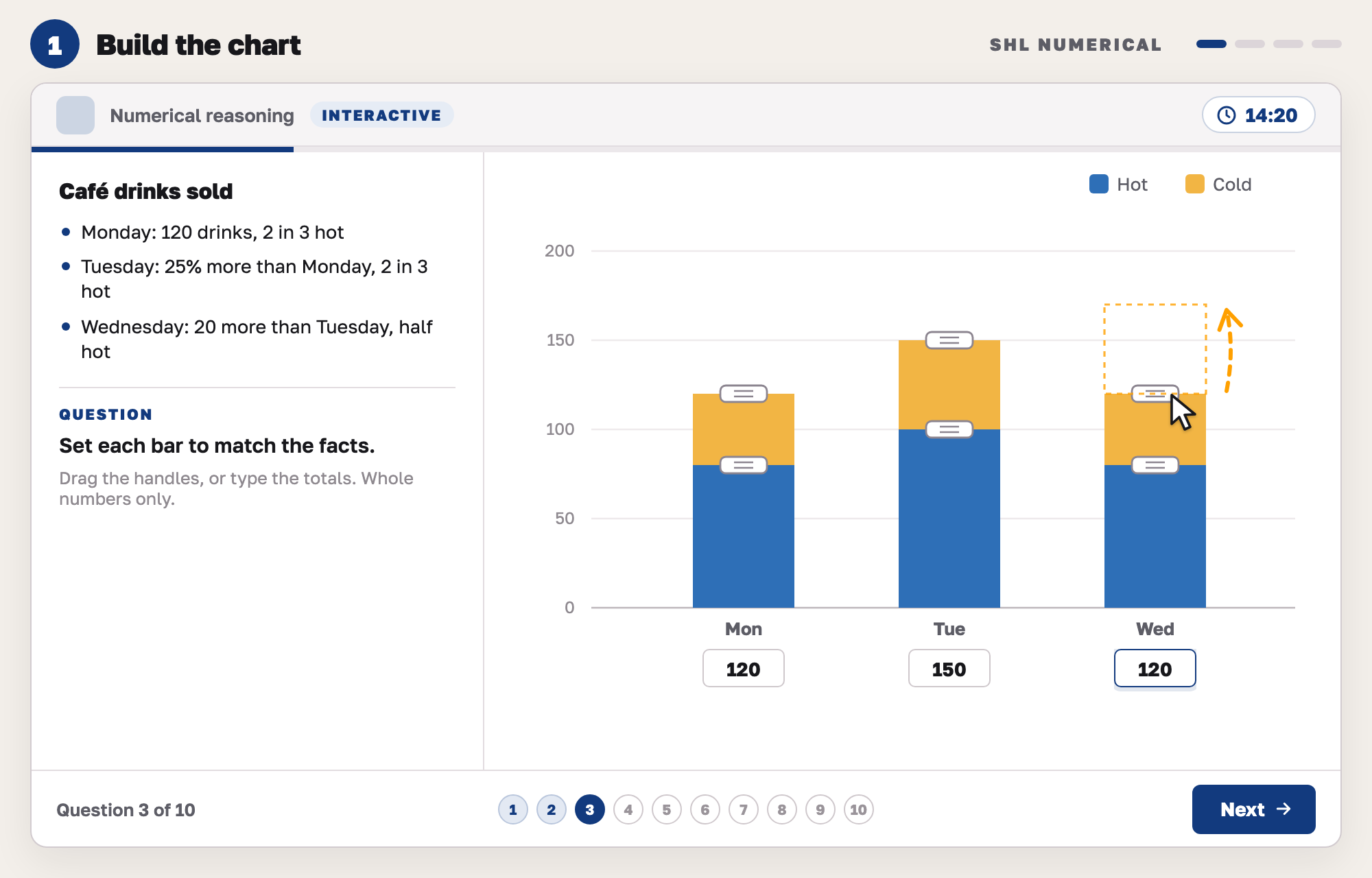
Build the chart
Read the facts on the left, then drag each bar to the right height or type the total under it. Employers set their own version, so yours may differ.
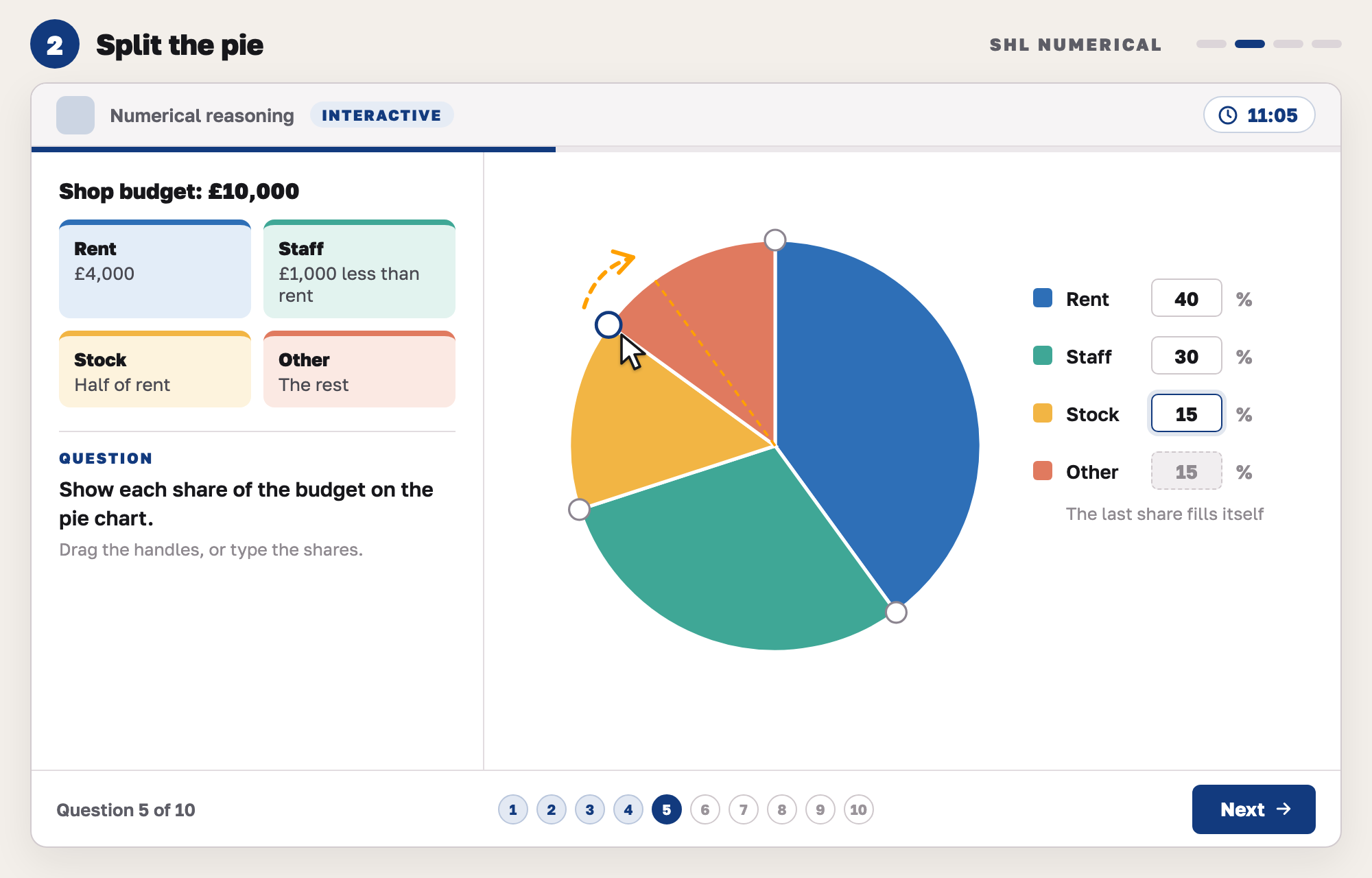
Split the pie
Work out each share of the budget, then drag the handles round the pie or type the percentages.
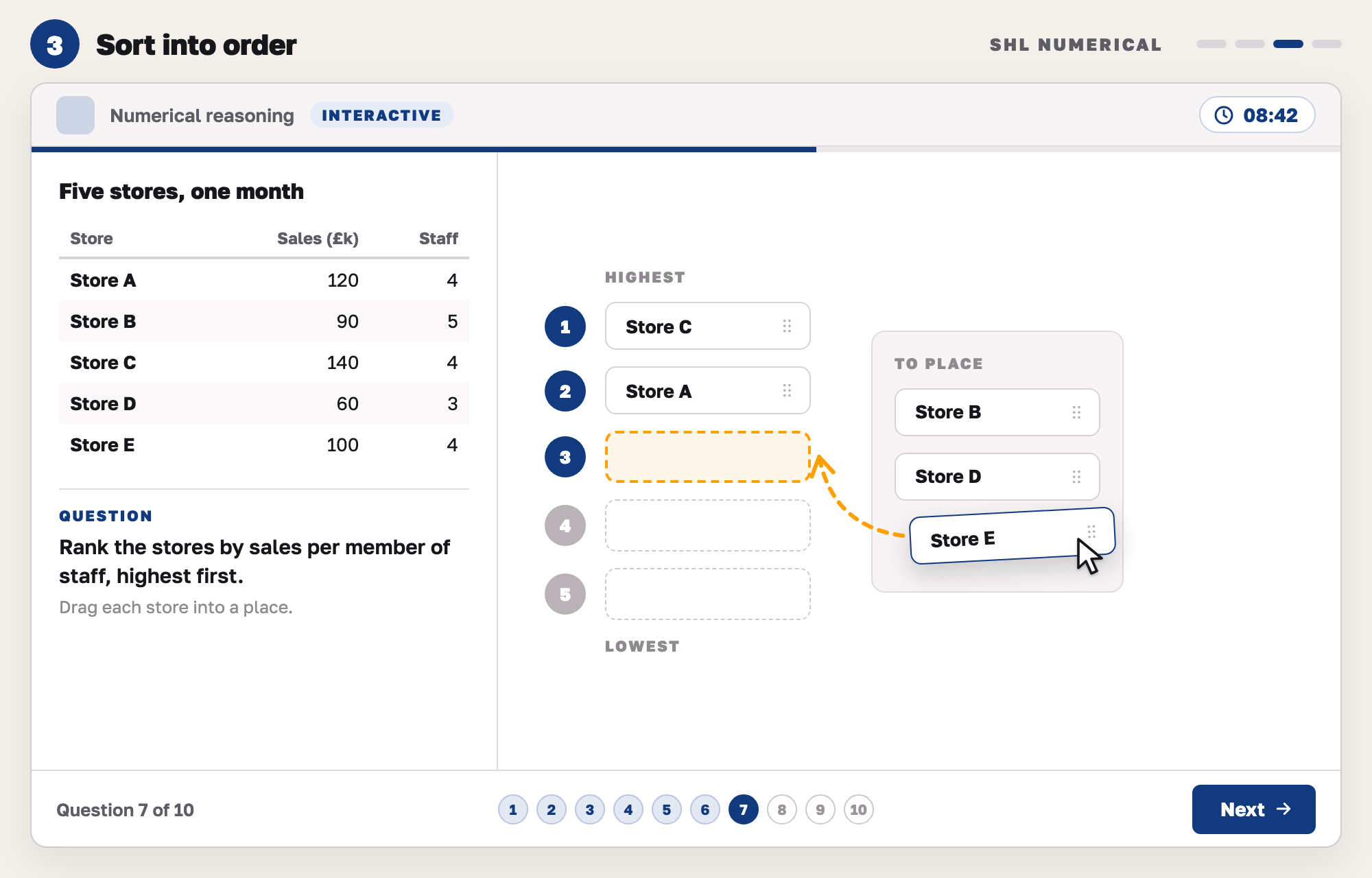
Sort into order
Work out a value for each row of the table, then drag the items into order from highest to lowest.
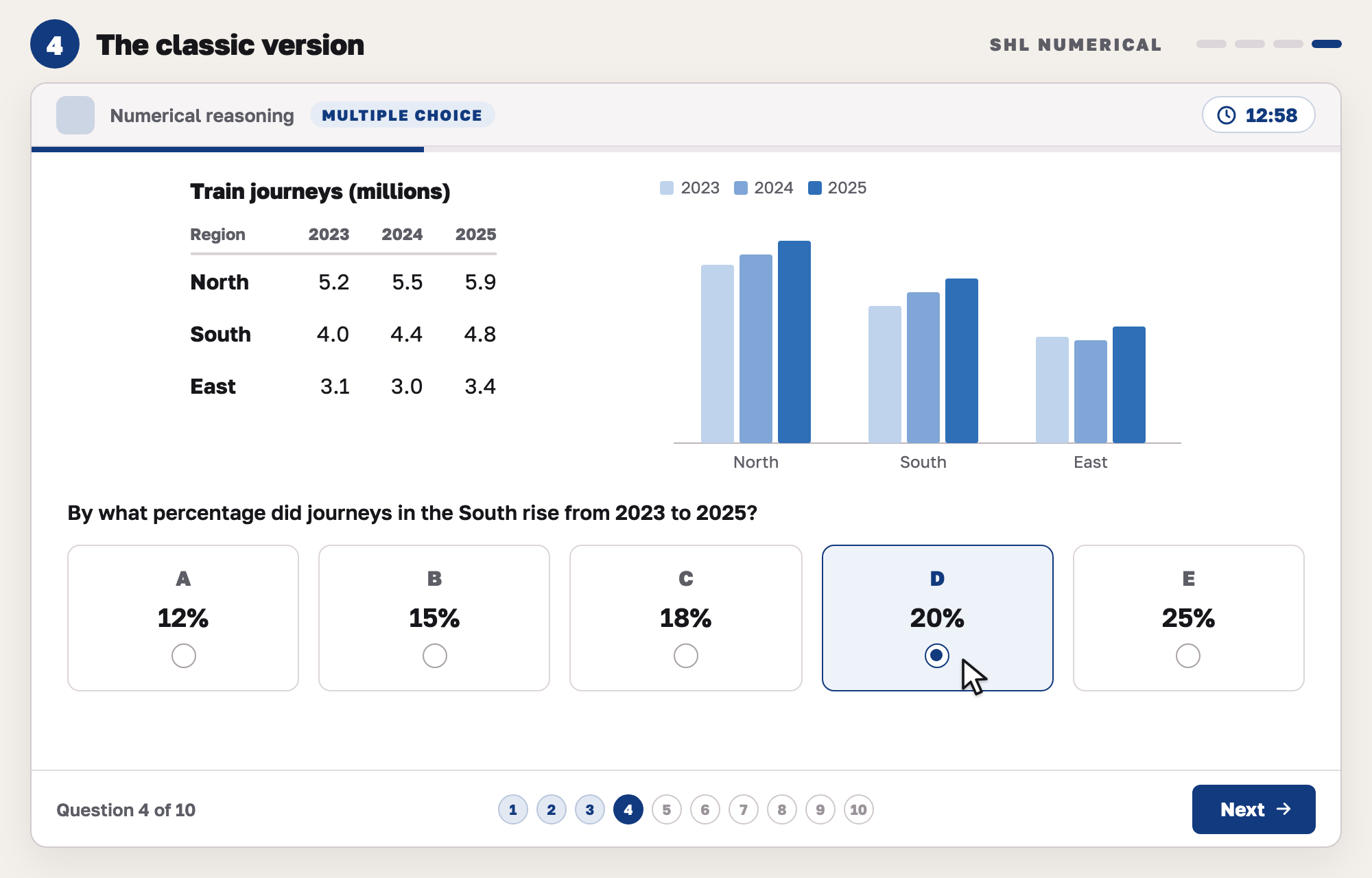
The classic version
SHL also offers a multiple-choice version. Read the table and chart, then pick one of five answers.
Your moves
- Drill percentage change, ratios and totals from tables.
- Keep paper and a pen for working, as PwC’s practice suggests.
Inductive: timed
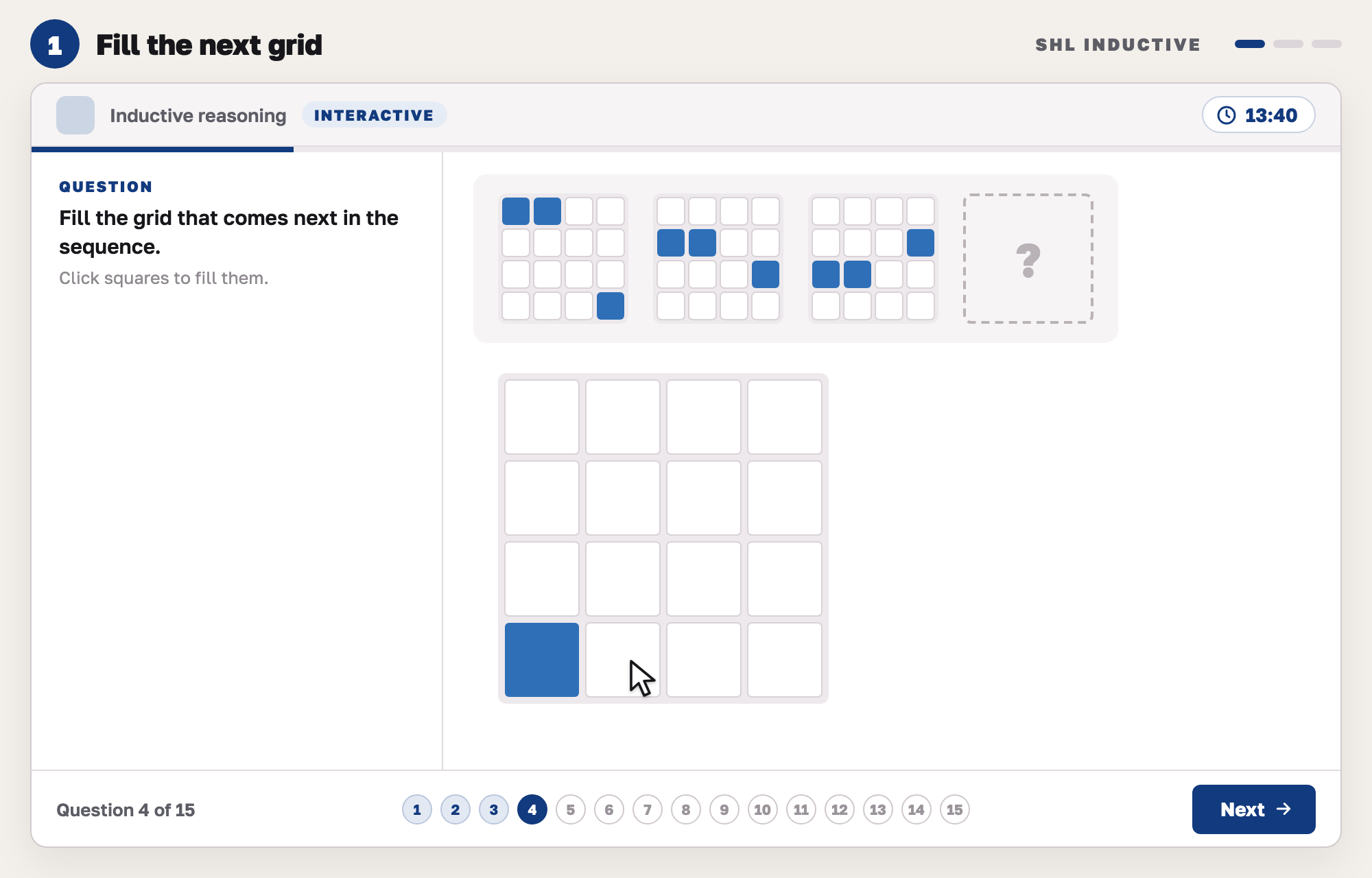
Fill the next grid
Spot how the pattern moves from grid to grid, then click squares in the big grid to draw the one that comes next. Employers set their own version, so yours may differ.
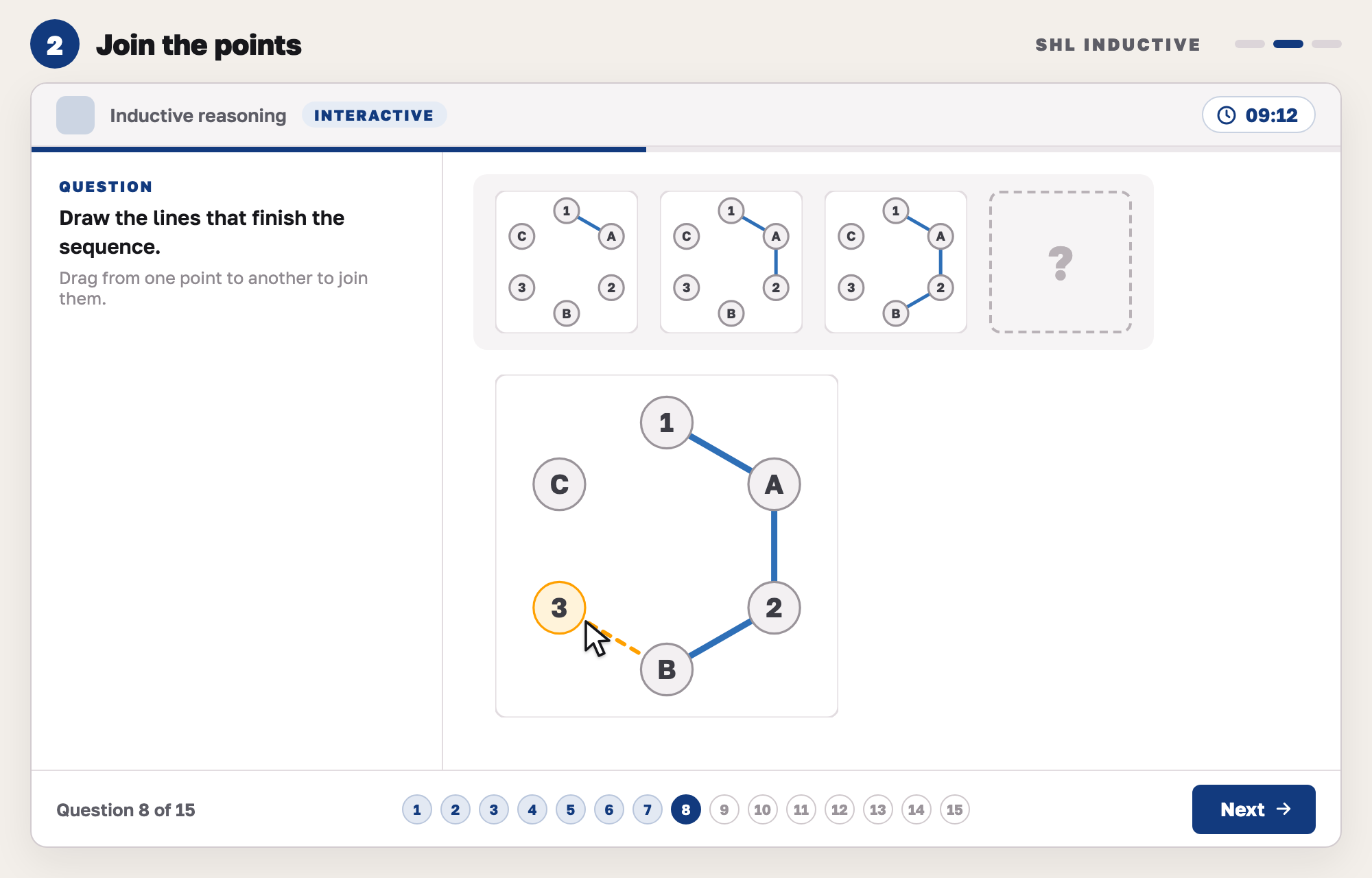
Join the points
Each step adds a line. Find the rule, then drag from point to point to draw the lines that finish the sequence.
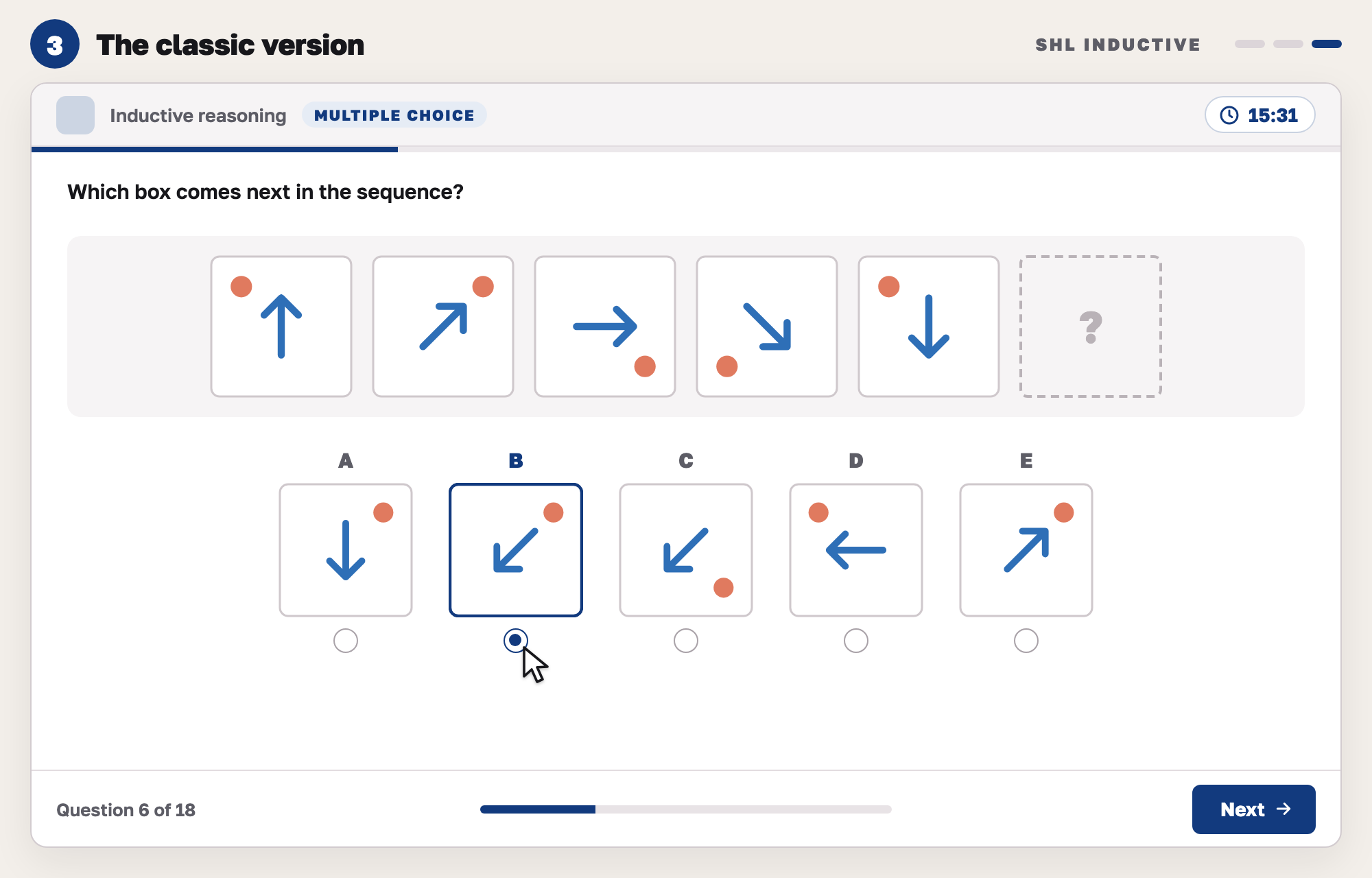
The classic version
In the multiple-choice version you see a row of figures and pick the one that comes next from five options.
Your moves
- Track one change at a time: shape, position, then count.
- Say the rule in words before you answer.
Deductive: timed
PwC publishes no deductive example. SHL’s sample gives you facts and asks which statement must be true.
Your moves
- Write each rule as a short note.
- Start with the item that has the most rules.
Our own simplified drawings of SHL’s screens, not screenshots. Numbers on them are examples. PwC’s version may differ.
For more on reasoning items, see our tips for psychometric tests.
The rules: allowed and banned
Allowed
- Practice tests sent with your invite
- Adjustments, if you ask when you apply
- A laptop or tablet, as PwC recommends
- A calculator in PwC’s practice. Check your invite for the real test.
Banned
- AI tools, unless PwC authorises them
- Help from anyone else
- Duplicate accounts
- Copied answers
From PwC’s selection page. PwC checks for “highly similar responses” and signs of AI-assisted support. It withdraws applications it flags.
Go further: the best outside help
Our own picks, checked on 15 October 2026. We are not linked to any of these sites and earn nothing from them.
From PwC
- PwC’s own guide to the online testsPwC Careers · up to 45 min · no account neededPwC’s practice questions for each test, with its own tips.Free
Practise
- SHL’s free practice testsSHL, the test maker · free SHL account neededThe test maker’s own practice. PwC links to it.Free
- SHL’s example questionsSHL · no account neededSee the formats before you sign up. Skip verbal and SJT.Free
Watch
- 15 SHL reasoning questions solved, step by stepAptitude-Test-Prep on YouTube · Mar 2025 · 54 min · the host is a JobTestPrep affiliateInteractive numerical, inductive and deductive items, worked through.Free
Skip leaked PwC questions and AI helpers. PwC checks for copied answers and AI help, and withdraws applications it flags.
Next: build your speed on numbers and logic with our guide to psychometric and logic tests.
06/10Stage 3 · Interviews
The video interview and assessment centre
Two stages: a recorded video interview, then a virtual assessment centre. Both test the six behaviours. PwC publishes no technical interview for any area.
Video interviewSHL, on demand
Questions on screen · Recorded · Reviewed by PwC
Assessment centreVirtual, immersive
Human and technical skills · Exercises not published
PwC says: “we do not use AI to assess candidate performance”.
PwC says the video questions “will focus on how you typically approach your work, for example at school, university or any prior work experience you may have”. It publishes no question counts, timings or assessment centre exercises.
How to answer: PwC’s STAR method
PwC’s interview guide recommends STAR. Build each story in four parts:
Situation
Set the scene in one or two lines.
Task
What you had to achieve.
Action
What you did, not the team.
Result
What changed, with a number.
Follow-ups to rehearse
What would you do differently?Which PwC behaviour does this show?Why this area of tech?
PwC’s tip: “you can use notes as prompts, but don’t read from them”. The follow-ups are ours.
See our guides on how to pass a job interview and the toughest interview questions.
Practise: one question at a time
Motivation questions
The first two come from PwC. The rest, and all answers, are ours.
Motivation
“Why do you want to join your preferred employer?”
PwC’s own practice question, with two minutes to answer
What they’re testing: a clear, specific reason.
Show a strong answer
- Give one reason about your area, one about PwC and one about you. Record it, then watch it back.
Why PwC
Why are you interested in joining PwC?
PwC says its final interview covers this
What they’re testing: that you researched PwC, not just the industry.
Show a strong answer
- Name something specific: a PwC behaviour that fits you, or a task from your area’s tab on PwC’s programme page.
Why your area
Why Cyber Security, EDSA or Financial Crime and Forensics?
What they’re testing: that you know what the work is.
Show a strong answer
- Name one task from PwC’s tab: “Identifying vulnerabilities”, mining client data, or “conducting investigations”.
- Link it to something you did, such as a project, a course or a club role.
No tech degree
Your degree is not in tech. Why this programme?
What they’re testing: “the desire to get into the details of how things work”.
Show a strong answer
- Show a time you dug into how a tool or system worked, on your own.
- Say what you learned and what you would like to learn next.
EDSA and CFAB
For EDSA: how will you handle CFAB alongside client work?
What they’re testing: commitment, and “a good appreciation of the professional qualifications aligned to your preferences”.
Show a strong answer
- Say what CFAB is: ICAEW’s six exams, in “12 months or less”. PwC says “Your CFAB studies are embedded in your learning and development programme”.
- Add a time you kept up hard study alongside other work.
Behaviour questions
These prompts and answers are ours, one per behaviour.
Inspire
Tell me about a time people chose to follow your lead.
What they’re testing: influence.
Show a strong answer
- A role you earned, how you earned it, and what the group achieved.
Empower
Tell me about a time you explained something technical to someone who found it hard.
What they’re testing: coaching.
Show a strong answer
- Who needed help, how you made it simple, and what they could do afterwards.
Evolve
Tell me about a time you learned a new tool or skill fast.
What they’re testing: whether you grow.
Show a strong answer
- Why you needed it, how you learned it, and what you did with it next.
Champion
Tell me about a time you raised a problem others had missed.
What they’re testing: quality and integrity.
Show a strong answer
- What you noticed, why it mattered, how you raised it, and what changed.
Build
Tell me about a time you made a process work better.
What they’re testing: a business mindset.
Show a strong answer
- The old way, your change, and the saving in time, money or errors.
Deliver
Tell me about a time you worked across groups to finish something.
What they’re testing: teamwork.
Show a strong answer
- Who was involved, how you kept them aligned, and what the end user got.
Your story bank: a worksheet to print or copy
Two STAR stories per behaviour, plus your area answers.
| Behaviour | Story 1 | Story 2 |
|---|---|---|
| Inspire | ||
| Empower | ||
| Evolve | ||
| Champion | ||
| Build | ||
| Deliver | ||
| Why your area, and CFAB if EDSA |
Go further: the best outside help
Our own picks, checked on 15 October 2026. We are not linked to any of these sites and earn nothing from them.
From PwC
- The six behaviours PwC scoresPwC Careers · no account neededMatch one story to each behaviour.Free
- PwC’s interview guide, with a 2-minute practicePwC Careers · no account neededFilm a two-minute answer, then review it with PwC’s checklist.Free
- PwC’s guide to assessment centresPwC Careers · no account neededCommon exercises and tips for a virtual centre.Free
- What each Tech and AI area doesPwC Careers · open your area’s tab · no account neededPick one task in your area, such as finding vulnerabilities or mining client data, and say why it interests you.Free
From ICAEW
- How the ICAEW exams workICAEW, the body that sets them · for EDSA applicants · no account neededEDSA roles may include CFAB. Its six exams are the first level of the ACA, set out here.Free
Watch
- PwC recruiters answer the top questionsPwC UK Careers on YouTube · Oct 2026 · 5 minAnswers on AI, one application, several business areas and practice tests.Free
07/10Stage 4 · Final
Matching and the final interview
The final interview is in person, with a senior leader from your matched business area.
Matching
After the assessment centre, PwC matches you to a business area and office, based on your results and preferences.
Recruiter call
You book a call with a recruiter. It includes a recap of your feedback so far.
Senior leader interview
In person, in your matched office. PwC wants to hear “why you are interested in joining PwC”.
Outcome
The PwC UK Careers team gives you feedback and the result. It could take up to a month.
Name one task from your matched area in your “why” answer. For EDSA, show you know what CFAB is.
Offer checks and start date
- Checks. Fit and Proper and Independence assessments, background and criminal record checks, and right to work. PwC also checks “your grades and job history”.
- No deferrals. PwC does not offer deferred starts.
Key dates: September 2027 intake
17 Sep 2026
PwC graduate roles opened
18 Sep 2026
Technology and AI office ads posted
15 October 2026
Ads open, no closing date. Apply now
This cycle
This year’s ads have closed
Your ad
Apply by the date on your ad
Each stage
Invite usually open 7 days
Each stage
Invite usually open 7 days
Sep 2027
Start date, in your matched office
08/10
Visa sponsorship
PwC does not sponsor visas for Technology and AI. All three ads we checked said so. You need your own right to work.
No
Sponsorship, on all 3 ads we checked
Not listed
On PwC’s October 2026 visa list
18 months
Graduate visa, if you apply from 2027
On a Graduate visa? PwC says your right to work must cover “the full duration of the position”. A Graduate visa you apply for from 1 January 2027 lasts 18 months, and you cannot extend it (GOV.UK). So ask PwC before you apply.
PwC’s immigration page, “correct as of October 2026”, leaves Technology and AI off its sponsored list.
See our guides to staying in the UK after studying and UK companies that sponsor visas. This is general information, so check GOV.UK.
09/10
Key takeaways
Before you apply
- Belfast, Birmingham and Leeds had public ads when we checked on 15 October 2026, with no closing date. So apply now.This year’s ads have closed. PwC filled roles on a rolling basis, with no closing date.Check your office’s ad for its closing date, and apply before it.
- You apply once for one office, then pick Cyber Security, EDSA or Financial Crime and Forensics.
- Cyber Security and Financial Crime and Forensics are “No PQ”. Some EDSA roles include CFAB.
- You need no tech degree, but some roles may need a STEM degree.
- The online tests run on SHL. PwC names no coding or technical test.
- Your “why” answer should name a real task from your area.
- PwC does not sponsor visas for Technology and AI.
When a scheme gives a close date, we email you a few days before it closes. Save PwC once and the reminder is set.
Set my reminders freeFree account, no card.

10/10
Frequently asked questions
Do I need a tech degree for the PwC Technology and AI graduate scheme?
No. PwC accepts any degree subject and says you don’t need an engineering or tech background. Some roles in each area may need a STEM degree, so check your office’s ad.
Which PwC offices hire Technology and AI graduates?
Belfast, Birmingham and Leeds had public ads for September 2027 when we checked on 15 October 2026. London and Manchester ads were not visible on PwC’s job site, so check it before you apply.PwC’s programme page names Belfast, Birmingham, Leeds, London and Manchester. This year’s ads had closed when we checked on 15 October 2026.PwC’s programme page names Belfast, Birmingham, Leeds, London and Manchester. Check PwC’s job site for each office’s ad.
Will I get a qualification in PwC Technology and AI?
Only in some Engineering, Data Science and Analytics roles, which include CFAB, ICAEW’s six-exam certificate. Your office’s ad says which. Cyber Security and Financial Crime and Forensics are No PQ, meaning no professional qualification.
Is there a coding test for PwC Technology and AI?
PwC names no coding or technical test. You take its usual SHL tests: a values activity, an untimed behavioural test and a timed reasoning test.
Does PwC sponsor visas for Technology and AI?
No. All three ads we checked said no sponsorship, and PwC’s October 2026 visa list leaves Technology and AI out. You need your own right to work for the whole programme.
When does the PwC Technology and AI graduate scheme close?
PwC publishes no closing date. It fills roles on a rolling basis, and they may close without warning. So apply as soon as you are ready.PwC published no closing date. It filled roles on a rolling basis. This year’s ads had closed when we checked on 15 October 2026.Check your office’s ad for its closing date. PwC may also close roles without warning.