 By Andre Atallah, CEO of EP Advisory

Graduate Development Programme · UK · 2027 intake
Not open yet · checked 18 October 2026Open · check the ad for the closeClosed for the 2027 intakeOpening date out · see the Bank’s pageStill a student? Other routes
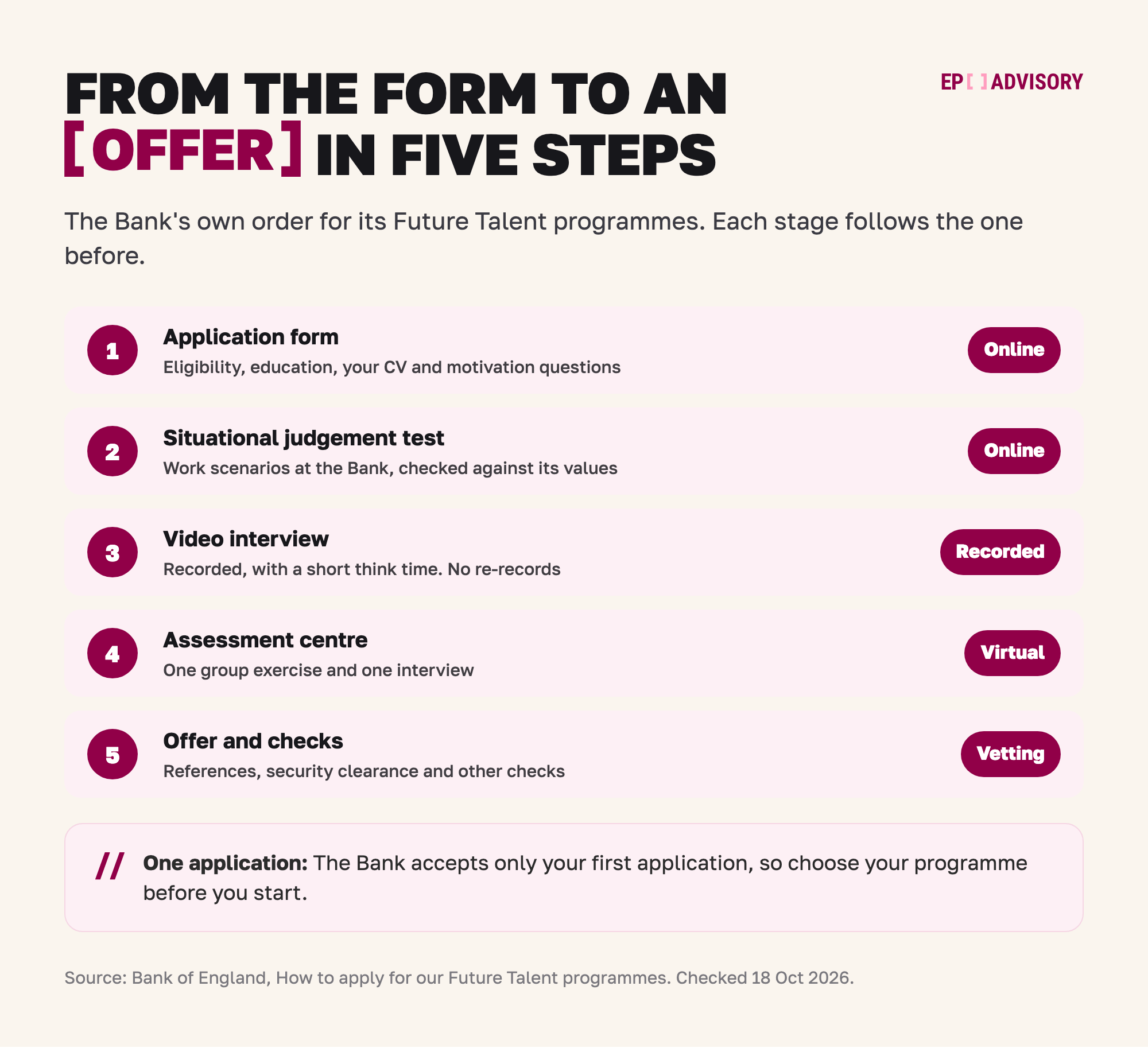
Short answer: Applications are not open yet. On 18 October 2026, the Bank invited you to register your interest for 2027. It gives no opening date.Applications for the 2027 intake were open when we checked on 18 October 2026. Check the Bank’s ad for the closing date.Applications for the 2027 intake had closed when we checked on 18 October 2026.The Bank has given an opening date for the 2027 intake. Check its graduate page. Last cycle’s ads went up on 26 January 2026. Register on the Bank’s free form now.Apply on the Bank’s early careers job board.Watch the Bank’s graduate page for the next round. The stages are an online form, a situational judgement test, a recorded video interview and a virtual assessment centre. The 2026 intake ad paid £33,525 in Leeds.
Where are you now?
Independent guide. EP Advisory is not affiliated with the Bank of England.
The Bank of England’s graduate programme is two years at the UK’s central bank. In the 2026 intake ad, it began with a foundation year and led “to a permanent position”.
This playbook gets you ready, then takes you through each of the Bank’s stages. For nearly 10 years, we’ve helped more than 5,000 professionals get hired. Want to know if your CV will pass screening in the UK? Check your CV for free: a score in 30 seconds, then a fix for each problem.
01/10
Your route to an offer
Applications are not open yet. The Bank had no graduate ad on 18 October 2026.Applications for the 2027 intake were open when we checked on 18 October 2026. Check the ad for the closing date.Applications for the 2027 intake had closed when we checked on 18 October 2026. Watch the Bank’s graduate page for the next round.The Bank has given an opening date for the 2027 intake. Check its graduate page.
The Bank’s graduate page, read on 18 October 2026, says: “Applications are closed, but you can register your interest for our 2027 opportunities.” Its Future Talent page says it will update its programme pages “in autumn 2026, ahead of the 2027 recruitment round”. The Bank gives no opening date.On 18 October 2026, the Bank’s graduate page said: “Applications are closed, but you can register your interest for our 2027 opportunities.” Its Future Talent page said it would update its programme pages “in autumn 2026, ahead of the 2027 recruitment round”.On 18 October 2026, the Bank’s graduate page said: “Applications are closed, but you can register your interest for our 2027 opportunities.” Its Future Talent page said it would update its programme pages “in autumn 2026, ahead of the 2027 recruitment round”.
Past windows, from the Bank’s own pages and ads
7 Oct 2024
2025 intake: the Bank’s page said applications were open
18 Nov 2024
2025 intake: closed at “12pm (midday) GMT on Monday 18 November”
26 Jan 2026
2026 intake: Data and Risk ads posted, both in Leeds
9 Feb 2026
2026 intake: both ads still live
15 Feb 2026
2026 intake: no graduate ads left on the board
2027 intake
Not open on 18 October 2026. No date givenOpen on 18 October 2026. Check the ad for the closeClosed when we checked on 18 October 2026Opening date given. See the Bank’s page
From the Bank’s 2025 intake page, its 2026 intake Data ad and its job board, all saved by the Wayback Machine. We did not find the exact day the 2026 ads closed. The window moved by over two months, so plan around neither.
Do this now
Register your interest on the Bank’s free form. The Bank links it from its graduate page.Apply on the Bank’s early careers job board. Check the ad for the closing date.Watch the Bank’s graduate page. It will show the next round.
Check the Bank’s two pages often. It says it will update them in autumn 2026.
Be ready before the window opens.Apply early.Be ready before the next window opens. Last cycle’s ads were gone within three weeks.
Register on the Bank’s register-interest form, linked from its graduate page. Ads appear on the Bank’s early careers job board. Last cycle they were titled “2026 Graduate Development Programme”.
Get ready now
Six things to finish before the ads go up. Each comes from the Bank’s own pages.
Check the entry rules
The 2026 intake asked for a 2.1, achieved or predicted, and 120 UCAS points from three A levels or equivalent.
Update your CV
The form asks you to upload it. Put your results and your skills with data near the top.
Draft your motivation
The form’s free-text questions ask you to “tell us about you and your motivations”.
Two stories per Bank Behaviour
Act inclusively, Drive growth and Deliver outcomes. Build each story with the Bank’s STARR method.
Read the Bank’s explainers
Short guides to what the Bank does. They feed your motivation and analytical answers.
Practise recorded answers
The video interview has a time limit per answer and “You will not be able to re-record.”
Pick your stage and tick each step when done. Stages are from the Bank’s pages, checked 18 October 2026. Prep times are ours.
1. Get ready and apply: not open yetopen, see the adclosed this yearsee the Bank’s page
One online form with your CV and motivation answers. Prep 1 to 2 weeks.
2. Judgement test: online, work scenarios
Scenarios from working life at the Bank, checked against its values. Prep 2 to 3 days.
3. Video interview: recorded, no re-records
Recorded answers to set questions, each with a time limit. Prep 3 to 5 days.
4. Assessment centre: group exercise and interview
A virtual day with one group exercise and one interview. Prep about 1 week.
Your ticks save on this device.
02/10
The programme at a glance
A two-year programme with a foundation year and a permanent role at the end. Most detail comes from the 2026 intake. The Bank has not published 2027 terms.
Not openOpenClosedCheck
2027 intake, checked 18 October 20262027 intake, checked 18 October 20262027 intake, checked 18 October 2026The Bank’s page has the date
24 months
Length in the 2026 intake ad
£33,525
Pay in the 2026 intake ad, Leeds
50%
Of your time in the office
26 days
Annual leave
Master’s
In year two, per the 2026 intake ad
2026 intake: Data stream, Leeds
Skills named: “data analysis and visualisation (e.g. Python, R, Excel)”.
2026 intake: Risk stream, Leeds
Skills named: “coding in R and Python” and “strong analytical and numerical skills”.
Where these facts come from
- Streams today. The Bank’s graduate page says only “With a variety of streams to choose from”. The 2027 streams and offices are not published yet.
- Last cycle. The 2026 intake page said “we will only be opening applications for Leeds based graduate roles for the 2026 recruitment round”. The start was “early September 2026”.
- Structure, 2026 intake. “In your first 12 months, you will take part in a foundation year covering the Bank’s breadth of work. In your second year, you will have the opportunity to study for a masters in Global Central Banking and Financial Regulation with Warwick Business School.”
- Pay. The 2026 intake ad paid “£33,525 per annum”, in Leeds. The 2025 intake paid “London £36,500 and Leeds £32,750”. No 2027 figure is published. Compare salaries in the UK.
- Benefits and office time. The Bank’s benefits page, updated 8 October 2026, lists “a discretionary, non-pensionable cash award” and “a defined-benefit, non-contributory career average pension”. It says “We require for all colleagues to spend 50% of their time in the office”.
03/10
What the Bank of England looks for
The Bank names three Bank Behaviours. Its judgement test “helps us understand how closely you align with our values”.
Act inclusively
“earn trust and gain the confidence of others through consistent honesty, integrity, and authenticity”
Drive growth
“have the courage to overcome fear and to do what is right” and “demonstrate self-awareness through reflection and feedback”
Deliver outcomes
“we focus on what matters most”, including “responding to change”
Keen to learn
The graduate page wants people “keen to learn about what we do and gain practical experience”
Curious about central banking
“eager to gain a unique insight into the workings of the UK’s central bank”
A career at the Bank
“looking to build your network and pursue a career at the Bank of England”
The Behaviours are from the Bank’s how to apply page. The last three rows are from its graduate page, read on 18 October 2026. The 2026 intake asked for “a 2.1 degree classification” and “120 UCAS points from three A levels (or equivalent)”. The Bank says it will update its entry criteria in autumn 2026.
04/10Stage 1 · Apply
How to apply
Applications were not open on 18 October 2026. When they open, you apply with one online form.Applications were open when we checked on 18 October 2026. You apply with one online form.Applications had closed when we checked on 18 October 2026. Each round uses one online form.
1
Register
Then an eligibility check
2
Your background
Education and work experience
3
Upload your CV
Used for eligibility checks
4
Free-text answers
You and your motivations
The one-application rule, mandatory answers and support
- One application. “We do not accept more than one application per candidate.” The Bank adds “Please apply for the one most relevant to you” and “We will only accept your first application.”
- Your answers count later too. “We will consider your answers throughout the process”.
- Mandatory answers. The 2026 intake ad said “Your application will not be considered if all mandatory questions are not fully completed.” It asked for the CV “for eligibility checks”.
- Qualifications from abroad. The Bank links the UCAS tariff calculator to convert them into UCAS points.
- Disability Confident. The Bank fast-tracks those who apply through the scheme and meet the minimum requirements to the video interview.
Your form and CV: do and don’t
Do
“I built a model in R for my dissertation and want to test it against real supervision data”
Tie your motivation to the Bank’s work and to something you have done. The Bank says “Focus on real-life experiences.”
Don’t
“I am passionate about joining a prestigious institution”
It could fit any employer. The Bank says “Avoid copying and pasting an AI-generated response”.
The Bank lets you use AI to research it and to proofread your form. It asks you to use your own words when you describe your experiences. Our CV achievement examples show how to give each line a result. Getting ready to apply for jobs in the UK? Check your CV for free: see it the way a recruiter does, then fix each problem.
Save Bank of England and over 2,000 other UK schemes to one free calendar. See what closes next and what you have applied to.
Track my schemes freeFree account, no card.
Still a student, or already working? Other Bank routes
- Summer internships. For students in their penultimate or final year (internships page).
- Black Heritage Sponsored Internship. For penultimate-year students, with “funding of at least £5,000 towards living costs”.
- Industrial placement. A 13-month placement during your degree (placements page). Its Economist and Data streams add an online Excel test.
- Status. When we read them on 18 October 2026, each page invited you to register interest for 2027.Each page gives its own dates, so check it.Each page gives its own dates, so check it.Each page gives its own dates, so check it. Last cycle’s internships closed on “Monday 1 December 2025 at 12pm (midday)”.
- Already working? The Bank’s main job board lists experienced roles in London and Leeds.
05/10Stage 2 · Judgement test
The situational judgement test
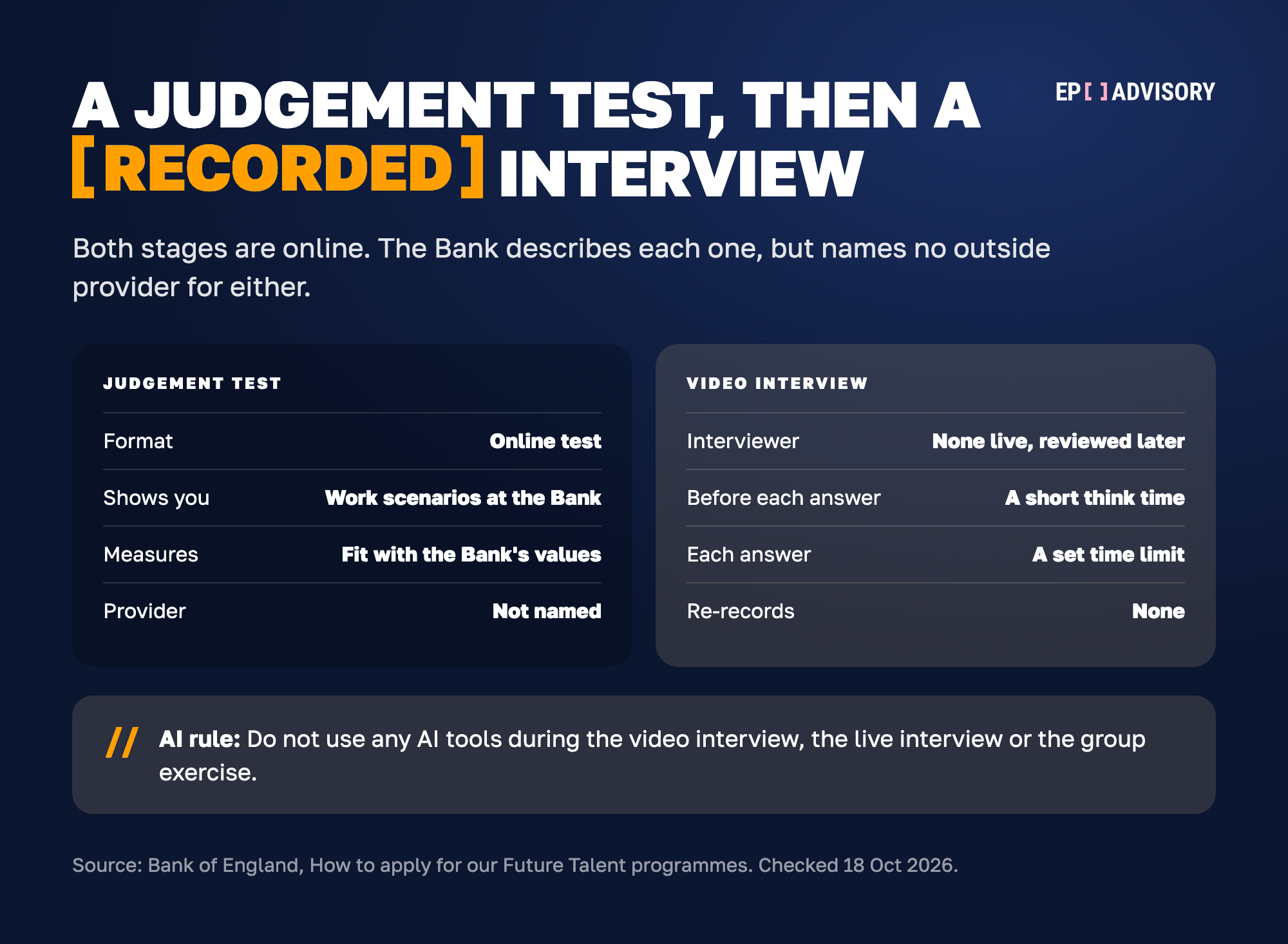
The online test is a situational judgement test. It is the first stage after the form.
Online
Taken after the form
Not named
No provider given by the Bank
Not published
Length and number of questions
“We will give you scenarios that reflect working life at the Bank of England and use this to gauge what you think you would do in certain situations. It helps us understand how closely you align with our values.” (how to apply page)
How to prepare for the judgement test
The test checks your fit with the Bank’s values, so learn them first. The Bank offers no practice test.
Know the three Behaviours
Act inclusively, Drive growth and Deliver outcomes. Read the Bank’s own lines on each.
Answer as you would act
The Bank wants “what you think you would do”. Pick the choice you would really make at work.
Ask for adjustments early
The Bank asks you to tell it “in advance” about any adjustments you need.
There is no numerical or verbal test for graduates. The Bank’s Excel test is only for two industrial placement streams.
The AI rules: allowed and banned
Allowed
- AI to research the Bank before you apply
- AI to proofread your CV and form
- AI to improve structure and word choice
- AI mock interviews to practise
Banned
- Copying and pasting an AI answer
- AI tools during the video interview
- AI tools in the live interview
- AI tools in the group exercise
From the Bank’s 11 points on AI, on its how to apply page. It says “We want you to be as present as possible.”
Go further: the best outside help
Our own picks, checked on 18 October 2026. We are not linked to any of these sites and earn nothing from them.
From the employer
- How to apply for our Future Talent programmesBank of England careers · updated Dec 2025 · no account neededThe Bank’s own words on the judgement test: work scenarios, checked against its values.Free
- Application tips and Bank BehavioursBank of England careers · updated Nov 2025 · no account neededThe three Bank Behaviours the test and interviews look for. Written for all Bank hiring, not only graduates.Free
Read
- Psychometric testsProspects (Jisc) · updated Sep 2026 · no account neededHow situational judgement tests work and how to approach them.Free
Skip paid “Bank of England test” packs. The Bank names no test provider and publishes no practice test, so any pack is guessing.
Next: see how other employers use judgement, reasoning and personality tests in our guide to psychometric and logic tests.
06/10Stage 3 · Video interview
The video interview and how to answer
The video interview is recorded, with no live interviewer. You cannot re-record an answer.
“We won’t be behind the camera in real time, so each response will be recorded and reviewed later.” “After each question, you will have a short period to think about your response before the recording starts.” “All questions have a set time limit”. The Bank names no platform, and no question count is published.
How to answer: the Bank’s STARR method
The Bank says “At the Bank, we use the STARR (situation, task, action, result, reflection) interview method.” Use it in the video interview and at the assessment centre.
S
Situation
T
Task
A
Action
R
Result
R
Reflection
What you learned
Be ready to talk about
Why the BankWhy this programmeA story for each BehaviourHow you work with numbers
The Bank warns that “Perfectly scripted and impersonal video interviews will not get you as far as genuine examples of your thought processes.” See also our guides on how to pass a job interview and the toughest interview questions.
Practise: questions on the Bank’s themes
Motivation questions
Our own practice questions. The Bank publishes none for graduates. It says its interviewers ask “motivation, behaviour-based and analytical/technical questions”, so there is one tab for each.
Why the Bank
Why do you want to work at the Bank of England?
What they’re testing: whether you are “eager to gain a unique insight into the workings of the UK’s central bank”.
Show a strong answer
- Name one part of the Bank’s work you have read about, such as an explainer.
- Link it to something you studied or did.
- Say what you want to learn there.
The mission
What does the Bank’s mission mean to you?
What they’re testing: the 2026 intake ad’s line, “Our mission is to promote the good of the people of the UK by maintaining monetary and financial stability.”
Show a strong answer
- Put the mission in your own words.
- Give one way it touches ordinary people, such as prices or safe banks.
- Say where you could help.
The programme
Why a graduate programme here, rather than a job in the private sector?
What they’re testing: whether you are “keen to learn about what we do and gain practical experience”.
Show a strong answer
- Point to the foundation year and the breadth of work it covers.
- Be honest about what draws you to public service.
- Avoid running down other employers.
Your future
Where do you see yourself after the two years?
What they’re testing: whether you want to “pursue a career at the Bank of England”.
Show a strong answer
- Name an area of the Bank you would like to grow into.
- Say which skills you want to build first.
- Keep it open, as the Bank allocates you after the foundation year.
Behaviour questions
Our own questions on the Bank Behaviours. Answer each with STARR.
Act inclusively
Tell us about a time you earned someone’s trust.
What they’re testing: that you “earn trust and gain the confidence of others through consistent honesty, integrity, and authenticity”.
Show a strong answer
- A person who did not trust you at first.
- What you did, again and again, to change that.
- Reflection: what you would keep doing.
Drive growth
Tell us about a time you did the right thing when it was hard.
What they’re testing: “the courage to overcome fear and to do what is right”.
Show a strong answer
- What made it hard, such as speaking up to someone senior.
- What you said or did.
- What happened, and what you learned.
Drive growth
Tell us about feedback that changed how you work.
What they’re testing: that you “demonstrate self-awareness through reflection and feedback”.
Show a strong answer
- Real feedback, including some that stung.
- The change you made.
- Proof the change stuck.
Deliver outcomes
Tell us about a time you had to choose what mattered most.
What they’re testing: “we focus on what matters most”.
Show a strong answer
- Too many tasks, too little time.
- How you decided what came first, and what you dropped.
- The result, and what you would do differently.
Analytical questions
Our own questions. The skills quoted are from the 2026 intake streams.
Data
Talk us through a dataset you analysed. What did you find?
What they’re testing: “data analysis and visualisation (e.g. Python, R, Excel)”, from the 2026 Data stream.
Show a strong answer
- The question you were trying to answer.
- The tool you used and one choice you made.
- The finding, in one plain sentence.
Numbers
A number in a report looks wrong. What do you do?
What they’re testing: “strong analytical and numerical skills”, from the 2026 Risk stream.
Show a strong answer
- Check the source and the units first.
- Rebuild the number another way.
- Flag it clearly, with what you checked.
Explain it
Explain one thing the Bank does to someone with no economics background.
What they’re testing: the “analytical/technical questions” the Bank says its interviewers ask.
Show a strong answer
- Pick one topic from the Bank’s explainers.
- Say what the Bank does and who it affects.
- Use one everyday example, and keep it under two minutes.
In the news
Pick a recent economic news story. What could it mean for the Bank?
What they’re testing: your “insight into the workings of the UK’s central bank”.
Show a strong answer
- One story, in two sentences.
- Which part of the Bank’s work it touches.
- One question you would want answered.
Your story bank: a worksheet to print or copy
Two STARR stories for each Bank Behaviour, plus your motivation and an analytical example.
| Theme | Story 1 | Story 2 |
|---|---|---|
| Act inclusively | ||
| Drive growth | ||
| Deliver outcomes | ||
| Why the Bank | ||
| An analytical problem |
Go further: the best outside help
Our own picks, checked on 18 October 2026. We are not linked to any of these sites and earn nothing from them.
From the employer
- Video interview, assessment centre and AI rulesBank of England careers · updated Dec 2025 · no account neededNo re-records, STARR answers, and no AI tools during interviews or the group exercise.Free
- Bank of England explainersBank of England · no account neededShort guides to what the Bank does. Use them for motivation and analytical questions.Free
Read
- Video interview tipsProspects (Jisc) · updated Mar 2026 · no account neededHow to handle recorded questions with a short think time, which is the Bank’s format.Free
- Competency-based interviewsProspects (Jisc) · updated Sep 2026 · no account neededBuilds answers with STARR, the method the Bank says it uses.Free
- Assessment centresProspects (Jisc) · updated Sep 2026 · no account neededWhat to expect from a group exercise and a final interview.Free
07/10Stage 4 · Final
The assessment centre and your offer
The final stage is a virtual assessment centre. The Bank says it has “one group exercise and one interview”.
The invite
“We will notify successful applicants two weeks after the application deadline and they will move on to the final stage”.
One group exercise
Online, with other candidates. The task and length are not published. Listen, build on others and help the group finish.
One interview
“The interviewers will ask motivation, behaviour-based and analytical/technical questions.”
No AI tools
The ban covers the live interview and the group exercise. A “human assessor” reviews you.
From the Bank’s how to apply page, read on 18 October 2026. No hear-back time after the assessment centre is published.
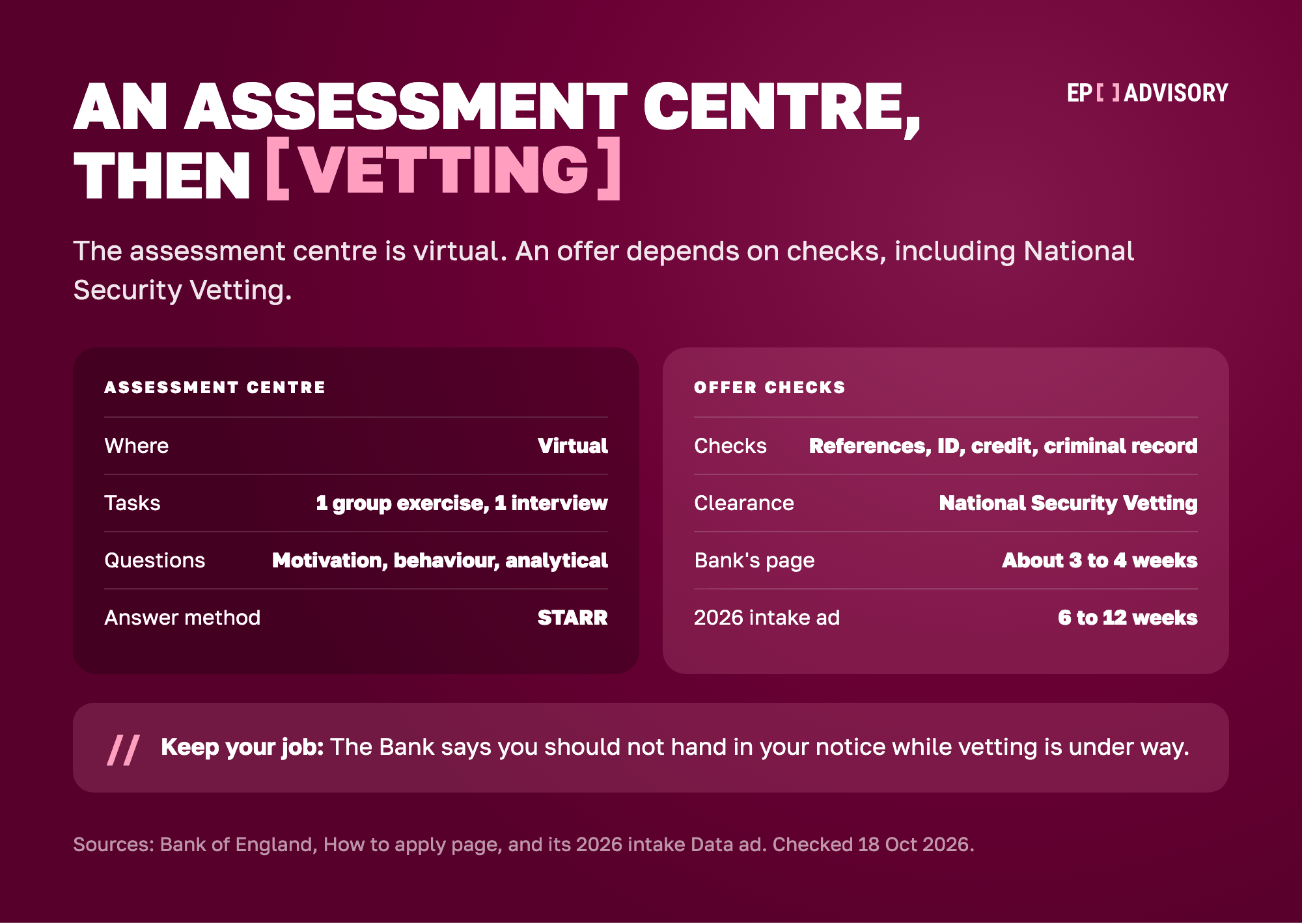
Offer checks and vetting
Plan for vetting to take up to 12 weeks. The Bank’s page says about 3 to 4 weeks, “but can take much longer”. The 2026 intake ad said “typically can take between 6 to 12 weeks post offer”.
What your offer depends on
- Checks. References, security clearance, identity checks, criminal record checks, credit checks, proof of qualifications and immigration clearance where relevant. You also complete a medical questionnaire.
- National Security Vetting. Required “for all staff joining the Bank”. During vetting, “you should not hand in your notice to your employer.”
- If clearance fails. “If security clearance is not granted, we will have to retract our offer.”
- Time abroad. If you lived outside the UK in the last five years, the Bank runs overseas checks. “There are certain countries where it is not possible for the Bank to complete the necessary checks. In these situations, the Bank will be unable to employ you.”
08/10
Visa sponsorship
Our reading: sponsorship is case by case, so ask before you rely on it. If you need a visa, ask the Bank before you apply.
The Bank’s how to apply page says: “For our graduate programmes, the Bank may be able to offer visa sponsorship in specific circumstances. We will assess eligibility on a case-by-case basis, taking individual circumstances into consideration.” It adds: “should we offer sponsorship, the cost of the skilled worker visa application and the immigration health surcharge (IHS) will be payable by the applicant and the Bank will not reimburse this.”
The Graduate visa and time abroad
- Graduate visa. It lasts “2 years if you apply on or before 31 December 2026” and “18 months if you apply on or after 1 January 2027” (GOV.UK). The programme ran 24 months in the 2026 intake.
Need sponsorship? See our guides to UK companies that sponsor visas and staying in the UK after studying. This is general information, so check GOV.UK.
09/10
Key takeaways
Before you apply
- Applications were not open on 18 October 2026. Register your interest on the Bank’s free form now.Applications were open when we checked on 18 October 2026. Check the ad for the closing date.Applications had closed when we checked on 18 October 2026. Watch the Bank’s page for the next round.
- The window moves, so be ready early. Last cycle’s ads went up on 26 January 2026.
- The Bank accepts only your first application, so pick one programme.
- The stages are a form, a judgement test, a recorded video interview and a virtual assessment centre.
- Use no AI tools during the video interview, the live interview or the group exercise.
- Vetting can take 6 to 12 weeks, so do not hand in your notice early.
When a scheme gives a close date, we email you a few days before it closes. Save Bank of England once and the reminder is set.
Set my reminders freeFree account, no card.

10/10
Frequently asked questions
Is the Bank of England graduate programme open now?
Not yet. On 18 October 2026, the Bank’s graduate page invited you to register your interest for its 2027 opportunities. The Bank gives no opening date. Register on its free form and get ready now.Applications for the 2027 intake were open when we checked on 18 October 2026. Check the Bank’s ad for the closing date, and apply early.Applications for the 2027 intake had closed when we checked on 18 October 2026. Watch the Bank’s graduate page for the next round.Not yet. The Bank has given an opening date for the 2027 intake. Check its graduate page and get ready now.
When does the Bank of England graduate programme open?
The Bank gives no date, and the window has moved.It was open when we checked on 18 October 2026. The window has moved before.It had closed when we checked on 18 October 2026. The window has moved before.The Bank has given a date on its graduate page. The window has moved before. The 2025 intake closed at midday on 18 November 2024. The 2026 intake ads went up on 26 January 2026 and were gone by 15 February 2026.
What are the Bank of England graduate entry requirements?
For the 2026 intake, the Bank asked for a 2.1 degree, achieved or predicted, and 120 UCAS points from three A levels or equivalent. The Bank says it will update its entry criteria in autumn 2026.
How much does the Bank of England graduate programme pay?
The 2026 intake ad paid £33,525 a year in Leeds. The 2025 intake paid £36,500 in London and £32,750 in Leeds. No 2027 figure is published yet.
What are the Bank of England graduate assessment stages?
An online form, a situational judgement test, a recorded video interview, then a virtual assessment centre with one group exercise and one interview. The Bank says the process is the same for apprentices, interns, placement students and graduates.
Can I use AI in my Bank of England application?
For research and proofreading, yes. The Bank says to avoid copying and pasting an AI answer. You must not use any AI tools during the video interview, the live interview or the group exercise.
Does the Bank of England sponsor visas for graduates?
The Bank says it may be able to offer visa sponsorship in specific circumstances, case by case. If it does, you pay the visa application and the health surcharge. Ask the Bank before you rely on it.