 By Andre Atallah, CEO of EP Advisory

Short answer: yes. An American nurse can work in the UK after joining the Nursing and Midwifery Council (NMC) register. You apply online, pass a computer test (the CBT) and a practical exam in the UK (the OSCE), and pay £1,226 in NMC fees. An NHS employer can then sponsor your Health and Care Worker visa. It costs £324 to £628 and has no health surcharge. Band 5 pay in England starts at £32,073 a year gross.
Can an American nurse work in the UK? Yes. The NMC and GOV.UK publish every step. This guide is for US registered nurses (RNs) who want to work in the UK, mostly in the National Health Service (NHS). It also covers nurse practitioners.
You get the NMC steps in order, every fee in pounds and dollars, the visa rules for nurses and what NHS pay bands mean after US pay. The facts link to the NMC, GOV.UK, NHS Employers and the US Bureau of Labor Statistics. All figures were checked on 3 November 2026.
For nearly 10 years, we’ve helped more than 5,000 professionals find jobs abroad. Want to know if your CV will pass screening in the UK? Check your CV for free: a score in 30 seconds, then a fix for each problem.
Can an American nurse work in the UK? Yes, once you are on the NMC register
To work as a nurse in the UK, you need two things: NMC registration and a visa.
The NMC is the UK regulator for nurses and midwives. It plays the role of your state board of nursing, but for the whole UK. One registration covers England, Scotland, Wales and Northern Ireland. There is no compact licence or state-by-state system.
When you join the register, the NMC gives you a PIN. That is your UK registration number. Employers check it before you work as a registered nurse.
The visa is the second part. Most US nurses come on the Health and Care Worker visa. An NHS trust or another approved health employer sponsors it. An NHS trust is a public body that runs one or more hospitals or community services. It is the UK version of a hospital system.
The good news for Americans:
- The US counts as English-speaking. Most US-trained nurses can skip an English test. The English section shows how.
- You can usually take the CBT near home. Pearson runs it at test centres in most countries around the world.
- No health surcharge. Health and Care Worker visa holders and their families do not pay the Immigration Health Surcharge, the yearly fee most migrants pay to use the NHS.
- Employers recruit abroad. Many NHS trusts hire nurses from overseas, and some help with OSCE preparation.
This page covers nurses only. For the wider UK job hunt, see our guide on how to get a job in the UK as an American. For every visa route, see UK work visas for Americans.
Does a US nursing degree and RN licence meet NMC standards?
The NMC asks one main question: did your qualification let you register as a nurse where you trained?
In the NMC’s words: “We need to know that your qualification will or has allowed you to register in the country you trained in. We’ll contact your regulator to confirm this.” For a US nurse, the regulator is your state board of nursing. The registration exam is the NCLEX-RN.
The NMC also says that if your regulator cannot confirm this, “for example if you have not completed a registration examination, we may not be able to accept your eligibility application.” So a US nurse who passed the NCLEX and holds an RN licence meets the starting point. Read the full rule on the NMC qualification and registration page.
BSN or ADN?
The NMC’s overseas pages do not set a degree level. They do not mention a Bachelor of Science in Nursing (BSN) or an Associate Degree in Nursing (ADN) by name. The NMC looks at your qualification and your registration in your eligibility application. It then tells you whether you can go on to the test of competence.
What this means for you:
- Have both documents ready. You need your nursing transcript and your current RN licence details. The transcript should show your clinical and theory hours.
- Keep your US licence active. The NMC confirms your registration with your board. The no-test English route through practice also needs registered practice within the last two years.
- Let the NMC decide on your degree. The eligibility check costs £167. The NMC aims to answer within 14 days of hearing back from your board. That is cheaper and faster than guessing.
Which field you register in
The UK registers nurses in fields. The main ones are adult, mental health, learning disabilities and children’s nursing. Midwifery is separate. The NMC says your qualification “doesn’t need to be specific to the field of nursing you are applying to, but you’ll need to complete the specific test of competence for the field you choose.” If you nursed adult patients in the US, the adult field is the closest match.
Is there a minimum amount of experience?
The NMC’s eligibility pages set no minimum period of work after you qualify. Employers can set their own experience rules, so read each job ad. If you want to use the practice route for English, you need at least one year of registered practice within the last two years.
Nurse practitioners and advanced roles
The UK has no separate NMC register for nurse practitioners yet. A US nurse practitioner (NP) joins the register as a nurse. The NMC is reviewing advanced practice. It plans to start work on advanced practice standards in spring 2027, with a public consultation. NHS employers do hire advanced practitioners. They set those roles and their entry rules themselves. So an NP registers as a nurse first, then applies for advanced roles with UK employers.
How to become a nurse in the UK from the US: the NMC steps
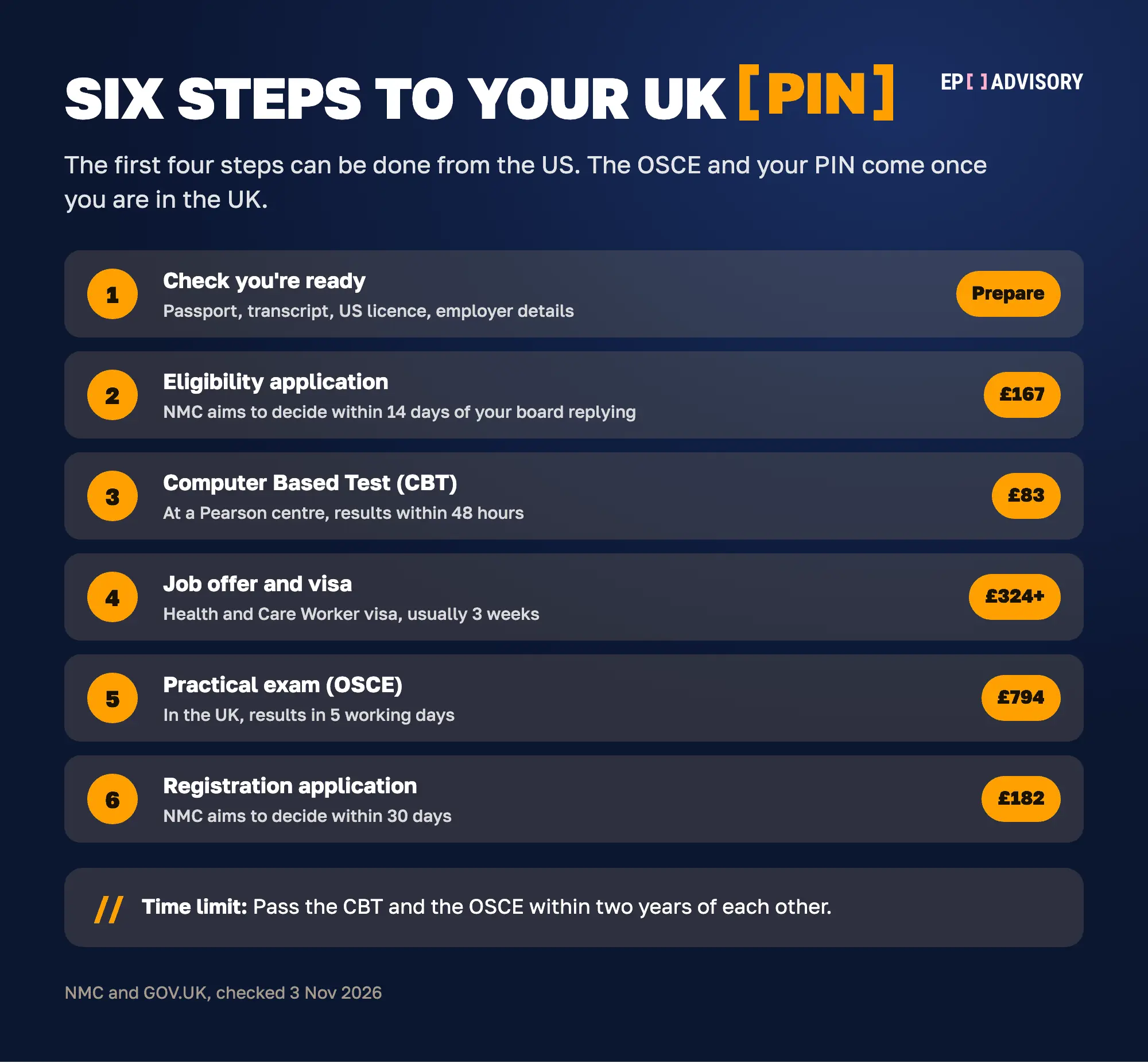
The NMC route has four stages. Below they are split into six practical steps, and you can do the first four from the US.
The steps below follow the NMC’s own step-by-step guide for nurses trained outside the UK.
- Check you’re ready. Gather your passport, nursing transcript, licence details and employer details. Then create your MyNMC account, the NMC’s online portal.
- Send the eligibility and qualification application. The fee is £167. The NMC aims to assess it within 14 days of hearing back from your state board. Once you pass, you have two years to finish registering.
- Pass the CBT. This is the Computer Based Test, part one of the NMC test of competence. It costs £83. You book it once the NMC tells you to, at a Pearson test centre. Search Pearson’s centre list for one near you. Results come within 48 hours.
- Find a job and get your visa. A sponsoring employer gives you a certificate of sponsorship. That is the employer’s reference number for your visa. You can then apply. To start work before the OSCE, the visa rules say you must pass the CBT and meet the NMC English requirement before you apply.
- Pass the OSCE in the UK. This is the Objective Structured Clinical Examination, the practical part of the test of competence. It costs £794 and takes place at one of three UK centres. Results come within 5 working days.
- Finish the registration application. You send health and character declarations, your English evidence, indemnity cover and the £182 registration fee. The NMC aims to decide within 30 days. Then you get your PIN.
The CBT: what to expect
The CBT has two parts. Part A is numeracy: 15 questions in 30 minutes. Part B is clinical: 100 questions in 2 hours 30 minutes. Pearson offers free practice tests that you can use without booking. The NMC CBT page links to them.
You get three attempts in one application, at least 10 days apart, within one year. Plan to pass on the first try. Do the practice tests until the numeracy part feels easy.
The OSCE: what to expect
The OSCE has 10 stations. Four test the nursing process: assessment, planning, implementation and evaluation. Four test clinical skills. Two test professional values and evidence-based practice. Full details are on the NMC OSCE page.
The three centres are the University of Northampton, Ulster University and Leeds Teaching Hospitals NHS Trust. You get up to three attempts, all at the same centre. If you fail 7 stations or fewer, the resit costs £397. You must pass the CBT and the OSCE within two years of each other.
The OSCE tests UK practice, not US practice. Documentation, consent and medicine rules follow UK standards. Experienced US nurses do well when they learn these UK habits on purpose. Some trusts run OSCE training for the nurses they hire. Ask about it in every interview.
How long it takes
The NMC and the Home Office publish target times for each step. Your own pace sets the rest.
| Step | Official target |
|---|---|
| Eligibility and qualification decision | 14 days, once your board replies |
| CBT result | 48 hours |
| Visa decision, from outside the UK | Usually 3 weeks |
| OSCE result | 5 working days |
| Registration decision | 30 days |
The official targets add up to about 10 weeks. Waiting for your state board to reply comes first. The time to find a job, book the OSCE and move comes on top. The NMC timings are on its how long it takes page. Keep your application moving. The NMC closes applications that have not progressed within 3 months of being opened.
English rules for US-trained nurses
Most US-trained nurses can meet the NMC English rule without taking a test.
The NMC asks every nurse trained outside the UK for English evidence, “irrespective of their nationality”. So a US passport alone is not enough for the NMC. But the NMC lists the United States as a majority English-speaking country. That opens two routes with no test. The rules are on the NMC English language requirements page.
- Your training was in English. Your pre-registration nursing programme was “taught and examined in English”. As you trained in the US, you show this with a transcript of your training.
- You have practised for a year in English. You have “recent practice of at least one year in a majority English speaking country”. It must be registered practice within the last two years. You upload your most recent registration certificate. The NMC asks your employer to confirm your English.
- Or you take a test. IELTS Academic needs 7 in reading, listening and speaking, and 6.5 in writing. OET needs grade B in reading, listening and speaking, and C+ in writing. Results are valid for two years.
Pick the route that fits your papers best. Most US nurses use the training route. Ask your school for a personal transcript early. The NMC wants it to show your clinical and theory hours.
The visa side is easier. US nationals do not need to prove English for the Health and Care Worker visa.
Score your CV in 30 seconds, then fix its biggest problems one by one. Both free.
Free, no card. A free account unlocks every fix.

What it costs to move to the UK as a nurse, and who pays
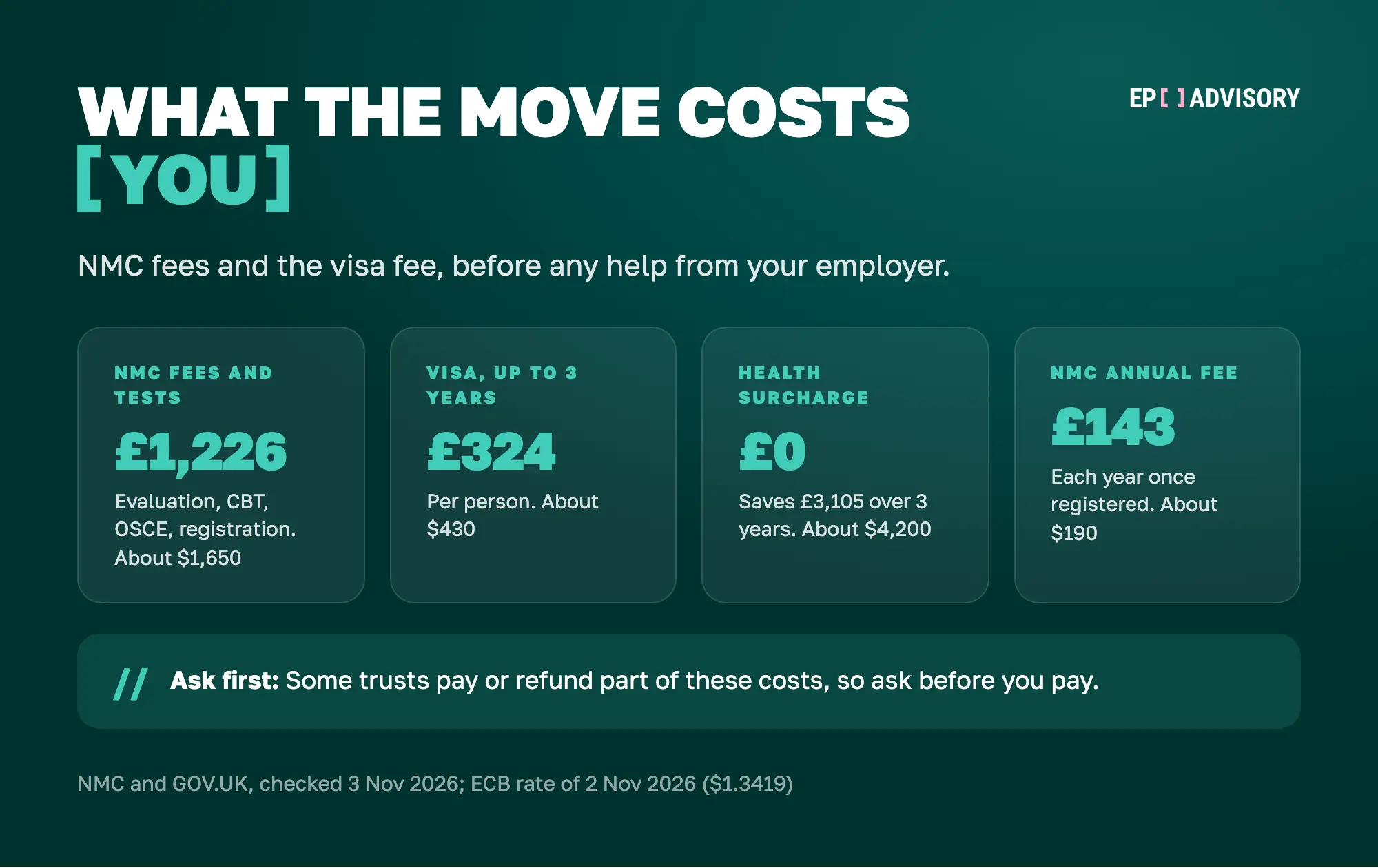
The NMC fees and tests cost £1,226 in total (about $1,650 at ECB rates of 2 November 2026).
The NMC raised its fees on 1 October 2026. Older guides show lower figures. These are the current ones from the NMC costs page and the GOV.UK visa page. Dollar figures use ECB rates of 2 November 2026.
| Cost | Amount | In dollars |
|---|---|---|
| NMC qualification evaluation | £167 | about $220 |
| CBT | £83 | about $110 |
| OSCE | £794 | about $1,070 |
| NMC registration fee | £182 | about $240 |
| NMC total | £1,226 | about $1,650 |
| Health and Care Worker visa, up to 3 years | £324 per person | about $430 |
| Health and Care Worker visa, over 3 years | £628 per person | about $840 |
| Immigration Health Surcharge | £0 on this visa | $0 |
| Savings to show (unless your employer covers you) | £1,270, held 28 days | about $1,700 |
| NMC annual fee, once registered | £143 a year | about $190 |
The surcharge exemption is a big saving. On most other work visas, the Immigration Health Surcharge is £1,035 a year. For a 3-year visa, that would be £3,105 (about $4,200). GOV.UK says: “You – and your partner or children – will not have to pay the healthcare surcharge.”
Who pays
The NHS code of practice for international recruitment protects you. It says international health staff “will not be charged fees for recruitment services in relation to gaining employment in the UK.” So a recruitment agency that follows the code must not charge you for finding you a job in UK health care. The code is on the NHS Employers website.
Some trusts also pay for part of the move. Packages differ by trust. Ask each employer these questions before you accept:
- Fees: do you pay or refund the OSCE, the NMC fees and the visa fee?
- Travel and housing: do you pay the flight and the first weeks of housing?
- Training: do you run OSCE preparation, and is it paid time?
- Repayment clause: do I repay costs if I leave early? The code says any repayment clause “must be transparent, proportionate, time-limited and flexible.” Read it before you sign.
The Health and Care Worker visa for nurses
The Health and Care Worker visa is the main route for nurses, and it is built for NHS jobs.
It is a type of Skilled Worker visa with lower fees and no health surcharge. You need a confirmed job offer from an approved health employer before you apply. The employer issues your certificate of sponsorship. The visa lasts up to 5 years and you can extend it. To see which employers hold a licence, read our guide to UK companies that sponsor visas.
The visa lists seven nursing occupation codes. They cover midwifery, community, specialist, mental health, children’s and other nurses, plus nurse practitioners.
The salary rule for nurses
Nurses do not use the general Skilled Worker salary bar. GOV.UK says you will “usually need to be paid at least £25,000”, or the going rate for your job if higher. For NHS jobs, the going rate comes from a table of national pay scales by band and UK nation. In England, the visa rate for Band 5 is £29,970 a year gross. Real NHS Band 5 pay in 2026/27 starts higher, at £32,073. So a standard Band 5 offer clears the visa rule. For the general rules, see our guide to the UK Skilled Worker visa salary threshold.
Working before you have your PIN
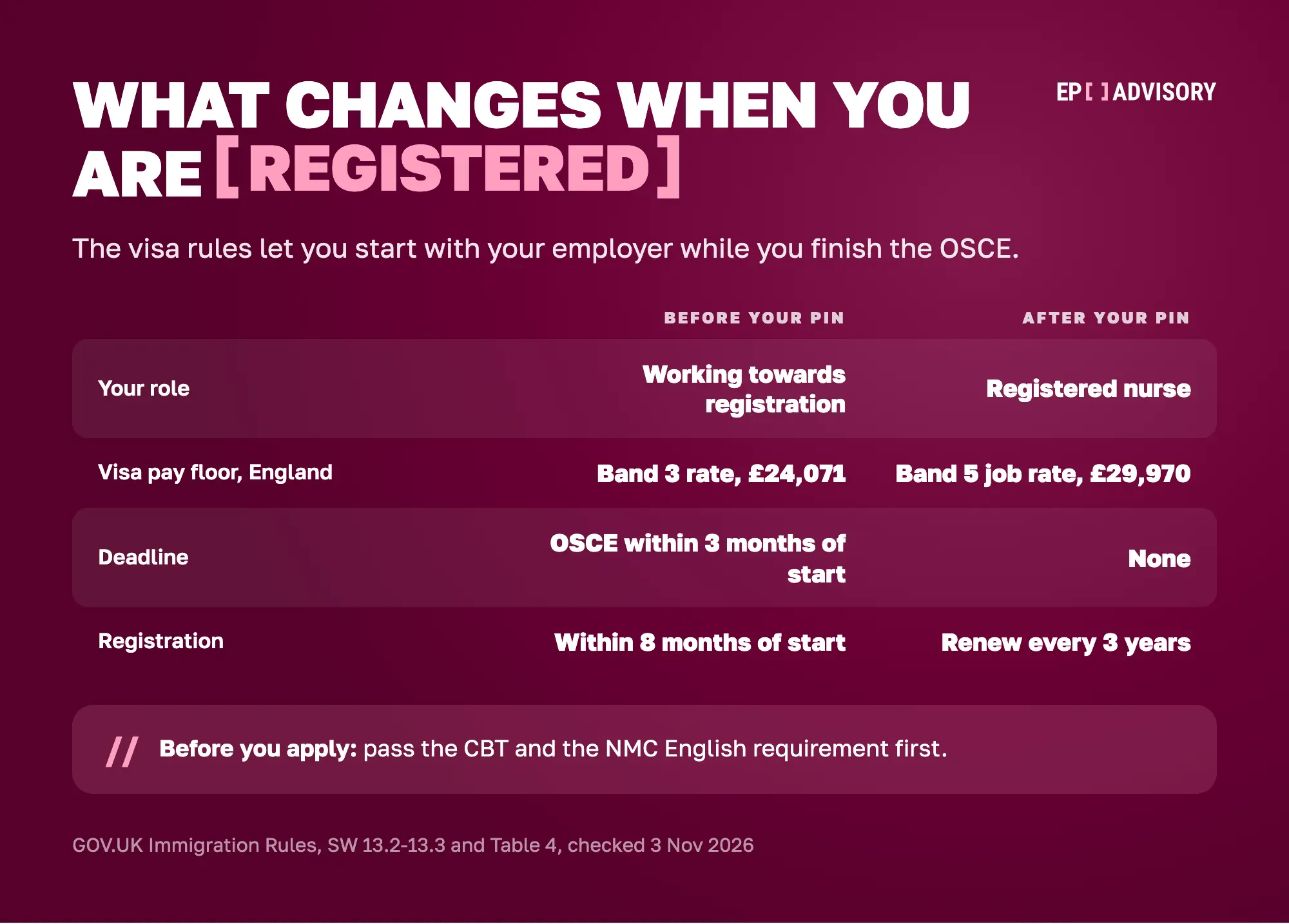
Most US nurses arrive with the CBT passed and the OSCE still to do. The Immigration Rules allow for this. Your pay may be below £25,000 for up to 8 months while you work towards NMC registration. Three conditions apply:
- You passed the NMC English requirement and the CBT before you applied for the visa.
- You will sit the OSCE no later than 3 months after your job start date.
- Your employer stops sponsoring you if you are not fully registered within 8 months of starting.
During that time, your pay must be at least the Band 3 rate in the national pay scale table. In England that rate is £24,071 a year gross. Employers use different job titles for this period. Ask each trust what band and pay point you get before and after your PIN. The rule is in Appendix Skilled Worker, paragraphs SW 13.2 and SW 13.3.
Family and settlement
Your partner and children can come with you. Each pays the same visa fee as you, and none pays the health surcharge.
After 5 years on the visa, you can apply to settle today. Settlement is called indefinite leave to remain (ILR). On 2 November 2026 the government published plans to change settlement rules. They are only plans. They are not law yet and have no start date. The settlement plans say applications are usually decided under the rules in force on the date of the decision. So check the current rules with the official site or a regulated adviser before you apply.
NHS nurse pay in 2026/27: Band 5 to Band 7 in pounds and dollars
The 2026/27 NHS pay award is in force: the new rates have applied in England since 1 April 2026.
NHS staff are paid on Agenda for Change, the national pay system for most NHS roles except doctors. Every job sits in a band. Each band has pay points, and you move up after set years in the band. These are the England rates from NHS Employers pay scales 2026/27. They are gross per year. Dollar figures use ECB rates of 2 November 2026.
| Band | Typical nurse role | Entry | Top of band |
|---|---|---|---|
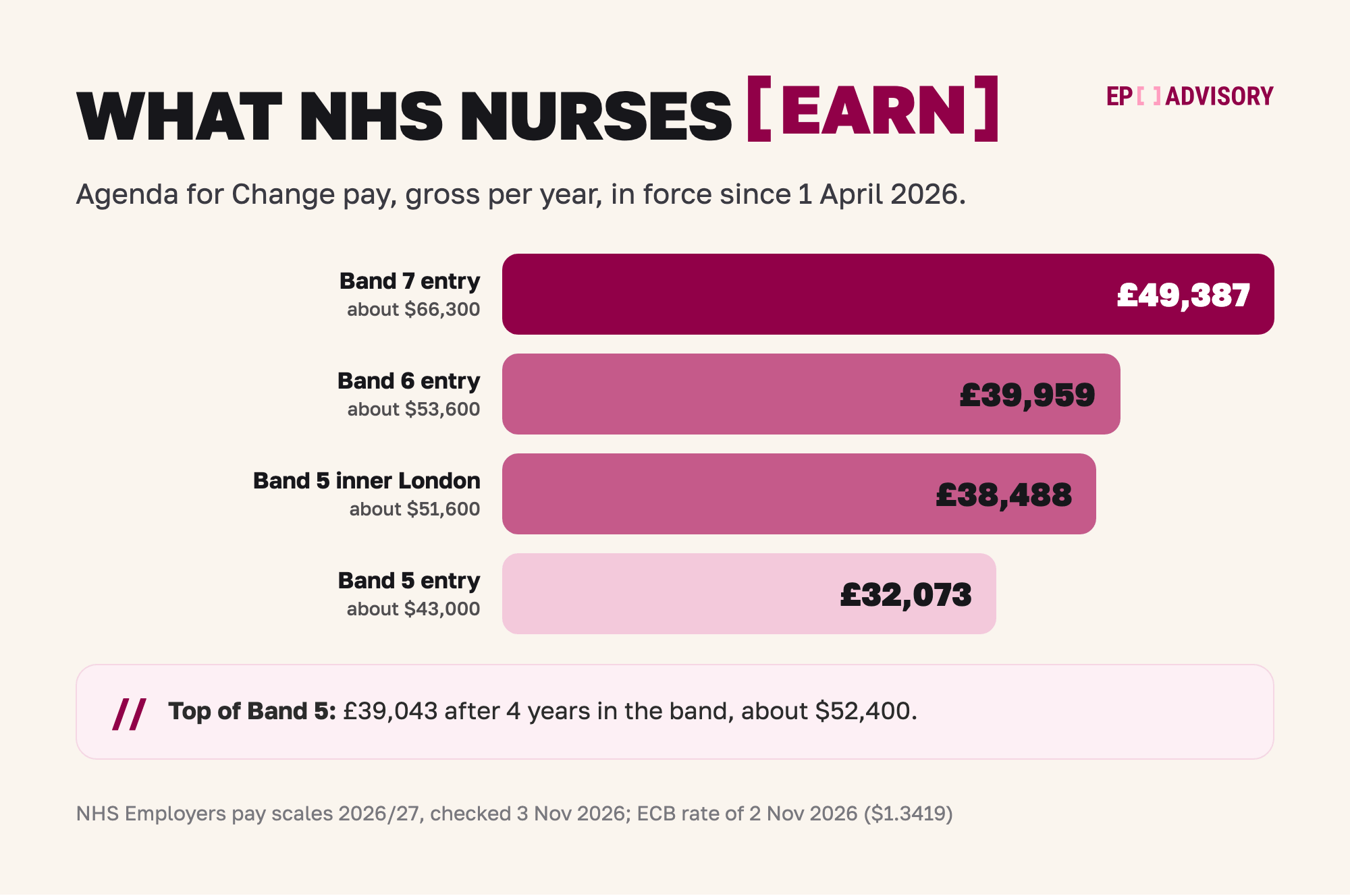
| Band 5 | Registered (staff) nurse | £32,073 (about $43,000) | £39,043 (about $52,400) |
| Band 6 | Senior or specialist nurse | £39,959 (about $53,600) | £48,117 (about $64,600) |
| Band 7 | Ward manager or advanced practitioner | £49,387 (about $66,300) | £56,515 (about $75,800) |
Band 5 has three pay points. You start at £32,073, move to £34,592 after 2 years, and reach £39,043 at the top. Scotland, Wales and Northern Ireland set their own rates, so check the figures for the nation you choose.
London pay
London jobs add a high cost area supplement. This is like a cost-of-living extra. Inner London adds 20% of basic pay, within a minimum and maximum. Outer London adds 15%. The fringe around London adds 5%.
- Inner London, Band 5: £38,488 entry to £46,852 top (about $51,600 to $62,900).
- Outer London, Band 5: £36,943 entry (about $49,600).
- Inner London, Band 6: £47,951 entry (about $64,300).
Next to US nurse pay
The US median for registered nurses was $97,550 a year gross in May 2025, says the US Bureau of Labor Statistics. That is about £72,700. So the NHS headline pay is lower than the US median. Nurses who move weigh the whole package, not only the salary.
Parts of the package to count:
- Annual leave: 27 days plus 8 public holidays from day one, rising to 29 after 5 years of NHS service and 33 after 10. Ask whether your trust counts any US service. This is in the NHS terms and conditions handbook.
- Healthcare: you and your family use the NHS without paying the health surcharge.
- Pension: NHS staff can join the NHS Pension Scheme, run by the NHS Business Services Authority. Ask each trust about joining and the current contribution rates.
- Unsocial hours pay: evenings, nights, weekends and public holidays earn extra pay under Agenda for Change. The rate depends on your band and the hours.
For tax, take-home pay and cost of living, see our guide to UK vs US salary and our page on salaries in the UK. US citizens are taxed by the US on worldwide income, so talk to a cross-border tax adviser before you move.
Band 5 or Band 6: where an experienced US nurse starts
In the NHS, the band belongs to the job, not to the person.
Each NHS post is graded through job evaluation. So a ten-year US nurse who applies for a Band 5 staff nurse post is paid Band 5. International recruitment posts are often Band 5 staff nurse roles. Many US nurses find this a step down at first. It is a starting point, and you can move up.
Ways to start well or move up fast:
- Ask about your pay point. Ask whether the trust counts your US experience when it sets your starting point in the band. Terms differ by employer, so get the answer in writing.
- Apply for Band 6 once registered. Band 6 posts need UK registration plus the skills in the job’s person specification. Your US specialty, such as ICU, ER or theatres (UK for operating rooms), counts here.
- Match the job to your specialty. A US critical care nurse fits an ICU Band 5 post better than a general ward. You learn UK practice faster in a familiar setting.
- Plan the first year. Learn UK documentation, then ask your manager what a Band 6 needs on your ward.
Nurse practitioners follow the same pattern. You join as a registered nurse, often at Band 5 or 6. You then apply for advanced practitioner posts, often at Band 7 or above. Each employer sets the entry rules for these roles.
How to land an NHS nurse job from the US
Start with trusts that hire internationally and support the OSCE.
NHS jobs are posted on NHS Jobs, the official NHS job site for England and Wales. Scotland and Northern Ireland have their own sites. Search for “international nurse” or “international recruitment” to find trusts with programmes. Read each ad for three things: visa sponsorship, OSCE support and the start date.
An NHS application is not a US resume. Many NHS applications use an online form with a supporting statement. The supporting statement is your written answer to the person specification. That is the list of essential and desirable criteria in the ad. Write it so a shortlister can tick each one.
- Answer each essential criterion. Use the ad’s words as headings, then give one real example for each.
- Translate US terms. Write “registered nurse (US, state licence)” and add “NMC application in progress” or “CBT passed”.
- Show numbers. Patient ratios, unit size, years in specialty, audits you led.
- Use UK format. UK employers expect a CV, not a resume. Our guide to the UK CV vs US resume shows what changes.
If you have sent applications and heard nothing back, our page on why UK employers ignore American applications lists the fixes. A strong CV also helps with agencies and private hospitals. Getting ready to apply for jobs in the UK? Check your CV for free: see it the way a recruiter does, then fix each problem.
NHS interviews are often panel interviews with scenario questions. Expect questions on patient safety, escalation and the NHS values. Prepare five short stories from your US work. Our guide on how to pass a job interview shows how to shape them.
Next: before you apply to trusts, turn your US resume into a UK CV with our UK CV vs US resume guide.
Key takeaways
- An American nurse can work in the UK after joining the NMC register and getting a Health and Care Worker visa.
- The NMC checks that your qualification let you register in the US, so keep your RN licence active and your transcript ready.
- NMC fees and tests cost £1,226 in total since 1 October 2026, about $1,650 at ECB rates of 2 November 2026.
- The visa costs £324 for up to 3 years or £628 for longer, and nurses pay no Immigration Health Surcharge.
- Most US-trained nurses meet the NMC English rule with no test, using a transcript or a year of registered US practice within the last two years.
- The 2026/27 NHS pay award is in force: Band 5 in England pays £32,073 to £39,043 a year gross.
- You can start work before your PIN if you passed the CBT and the NMC English requirement, sit the OSCE within 3 months and register within 8 months.
See what a recruiter sees, then fix it before you apply. An instant score, then the fix for every problem.
Free, no card. A free account unlocks every fix.
Frequently asked questions
Can a US RN work in the UK without NMC registration?
Not as a registered nurse. You need NMC registration to work as a nurse in the UK. Under the visa rules, you can start with a sponsoring employer before your PIN if you passed the CBT and the NMC English requirement, sit the OSCE within 3 months of starting and register within 8 months.
Do American nurses need to take IELTS or OET?
Usually not. The NMC lists the US as a majority English-speaking country. You can use a transcript showing your nursing programme was taught and examined in English, or at least one year of registered practice in the US within the last two years. A test is a third option.
Can I take the NMC CBT in the United States?
Usually, yes. Pearson Professional Assessments runs the CBT at test centres in most countries around the world, so search Pearson’s centre list for one near you when you book. It costs £83 and results come within 48 hours. The OSCE is only held in the UK, at Northampton, Ulster or Leeds.
Can an American nurse practitioner work in the UK?
Yes, but there is no separate NMC register for nurse practitioners yet. You register as a nurse through the same steps, then apply for advanced practitioner roles. Employers set the entry rules for those roles. The NMC plans to start work on advanced practice standards in spring 2027.
Is an ADN enough to register with the NMC?
The NMC does not set a US degree level on its overseas pages. It checks that your qualification allowed you to register as a nurse in the US, and confirms this with your state board. Send the eligibility application, which costs £167, and the NMC will tell you if you can continue.