 By Andre Atallah, CEO of EP Advisory

Short answer: some big UK graduate schemes sponsor international students, but many do not. Barclays (for its 2027 corporate banking scheme), KPMG (named London programmes) and Arm say on their own pages that they can sponsor. Deloitte sponsors only people already on a UK Student visa. BDO does not sponsor its early-career programmes, and HMRC’s Tax Specialist Programme is not eligible for sponsorship. If you are under 26, a lower visa salary floor of £33,400 gross a year applies.
This guide is for American and other overseas graduates who want a place on a UK graduate scheme. A graduate scheme is a structured entry-level programme at a large employer, usually 2 to 3 years long. UK employers hire for these a year ahead and judge grades differently from US recruiters.
You get three things here: which visa can get you in, what named employers say about sponsorship, and how the UK calendar and grades work.
For nearly 10 years, we’ve helped more than 5,000 professionals find jobs abroad. Want to know if your CV will pass screening in the UK? Check your CV for free: a score in 30 seconds, then a fix for each problem.
Three visas can get you onto a UK scheme
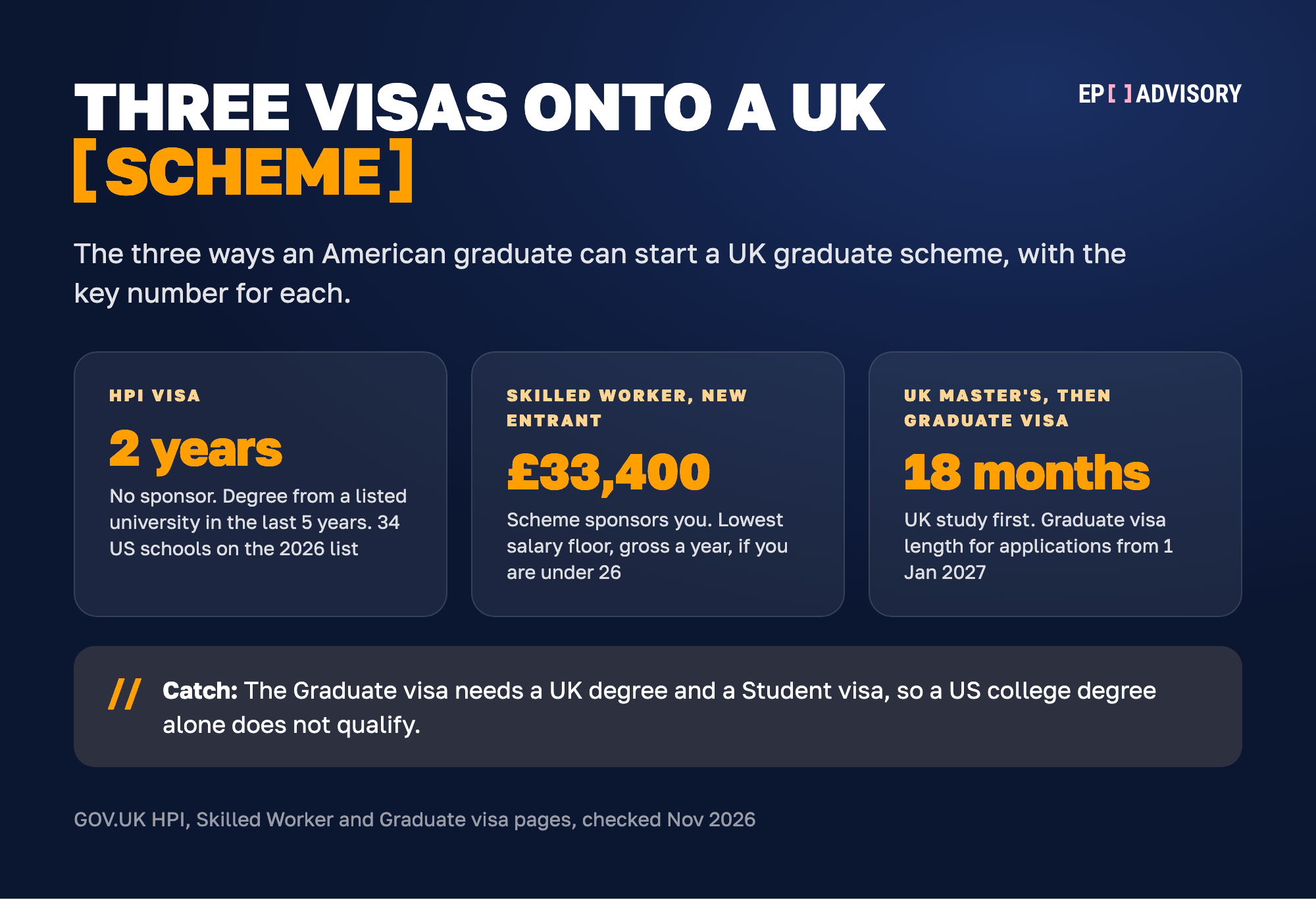
Unless you qualify for the HPI visa, you will need a sponsored Skilled Worker visa. A third route needs UK study first.
A sponsored visa means the employer holds a sponsor licence from the Home Office and assigns you a certificate of sponsorship (CoS), a digital record of the job offer. You then apply for the visa yourself. These are the three routes in:
- High Potential Individual (HPI) visa. If your degree was awarded in the last 5 years by a university on the Home Office list for your award year, you can get 2 years of open work rights with no sponsor. The 2026 list covers degrees awarded from 1 November 2026 to 31 October 2027. It has 82 universities, 34 of them in the US. The visa cannot be extended. Details are on the GOV.UK HPI page.
- Skilled Worker visa at the new-entrant rate. The scheme employer sponsors you. Graduates under 26 can be paid a lower salary floor than experienced hires. This is the main route for a US graduate applying from home.
- A UK master’s, then the Graduate visa. You study in the UK on a Student visa. Afterwards the Graduate visa gives you time to work without a sponsor. This route costs a year of fees, but some employers sponsor only from it.
HPI is the simplest if you qualify. Americans can check our HPI visa guide for Americans. But it lasts 2 years, so most people still need a sponsored job before it ends.
The Graduate visa is not for US college graduates
You can only get a Graduate visa after studying in the UK.
GOV.UK says “You must be in the UK when you apply”, your current visa must be a Student visa, and you must have completed a UK bachelor’s, postgraduate or other eligible course. A degree from Ohio State or UCLA does not count.
If you do take a UK master’s, plan for the length. The Graduate visa gives 2 years if you apply on or before 31 December 2026 and 18 months if you apply on or after 1 January 2027 (3 years after a PhD). The Budget of 28 October 2026 promised 2 years again for graduates of high-compliance universities. That is announced only. There is no list yet and the rules have not changed.
The full rules for staying on after UK study are in our guide on how to stay in the UK after studying.
The new-entrant rate lowers the pay a sponsored job needs
If you are under 26, the visa salary floor for your first sponsored job is much lower.
A Skilled Worker job normally has to pay at least £41,700 gross a year (GOV.UK, 2026), or the going rate for the occupation if that is higher. That is about $56,000 at ECB rates of 2 November 2026. Going rates are the Home Office’s minimum for each job code, published in Appendix Skilled Occupations. For software developers (code 2134) it is £54,700 gross a year. For management consultants and business analysts (code 2431) it is £50,200.
New entrants can be paid 70% of the going rate, with a floor of £33,400 gross a year (about $44,800 at ECB rates of 2 November 2026). You count as a new entrant if any one of these applies:
- Age. You are under 26 on the date you apply. This is the one that helps most US graduates.
- UK study. You are in the UK on a Student visa at bachelor’s level or above, or you were in the last 2 years.
- Graduate visa. You hold one now, or it was your last visa within the past 2 years.
- Professional training. You will be working towards a recognised qualification in a UK regulated profession, or towards full registration or chartered status in the job you are sponsored for.
The going-rates table prints the 70% figure for each code, rounded to the nearest £100 and based on a 37.5-hour week. For two common graduate roles:
- Software graduate: the 70% rate for £54,700 is £38,300 gross a year (about $51,400 at ECB rates of 2 November 2026).
- Consulting or business analyst graduate: the 70% rate for £50,200 is £35,100 gross a year (about $47,100 at ECB rates of 2 November 2026).
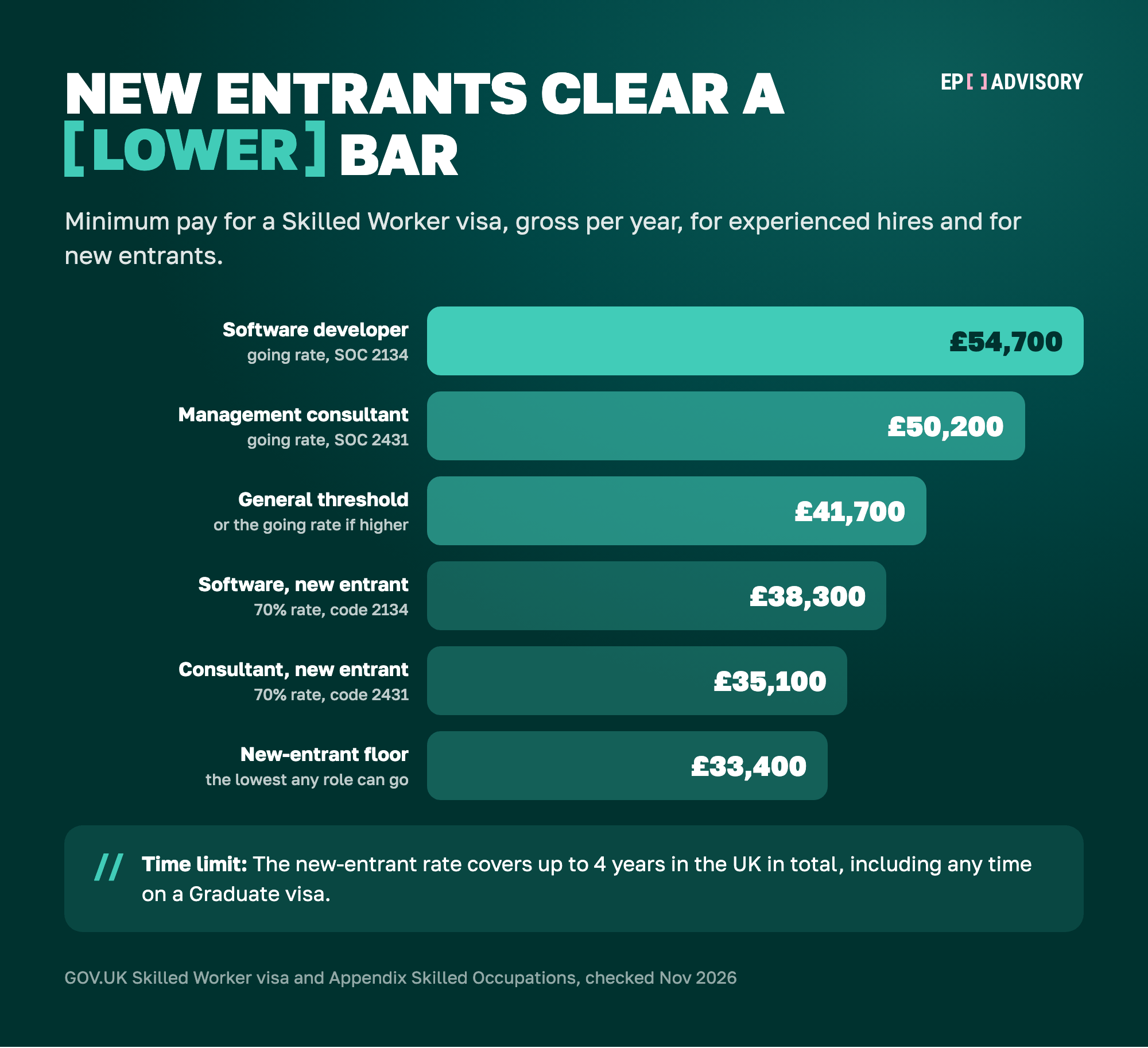
The catch is time. GOV.UK says “Your total stay in the UK cannot be more than 4 years if you apply for one of these reasons.” Time on a Graduate visa counts towards those 4 years. To stay longer, you would need to qualify without the discount, so your pay has to reach the full rate by then. Check the pay steps before you accept.
The Budget of 28 October 2026 also announced changes “from spring 2027”: going rates cut to the 25th percentile, and the new-entrant discounts merged into one figure “for those studying, recently graduated, or in professional training”. That Budget line does not mention the under-26 reason. These changes are announced only and are not law yet. Our guide to the Skilled Worker salary threshold tracks the full rules.
Score your CV in 30 seconds, then fix its biggest problems one by one. Both free.
Free, no card. A free account unlocks every fix.

Which UK graduate schemes sponsor international students
Policies vary widely, even between firms in the same industry.
We read each employer’s own careers page on 3 November 2026 (for HMRC, an answer to Parliament) and checked each one against the GOV.UK register of licensed sponsors dated 2 November 2026. Policies change each season, so check the live ad.
| Employer | What its own page says | Licensed sponsor? |
|---|---|---|
| Barclays (UK Corporate Banking Graduate Programme 2027, London) | Will “provide a skilled worker visa for successful applicants” who meet Home Office rules. Its FAQ adds that it “may take your work authorisation status into consideration”. See the ad. | Yes, A rating |
| KPMG | Sponsors London audit, tax, and consulting and technology programmes, plus all consulting actuarial programmes. “KPMG cannot make any guarantee”. KPMG page. | Yes, A rating |
| Arm (Cambridge) | “If you don’t currently hold the right to work in the UK, Arm is authorised to sponsor individuals.” Arm FAQ. | Yes, A rating |
| EY | Check “individual vacancy pages”. Applicants need new-entrant status, and some roles do not accept former Graduate visa holders. No sponsorship for internships. EY FAQ. | Yes, A rating |
| Deloitte | Sponsors only people who “currently hold a UK Student Visa”. No one who has held a Skilled Worker or Graduate visa. Deloitte page. | Yes, A rating |
| BDO | “unable to provide visa sponsorship for any of our early career’s programmes as they do not meet the current minimum salary requirements”. BDO FAQ. | Yes, A rating |
| HMRC (Tax Specialist Programme) | A Treasury answer to Parliament on 20 January 2026 said the programme “is not designated as a role eligible for sponsorship”. We could not open HMRC’s own careers page on 3 November 2026. | Yes, A rating |
So for someone applying from the US today, Barclays’ corporate banking scheme, KPMG’s named London programmes and Arm say they can sponsor. EY depends on the vacancy. Deloitte is only open to you while you hold a UK Student visa, for example during a UK master’s. BDO’s early-career programmes and HMRC’s Tax Specialist Programme do not sponsor. Our HMRC Tax Specialist Programme guide covers that scheme for readers who already have UK work rights.
We could not check NatWest, PwC, Google or Tesco scheme pages today, so we make no claim about them. The BCG visa page we found is for UK students joining BCG offices abroad, so we make no claim about BCG either. Our NatWest guide and Google early careers guide cover their steps. Ask their recruiters about sponsorship.
A sponsor licence is not a yes for the scheme
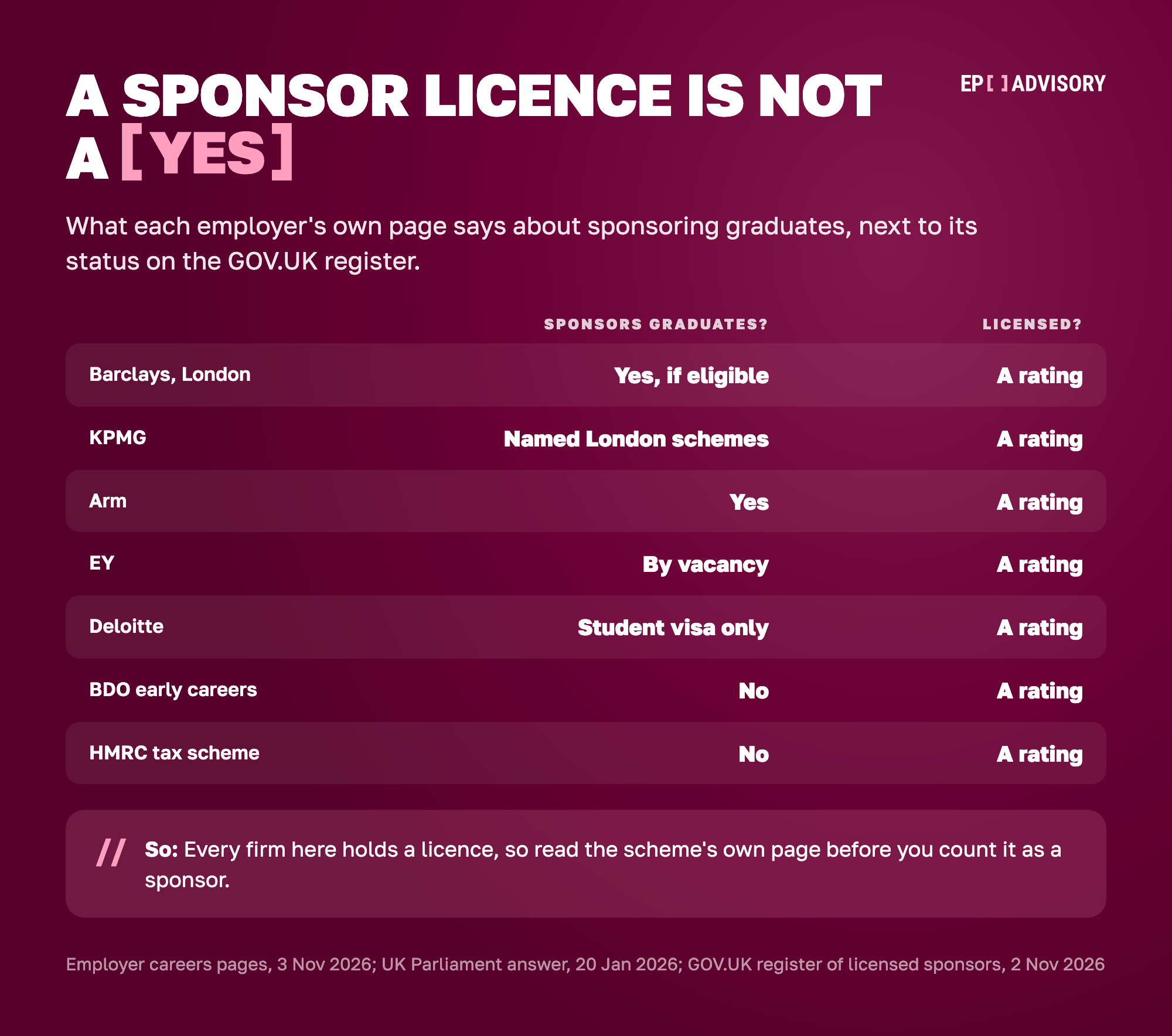
Every employer in the table holds a licence, including three that will not sponsor someone applying from the US.
The GOV.UK register of licensed sponsors lists more than 122,000 organisations licensed for Skilled Worker on 2 November 2026. A licence means the firm can sponsor someone. It does not mean it will sponsor a graduate trainee. BDO, HMRC and Deloitte all hold A ratings, yet their graduate schemes are closed to most overseas applicants.
Sponsoring also costs the employer money. A certificate of sponsorship costs £525. A medium or large employer also pays the Immigration Skills Charge: £1,320 for the first 12 months and £660 for each extra 6 months. So a 3-year visa costs £3,960 in that charge alone (about $5,300 at ECB rates of 2 November 2026). GOV.UK says the employer must pay it, not you.
The register still helps. An employer not on it cannot sponsor you. How to search it and read the ratings is covered in our guide to UK companies that sponsor visas.
UK schemes hire a year ahead
Apply in the autumn of your final year, not in the spring before you graduate.
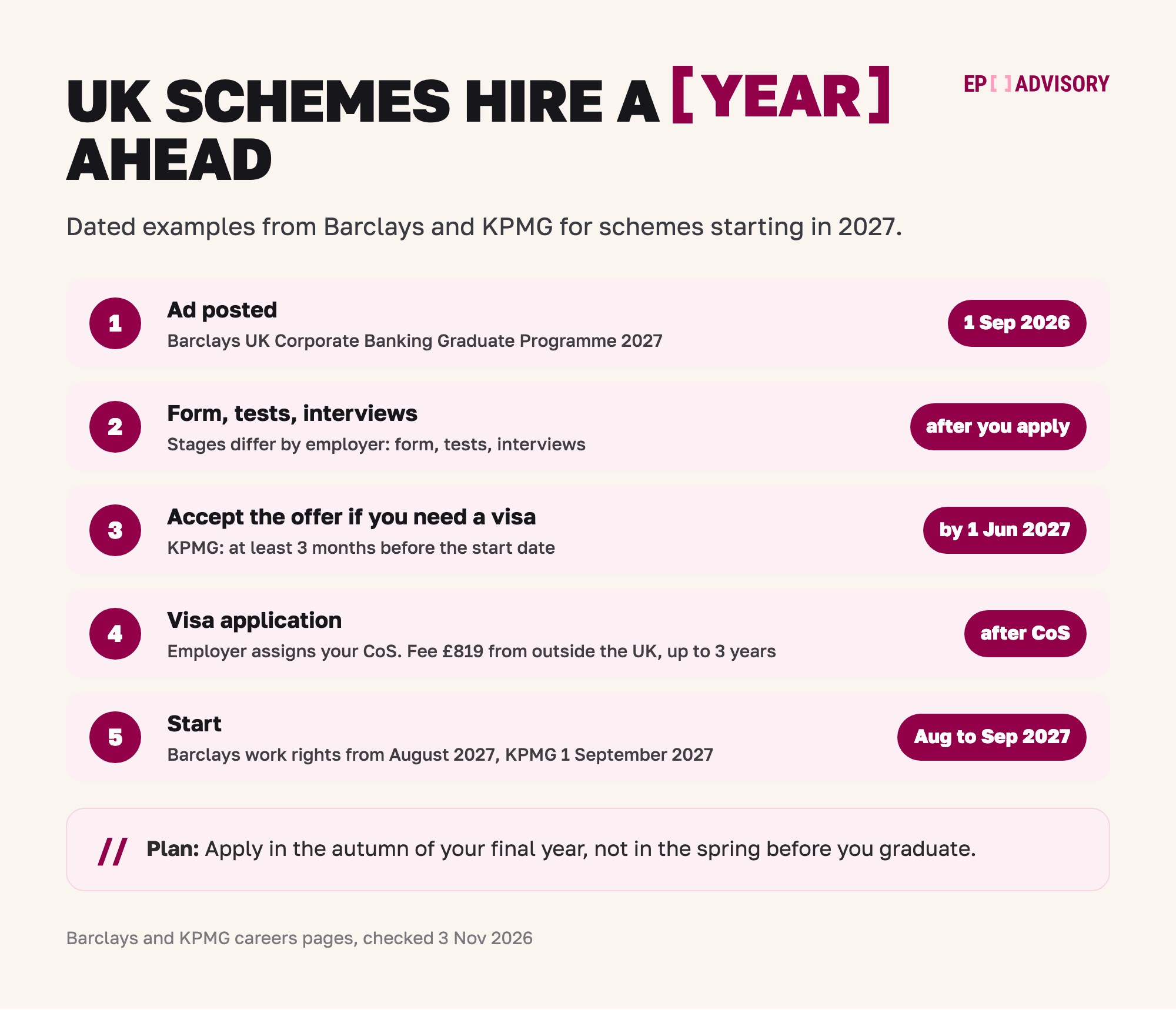
Many large UK schemes open applications in the autumn for a start the following summer or autumn. Two dated examples from employer pages:
- Barclays. The UK Corporate Banking Graduate Programme 2027 ad was posted on 1 September 2026. It asks applicants who will not be sponsored to have UK work rights from August 2027 to August 2029.
- KPMG. Autumn 2027 graduate programmes start on 1 September 2027. Anyone who needs sponsorship must accept the offer at least 3 months before the start, so by 1 June 2027.
The usual stages are an online form, online tests, a video interview, then an assessment centre (a half or full day of group tasks and interviews). Each employer’s steps, tests and dates differ. Our graduate schemes hub has dated guides to 100 schemes, and our Barclays application guide and EY audit graduate guide walk through two of them.
Your visa comes after the offer. Under Skilled Worker rules the employer assigns your CoS and you apply from the US. The visa fee from outside the UK is £819 for up to 3 years, plus the Immigration Health Surcharge of £1,035 a year. US nationals do not need an English test.
2:1s, A-levels and your GPA
Give your grades as they were awarded. Let the employer convert them.
UK degrees are graded in classes, not GPAs. From the top: a First, an upper second (a “2:1”), a lower second (a “2:2”) and a Third. Many UK ads ask for a class. Some also ask for A-levels, the exams English students take at 18. Newton, a consulting firm, asks for “AAB at A-Level or equivalent”, for example.
You do not have to work out the equivalent yourself. KPMG’s page says: “If you’ve studied overseas, you’ll need to have qualifications equivalent to our UK requirements.” It also says: “you must state your qualifications as they were awarded to you.” So enter your GPA and its scale, for example 3.6 out of 4.0. Do not write “2:1 equivalent” unless the employer has told you that. Some schemes set no minimum at all. Barclays’ corporate banking ad asks only for “a degree or expected degree in any area”.
If an ad asks for A-level grades and gives no US equivalent, email the graduate recruitment team before you apply.
How to apply from the US: the plan we coach
Check eligibility first. Then build a short list of schemes that say yes, and apply early.
- Check HPI first. If your university is on the list for your award year, an HPI visa would let you apply to schemes as someone with UK work rights for 2 years.
- Confirm you are a new entrant. Note your age on your likely visa application date. If you turn 26 before then, check whether another new-entrant reason applies.
- Build a list from employer pages, not the register. Keep only schemes whose own page or live ad says they sponsor.
- Write a UK CV, not a resume. A UK graduate CV is usually up to 2 pages and lists your degree, grades and relevant modules. The differences are in our UK CV vs US resume guide.
- Say you need sponsorship, plainly. Application forms ask. Answer honestly and do not apologise for it.
- Apply in the first weeks the scheme opens. Practise the online tests before the first form goes in.
Your CV is the first filter, often read before anyone looks at your visa answer. In our experience, a one-page US resume with no modules or grades reads as thin to a UK recruiter. Getting ready to apply for jobs in the UK? Check your CV for free: see it the way a recruiter does, then fix each problem.
Visa rules change several times a year, and 2027 brings Budget changes not yet in law. Before you accept an offer, check the current rules on GOV.UK or with a regulated adviser.
Next: open the graduate schemes hub, then shortlist the schemes whose own page says they sponsor.
Key takeaways
- Barclays (2027 corporate banking), KPMG’s named London programmes and Arm say on their own pages that they can sponsor graduates. BDO and HMRC’s Tax Specialist Programme do not.
- Deloitte sponsors only people already on a UK Student visa, so it is closed to you if you apply from the US.
- Under 26, the new-entrant floor is £33,400 gross a year, or 70% of the going rate if higher, for up to 4 years in total.
- The Graduate visa needs UK study, and it falls from 2 years to 18 months for applications from 1 January 2027.
- A sponsor licence on the GOV.UK register is not a yes. Check the scheme’s own page for its policy.
- Many UK schemes open in the autumn for a start the following August or September, so apply about a year ahead.
- State your GPA as awarded and let the employer convert it.
See what a recruiter sees, then fix it before you apply. An instant score, then the fix for every problem.
Free, no card. A free account unlocks every fix.
Frequently asked questions
Does Barclays sponsor international students for its UK graduate schemes?
For its UK Corporate Banking Graduate Programme 2027 in London, yes. The ad says Barclays will provide a Skilled Worker visa to successful applicants who meet Home Office rules. Its FAQ adds that it may consider work authorisation depending on the number of candidates with UK work rights. Check each Barclays ad, because policies differ by programme.
Does NatWest sponsor visas for graduates?
We could not verify NatWest’s current graduate sponsorship policy from its own pages on 3 November 2026, so we make no claim. NatWest Group PLC is on the GOV.UK register of licensed sponsors, but a licence does not mean a scheme sponsors. Ask NatWest’s graduate recruitment team before you apply.
Can I get a UK Graduate visa with a US degree?
No. The Graduate visa is only for people in the UK on a Student visa who have completed an eligible UK course. A US college graduate would need to study in the UK first, or use another route such as the High Potential Individual visa or a sponsored Skilled Worker visa.
What salary does a UK graduate job need to pay for visa sponsorship?
For a new entrant, at least 70% of the going rate for the job, and never less than £33,400 gross a year. You count as a new entrant if, for example, you are under 26 when you apply. For a software graduate that works out at £38,300, and for a consulting graduate £35,100.
When should I apply for UK graduate schemes from the US?
In the autumn of your final year, about a year before the start date. For example, Barclays posted its 2027 corporate banking ad on 1 September 2026, and the ad asks for UK work rights from August 2027. Apply in the first weeks a scheme opens, because the process has several stages.