 By Andre Atallah, CEO of EP Advisory
Short answer: yes, foreigners can get jobs in Malta, and the work runs in English. EU citizens need no permit. Non-EU workers need a single permit, which the Maltese employer files for €600 after advertising the job for 3 weeks. First-time applicants also pass a €250 pre-departure course, and hotel and restaurant staff need a Skills Pass. Roles paying €45,000 or more can use the Key Employee Initiative, decided in about 5 working days.
Malta is a small island with a large foreign workforce. Jobsplus, the public employment service, counted 135,417 foreign nationals in work at the end of 2025, up from 29,003 in 2015 (Jobsplus). English is an official language next to Maltese under Article 5 of the Constitution, so offices, gaming firms and hotels hire in English. Two kinds of foreign hire dominate. Professionals come for iGaming, finance and tech. Workers on single permits fill care, hospitality, construction and other service jobs.
Malta rewrote its labour migration rules in August 2025, in October 2025 and again in 2026. Confirm each step on the Identità website before you pay any fee.
For nearly 10 years, we’ve helped more than 5,000 professionals find jobs abroad. Want to know if your CV will pass screening in Malta? Check your CV for free: a score in 30 seconds, then a fix for each problem.
Who can work in Malta: EU and non-EU routes
EU citizens can live and work in Malta without a permit. Identità, the agency that issues residence and work permits, says so on its EU nationals page. You apply like a Maltese candidate and can start as soon as you are hired.
Everyone else is a third-country national, which is Malta’s legal term for a non-EU citizen. British citizens are in this group unless the Withdrawal Agreement covers them, and Identità keeps a separate page for British nationals. For a third-country national, the job comes first. A Maltese employer registered with Jobsplus offers you a contract, then files the permit for you.
Which permit the employer files depends on the salary and the role. The table shows the four main routes and the one for EU citizens.
| Route | Who it fits | Job advert first | Decision time |
|---|---|---|---|
| Single permit | Any job offer from an employer registered with Jobsplus | 3 weeks on Jobsplus and EURES | Legal maximum 4 months, about 2 on average |
| Single permit, care roles | Health, elderly and disability care | Not needed | Legal maximum 4 months |
| Specialist Employee Initiative (SEI) | Pay of €30,000 or more, with a degree or 3 years of related experience | 2 weeks | 15 working days |
| Key Employee Initiative (KEI) | Pay of €45,000 or more, in a managerial or highly technical role | 2 weeks | About 5 working days |
| EU Blue Card | Pay of 1.5 times the average salary, with a 3-year degree or 10 years of experience | 2 weeks | Up to 90 days |
| EU citizen | Any job | Not needed | No permit |
The advert rule comes from the Identità fact sheet of August 2025. It means your employer must show that the job was open to local and EU candidates before hiring you. Firms recommended by Malta Enterprise, the Civil Aviation Directorate or Gaming Malta skip that advert.
The single permit: steps, fee and timing
The employer files the single permit, and you confirm it. The single permit combines an employment licence and a residence permit in one card. It is tied to the employer named on it. You need a new permit, or a change of employer, to switch jobs.
The steps run in this order, according to the Identità application page and the second-phase rules of October 2025:
- The employer advertises the job on the Jobsplus portal and EURES for 3 weeks, within the 2 months before applying.
- You complete the pre-departure course, if this is your first single permit.
- The employer files on singlepermit.gov.mt. You get a link by email to confirm your details.
- The employer submits and pays the €600 fee online. Renewals cost €150 for each year.
- Identità, Jobsplus and the Police check the file. You then get an Approval in Principle letter by email.
- You book biometrics. Identità says appointments are available within 24 hours of the invitation.
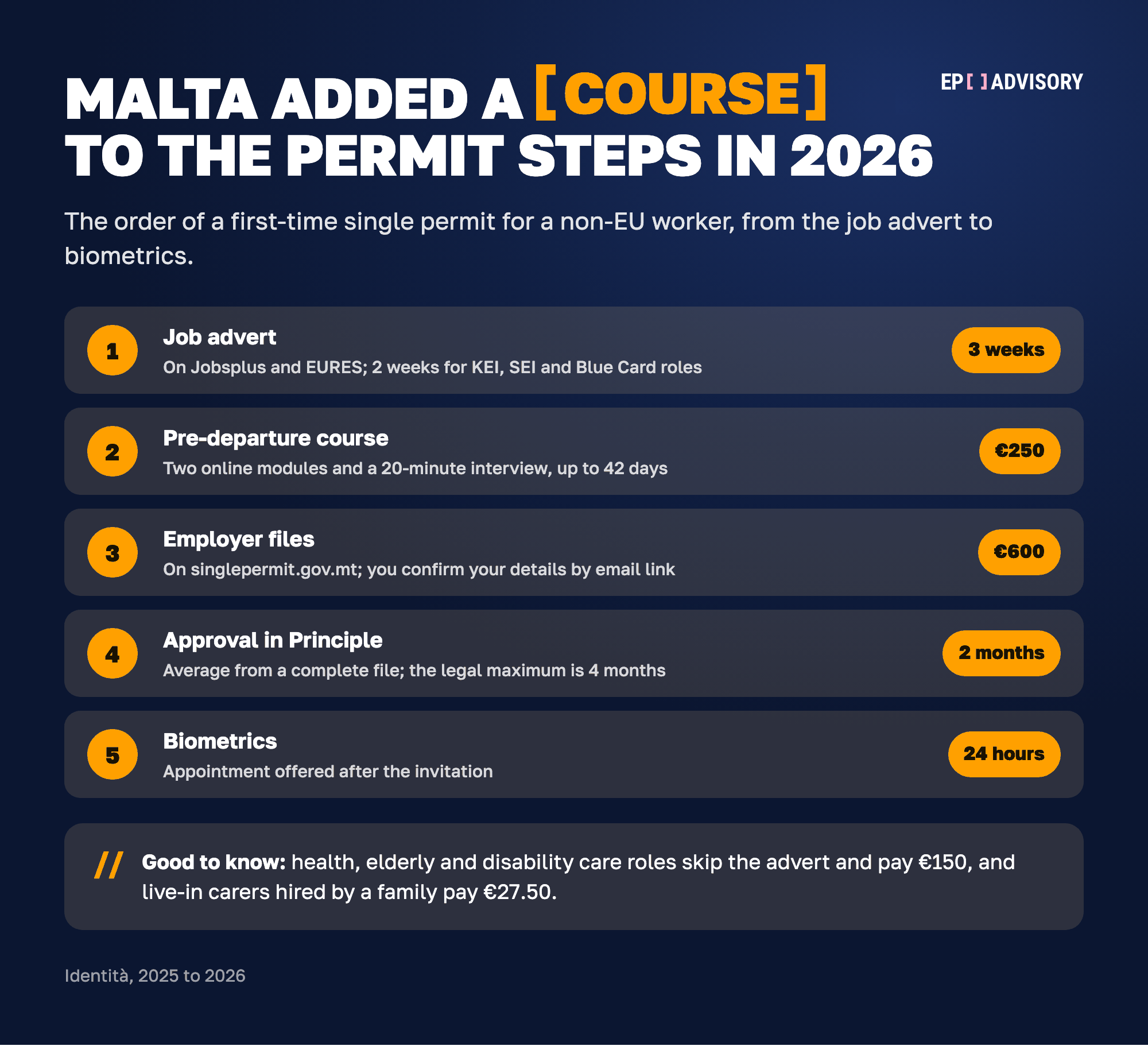
The legal maximum is 4 months from a complete application, and the average is closer to 2 months, says the processing page. The clock starts only when the file is complete. So a full document set is the fastest thing you control.
The document list is long. It includes a passport valid for 8 months, a signed Europass CV, health insurance with at least €100,000 of cover, and a health screening certificate. You also need a signed contract, the job description, proof the job was advertised, recognition of your qualifications by MQRIC (Malta’s qualifications recognition centre), and a lease for your accommodation. From 4 May 2026, health screening runs through a new automated system for all third-country nationals (Identità notice).
One rule changes travel plans. If your passport lets you visit Schengen without a visa, you can apply from inside Malta within 60 days of entering Schengen. You get a receipt and may stay while Identità decides. If you apply on days 61 to 90, you must wait outside Schengen.
The pre-departure course
Since January 2026, every first-time single permit applicant must pass a pre-departure course costing €250. It has two online modules, “Living and Working in Malta” and “Rights and Obligations in the Workplace”, of about 10 to 12 hours each. A 20-minute live interview follows. You have up to 42 days to finish. Identità has checked the certificate on every application since 1 March 2026. Start the course as soon as you have an offer, because it can take most of those 42 days.
The Skills Pass for hotel and restaurant jobs
Only tourism and hospitality jobs need a Skills Pass today. The Skills Pass site says this is currently the only sector that has claimed one. The Institute of Tourism Studies runs it. The tourism and hospitality section costs €230, including a €5 booking fee.
The Skills Pass has two phases, according to the Identità Skills Pass page:
- Phase 1 happens from your home country, before the employer files the permit.
- Phase 2 comes after the Approval in Principle and before your visa or travel.
You also need it to move into a hospitality job from another sector, or to change role inside hospitality. If you plan to work as a waiter, chef, housekeeper or receptionist, budget about €480 for the course and the Skills Pass together, plus the employer’s €600 fee. Ask your employer in writing who pays each one.
Score your CV in 30 seconds, then fix its biggest problems one by one. Both free.
Free, no card. A free account unlocks every fix.

Fast tracks: Key Employee Initiative, SEI and Blue Card
A higher salary buys a faster decision in Malta. Malta has three fast routes for skilled hires. Each one needs only a 2-week advert instead of 3 weeks.
The Key Employee Initiative (KEI) is for managerial or highly technical roles paying at least €45,000 gross a year. Innovators in start-ups endorsed by Malta Enterprise also qualify. Identità aims to decide in about 5 working days from a complete application. You need qualifications or experience that match the role.
The Specialist Employee Initiative (SEI) starts at €30,000 a year. It needs a degree at MQF Level 6, which is Malta’s bachelor’s level, or a lower qualification plus 3 years of related experience. The target is 15 working days.
The EU Blue Card needs a salary of at least 1.5 times Malta’s average gross annual salary. The EU Immigration Portal last put that bar at €34,956 a year, on its page of April 2025. Ask your employer for the current figure. The card lasts 2 years and costs €600 the first time. Malta issued 218 Blue Cards in 2024. See our guide to work visa salary thresholds in Europe to compare Malta’s bar with the main EU destinations.
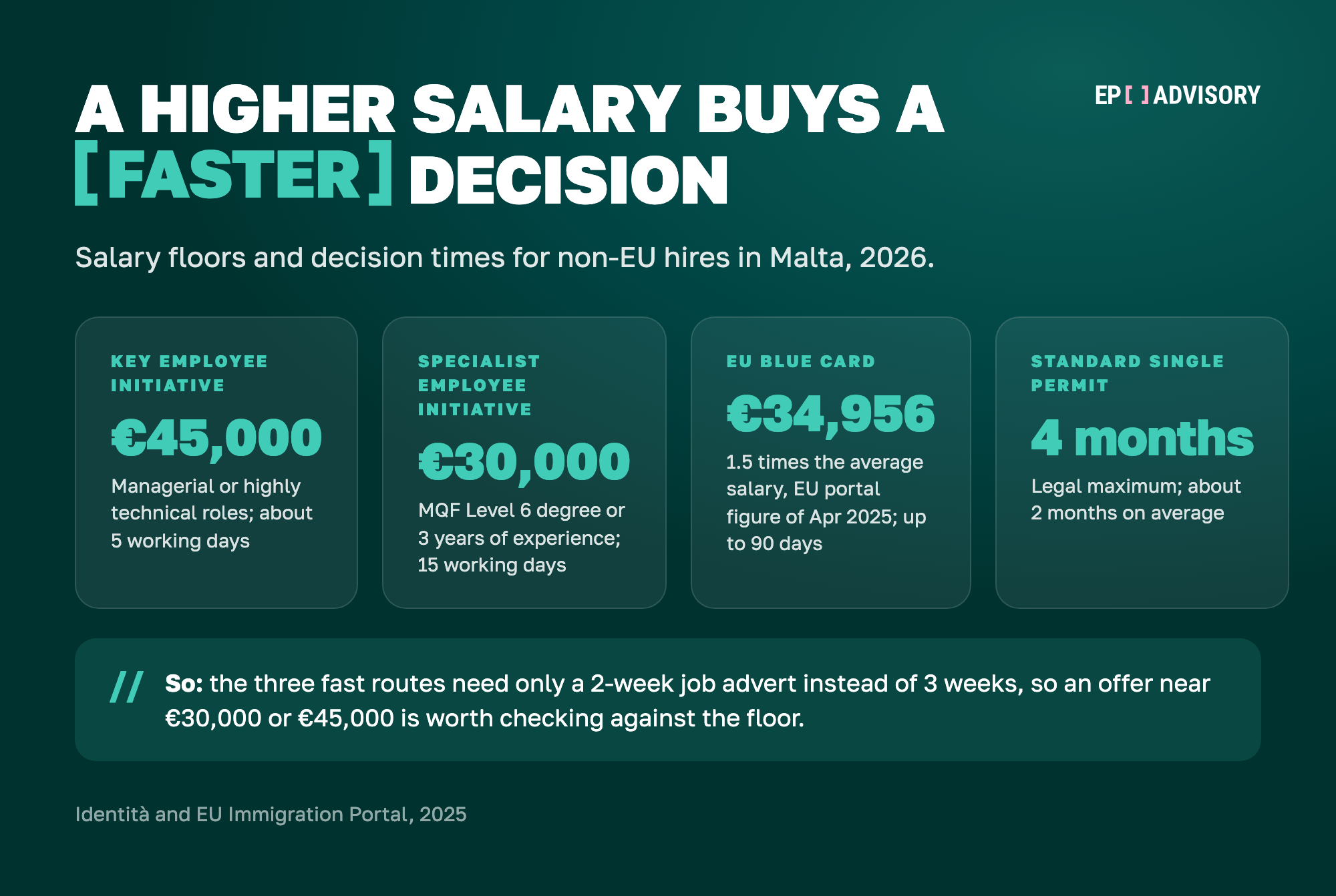
If your offer sits near €30,000 or €45,000, the threshold matters more than a small raise. A role at €44,000 goes through the slower route. Ask whether the package can reach the KEI floor, and see our guide on how to negotiate salary before that conversation.
Which jobs in Malta hire foreigners
Malta hires foreigners at both ends of the pay scale. The Jobsplus data shows two clear groups. Of the third-country nationals in work, 26% are in elementary jobs and 24% in service and sales. Only 8% are professionals. EU nationals look different: 18% are professionals, 15% are managers, and 16% work in arts and entertainment, which in Malta mostly means iGaming.
iGaming, finance and tech
Online gaming is Malta’s signature industry for foreign professionals. The Malta Gaming Authority annual report counted 15,039 people working for its licensed operators at the end of 2025, up 4.8% in a year. Counting indirect jobs, gaming supports about 19,150 jobs, or around 6.5% of the workforce. Jobs include compliance, risk and fraud, payments, customer support in many languages, marketing, data and software. Finance and fund administration hire for similar compliance and accounting skills.
Care work
Care is the easiest single permit route. Health, elderly and disability care jobs need no 3-week advert, and their permit fee is €150 instead of €600. A family that hires a live-in carer can file through singlepermit.gov.mt as an individual employer for €27.50. A first-time carer still needs the pre-departure course.
Hospitality, construction and services
Accommodation and food employ 16% of third-country workers, and construction 10%. Professional and administrative services, which include cleaning, security and staffing firms, employ 25%. Hotel and restaurant jobs need the Skills Pass. Other roles use the standard single permit.
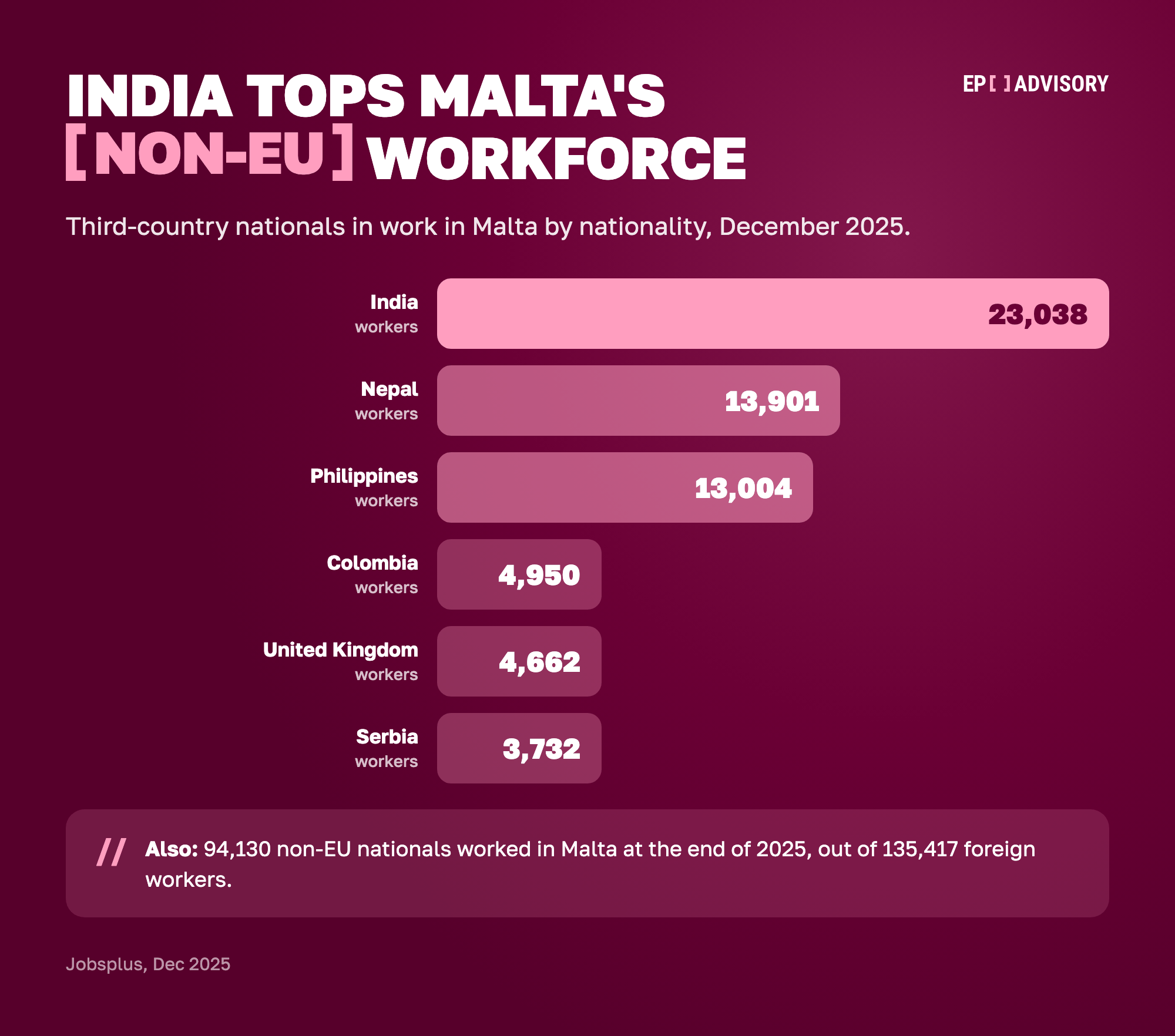
India, Nepal and the Philippines supply the most non-EU workers. Colombia and the UK come next, ahead of Serbia, Albania and Pakistan.
What jobs in Malta pay
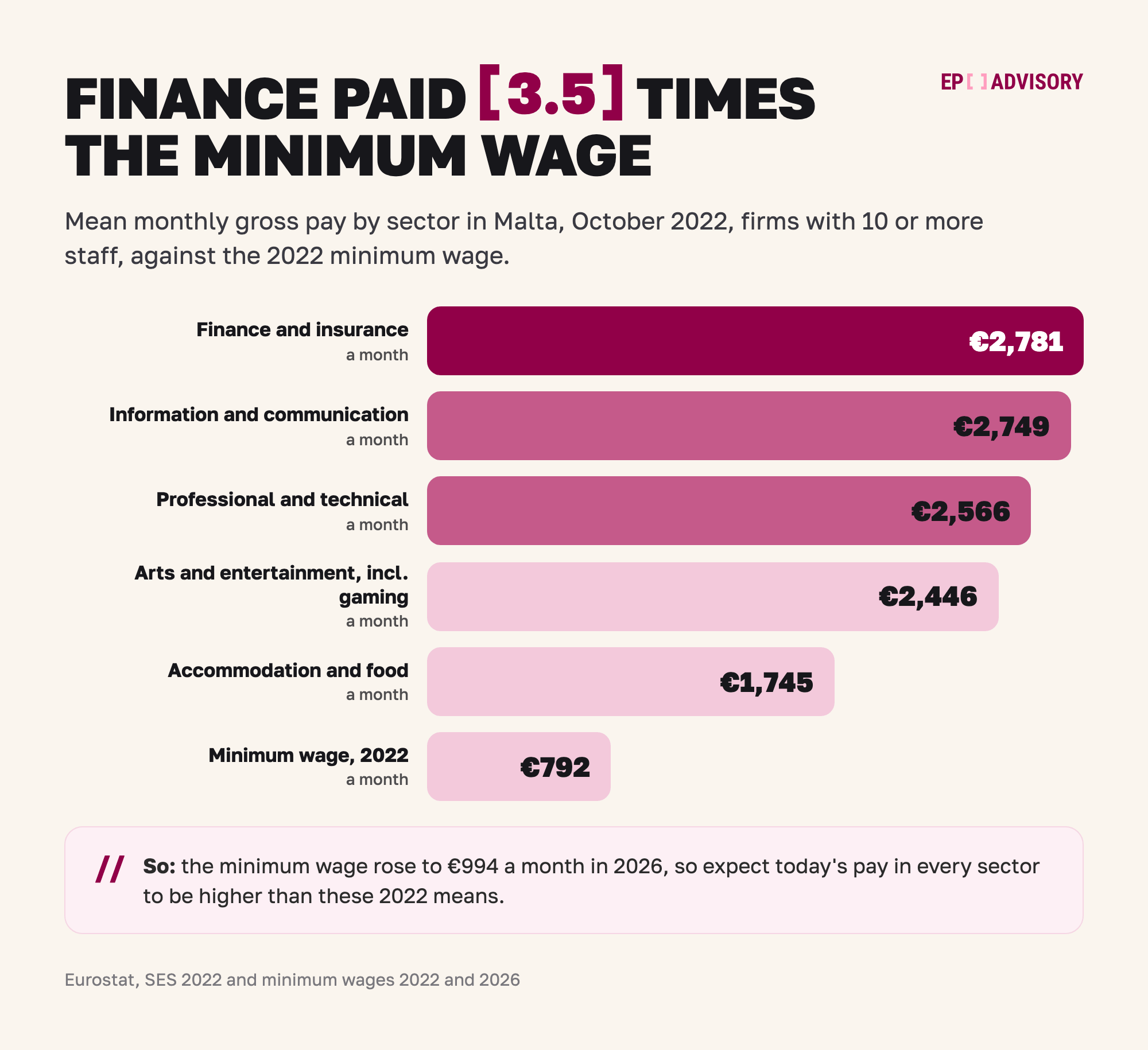
Malta’s minimum wage is €994 a month in 2026. That figure comes from Eurostat, and it has risen every year from €792 in 2022. It is the legal floor for every employee, including single permit workers.
Office pay is far higher. In the latest EU-wide earnings survey, the Structure of Earnings Survey, the mean monthly gross pay in October 2022 was €2,063 across sectors outside public administration. Finance paid €2,781, about 3.5 times the minimum wage then. These figures cover firms with 10 or more staff.
| Sector | Mean monthly gross pay, Oct 2022 |
|---|---|
| Financial and insurance | €2,781 |
| Information and communication | €2,749 |
| Professional, scientific and technical | €2,566 |
| Arts, entertainment and recreation (includes gaming) | €2,446 |
| Education | €2,185 |
| Health and social work | €2,011 |
| Construction | €1,843 |
| Accommodation and food | €1,745 |
| Administrative and support | €1,641 |
These are 2022 averages, so expect 2026 pay to be higher. The minimum wage alone has risen about 25% since that survey. A KEI offer of €45,000 a year works out at €3,750 a month over 12 months, well above every sector mean in the table.
Next: before you accept an offer, compare it with the KEI and SEI floors, then use our guide on how to negotiate salary to ask for the route that suits you.
Where to find jobs in Malta
Start with the boards where Maltese employers must advertise. Since October 2025, an employer hiring a third-country national advertises the job on the Jobsplus portal and on EURES first. So those two boards show many roles that can lead to a single permit.
| Where | Best for | Tip |
|---|---|---|
| Jobsplus | All sectors, including care, hospitality and trades | A job you see here may be on its 3-week advert before a permit application |
| EURES | Jobs open to EU candidates and permit hires | Filter by Malta as the work country |
| iGaming, finance, compliance and tech | Follow gaming operators and fund administrators in Malta | |
| Company career pages | Gaming operators, banks, audit firms, hotels | Apply direct, and keep the advert for your permit file |
For a wider plan across several countries, see how to find a job in Europe. If your work can be done from anywhere, our guide to remote jobs in Europe covers that route.
CVs and interviews for Maltese employers
Malta’s permit file asks for a signed Europass CV. That makes Malta unusual. Your employer will want a clean, modern CV to hire you, and Identità will want the Europass version for the file. Keep both. Use our guide to the European CV format to build the first, and the Europass template from the EU Europass site for the second.
Gaming and finance recruiters screen for regulation. Name the licences, markets and rules you have worked with, such as anti-money laundering, KYC (know your customer) checks or payment systems. Put every language you speak near the top of the CV. If you have a degree, start the MQRIC recognition early, because the permit file needs it, or at least the receipt for your request.
A cover letter helps when you apply from abroad. Say when you can start and that you understand the single permit steps. Our guide to the cover letter for a job abroad shows how. Our guide on how to pass a job interview covers what to prepare, including video calls. Getting ready to apply for jobs in Malta? Check your CV for free: see it the way a recruiter does, then fix each problem.
Scams and paid agencies in Malta
Maltese law bans agencies from charging job seekers. Regulation 10(1) of S.L. 452.130 says no payments or charges may be demanded from any applicant for employment services. Regulation 10(2) also bans deductions from your wages for those services. If anyone asks you for a placement fee, walk away.
Three more checks protect you:
- Licence number. A licensed agency must print its licence number in every job advert. No number means do not proceed.
- Who files. Only the employer, or a licensed agency, can file your single permit. Identità says unlicensed agencies cannot submit applications.
- Where fees go. The €600 permit fee is paid online through singlepermit.gov.mt. The course and Skills Pass fees are paid on their own portals. Be wary of anyone who asks you to pay a permit fee into a personal bank account.
Identità also says it only takes applications from people still abroad or legally in Malta, and that an ineligible application is refused with no refund (Identità eligibility page). So check the employer before you pay for anything. If your job ends on or after 1 August 2025, you have 30 days to find a new one, or 60 days if you can show you can support yourself.
If you are comparing Mediterranean options, our guides to jobs in Greece for foreigners and jobs in Croatia for foreigners cover the permit rules there.
Key takeaways
- EU citizens can work in Malta without a permit. Everyone else needs a job offer first.
- The single permit costs the employer €600 and takes about 2 months, with a legal maximum of 4.
- Employers must advertise on Jobsplus and EURES for 3 weeks, or 2 weeks for the fast routes. Care roles skip the advert.
- First-time applicants pass a €250 pre-departure course. Hotel and restaurant staff also need the €230 Skills Pass.
- Pay of €45,000 opens the Key Employee Initiative, decided in about 5 working days. €30,000 opens the SEI.
- The minimum wage is €994 a month in 2026. Finance, tech and gaming pay well above it.
- Agencies cannot charge you, and every licensed agency shows its licence number.
See what a recruiter sees, then fix it before you apply. An instant score, then the fix for every problem.
Free, no card. A free account unlocks every fix.
Frequently asked questions
Can foreigners get jobs in Malta with visa sponsorship?
Yes. In Malta the employer files a single permit for you, which is the local form of sponsorship. The employer must be registered with Jobsplus, advertise the job for 3 weeks, and pay a €600 fee. Roles paying €45,000 or more can use the Key Employee Initiative, which is decided in about 5 working days.
How long does a Malta work permit take in 2026?
Identità says the legal maximum for a single permit is 4 months, and the average is closer to 2 months from a complete application. The Specialist Employee Initiative targets 15 working days, and the Key Employee Initiative about 5 working days. Add the 3-week advert and up to 42 days for the pre-departure course.
How much does a Malta work permit cost?
The first single permit costs €600 and each year of renewal costs €150. Health and care roles pay €150, and live-in carers hired by a family pay €27.50. First-time applicants also pay €250 for the pre-departure course. Hotel and restaurant staff pay €230 for the Skills Pass.
Can I get a caregiver job in Malta?
Yes, care is one of the simplest routes. Health, elderly and disability care roles need no job advert and pay a lower permit fee of €150. A family can hire a live-in carer and file the permit itself for €27.50. The carer still needs the pre-departure course and a health screening.
Are there unskilled or immediate jobs in Malta for foreigners?
Many foreign workers in Malta do elementary jobs, such as cleaning, delivery and kitchen work. For a non-EU worker, no job is immediate, because the advert, course and permit take 2 to 4 months. EU citizens can start as soon as they are hired. If you already hold a single permit, changing employer needs no new advert.
Do EU citizens need a work permit in Malta?
No. Identità says EU nationals do not need a permit to live and work in Malta. You apply for jobs like a Maltese candidate. British citizens count as non-EU unless the Withdrawal Agreement covers them.