 By Andre Atallah, CEO of EP Advisory
Short answer: yes, foreigners can work in Greece. EU citizens need no permit. Most non-EU workers need a Greek employer to file an invitation online, called a metaklisi, before any visa is issued. Greece set 94,240 work permit places for 2026, mostly in farming, factories, building, hotels and care. Graduates can use the EU Blue Card. The minimum wage is €920 a month, paid 14 times a year.
Greece is approving far more foreign workers than a year ago. Employer invitations approved in the first nine months of 2026 reached 68,000, up from 41,000 in the same months of 2025, the Migration Minister told Parliament on 4 November 2026. Unemployment fell to 7.6% in September 2026, from 8.8% a year earlier (ELSTAT). Most of the permit places sit in hands-on jobs, so the useful question is simple: which job category can a Greek employer file you under?
Immigration rules change often, and Greece amended its migration law in 2026. The figures on this page were checked on 5 November 2026. Confirm the current rules with the official authority before you act.
For nearly 10 years, we’ve helped more than 5,000 professionals find jobs abroad. Want to know if your CV will pass screening in Greece? Check your CV for free: a score in 30 seconds, then a fix for each problem.
Can foreigners work in Greece? The four legal routes
EU, EEA and Swiss citizens can work in Greece without a permit. You can stay for 3 months on your ID card or passport. After that, you register at the local police station for a registration certificate, which is free (EURES Greece). Everything else on this page is about non-EU citizens.
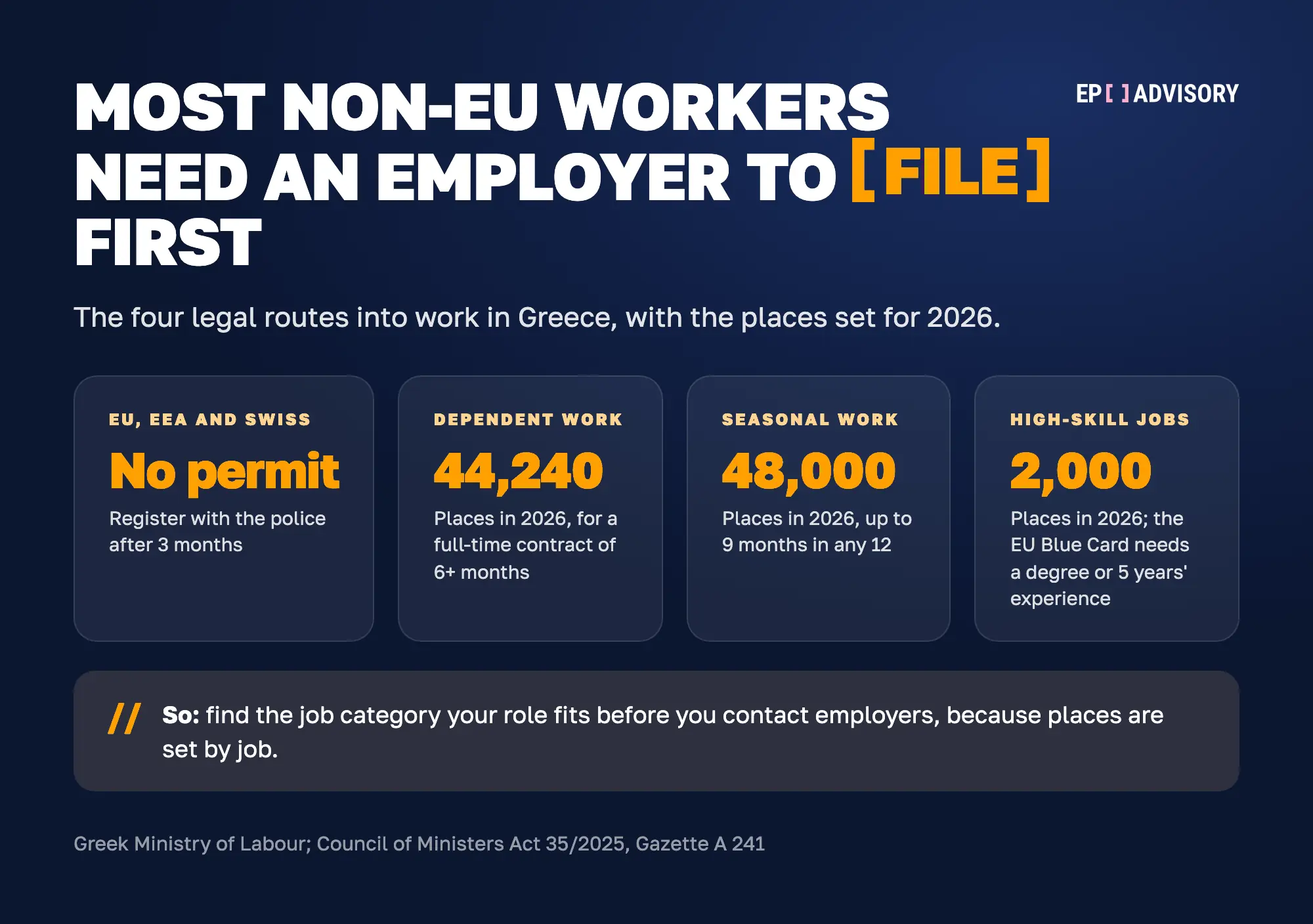
For non-EU citizens, the Greek system starts with the employer. The rules sit in the Migration Code, Law 5038/2023, which Law 5275/2026 amended in February 2026 (Ministry of Labour). Each year, the government also caps how many workers can be invited, job by job. The table shows the four routes most job seekers use.
| Route | Who it fits | Who acts first | 2026 places |
|---|---|---|---|
| EU free movement | EU, EEA and Swiss citizens | You, at the police after 3 months | No limit |
| Dependent work invitation (E.4) | A full-time job of at least 6 months | The employer, online | 44,240 |
| Seasonal work (E.5 and E.6) | Farm, fishing and tourism work, up to 9 months in 12 | The employer, online | 48,000 |
| EU Blue Card (E.1) | A degree or 5 years of comparable experience, and high pay | The employer, online | 2,000 high-skill places |
The Blue Card needs a work contract of at least one year. The pay must be at least 1.6 times the average gross annual salary. The last published figure is €31,918.83 a year, for 2024 (EU Immigration Portal). The maximum decision time is 90 days and the fee is €150. If you are weighing southern Europe as a whole, our guides to jobs in Italy and jobs in Spain set out how their permits work.
How the employer invitation (metaklisi) works
Many people search for how to apply online for a Greek work visa in 2026. The online application is filed by the employer, not by you. The employer logs into the Migration Ministry’s employer invitation portal with its TAXISnet tax codes. It pays €200 per worker for dependent work and €100 per worker for seasonal work. Blue Card, intra-company transfer and special category invitations carry no portal fee.
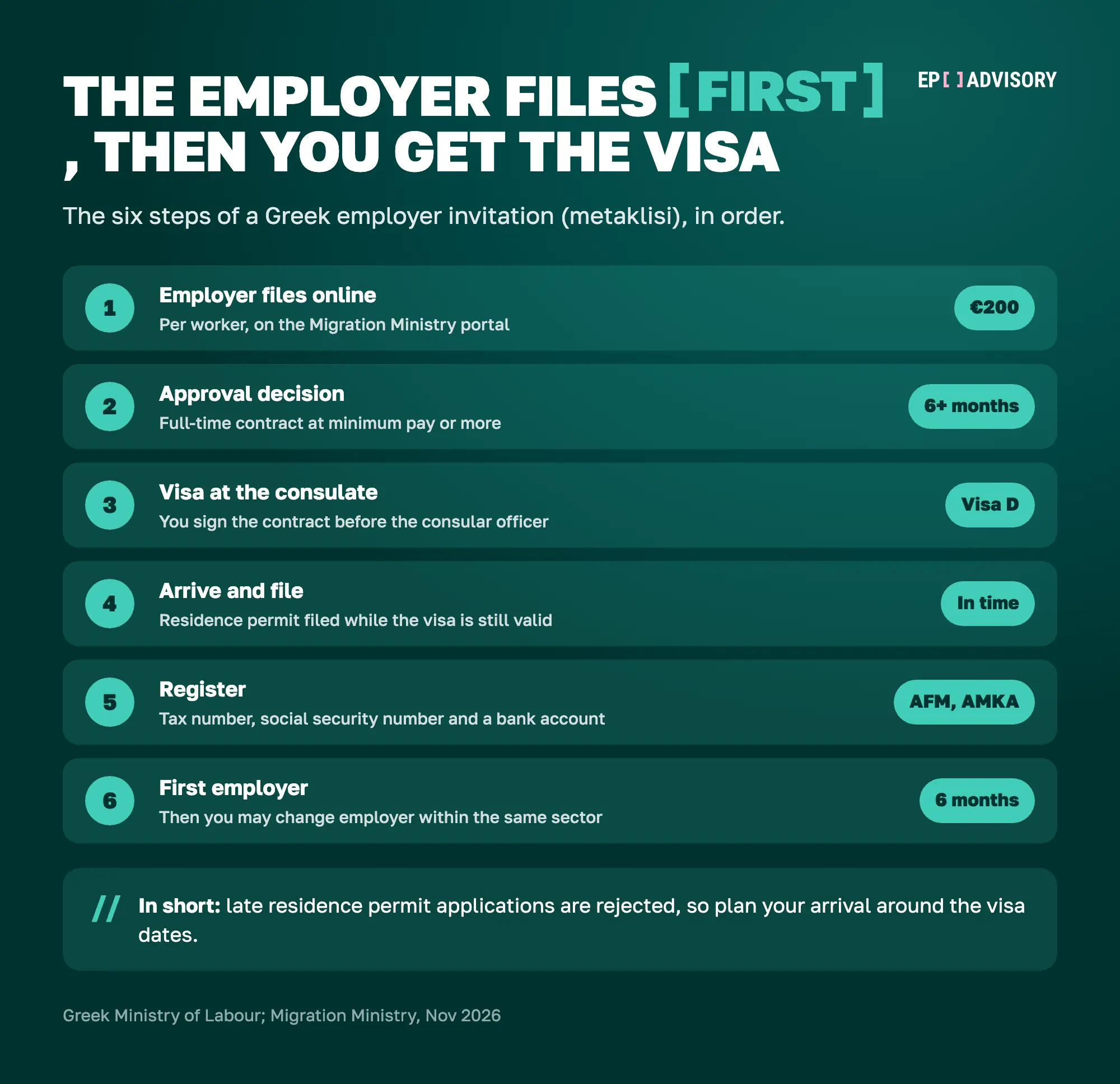
The steps run in a fixed order (Ministry of Labour):
- The employer offers a full-time contract of at least 6 months and files the invitation.
- The Decentralised Administration where the employer has its seat issues an approval decision.
- You apply for a national visa at the Greek consulate. You sign the work contract in front of the consular officer.
- You enter Greece and apply online for your residence permit while the visa is still valid. Late applications are rejected.
- You get a tax number (AFM), a social security number (AMKA) and a Greek bank account.
- On a single permit, you work at least 6 months for the employer who invited you.
The employer has to prove it can pay. It shows a tax return or tax statement, and the pay must be at least the monthly wage of an unskilled worker under the Labour Code. A temporary work agency can be the direct employer. It needs share capital of at least €1,000,000 and an agreement with the firm where you will work.
Once you file for the residence permit, you get an electronic submission certificate, known as the blue certificate, within 40 days. It lets you work while the permit is processed. Two 2026 changes help after arrival. You may change employer after 6 months, within the same sector, and renewed permits are issued for at least two years (Migration Ministry).
The 2026 quota: 94,240 places, set by job
Every year, the Council of Ministers sets the maximum number of non-EU workers employers can invite. For 2026, Act 35 of 27 November 2025 (Government Gazette A 241) sets 94,240 places. That is 44,240 for dependent work, 48,000 for seasonal work and 2,000 for high-skill jobs. The total can rise by up to 10% for urgent needs.
The places are set by job for the whole country, not by nationality. Apart from two seasonal agreements covered below, every non-EU citizen draws on the same lists. So before you contact employers, find the category your job falls under.
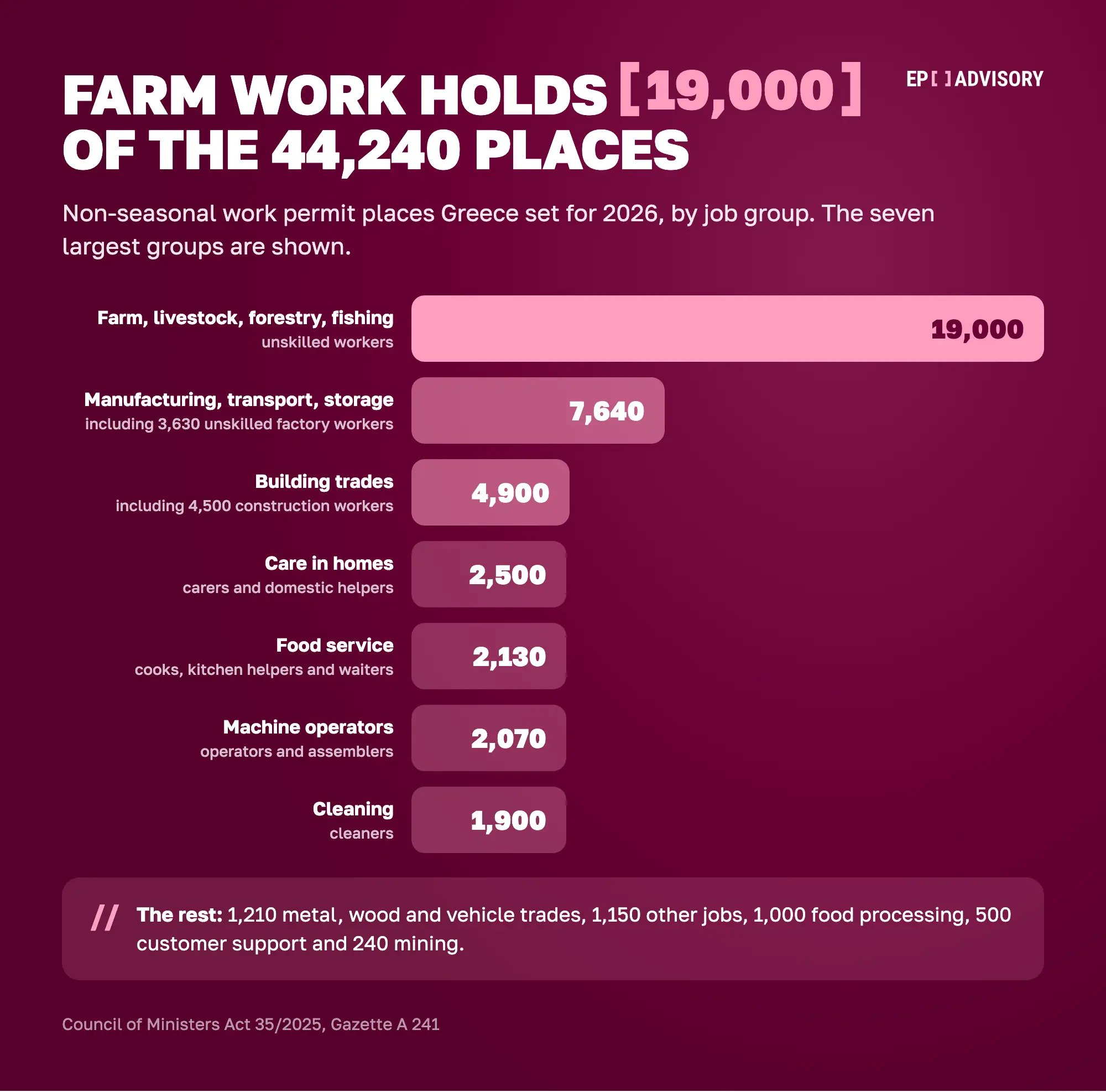
A few smaller lines matter for office and skilled workers. The decision sets 500 places for office staff in Greek branches of foreign companies who do product promotion and technical support for foreign customers. That is the customer support work recruiters often advertise for speakers of other European languages. It also sets 1,000 places for production line workers making pharmaceutical or medical products, and 150 for massage therapists. Roles that need a degree usually fit the Blue Card better than the quota lists.
Score your CV in 30 seconds, then fix its biggest problems one by one. Both free.
Free, no card. A free account unlocks every fix.

Seasonal and farm jobs: up to 9 months a year
Seasonal permits cover agriculture, forestry, livestock, fishing and tourism. You can work up to 9 months in total in any 12 months. Fishermen get a visa of up to 11 months, tied to one employer. An employer can ask to bring the same workers for up to 5 years at once. The multi-year seasonal permit lasts up to 5 years, can be renewed and allows no more than 10 years in total (Ministry of Labour).
The 48,000 seasonal places for 2026 split by job. Unskilled farm work has 32,000. Hotel food service has 6,200, of which 4,000 are kitchen helpers, 1,100 waiters, 700 cooks and 400 bar staff. Hotel cleaning has 4,800, fishing 4,000, other tourism staff 700 and transport 300.
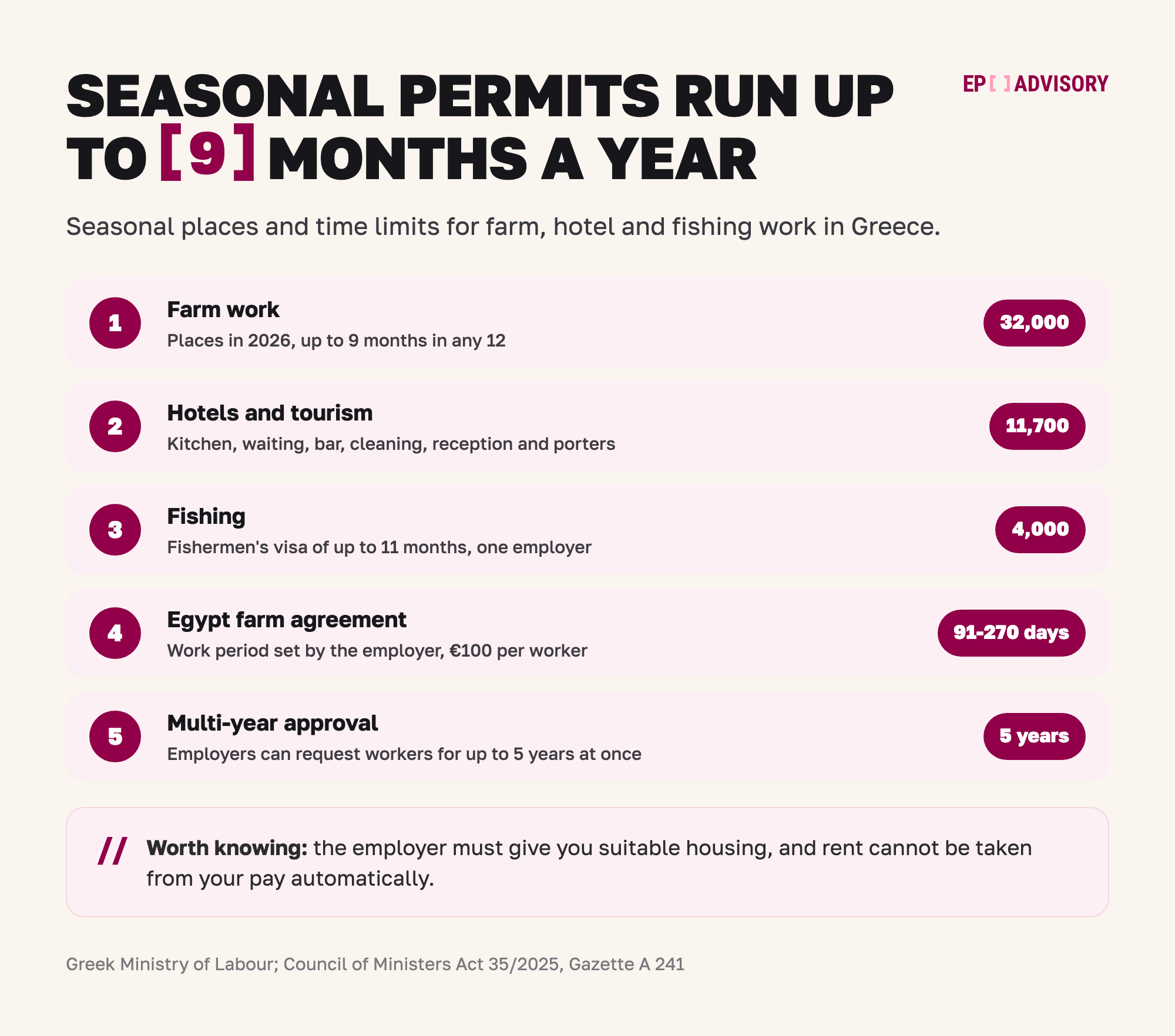
Two protections apply to every seasonal worker. The employer must provide suitable housing under Joint Ministerial Decision 41835/2024. Any rent must be proportionate to your pay, and it cannot be taken from your wages automatically. An employer that breaks seasonal work rules is barred from new invitations for 3 years.
Timing matters in tourism. Hotel demand is highest in the summer months on the South Aegean islands, the Ionian Islands and Crete, and Crete hires from spring (EURES labour market page). The invitation and the visa come before your first shift. So contact hotels and farms months ahead of the season, not when it starts.
Bangladesh and Egypt: the two agreements in force
Article 4 of the 2026 decision reserves up to 9,000 of the seasonal places for two bilateral agreements. These are the only nationality-specific places in the 2026 quota.
| Agreement | In force since | Reserved places in 2026 | Jobs covered |
|---|---|---|---|
| Greece-Bangladesh migration and mobility memorandum (Law 4959/2022) | 1 September 2022 | Up to 4,000 | Seasonal farm, forestry, livestock, fishing and tourism work |
| Greece-Egypt seasonal farm work agreement (Law 5009/2023) | 24 January 2023 | Up to 5,000 | Seasonal farm work |
Under the Egypt agreement, the employer files a separate application on the same portal. It sets the work period at between 91 and 270 days and pays €100 per worker.
Citizens of Pakistan, India, the Philippines, Nepal and every other non-EU country use the general route. The 2026 decision reserves no places for them. The rules are the same as for any invitation: a Greek employer files for a listed job, pays the fee and waits for approval, then you apply for the visa at the Greek consulate in your country. On the general route, the steps and fees are the same for every nationality. What changes your chances is whether your job is on the list and whether an employer files for you.
Which jobs are in demand in Greece
The shortage occupations named for 2024 were health professionals, customer services clerks, and stationary plant and machine operators. Most employees work in three sectors: trade at 24.5%, accommodation and food at 21.1% and manufacturing at 11.3%, in 2022 (EURES).
For unskilled jobs, the quota tells you where employers expect to hire. The 2026 lists include 19,000 farm, livestock, forestry and fishing workers, 3,630 unskilled manufacturing workers and 4,500 construction workers. They also include 1,900 cleaners, 1,500 domestic helpers, 1,200 kitchen helpers and 1,050 loaders. None of these needs a degree. The employer must still pay at least the minimum wage and give you a written contract.
Language shapes the rest, so check what each ad asks for. Roles serving foreign customers, such as the 500 support places above, are where non-Greek speakers have the clearest case. List every language you speak with its level on your CV, and start learning Greek before you arrive. If you are comparing Mediterranean markets, read our guides to jobs in Malta and jobs in Croatia too.
Pay versus the minimum wage
From 1 April 2026, the minimum wage is €920 gross a month for employees and €41.09 a day for manual workers (Ministerial Decision 8934/27.3.2026). In 2025, the figures were €880 and €39.30.
Greek private sector pay comes in 14 payments a year, not 12. You get 12 monthly salaries, a full extra month at Christmas, half a month at Easter and half a month in summer (EURES). The standard week is 40 hours. Paid leave is 20 working days a year on a five-day week. In your first 12 months, you earn it in proportion to the time you have worked.
| Pay floor | Amount | In US dollars |
|---|---|---|
| Minimum wage, monthly gross | €920 | about $1,037 |
| Minimum wage, yearly gross (14 payments) | €12,880 | about $14,512 |
| Manual worker, daily gross | €41.09 | about $46 |
| EU Blue Card, yearly gross (2024 figure) | €31,918.83 | about $35,963 |
Dollar figures use the ECB reference rate of $1.1267 per euro on 4 November 2026. When you compare offers, check whether the figure is gross or net and whether it counts 12 or 14 payments. A yearly figure divided by 14 gives the true monthly rate. Our guide to negotiating your salary helps once you have an offer.
Next: see how pay bars for work permits compare across Europe in our guide to work visa salary thresholds in Europe.
Where to search: DYPA, EURES and Greek job boards
Use public services first, then the private boards. Authorised private employment agencies may not charge you for finding work. In the words of EURES, “mediation does not entail any financial burden for employees”.
| Where | What it is good for |
|---|---|
| DYPA vacancy search | The public employment service, with 115 employment promotion centres and online CV registration |
| DYPA EURES and EURES portal | EU job ads and EURES advisers who handle cross-border hiring |
| kariera.gr | A Greek job board with private sector vacancies |
| xe.gr | A Greek classifieds site with a jobs section |
| Skywalker.gr and Indeed Greece | Greek job sites that gather private sector ads |
| LinkedIn Jobs and company sites | Multinationals and specialist roles |
Greek newspapers also carry manager and specialist ads, often in Greek and English. For any job, a Greek CV should be one or two pages and tailored to the role. Show each language with its level and add two or three references at the end. Keep the cover letter to one page and sign it by hand (EURES). Europass and DYPA templates are common, though many firms use their own forms. Our guides to the European CV format and a cover letter for a job abroad cover the layout, and you can turn duties into results with our CV achievement examples. If your CV was built for another market, rework it for Greek employers before you send it. Getting ready to apply for jobs in Greece? Check your CV for free: see it the way a recruiter does, then fix each problem.
When an employer replies, prepare for an interview, which may be online while you are abroad. Our guide on how to pass a job interview walks through the common questions. For a wider search plan across countries, see how to find a job in Europe.
How to spot a fake offer
Fake Greek job offers usually break one of the official rules. Check any offer against this list.
- A fee for the job. Authorised agencies may not charge workers. The invitation fee of €200 or €100 is paid by the employer when it files. Be wary of anyone who asks you to cover it.
- No contract, or a contract under 6 months. A dependent work invitation needs a full-time contract of at least 6 months. You sign it at the consulate.
- Pay below the minimum. Invitation pay must be at least the unskilled worker wage, and the 2026 minimum is €920 a month.
- Rent taken straight from your pay. For seasonal work, the employer must provide housing, and rent cannot be deducted automatically.
- Come on a tourist visa and we will sort it out. Work needs the approval decision and a national visa first. Employers face fines of €10,500 per undeclared worker and €5,000 per worker without legal stay, doubled for repeat offences.
If something looks wrong, ask the employer for its company name and tax number, then check with the authorities. You can contact the Labour Inspectorate, the Greek Ombudsman or the Ministry of Labour call centre on 1555.
Key takeaways
- EU, EEA and Swiss citizens can work in Greece without a permit and register with the police after 3 months.
- Non-EU workers need a Greek employer to file an invitation online first, at €200 per worker for dependent work or €100 for seasonal work.
- Greece set 94,240 work places for 2026, by job and not by nationality, with 19,000 dependent places in farm, livestock, forestry and fishing work.
- Seasonal permits allow up to 9 months of work in any 12, or up to 11 months for fishermen, with housing provided by the employer.
- Only Bangladesh and Egypt have reserved places in 2026. Every other country uses the general route.
- The minimum wage is €920 a month from 1 April 2026, paid 14 times a year, which makes €12,880 gross.
- No authorised agency may charge you for a job, so treat any fee request as a warning sign.
See what a recruiter sees, then fix it before you apply. An instant score, then the fix for every problem.
Free, no card. A free account unlocks every fix.
Frequently asked questions
Can I get a job in Greece with visa sponsorship?
Yes. In Greece, sponsorship means an employer invitation, called a metaklisi. The employer files it online for a full-time contract of at least 6 months and pays €200 per worker. After approval, you apply for a national visa at the Greek consulate. Greece set 94,240 work places for 2026.
How do I apply online for a Greece work visa in 2026?
You do not file the first application yourself. Your Greek employer files the invitation on the Migration Ministry’s employer portal with its TAXISnet codes. Once it is approved, you apply for the visa at the Greek consulate. After you arrive, you apply online for the residence permit while your visa is still valid.
Can Pakistani citizens get a work visa for Greece?
Yes, through the general route. A Greek employer files an invitation for a job on the 2026 list, then you apply for a national visa at the Greek consulate. The 2026 decision reserves no places for Pakistan. Only Bangladesh and Egypt have reserved seasonal places.
Are there unskilled jobs in Greece for foreigners?
Yes. Most 2026 permit places are for jobs without a degree. They include 19,000 farm and livestock workers, 4,500 construction workers, 3,630 unskilled manufacturing workers, 1,900 cleaners and 1,500 domestic helpers. A further 32,000 seasonal farm places are open. Pay must be at least the minimum wage.
How long can I work in Greece on a seasonal permit?
Up to 9 months in total in any 12 months, in farming, forestry, livestock or tourism. Fishermen can get a visa for up to 11 months. Employers can request workers for up to 5 years at once, and the employer must provide suitable housing.
What is the minimum wage in Greece in 2026?
From 1 April 2026, it is €920 gross a month for employees and €41.09 a day for manual workers. Private sector pay comes in 14 payments a year, so the monthly minimum adds up to €12,880 gross a year.