 By Andre Atallah, CEO of EP Advisory

Short answer: yes, foreigners can get jobs in Romania, and non-EU workers need an employer to file for them. Since 8 August 2026 the old work permit (aviz de muncă) is gone. The employer or a licensed agency now files one single application on WorkinRomania.gov.ro, which leads to a D/AM work visa and then a residence card. The 2026 quota is 90,000 places. EU citizens apply and start like locals.
Romania rebuilt its foreign hiring system in 2026. Emergency Ordinance 32/2026 came into force on 27 April 2026 and replaced the employer’s work permit with a single online application. It also set new rules on agencies, housing and changing employer (OUG 32/2026). Many guides online still describe the old aviz, so check their date.
This guide covers the two visa routes, the quota, each legal deadline, how to check an employer, pay and your rights.
Immigration rules change often, so check the current rules with the official authority before you act.
For nearly 10 years, we’ve helped more than 5,000 professionals find jobs abroad. Want to know if your CV will pass screening in Romania? Check your CV for free: a score in 30 seconds, then a fix for each problem.
Can foreigners work in Romania? The two visa routes
EU, EEA and Swiss citizens can work in Romania without a permit. Everything below applies to non-EU citizens.
Non-EU workers enter on a long-stay work visa, coded D/AM. The ordinance splits it into two types, and the type decides who files your application and whether the quota applies to you.
| Visa type | Who it covers | Who files | Quota | Pay rule |
|---|---|---|---|---|
| D/AM1 | Highly qualified workers; staff for ministry-requested projects; state university and cultural staff; professional athletes; full-time workers from Moldova, Ukraine and Serbia | The employer alone | Not tied to the quota | Average gross earnings (9,192 lei a month) for highly qualified workers; at least the minimum wage for others |
| D/AM2 | Permanent, seasonal and cross-border workers in an occupation on the shortage list | A licensed placement agency or an authorised employer | Issued only while the 90,000 quota lasts | At least the minimum gross wage (4,325 lei a month) |
| EU, EEA or Swiss citizen | Any job | No one | None | Same as locals |
The split comes from articles 27^1, 27^2 and 44 of the ordinance (OUG 32/2026).
A highly qualified job needs a full-time contract, open-ended or at least 6 months long. You need a recognised degree or, in some cases, 5 years of relevant experience, or 3 of the last 7 years for ICT roles. The employer needs a labour-availability certificate from ANOFM, the national employment agency, issued within the last 90 days. To compare the 9,192 lei bar with other countries, see our guide to work visa salary thresholds in Europe.
The 2026 reform: what replaced the aviz de muncă
From 8 August 2026, the employer’s work permit no longer exists for new hires. Before, the employer got an aviz de muncă from the immigration office (IGI), then the worker applied for a visa. OUG 32 repealed that system. Applications filed before 27 April 2026 were still decided under the old rules (articles 48 to 51).
The new system runs on one government platform, WorkinRomania.gov.ro. Four changes matter most to a worker:
- One application. The employer or agency files a single application (cerere unică). It covers the visa and the right to work.
- Registered employers only. An employer must register on the platform before it can hire a foreigner (article 4).
- Licensed agencies for most jobs. D/AM2 hires go through an authorised placement agency or an employer authorised by the state.
- A higher visa fee. The long-stay visa now costs €300, up from €120, for applications made through the eViza portal since 27 April 2026.
One catch applies today. The Bucharest Court of Appeal has suspended the order that approved the shortage list, Order 1073/2026, in case 5633/2/2026. So the platform has switched off new employer registration, employer authorisation and D/AM2 applications (WorkinRomania notice). The notice does not mention D/AM1 applications. If your job is on the D/AM2 route, ask the employer or agency to show you the date their application was filed.
Score your CV in 30 seconds, then fix its biggest problems one by one. Both free.
Free, no card. A free account unlocks every fix.

The 2026 quota: 90,000 places for new workers
Romania caps the number of new foreign workers each year. For 2026 the cap is 90,000, set by Government Decision 1.169/2025, down from 100,000 a year in 2022 to 2025. OUG 32 keeps that decision in force for quota checks (article 53).
Under the new law, the cap only limits D/AM2 visas, and the government can raise it during the year (article 1). D/AM1 workers do not compete for these places.
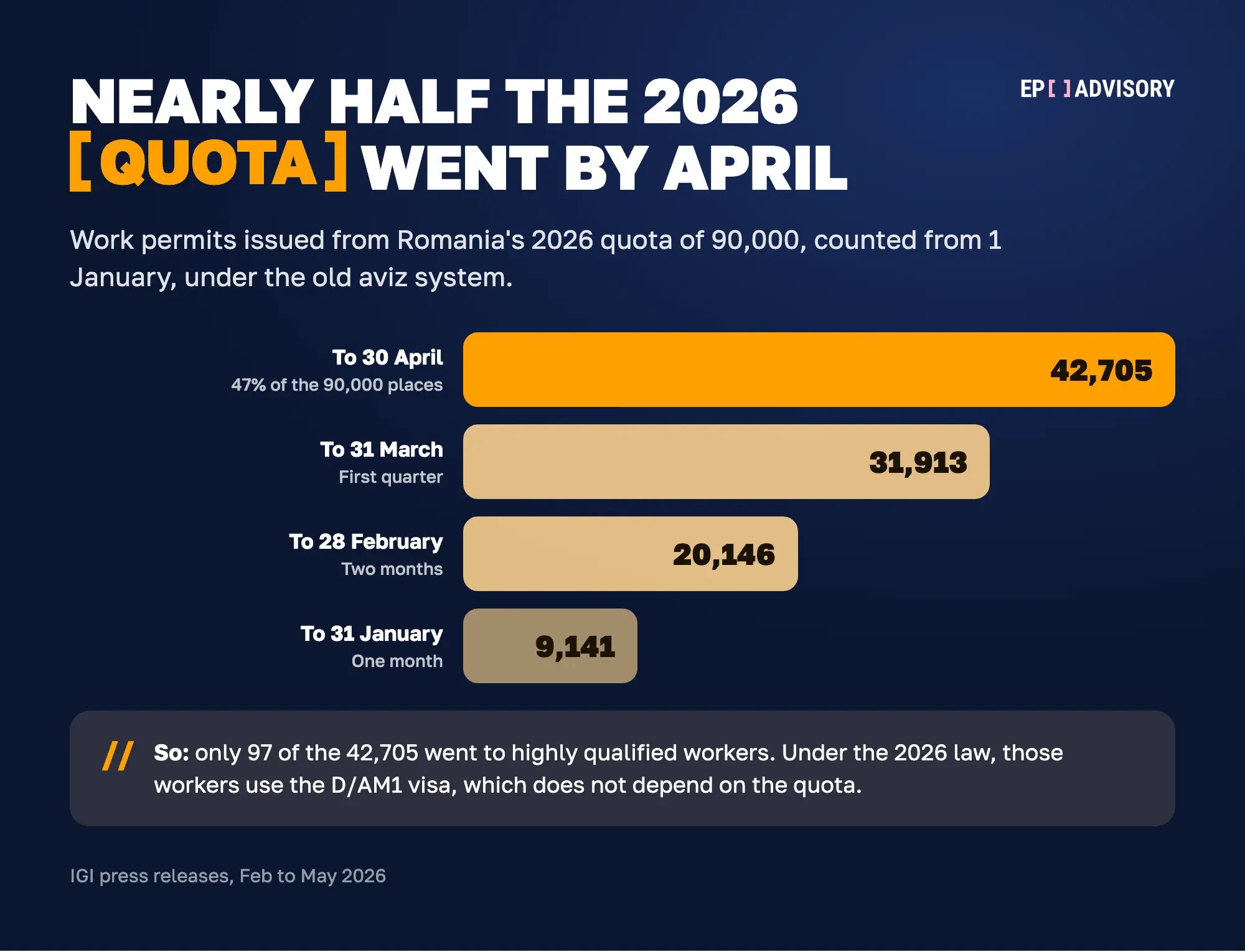
The quota filled fast under the old system. By 30 April 2026, IGI had issued 42,705 work permits from the 2026 quota, almost half the total. Of these, 42,371 were for permanent workers and only 97 were for highly qualified workers (IGI, 6 May 2026). So if you have a degree-level offer, the D/AM1 route is likely to be the quicker one.
Steps from job offer to residence card
The process has three stages: the single application, the D/AM visa and the residence card. Each stage has a legal deadline in the ordinance.
- Contract. You sign a job contract, and the employer registers it in REGES-ONLINE, the national employee register.
- Single application. The employer (D/AM1) or the agency or authorised employer (D/AM2) uploads the contract and your documents to WorkinRomania. IGI checks them within 30 days of filing (article 44(10)). A rejection at this check cannot be appealed.
- Documents you supply. A legalised criminal record certificate translated into Romanian, English or French; travel medical insurance of at least €30,000; a passport copy; and, unless you are highly qualified, proof of funds equal to 90 days at the minimum wage.
- Visa. You apply on eViza, the Foreign Ministry’s visa portal, and attend the consulate with your original passport. The consulate decides within 30 days of your appointment (article 44(14)). The fee is €300.
- Entry. The visa is valid for 90 days. For seasonal work it covers the contract plus 5 days, up to 90 days.
- Residence card. The employer or agency files a new single application to extend your stay. IGI decides within 30 days, plus 15 for extra checks. Once approved, you book biometrics at your county IGI office within 10 days (article 56(11)). You then receive a single permit (permis unic) or an EU Blue Card.
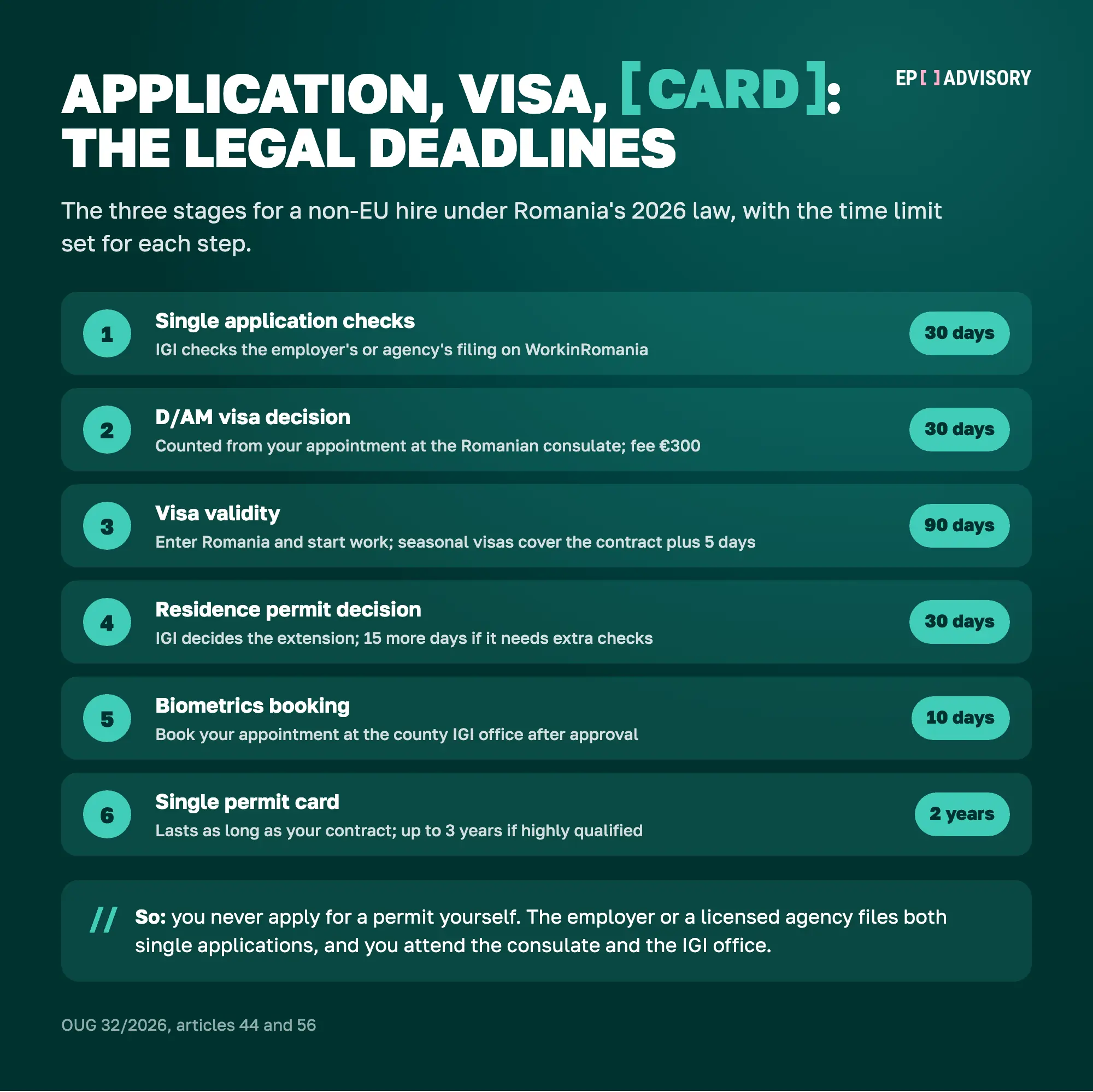
The single permit lasts as long as your contract, up to 2 years, and highly qualified workers can get up to 3 years. Graduates of Romanian universities with a valid study permit can switch to work without leaving for a new visa (article 56(9)).
How to check a Romanian work permit or job offer
There is no public IGI page where you type in a permit number. The IGI portal is a login service for booking appointments. Under the 2026 law, the useful checks are in the public registers on WorkinRomania. Every registered employer, licensed agency and authorised employer goes into one of them automatically (article 41).
Run these five checks before you pay for flights or quit a job:
- The employer is in R.A.S. Search the employer register by company name or CUI, the Romanian tax number, on the public registers page. An employer that is not registered cannot hire you under the new system.
- The agency is in R.A.P.S. If an agency recruits you, find it in the placement agency register. If the employer says it files D/AM2 applications itself, look for it in R.A.A., the register of authorised employers.
- Your job is on the shortage list. For a D/AM2 visa, your occupation must be on the shortage list. Ask for the occupation code on your contract and search it.
- Your visa comes from a consulate. A real D/AM visa is applied for on eViza and stamped by a Romanian consulate. Nobody else can issue one, and the fee is €300.
- Your contract is in REGES-ONLINE. Ask the employer for proof that your contract is registered. Every permit depends on that record.
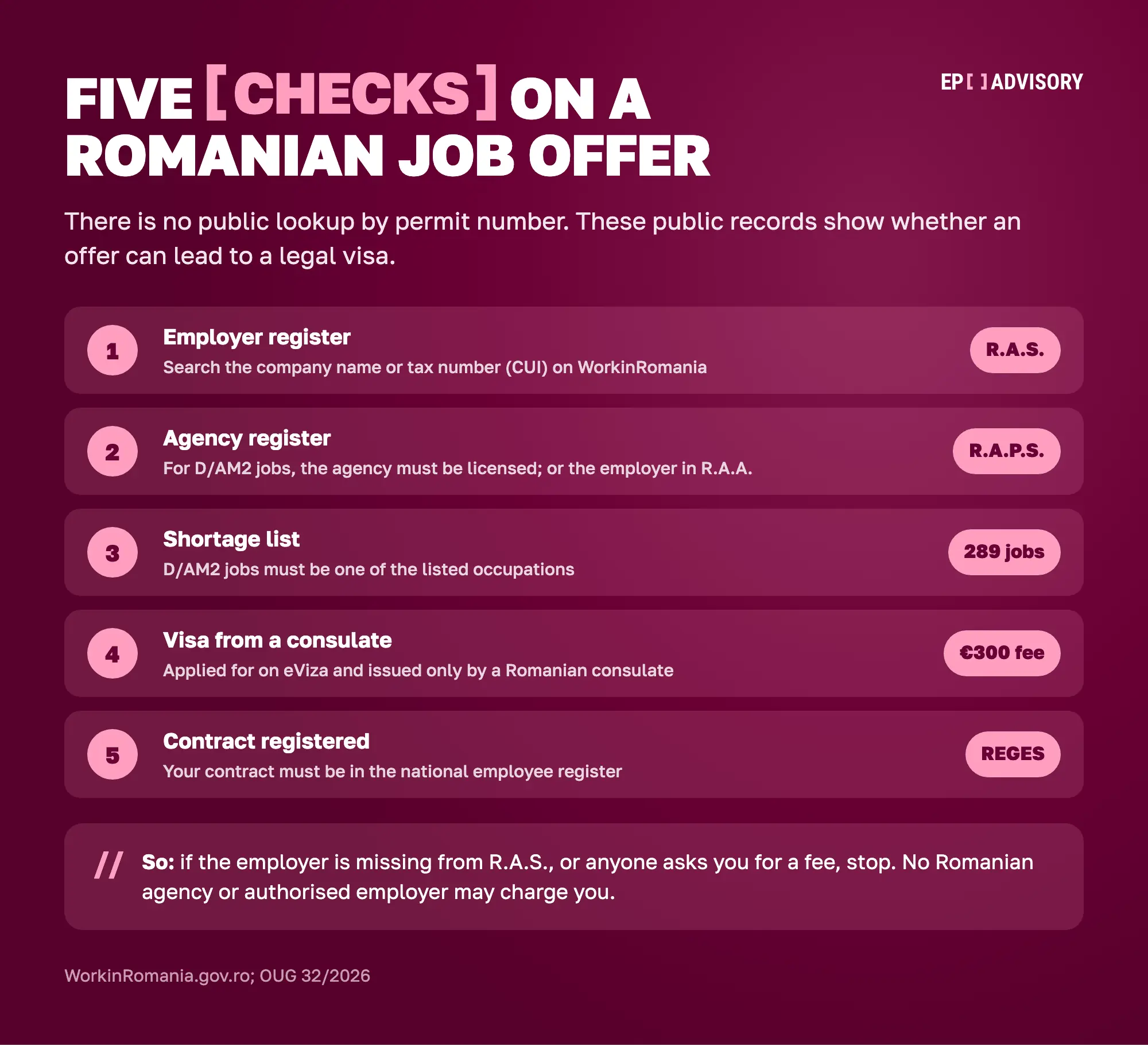
Compare the register’s company name and tax number with your contract. If they do not match, stop and ask. You can report a suspicious offer through the platform’s reporting page.
Changing employer: the 6-month and 2-year rules
D/AM2 workers are tied to their first job for at least 6 months. The ordinance counts from the start date in REGES-ONLINE. During those 6 months, you cannot start a change of employer yourself, unless the employer seriously breaches the contract. After 6 months, and until 2 years from your start date, you can change employer only through the placement agency that brought you (OUG 32, title I).
On a single permit or EU Blue Card, you can resign and move after at least 6 months with your previous employer (article 56(13)). If the job ends early, you keep your right to stay while you receive unemployment benefit, or for 90 days. For an agency placement, the agency must try to present at least 2 job offers from other employers within those 90 days.
The court suspension affects this too. On 25 September 2026, IGI said D/AM2-type extensions for a change of employer cannot be filed for now, and will be assessed one by one when filing resumes (IGI notice). If you plan a move, ask your county IGI office before you resign.
Which jobs foreigners get in Romania
The shortage list points foreign workers to couriers, warehouses, construction, hotels and food. The list on WorkinRomania has 289 occupations. It is updated every six months. Typical entries include:
- Warehouse and logistics: goods handler (manipulant mărfuri), forklift driver (stivuitorist), warehouse keeper (gestionar depozit), loader-unloader and hand packer.
- Couriers and drivers: courier, courier agent, truck and HGV drivers, bus and trolleybus drivers.
- Construction and trades: bricklayer, steel fixer, scaffolder, welder in several grades, electrician, plumber, solar panel installer.
- Hotels and food: cook, kitchen assistant, waiter, barista, hotel receptionist, baker and pizza maker.
- Care: home carer for older people, nursing auxiliary and childminder.
- Unskilled work: several unskilled labourer (muncitor necalificat) entries in farming, packaging, metalwork, road maintenance and demolition.
Software developers are not on the list, apart from a junior programmer entry (programator ajutor) and some IT technician roles. So a specialist outside the list needs the highly qualified D/AM1 route, at 9,192 lei a month or more.
The work visa does not test your Romanian. Your employer must provide Romanian lessons for at least 6 months, at least 6 hours a week. Long-term residence later requires Romanian at level A2.
Minimum wage and pay in Romania in 2026
The minimum gross wage is 4,325 lei a month from 1 July 2026, or about 25.95 lei an hour. It was 4,050 lei before that date (Government Decision 146/2026). That is about €809 or $910 at the National Bank of Romania rates for 4 November 2026 (BNR). An employer that pays less risks a fine of 3,000 to 5,000 lei per worker (Labour Inspectorate).
The bar for highly qualified workers is the average gross earnings figure in the state social insurance budget. For 2026 it is 9,192 lei a month (Law 44/2026, article 19), about €1,720 or $1,934. Every work permit extension also needs a full-time contract at least at the minimum wage.
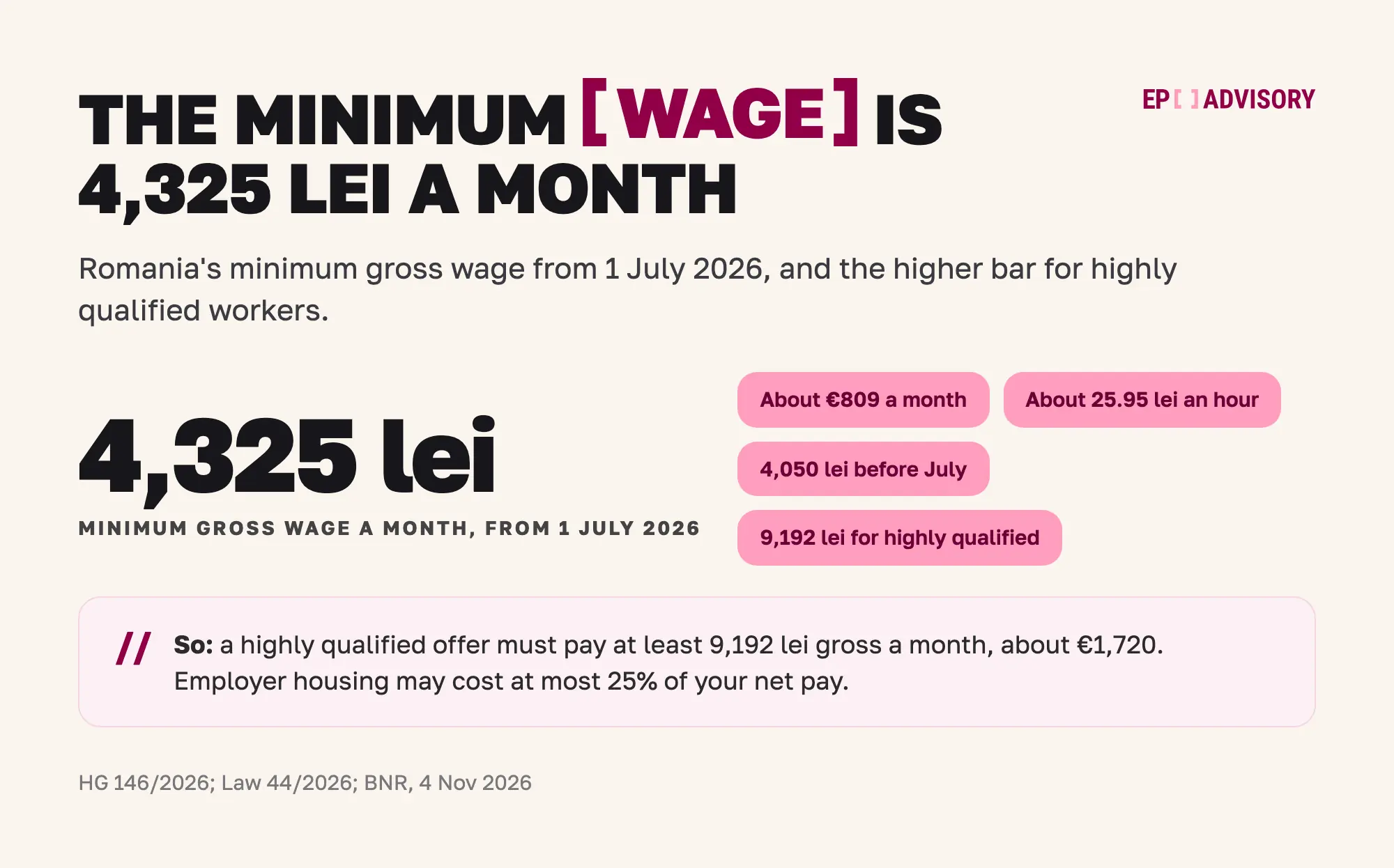
Romanian offers state pay as a gross monthly figure (salariu brut). Ask for the net figure too, and ask whether housing is included. When you have an offer in hand, our guide on how to negotiate salary helps you ask for more.
Next: see how Romania’s 9,192 lei bar compares with Poland’s market in our guide to salaries in Poland.
Where to find jobs in Romania and how to apply
Search Romanian job boards and go direct to employers that are already registered. The R.A.S. register lists every company that has signed up to hire foreigners, so it doubles as a target list for direct applications.
| Where | Best for | Language of most ads |
|---|---|---|
| International companies and English-speaking roles | English | |
| eJobs | The broad Romanian private-sector market | Romanian, some English |
| BestJobs | Office, sales and IT roles | Romanian and English |
| ANOFM | Vacancies declared to the national employment agency, which D/AM2 hires depend on | Romanian |
| EURES Romania | EU job mobility network, with living and working information | English and Romanian |
| WorkinRomania registers | Names of employers and agencies allowed to hire foreigners | Romanian |
Ask on the first call which visa type the employer will use, D/AM1 or D/AM2. If it is D/AM2, ask which licensed agency will file. Our guide on how to find a job in Europe covers the wider method. For nearby EU markets, see our guides to jobs in Poland and jobs in Croatia.
For a highly qualified role, your CV is part of the official file. The employer uploads it with the single application, so its dates, titles and degree must match your documents.
- Your status. State your nationality and the visa type you expect. Moldovan, Ukrainian and Serbian citizens can be hired on D/AM1, so say so.
- Experience in years. Without a degree, show 5 years of relevant work, or 3 of the last 7 for ICT roles, with clear dates.
- Results, not duties. Use numbers, as in our CV achievement examples. For layout, see the European CV format.
If your CV was written for another market, rework it for a Romanian employer before you apply. Getting ready to apply for jobs in Romania? Check your CV for free: see it the way a recruiter does, then fix each problem.
Add a short cover letter for a job abroad with your start date. Our guide on how to pass a job interview covers preparation.
Scams and your rights: what no one may charge you
No Romanian placement agency or authorised employer may charge you a fee, commission or deposit for a job. A recruiter in your home country that works for a Romanian employer is bound by the same ban, except within limits your own country’s law allows. A licensed Romanian agency must also lodge a financial guarantee of at least €75,000 with the tax authority. The official visa cost is the €300 consular fee.
Many Romanian work visas are never used for work. Over half of foreigners leave Romania after getting a long-stay work visa. In the first 9 months of 2025, 24.5% of migrants caught crossing a border illegally had entered Romania legally on a work visa (WorkinRomania statistics). The new rules exist to stop this, and they give you protections:
- Job facts 10 days ahead. On an agency placement, you get the key facts about your job at least 10 days before you arrive.
- A contract you can read. It must be in Romanian and in a language you understand.
- Housing capped at 25% of net pay when the employer provides it.
- Your passport stays with you. An employer that holds it is a warning sign.
- Several places to report. The WorkinRomania worker page lists them: the platform, the Labour Inspectorate, IGI, the Police and ANITP, the national anti-trafficking agency.
Treat these as red flags: a request for money, no contract before departure, an employer missing from R.A.S., or a promise that you can enter without a visa.
Key takeaways
- Since 8 August 2026, the employer or a licensed agency files one single application on WorkinRomania.gov.ro. The old aviz de muncă is gone.
- Highly qualified workers and full-time workers from Moldova, Ukraine and Serbia use the D/AM1 visa, filed by the employer alone.
- The 2026 quota of 90,000 places applies to D/AM2 visas, for jobs on the 289-occupation shortage list.
- D/AM2 applications are paused while a court suspends the shortage list.
- Check the employer in R.A.S. and the agency in R.A.P.S. before you travel. No Romanian agency or employer may charge you a fee.
- The minimum gross wage is 4,325 lei a month. The highly qualified bar is 9,192 lei.
See what a recruiter sees, then fix it before you apply. An instant score, then the fix for every problem.
Free, no card. A free account unlocks every fix.
Frequently asked questions
Can foreigners get a job in Romania in 2026?
Yes. EU citizens apply like locals. Non-EU workers need an employer registered on WorkinRomania.gov.ro. Highly qualified workers and full-time Moldovan, Ukrainian and Serbian workers use the D/AM1 visa. Most other jobs use D/AM2, within the 2026 quota of 90,000.
How do I get a work permit for Romania in 2026?
You do not apply for a permit yourself. Your employer, or a licensed placement agency for D/AM2 jobs, files a single application on WorkinRomania.gov.ro. After it is approved, you apply for a D/AM visa on eViza and attend the consulate. In Romania, you get a single permit card from IGI.
How can I check if my Romanian work permit is real?
There is no public lookup by permit number. Search the employer in the R.A.S. register and the agency in the R.A.P.S. register on WorkinRomania.gov.ro. Check your occupation is on the shortage list for D/AM2 jobs. A real visa is applied for on eViza and issued only by a Romanian consulate.
Can I change employer in Romania on a work visa?
On a D/AM2 visa, you cannot start a change for 6 months from your start date, unless the employer seriously breaches the contract. Until 2 years, changes go through your placement agency. On a single permit or Blue Card, you can resign and move after 6 months.
What is the minimum wage in Romania in 2026?
4,325 lei gross a month from 1 July 2026, or about 25.95 lei an hour. That is about €809 at the BNR rate of 4 November 2026. Highly qualified workers need at least 9,192 lei gross a month, the 2026 average gross earnings figure.
Are there unskilled and warehouse jobs in Romania for foreigners?
Yes. The shortage list includes unskilled labourer roles in farming, packaging and construction, and warehouse roles such as goods handler, forklift driver and loader. These jobs use the D/AM2 visa through a licensed agency or authorised employer, and neither may charge you a fee.