 By Andre Atallah, CEO of EP Advisory
Short answer: yes, foreigners can get jobs in Croatia, and Croatia issued 170,723 work permits in 2025. If you are not an EU citizen, the employer does most of the work. First it asks the Croatian Employment Service (HZZ) for a labour market test. Then it files your stay-and-work permit with the police, who have 90 days to decide. The official permit and card fees come to about €115.
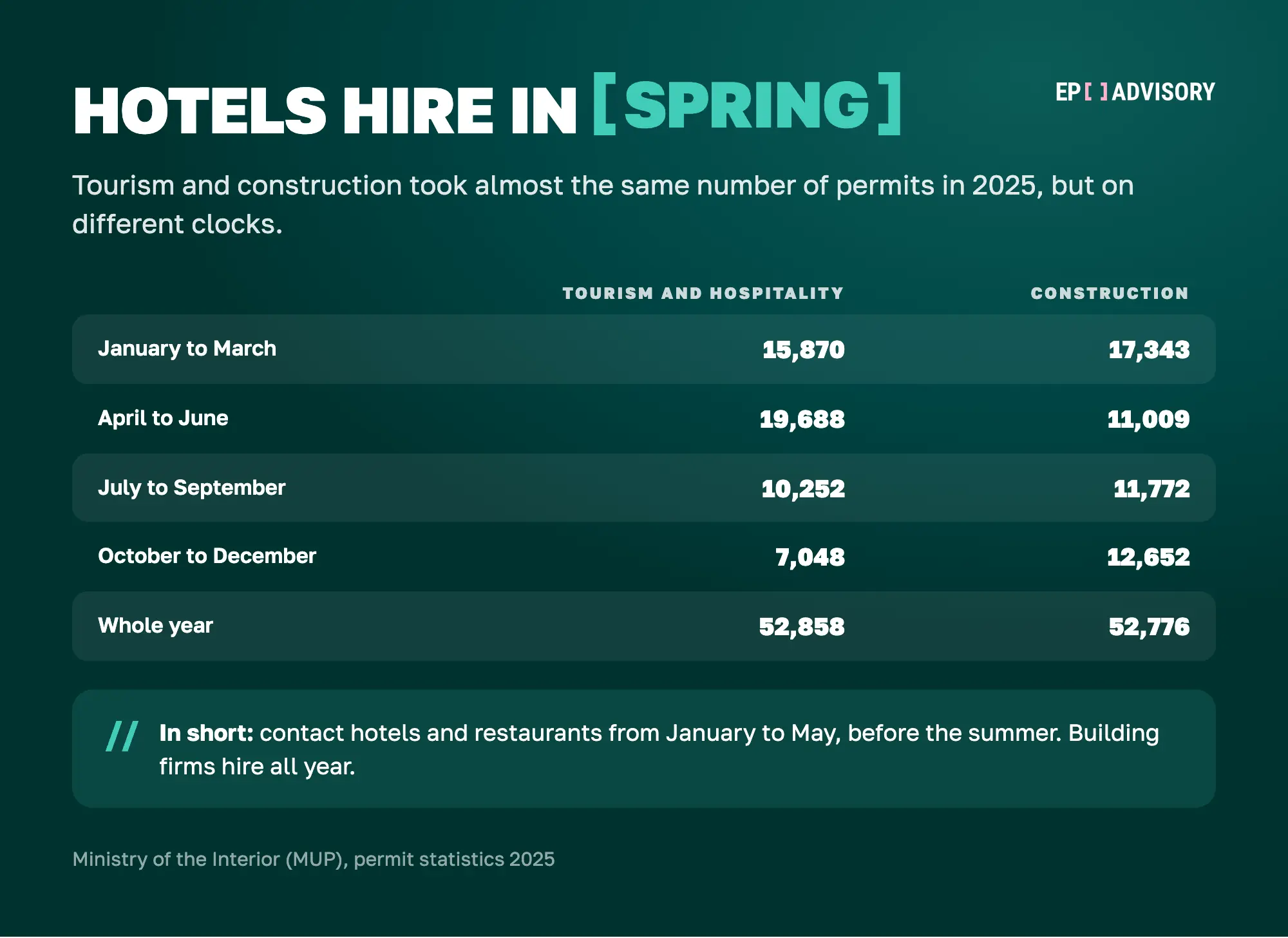
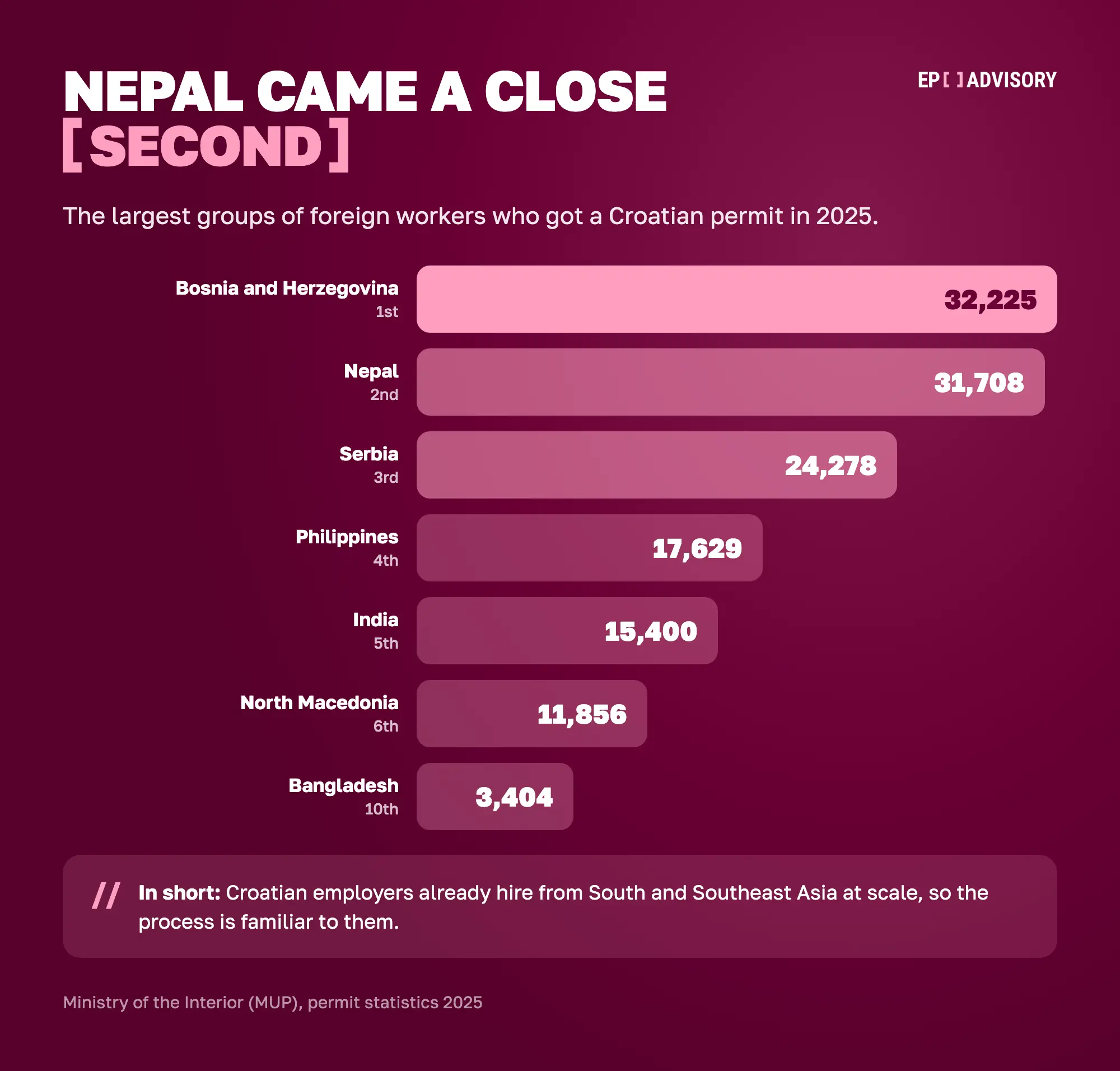
Croatia relies on foreign workers. In 2025 the Ministry of the Interior (MUP) issued 170,723 stay-and-work permits, according to its permit statistics. Hotels and restaurants took 52,858 of them and building sites took 52,776. Workers from Nepal, India, the Philippines and Bangladesh are now among the largest groups, next to neighbours such as Bosnia and Herzegovina and Serbia. For you, this means Croatian employers know the process and many have done it before.
The route is the same whether the job is in a Zagreb office, a Split hotel or a warehouse near Rijeka. You need a real employer who meets the conditions in the Aliens Act, and that employer applies. Below are the steps, the legal deadlines, the fees and the rights you keep at work. Immigration rules change often, so check the current rules with the official authority before you act.
For nearly 10 years, we’ve helped more than 5,000 professionals find jobs abroad. Want to know if your CV will pass screening in Croatia? Check your CV for free: a score in 30 seconds, then a fix for each problem.
Who needs a work permit in Croatia
EU, EEA and Swiss citizens do not need a work permit in Croatia. You apply for jobs like a local. Everything else on this page is for citizens of other countries, called third-country nationals in Croatian law.
For third-country nationals, the main document is the stay-and-work permit (dozvola za boravak i rad). It covers both your right to live in Croatia and your right to do one job for one employer. The permit always starts from a job offer. The table shows which version fits which worker.
| Who you are | What you need | Labour market test | How long it lasts |
|---|---|---|---|
| EU, EEA or Swiss citizen | No permit | No | No limit |
| Non-EU worker, regular job | Stay-and-work permit | Yes, unless the job is on the shortage list | Contract length, up to 3 years |
| Non-EU seasonal worker in tourism, farming or forestry | Seasonal stay-and-work permit | No, for up to 90 days | Up to 9 months a year |
| Graduate or specialist on high pay | EU Blue Card | No | Up to 48 months |
| Key staff, intra-company transferee | Stay-and-work permit under Article 110 | No, and no HZZ opinion | Up to 2 years |
If you are from a country whose citizens need a visa for Croatia, you also apply for a long-stay visa once the permit is approved. That includes citizens of India, Nepal, Bangladesh and the Philippines. Citizens of visa-free countries skip the visa step.
How the permit works: your employer files first
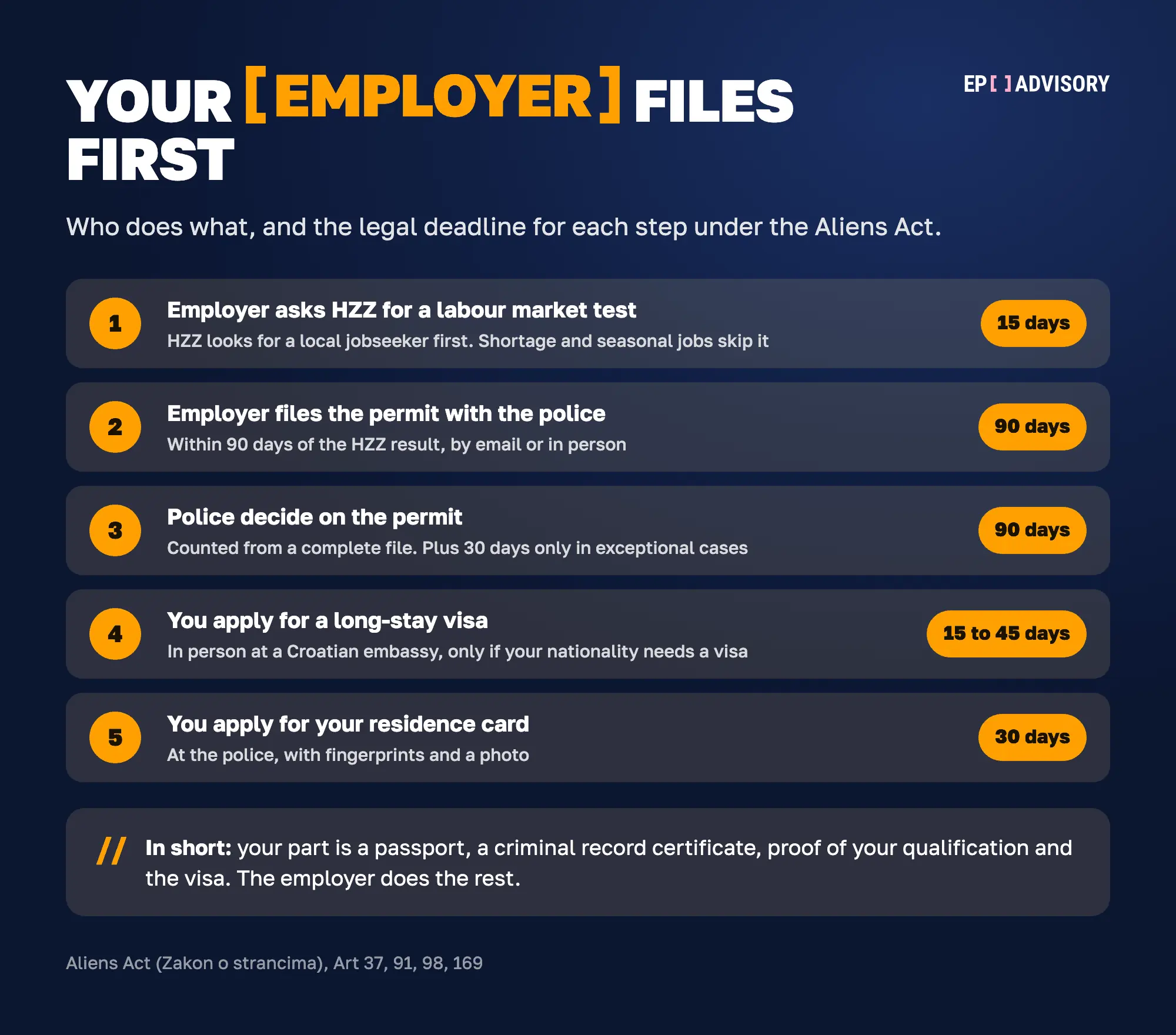
The steps below follow the Aliens Act (Zakon o strancima), which sets a deadline for every stage.
- The employer asks HZZ for a labour market test. HZZ checks whether a suitable person is already registered as unemployed in Croatia. It gives its result within 15 days.
- The employer files the permit application. It has 90 days from the HZZ result to send it to the police administration where you will work. Employers can send it by email as a PDF.
- The police decide. The law gives them at most 90 days from a complete application. In exceptional cases they can add 30 days, but never for seasonal work.
- You apply for a long-stay visa, if your nationality needs one. You go in person to a Croatian embassy or consulate within 3 months either side of the permit start date. The consulate decides within 15 days, or 45 days at most.
- You arrive and apply for your residence card. You have 30 days from the start of your visa. The police take your fingerprints and photo for the biometric card.
You can start work once the police confirmation reaches your employer and you are registered for pension and health insurance. Your part of the file is short. You give your employer a passport valid at least 3 months beyond the contract, a criminal record certificate from your home country, proof of your qualification and, for visa nationals, a recent health certificate, according to the MUP filing guidance from November 2026.
Score your CV in 30 seconds, then fix its biggest problems one by one. Both free.
Free, no card. A free account unlocks every fix.

The HZZ labour market test, and who skips it
The labour market test is where many Croatian applications slow down, and it is the employer’s job, not yours. HZZ looks for a registered jobseeker who could fill the role. If it finds local workers for an occupation, it will not run a new test for that occupation for 90 days. That is why some employers wait and then try again.
Several groups skip the test, according to HZZ and the Aliens Act:
- Seasonal work in hospitality, tourism, farming and forestry for up to 90 days.
- A renewal with the same employer, in the same job.
- Jobs on the HZZ shortage list. These skip the test, but HZZ still gives an opinion on the employer and the contract. The list of exempt occupations is long and covers many trades.
- Key staff, EU Blue Card holders, intra-company transferees and a few other groups. They need neither the test nor the HZZ opinion.
The process also checks the employer, which protects you. A Croatian employer must have run its business for at least a year, paid its taxes and had at least one local worker on a permanent full-time contract. A company needs at least €100,000 flowing through its bank account in the last 12 months. Local staff must make up at least 20% of its foreign workers, or 10% for shortage jobs. Your pay must match what Croatian workers get for the same job under the law and collective agreements. A firm with no office, no local staff and no turnover cannot pass these checks.
Processing time and fees: what to expect
The legal deadlines add up to about 5 months if the employer files straight after the test. That is 15 days for the test, 90 days for the police and up to 45 days for the visa. The law tells the police to decide as soon as possible, so many cases finish sooner. The wait grows if the employer uses its full 90 days to file, or if the police add their extra 30 days.
The official fees are low. These are the amounts on the MUP fees page:
| Item | Fee |
|---|---|
| Stay-and-work permit | €74.32 |
| Biometric residence card | €31.85 (€59.73 fast track) |
| Extra fee for issuing the card | €9.29 |
| Work registration certificate (jobs that need no permit) | €39.82 |
| Long-stay visa | Set by the consulate |
The permit, card and card fee come to €115.46 in total. Use it as your yardstick when anyone quotes you a fee. Renewals must be filed at least 30 days before your permit runs out, so diary the date the day you get your card.
Where foreigners work in Croatia: tourism, construction, transport
Tourism and construction take more than 60% of all permits. Industry came third in 2025 with 24,479 permits, then transport and communications with 13,039 and trade with 8,601. The Zagreb police area issued the most permits, 43,113. Next came the coastal areas of Istria, Split-Dalmatia and Primorje-Gorski Kotar around Rijeka, where the hotel trade is concentrated.
The two big sectors hire on different clocks. Tourism permits peak in spring, from March to June, because hotels need staff in place before the summer. By August, tourism permits fall to under a third of the June figure. Construction hires all year, with its busiest quarter in January to March. If you want a hotel job in Croatia, contact employers between January and May. Construction and transport employers can be approached at any time.
Seasonal permits last up to 90 days or up to 9 months in a calendar year. An employer can also get a multi-season permit that covers up to 3 years with the same employer, so a good first season can turn into a return contract.
The workforce has changed fast. In 2025 Nepal sent almost as many workers as Bosnia and Herzegovina, and India and the Philippines were each above 15,000. The total fell from 206,529 in 2024 to 170,723 in 2025. Most of the fall was in new permits, while renewals rose. Employers kept more of the staff they already had. For you, this means fewer new places than in 2024, so a clear CV and a direct approach matter more.
Your rights once you work in Croatia
The Aliens Act gives foreign workers more protection than most readers expect. Know these rules before you sign, because they are your best check on a bad offer.
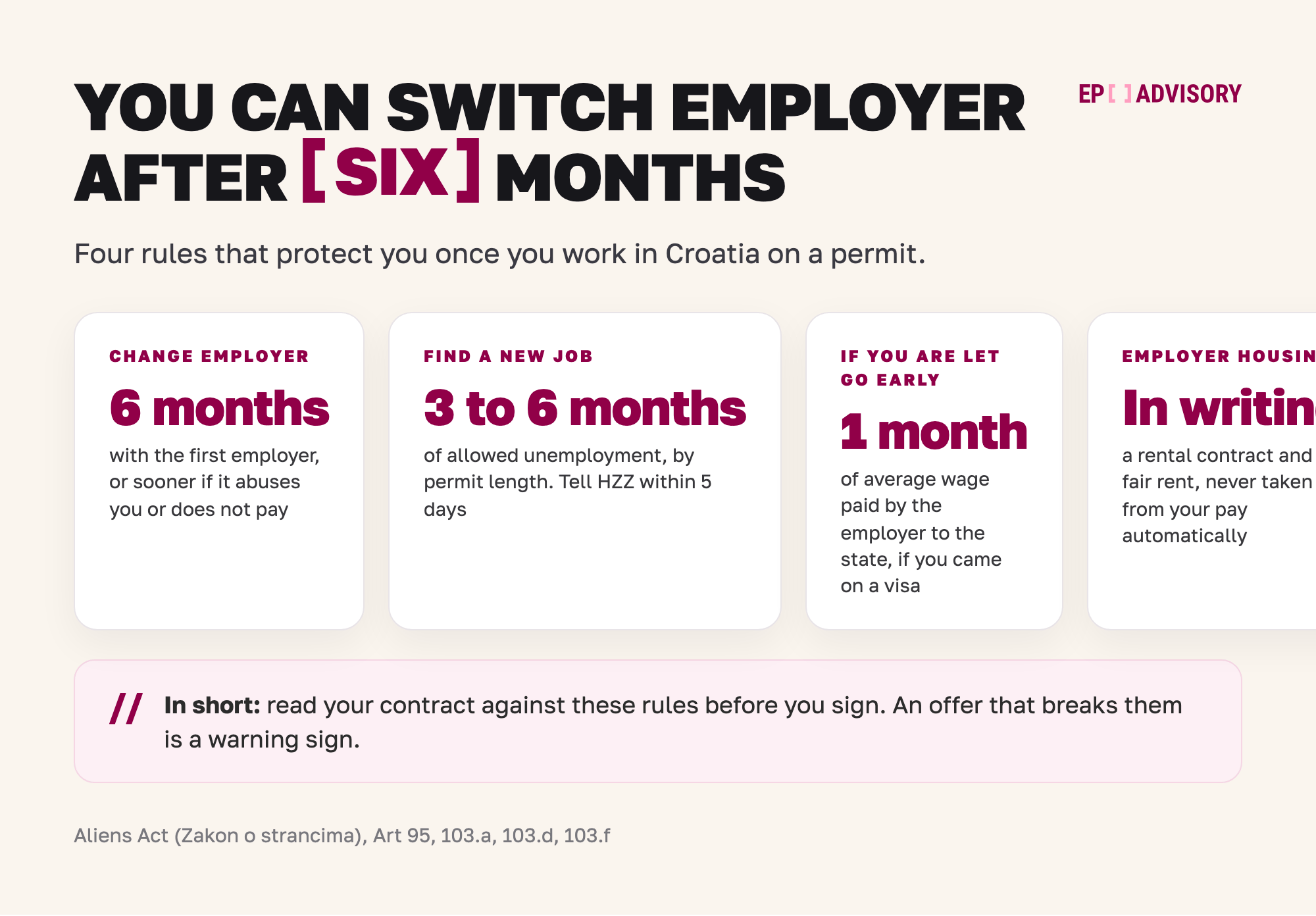
- Changing employer. You can move to a new employer after 6 months with the one who brought you. You can move sooner if that employer abuses you or does not pay your wages. The new employer needs its own labour market test, and the police decide within 45 days.
- Losing your job. You may stay unemployed for up to 3 months on a permit under 2 years, or 6 months on a longer one. Tell HZZ within 5 days.
- A guarantee on arrival. If you came on a visa and the employer does not take you on, or lets you go in the first 3 months through no fault of yours, the employer pays the state one average monthly wage. This does not apply to seasonal work.
- Housing. If the employer provides housing, it must be adequate, with a written rental contract and a fair rent. Rent may not be taken from your wages automatically.
One new rule is coming. From about June 2027, workers who have been on a permit for a year will need to pass a basic Croatian test at A1.1 level, paid for by the employer. Seasonal workers, people educated in Croatia and speakers of South Slavic languages are exempt. Starting a little Croatian before you go helps in interviews too.
The EU Blue Card for graduates and specialists
If you have a degree or high-level skills and a well-paid offer, the EU Blue Card is a faster route. It needs no labour market test, and the police decide within 60 days. The card lasts up to 48 months, and you can file at a consulate or, if you are already in Croatia legally, at the police.
The pay bar is set by law as 1.5 times Croatia’s average gross wage for the previous year, as measured by the state statistics office. For 2025 that average was €2,016 a month, according to the DZS wage release. MUP publishes no euro figure for 2026, so this is our own arithmetic: 1.5 x €2,016 = about €3,024 a month gross. If you finished your degree in the last 3 years, the law lets you earn 80% of the bar, which works out at about €2,419. Ask the employer to confirm the exact figure with the police before you sign.
Digital nomads are a separate case. Croatia gives up to 18 months of temporary stay to digital nomads who work for a company outside Croatia, but it does not allow work for Croatian employers.
How to find a real employer in Croatia
Start with the official job board. HZZ runs the Burza rada job board, where Croatian employers post vacancies, and you can filter by county and occupation. Search by job title in Croatian too, for example konobar for waiter, zidar for bricklayer or vozač for driver.
Next, go straight to employers. Many hotel groups on the coast, building firms in Zagreb and logistics firms hire directly through their own careers pages. Ask each one who files the permit, what the gross pay is and whether housing is included. Our guide on how to find a job in Europe covers direct approaches step by step.
Croatian employers read a short, clear CV. Put your trade or job title at the top, list licences such as driving categories or welding certificates, and give dates for every job. Follow the European CV format and add a short cover letter for a job abroad that says when you can start. If your CV was written for the Gulf or for your home market, rework it before you apply to Croatian employers. Getting ready to apply for jobs in Croatia? Check your CV for free: see it the way a recruiter does, then fix each problem.
If your first interview is on video, prepare short answers about your experience, your start date and why Croatia, using our guide on how to pass a job interview.
Agency fees and scams: what to refuse
Never pay thousands of euros for a Croatian work permit. The official fees for the permit and card are about €115. Be wary of any recruiter who asks for a large fee up front for a “visa job” in Croatia. Some offers come from firms that could never pass the HZZ employer checks. A fake offer can also use a real company’s name, so contact the company yourself.
Before you pay anyone or send your passport, check four things:
- The employer is a real Croatian company with an address, a website and staff. You can call it directly and speak to someone who knows your role.
- You have a written contract that shows the gross monthly pay, the hours and the housing terms. The pay is at least the Croatian minimum wage of €1,050 gross a month.
- The employer, not a middleman, files the permit at a Croatian police administration. Ask which one.
- Nobody asks you to enter on a tourist visa and “sort the papers later”. Working without a permit is illegal, and employers caught doing it face fines of €5,000 to €15,000 per worker. The fine rises to €10,000 to €20,000 if the worker is in Croatia illegally.
If an offer fails any of these checks, walk away. A real Croatian employer runs the labour market test and files the application itself. The guarantee and the fines fall on the employer, so it has every reason to hire you properly.
What jobs in Croatia pay
The legal floor in 2026 is €1,050 gross a month, set by government regulation NN 132/2025. The average across all employees in 2025 was €2,016 gross and €1,449 net a month. Your offer must be at least the floor, and it must match what Croatian workers earn in the same job. If an offer includes housing or meals, count that in its real value.
Compare offers on gross monthly pay, hours and what is included. Ask whether overtime is paid and whether housing is deducted, since the law bans automatic rent deductions. When you have a real offer, you can often improve it. Our guide on how to negotiate salary shows what to ask for. If you are weighing Croatia against its neighbours, see our guides to jobs in Romania and jobs in Greece.
Next: compare Croatia’s pay bar with other EU countries in our guide to work visa salary thresholds in Europe.
Key takeaways
- EU, EEA and Swiss citizens work in Croatia without a permit. Everyone else needs a stay-and-work permit filed by the employer.
- The employer asks HZZ for a labour market test first, and HZZ answers within 15 days. Seasonal jobs up to 90 days and shortage occupations skip it.
- The police have up to 90 days to decide on the permit. With the test and a visa, the legal deadlines add up to about 5 months.
- The official permit and card fees total €115.46. Large agency fees are not part of the legal process.
- Tourism hires in spring and construction hires all year, so time your hotel applications for January to May.
- You can change employer after 6 months, and you keep 3 to 6 months to find a new job if you lose yours.
See what a recruiter sees, then fix it before you apply. An instant score, then the fix for every problem.
Free, no card. A free account unlocks every fix.
Frequently asked questions
Can foreigners get a job in Croatia in 2026?
Yes. EU, EEA and Swiss citizens apply like locals. Other nationals need an employer who files a stay-and-work permit for them. Croatia issued 170,723 of these permits in 2025, mostly in tourism, construction, industry and transport.
How long does a Croatia work visa take?
The HZZ labour market test takes up to 15 days and the police have up to 90 days to decide on the permit. A visa, if you need one, takes 15 to 45 days. Together that is about 5 months, if the employer files straight after the test and the police do not extend.
How much are the Croatia work visa fees?
The stay-and-work permit costs €74.32 and the biometric residence card costs €31.85, plus a €9.29 issuing fee. That is €115.46 in total. The consulate sets the long-stay visa fee separately.
Can Indians get a work visa for Croatia?
Yes. Indian citizens follow the same steps as other non-EU workers. The employer files the permit, then you apply for a long-stay visa at a Croatian embassy or consulate. India was the fifth largest source of workers in 2025, with 15,400 permits.
Can I get unskilled or factory jobs in Croatia?
Yes. Many permits go to hotel, kitchen, building-site, factory and warehouse jobs. The employer still needs a labour market test unless the job is seasonal or on the shortage list. Your pay must be at least the minimum wage of €1,050 gross a month.
Do I need to pay an agency to get a job in Croatia?
No. The employer asks for the labour market test and files the permit. The official fees for the permit and card are about €115. Be very careful with anyone who asks for thousands of euros up front.
Can I change jobs on a Croatian work permit?
Yes, after 6 months with the employer who brought you, or sooner if that employer abuses you or does not pay your wages. The new employer needs a labour market test, and the police decide within 45 days.