 By Andre Atallah, CEO of EP Advisory

Short answer: yes, there are many jobs in the Netherlands for foreigners, and many skilled roles work in English. EU, EEA and Swiss citizens apply like locals. Most non-EU professionals come as highly skilled migrants. For that you need an offer from one of about 13,000 recognised sponsors, and a salary of at least €5,942 gross a month (€4,357 under 30) in 2026.
For a foreign professional, two things decide the plan. First, which permit your job fits. Second, whether the employer is allowed to sponsor you.
For nearly 10 years, we’ve helped more than 5,000 professionals find jobs abroad. Want to know if your CV will pass screening in the Netherlands? Check your CV for free: a score in 30 seconds, then a fix for each problem.
Jobs in the Netherlands for foreigners: the main routes
EU, EEA and Swiss citizens can work in the Netherlands without a work permit. You apply like a Dutch candidate and register with your town hall when you arrive. Everything below about permits applies to non-EU citizens.
If you are from outside the EU, your employer usually starts the process. For most routes, the employer applies to the IND (the Immigration and Naturalisation Service) for your residence permit. If your passport needs one, the same procedure covers the MVV, the entry visa. Citizens of Australia, Canada, Japan, New Zealand, South Korea, the UK and the US, among others, do not need an MVV (IND MVV exemptions). These are the four routes most foreign job seekers use. The 2026 figures come from the IND income requirements and IND fees. The first table shows who each route fits and what it must pay:
| Route | Who it fits | Pay floor 2026 (gross a month) |
|---|---|---|
| Highly skilled migrant (kennismigrant) | Any professional with a qualifying offer. No degree rule. | €5,942 (30 or older), €4,357 (under 30), €3,122 (recent graduates) |
| EU Blue Card | Degree of 3+ years, or 5 years of degree-level experience (3 in the last 7 for IT managers and specialists). Contract of 6+ months. | €5,942, or €4,754 for recent graduates |
| Single permit (GVVA) | Jobs below the skilled thresholds, where no suitable EU worker is found | Normal pay for the job, at least €2,337 (from 1 July 2026) |
| Orientation year (zoekjaar) | Recent graduates of Dutch universities, or master’s and PhD graduates of top-200 universities abroad | None while you search |
| EU, EEA or Swiss citizen | Any job | Same as locals |
The second table shows the sponsor rule, the fee and how long the IND can take:
| Route | Employer must be a recognised sponsor? | IND fee | Legal decision time |
|---|---|---|---|
| Highly skilled migrant | Yes | €423 | 90 days (target 2 weeks via a recognised sponsor) |
| EU Blue Card | No | €423 | 30 days via a recognised sponsor, otherwise 90 days |
| Single permit (GVVA) | No | €423 | 90 days |
| Orientation year | No (you apply yourself) | €254 | 90 days |
| EU, EEA or Swiss citizen | Not needed | None | Not needed |
The EU Blue Card suits graduates whose employer is not a recognised sponsor. The salary bar is the same, but a foreign degree must be evaluated by Nuffic (IND Blue Card).
The single permit (GVVA) covers jobs below the skilled bars, but it is hard to get. The employer must first look for a worker in the Netherlands and the rest of the EU. It must also register the vacancy with UWV, the public employment service, which then advises the IND (IND GVVA). Warehouse, hospitality and production jobs advertised in English are aimed at EU workers. If an agency offers you one from outside the EU, ask in writing how they will get your permit.
The pay floors exclude holiday allowance, and they change every 1 January. The 2027 amounts had not been published on 24 November 2026. This page covers how to get hired. For every permit detail, including intra-company transfers and the self-employed route, read our full guide to the Dutch work visa.
Your first steps
- Find your route in the tables above. If you are an EU, EEA or Swiss citizen, you need no permit.
- Compare your target salary with the 2026 bar for your age, in the next section.
- Search the IND register of recognised sponsors for firms in your field.
- Apply on those firms’ careers pages, or message their recruiters.
- Ask about the 30% ruling before you sign the offer.
- Resign from your current job only after the IND approves your permit.
Immigration rules change often, so check the current rules with the IND before you act.
Highly skilled migrant salary 2026 and the sponsor rule
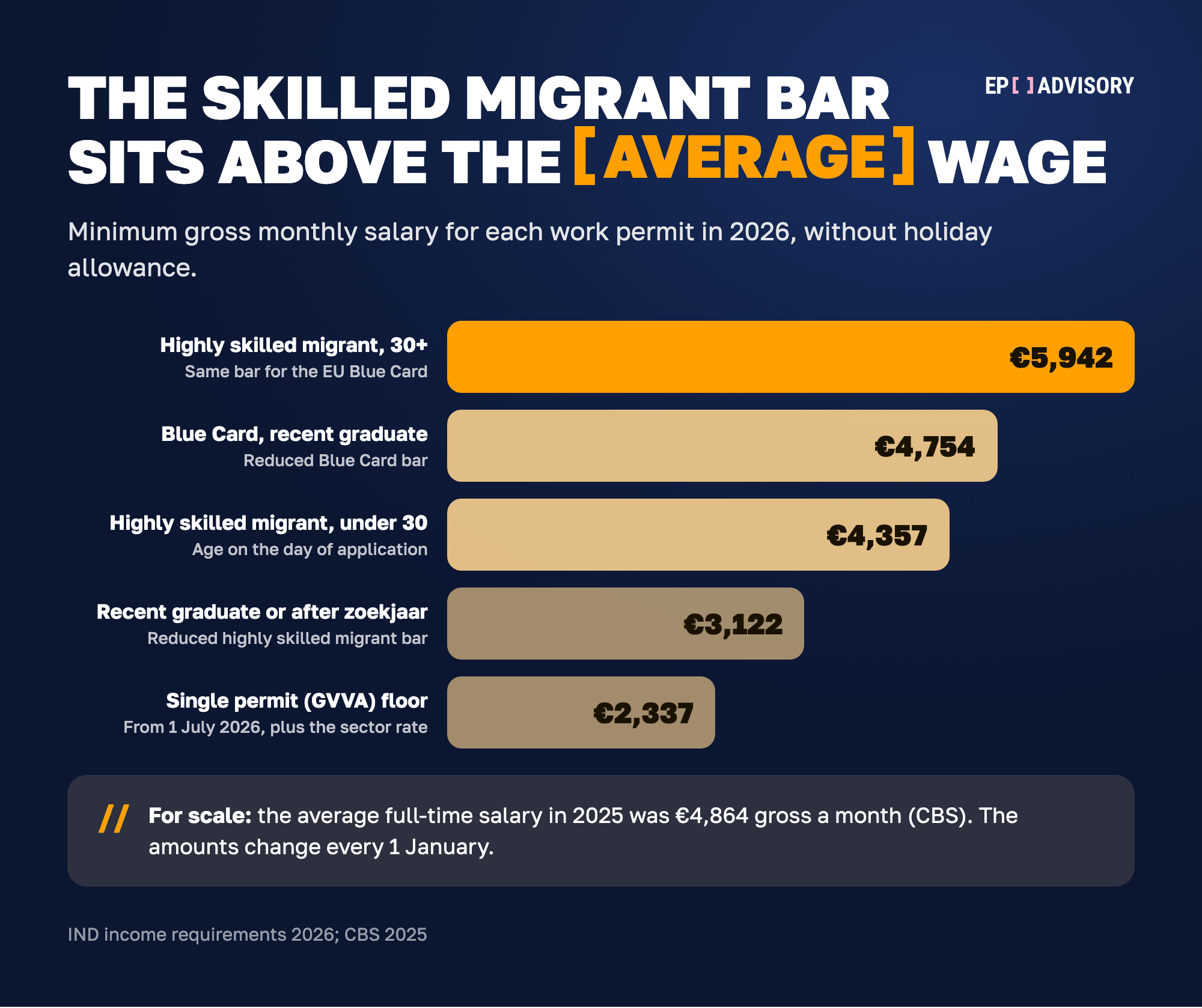
The highly skilled migrant permit is the main route for non-EU professionals, and it turns on salary, not on your degree. In 2026 the IND asks for at least these gross monthly salaries, without holiday allowance:
- €5,942 if you are 30 or older. That is about $6,660 or £4,970 a month at ECB rates of 2026-11-02.
- €4,357 if you are under 30.
- €3,122 under the reduced criterion. This is mainly for people who graduated within the last 3 years from a Dutch university, or with a master’s or PhD from a top-200 university abroad. It also covers people switching from the orientation year.
The salary must also be normal for the job in the Dutch market. If similar roles usually pay more, a salary just at the bar is not enough. For comparison, CBS, the national statistics office, measured the average full-time salary in 2025 at €4,864 gross a month. That is before holiday pay and bonuses. So the bar for over-30s sits well above the average wage. To compare it with other countries, see our table of work visa salary thresholds in Europe.
Only a recognised sponsor can hire you on this permit. A recognised sponsor is an employer the IND has approved to bring in foreign staff. The IND publishes them all in its public register of recognised sponsors. The work list held 13,089 organisations when it was last updated on 3 November 2026, and it is updated every month. That list is one of your best job-search tools, and the search section below shows how to use it.
If a company you like is not on the register, it can still apply. Recognition costs the employer €5,080, or €2,539 with 50 staff or fewer. The legal decision period is 3 months (IND decision periods). After that, the employer’s permit applications go faster. For a complete application from a recognised sponsor, the IND aims to decide within 2 weeks. A small firm that really wants you may do this. A large firm that is not registered usually means the role is not open to sponsorship.
The rules work in your favour once you are in. The permit lasts as long as your contract, up to 5 years. If you lose your job, you have 3 months to find a new sponsor. You have 6 months if the job ended on or after 22 May 2026 and you had held the permit for at least 2 years (IND highly skilled migrant).
The government has said it plans to tighten the scheme. In July 2025 it announced plans to raise the salary criterion and make sponsor recognition stricter (Rijksoverheid). No start date had been set by 24 November 2026. The flow has already slowed: 13,900 knowledge migrants came from outside the EU in 2025, down from 21,500 in 2023 (CBS). So a clear offer at the right salary matters more than before.
The orientation year: a year to look for work
If you graduated recently from a strong university, you can move first and search from inside the country. The orientation year, or zoekjaar, is a one-year permit for job seekers (IND orientation year). These rules apply in 2026:
- Who qualifies. Graduates of a Dutch bachelor’s, master’s or post-master’s programme. Graduates of a master’s, PhD or post-master’s programme abroad. For them, the institution must be in the top 200 of at least two of three rankings (Times Higher Education, QS, Shanghai) on the date you graduated. General or subject rankings both count. A foreign bachelor’s degree alone does not qualify.
- Timing. You apply within 3 years of finishing your studies.
- English. Foreign graduates also show IELTS 6.0 or equal, or a degree taught in English or Dutch.
- Work. You can work freely during the year, with no work permit.
- Length and cost. One year, with no extension. The fee is €254.
The real prize comes after. When you find a job, a recognised sponsor can hire you as a highly skilled migrant at the reduced bar of €3,122 a month. That is about half the bar for over-30s, so many more entry-level offers qualify. Use the year with a weekly plan, not as a holiday with job ads.
Score your CV in 30 seconds, then fix its biggest problems one by one. Both free.
Free, no card. A free account unlocks every fix.

 Sample report
The 30% ruling in 2026 and 2027
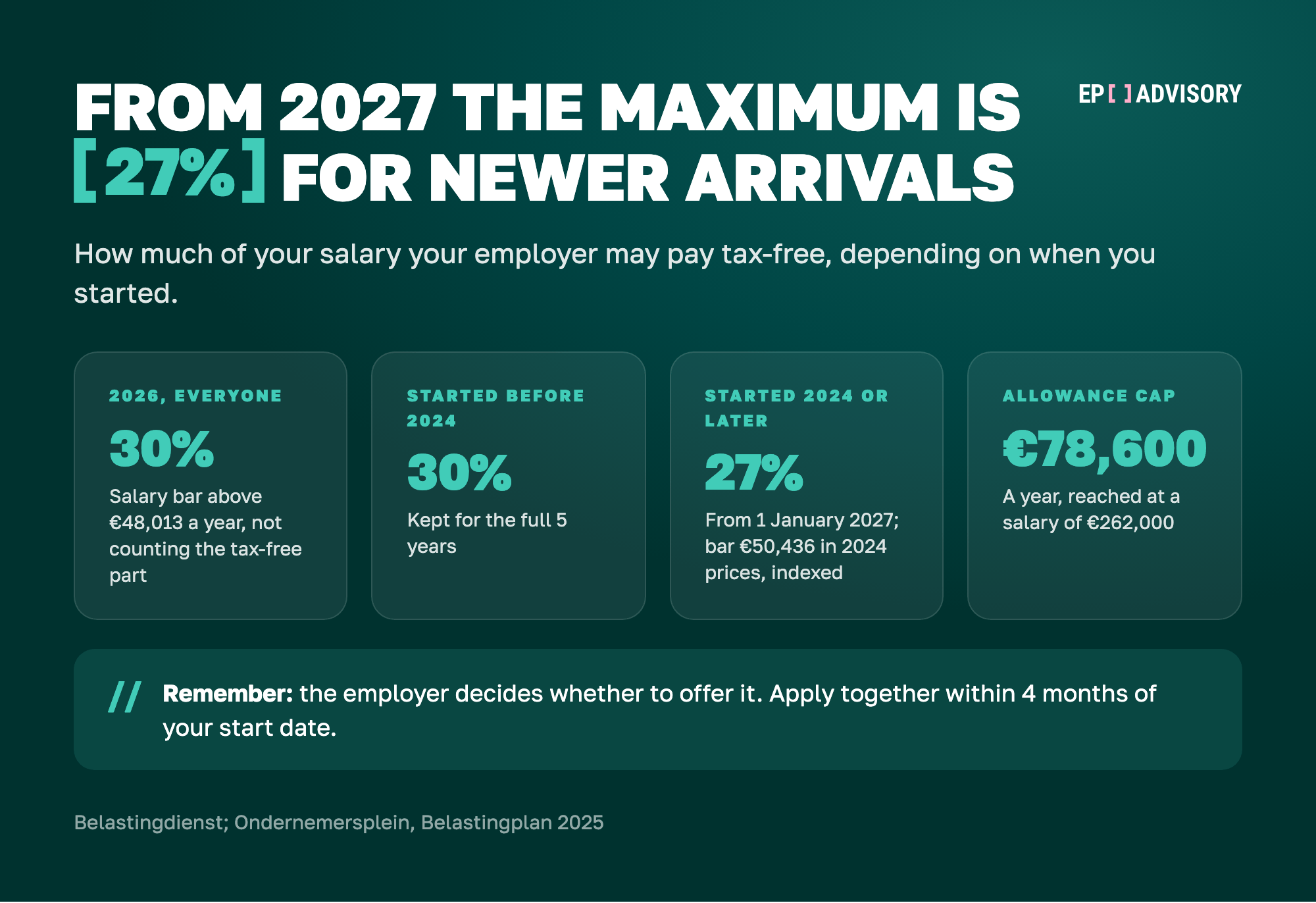
The 30% ruling lets your employer pay up to 30% of your salary tax-free, for up to 5 years. It is not automatic. The employer chooses whether to offer it, and it may pay less than 30%. In 2026 you qualify if all of these apply (Belastingdienst, the Dutch tax office):
- You were recruited from abroad. For more than 16 of the 24 months before you started, you lived more than 150 km from the Dutch border.
- Your salary is high enough. Your annual salary, not counting the tax-free part, is more than €48,013 (about $53,900). If you are under 30 with a master’s degree, the bar is €36,497. Researchers and medical specialists in training have no salary bar.
- You and your employer apply together. Apply within 4 months of your start date. The tax office decides within 8 weeks.
The tax-free allowance is capped at €78,600 a year, which is reached at a salary of €262,000. Above that, the ruling still applies, but the allowance stops growing.
From 1 January 2027, the maximum drops to 27% for people who started on or after 1 January 2024. This is law, not a proposal: the Belastingplan 2025 (Staatsblad 2024, 434) replaces 30% with 27% from that date (Ondernemersplein). People who started using the ruling before 2024 keep 30% for their full 5 years. For everyone else the 2027 salary bar becomes €50,436 in 2024 prices, or €38,388 under 30 with a master’s degree. Both are raised each year for inflation. The indexed 2027 amounts had not been published on 24 November 2026.
Ask about the ruling before you sign. It is easier to agree on it as part of the offer than to raise it after you start.
Which jobs are in demand in the Netherlands
Tech, engineering and healthcare lead the shortage lists, and trade and care hold the most vacancies. UWV’s list of promising occupations for 2026-2027 (UWV kansrijke beroepen) names these, among others:
- ICT. Software developers, programmers, security specialists, network engineers, data analysts and data scientists, ICT architects and ICT managers.
- Engineering. Electrical installation engineers, embedded software engineers, PLC programmers, maintenance and mechanical engineers.
- Healthcare. General, community and specialised nurses, and nurse specialists.
UWV adds a warning for ICT: employers set high demands, so the chances are mainly for people who already have ICT experience or training. For a foreign hire, that means a career change into tech is hard to sell from abroad. Experienced developers and engineers have the strongest case.
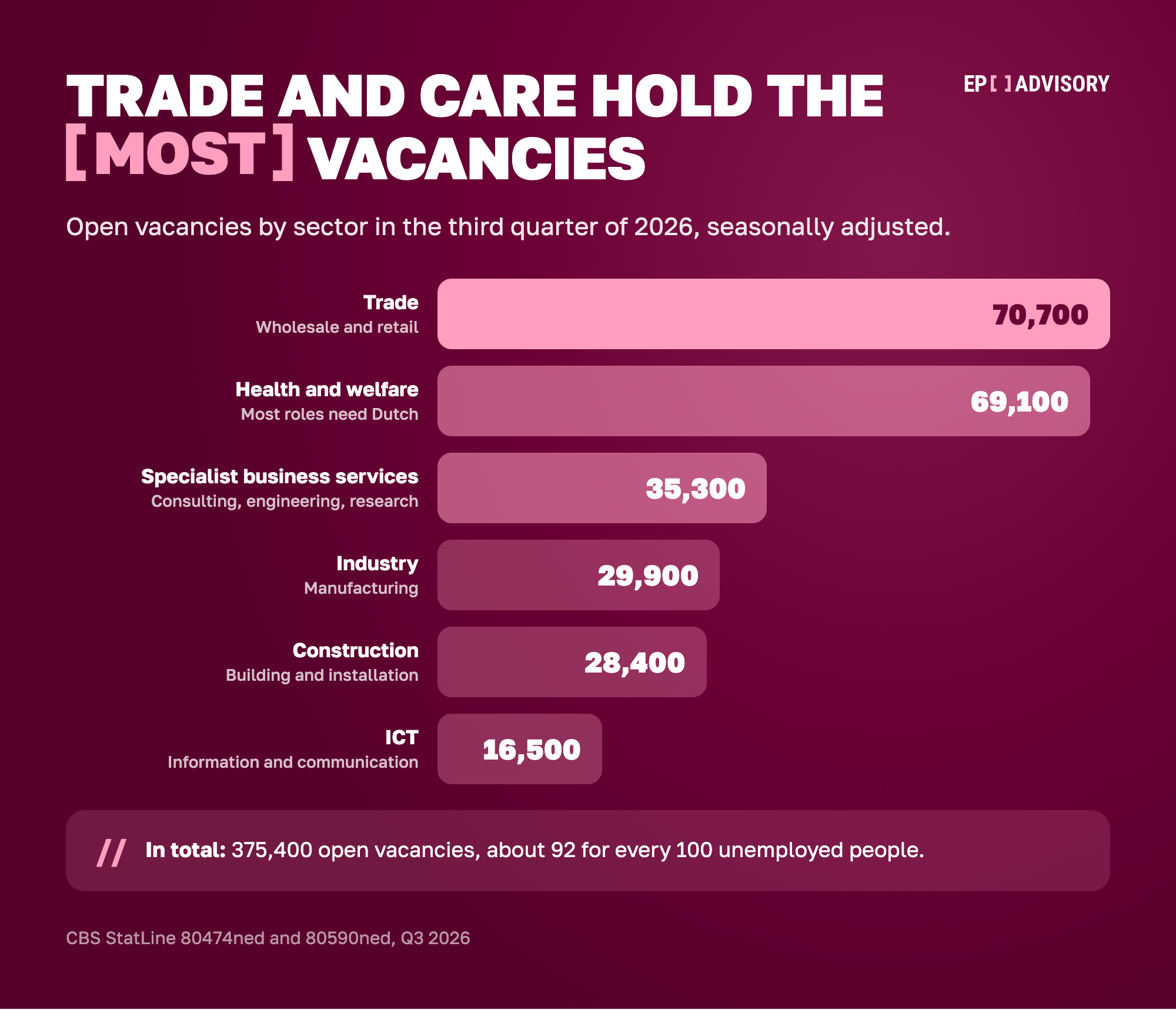
The Dutch job market is still tight. In the third quarter of 2026 there were 375,400 open vacancies, against 407,000 unemployed people. That is about 92 vacancies for every 100 people looking (CBS vacancies). Unemployment was 4.0% in October 2026 (CBS unemployment).
The sector counts show where the volume is. In the third quarter of 2026, trade had 70,700 open vacancies and health and welfare 69,100. ICT had 16,500. Many trade and care jobs need Dutch, while ICT and specialist services hire more in English. So volume and access are not the same thing. Fewer vacancies in a sector that hires in English can be the better bet.
Region matters too. Most international employers sit in the Randstad, the urban ring of Amsterdam, Rotterdam, The Hague and Utrecht. Eindhoven and its Brainport region are the centre for high-tech manufacturing and chip-machine engineering.
English-speaking jobs in the Netherlands and the Dutch reality
You can work in English in many skilled jobs, but Dutch widens your options a lot. No permit route on this page tests your Dutch. Many tech companies, multinationals, research institutes and universities use English at work. Logistics hubs and head offices often hire for European roles where other languages count more than Dutch.
Dutch is usually expected in these areas:
- Healthcare. To register as a nurse or doctor with a foreign diploma, you must prove your Dutch. The level is B1 for nursing, B2 for professions such as physiotherapy and midwifery, and B2+ for doctors, dentists and pharmacists (BIG register).
- Public sector and schools. Most government and teaching jobs work in Dutch.
- Customer-facing jobs. Retail, local sales and Dutch-market customer service usually need fluent Dutch.
Even in English-speaking teams, some Dutch helps. It shows you plan to stay, and it makes daily life easier. Put your level on your CV on the European language scale (CEFR, A1 to C2), even if it is A1, and keep a course going.
Where to find jobs in the Netherlands
Start with employers that can sponsor you, then use boards and agencies to find their openings. These are the main channels:
| Channel | Best for | Tip |
|---|---|---|
| IND sponsor register | Finding firms that can hire non-EU staff | Search it for firms in your field, then go to their careers pages |
| LinkedIn Jobs | Tech, finance, multinationals, English-language roles | Set your location to the Netherlands and message the recruiter |
| Werk.nl (UWV) | The public job board, mostly Dutch-language | Search in Dutch job titles, for example “verpleegkundige” |
| Indeed and Nationale Vacaturebank | Broad volume across all sectors | Filter for English; many listings are in Dutch |
| IamExpat Jobs | English-speaking roles | Check that the employer can sponsor before you apply |
| EURES | EU citizens moving within Europe | Use it for vacancies open to EU candidates |
| Recruitment agencies | Specialist and multilingual roles | Undutchables, Hays, Michael Page and Randstad are active; ask whether they place non-EU candidates |
The sponsor register is your filter. A firm on it has hired from abroad before, or at least is set up to. So a direct application to its careers page, or a message to its recruiter, is worth more than many applications to firms that cannot sponsor.
Speculative applications are normal. A short email to the hiring manager, with a CV and two lines on what you would do in the first months, often gets a reply. Many Dutch employers follow the NVP recruitment code, which sets out how they should treat applicants. So it is fine to ask how their process works and how long it takes. If you are also looking at Benelux neighbours, compare jobs in Luxembourg and the Belgium job search guide. For the biggest market next door, see jobs in Germany.
Dutch CVs, interviews and offers
Dutch recruiters like a short, direct CV that shows results fast. These norms work well:
- Length. One or two pages. A photo is optional, and many international firms prefer none.
- Your status. State your nationality, where you live, and whether you need a highly skilled migrant permit or already have the right to work.
- Results, not duties. Put numbers on what you achieved. Our CV achievement examples show how.
- Languages. List English and Dutch with CEFR levels.
- Foreign diploma. An employer may ask for a credential evaluation, which shows the Dutch level of your degree. IDW does this for €148.83. It is usually not required. The Blue Card needs a Nuffic evaluation, and regulated jobs such as healthcare have their own recognition procedure.
- Format. A clean European layout works. See our guide to the European CV format.
In our coaching for the Dutch market, the same pattern comes up again and again. Strong candidates write long, polite cover letters. Dutch hiring managers want to know quickly what you have done and what you would do for them. We help clients cut the CV to the results that matter for the role and open the letter with the reason for this company. We also have them check the sponsor register before they apply, so their effort goes to employers who can hire them. Our guide to the cover letter for a job abroad shows the structure.
If your CV was written for another market, rework it for the Netherlands before you apply. Getting ready to apply for jobs in the Netherlands? Check your CV for free: see it the way a recruiter does, then fix each problem.
Interviews are direct and often informal. Expect a first call with a recruiter, one or two interviews with the team, and sometimes a case or technical test. Dutch interviewers ask plain questions and expect plain answers, including about salary. Our guide on how to pass a job interview covers preparation.
The written contract sets the salary, hours and probation. By law, there is no probation on a contract of 6 months or less. It can be up to 1 month on a longer temporary contract under 2 years. It can be up to 2 months on a permanent contract, or on one of 2 years or more (Rijksoverheid). A collective agreement can set other terms. Offers are often quoted as a gross annual salary. Check whether that figure includes holiday allowance, and whether the 30% ruling is part of it. Before you sign, read our tips on how to negotiate salary.
From offer to first payslip: steps and deadlines
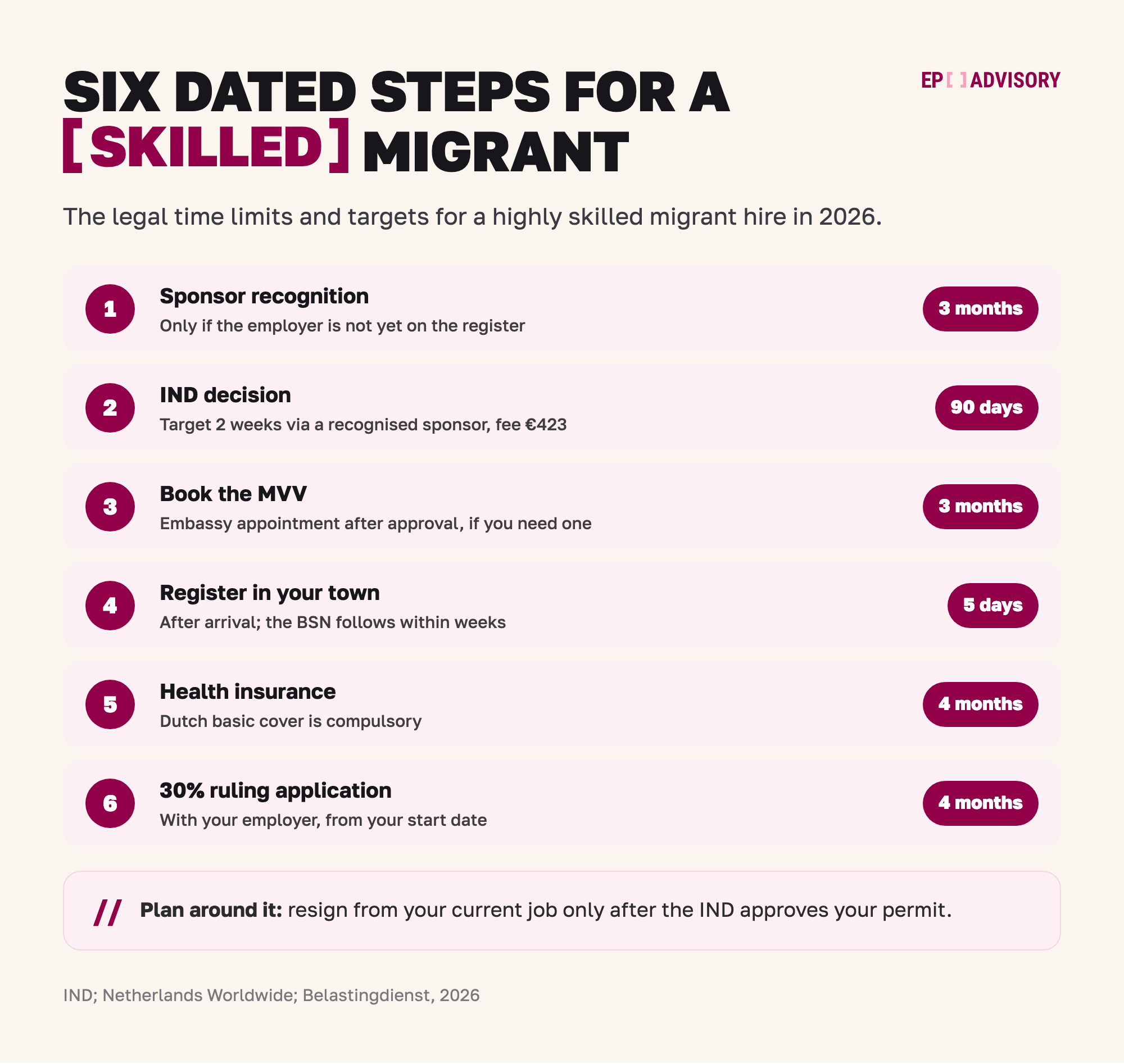
Most of the waiting happens before you travel, so plan your notice period around the IND decision. These are the steps for a highly skilled migrant in 2026:
- Check the sponsor. The employer is on the register, or applies for recognition. The legal decision period for recognition is 3 months.
- Wait for the permit. The employer applies for your residence permit, and the MVV entry visa if you need one. It pays the €423 fee. For a complete application from a recognised sponsor the IND aims to decide within 2 weeks. The legal limit is 90 days, and the IND can extend it, so do not resign before the decision.
- Collect your entry visa. After approval, book your MVV appointment at the Dutch embassy or consulate within 3 months. The MVV is then valid for 90 days.
- Register on arrival. Register with your town hall within 5 days of arrival. You get your citizen service number (BSN) within a few weeks. You need it for tax and your salary, and to apply for DigiD, the login for government services (Netherlands Worldwide).
- Take out health insurance. Get Dutch basic health insurance within 4 months of arrival. It is compulsory for everyone who lives and works in the Netherlands. The cover runs from the day you arrive (Government.nl).
- Book a TB test, if you need one. Some nationalities need a tuberculosis (TB) test, and the application tells you if you do. Book it at the GGD, the municipal health service, within 3 months of getting your residence permit.
- Apply for the 30% ruling. Apply with your employer within 4 months of your start date. The decision comes within 8 weeks.
Housing is the hardest part of the move, so start early. The country is short of about 384,000 homes in 2026, or 4.6% of all homes. If about 100,000 homes are built each year, a balanced market is expected only around 2034 (Volkshuisvesting Nederland). Ask your employer about relocation help and temporary housing. Where it is offered, it buys you time to find a long-term rental. Never pay a deposit for a flat you have not seen, or to a landlord you cannot verify.
Worked example: a software engineer from India hired in Eindhoven
Priya is 31 and a backend engineer in Bengaluru with 7 years of experience. A high-tech firm in Eindhoven, listed in the IND sponsor register, offers her a permanent contract at €6,500 gross a month, or €78,000 a year before holiday allowance. These are the figures as they stood on 24 November 2026.
- Does the salary qualify? Yes. She is 30 or older, so she needs €5,942 a month. Her €6,500 clears it, and it is a normal salary for a senior engineer.
- Which permit? Highly skilled migrant. Her employer is a recognised sponsor, so it applies for her. She does not need a Nuffic evaluation of her degree, as she would for a Blue Card.
- Cost. The IND fee is €423, which her employer pays. Her husband applies as a family member at the same time, for €254.
- Timeline. The employer files a complete application in early December 2026. The IND aims to decide within 2 weeks for a recognised sponsor, so a decision before Christmas is realistic. The legal limit is 90 days, early March 2027. She then has 3 months to book her MVV appointment in India, and the MVV gives her 90 days to travel. If the application says she needs a TB test, she books it at the GGD within 3 months of getting her permit.
- Notice period. She resigns only once the permit is approved. With a 2-month notice and a decision in late December, a realistic start is March 2027. If the IND uses its full 90 days, it moves to about June.
- Arrival. She registers with the municipality of Eindhoven within 5 days and takes out health insurance in her first weeks, well within the 4-month limit.
- 30% ruling. She lived in India, more than 150 km from the Dutch border, for all 24 months before she started. She starts in 2027, so the maximum for her is 27%, up to €21,060 a year tax-free. Her salary without that part is €56,940. The 2027 bar is €50,436 in 2024 prices, raised for inflation, so she has a margin, but she checks the published 2027 figure. She and her employer apply within 4 months of her start.
- Probation. Her permanent contract can include up to 2 months of probation.
The lesson from her case: the offer letter, the sponsor status and the salary bar decide everything. Once those three are right, the rest is a set of dated steps.
What jobs in the Netherlands pay
The average full-time salary in the Netherlands was €4,864 gross a month in 2025, without overtime. That is €59,050 a year before holiday pay and bonuses (CBS 81431NED, updated 8 October 2026). That is about $5,460 a month at ECB rates of 2026-11-02. The minimum wage is €14.99 gross an hour from 1 July 2026, for workers aged 21 and over.
The highly skilled migrant bar of €5,942 a month for over-30s is above the national average. So a non-EU hire is usually a mid-career or senior professional, or a young graduate on the lower bars.
Next: check what your role pays by sector, and what is left after tax and rent, in our guide to salaries in the Netherlands.
Key takeaways
- EU, EEA and Swiss citizens can work in the Netherlands without a permit.
- Most non-EU professionals come as highly skilled migrants. In 2026 the bar is €5,942 gross a month at 30 or older, €4,357 under 30 and €3,122 for recent graduates.
- Only a recognised sponsor can hire you on that permit. The IND register listed 13,089 organisations on 3 November 2026, so use it to choose where to apply.
- Recent graduates of Dutch universities, and master’s or PhD graduates of top-200 universities abroad, can use the one-year orientation year to search from inside the country.
- The 30% ruling gives up to 30% tax-free in 2026. From 2027 the maximum is 27% for people who started on or after 1 January 2024.
- Tech, engineering and nursing top the shortage lists. Healthcare needs Dutch at B1 or higher, while many tech jobs run in English.
- Housing is the hardest part of the move, so ask about relocation help before you sign.
See what a recruiter sees, then fix it before you apply. An instant score, then the fix for every problem.
Free, no card. A free account unlocks every fix.
Frequently asked questions
Can foreigners get a job in the Netherlands in 2026?
Yes. EU, EEA and Swiss citizens can work without a permit. Non-EU professionals usually need an offer from a recognised sponsor that meets the highly skilled migrant salary bar, which is €5,942 gross a month at 30 or older in 2026. Graduates can also use the EU Blue Card or the orientation year.
What is the highly skilled migrant salary in 2026?
The gross monthly salary, without holiday allowance, must be at least €5,942 if you are 30 or older, €4,357 if you are under 30, and €3,122 under the reduced criterion for recent graduates. The amounts change every 1 January.
How do I find a job in the Netherlands as a foreigner?
Start with the IND public register of recognised sponsors to find firms that can hire non-EU staff. Then apply on their careers pages, on LinkedIn and through specialist agencies. Werk.nl, the public job board, and Indeed have more volume, but many listings are in Dutch.
Can I get a job in the Netherlands without speaking Dutch?
Yes, in many skilled jobs. Tech companies, multinationals, research institutes and universities often work in English. Healthcare, public sector, teaching and local customer-facing jobs usually need Dutch. Nurses with a foreign diploma need at least level B1 to register.
What is the 30% ruling in 2026?
Your employer may pay up to 30% of your salary tax-free for up to 5 years if you were recruited from abroad and earn more than €48,013 a year, not counting the tax-free part. From 1 January 2027 the maximum is 27% for people who started on or after 1 January 2024.
How long does a Dutch work permit take?
The IND has 90 days by law to decide on a highly skilled migrant or single permit application. For a complete highly skilled migrant application from a recognised sponsor, it aims to decide within 2 weeks. For an EU Blue Card through a recognised sponsor, the limit is 30 days. After approval, you have 3 months to book your entry visa appointment, if you need one.