 By Andre Atallah, CEO of EP Advisory

Short answer: yes. Jobs in Luxembourg for foreigners are common, and employers are used to hiring people from abroad. EU citizens apply like locals. Non-EU professionals need a job offer first. Since 1 October 2026, they then apply for a long-stay visa D at the embassy. The EU Blue Card needs €65,652 gross a year.
Many guides still describe the old process for non-EU hires, the temporary authorisation to stay. New applications no longer need it. The market is also tighter than it was, so a targeted search wins over a scattered one.
For nearly 10 years, we’ve helped more than 5,000 professionals find jobs abroad. Want to know if your CV will pass screening in Luxembourg? Check your CV for free: a score in 30 seconds, then a fix for each problem.
Jobs in Luxembourg for foreigners: who needs a permit
Your passport decides your route, not your job title. EU, EEA and Swiss citizens can live and work in Luxembourg without a work permit. They apply for jobs the same way local candidates do. Everything below about visas and ADEM certificates applies to non-EU citizens.
Non-EU professionals have three main options. Which one fits depends on your pay, your job and where you plan to live.
| Route | Who it fits | Pay rule | ADEM certificate |
|---|---|---|---|
| EU Blue Card | Highly qualified jobs, with the degree or qualifications they need | At least €65,652 gross a year | Not on the document list |
| Salaried worker | Any job, at any skill level | At least the social minimum wage | Needed |
| Cross-border worker | People already resident in France, Belgium or Germany | Same as locals | Needed, unless highly qualified |
| EU, EEA or Swiss citizen | Any job | Same as locals | Not needed |
Where you live: Blue Card holders and salaried workers live in Luxembourg. Cross-border workers live in a neighbouring country. EU, EEA and Swiss citizens can live in either.
The first two routes now share the same two steps. First you get a visa D at the embassy. Then you get your residence permit after you arrive. The next section walks through both.
Your first move: check whether your offer could reach the Blue Card bar. If it can, ask the employer to use that route.
The visa D procedure since 1 October 2026
You now apply for your visa at the embassy, not to the immigration office in Luxembourg. The government announced the change on 23 September 2026. Until then, Luxembourg was the last EU country with its own separate step, the temporary authorisation to stay. That step is gone.
The press release cites no new law. It says the government approved the reform in July 2025. Guichet.lu, the reference for the steps, cites the amended immigration law of 29 August 2008 as the legal basis. Applications filed up to 30 September 2026 still follow the old procedure. Temporary authorisations already issued stay valid, according to the foreign ministry.
Here is how it works now, based on the Guichet.lu salaried-worker page and the first residence permit page:
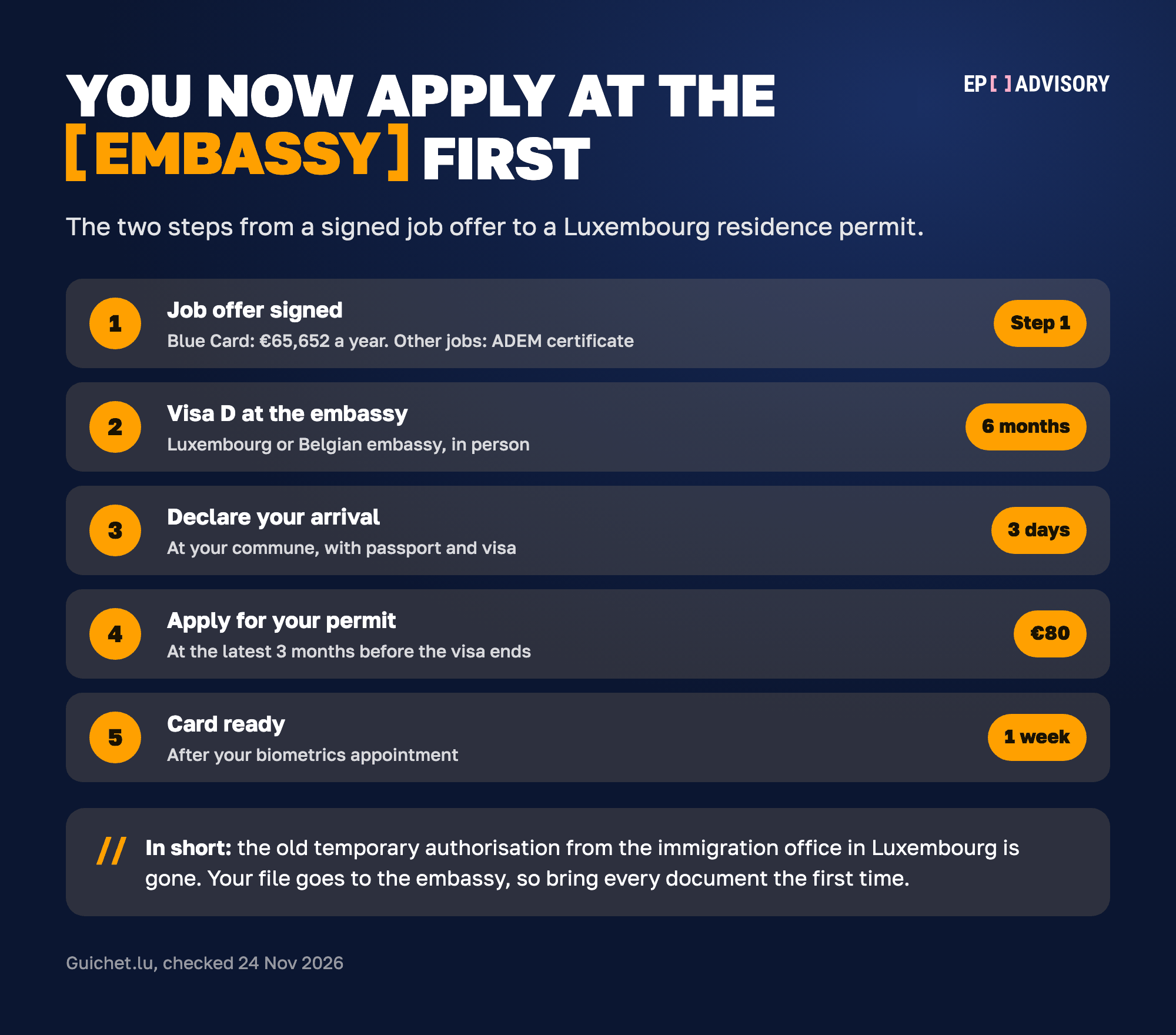
- Apply for a visa D in person. Go to the Luxembourg embassy in your country of origin or residence. If Luxembourg does not issue long-stay visas there, use the one in a neighbouring country. Only Luxembourg and Belgian embassies can issue this visa. In some countries an external service provider takes the application for the embassy. You cannot apply from inside Luxembourg.
- Bring a complete file. Only complete applications go on to the immigration directorate (DGIM).
- Receive a visa valid for 6 months. It lets you enter Luxembourg and travel in the Schengen area until your residence permit is ready.
- Declare your arrival within 3 days. Do this at the commune where you live, with your passport and visa. That date normally starts your permit.
- Take the medical check. It includes a tuberculosis screening.
- Apply for your residence permit at least 3 months before your visa runs out. Include proof of suitable housing, unless you already gave it with your visa application. The DGIM then asks you to pay the €80 fee and give your biometrics. The card is ready about one week later.
The file for both routes includes:
- your full passport
- a criminal record extract under 3 months old
- your CV and your diplomas
- the signed job contract
- Schengen travel health insurance
The insurance must cover medical care, hospital costs, repatriation and death for the whole visa period. Documents not in French, German or English need a sworn translation. A salaried worker also adds the ADEM certificate. The foreign ministry’s visa page adds two passport rules. It must be valid for at least 6 months beyond the planned stay. It must also have been issued less than 10 years ago.
Guichet.lu does not give a processing time for the visa D. The foreign ministry says a visa application generally takes 15 days, and up to 45 days if more documents are needed. That is its general figure for visas, not a separate one for the visa D. So build in a margin before your start date. Order your criminal record extract last, so it is still under 3 months old.
Your first steps
- Check whether the gross annual pay on your offer reaches the €65,652 Blue Card bar.
- Ask your employer which route it will use. Below the bar, it needs the ADEM certificate first.
- Gather your documents, and order the criminal record extract last.
- Book your visa D application in person at the Luxembourg or Belgian embassy that covers your country.
- Declare your arrival at your commune within 3 days.
- Apply for your residence permit at least 3 months before your visa runs out.
Immigration rules change often, so check the current rules with the official authority before you act.
The EU Blue Card: €65,652 and no labour-market certificate
If your salary reaches the bar, the Blue Card is the simpler route. The Guichet.lu Blue Card page, updated on 1 October 2026, sets these conditions:
- Pay of at least €65,652 gross a year. That is about €5,471 a month, or about $73,600 (£54,900) a year at ECB rates of 2026-11-02. The amount is the 2024 average gross annual salary, published in a ministerial regulation of 23 February 2026.
- A contract of at least 6 months with an employer legally established in Luxembourg.
- A highly qualified job, with the professional qualifications it needs. For a regulated profession, you must meet its conditions.
Guichet.lu gives one figure for all jobs, with no lower bar for shortage occupations. The ADEM certificate is not on the Blue Card document list, so your employer does not wait for the labour-market check. The employer must still declare the vacancy to ADEM before advertising it, as every employer in Luxembourg must.
One rule to know after you start. To change employer, you send a notification to the DGIM first. The minister then has 30 days to object, and you wait until that period ends. If you move to a job that is not highly qualified, you restart as a salaried worker. To compare this bar with other countries, see our guide to work visa salary thresholds in Europe.
So before you negotiate, check the gross annual figure on your offer. If it sits just under €65,652, ask whether the package can be moved above it.
Score your CV in 30 seconds, then fix its biggest problems one by one. Both free.
Free, no card. A free account unlocks every fix.

 Sample report
The salaried-worker route and the ADEM certificate
Below the Blue Card bar, your employer must first show ADEM that no suitable local candidate is available. This is the labour-market test. Guichet.lu describes a 3-week rule. If an employer finds no suitable candidate within 3 weeks of declaring the vacancy, it can ask ADEM for a certificate. The certificate lets it hire the person of its choice.
ADEM’s own deadlines are set in working days. They come from the Guichet.lu employer page:
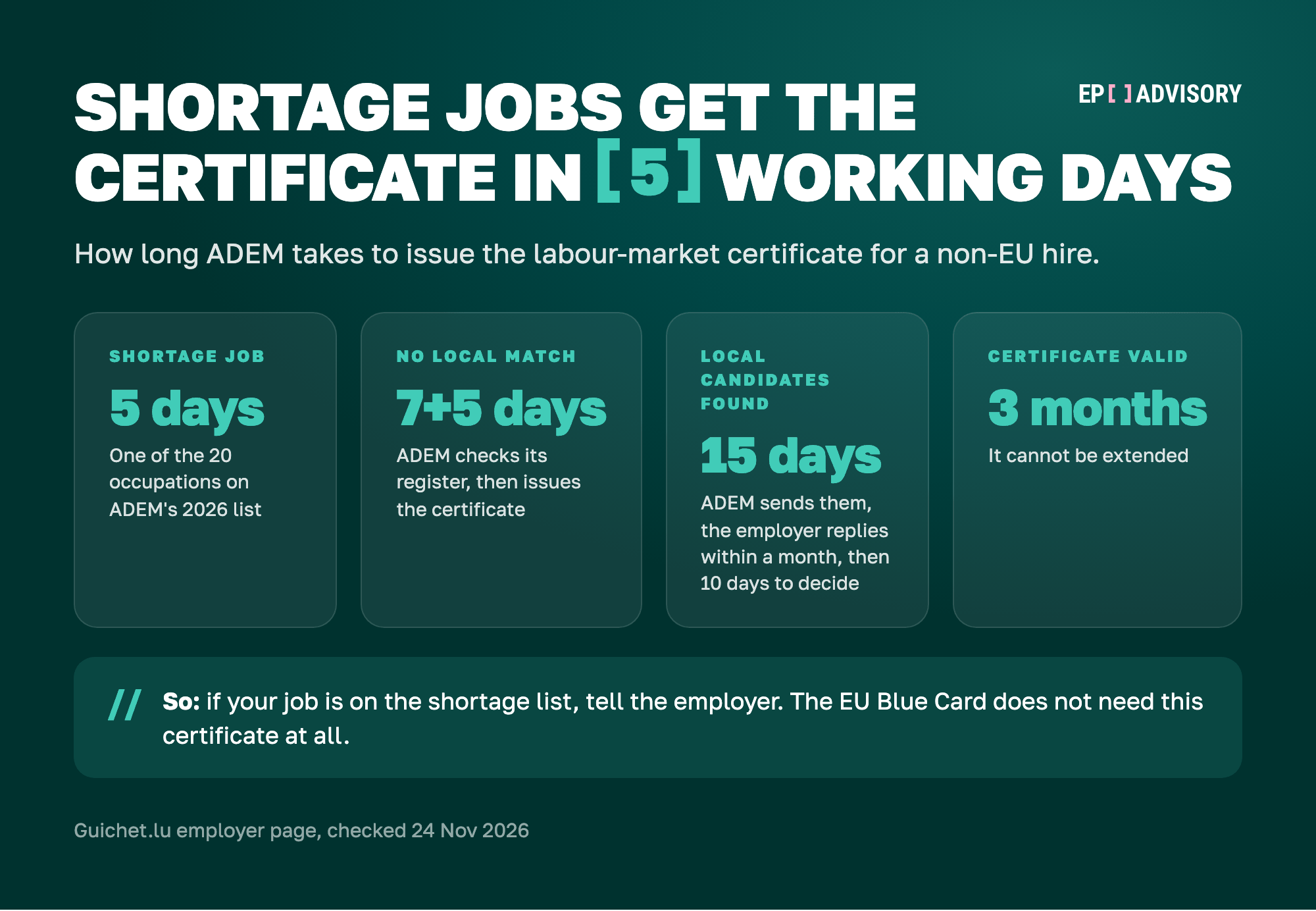
- Shortage job: the certificate comes within 5 working days of ADEM’s acknowledgement.
- Other jobs: ADEM checks its register for 7 working days. If no one fits, the certificate follows within 5 working days.
- If ADEM finds candidates: it has 15 more working days to send them. The employer then has one month to give reasons for each refusal. If ADEM still has no suitable candidate, it issues the certificate within 10 working days.
- Validity: the certificate lasts 3 months and cannot be extended.
A vacancy declared to ADEM stays active for 2 months, and the employer can ask for the certificate at any time in that window. The pay must be at least the social minimum wage. You then apply for the visa D with the certificate in your file.
One change is still pending: the EU single permit. Parliament (the Chamber of Deputies) adopted the bill (bill 8586) on 14 October 2026. The Council of State waived the second vote on 28 October 2026. On 24 November 2026, Guichet.lu still listed its rules as not yet in force. It says that once they apply, the first salaried permit will last up to 2 years. You will not be able to change employer in the first 6 months, except where the employer has seriously broken working conditions. Until then, treat these rules as future ones.
If your job is on the shortage list, say so in your application. It tells the employer the certificate step takes about a week.
Which jobs are in demand in Luxembourg
Finance, IT, engineering, care and law lead the 2026 shortage list. ADEM’s list of occupations in high demand for 2026 names 20 occupations, based on vacancies in 2025:
- Banking and finance: credit analysis and KYC (know your customer) analysts, bank client advisers, front-office and fund administration roles, financial analysis, audit and control.
- IT: systems administration, IT expertise and support, and software research and development.
- Engineering and industry: industrial research and development, quality engineering, equipment and mechanical maintenance, and car body repair.
- Care and social work: nursing, care assistants, social work, early childhood education and socio-educational work.
- Law: legal defence and advice.
- Trades: roofing and solar panel installation.
The size of each sector matters too. In 2025, health and social work employed 62,300 people. Professional and technical services employed 57,500, finance and insurance 55,400, construction 47,900 and IT 22,500 (STATEC).
The market is tighter than it was. ADEM, the national employment agency, counted 20,435 registered jobseekers at the end of October 2026. That is 9.2% more than a year earlier, and unemployment stood at 6.4%. Employers still reported 3,236 new vacancies that month, and 6,793 were open at the end of October (ADEM, 20 November 2026). In October 2026, ADEM reported the strongest year-on-year rise in vacancies in warehousing, paramedical care, social work and food retail.
So match your search to these lists. If your occupation is on the shortage list, put the exact job title from the list in your CV headline.
Living across the border: the cross-border option
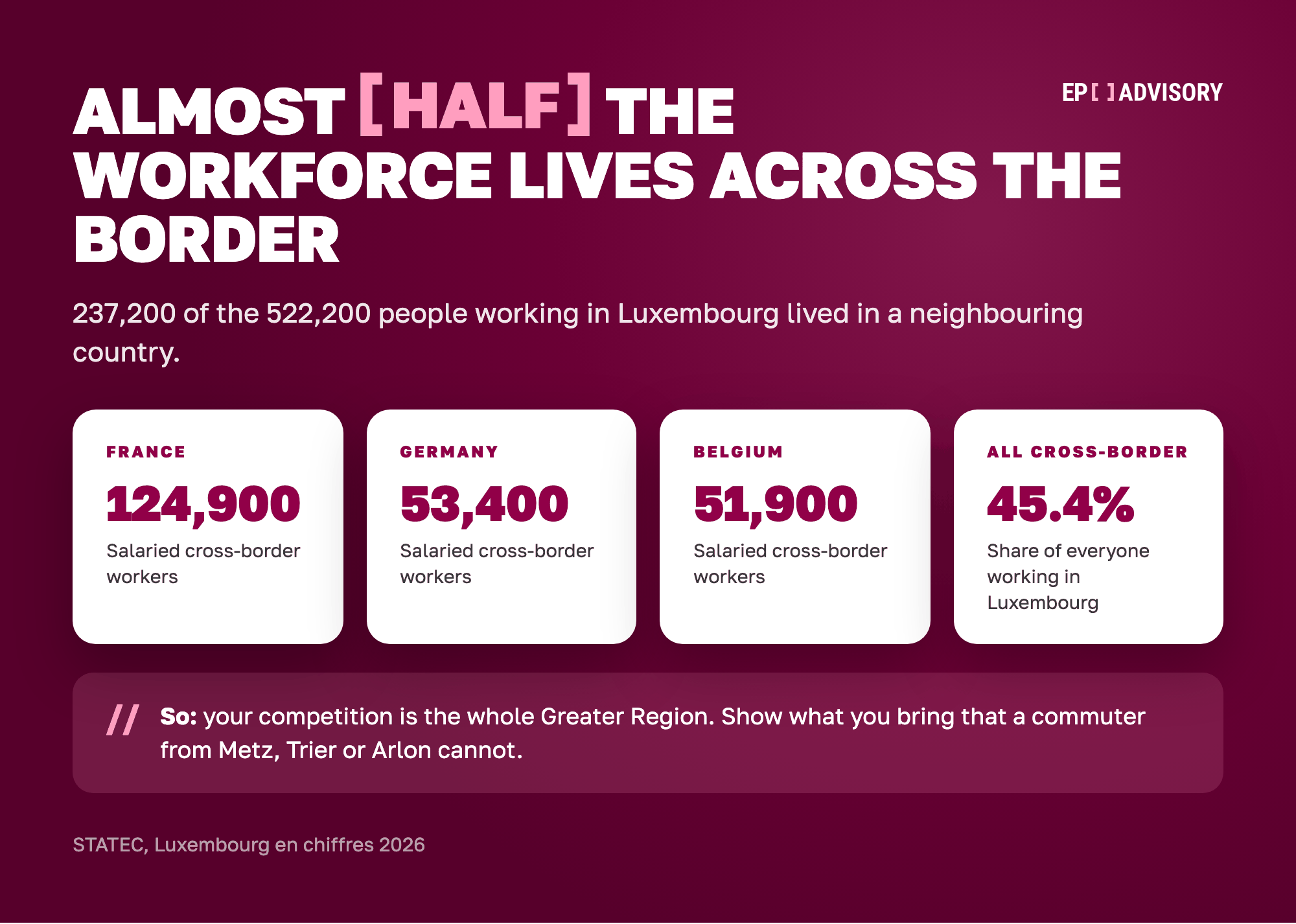
Almost half of Luxembourg’s workforce lives in another country. In 2025, 237,200 of the 522,200 people working in Luxembourg were cross-border workers living in France, Belgium or Germany, about 45% (annual averages). Of the salaried ones, 124,900 lived in France, 53,400 in Germany and 51,900 in Belgium, according to STATEC’s Luxembourg en chiffres 2026. Employers here are used to hiring people who were not born in Luxembourg and do not speak Luxembourgish.
This shapes hiring in three ways:
- Your competition includes the whole Greater Region. Employers can draw on candidates from Metz, Trier, Arlon and beyond. Show what you add that a commuter from the next town cannot.
- Telework has limits. Cross-border workers stay taxed only in Luxembourg if they work no more than 34 days a year outside the country. They stay in Luxembourg social security up to 49% of working days outside, according to the government’s Work in Luxembourg portal. Employers plan roles around these limits.
- Housing can sit across the border. Many people choose this because homes in Luxembourg cost more.
For non-EU citizens, living across the border is not a shortcut. You need the right to live in another EU country, usually France, Belgium or Germany. You also need a work authorisation from the DGIM before you start, as Guichet.lu explains. Your employer goes through the ADEM test. The exception is a highly qualified job that pays at least €65,652, with a contract of 1 year or more. The answer comes in principle within 3 months, and no answer means refusal. In the first year, the authorisation covers one profession in one sector. If you already live in one of these countries, read that page before you apply, so you can tell employers exactly what they need to do.
Do you need French? Languages by sector
English is enough in finance, international firms and the EU institutions. Most other jobs expect French. According to the government’s official portal, French is the most used language at work in almost every sector. English comes second and leads in banking, finance, insurance, international trade and the EU institutions.
| Sector | Language you will use most |
|---|---|
| Banking, funds, insurance | English, often with French |
| EU institutions, international trade | English and French |
| Retail, hospitality, most private firms | French |
| Public administration, education | Luxembourgish |
| Construction, cleaning, hotels | French and Portuguese |
The 2021 census shows the mix among residents of the capital: 67% use French at work and 58% use English. Luxembourgish is the most used language in the country overall, but at work French comes first. A 2019 University of Luxembourg study of job adverts is cited on the same portal. It found that nearly half asked for all three national languages: Luxembourgish, German and French.
The rule for your CV: write in the language of the advert. List every language with its CEFR level, the European scale from A1 to C2. If you want to work outside finance and tech, start French lessons before you arrive.
Where to find jobs in Luxembourg
Start with the boards local employers use, then go direct. Every employer must declare a vacancy to ADEM before advertising it, so the public board is a good first stop.
- ADEM JobBoard: the national employment agency’s board. It lists vacancies declared to ADEM, and some offers are reserved for jobseekers registered with ADEM.
- Work in Luxembourg: a government-led portal for international talent, with job offers in English.
- jobs.lu and Moovijob: the main commercial job boards.
- LinkedIn: widely used in finance, funds, consulting and tech. Recruiters search by keyword, so use the job titles from real adverts.
- EURES: the EU job portal. Employers can send their ADEM vacancy to EURES too.
- Recruitment agencies: international and local agencies recruit for finance, IT and admin roles.
Speculative applications also work in a small market. Many employers sit in the Kirchberg, Cloche d’Or and Gasperich business districts. Make a list of 30 target firms in your field, and write to the hiring manager, not only the careers inbox.
EU institution jobs in Luxembourg
Luxembourg hosts the Court of Justice of the EU, the European Investment Bank and parts of other EU bodies. They hire through their own systems. Permanent posts go through EPSO competitions, listed on EU Careers, along with contract staff and traineeships. The EIB and the Court of Justice also publish vacancies on their own sites. Read the eligibility section of each notice, including nationality, before you spend time on an application.
If you would rather search on the spot, check our guide to job-seeker visas in Europe. For a Benelux search, our guide to finding a job in Belgium covers the neighbouring market.
Luxembourg CVs, interviews and offers
A Luxembourg CV is short, factual and clear about languages and permits. ADEM’s CV guide says a photo is not required and recommends CEFR levels for languages. Add these points:
- Length. One or two pages. Two is fine for senior profiles. Our guide to the European CV format shows the layout.
- Your status. State your nationality, where you live and whether you need a visa. If you qualify for the Blue Card, say so.
- Results, not duties. Show numbers for what you achieved. Our CV achievement examples show how.
- A cover letter. Many employers still expect one, especially in French-speaking firms. See our guide to the cover letter for a job abroad.
When we coach clients for Luxembourg, the same gaps come up. CVs written for London or Dubai often hide languages at the bottom of page two, when a Luxembourg recruiter looks for them first. Profiles in funds and banking get more replies when they use the market’s own terms instead of general ones. Examples are fund administration, KYC, AML (anti-money laundering) or depositary. And candidates from outside the EU do better when the first page answers the permit question before the reader asks it.
If your CV was written for another market, rework it for Luxembourg before you apply. Getting ready to apply for jobs in Luxembourg? Check your CV for free: see it the way a recruiter does, then fix each problem.
In interviews, expect questions on your languages, your notice period and how soon you could relocate. Some interviewers switch to French for a few minutes to test your level. Our guide on how to pass a job interview covers preparation. Offers state gross annual pay. Before you sign, read our tips on how to negotiate salary.
Worked example: a software developer from India hired in Kirchberg
Here is how the new procedure plays out for one realistic profile. Arjun is a software developer in Bengaluru with a computer science degree. A firm in Kirchberg offers him a permanent contract at €72,000 gross a year, about $80,800 at ECB rates of 2026-11-02. All rules and fees below were checked on Guichet.lu on 24 November 2026.
- Route. €72,000 is above the €65,652 Blue Card bar and the contract is longer than 6 months, so the Blue Card fits. Software development is also on ADEM’s 2026 shortage list. So even the salaried route would get the ADEM certificate within 5 working days.
- Employer step. The firm declares the vacancy to ADEM before advertising it. The Blue Card file does not need an ADEM certificate.
- Documents. Arjun gathers his passport, a police clearance under 3 months old, his CV, his degree, the signed contract and Schengen travel health insurance for 6 months. His degree and contract are in English, so they need no sworn translation.
- Visa D. He applies in person at the embassy that issues Luxembourg long-stay visas for India. If approved, he gets a visa D valid for 6 months. The visa fee is set by the embassy, so he checks it when he books.
- Arrival. Within 3 days of arriving, he declares his address at the commune. He takes the medical check.
- Residence permit. He applies to the DGIM at least 3 months before his visa runs out. He pays €80 and gives his biometrics. His Blue Card is ready about one week later.
Two points Arjun checks before he signs. First, the impatriate tax regime needs fixed pay of at least €75,000 a year, among other conditions, so at €72,000 he does not qualify. Under the regime, 50% of gross annual pay is exempt from tax for 8 years. This applies to pay of up to €400,000, so at most €200,000 a year (Guichet.lu). The other conditions include deep technical knowledge or at least 5 years of specialised experience in the sector. He must also have had no tax home in Luxembourg, and no home within 150 km of its border, in the previous 5 years. So Arjun asks whether the fixed pay could reach €75,000, and checks the other conditions before he counts on the regime. Second, if he wants to change employer later, he must notify the DGIM first and wait out the 30-day objection period.
Your version of this plan starts with one number: the gross annual pay on your offer. Compare it with €65,652 and €75,000 before you reply.
What jobs in Luxembourg pay
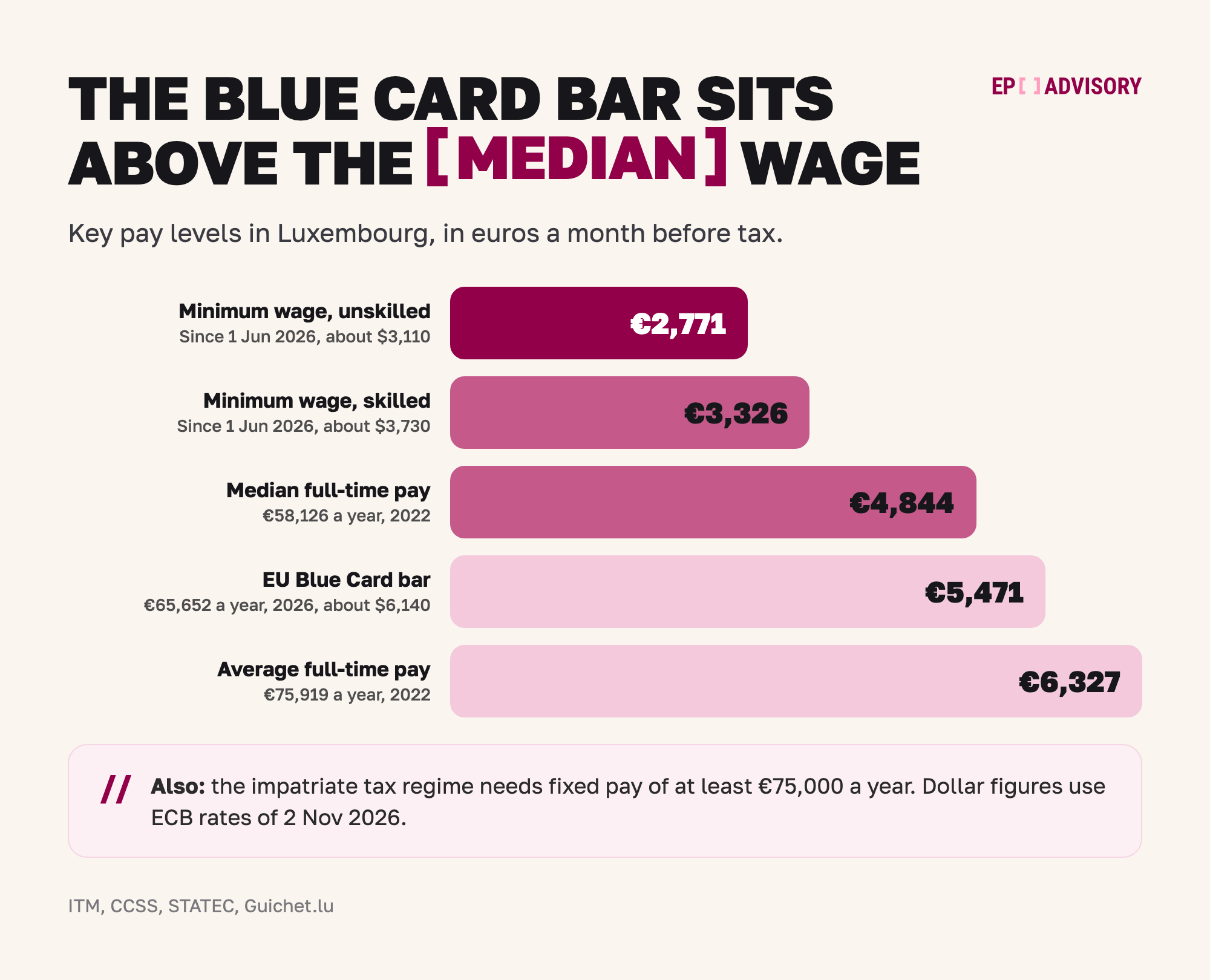
The minimum wage is high, and the Blue Card bar sits above the median wage. Since 1 June 2026, the social minimum wage for workers aged 18 and over is €2,771.33 gross a month unskilled and €3,325.59 skilled. These figures come from the labour inspectorate (ITM). That is about $3,110 and $3,730 a month at ECB rates of 2026-11-02. Wages rose by 2.5% on that date, when the index moved from 968.04 to 992.24 (CCSS).
The latest full salary survey covers 2022. Full-time workers employed all year earned €75,919 gross on average, and the median was €58,126 (STATEC). These include overtime, a 13th month and bonuses.
Housing is the cost to plan for. Since 1 August 2024, the revised rental law has cut the maximum rental deposit from 3 months’ rent to 2. Estate agency fees are now split 50/50 between landlord and tenant (Ministry of Housing). Even so, rents are a big share of take-home pay, which is one reason so many people live across the border. If you plan to commute, compare pay in our guide to salaries in France.
Next: check what your role pays by sector and what you keep after tax in our guide to salaries in Luxembourg.
Key takeaways
- EU, EEA and Swiss citizens need no work permit. Non-EU citizens need a job offer first.
- Since 1 October 2026, non-EU hires apply for a visa D at the Luxembourg or Belgian embassy. It is valid for 6 months.
- The EU Blue Card needs €65,652 gross a year and a contract of at least 6 months, with no ADEM certificate.
- Below that bar, the employer needs an ADEM certificate: 5 working days for the 20 shortage occupations, longer for other jobs.
- About 45% of the workforce commutes from France, Belgium or Germany, so your competition is regional.
- French is the main working language. English is enough mainly in finance, international firms and the EU institutions.
- The minimum wage is €2,771.33 a month unskilled and €3,325.59 skilled since 1 June 2026.
See what a recruiter sees, then fix it before you apply. An instant score, then the fix for every problem.
Free, no card. A free account unlocks every fix.
Frequently asked questions
Can foreigners get a job in Luxembourg in 2026?
Yes. EU, EEA and Swiss citizens apply like locals. Non-EU professionals need a job offer, then a visa D from the embassy and a residence permit after arrival. About 45% of people working in Luxembourg live in France, Belgium or Germany, so employers are used to foreign hires.
How do I get a work visa for Luxembourg?
Since 1 October 2026, you apply in person for a long-stay visa D at the Luxembourg embassy, or a Belgian one where Luxembourg does not issue these visas. You need a signed contract and, below the Blue Card bar, your employer’s ADEM certificate. The visa lasts 6 months. You then declare your arrival within 3 days and apply for your residence permit.
What salary do I need for an EU Blue Card in Luxembourg?
At least €65,652 gross a year, which is about €5,471 a month. Guichet.lu gives no lower figure for shortage occupations, and you also need a contract of at least 6 months.
Can I work in Luxembourg with English only?
Yes, in banking, funds, insurance, international firms and the EU institutions, where English is widely used. In most other sectors French is the main working language, and the public sector uses Luxembourgish. Listing your French level helps even in English-speaking roles.
Which jobs are in demand in Luxembourg?
ADEM’s 2026 list names 20 shortage occupations. They include KYC and credit analysts, bank client advisers, audit, financial analysis, software development, systems administration, industrial engineering, nursing, care, social work, early childhood education and legal advice.
What is the minimum wage in Luxembourg in 2026?
Since 1 June 2026, it is €2,771.33 gross a month for unskilled workers aged 18 and over and €3,325.59 for skilled workers. That is €16.0192 and €19.2231 an hour.