 By Andre Atallah, CEO of EP Advisory
A long, quiet job search is brutal, especially when you are trying to move to a new country. Every unanswered application chips away at your confidence, and it is easy to conclude the problem is you.
It is not. There is no one in the world who is genuinely unemployable. The search stalls for reasons that are fixable and, just as often, for reasons of mindset. This guide covers both, using the method we actually coach.
Official versus unofficial channels
There are two ways into a company. The official channel is applications and job boards. It feels hard because everyone is crammed into it. The unofficial channel is networking your way to a referral, and it is where doors actually open.
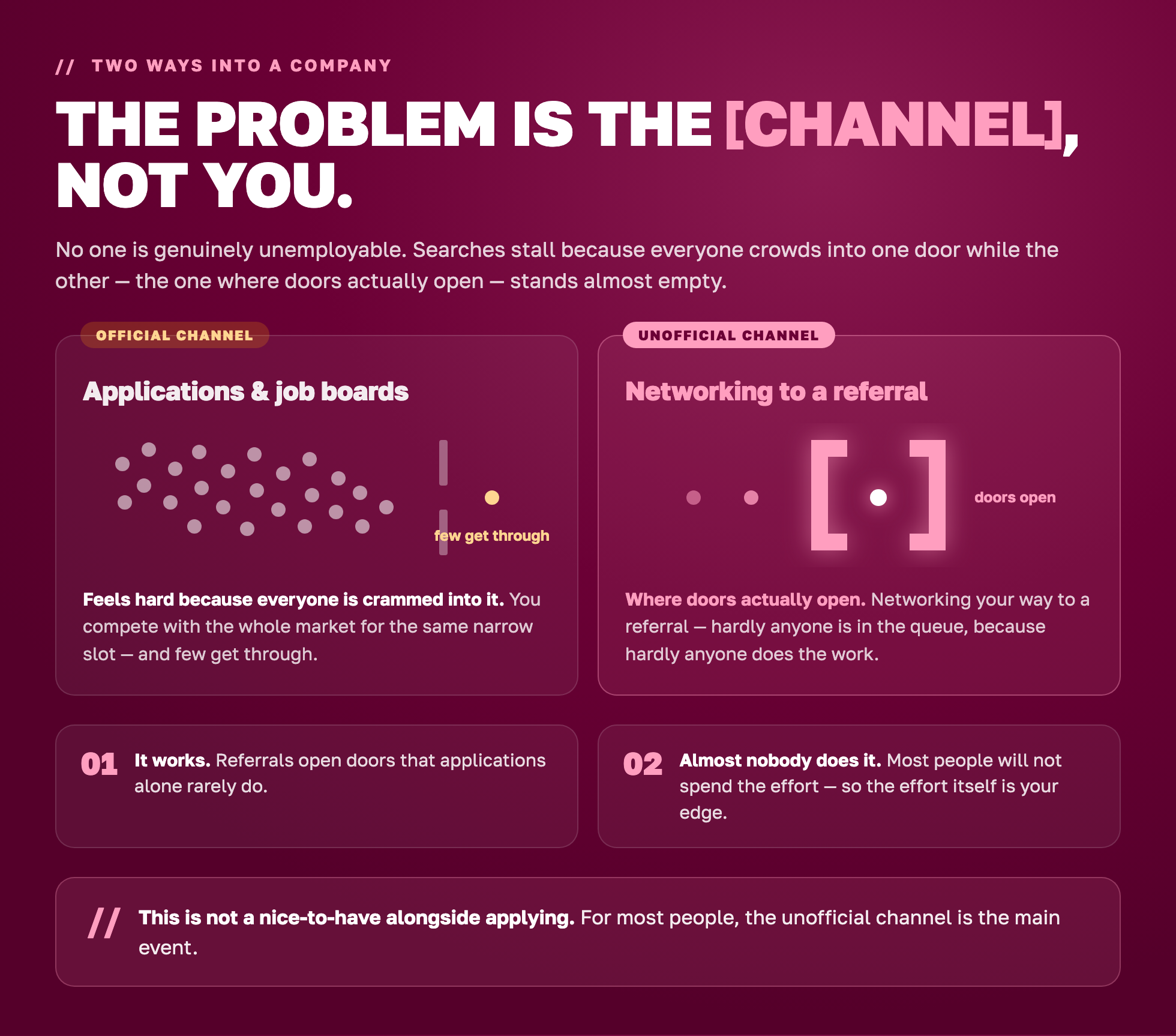
Here is why it works, in two parts. One, it works. Two, almost nobody does it. Most people will not spend the effort, so the effort itself is your edge. This is not a nice-to-have alongside applying. For most people it is the main event.
The networking funnel that actually lands referrals
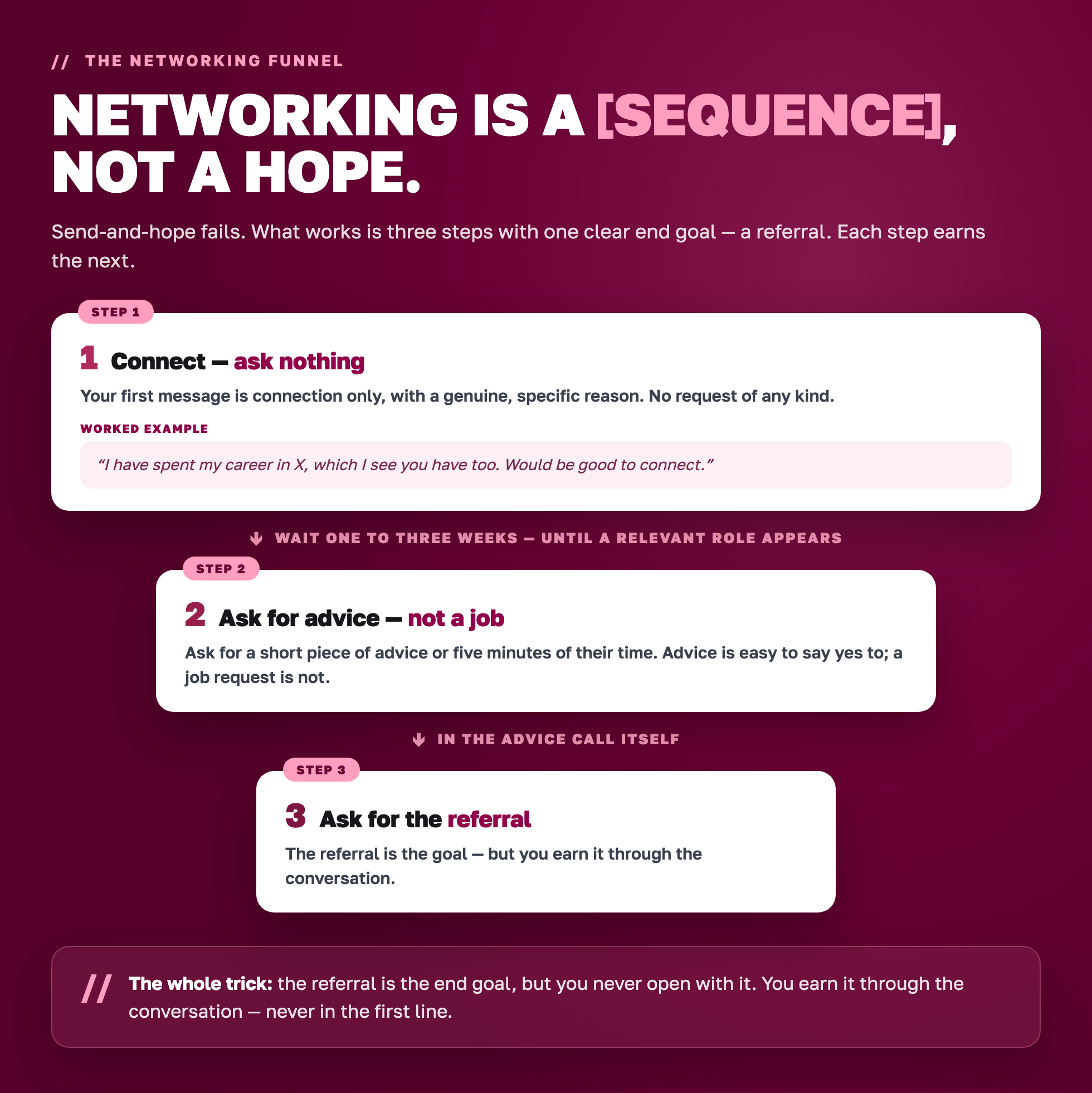
Networking fails when people treat it as “send messages and hope.” It works as a sequence with a clear end goal: a referral.
- Connect first, ask nothing. Your first message is connection only, with a genuine, specific reason. “I have spent my career in X, which I see you have too. Would be good to connect.” No request.
- Wait, then ask for advice. One to three weeks later, when a relevant role appears, ask for a short piece of advice or five minutes of their time. Not a job. Advice.
- In the advice call, ask for the referral. That is the whole trick. The referral is the goal, but you earn it through the conversation, never in the opening line.
How to write the message
Two rules decide whether you get a reply.
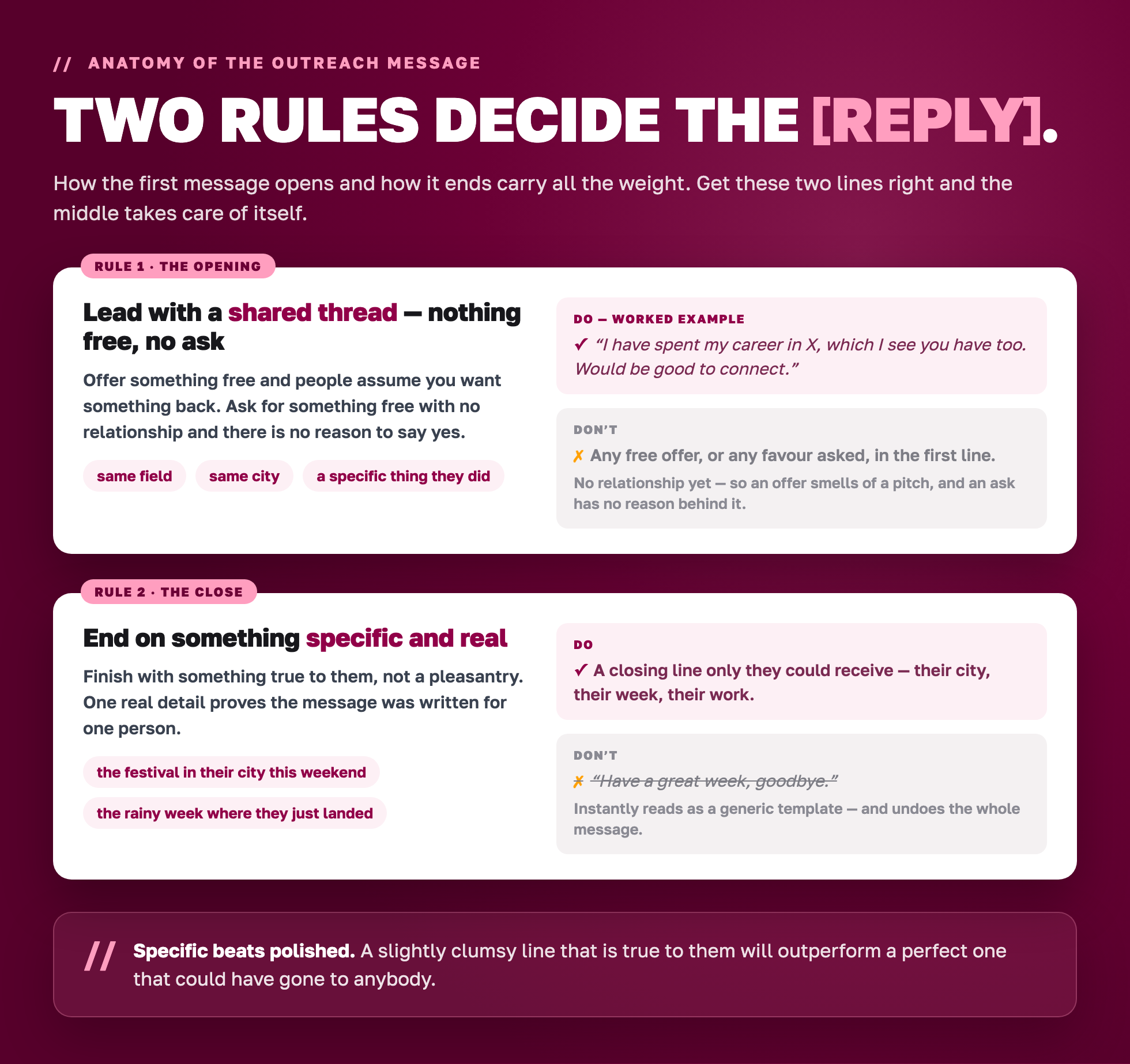
- Never offer or ask for anything free up front. Offer something free and people assume you want something back. Ask for something free with no relationship and there is no reason to say yes. Lead with a shared thread instead: same field, same city, admiration for a specific thing they have done.
- End with something specific and real. Never close with “have a great week, goodbye,” because it instantly reads as a generic template and undoes the whole message. Finish with something true to them: a festival in their city this weekend, the rainy week where they just landed. Specific beats polished.
Who to target
Aim at people roughly at your level, whose career path aligns with yours. Skip the managing directors and board members; they are too busy and too far from your role. Skip HR and recruiters; they are flooded with messages. Spend ten to fifteen seconds on each profile looking for one genuine point of alignment. And notice who actually posts: hardly anyone does, so a person who posts even occasionally is active and reachable.
It is a numbers game, with real numbers
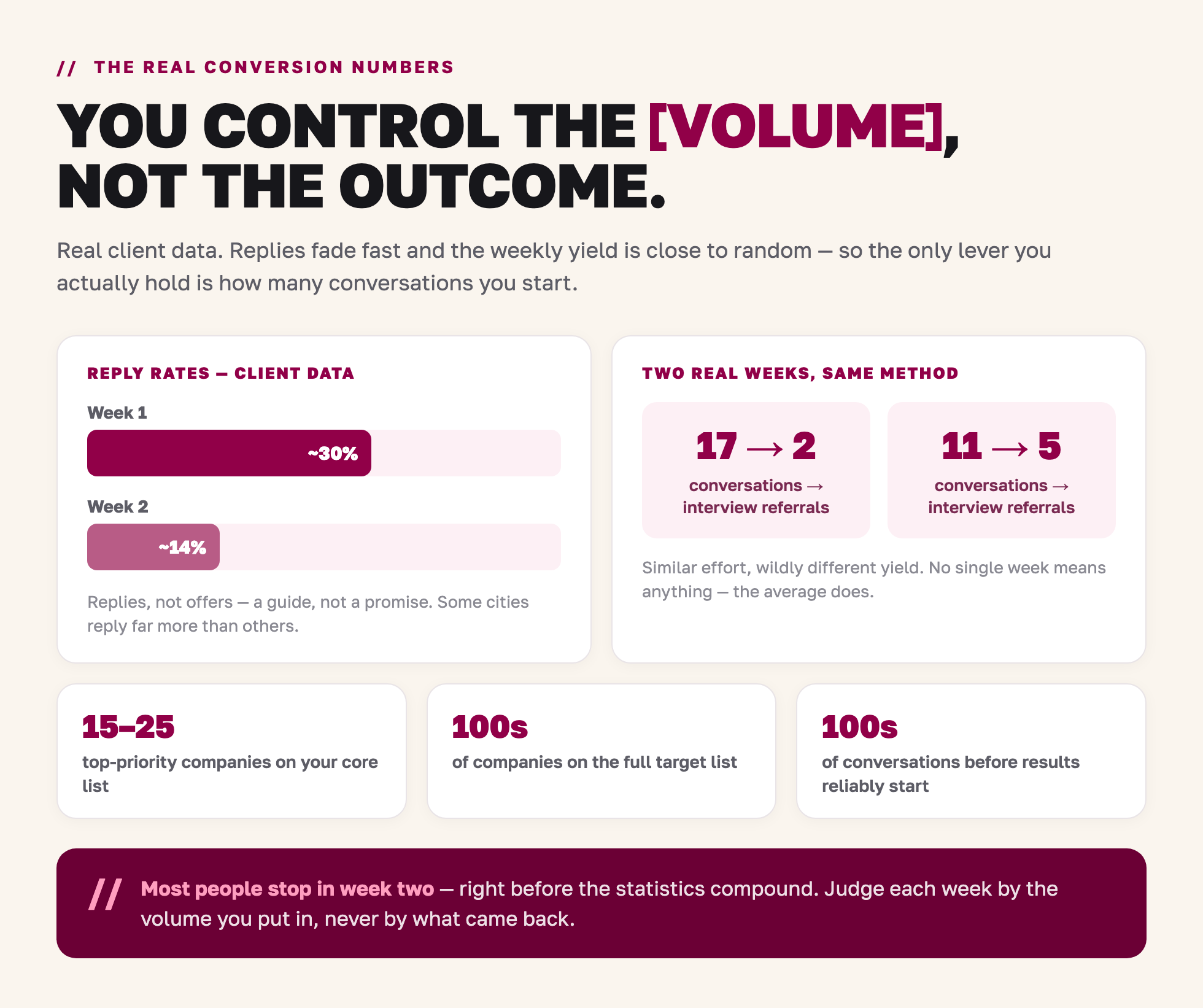
“It is a numbers game” is a cliche until you see the actual conversion. In our clients’ data, roughly 30% reply in the first week and about 14% in the second. One week, seventeen conversations produced two interview referrals; another week, eleven conversations produced five. The per-week yield is close to random, which means you control the volume, not the outcome.
So the honest target is hundreds of conversations, not dozens, before things reliably start to happen. Keep fifteen to twenty-five top-priority companies, but a real target list runs into the hundreds. Markets vary too: some cities reply far more than others, so treat the numbers as a guide, not a promise.
Why most searches stall
The method needs ten or fifteen minutes, every single day. Most people do it for a week or two, see little, and stop, right before the statistics compound. That is the real reason searches stall, far more often than employability.
A warning on shortcuts: AI tools that auto-apply to hundreds of jobs are low quality and untargeted. It is like throwing money into the sea. Volume without targeting does not move the numbers that matter.
Protect your mindset: the dog in the cage
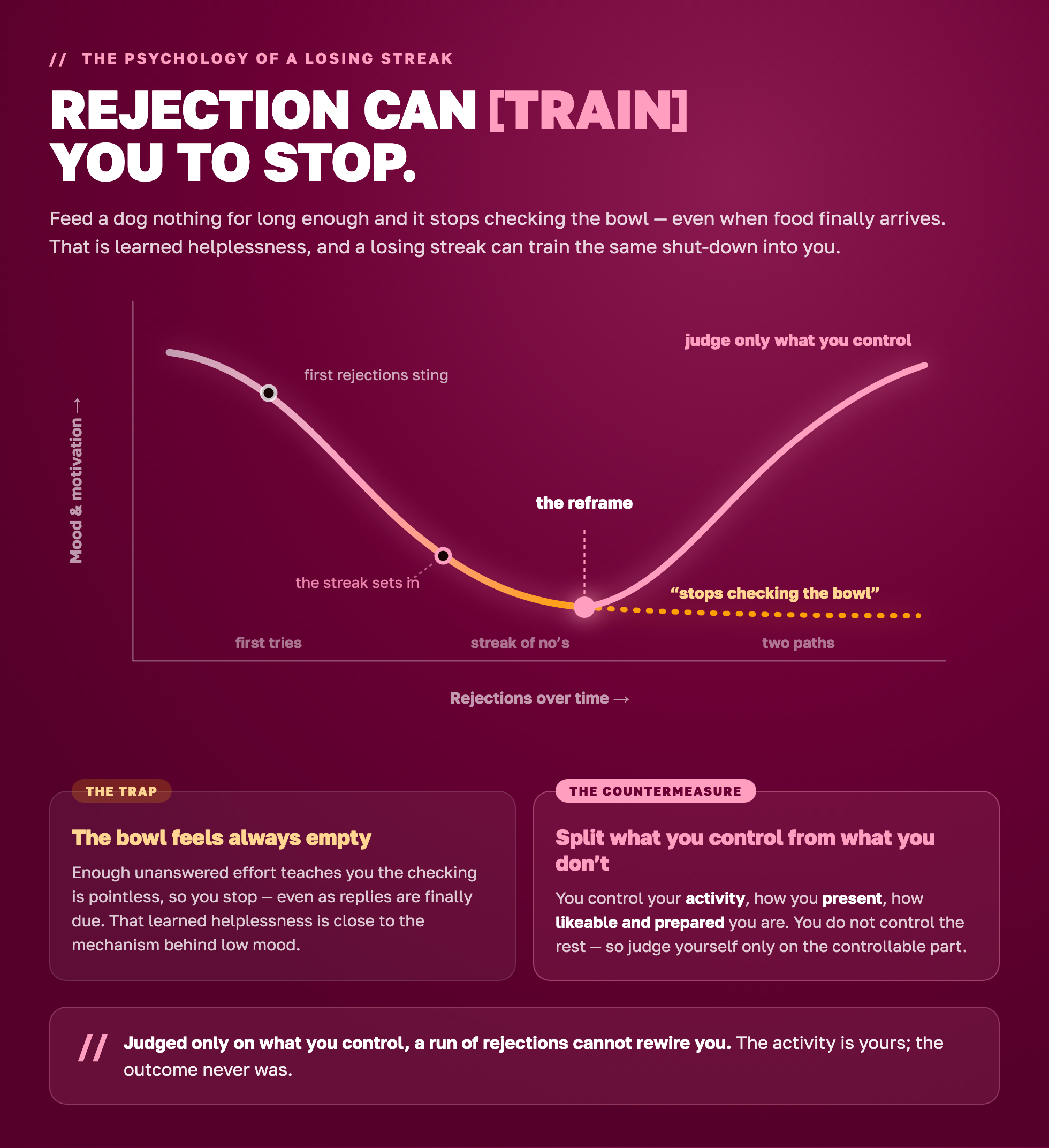
Here is why repeated rejection is dangerous, and it is not just “it feels bad.” There is a known psychological loop behind it. Put a dog in a cage and give it no food for long enough, and when you finally put food in the bowl, it stops checking, because it has learned the bowl is always empty. That learned helplessness is close to the mechanism behind low mood, and a losing streak can train the same response into you.
The countermeasure is to separate what you control from what you do not. You control your activity, how you present, how likeable and prepared you are. You do not control the rest. Judge yourself only on the controllable part, and a run of rejections cannot rewire you.
Two reframes that keep you going
- You only need one, like a partner. The goal is one offer at a company you like. Like finding a life partner, you do not need many, and it can arrive at any time, even from a company that went quiet three months ago.
- Assume today is a fail. Before a hard interview, decide in advance that it will probably not work out, and that is fine. Every “wasted” interview is free live practice. Paying a senior person to rehearse with you would cost a fortune. Do enough of them and you become almost bulletproof to the process.
Do not skip the fixable basics
Alongside the mindset work, check the mechanics: are you targeting roles that genuinely match, does your CV show your value in the first few seconds, and are enough of the right people seeing you? Ten focused applications beat fifty generic ones. For a move abroad, make sure a visa or language filter is not quietly removing you before a human ever reads your name.
Your first month of networking
This is a program, not a burst of effort. Ten to fifteen minutes a day, every day, run in this order.
- Week 1: set up. Build your target list, fifteen to twenty-five core companies plus a wider list running into the hundreds. Tidy your profile and use a warm, genuine photo.
- Week 2 onward: connect. Send five to ten connection requests a day, and keep this going the whole time. First message is connection only, with a specific, genuine reason and no ask. LinkedIn caps you here, which is exactly why you start now.
- From week 3: advice and referrals. As people start accepting, send a short advice request, and in the advice call itself, ask for a referral. The connecting from the previous step keeps running underneath.
- Throughout: protect the mindset. Track your funnel. As a rough guide, not a promise, around 30% of people reply in week one and 14% in week two, and those are reply rates, not offers. On interview days, assume today is a fail and treat it as free practice. The people who get the offer are usually just the ones who did not stop at week two.
Summary and FAQs on a stalled job search
Get out of the official channel and into the unofficial one. Run the connect, advice, referral funnel with real volume, write messages that feel human, and protect your mind from the losing-streak trap. You only need one offer, and the people who get it are usually just the ones who did not stop.
If the search has stalled and you want a clear read on why, our consultants can help. Use the free consultant picker tool. When interviews come, prepare with how to pass a job interview abroad and calming your nerves.