 By Andre Atallah, CEO of EP Advisory
Most advice about interview nerves is useless, because it tells you to do something in the moment that only works if you have already done the work beforehand. “Take a deep breath.” “Just be confident.” If it were that easy, nobody would freeze.
We coach this differently, and it comes from experience rather than theory. I spent more than a decade in acting training for one reason: to fix my own habit of going blank on stage. The techniques below are what actually move the needle, and most of them are the opposite of the usual tips.
Nerves are not the problem. Your baseline is.
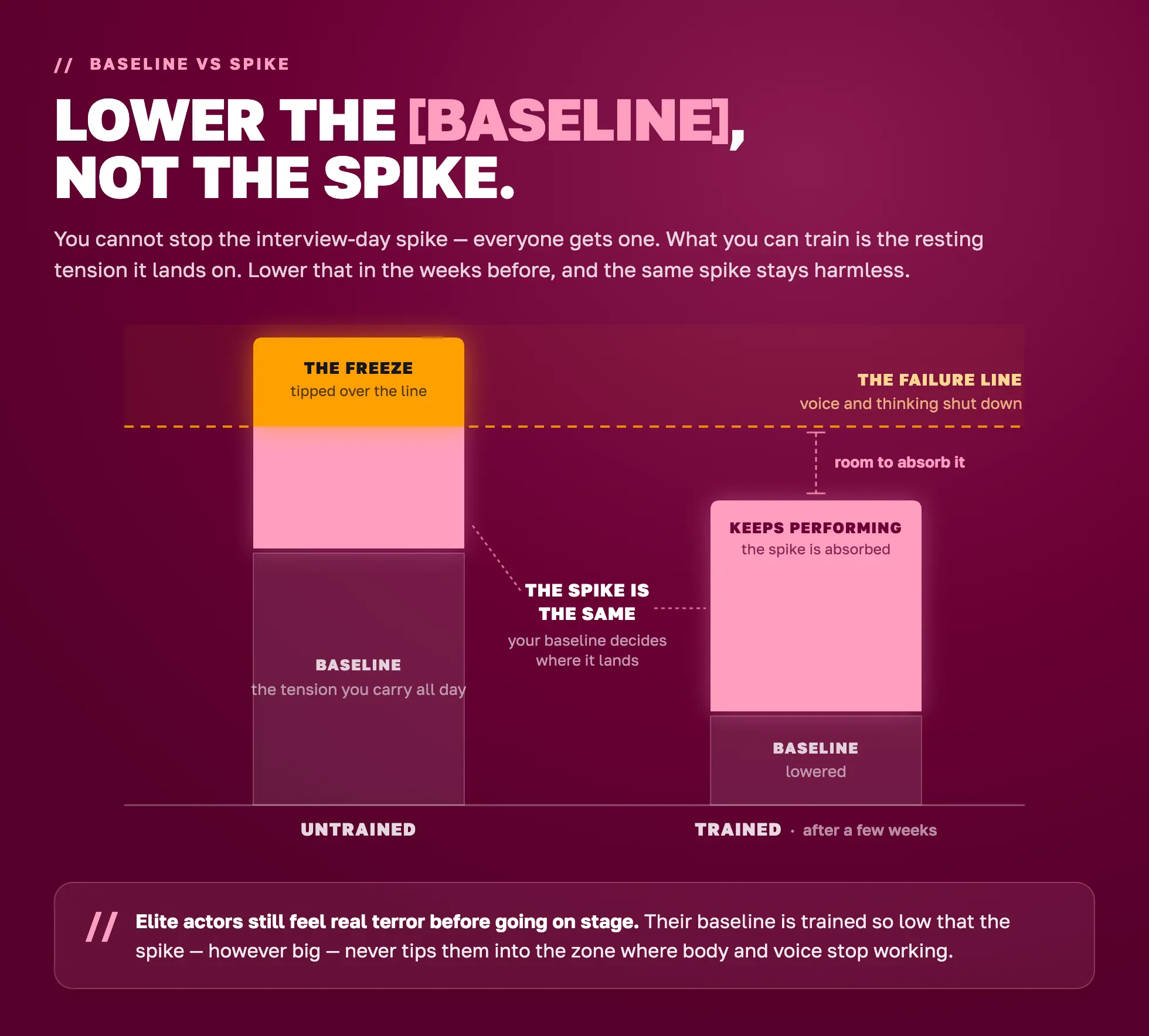
Think of your body as having two layers of tension. Your baseline is the tension you carry all day, even sitting at your desk. Your situational tension is the spike that a high-stakes moment adds on top.
You cannot stop the spike. Here is the part people miss: elite actors feel real terror before going on stage, and they are not lying about it. But they have trained their baseline so low that the spike, however big, never tips them into the zone where their body and voice stop working.
So the goal is not to feel calm on the day. The goal is to lower your resting tension in the weeks before, so that when the spike comes, you have room to absorb it. That single reframe changes everything you do next.
Why “just relax” does not work
You cannot drop your shoulders and instantly feel different. Your muscles, tendons, and nervous system are habituated to the position you hold every day. Telling them to change in the moment is like expecting a new tennis serve to appear under match pressure.
Lowering your baseline takes a few weeks of small, repeated practice. That is not bad news. It means the work is reliable. Do it, and calm becomes your default rather than something you have to summon.
Why your voice disappears when you are nervous
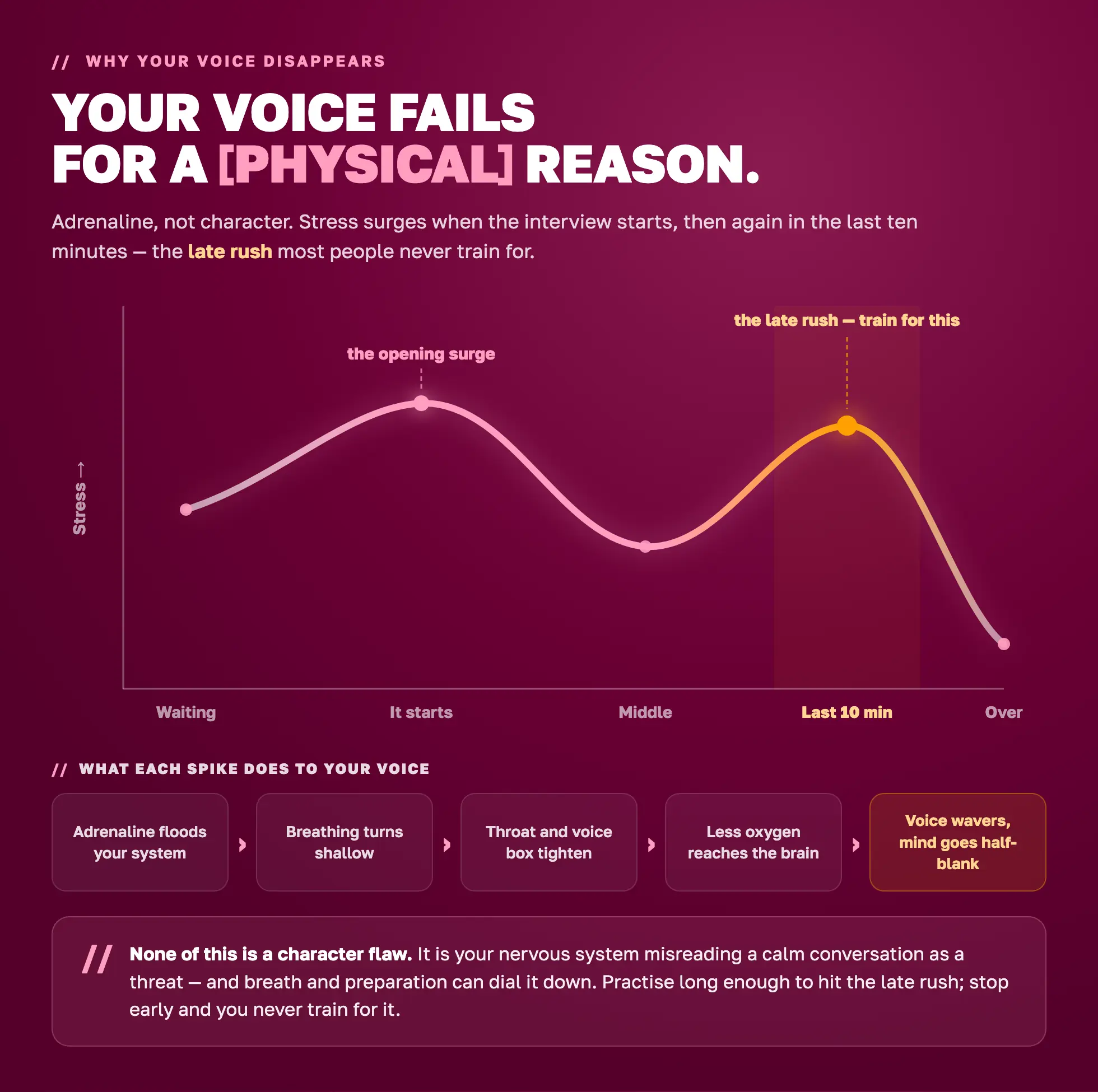
There is a real, physical reason your words stick under pressure. Adrenaline floods your system. Your breathing turns shallow, the muscles around your throat and voice box tighten, and less oxygen reaches your brain. So your voice wavers and your mind goes half-blank.
None of that is a character flaw. It is your nervous system misreading a calm conversation as a threat. Knowing it is physical, and that breath and preparation can dial it down, is the first step to controlling it.
Breathing techniques that shrink the spike
Breathing is the one part of the stress response you can control on purpose. Use these to lower the spike in the moment, and practise them daily to lower your baseline over time.
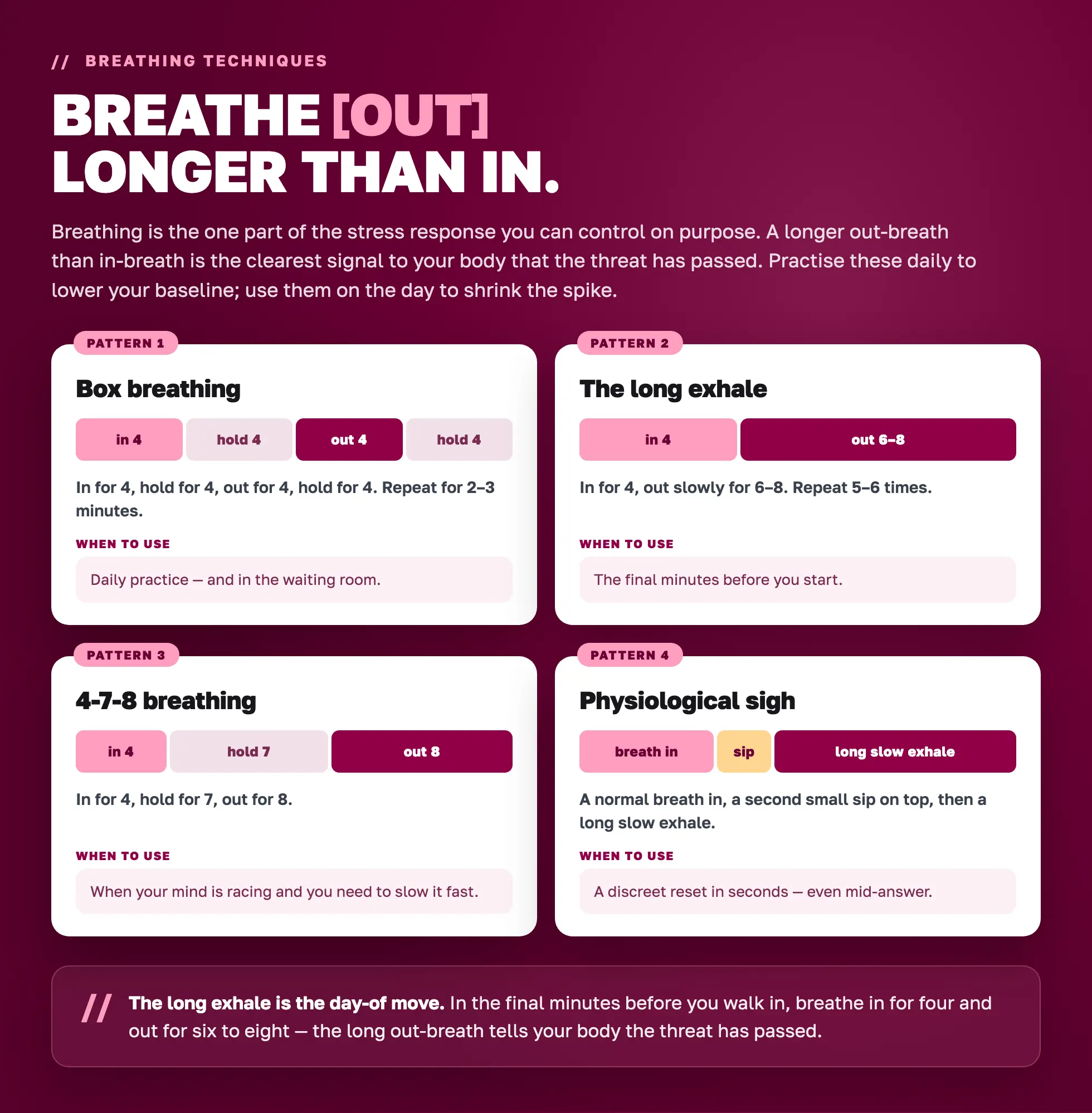
| Technique | How to do it | When to use it |
|---|---|---|
| Box breathing | In for 4, hold for 4, out for 4, hold for 4. Repeat 2–3 minutes. | Daily practice, and in the waiting room. |
| The long exhale | In for 4, out slowly for 6–8. Repeat 5–6 times. | The final minutes before you start. |
| 4-7-8 breathing | In for 4, hold for 7, out for 8. | When your mind is racing and you need to slow it fast. |
| Physiological sigh | A normal breath in, a second small sip on top, then a long slow exhale. | A discreet reset in seconds, even mid-answer. |
Find where your tension hides: the body scan

You cannot fix nerves by thinking about them. You have to recreate the pressure and watch your body. This is the single most useful practice we teach, and it comes straight from acting training.
Sit somewhere quiet, close your eyes, and imagine you are mid-interview in front of the people who matter. Then ask one question: where in my body is the tension right now? It hides in strange places: the jaw, the eyebrows, one shoulder. Naming the exact spot is what lets you release it. Run this for ten or fifteen minutes at a time.
Two things to know. Build up the realism gradually: practise your answers on camera alone, then have someone hold the phone and watch, so you feel real social pressure. And practise long enough, because nerves often return in the last ten minutes as a late adrenaline rush. If you stop early, you never train for that moment.
Posture starts with your head, not your spine
Everyone is told to “sit up straight,” so they fix their back and leave their head jutting forward from years at a screen. That is backwards.
Fix the head first. Bring your chin gently in, not down and not up, so the back of your neck supports your head. Picture your head as a tennis ball floating on a jet of water: free to move, but always centred and balanced. Get the head right, then let the rest of your body settle underneath it. Do this, and the tension that travels up into your voice has nowhere to start.
When your mind goes blank
Under pressure, most people freeze, then scramble to rescue themselves with logic: “okay, what do I actually know here?” That scramble is itself a tell. It quietly signals that you have handed the other person all the authority in the room.
The fix is counter-intuitive. Accept the blank first instead of fighting it. Take one slow breath. Then buy honest time: “Let me think about that for a second.” Repeat the question back in your own words, which often unlocks the answer. Handling a blank moment calmly reads as more senior than a rushed, perfect reply.
Reframe the nerves as readiness
The physical signals of nervousness and excitement are nearly identical: racing heart, alert mind, energy in the body. The difference is the label. Swap “I am so nervous” for “I am ready and switched on for this.” You are not lying to yourself. You are pointing the same energy in a useful direction.
One more reframe helps most of all. This is a two-way choice. You are not only being judged; you are deciding whether this company and team are right for you. That balance takes the pressure down a notch on its own.
When it is more than nerves
Everyday interview nerves respond to breathing, practice, and a lower baseline. If you experience severe, lasting anxiety that stops you attending interviews at all, that deserves proper support from a professional. There is no shame in it. The techniques here are for the normal nerves that everyone feels.
Your baseline-lowering plan
Because this is physical retraining, it works as a staged plan over about three to four weeks. Start today, and do not skip ahead: each stage makes the next one work.
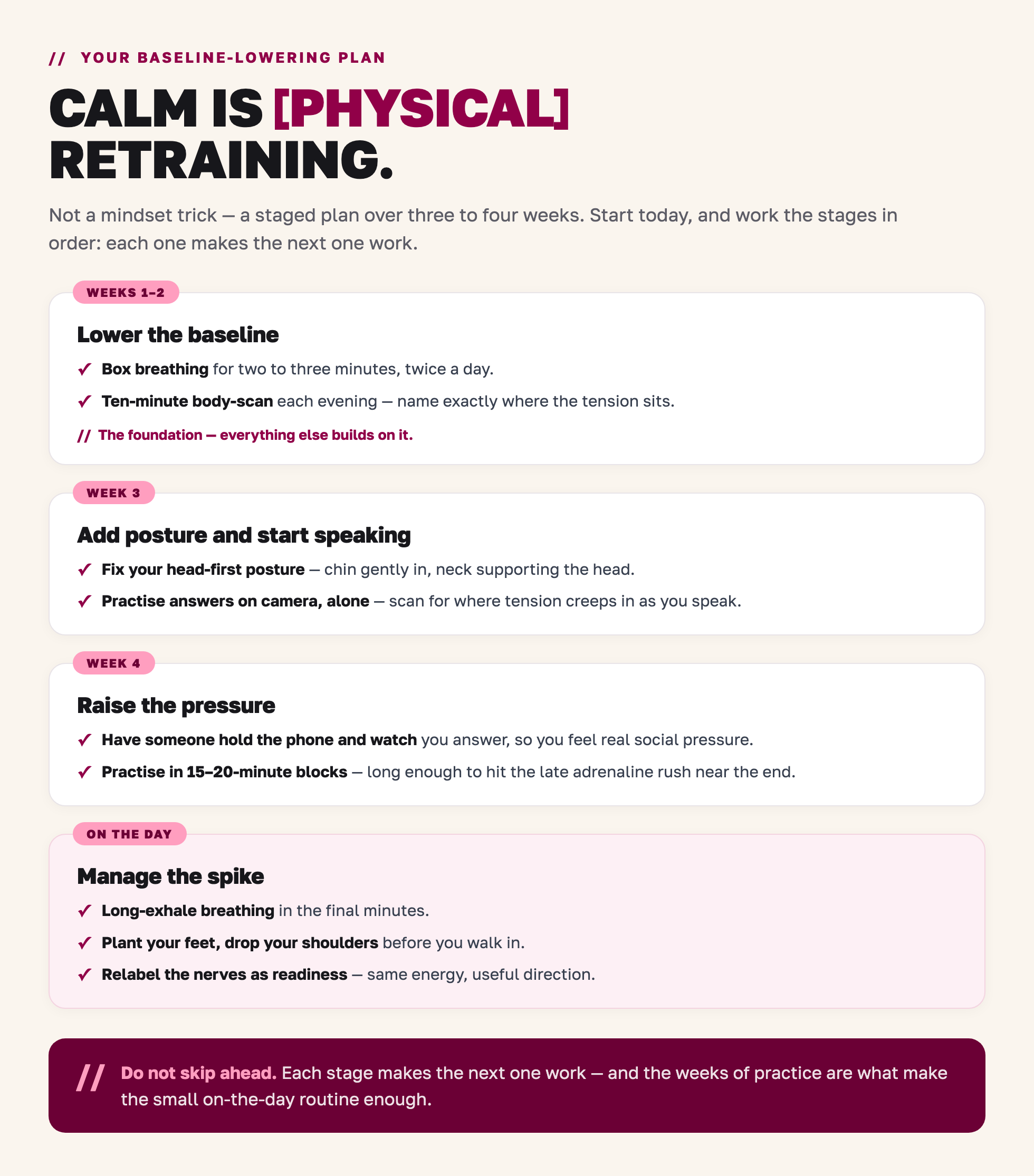
- Weeks 1–2: lower the baseline. Box breathing for two to three minutes, twice a day, and a ten-minute body-scan each evening, naming where the tension sits. This is the foundation; everything else builds on it.
- Week 3: add posture and start speaking. Once breathing is a habit, fix your head-first posture. Begin practising your answers on camera, alone, scanning for where tension creeps in as you speak.
- Week 4: raise the pressure. Escalate the realism. Have someone hold the phone and watch you answer, so you feel real social pressure. Practise in blocks of fifteen to twenty minutes, long enough to hit the late adrenaline rush that arrives near the end.
- On the day: manage the spike. Long-exhale breathing in the final minutes, plant your feet and drop your shoulders before you walk in, and relabel the nerves as readiness. The weeks of work are what make this small step enough.
Summary and FAQs on calming interview nerves
Stop trying to feel calm on the day. Lower your baseline in the weeks before, breathe to shrink the spike, scan your body for hidden tension, and start your posture at your head. Do that, and the nerves are still there. They just cannot touch your performance.
Nerves are best trained under real pressure, and a mock interview is the fastest way to create it. Use our free consultant picker tool to practise with a coach. For how you come across on camera, see our guide on presenting yourself in an interview, and for the full picture, how to pass a job interview abroad.