 By Andre Atallah, CEO of EP Advisory

Short answer: yes. An American doctor can work in the UK once three things are in place: registration with a licence to practise from the General Medical Council (GMC), a job offer from an NHS employer or other licensed sponsor, and a Health and Care Worker visa. Most US-trained doctors use one of two GMC routes: USMLE, if they passed Step 2 CS by 13 March 2020, or the UK’s PLAB exams if they did not.
This guide is for US medical graduates, residents and attending physicians who want to practise in the UK. You may be weighing a move for family, for a better work and life balance, or for a few years abroad. The questions are the same: which licence route fits your training, what it costs, how long it takes and what the NHS pays at your level.
We cover the four GMC routes that matter for US doctors, the 2026 law that changed UK training places, the visa and its costs in pounds and dollars, and NHS pay for 2026/27 against US pay. Then we show how to land the first job. For nearly 10 years, we’ve helped more than 5,000 professionals find jobs abroad. Want to know if your CV will pass screening in the UK? Check your CV for free: a score in 30 seconds, then a fix for each problem.
Yes, an American doctor can work in the UK: the three gates
Every US doctor passes the same three gates, in the same order: GMC registration, a job offer, then the visa.
The General Medical Council is the UK’s medical regulator. It works like a state medical board, but for the whole country. You need full registration with a licence to practise before you can work as a doctor in any UK hospital or practice. A US licence does not transfer on its own.
- Gate 1, the GMC: you show your knowledge and skills through an exam or qualification the GMC accepts, prove your English, and show an acceptable internship. Registration with a licence costs £481 from 1 April 2026.
- Gate 2, the job: an NHS trust (a hospital group, run like a US health system), a GP practice or a private provider of NHS services offers you a role. It must hold a sponsor licence from the Home Office.
- Gate 3, the visa: your employer gives you a certificate of sponsorship. You then apply for the Health and Care Worker visa, which costs £324 for up to 3 years and has no health surcharge.
The Royal College of Radiologists gives the same order in its advice to doctors moving to the UK: register first, then find the job, then apply for the visa once the offer is confirmed. You can apply for jobs while your GMC application is in progress. But you cannot start work as a doctor until your registration and licence are in place.
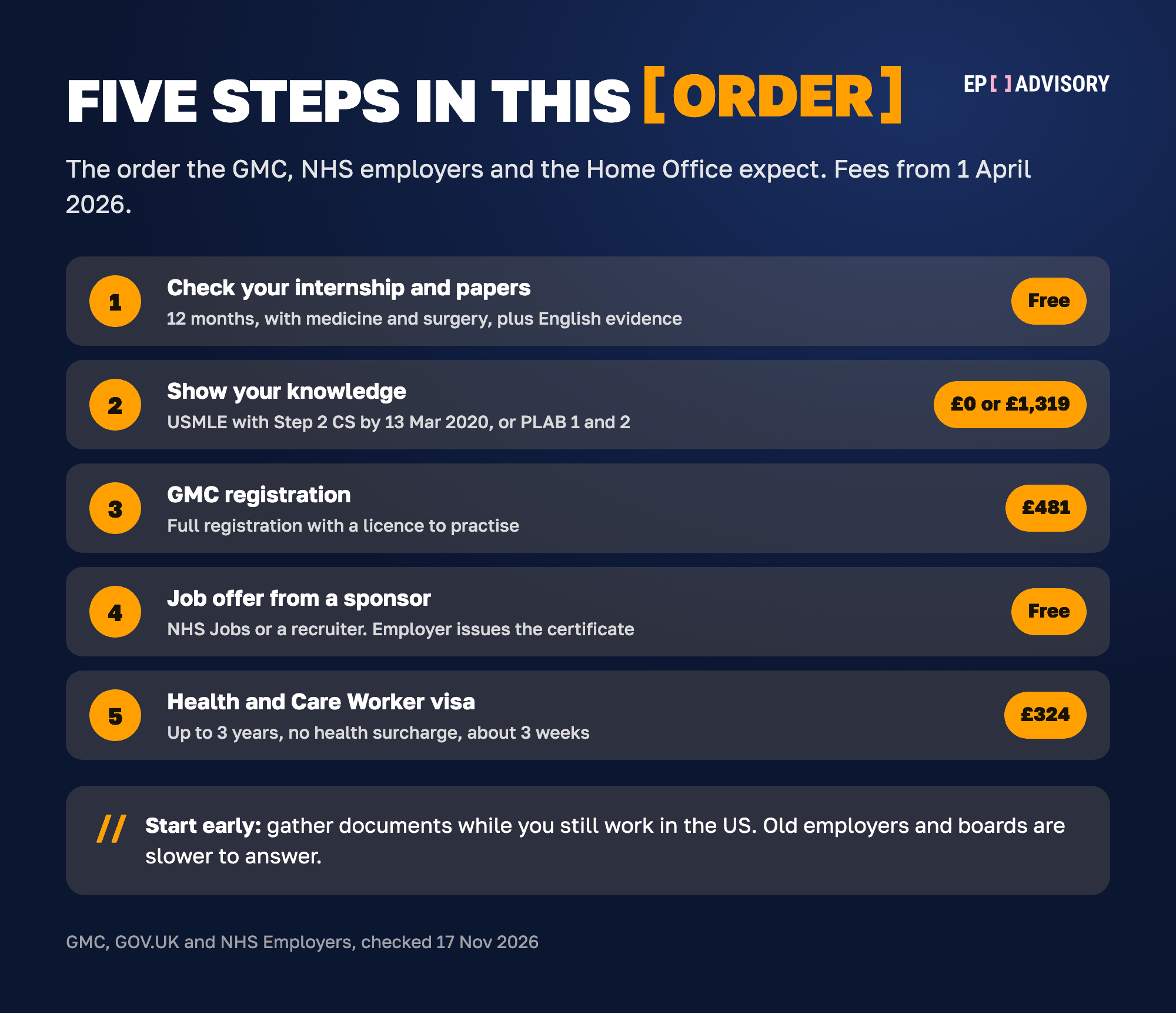
Start Gate 1 while you are still in your US job. Your current employer, residency programme and state boards are much easier to reach for documents while you work there.
Which GMC route fits a US-trained doctor
Your route depends on two dates and one certificate: when you passed Step 2 CS, whether you have practised in recent years, and whether you hold a US qualification the GMC lists.
The GMC accepts several ways for international medical graduates to show their knowledge and skills. For US-trained doctors, four matter in practice.
| Your situation | Likely GMC route | Exam fees (from 1 Apr 2026) |
|---|---|---|
| Passed USMLE Step 1, Step 2 CK and Step 2 CS, with CS on or before 13 March 2020 | Acceptable overseas registration exam (USMLE) | None extra |
| Sat Step 2 CK after Step 2 CS ended, so no CS pass | PLAB 1 and PLAB 2 | £1,319 (£283 + £1,036) |
| Passed the American Board of Radiology diagnostic radiology exam, or hold another US qualification on the GMC list, usually awarded in the last 3 years | Acceptable postgraduate qualification | None extra |
| Board-certified attending who wants consultant, specialist or GP roles | Specialist or GP Register through the Portfolio pathway | £1,974 application |
The fees come from the GMC’s fees for doctors page, from 1 April 2026. At ECB rates of 2 November 2026, the PLAB fees come to about $1,770 and the Portfolio pathway fee to about $2,650.
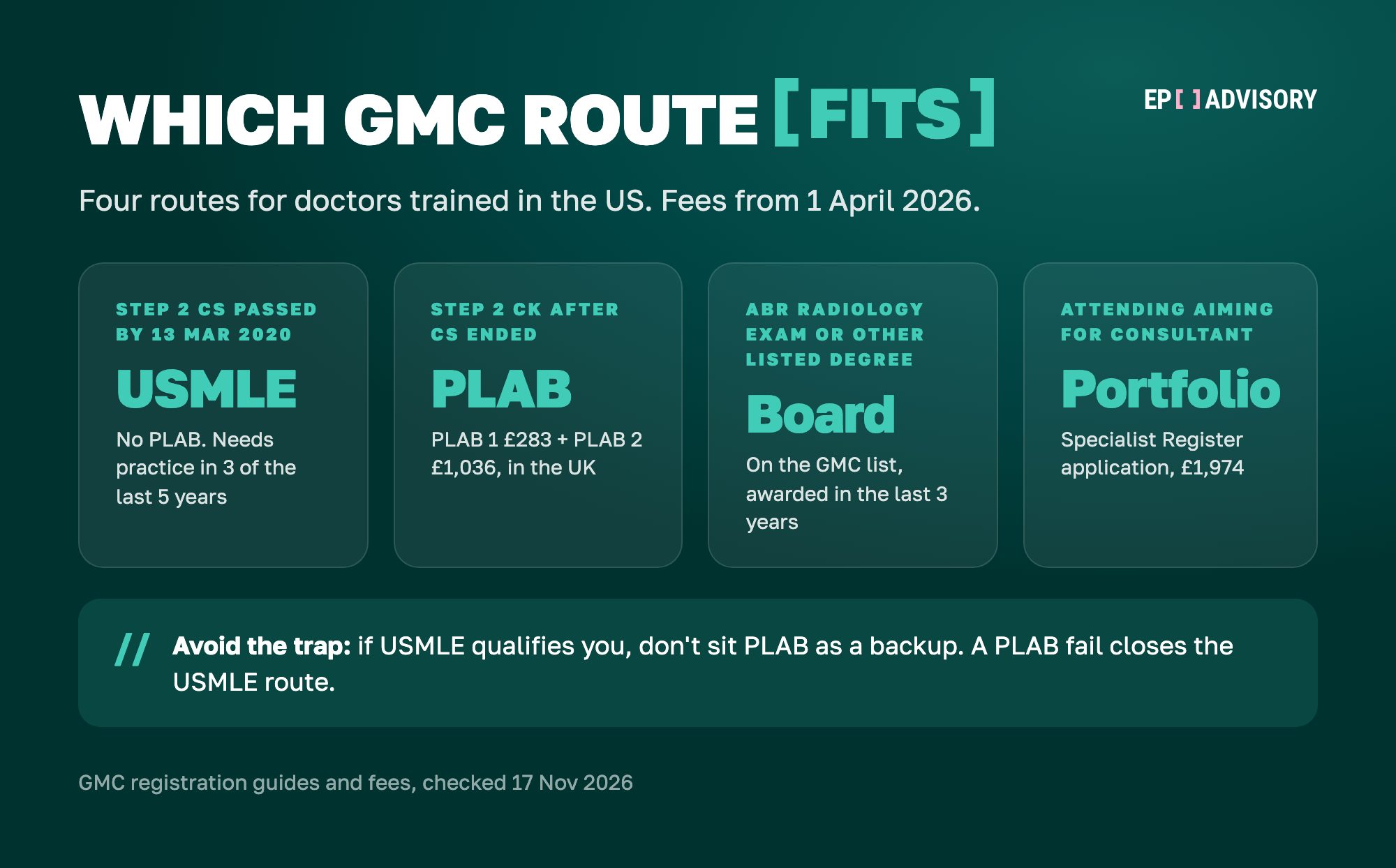
Two of these routes can stack. A board-certified attending can first register through USMLE, PLAB or a listed qualification and take a specialty doctor post. They then build the evidence for the Specialist Register while working in the NHS. If you are not sure which route is yours, ask the GMC before you pay any fee.
The USMLE route: check your Step 2 CS date first
USMLE still counts for GMC registration, but only if you passed Step 2 CS on or before 13 March 2020.
The GMC lists USMLE as an acceptable overseas registration exam. You need passes in Step 1, Step 2 CK and Step 2 CS. Step 3 is not required. Step 2 CS has since been discontinued. So doctors who sat Step 2 after it ended have no CS pass and cannot use this route. They take PLAB instead.
Three more conditions catch people out.
- The 2-year clock: if your clinical skills pass is more than 2 years old, you must show medical practice in 3 of the last 5 years, including at least 6 of the most recent 12 months, backed by consultant reports. Every Step 2 CS pass is now older than that, so this rule applies to everyone on the USMLE route. A doctor on a career break may not meet it, so check the GMC’s current guidance on recent practice.
- The PLAB trap: if you sit PLAB 1 or PLAB 2 after passing any part of USMLE and fail it, you can no longer use the USMLE route. If USMLE qualifies you, do not take PLAB as a backup.
- The internship: the GMC needs an acceptable internship. That means at least 12 months of continuous practice. If it lasted 12 to 18 months, it must include at least 3 months in medicine and 3 months in surgery. Honorary posts and observerships don’t count. The GMC also accepts at least 2 years of continuous supervised practice after medical school, with at least 3 months in a branch of medicine and 3 months in a branch of surgery.
US residency years are not called an internship, and the GMC looks at each case. A categorical PGY-1 in a single specialty may not show the medicine and surgery mix on its own. So gather your rotation schedules and your programme director’s letters early. Then ask the GMC to confirm before you pay for anything else.
You also need evidence of English. The visa does not ask US citizens for it, but the GMC does. The GMC accepts IELTS or OET results, and in some cases a medical degree taught and examined in English, or confirmation from a recent employer. Each has its own conditions. Check which one fits you on the GMC’s English language pages before you book a test.
PLAB: the route for most doctors who sat Step 2 after 2020
PLAB is the UK’s own licensing exam for international graduates, and it is the default route for US doctors without a Step 2 CS pass.
PLAB stands for the Professional and Linguistic Assessments Board test. It has two parts.
- PLAB 1: a written exam of multiple-choice questions on clinical knowledge. It costs £283 from 1 April 2026. That is about $380 at ECB rates of 2 November 2026.
- PLAB 2: a practical exam of clinical stations with actors and examiners, much like the old Step 2 CS. It costs £1,036, about $1,390. You take PLAB 2 in the UK, so budget for a flight and a short stay.
The exam is set at the level of a UK doctor starting the second year of foundation training, just after their first year. PLAB tests safe practice in the UK, not US practice. So study the UK clinical guidelines, such as NICE guidance, and UK prescribing habits. American drug names, units and referral pathways differ.
After PLAB, you apply for full registration with a licence to practise for £481. Your internship and English evidence must meet the same rules as the USMLE route.
Score your CV in 30 seconds, then fix its biggest problems one by one. Both free.
Free, no card. A free account unlocks every fix.

Board-certified? Aim for the Specialist Register, but plan the steps
A US board certificate can help you register, but only the Specialist Register lets you take a permanent NHS consultant post.
The GMC keeps a list of acceptable postgraduate qualifications. The Royal College of Radiologists notes that the American Board of Radiology diagnostic radiology exam is on it. The qualification should usually have been awarded no more than 3 years before the GMC approves your application. An older one needs extra evidence of recent practice. It gives you full registration without PLAB, but it does not guarantee a UK training post or give automatic entry to the Specialist Register. If your board is not on the list, the GMC may accept a letter from a UK royal college confirming it matches the college’s own qualification. Check the list before you rely on it.
The Specialist Register is a separate list. A permanent NHS consultant must be on it. To work as a GP, you need the GP Register. US-trained doctors join through the Portfolio pathway. It used to be called CESR (and CEGPR for GPs). Older guides still use those names. The application costs £1,974 from 1 April 2026.
On the Portfolio pathway, you show that your training and experience match the UK curriculum for your specialty. The evidence is detailed: logbooks, rotation records, assessments, audits and references. Some evidence the UK expects may not exist in US training records. So the practical plan is often:
- Register first: use USMLE, PLAB or a listed qualification to get full registration.
- Take a senior non-training post: a specialty doctor or specialist role.
- Build the portfolio in the NHS: fill the gaps against the UK curriculum while you work.
- Apply for the Specialist Register: then apply for substantive (permanent) consultant posts.
Before you leave a US job, copy your case logs, procedure numbers and evaluations. Ask for reference letters while your supervisors still know your work. Patient-identifiable records must stay with your employer, so keep only anonymised logs and summaries.
UK training posts now favour UK graduates, so start in a non-training job
A 2026 law moves US graduates to the back of the queue for UK training posts, so most Americans should target non-training jobs.
In the UK, residency is called training. Foundation years (FY1 and FY2) come first. Specialty training follows, with core and specialty training years (CT1 to ST8), until the doctor earns a certificate of completion of training. Places are competitive.
The Medical Training (Prioritisation) Act 2026 came into force on 6 March 2026. It says foundation and specialty training places must go first to graduates of UK medical schools and to a priority group: graduates of medical schools in Ireland, Iceland, Norway, Liechtenstein and Switzerland. Only then can other applicants get offers. For specialty training, the priority also covers people who have completed, or are on, a relevant UK training programme such as foundation training. For 2026 specialty offers, the Act itself also put British, Irish and settled applicants first. From 2027, the priority covers interviews as well as offers.
From 1 January 2027, new regulations keep these groups first for specialty training interviews and offers: British citizens, Commonwealth citizens with the right of abode, Irish citizens, people with indefinite leave to remain, and people with status under the EU Settlement Scheme. A US doctor on a work visa, with no UK foundation years, ranks after all of these groups. You can still apply. But expect few offers.
The jobs that stay open to you are outside formal training:
- Locally employed doctors: also called trust doctors or clinical fellows. These posts come at several levels, and each employer sets the terms and pay.
- Specialty doctors: permanent senior roles on a national contract, often for doctors with several years of experience after medical school.
- Specialists: a senior grade for very experienced doctors who work on their own, below consultant.
- Consultants: open once you are on the Specialist Register.
One older route has gone. The Medical Training Initiative, a 2-year sponsored training scheme run by the Academy of Medical Royal Colleges, closed to new applicants at midday on 31 March 2026. Older guides may still mention it.
The Health and Care Worker visa: low cost, no health surcharge
Doctors use the Health and Care Worker visa, which costs far less than most UK work visas because you and your family pay no health surcharge.
The Health and Care Worker visa covers doctors under occupation codes 2211 (generalist medical practitioners) and 2212 (specialist medical practitioners). Here is what it needs and costs.
- A sponsor and an offer: a confirmed job offer from an approved UK employer, and a certificate of sponsorship. You must apply within 3 months of getting the certificate.
- Salary: usually at least £25,000, or the going rate for your grade if that is higher. For doctors the going rate comes from the government’s national pay scales table.
- Visa fee: £324 per person for up to 3 years, or £628 for longer. That is about $430 or $840.
- Health surcharge: none for you, your partner or your children. On most other work visas you pay it for every year of the visa.
- Savings: £1,270 in your bank account for 28 days, about $1,700, unless your employer certifies maintenance on your certificate of sponsorship. Ask your employer whether it will.
- English: US nationals do not need to prove English for the visa. The GMC still needs its own evidence.
- Timing: apply up to 3 months before your start date. You usually get a decision within 3 weeks.
If a grandparent was born in the UK and you also hold a Commonwealth passport, you may need no sponsor: see the UK Ancestry visa for US citizens.
The going rates in the table are based on a 40-hour week in England. They run from £36,616 for a foundation year 1 doctor to £105,504 for a consultant. NHS basic pay for 2026/27 is already above these rates at every grade, so a standard NHS offer usually clears the salary rule. Your employer checks this before issuing the certificate.
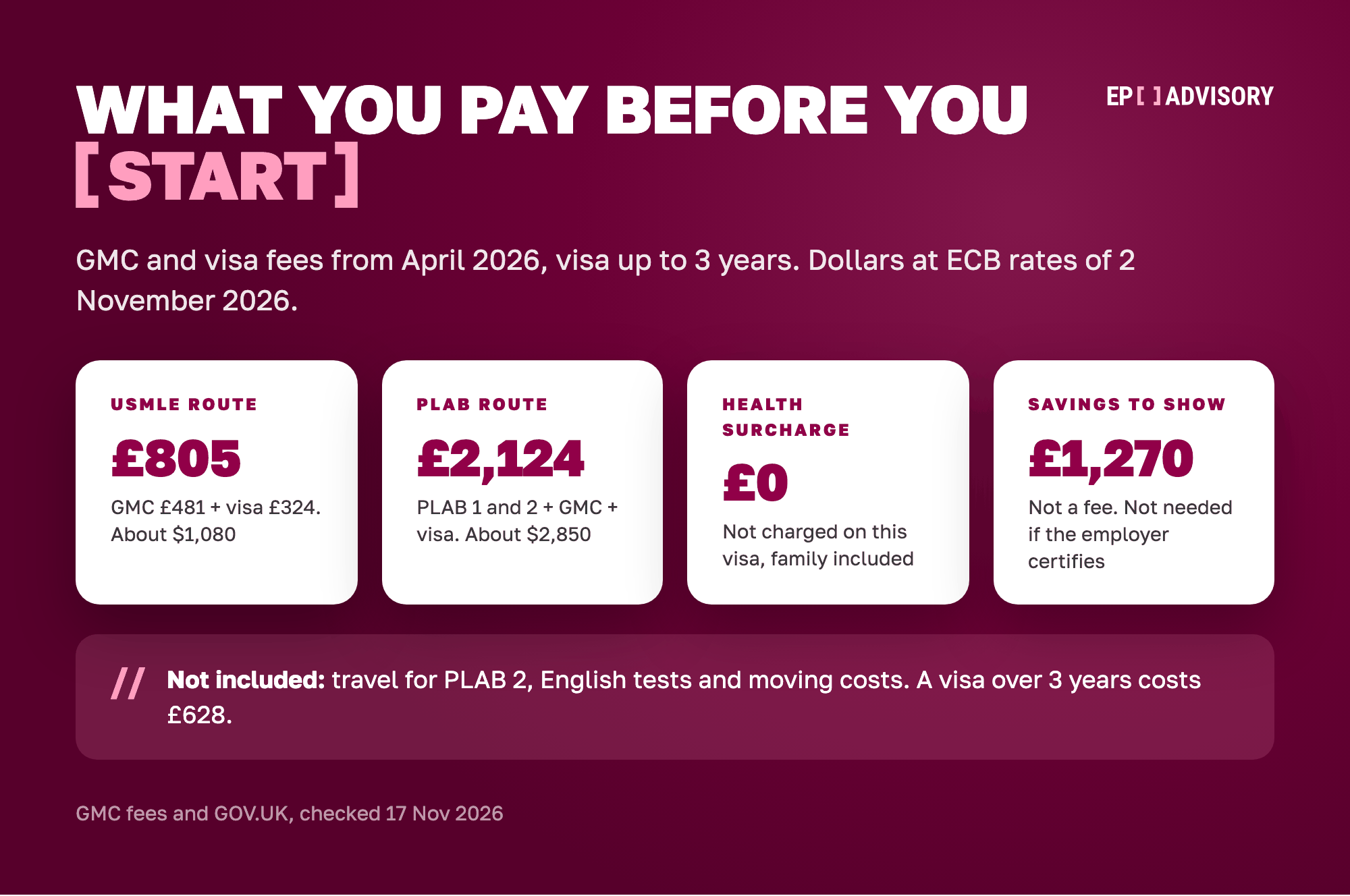
Two more costs are worth planning for. PLAB 2 means a trip to the UK before you move. And if your employer does not certify maintenance, you need the £1,270 in savings. A health employer in England that follows the government’s code of practice for international recruitment should not charge you recruitment fees. Some employers pay relocation costs, visa fees or exam fees. The code lets them recover part of this if you leave within a set period, so ask about any repayment clause at the offer stage.
Family and settlement
Your partner and children can apply to join you as dependants, and they also pay no health surcharge. The visa lasts up to 5 years and can be extended. Under today’s rules, you may be able to apply to settle after 5 years. Settlement is called indefinite leave to remain (ILR). On 2 November 2026 the government published plans to change settlement rules. They keep a 5-year path for people earning over £50,271 and for some public service workers, and they name doctors among them. The government calls them proposals, and the announcement gives no start date. So check the current rules on GOV.UK or with a regulated adviser before you apply.
Next: compare the Health and Care Worker visa with every other route in our guide to the UK work visa for Americans.
NHS doctor pay in 2026/27, and how it compares with US pay
NHS pay is well below US physician pay at every level, so the case for moving rests on hours, training, family and lifestyle, not salary.
NHS pay in England rose by 3.5% from 1 April 2026. The figures below are basic pay, gross per year, from the NHS Employers pay and conditions circular of July 2026. Extra pay for nights, weekends and extra hours comes on top. Dollars are at ECB rates of 2 November 2026.
| NHS grade (England, 2026/27) | Rough US match | Basic pay, gross a year | In US dollars |
|---|---|---|---|
| Foundation year 1 (FY1) | Intern, PGY-1 | £41,226 | about $55,300 |
| Foundation year 2 (FY2) | PGY-2 | £47,610 | about $63,900 |
| Core or specialty trainee, years 1 to 2 | Junior resident | £55,355 | about $74,300 |
| Specialty trainee, year 3 | Senior resident | £67,325 | about $90,300 |
| Specialty trainee, years 7 to 8 | Fellow | £77,348 | about $103,800 |
| Specialty doctor (2021 contract) | Early attending, non-partner | £63,696 to £102,689 | about $85,500 to $137,800 |
| Specialist | Experienced attending | £104,401 to £115,341 | about $140,100 to $154,800 |
| Consultant (2003 contract) | Attending, head of a service | £113,565 to £150,569 | about $152,400 to $202,000 |
| Salaried GP | Employed family physician | £78,699 to £118,759 | about $105,600 to $159,400 |
Consultants reach the top point after 14 years as a consultant. Specialty doctors move up in steps every 3 years. GP partners and private practice can earn more, but those figures are not set nationally.
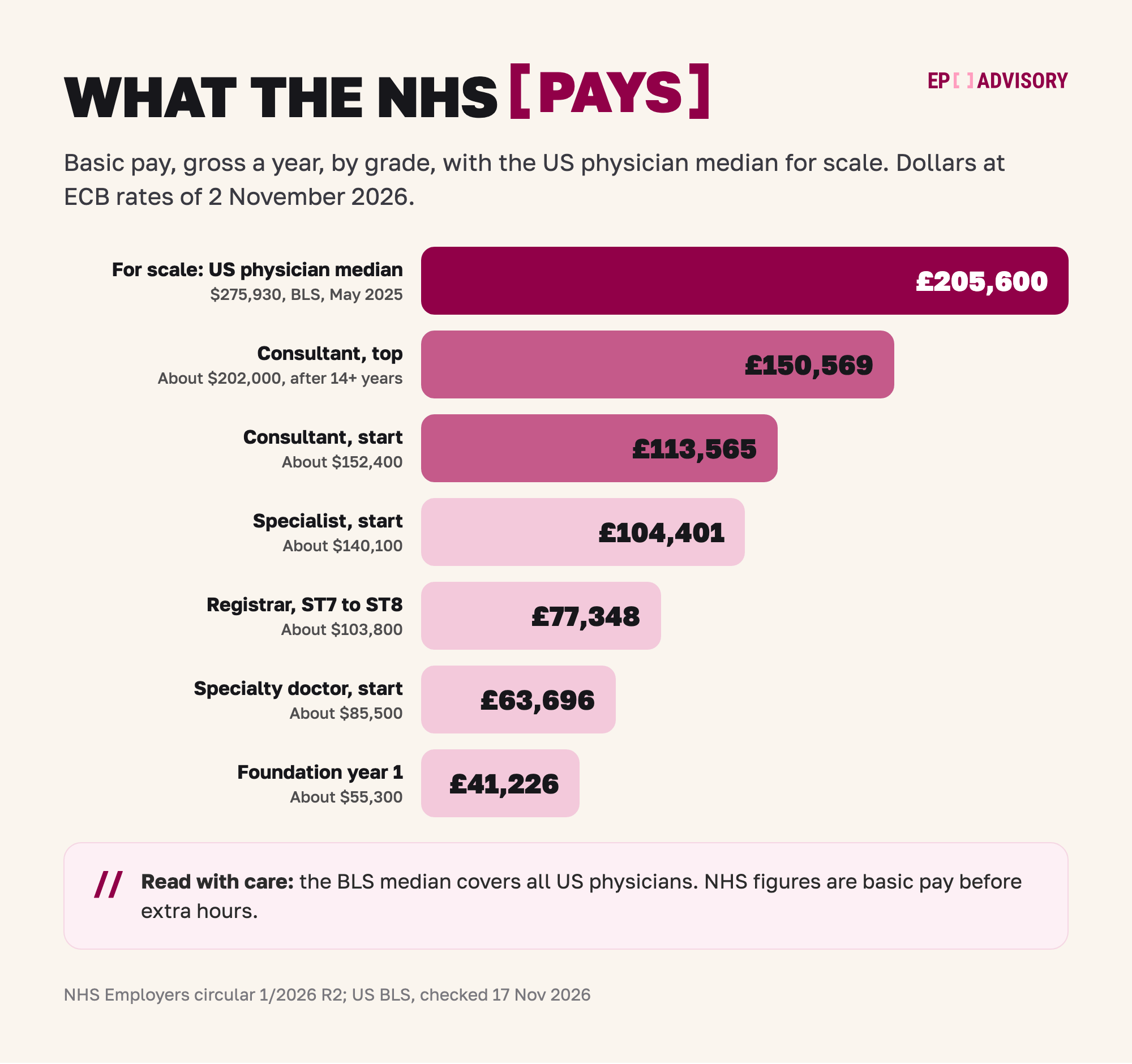
The US median annual wage for physicians and surgeons was $275,930 in May 2025, says the US Bureau of Labor Statistics. That is about £205,600. Family medicine physicians had a median of $244,180 and pediatricians $210,040. The two sources measure different things, so treat this as a rough guide. The BLS figure covers all employed physicians, while the NHS figures are basic pay for each grade.
Compare the whole package, not only the salary: hours, leave, pension and the cost of living where you would work. For take-home pay, tax and living costs, see our guides to UK vs US salary and salaries in the UK.
The US taxes its citizens on worldwide income. The foreign earned income exclusion is $132,900 for 2026, so senior NHS salaries can go above it. Talk to a cross-border tax adviser before you move.
How to land your first NHS job from the US
NHS trusts advertise doctor jobs on NHS Jobs, and each application needs a UK-style CV and a supporting statement written for the post.
NHS trusts post doctor vacancies on NHS Jobs. Search by grade, such as “clinical fellow”, “trust grade” or “specialty doctor”, and check each advert for visa sponsorship. Our list of UK companies that sponsor visas explains how to check an employer’s licence.
Each NHS application has two parts that US doctors often get wrong.
- The person specification: every advert lists essential and desirable criteria. Shortlisters score you against each one. Use the same words and give one piece of evidence for each.
- The supporting statement: a written section that does the job of a cover letter. Show how your US experience meets the criteria, and explain US terms such as attending, PGY or board certification in UK language.
Your CV also needs to change. A UK medical CV lists your GMC number and registration status at the top, then posts in reverse order with grade, specialty and dates, then audits, teaching, research and courses. It leaves out photos and personal details. Our guide to the UK CV vs US resume shows the switch, and why UK employers ignore American applications covers the common mistakes. Before you send the first application, check that your CV reads well to a UK recruiter. Getting ready to apply for jobs in the UK? Check your CV for free: see it the way a recruiter does, then fix each problem.
A realistic order for the move looks like this:
- Confirm your GMC route: check your Step 2 CS date, your internship and your board certificate against the GMC rules.
- Collect documents: degree, transcripts, internship and residency letters, good standing evidence from your boards, English evidence and logs.
- Sit PLAB if you need it: PLAB 1 first, then PLAB 2 in the UK.
- Apply for registration: £481 for full registration with a licence to practise.
- Apply for jobs: many interviews are held online, so ask whether you can join from the US.
- Get the certificate and visa: apply within 3 months of the certificate, up to 3 months before you start, and expect a decision within about 3 weeks.
Interviews for non-training posts are often short and clinical. They may include a scenario on a deteriorating patient, a question on clinical governance (the UK term for quality and safety systems) and a question on teamwork. When the offer comes, ask which pay point you start on, because NHS employers can set it by your experience. Our guide on how to negotiate salary helps with that conversation. For the wider UK job search, read how to get a job in the UK as an American. If a partner is a nurse, our guide for American nurses in the UK covers the NMC route. If your partner is a lawyer or a teacher, see our guides for an American lawyer in London and for American teachers in the UK.
Key takeaways
- An American doctor can work in the UK with GMC registration and a licence to practise, a sponsored job offer and a Health and Care Worker visa.
- USMLE counts for GMC registration only if you passed Step 2 CS on or before 13 March 2020; otherwise most US doctors take PLAB 1 (£283) and PLAB 2 (£1,036).
- Full GMC registration with a licence costs £481 from 1 April 2026, and the visa costs £324 for up to 3 years with no health surcharge.
- Consultant posts need the Specialist Register, which US-trained doctors join through the Portfolio pathway for £1,974.
- Since the Medical Training (Prioritisation) Act 2026, UK training posts go first to UK graduates, and specialty training also to British, Irish and settled applicants, so target trust, specialty doctor or specialist posts.
- NHS basic pay in England for 2026/27 runs from £41,226 for FY1 to £150,569 for a senior consultant, well below the US physician median of $275,930.
See what a recruiter sees, then fix it before you apply. An instant score, then the fix for every problem.
Free, no card. A free account unlocks every fix.
Frequently asked questions
Can an American doctor work in the UK without taking PLAB?
Yes, in two cases. You can register through USMLE if you passed Step 1, Step 2 CK and Step 2 CS, with Step 2 CS on or before 13 March 2020. Or you can register with a postgraduate qualification on the GMC’s list, such as the American Board of Radiology diagnostic radiology exam, usually if it was awarded in the last 3 years. Otherwise PLAB 1 and PLAB 2 are the usual route.
Does a US medical licence transfer to the UK?
No. A US state licence does not transfer. You need full registration with a licence to practise from the General Medical Council. Your USMLE results, internship and board certificates can count towards it, depending on the route.
Can a US board-certified doctor become an NHS consultant?
Yes, but only once you are on the GMC Specialist Register. US-trained doctors usually apply through the Portfolio pathway, which costs £1,974 and compares your training with the UK curriculum. Many first work in a specialty doctor or specialist post while they build the evidence.
How much does an NHS doctor earn compared with a US doctor?
NHS basic pay in England for 2026/27 is £41,226 a year gross for FY1, £63,696 to £102,689 for a specialty doctor and £113,565 to £150,569 for a consultant. The US median for physicians and surgeons was $275,930 in May 2025, about £205,600. So UK pay is much lower, though the surveys measure different things.
Which visa does an American doctor need for the UK?
The Health and Care Worker visa. You need a job offer and a certificate of sponsorship from a licensed employer. The fee is £324 for up to 3 years or £628 for longer, and you and your family pay no health surcharge. US citizens do not need to prove English for the visa.