 By Andre Atallah, CEO of EP Advisory
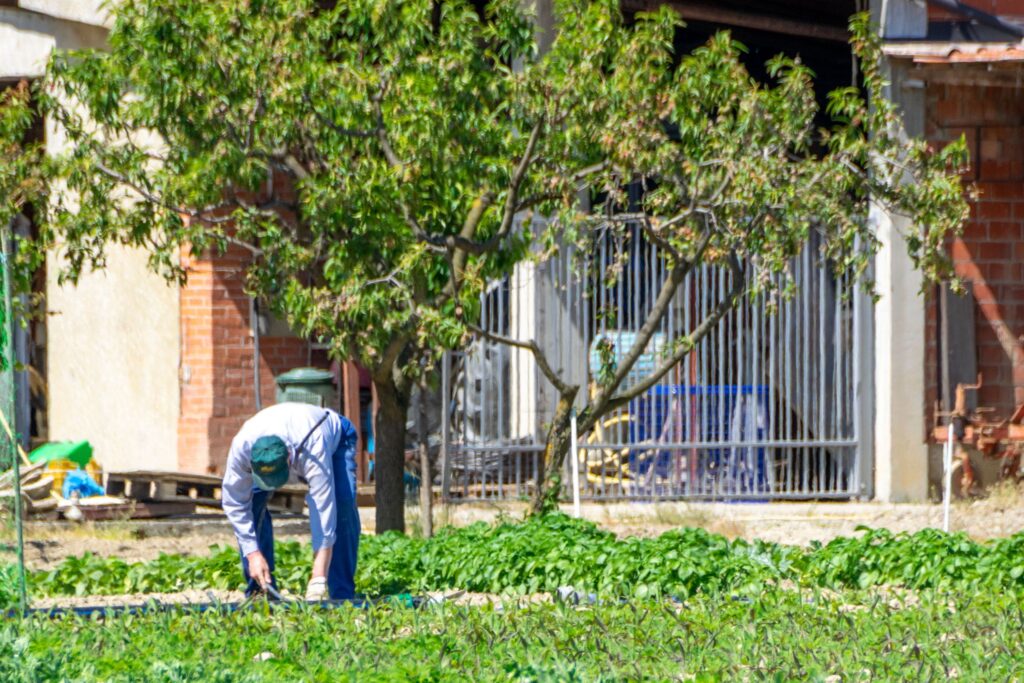
Short answer: the decreto flussi 2027 opens 165,850 work entry places for non-EU workers. Your Italian employer files the request, not you. Employers pre-fill requests online until 20:00 on 7 December 2026. They send them on click day: 12 January 2027 for farm seasonal work, 9 February for tourism, 16 February for other jobs and 18 February for family care. Places go in the order requests arrive.
Italy admits many non-EU workers through yearly quotas. The decreto flussi (the “flows decree”) sets how many people can come, for which jobs and from which countries. For 2027 the numbers are fixed, the pre-fill window is open and the click days are set.
The catch is that a worker cannot apply alone. An employer in Italy has to want you, prepare a file and press send at the right minute. This guide is for both sides. If you are the worker, it shows what your employer must do, so you can check the file is real and moving. If you are the employer, it is a checklist you can work through before 7 December.
For nearly 10 years, we’ve helped more than 5,000 professionals find jobs abroad. Want to know if your CV will pass screening in Italy? Check your CV for free: a score in 30 seconds, then a fix for each problem.
Decreto flussi 2027 dates: the pre-fill closes on 7 December
Every 2027 request has to be drafted before 20:00 on 7 December 2026. A request that is not drafted by then cannot be sent on click day.
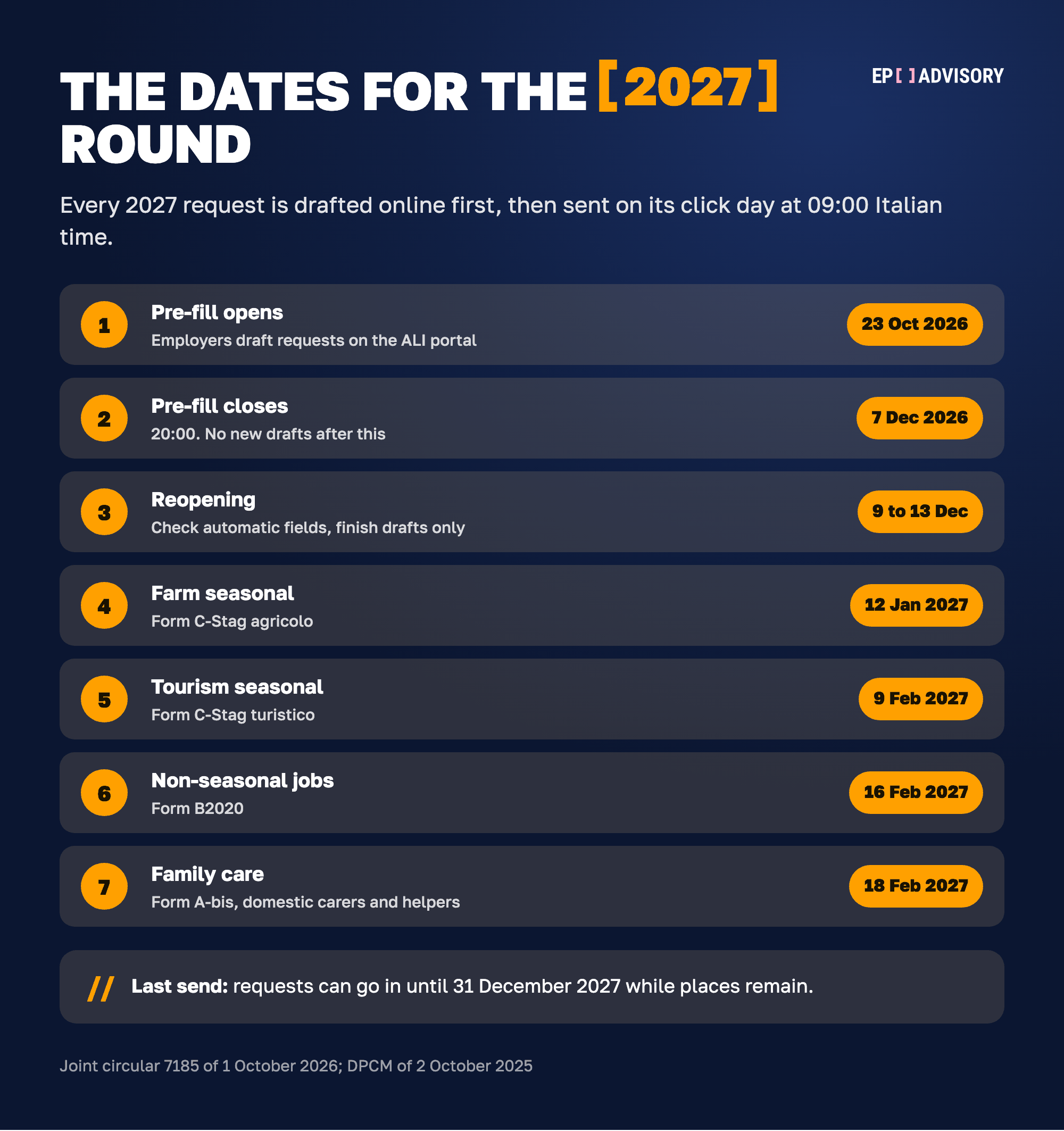
The joint circular of 1 October 2026 (circular 7185) sets the calendar:
- Pre-fill: from 09:00 on 23 October to 20:00 on 7 December 2026. The portal is open every day, holidays included, with no hour limits.
- Reopening: from 09:00 on 9 December to 20:00 on 13 December 2026. This is only to check fields the system fills in later and to finish drafts. You cannot start a new form.
- Click days: all at 09:00. Farm seasonal work on 12 January 2027. Tourism seasonal work on 9 February. Non-seasonal jobs on 16 February. Family care (domestic carers and helpers) on 18 February.
- Last send: requests can still go in until 31 December 2027, while places remain.
The decree behind all this, the DPCM of 2 October 2025, covers three years at once. It already fixes the same click-day dates for 2028. So if you miss this round, you know when the next one starts. For a side-by-side table of the 2026 and 2027 dates, and the other routes into Italian jobs, see our guide to jobs in Italy for foreigners.
165,850 places, but your passport decides which ones you can use
Most places are reserved for citizens of named countries. If your country is not on the list, you compete for a much smaller pool.
The 2027 total is 165,850. It splits three ways: 76,200 non-seasonal jobs, 89,000 seasonal jobs in farming and tourism, and 650 self-employed places. Inside those totals, the decree reserves places by country and by who files.
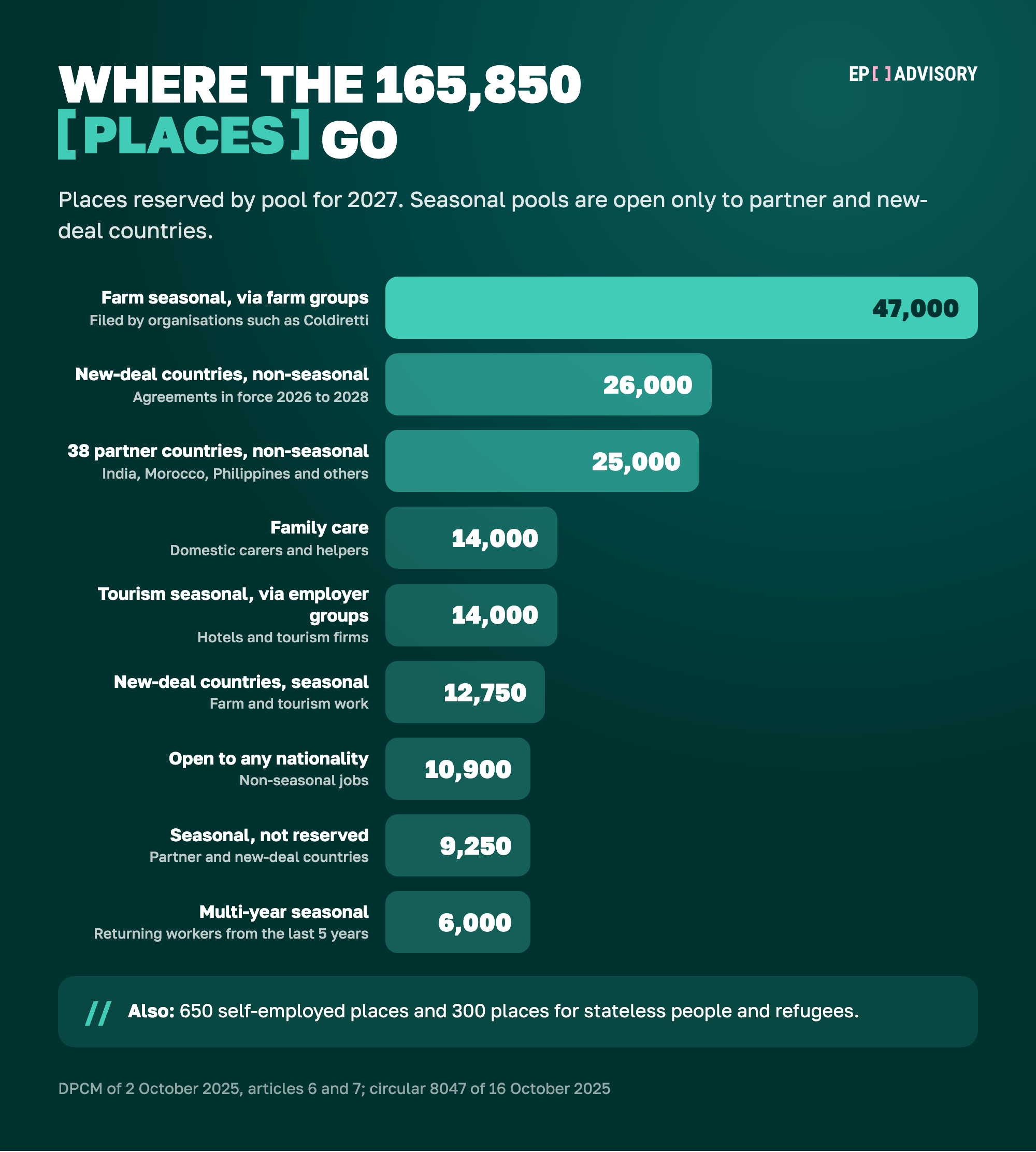
Non-seasonal jobs, 76,200 places:
| Pool | 2027 places | Who can use it |
|---|---|---|
| Countries with new migration deals | 26,000 | Countries whose migration cooperation agreements with Italy come into force from 2026 to 2028. Circular 7185 adds Kenya to the origin countries from 2027, after a memorandum signed on 2 July 2026. |
| 38 partner countries | 25,000 | Albania, Algeria, Bangladesh, Bosnia-Herzegovina, Côte d’Ivoire, Ecuador, Egypt, El Salvador, Ethiopia, Gambia, Georgia, Ghana, Guatemala, India, Japan, Jordan, Kosovo, Kyrgyzstan, Mali, Mauritius, Moldova, Montenegro, Morocco, Niger, Nigeria, North Macedonia, Pakistan, Peru, Philippines, Senegal, Serbia, South Korea, Sri Lanka, Sudan, Thailand, Tunisia, Ukraine, Uzbekistan |
| Family care | 14,000 | Domestic carers and helpers hired by households. The decree ties no country list to this pool. |
| Not reserved | 10,900 | Any nationality, in the sectors the decree lists |
| Stateless people and refugees | 300 | People recognised by the UN refugee agency or by the authorities of a first-asylum or transit country |
Seasonal jobs, 89,000 places, are only for citizens of the 38 partner countries and the new-deal countries. Within that total, 47,000 farm places go first to requests filed by the big farm organisations, such as Coldiretti, Confagricoltura and CIA. Another 14,000 tourism places go first to requests filed by tourism employer organisations. A further 6,000 are for multi-year permits for workers who have done seasonal work in Italy in the last 5 years. The new-deal countries have 12,750, and 9,250 are not reserved.
In general, by nationality:
- From a partner or new-deal country? Your country’s pool, the open pool, family care and the seasonal pools are all open to you. Seasonal places are the largest share, and farm and tourism groups file in bulk.
- From anywhere else? Seasonal places are closed to you. The quota places open to you are the 10,900 open non-seasonal places, family care and the self-employed places. Routes outside the quota, further down, may also apply, for example to graduates in qualified roles.
- A returning seasonal worker? If you worked in Italy on a seasonal permit in the last 5 years, kept to its terms and left when it expired, the law gives you priority to come back, to the same or another employer. An employer can also request a multi-year seasonal permit for you.
The non-seasonal sectors are wide: farming, forestry and fishing, food and drink, textiles, metals and other industry, construction, retail and wholesale, hotels and restaurants, tourism, transport and logistics, business and personal services, and health and social care. Of the 650 self-employed places, the decree reserves 500 for investors putting in at least €500,000 of their own funds and creating 3 jobs, certain freelancers, company officers, renowned artists and founders of innovative start-ups. Another 50 are for people of Italian descent and 20 for stateless people and refugees.
The employer’s checklist before 7 December
A request with missing paperwork can be refused or held up. Work through this list before the pre-fill closes.
Workers, share this section with your future employer. A small firm hiring abroad for the first time often does not know it.
- Digital identity. The person filing logs in with SPID or CIE, Italy’s digital ID and electronic ID card.
- A certified email address (PEC). The PEC must be registered in INI-PEC for companies, or in INAD, the national register, for others and private households. The portal sends an activation code to it.
- A job-centre check. Before any non-seasonal request, family care included, the employer must ask the local job centre (centro per l’impiego) whether a suitable worker is already available in Italy. If the centre does not answer within 8 calendar days, the employer can go ahead. The form is uploaded as “Dichiarazione verifica centro per l’impiego”. If candidates are sent but do not turn up, the employer reports it after 20 working days.
- The asseverazione. This is a signed statement from a labour consultant (consulente del lavoro), another authorised professional such as a lawyer or accountant, or an employer organisation. It confirms the job offer meets the legal and contract rules. It is needed in every sector, family care included. It is not needed when an employer organisation that has signed the Labour Ministry’s protocol files for its member, or when a person who cannot look after themselves hires their own carer. In that case a doctor’s certificate is used instead.
- Income. Outside family care, the employer needs at least €30,000 in taxable income or turnover. A household hiring a domestic worker needs €20,000 for a single person or €27,000 for a family.
- Housing. The worker needs suitable housing, and the documents must be digitally signed. Since December 2025, lodging in hotels or other accommodation and permanent dormitories on building sites can count, under law 182/2025 and the Interior Ministry’s circular 9859 of 15 December 2025.
- A clean record. A request is not accepted if, in the last 3 years, the employer filed before and then did not sign the residence contract, unless that was not their fault. It is also refused if the employer faces trafficking or gangmaster (caporalato) charges.
- The 3-request cap. A private employer can file at most 3 requests a year alone. There is no cap when filing through an employer organisation, a labour consultant or a staffing agency.
Hiring a driver? Driver requests are only for citizens of the partner and new-deal countries. The licence must be convertible in Italy under a reciprocity deal (category CE for freight, or C1, C, D or a related category for passengers), and the contract is fixed-term for up to 1 year, unless the driver already holds an EU licence and a valid CQC. The professional driver qualification (CQC) can be gained in Italy.
Score your CV in 30 seconds, then fix its biggest problems one by one. Both free.
Free, no card. A free account unlocks every fix.

How to apply: pre-fill the request step by step
The pre-fill is where the work happens. On click day you only press send.
The employer, or the consultant or organisation acting for them, works on the Interior Ministry’s ALI portal:
- Log in and activate. Sign in with SPID or CIE, enter the PEC and type in the activation code that arrives there.
- Pick the right form. C-Stag agricolo for farm seasonal work. C-Stag turistico for tourism seasonal work. B2020 for other non-seasonal jobs, including health and social care hires that are not domestic. A-bis for family care in a household.
- Fill in the worker’s details. Use the name and passport number exactly as they appear on the passport. One wrong letter can hold up the visa later.
- Upload the documents. Each file can be 2 MB at most. The housing documents and the asseverazione must be digitally signed.
- Wait for the automatic fields. Some fields, such as income and VAT number, fill in by themselves within 6 days of starting a draft.
- Save as ready to send. A finished draft must move from “da completare” (to complete) to “da inviare” (ready to send). Only drafts in “da inviare” can go on click day.
The Labour Inspectorate can check pre-filled forms before click day. So problems with a file can surface before click day.
Use the reopening from 9 to 13 December to check the automatic fields and move any last drafts to “da inviare”. If something goes wrong, use “Scrivi all’Help Desk” on the portal. The rules can change during the year. Check the current rules on the official portal, with the Sportello Unico per l’Immigrazione (the immigration desk at each prefecture) or with a regulated adviser, such as a labour consultant or immigration lawyer, before you rely on them. Employer organisations that file for members also help with the forms.
Click day and after: every deadline to your residence permit
Getting into the quota is the start, not the finish. After click day both sides have short legal deadlines.
On click day, places go by send time, so the request should go at 09:00 sharp. If a request is sent but the places are gone, the portal shows “La pratica risulta al momento non in quota” (not in quota for now). Do not give up at that point. Within 10 days, places are shared out between provinces. After 50 days, unused places can be moved to where they are needed, so a request can still come into the quota later.
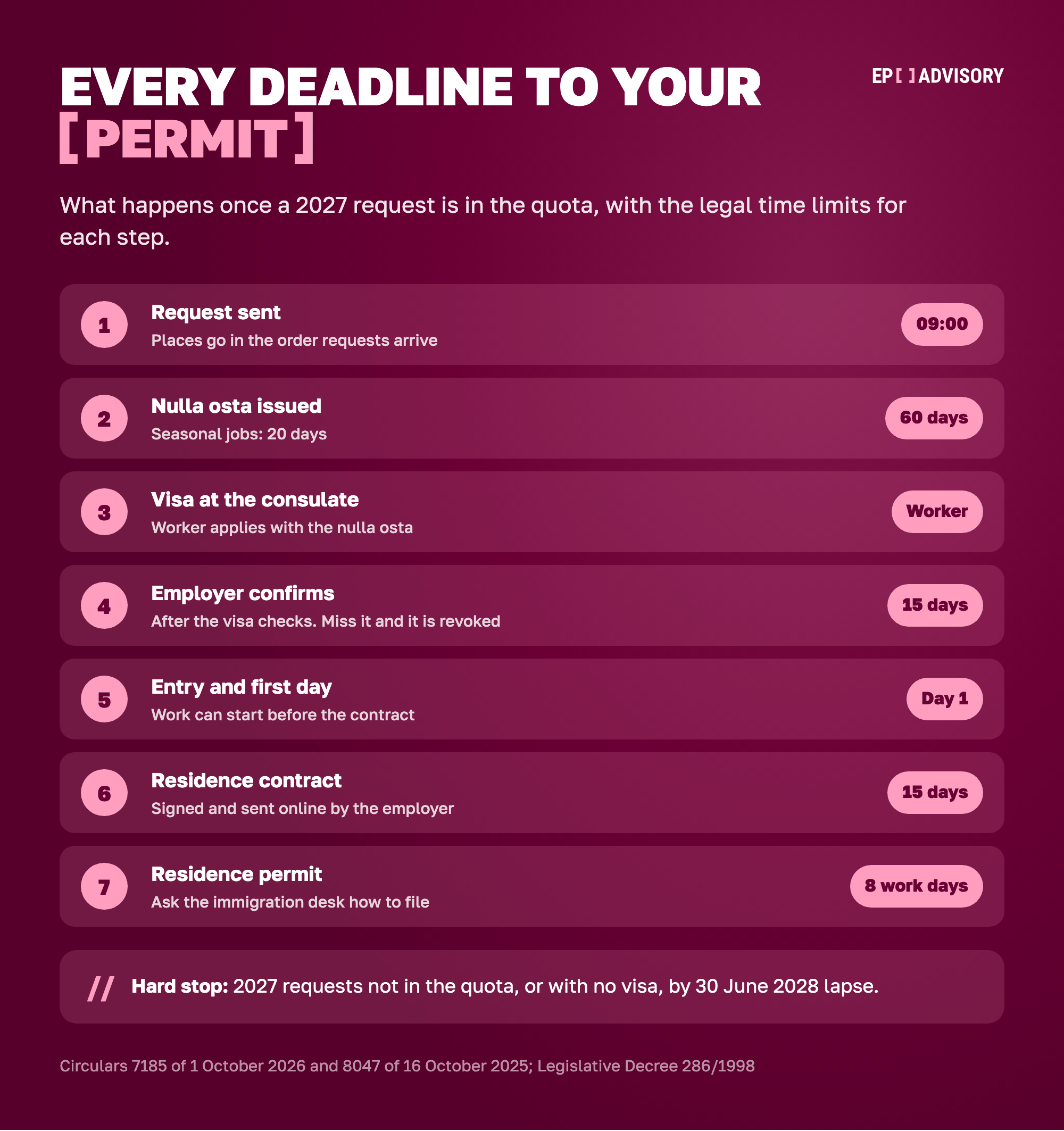
Here is what follows, in order:
- Nulla osta (work clearance). The immigration desk has 60 days from the quota allocation for non-seasonal jobs and 20 days for seasonal ones. If it does not object in time, the clearance is issued by silent approval. For citizens of Bangladesh, Pakistan, Sri Lanka and Morocco, there is no silent approval: the police and the Labour Inspectorate must check first. These are the countries on the Foreign Ministry’s high-risk list cited in circular 8047, and the list can change. If that is you, expect a longer wait and keep every document ready.
- Visa application. The worker applies for the work visa at the Italian consulate in their country, with the nulla osta. The Foreign Ministry’s visa finder checks, by nationality and reason for the stay, which visa you need.
- Employer confirms within 15 days. When the consulate’s checks are complete, the employer is told. From then, the employer has 15 days to confirm the request. If they miss it, the request counts as refused and the nulla osta is revoked. The employer must also pass on every message about the file to the worker straight away. Workers: ask your employer to forward these to you.
- Entry and first day. Once in Italy, the worker can start work straight away, before the contract is signed.
- Residence contract within 15 days. The worker and employer sign the contratto di soggiorno (residence contract) within 15 days of entry. The employer sends it online in the same 15 days.
- Residence permit. Under Italy’s immigration law, the permesso di soggiorno is requested within 8 working days of entry. For quota workers, the signed contract the employer sends to the immigration desk is part of that request. Ask the immigration desk how to file in your case, and sign the contract early rather than on day 15.
The 2027 files have a hard end date. Requests that are still not in the quota by 30 June 2028 lapse. So does a nulla osta that has not led to a visa by then. If your visa is taking long, ask the consulate early and keep the employer involved.
What changed from 2026 to 2027
The deadlines are longer, the open pool is smaller, and Kenya is in.
The quotas come from the same three-year decree, so most rules carry over. Circular 8047 of 16 October 2025 still sets the operating rules. The changes come from the yearly numbers and from changes to the immigration law: decree-law 146/2025, as amended when law 179/2025 converted it, and legislative decree 83/2026.
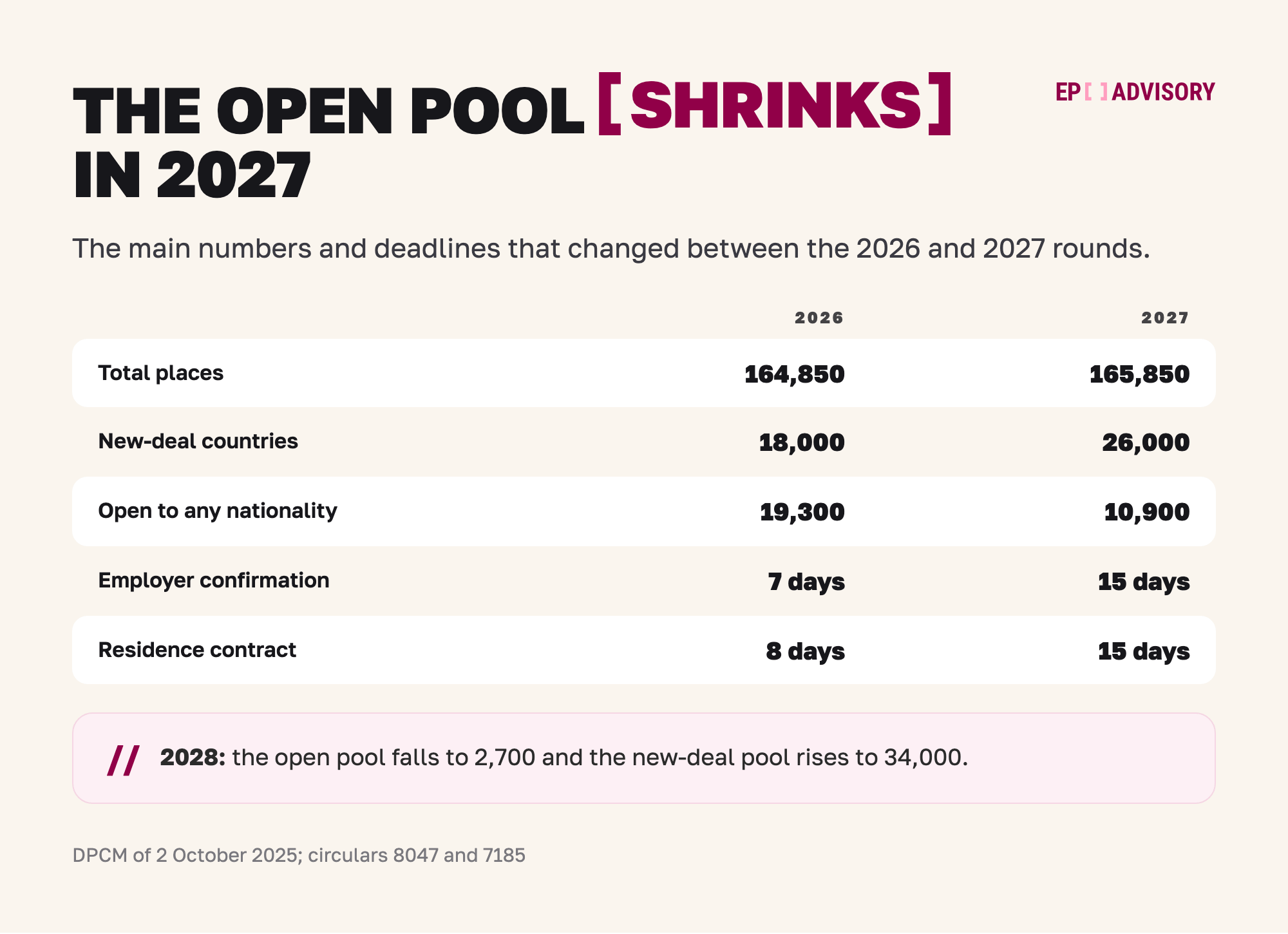
| Item | 2026 | 2027 |
|---|---|---|
| Total places | 164,850 | 165,850 |
| New-deal countries, non-seasonal | 18,000 | 26,000 |
| Not reserved, non-seasonal | 19,300 | 10,900 |
| Family care | 13,600 | 14,000 |
| Seasonal total | 88,000 | 89,000 |
| Tourism places for employer organisations | 13,000 | 14,000 |
| Multi-year seasonal permits | 5,000 | 6,000 |
| Seasonal, not reserved | 10,400 | 9,250 |
| Employer confirmation after visa checks | 7 days (15 from December 2025) | 15 days |
| Residence contract after entry | 8 days (15 from December 2025) | 15 days |
| Kenya | Not listed | Included |
The two deadline rows compare circular 8047 (October 2025) with circular 7185 (October 2026). Law 179/2025 wrote both 15-day deadlines into the immigration law in December 2025, before the 2026 click days. So a 2026 file still open has 15 days too. Check with the immigration desk if you are unsure.
Three other changes matter in practice:
- Intermediaries can act. Authorised professionals, such as labour consultants, and employer organisations can now send the confirmation and the residence contract for the employer.
- The worker must be kept informed. The employer must tell the worker promptly about every message on the file.
- Housing is easier to prove. Hotel lodging and permanent dormitories on building sites can count, under the housing rules described in the checklist above.
Plan for 2028 now if you have no country reservation. The open non-seasonal pool falls again, to 2,700 places in 2028, while the new-deal pool rises to 34,000. In April 2026 the Labour Ministry also gave further 2026 seasonal places to requests filed by the main employer organisations: 5,389 for farms and 3,476 for tourism, under article 9 of the decree.
How to find an employer who will file for you
You need a real employer first. A nulla osta without a real job behind it is worth nothing.
The quota is not a lottery you enter on your own. It starts with a job. For job boards, in-demand jobs and English-speaking roles, see where to find jobs in Italy. These are the employers most likely to file:
- Farms and farm groups. The large farm organisations file thousands of seasonal requests for their members. If you are from a partner country, ask farm employers whether they file through their organisation.
- Hotels and tourism firms. Seasonal tourism work runs on the 9 February click day. Contact hotels in the summer resorts in autumn, before the pre-fill closes.
- Staffing agencies. Licensed agencies can file and are not held to the 3-request cap. Ask any agency for its authorisation number and check it on the Labour Ministry’s register of employment agencies (Albo informatico delle Agenzie per il Lavoro).
- Logistics, construction, manufacturing and care. These sectors fill the non-seasonal pool. Small firms may never have filed before, so offer them the checklist above.
Apply as you would for any job. Italian employers expect a short CV with clear dates, your skills and the languages you speak. Basic Italian helps a lot, even for manual jobs. Before you send it, Getting ready to apply for jobs in Italy? Check your CV for free: see it the way a recruiter does, then fix each problem. Our page on CVs and LinkedIn profiles shows how we rewrite them for a new market. Check pay before you agree to anything. Our guide to salaries in Italy has typical pay by job, and our tips on how to negotiate salary work for a first offer too.
Never pay for a nulla osta. Italy’s government said in 2024 that organised crime had, in its view, infiltrated these requests. In a Council of Ministers statement of 4 June 2024, it said that, according to some sources, up to €15,000 a file was being asked. In Campania, fewer than 3% of people who entered on a nulla osta went on to sign a work contract. Protect yourself:
- Check the employer exists. Ask for the company name, VAT number and address. Look them up, and speak to someone there by video.
- Ask for the contract terms in writing. You want the job, hours, pay and housing before anyone files.
- Walk away from fees. No middleman can sell you a place. Places go by send time. On your side, the costs are official fees such as the visa and residence permit fees.
- Get the confirmation messages. The employer must pass on every message about your file. If they will not, treat that as a warning.
Next: if you are not tied to Italy, compare it with other countries in our guide on how to find a job in Europe. If your work can be done online, see remote jobs in Europe.
If the quota is full: routes outside the decreto flussi
Many skilled workers never need a quota place. Check these first.
- Highly qualified jobs. Graduates hired into qualified roles can use the EU Blue Card and other Article 27 routes. These sit outside the yearly quotas and have no click day. Our guide to jobs in Italy for foreigners explains how they work.
- Seasonal to non-seasonal. A seasonal worker with at least 3 months of legal work in Italy can switch to a non-seasonal work permit outside the quota, with an offer of a fixed-term or permanent contract.
- EU long-term residents. If you hold long-term resident status in another EU country, you can move to Italy for work outside the quota.
- Italian descent. Descendants of Italian citizens who live abroad and hold the citizenship of certain listed countries can be hired outside the quota.
Comparing countries? Switzerland and Ireland hire non-EU staff through very different systems. See salaries in Switzerland and salaries in Ireland for what the jobs pay.
Key takeaways
- The decreto flussi 2027 has 165,850 places: 76,200 non-seasonal, 89,000 seasonal and 650 self-employed.
- The employer files. Requests must be pre-filled by 20:00 on 7 December 2026 and are sent from 12 January 2027.
- Your passport decides your pool. Seasonal places are only for the 38 partner countries and the new-deal countries, and the open non-seasonal pool is 10,900.
- Before filing, the employer needs SPID or CIE, a registered PEC, a job-centre check, an asseverazione and enough income.
- After the visa checks, the employer has 15 days to confirm, and the residence contract is due within 15 days of entry.
- Places go by send time, so nobody can sell you one. Never pay for a nulla osta.
See what a recruiter sees, then fix it before you apply. An instant score, then the fix for every problem.
Free, no card. A free account unlocks every fix.
Frequently asked questions
When is the decreto flussi 2027 click day?
There are four click days, all at 09:00 Italian time: 12 January 2027 for farm seasonal work, 9 February for tourism seasonal work, 16 February for non-seasonal jobs and 18 February for family care. Requests must be pre-filled by 20:00 on 7 December 2026.
Can I apply for the decreto flussi myself?
No. The employer in Italy files the request for a nulla osta, either alone or through a labour consultant, employer organisation or staffing agency. As the worker, you find the job, give your passport details and then apply for the visa once the nulla osta is issued.
How many places are there in the decreto flussi 2027?
There are 165,850 places: 76,200 for non-seasonal jobs, 89,000 for seasonal farm and tourism work and 650 for self-employed workers. Most are reserved for citizens of named countries, and 10,900 non-seasonal places are open to any nationality.
What changed in the decreto flussi for 2027?
The new-deal pool rose to 26,000, the open pool fell to 10,900 and Kenya has joined. The employer has 15 days, not 7, to confirm the request after the visa checks, and the residence contract is due within 15 days of entry, not 8. Both longer deadlines have applied since December 2025.
What happens if my request is not in the quota?
It stays on file. Places are shared out between provinces within 10 days, and unused places can be moved after 50 days, so it can still come in. Requests still outside the quota by 30 June 2028 lapse.