 By Andre Atallah, CEO of EP Advisory

Short answer: yes. On almost every UK work visa, a partner who joins as a dependant can work for any employer, full time or part time, or be self-employed. The only job ruled out is professional sportsperson or coach. You need no sponsor and no job offer of your own. The main gaps: care workers who started on or after 11 March 2024 cannot bring new dependants, and most students cannot either.
This guide is for the partner or spouse of someone moving to the UK on a work visa. Your partner has the job. You have the visa that comes with it, and a career to restart in a new country. That is a strong place to start, because a UK employer can hire you without the cost and paperwork of sponsorship.
First you get the rules in plain words: who can work on which route, what you cannot do, what it costs to join and how to prove your right to work. Then most of the page is about the job itself: the CV line that removes the visa doubt, how UK employers read foreign qualifications, where dependants find work, and a 90-day plan. It is written for any nationality, with one section for Americans. Dollar figures use ECB rates of 2 November 2026 (£1 = $1.3419). All rules were checked on GOV.UK on 18 November 2026.
For nearly 10 years, we’ve helped more than 5,000 professionals find jobs abroad. Want to know if your CV will pass screening in the UK? Check your CV for free: a score in 30 seconds, then a fix for each problem.
Can a dependant work in the UK? Yes, with very few limits
A dependant partner on a UK work visa can take almost any job, with no sponsor and no extra permit.
A dependant (spelled dependent in US English) is a family member whose visa is linked to the main visa holder’s. On GOV.UK, your partner means “your husband, wife, civil partner or unmarried partner”. The Skilled Worker page says your partner can:
- Work: “work, except as a sportsperson or coach”.
- Study: take a course without a separate student visa.
- Travel: leave the UK and come back.
- Settle: apply to settle permanently after 5 years, if the main holder’s route leads to settlement and the other rules are met.
The Immigration Rules say the same thing in more detail. Rule SW 36.3 of Appendix Skilled Worker says “work (including self-employment and voluntary work) is permitted, except as a professional sportsperson (including as a sports coach)”. So you can be an employee, a contractor, a freelancer or a volunteer. You can work for a different employer from your partner’s, in any sector, at any salary and at any skill level. You can also change jobs as often as you like.
Two limits apply to every dependant. You cannot claim most benefits, called “public funds” in the UK, or the State Pension through this visa. And your permission usually ends on the same date as the main holder’s, so your work right lasts as long as theirs. If your partner extends or switches, you apply too, either at the same time or before your own visa ends.
A sponsored worker’s employer must pay the going rate for that job. You are not sponsored, so no salary floor or approved job list applies to you. You can take a part-time role, a junior role while you build UK experience, or a contract.
Work rights by your partner’s visa route
The work right is the same on every main work route. What changes is whether you can come at all.
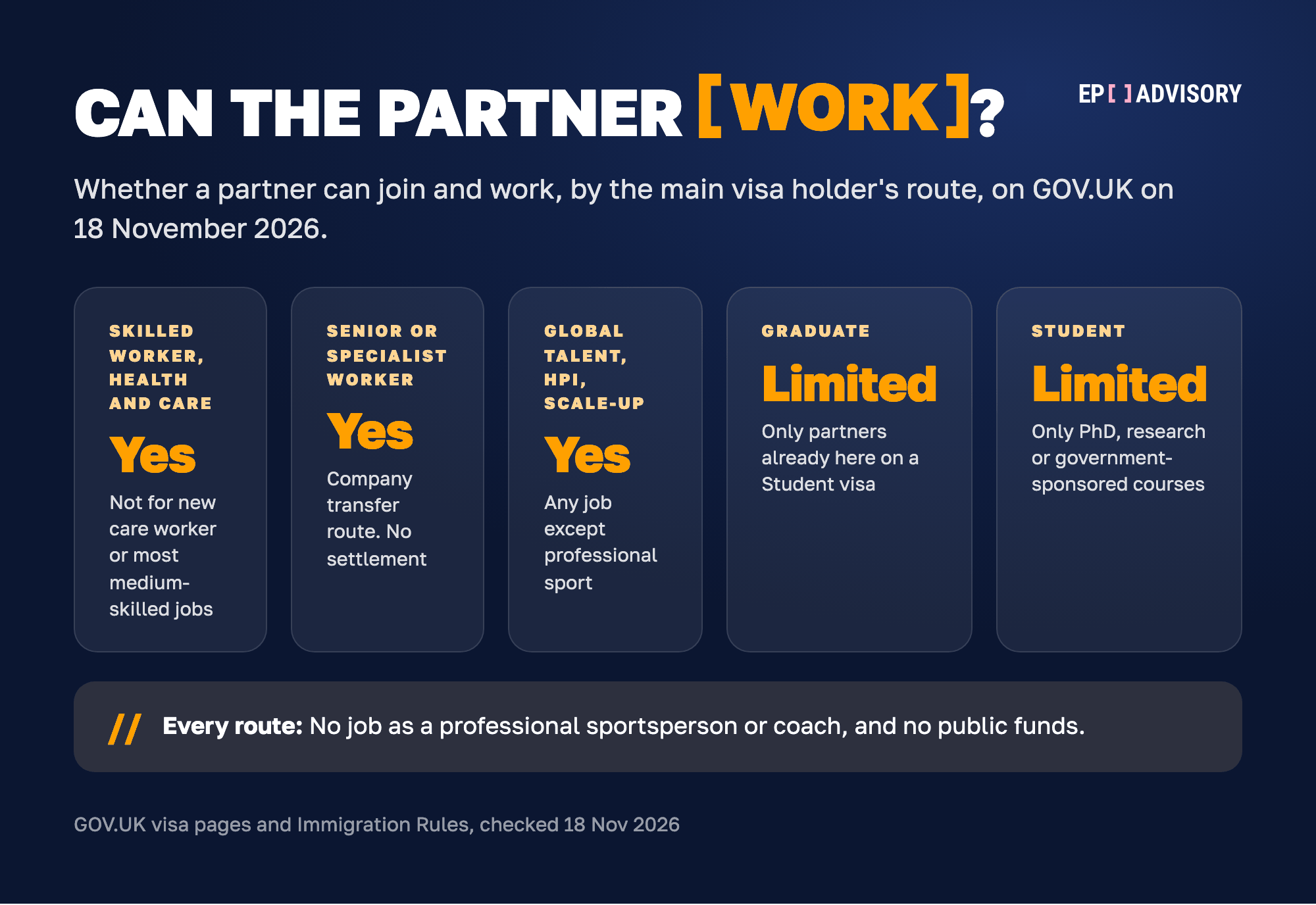
This table shows the position on GOV.UK on 18 November 2026. It covers the routes most people move on. “Can work” means any job except professional sport.
| Main holder’s route | Can the partner come? | Can the partner work? |
|---|---|---|
| Skilled Worker | Yes, except care workers who started on or after 11 March 2024 and most medium-skilled jobs started on or after 22 July 2025 | Yes |
| Health and Care Worker | Yes, for doctors, nurses and other health roles. Same care worker rule | Yes |
| Senior or Specialist Worker (intra-company transfer) | Yes | Yes |
| Global Talent | Yes | Yes |
| High Potential Individual (HPI) | Yes | Yes |
| Scale-up and Innovator Founder | Yes | Yes |
| Graduate | Only if already in the UK as the dependant of a Student | Yes |
| Student | Only for some courses, such as a PhD or research degree, or a government-sponsored course | Yes, with limits in some cases |
A few points on the routes that need more detail:
- Health and Care Worker: partners of doctors, nurses and other health staff can come and work. Health and care workers and their dependants also do not pay the Immigration Health Surcharge (IHS), a yearly charge for using the NHS, the UK’s public health service.
- Senior or Specialist Worker: this is the route for a transfer to your partner’s company’s UK office. You can work, but GOV.UK lists no settlement line, because the route itself does not lead to settlement.
- Graduate: a new partner cannot join from abroad. GOV.UK says new dependants “may be able to join you from outside the UK if you switch to a different visa, for example a Skilled Worker visa”.
- Student: if the course started on or after 1 January 2024 and is postgraduate, it must be a PhD, another doctorate or a research-based higher degree. Government-sponsored students on courses longer than 6 months can also bring family. One work limit applies where a partner stays on because the student is moving to a new course: if the new permission is under 9 months, or the new course is below degree level, the partner cannot work.
If your partner is still choosing a route, our guide to the UK work visa for Americans compares them side by side. The family rules apply to every nationality.
What a dependant cannot do, and who cannot come
The limits are short and clear, so check them once and move on to the job.
The one job you cannot take
Professional sportsperson, including a sports coach. That is the only job type excluded on the main work routes. If your work is in sport, check the exact conditions on your eVisa before you accept an offer.
Care workers and medium-skilled jobs
Since 11 March 2024, care workers and senior care workers cannot bring new dependants. GOV.UK keeps one exception: the main holder has been “continually employed as a care worker or senior care worker in the UK and on a Skilled Worker visa since before 11 March 2024”. There are a few exceptions for children too. Care worker jobs are now only open for extending, updating or switching a visa, not for new recruits from abroad.
A similar rule covers medium-skilled jobs, the ones below degree level that a sponsor can still fill in some cases. A partner can join only if the main holder has been in that job on a Skilled Worker visa “since before 22 July 2025”, with some exceptions for children.
Partners who are not yet married
An unmarried partner counts if you have lived together in a relationship for at least 2 years when you apply. A couple who cannot live together, for example because of work, can still qualify after 2 years in a relationship. A fiancé who has not hit either mark is not a dependant on these routes.
If your partner is a British citizen or settled in the UK, you need the family visa instead. It has its own rules, and a fiancé on that route cannot work before the wedding. See the family visa pages on GOV.UK.
Changes that are announced, not in force
The government’s May 2025 immigration white paper announced “a new English language requirement for all adult dependants of workers and students at level A1”, the most basic level. It also said the level would rise over time. On 18 November 2026 this is not in the Immigration Rules for Skilled Worker dependants. The settlement changes announced on 2 November 2026 are also not yet law. Plan around today’s rules and watch for the change.
This page is general information, not immigration advice. Check the current rules on GOV.UK or with a regulated adviser before you apply.
Join on time: fees, funds and decision times
Apply with your partner, not after, so you can start your job search on day one.
You can apply at the same time as the main holder or later. GOV.UK is clear that applying later does not save money: a partner who applies later will still “pay the fee for the same length of time as you even if they apply after your visa has been granted”. The main costs are the visa fee and the IHS.
| Cost for one adult partner | From outside the UK | From inside the UK |
|---|---|---|
| Skilled Worker, up to 3 years | £819 | £943 |
| Skilled Worker, over 3 years | £1,618 | £1,865 |
| Health and Care Worker, up to 3 years | £324 | £324 |
| Global Talent | £766 | £766 |
| Immigration Health Surcharge | £1,035 a year (£776 for students’ dependants; none for Health and Care Worker families) | |
Worked example: a partner joining a Skilled Worker from abroad on a 3-year visa pays £819 plus 3 years of IHS at £1,035. That is £3,924, about $5,300. You also need to show £285 in savings for the partner, held for 28 days in a row. You do not need to show it if you have all been in the UK with a valid visa for at least 12 months, or if the employer confirms on the certificate of sponsorship that it will cover your family’s costs in the first month.
GOV.UK says you will usually get a decision within 3 weeks if you apply from outside the UK, and within 8 weeks from inside. You cannot switch in from a visit visa, so apply as a dependant from home rather than flying in as a tourist and applying later.
Score your CV in 30 seconds, then fix its biggest problems one by one. Both free.
Free, no card. A free account unlocks every fix.

Prove your right to work with a share code
Have your share code ready before the first interview, and the visa question takes two minutes.
UK employers must check that every new hire has the right to work. The penalty for getting it wrong is up to £60,000 per worker, which is why recruiters ask about your visa early. The check itself is quick.
- Your status is digital. The UK now issues an eVisa, an online record of your status, linked to your UK Visas and Immigration (UKVI) account. Employers can no longer accept biometric residence permits (BRPs).
- A share code proves it. You get a share code on GOV.UK and send it to the employer with your date of birth. It shows the “types of job you’re allowed to do” and “how long you can work”. A share code lasts 90 days, so make a fresh one for each new offer.
- The employer cannot refuse eligible documents. GOV.UK says an employer “cannot reject your application because you gave them an eligible immigration document instead of a share code”.
- You can start before your National Insurance number arrives. A National Insurance (NI) number is your UK tax and social security reference. GOV.UK says you “can start work before you receive your National Insurance number if you can prove you have the right to work”. Many dependants on skilled worker routes get one automatically, and it appears on the eVisa.
When a recruiter asks “do you need sponsorship?”, the answer is “No. I have the right to work as a dependant, and I can send a share code today.”
No sponsor needed: say it in the first line
Your biggest advantage is that an employer pays no sponsorship costs to hire you, so make that impossible to miss.
A UK employer hiring a sponsored worker needs a sponsor licence, pays fees and charges, and must meet salary rules. Many small firms do not have a licence at all. You need none of that. But a recruiter who sees a foreign name, a foreign degree and a foreign address on a CV may assume you need a visa and move on. That is the moment to stop.
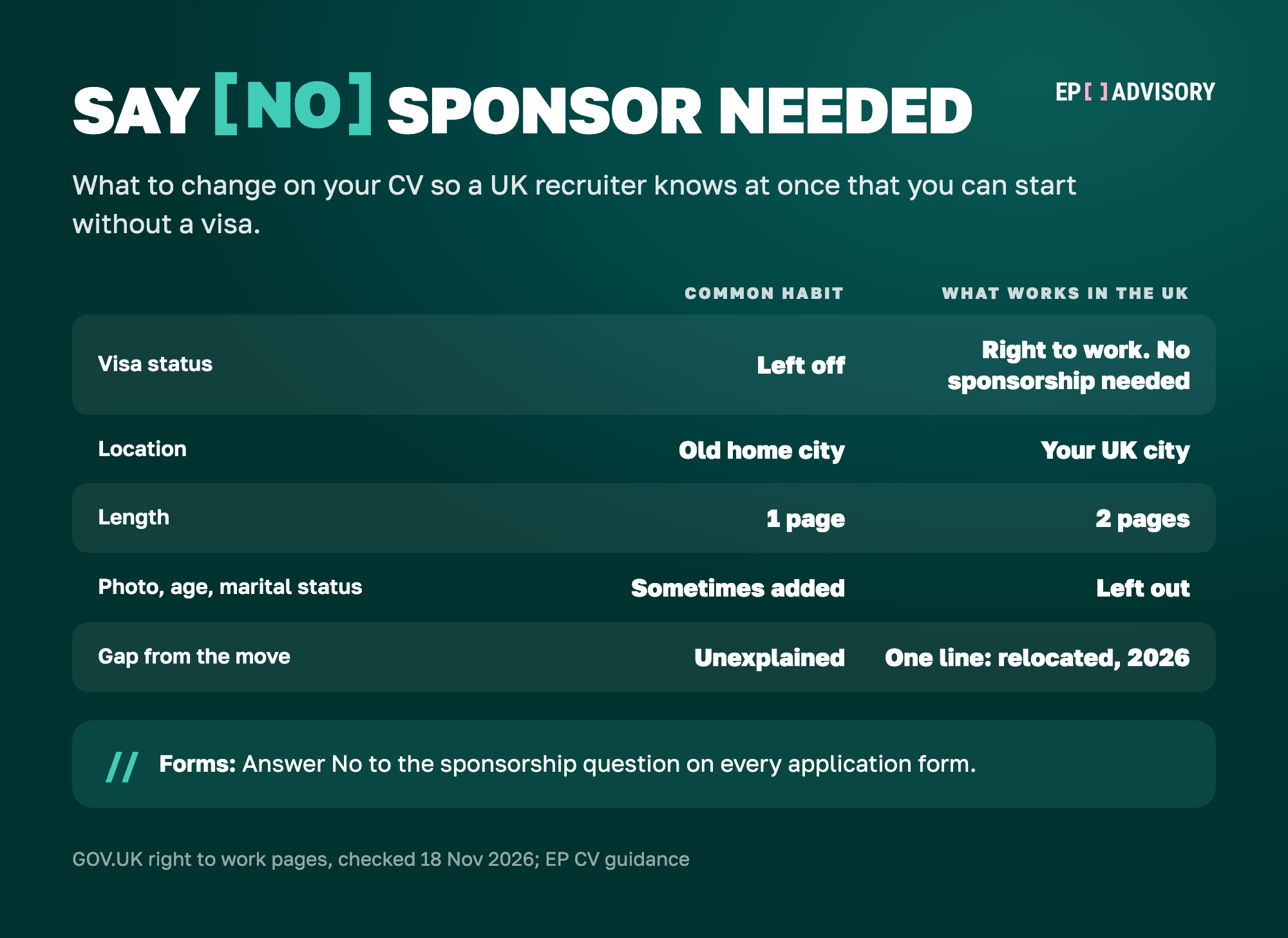
Put a right to work line in three places:
- Your CV header, under your name and contact details: “Right to work in the UK (dependant visa to 2029). No sponsorship needed.” Use your real visa end date.
- Your LinkedIn, in the “About” section and the first line of your headline if space allows. Set your location to the UK city you live in, not your old one.
- Every application form, where you will see “Do you require sponsorship?”. Answer “No”. Some online forms filter on this question, so a wrong click removes you before a person reads anything.
Then make the rest of the CV read like a UK CV. A UK CV is usually 2 pages, starts with a short profile, leaves out a photo, age and marital status, and shows results with numbers. If you are coming from the US, our guide to the UK CV vs US resume shows every change line by line. Explain a gap from the move in one line, such as “Relocated to London with family, 2026”. UK readers see this often.
Where dependants find work in the UK
Treat the search as a full-time project with a weekly target, and use the routes UK employers already trust.
Get your qualifications read the UK way
A UK recruiter may not know your university or what your degree is worth here. A UK ENIC Statement of Comparability solves that. UK ENIC is the official body that compares foreign qualifications with UK levels. The statement says, for example, that your degree compares to a UK bachelor’s degree. It is a paid service. It does not cover professional licences, so it will not license you as a nurse or a lawyer.
Some jobs are regulated, which means you need registration with a UK body before you can use the title or do the work. Check yours on the government’s regulated professions register. We have step-by-step guides for four of the most common:
- Nurses: registration with the Nursing and Midwifery Council. See American nurse in the UK.
- Doctors: a licence from the General Medical Council. See can an American doctor work in the UK.
- Teachers: qualified teacher status in England. See American teacher in the UK.
- Lawyers: foreign-law work is often open; the solicitor title needs exams. See American lawyer in London.
Start any registration before you move if you can. Some take months, and you can apply for other jobs while you wait.
Sectors and timelines
You can apply anywhere, so aim where your experience is strongest. London has large markets in finance, tech, consulting, law, media, health and the public sector. International firms are used to hiring people who have worked abroad. Our list of American companies in London is a good starting list if you have worked for a US brand or client. For a wider view of sectors and how foreigners get hired, see jobs in the UK for foreigners.
Plan for a search of a few months. UK hiring often runs to two or three interview rounds, plus reference checks after an offer. In our experience, December and August are quieter in many sectors, so use those weeks for networking and applications that will be read in January or September.
Recruiters and networks
- Specialist recruiters: pick two or three agencies that focus on your field. Tell them in the first message that you need no sponsorship. Some agencies skip candidates they think need a visa, so say it before they ask.
- Your partner’s network: your partner’s new colleagues know who is hiring. Ask for introductions, not jobs.
- Alumni and professional groups: your university alumni group in London, and the UK body for your profession, run events where hiring managers go.
- Short, direct messages on LinkedIn: write to people one level above the role you want. Ask one clear question about their team. Many UK jobs are filled through referrals.
Keeping a job from home
Your visa lets you do any work, so working remotely for an employer back home is allowed by the immigration rules. Tax and payroll are a separate question. Your employer may need to run UK payroll, and you may owe UK tax once you live here. This needs checking with your employer and a tax adviser before you rely on it. Our guide to how to work remotely in the UK for a US company walks through the questions to ask.
If you are American: four things that work differently
US citizens follow the same rules as everyone else, with four extra points to know.
- The ETA does not let you work. Americans can visit the UK with an Electronic Travel Authorisation (ETA). The ETA rules say you cannot “do paid or unpaid work for a UK company or as a self-employed person”. So do not fly in on an ETA and start a job while you wait. Get the dependant visa first.
- US tax still applies. The US taxes its citizens on worldwide income, wherever they live, so you file a US return as well as paying UK tax. You may also need to report UK bank accounts if they total more than $10,000. The IRS page for citizens abroad sets out the basics. Talk to a cross-border tax adviser before your first UK payday.
- Your resume needs a rebuild, not a trim. A one-page US resume reads as thin in the UK. Use 2 pages, British spelling, UK job titles where they differ, and the right to work line at the top.
- Open a UK bank account early. Your first employer will pay salary into a UK account. Opening one in your first weeks means you can say yes to an offer without delay.
For the full picture of how Americans get hired here, read our guide on how to get a job in the UK as an American.
Your 90-day plan to a UK job offer
A steady weekly pace beats a burst of applications, so set the pace in week one and keep it.
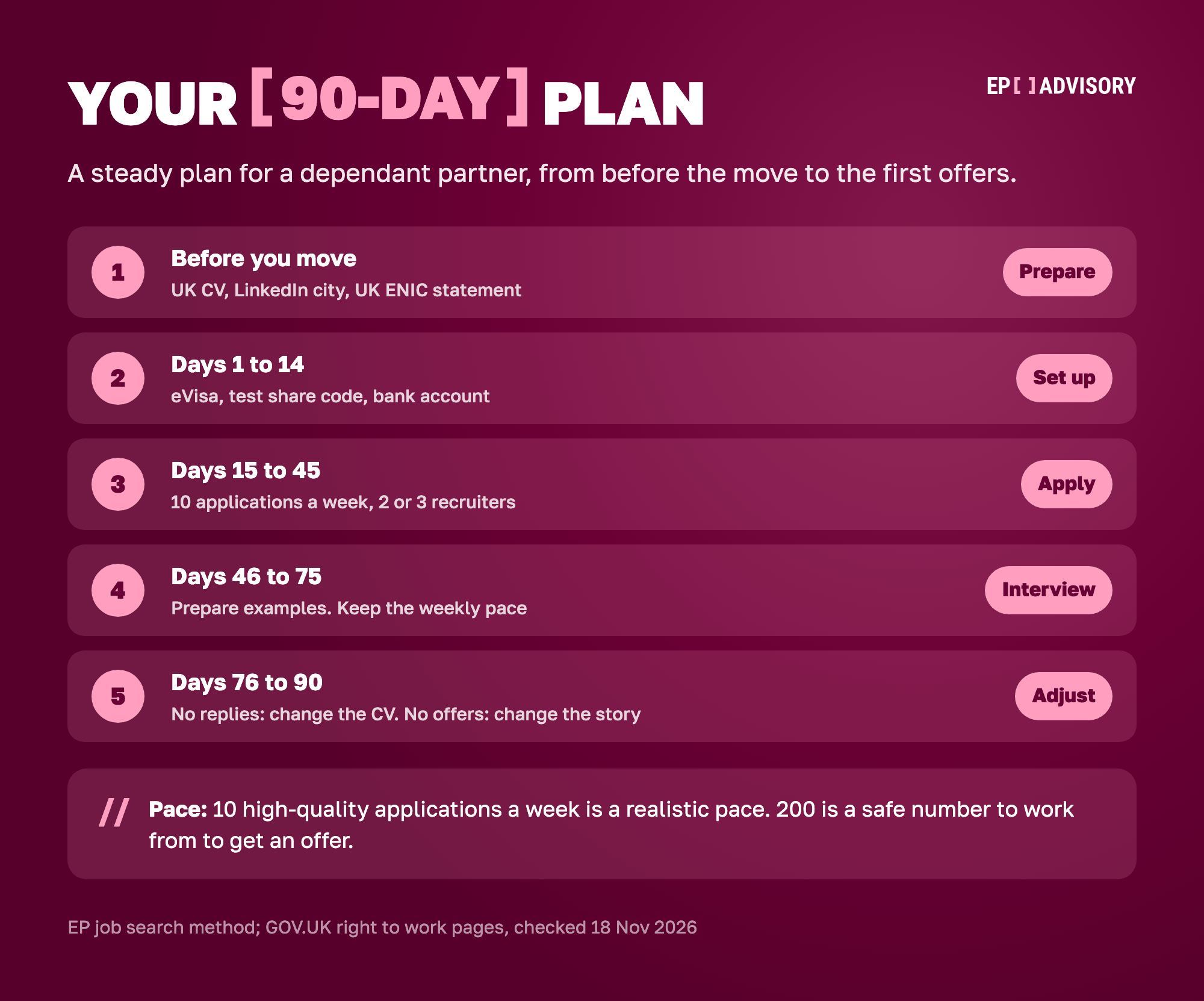
In our experience, 10 high-quality applications a week is a realistic pace. What we have seen in the market in 2026 is that 200 applications is a safe number to work from to get an offer. If you apply at 10 a week from day 15 to day 90, you will send around 110. That is a strong base to judge what is working.
- Before you move: rewrite your CV in the UK format with the right to work line. Change your LinkedIn location to your new city. Order your UK ENIC statement and start any professional registration.
- Days 1 to 14: sign in to your UKVI account, view your eVisa and test a share code. Open a bank account. Check whether your NI number is already on your eVisa.
- Days 15 to 45: send 10 tailored applications a week. Brief two or three specialist recruiters. Ask for 3 introductions a week through your partner, alumni and old colleagues.
- Days 46 to 75: prepare for UK-style interviews, which lean on examples from your past work. Keep your pace even when interviews start.
- Days 76 to 90: review what worked. If applications get no replies, change the CV. If interviews get no offers, change how you tell your examples. Then keep going.
A short, tailored first page does most of the work in a UK application. Before you start sending, Getting ready to apply for jobs in the UK? Check your CV for free: see it the way a recruiter does, then fix each problem.
Next: turn your resume into a UK CV with our guide to the UK CV vs US resume, then add your right to work line at the top.
Key takeaways
- A dependant partner on a UK work visa can work for any employer, full time, part time or self-employed, except as a professional sportsperson or coach.
- You need no sponsor, no job offer and no salary minimum, so tell every employer “No sponsorship needed” in your CV header and on forms.
- Care workers who started on or after 11 March 2024, most medium-skilled jobs from 22 July 2025 and most students cannot bring new dependants.
- A Skilled Worker partner joining from abroad for 3 years pays £819 plus £3,105 in IHS, £3,924 in total, about $5,300.
- Prove your right to work with a share code from GOV.UK. It lasts 90 days, and you can start work before your NI number arrives.
- An English test for adult dependants was announced in 2025 but is not in the rules on 18 November 2026.
- Aim for 10 tailored applications a week, and use recruiters, your partner’s network and UK ENIC to remove doubts early.
See what a recruiter sees, then fix it before you apply. An instant score, then the fix for every problem.
Free, no card. A free account unlocks every fix.
Frequently asked questions
Can a dependant work full time in the UK?
Yes. On the Skilled Worker, Health and Care Worker, Global Talent, Senior or Specialist Worker, HPI and Scale-up routes, a dependant partner can work full time or part time for any employer, or be self-employed. The only job ruled out is professional sportsperson or sports coach.
Does a dependant visa holder need sponsorship to get a job?
No. A dependant has the right to work through the main holder’s visa, so an employer does not need a sponsor licence to hire them. Say so in your CV header and answer No to the sponsorship question on application forms.
How do I prove my right to work as a dependant?
Get a share code from the prove your right to work page on GOV.UK and give it to the employer with your date of birth. The code shows what work you can do and for how long. It is valid for 90 days. Employers can no longer accept biometric residence permits.
Can I work for my home-country employer remotely on a dependant visa?
The visa allows any work except professional sport, so remote work is allowed under the immigration rules. Tax and payroll are separate. You may owe UK tax and your employer may need UK payroll, so check with your employer and a tax adviser first.
Can the partner of a care worker or student come and work?
Usually not as a new dependant. Care workers can bring a partner only if they have been continually employed as a care worker on a Skilled Worker visa since before 11 March 2024. Students can bring a partner only on certain courses, such as a PhD or research degree, or a government-sponsored course.