 By Andre Atallah, CEO of EP Advisory
Short answer: with the right approach, a UK job is very achievable for American professionals. Most roles need an employer that holds a sponsor licence and will sponsor your Skilled Worker visa. The job must be higher skilled and pay at least £41,700 a year gross, or the job’s going rate if higher. The plan: target sponsors, turn your resume into a two-page UK CV, check every offer against both bars, then apply for the visa.
American professionals start from a strong position in the UK job market. UK employers know US companies, US job titles and US ways of working. In tech, finance, consulting and research, US experience is a selling point. What you need is a plan built around one practical fact: most roles need an employer that will sponsor your visa.
This is the 6-step plan we use with clients moving from the US. It covers which employers to target, how to turn your resume into a UK CV, where to apply, how UK interviews differ, how to check an offer in pounds and dollars, and what the visa costs.
For nearly 10 years, we’ve helped more than 5,000 professionals find jobs abroad. Want to know if your CV will pass screening in the UK? Check your CV for free: a score in 30 seconds, then a fix for each problem.
Can an American work in the UK? Yes, with a sponsored visa
You need a work visa before you start. For most Americans, that is the Skilled Worker visa.
The Skilled Worker visa needs a job offer from a licensed sponsor. A licensed sponsor is a UK employer the Home Office has approved to hire people from abroad. You do not need to take an English test, because the US is on the list of majority English-speaking countries.
Three rules to know before you plan a trip:
- The ETA lets you visit, not work. Since 8 January 2025, Americans need an Electronic Travel Authorisation (ETA) to visit the UK. It costs £20 and lasts 2 years. A visitor cannot do paid or unpaid work for a UK company.
- You can interview as a visitor. Attending interviews is a permitted activity for visitors. You start the job once the work visa is granted.
- Youth Mobility is not open to US citizens. The UK’s two-year working holiday visa covers Australia, Canada, New Zealand, Japan, South Korea and a few others. The US is not on the eligible list.
Some Americans have other options. A recent degree from a listed top university can qualify for the High Potential Individual visa, and 33 of the 80 listed universities are American. A UK degree leads to the Graduate visa. A US employer can move you to its UK office on the Senior or Specialist Worker visa, which needs at least £52,500. Our guide to jobs in the UK for foreigners compares every route. These are general rules, so check the current rules on GOV.UK or with a regulated adviser before you apply.
Is it hard for an American to get a job in the UK? Very doable with a plan
For a strong candidate who targets the right employers, it is very doable.
Your background works for you. UK employers recognise your universities, your employers and your job titles. Your English is native. US companies with UK offices already know how to hire Americans. In our work with American clients, a strong US track record is one of the best assets a candidate can bring.
Once you have an offer, the visa usually follows. In the year to June 2026, fewer than 1 in 100 Skilled Worker applications from Americans were refused (Home Office statistics). So once a sponsor offers you a job that qualifies, you can plan with confidence. Hundreds of Americans also move each year by transferring within their own employer, so ask about UK roles at your current company.
What decides it is practical. Here are the three things we help clients get right:
- Aim at employers that sponsor. Sponsoring a 5-year visa at a medium or large company costs the employer about £7,125: the certificate of sponsorship (£525) and the Immigration Skills Charge (£6,600). The employer cannot pass the Skills Charge on to you. So some employers state “no sponsorship” in the job ad. Put your time into the ones that do sponsor.
- Send a UK CV. UK screeners expect a UK CV, not a US resume. The format is quick to change.
- Aim above the salary bar. The job must be on the list of higher-skilled occupations and pay at least £41,700 or the going rate. Mid-career professional roles are the natural target.
The steps below cover each one.
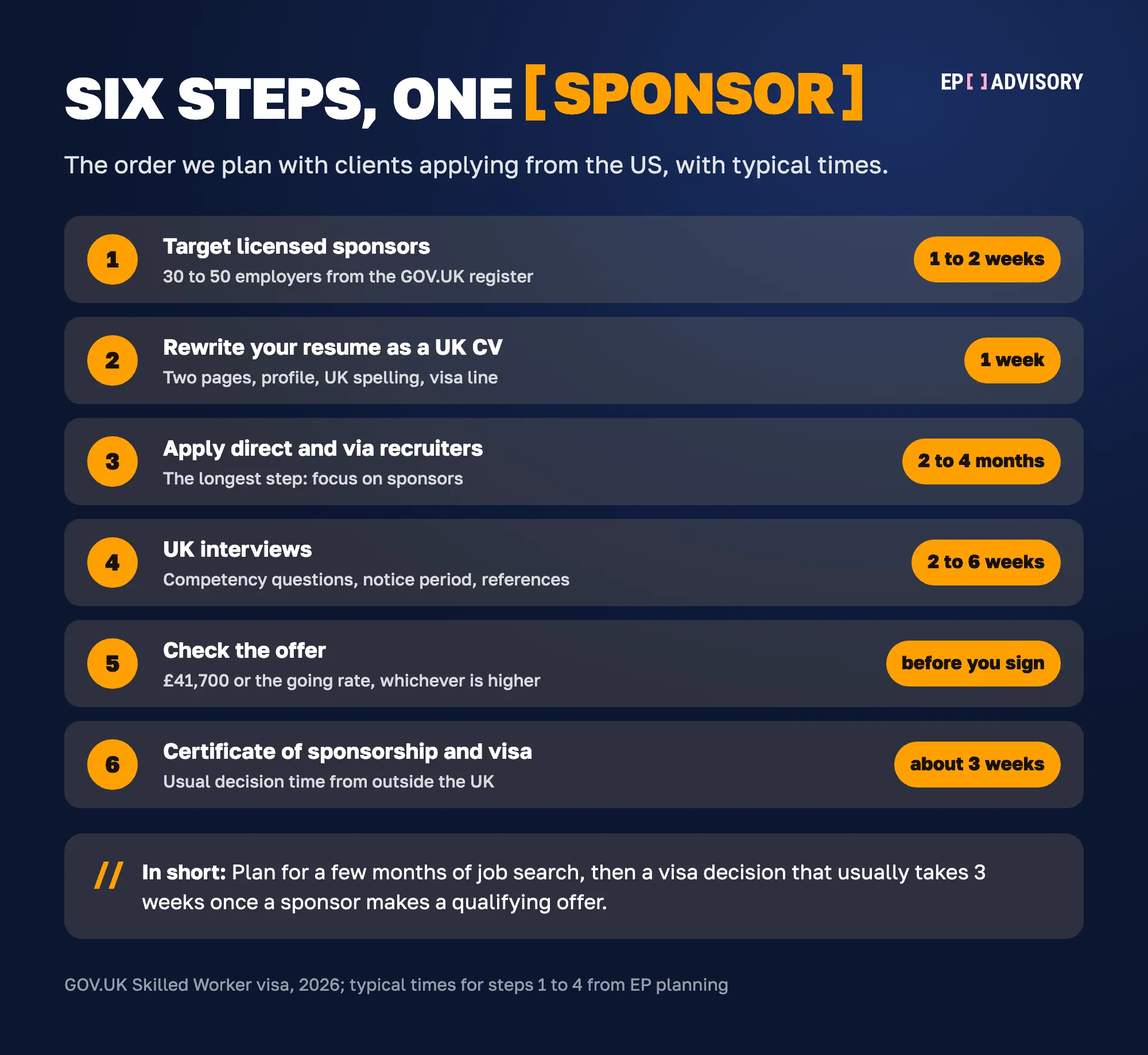
The 6-step plan we use with Americans
Work through the steps in this order. Plan for a job search of a few months and a visa decision of about 3 weeks.
- Target sponsors whose jobs clear the salary bars.
- Rewrite your resume as a UK CV.
- Apply where sponsored hiring happens, and answer the sponsorship question honestly.
- Prepare for UK interviews, which are more structured than most US ones.
- Check the offer against £41,700, the going rate and your take-home pay.
- Get the visa: certificate of sponsorship, application, decision, travel.
Score your CV in 30 seconds, then fix its biggest problems one by one. Both free.
Free, no card. A free account unlocks every fix.

Step 1: Build a list of employers that sponsor
Before you apply anywhere, build a list of 30 to 50 licensed sponsors in your field.
Start with the register of licensed sponsors, a file you can download from GOV.UK. It lists over 120,000 organisations on the Skilled Worker route (file dated 29 September 2026). The file shows each employer’s name, town, rating and route, but not its sector. So filter it by town and route, then check each name against real job ads in your field.
We point Americans to three groups first:
- US companies with UK offices. They already know your degree, your employers and your job titles.
- Large UK employers in tech, finance, consulting and research, many of which hire from abroad.
- Roles that pay well above £41,700, where the salary bar is not an issue.
A licence means the employer can sponsor. It decides role by role, so check each ad too. Our step-by-step guide to UK companies that sponsor visas shows how to filter the register and spot sponsor-friendly job ads.
Step 2: Turn your resume into a UK CV
A UK CV is usually two pages, starts with a short profile and uses British spelling.
In the UK, a CV (curriculum vitae) is the normal name for a resume. The changes are small, and they make your application read as local:
- Length: two pages is normal for mid-career. One page reads as junior.
- Profile: 3 or 4 lines at the top on who you are and what you deliver. No “Objective”.
- Spelling and dates: “organisation”, “programme”, day-month-year dates.
- Pay and grades: leave out US salaries and GPA unless asked. Convert results into numbers a UK reader can place.
- Visa line: one clear line, such as “US citizen. Will require Skilled Worker sponsorship.”
- No photo, no date of birth, no marital status.
Our guide to the UK CV vs the US resume has a side-by-side table and a before-and-after example.
Step 3: Apply where sponsored hiring happens
Apply direct to the employers on your list, and work with UK recruiters in your field.
Ten targeted applications beat fifty on a job board. In our experience, focused applications to sponsors get far more replies from abroad. Use these channels:
- Company career pages of the sponsors on your list. Many say in the ad whether they sponsor.
- LinkedIn, set to UK locations, with a UK-style headline and the visa line in your About section.
- UK specialist recruiters in your field. Tell them up front that you need sponsorship. A good recruiter will tell you quickly whether their clients sponsor.
- Your US network, especially people at US firms with London offices.
Many UK application forms ask if you have the right to work in the UK. Answer honestly: you do not yet, and you will need sponsorship. Employers must check right to work before you start, so a clear answer now saves time for both sides.
If replies are slow, the cause is usually specific and fixable. We show how to fix each one in why UK employers ignore American applications.
Step 4: Prepare for UK-style interviews
UK interviews are often competency-based. You answer “tell me about a time when…” questions with one real example each.
We ask clients to prepare 8 to 10 short stories using STAR: the Situation, the Task, the Action you took and the Result, with a number. Keep the tone factual. UK interviewers listen for what you did, not how big it sounds. Say “we” for team results and “I” for your part.
Prepare for three UK-specific questions:
- Notice period: how many weeks’ notice your current employer needs before you leave. Add the visa time on top.
- References: UK employers often contact former managers after the offer. Let your US referees know.
- Salary expectations: give a range in pounds, never dollars.
Our guide on how to pass a job interview covers the rest. If you are reaching interviews, your CV is working. Sharper stories are what turn interviews into offers. Getting ready to apply for jobs in the UK? Check your CV for free: see it the way a recruiter does, then fix each problem.
Next: before you apply, build your sponsor shortlist with our guide to UK companies that sponsor visas.
Step 5: Judge the offer in pounds and dollars
The offer must clear two bars: £41,700 gross a year, and the going rate for your occupation code. The higher one is your minimum.
The going rate is the minimum pay the Home Office sets for each occupation code, based on UK pay data. For many professional roles it sits above £41,700. The going rate for software developers (code 2134) is £54,700. For management consultants and business analysts (code 2431) it is £50,200 (Appendix Skilled Occupations, August 2026). Only guaranteed base pay counts. Bonuses do not.
Under 26 or a recent graduate? You may count as a new entrant. Then the minimum is 70% of the going rate, and never below £33,400. Our page on the Skilled Worker salary threshold explains every floor.
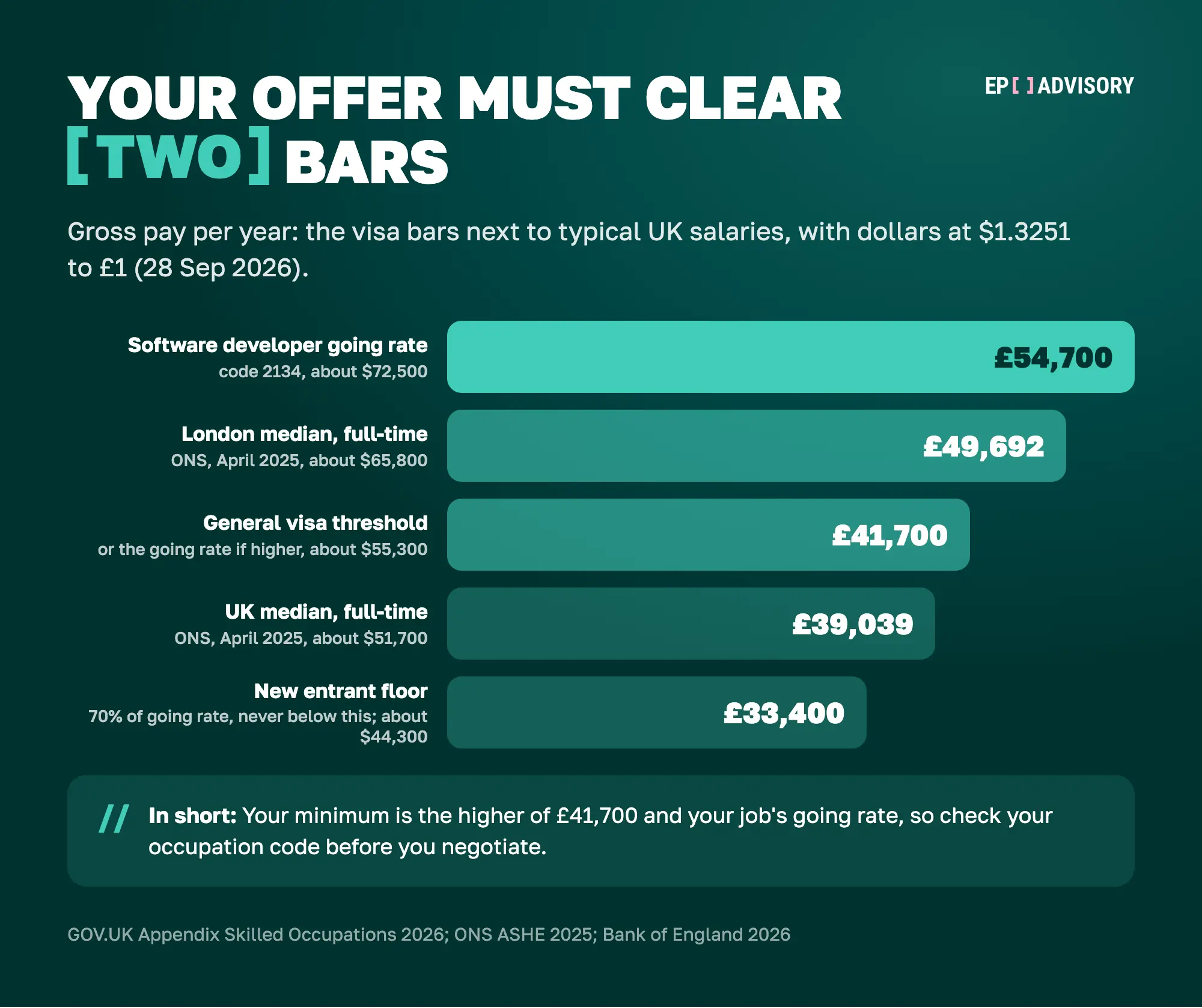
UK headline salaries are usually lower than US ones, so judge the whole package. The £41,700 visa minimum is about $55,300 a year gross (Bank of England rate of $1.3251 to £1, 28 September 2026). The typical UK full-time salary is £39,039 gross a year, about $51,700. In London it is £49,692, about $65,800 (ONS, April 2025).
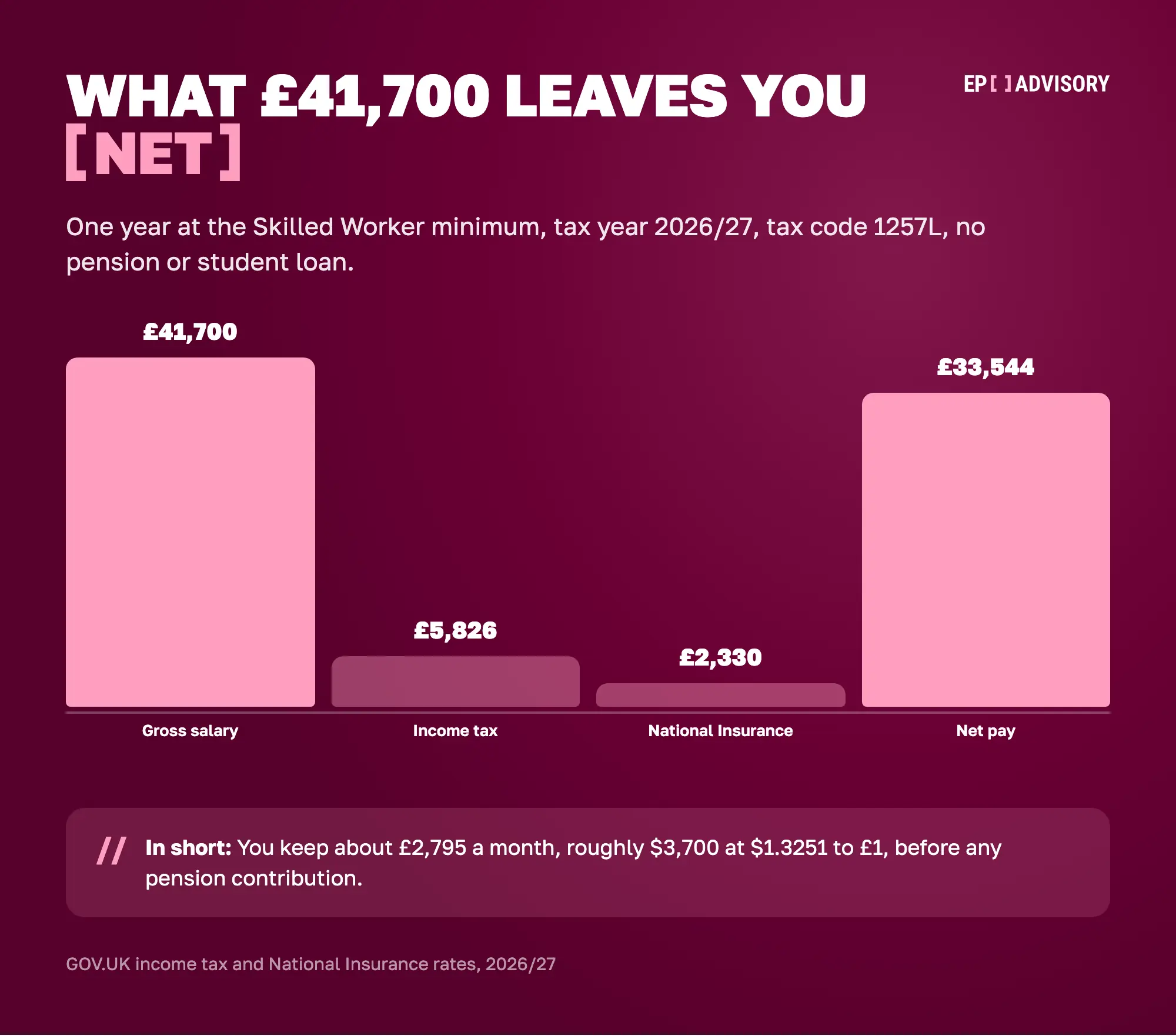
Then check take-home pay. At £41,700 in England, you pay £5,826 income tax and £2,330 National Insurance (the UK’s social security contribution). That leaves £33,544 a year, or about £2,795 a month net (about $3,700), before any pension contribution or student loan.
The package adds real value on top of the salary. You get at least 5.6 weeks of paid holiday by law (28 days on a 5-day week, which can include public holidays). A workplace pension comes with an employer contribution of at least 3%. NHS care is covered by the health surcharge. When you compare offers, compare the package and the cost of living, not the base pay alone. If the base is close to a bar, negotiate the base first, because only guaranteed basic pay counts toward the threshold. Our guide on how to negotiate salary shows how.
Step 6: Get the visa, and plan for US tax
After the offer, the employer assigns a certificate of sponsorship. You then apply online, and a decision usually takes 3 weeks from outside the UK.
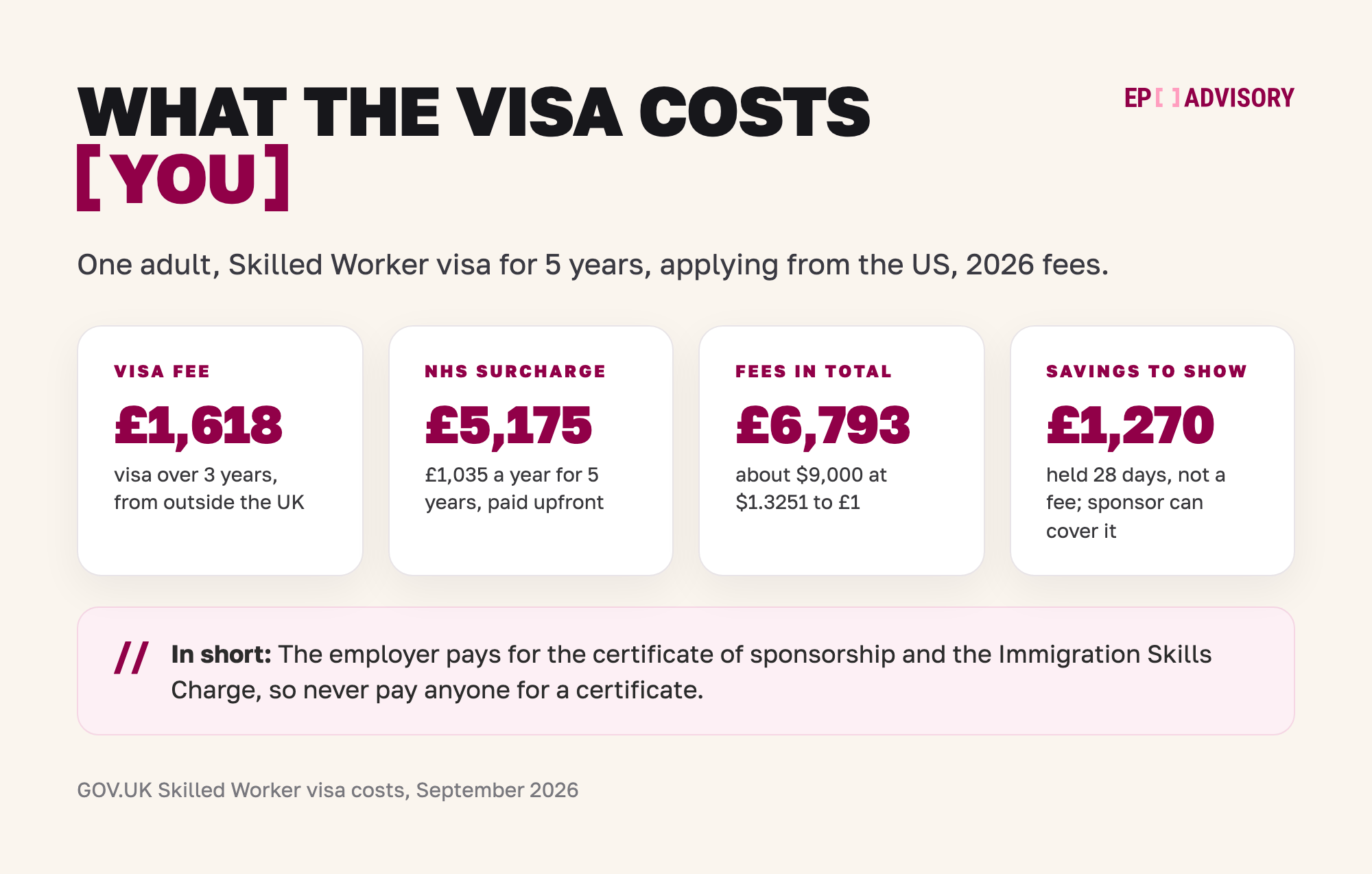
A certificate of sponsorship (CoS) is an electronic record with a reference number, not a paper certificate. You can apply up to 3 months before your start date. Budget for three things (Skilled Worker visa costs):
- The visa fee: £819 for up to 3 years, or £1,618 for longer (applying from outside the UK).
- The Immigration Health Surcharge: £1,035 per year of the visa, paid upfront. The exact amount depends on the dates of your visa, and you see it when you apply.
- Savings of £1,270, held for 28 days, unless your sponsor confirms it will cover you.
The certificate of sponsorship is the employer’s cost. Never pay anyone for one.
Once you arrive, you can start work before your National Insurance number arrives, as long as you can prove your right to work. The visa lasts up to 5 years and can be extended. Settlement (indefinite leave to remain) is possible after 5 years under today’s rules. A proposal to raise this to 10 years is under consultation and is not yet law.
US tax does not stop when you move. The US taxes citizens on worldwide income, so you still file a US return. You get an automatic extension to June 15, but interest runs from April 15. UK tax is usually higher, so many Americans in the UK use the Foreign Tax Credit (Form 1116) rather than the $132,900 foreign earned income exclusion for 2026. You may also need to report UK bank accounts (FBAR, over $10,000 in total). See the IRS guide for citizens abroad, and talk to a cross-border tax adviser before you move.
See what a recruiter sees, then fix it before you apply. An instant score, then the fix for every problem.
Free, no card. A free account unlocks every fix.
Key takeaways
- UK employers know and value US experience, so a strong American candidate aimed at the right employers is well placed.
- For most Americans applying from the US, the route is a Skilled Worker visa, which needs a job offer from one of over 120,000 licensed sponsors.
- The offer must pay at least £41,700 gross a year (about $55,300) or the going rate, whichever is higher.
- Fewer than 1 in 100 Skilled Worker applications from Americans were refused in the year to June 2026, so a qualifying offer is the step to focus on.
- A two-page UK CV with a clear visa line is easier for UK screeners to read than a US resume.
- A 5-year visa costs one adult £6,793 in fees and health surcharge (about $9,000), and the decision usually takes 3 weeks.
- The ETA (£20) covers visits and interviews. Start work on the visa, and keep filing US taxes from the UK.
Frequently asked questions
Can an American work in the UK without a visa?
No. A US passport and an ETA let you visit and attend interviews, but not work for a UK company, paid or unpaid. Get a work visa, usually the Skilled Worker visa, before you start.
Is it hard for an American to get a job in the UK?
Not for a strong candidate who targets the right employers. UK employers value US experience. Apply to licensed sponsors, use a UK CV and aim for roles that pay at least £41,700 or the going rate. Fewer than 1 in 100 Skilled Worker applications from Americans were refused in the year to June 2026.
Can a US citizen use the UK Youth Mobility Scheme?
No. The United States is not on the list of eligible countries. Americans can use a work visa such as Skilled Worker instead, or another route like the High Potential Individual visa if they qualify.
How much does a UK work visa cost for an American?
For a Skilled Worker visa from outside the UK, the fee is £819 for up to 3 years or £1,618 for longer, plus a health surcharge of £1,035 per year. A 5-year visa for one adult costs £6,793 in total.
Do I still pay US taxes if I work in the UK?
You still file a US tax return, because the US taxes citizens on worldwide income. Credits and exclusions often reduce the US tax owed. Talk to a cross-border tax adviser about your case.