 By Andre Atallah, CEO of EP Advisory
The short answer: the average salary in Luxembourg is €75,919 a year gross, or €6,327 a month divided by 12, on the latest official STATEC survey (reference year 2022). The median is €4,844 a month. Take-home on the average is about €4,350 to €4,425 a month. The minimum wage is €2,771.33 a month, the highest in the EU.
| Luxembourg, 2026 | Figure |
|---|---|
| Average salary, gross (STATEC survey, 2022) | €75,919 / year |
| Per month (÷ 12, gross) | €6,327 |
| Median (÷ 12, gross) | €4,844 |
| OECD average worker, 2025 (÷ 12, gross) | €6,487 |
| Take-home on the average (single, estimate) | ≈ €4,350–4,425 / month |
| Minimum wage from 1 June 2026 (unskilled / skilled) | €2,771.33 / €3,325.59 a month |
| EU Blue Card salary bar (from 3 March 2026) | €65,652 / year |
| Average Luxembourg City flat vs net on the average | €1,960 a month = 44–45% |
Luxembourg pays more than anywhere else in the EU: the highest average salary, the highest minimum wage, and a law that lifts every salary by 2.5% each time prices do. The average Luxembourg City flat is advertised at €1,960 a month, 44 to 45% of the take-home on the average salary. So almost half the workforce sleeps in France, Belgium or Germany, and is paid less for it: a frontalier earned 71% of a Luxembourg-national resident’s salary in 2022. Where you sleep decides what your payslip is worth.
This guide runs the arithmetic: the official average against the newer OECD and Eurostat readings, the index mechanism, the 2026 minimum wage and deductions, and the €65,652 Blue Card bar and ADEM test that decide whether a job can sponsor you. Every monthly figure here is an annual figure divided by 12 unless it says otherwise.
In nearly 10 years, we’ve helped more than 5,000 professionals find jobs abroad. Want to know if your CV will pass screening in Luxembourg? Check your CV for free: a score in 30 seconds, then a fix for each problem.
What Is the Average Salary in Luxembourg Per Month? (2026)
The average salary in Luxembourg is €75,919 a year gross, according to STATEC’s structure of earnings survey for reference year 2022, published in July 2024. It covers full-time employees who worked the whole year, bonuses included. Divided by 12 that is €6,327 a month gross. The median on the same survey is €58,126 a year, or €4,844 a month; the average sits 30% above the middle.
Luxembourg pays on 12 instalments as a rule, so the monthly conversion is simple. Newer readings sit higher: the OECD puts the 2025 average worker at €77,844 (€6,487 ÷12) and Eurostat’s 2024 full-time-adjusted average at €83,000 (€6,917 ÷12), the highest in the EU.
What counts as a good salary in Luxembourg? Above €58,126 a year you are in the top half of full-time employees; above €75,919, roughly in the top 40%; the ninth decile in the private sector was €132,913 in 2022. Sector medians sharpen the test: €93,843 in finance and insurance, €72,157 in ICT, €40,519 in commerce.
One thing to keep in perspective: your salary moves by law. When the six-month average of the consumer price index crosses a 2.5% threshold, every salary, wage and pension rises 2.5% from the first day of the following month (amended law of 25 March 2015). The last tranche fell on 1 June 2026, taking the index from 968.04 to 992.24; the previous one was 1 May 2025. STATEC’s September 2026 forecast puts the next in the third quarter of 2027: inflation was 2.2% in August 2026, and the six-month index average (1,054.27) is still below the 1,064.75 trigger. A contract signed in January is worth more by summer.
If the numbers work for you, the next step is practical: check your offer against Luxembourg’s Blue Card bar of €65,652 gross a year (explained below) and against the European work-visa salary thresholds in neighbouring countries, and salaries in Belgium covers the neighbouring market that 22.7% of Luxembourg’s cross-border workers commute from each morning.
Luxembourg Salaries at a Glance: The Essentials
- Average gross salary: €75,919/year, which is €6,327 ÷12, full-time, bonuses included (STATEC structure of earnings survey, reference year 2022)
- Median: €58,126/year, or €4,844 ÷12; the average is 30% above it (STATEC, 2022)
- Pay frequency: 12 payments. A 13th month is not required by law; it comes only through a collective agreement, contract clause or company custom (banking pays one in December)
- Indexation: +2.5% on all pay each time the six-month CPI average crosses a 2.5% threshold; last tranche 1 June 2026 (STATEC)
- Minimum wage: €2,771.33/month gross unskilled and €3,325.59 skilled from 1 June 2026 (ITM); the EU’s highest (Eurostat, 1 January 2026)
- Take-home on the average: about €4,350 to €4,425 a month, single, tax class 1; the OECD puts it at 68.0% of gross, with a tax wedge of 40.2% against an OECD average of 34.9% (2025)
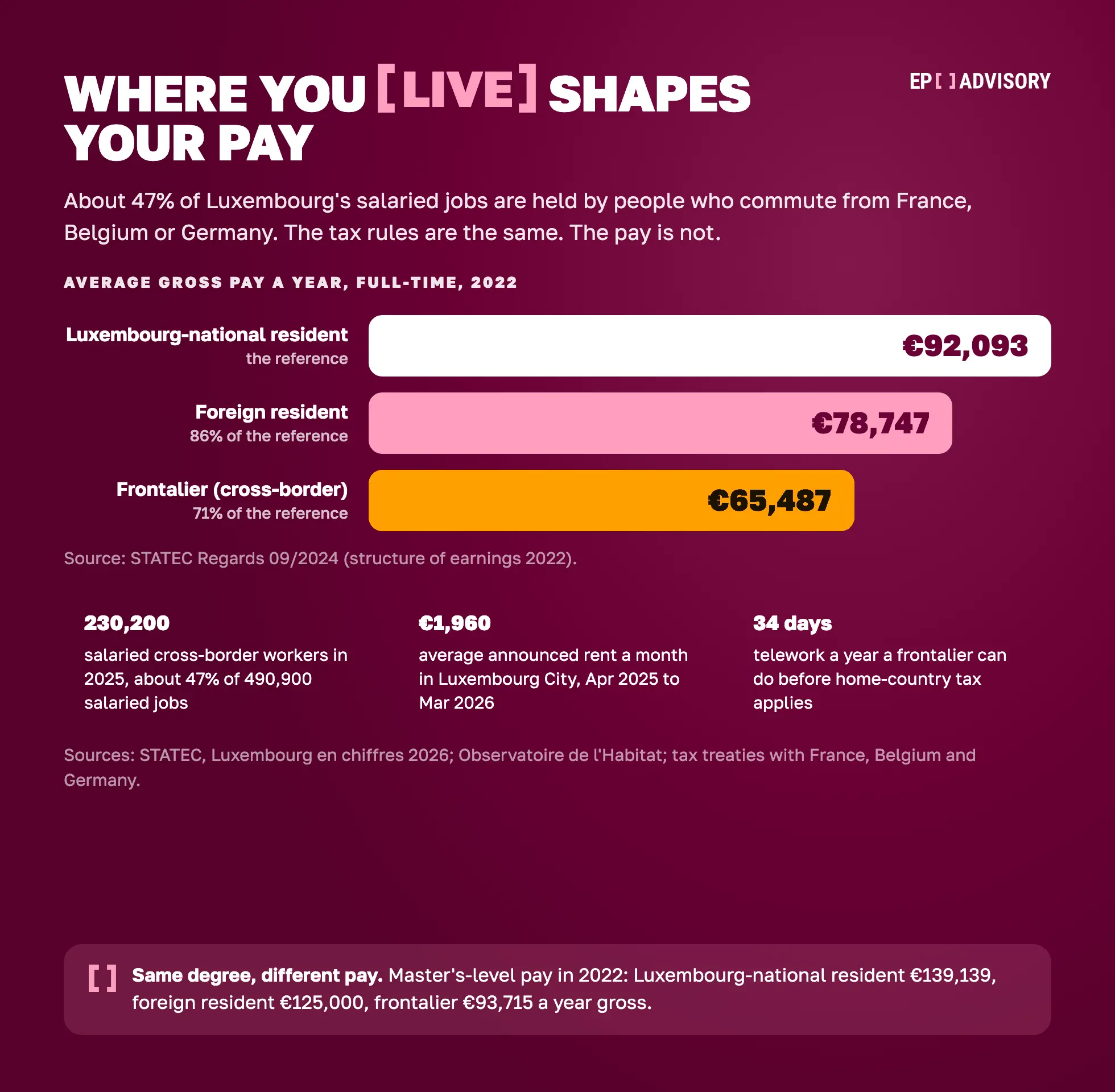
- Resident vs frontalier: Luxembourg-national residents €92,093, foreign residents €78,747, frontaliers €65,487 a year (STATEC, 2022)
- Rent: €1,960 a month announced in Luxembourg City, €1,796 nationally (Observatoire de l’Habitat, April 2025 to March 2026)
- EU Blue Card threshold: €65,652 gross a year for applications filed from 3 March 2026, no shortage-occupation discount (Guichet.lu; last checked September 2026)
A note on how to read all of this. The STATEC survey runs only every four years: 2022 is the latest reference year and the 2026 wave will not be published before 2028. Every “2026 average” on secondary sites is either this figure or an index-uplifted guess.
The Border Trap: Where You Sleep Decides What You Keep
Luxembourg’s workforce is split in two. In 2023, 225,840 people commuted in from France (54.2% of them), Germany (23.0%) and Belgium (22.7%), and 39.8% of the total wage bill went to non-residents, by far the highest share in Europe (STATEC, Regards 01/2026). In 2025 cross-border workers held 230,200 of Luxembourg’s 490,900 salaried jobs, about 47% (STATEC, Luxembourg en chiffres 2026). Almost half the people inside “the average” go home to another country every evening.
The two halves are not paid the same, and they do not pay the same rent. Here is the arithmetic:
| Resident | Frontalier | |
| Average gross salary, per year (STATEC, 2022) | €78,747 (foreign residents) | €65,487 |
| Relative to a Luxembourg-national resident (€92,093) | 86% | 71% |
| Luxembourg tax and social contributions | In full | In full on Luxembourg workdays (34 telework days a year tolerated) |
| Average announced apartment rent | €1,960 a month, Luxembourg City (Apr 2025 to Mar 2026) | Paid in France, Belgium or Germany (not in Luxembourg data) |
| Rent as a share of net on the average salary | 44–45% (54% on the median) | Not applicable |
Part of the pay gap is composition: a French frontalier averaged €58,276 in 2023 against €70,676 for a Belgian and €69,726 for a German. But it survives at equal education: a master’s-level Luxembourg-national resident averaged €139,139 in 2022 against €93,715 for a master’s-level frontalier.
The rent side is the mirror image. Both pay Luxembourg deductions, because Luxembourg taxes cross-border workers on their Luxembourg workdays. The resident pays €1,959.97 a month for the average announced city flat (Observatoire de l’Habitat, April 2025 to March 2026), 44 to 45% of the net on the average salary and 54% of the net on the median. The frontalier rents in Thionville, Arlon or Trier; we have not sourced those rents, so we quote none.
The question to ask before you sign. Ask which pool your offer is being compared with; “above the Luxembourg average” may be measured against a workforce that is almost half commuters. If you are moving in, benchmark against the foreign-resident average of €78,747, not the all-in €75,919. For the commuters’ home markets, see salaries in France and salaries in Germany.
One Country, Several Averages: Which Number to Trust
Ask what people in Luxembourg earn and you get at least five defensible answers. They measure different populations in different years, and the gap between the STATEC survey and the Eurostat figure alone is over €7,000 a year.
| Figure | Source and year | What it actually measures |
| €75,919 (€6,327 ÷12) | STATEC structure of earnings survey, reference year 2022, published July 2024 | Full-time employees who worked the whole year, all sectors, bonuses included. Median €58,126 |
| €77,844 (€6,487 ÷12) | OECD Taxing Wages 2026, reference year 2025 | The OECD “average worker”: a full-time adult in private sectors B to N |
| €80,713 (€6,726 ÷12) | STATEC/IGSS annual earnings table 2025, relayed by Frontaliers Grand Est | Private economy (sectors B to S), from social-security records |
| €83,000 (€6,917 ÷12) | Eurostat, 2024 | Wage bill per full-time-adjusted employee, all sectors. Highest in the EU; EU average €39,800 |
| €4,903 a month | STATEC/Eurostat SES 2022, via the MEGA observatory | All working patterns, part-time included, irregular bonuses excluded. Median €3,949 |
We headline the STATEC survey figure because it is the official one, the only source with the median, sector and resident/frontalier splits from the same population. Its weakness is age. The OECD and Eurostat figures are newer and sit higher, as an indexed economy would predict; the 2025 table reached us only through a relay, so treat it as indicative.
The mislabelling to watch for. Most pages ranking for “average salary Luxembourg 2026” publish the 2022 figure under a 2026 headline. The €4,903 monthly series is the other trap: real, but not full-time-equivalent and without irregular bonuses, so it understates full-time pay by more than €1,400 a month. A figure without a source and reference year is decorative.
Salaries by Sector and Role
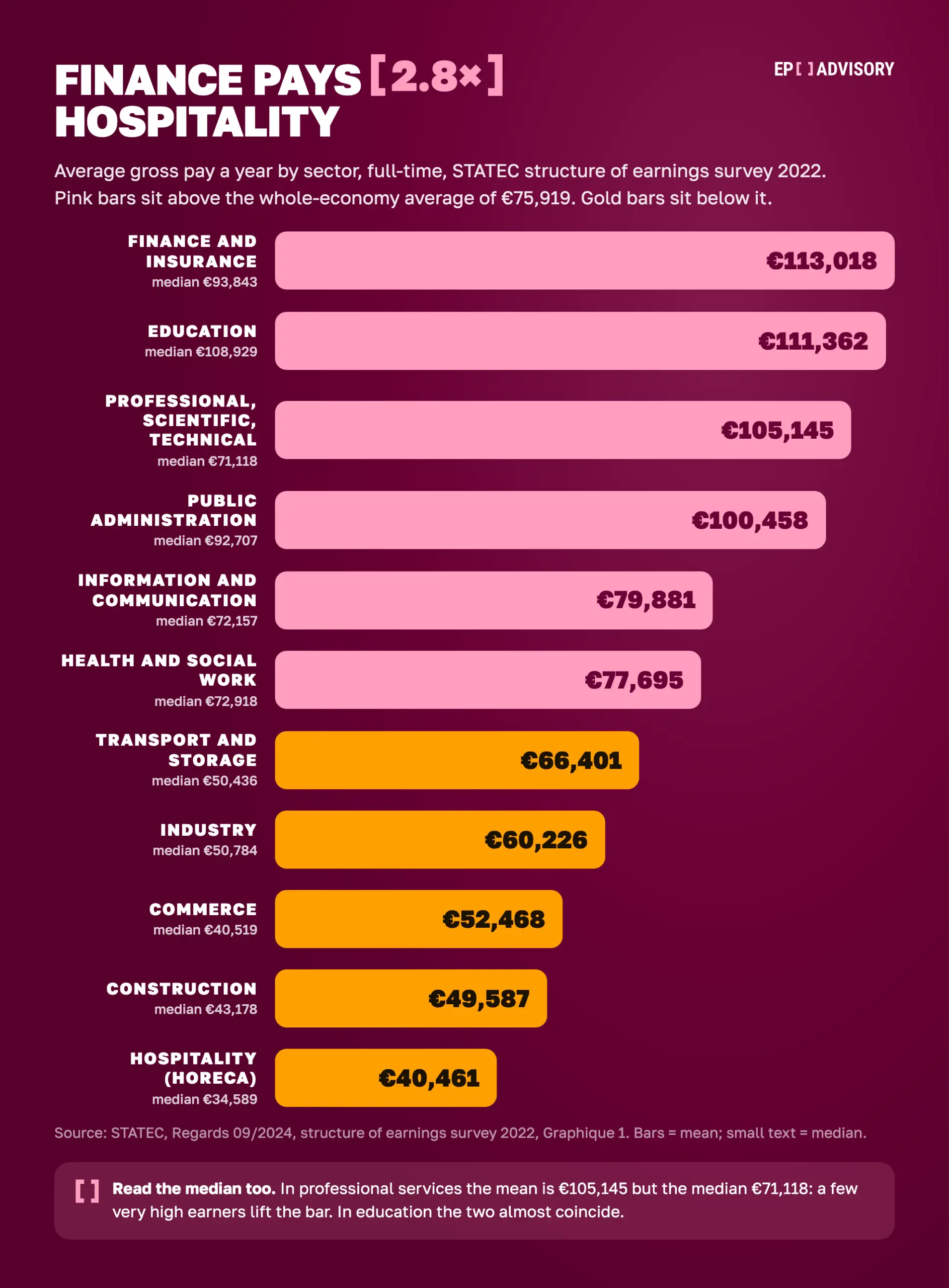
Two things move a Luxembourg salary more than anything else: the sector, and whether you hold a degree. The two are linked: 81% of finance employees held a university degree in 2022 against 11% in hospitality, and finance paid 2.8 times hospitality. Sector first, full-time gross a year on the STATEC 2022 survey, with the average divided by 12 in the last column.
| Sector (STATEC, 2022, full-time) | Average, per year | Median, per year | Average, per month (÷12) |
| Finance and insurance | €113,018 | €93,843 | €9,418 |
| Education | €111,362 | €108,929 | €9,280 |
| Professional, scientific and technical | €105,145 | €71,118 | €8,762 |
| Public administration | €100,458 | €92,707 | €8,372 |
| Information and communication | €79,881 | €72,157 | €6,657 |
| Health and social work | €77,695 | €72,918 | €6,475 |
| Whole economy | €75,919 | €58,126 | €6,327 |
| Transport and storage | €66,401 | €50,436 | €5,533 |
| Industry | €60,226 | €50,784 | €5,019 |
| Commerce | €52,468 | €40,519 | €4,372 |
| Construction | €49,587 | €43,178 | €4,132 |
| Hospitality (HoReCa) | €40,461 | €34,589 | €3,372 |
Read the median as well as the average: in professional services it is €71,118 against an average of €105,145, a sign of a few very high earners. Newer 2025 readings from the STATEC/IGSS annual table, relayed by Frontaliers Grand Est, keep the same order at higher levels: finance €118,692, the private economy €80,713, commerce €57,789.
Role second. By occupation group in 2022, managers averaged €158,242 a year, professionals €97,772 and elementary occupations €40,143: a manager earns four times an elementary worker. A master’s degree or higher averaged €115,892, 53% above the whole-economy average.
What this means for a job search. The €65,652 Blue Card bar sits below the sector average everywhere from transport upwards, and above it in industry, commerce, construction and hospitality. A median offer in commerce (€40,519) is not a Blue Card case; a median offer in ICT (€72,157) is.
Score your CV in 30 seconds, then fix its biggest problems one by one. Both free.
Free, no card.

Minimum Wage in Luxembourg 2026: €2,771.33 a Month
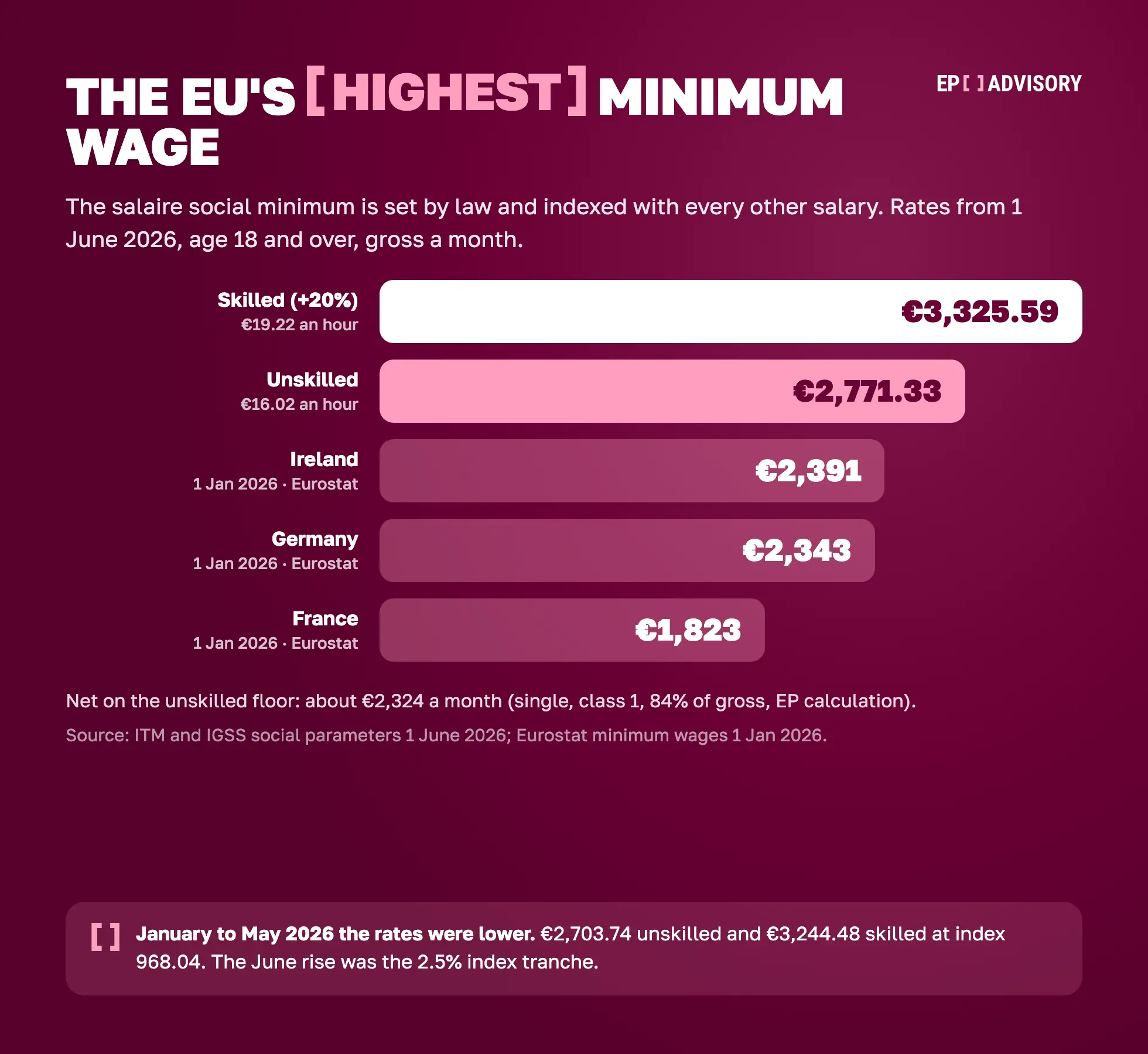
Yes, and it is the highest in the EU. The salaire social minimum, or SSM, is set by law and indexed like every other salary. From 1 June 2026, at index 992.24 (ITM and IGSS social parameters):
| Floor | Per month, gross | Per hour | In force |
| Unskilled, 18 and over | €2,771.33 | €16.0192 | From 1 June 2026 |
| Skilled (qualifié, +20%) | €3,325.59 | €19.2231 | From 1 June 2026 |
| Unskilled / skilled, January to May 2026 | €2,703.74 / €3,244.48 | €15.6285 / €18.7542 | Index 968.04 |
The June change was the 2.5% index tranche and nothing else. On 1 January 2026, Eurostat ranked Luxembourg’s €2,704 first in the EU, ahead of Ireland at €2,391, Germany at €2,343 and France at €1,823.
Who counts as skilled. An official certificate at least equal to the CATP or DAP for the job, a lesser certificate plus two to five years’ practice, or ten years’ experience with no certificate. The 20% uplift is worth €554 a month gross, so get your qualification recognised.
What the minimum leaves, and where it bites. Net on the unskilled SSM for a single person in tax class 1 is about €2,324 a month (84% of gross), and about €2,709 on the skilled floor. In hospitality the full-time average was €40,461 a year in 2022, or €3,372 a month divided by 12, barely above today’s skilled minimum. In hospitality, cleaning and elementary roles the SSM is roughly what the job pays.
Luxembourg City vs the Rest: The Rent Gap
STATEC publishes no regional pay split, so treat pay as national. The geography that matters in Luxembourg is rent. Average announced apartment rents, Observatoire de l’Habitat, April 2025 to March 2026:
| Area | Average announced rent, per month |
| Luxembourg City, all quartiers | €1,960 (€48.30 per m²) |
| Limpertsberg / Kirchberg / Ville-Haute / Gare | €2,443 / €2,417 / €2,290 / €2,237 |
| Hollerich / Bonnevoie / Dommeldange | €1,735 / €1,391 / €1,324 |
| Suburbs: Hesperange / Strassen / Bertrange / Mamer | €1,986 / €1,973 / €1,862 / €1,298 |
| Dudelange / Ettelbruck / Differdange / Esch-sur-Alzette | €1,674 / €1,541 / €1,377 / €1,102 |
| National average | €1,796 (€42.53 per m²) |
Two qualifications. First, cheap communes look cheap partly because the flats listed there are smaller. Esch-sur-Alzette’s €44.28 per square metre is close to the capital’s €48.30. Second, these are new listings, not existing leases. STATEC’s rent index for existing leases rose 1.4% in the fourth quarter of 2025 against 3.0% for announced rents, so a tenant in place for years pays less.
Where to Look for Work: Official Resources
Luxembourg hiring runs through the public employment service, two strong domestic boards and the international platforms. Start here.
- ADEM JobBoard: the public employment service’s board, login required. Employers declared 2,768 vacancies in August 2026, up 5.0% on the year, and 6,715 were still open at month end. The fastest growth was in social work, paramedical care, food trades, home help, construction and IT systems (ADEM, August 2026)
- jobs.lu: the main domestic board across sectors and seniority levels
- Moovijob: the other domestic board, which also runs recruitment fairs
- EURES: the EU mobility network, useful for cross-border roles and employers used to hiring non-locals
Two practical notes. Language first. French is the most used language at work in most sectors (67% in the capital on the 2021 census), English dominates banking, finance and insurance, Luxembourgish dominates public administration and education, German is strong in health and industry. Sponsorship second. For a standard salaried-worker permit the employer must first declare the vacancy to ADEM, which takes 5 to 12 working days when no priority candidate fits and longer when one does; only a Blue Card skips that test. Ask whether the employer has obtained an ADEM certificate for a non-EU hire before.
The Arithmetic: What Actually Lands in Your Account
Three things come off a Luxembourg gross salary: social contributions, income tax, and a solidarity surcharge on the tax. There is no church tax and no municipal tax on wages. For a single person in tax class 1 at 2026 rates, the shape is this:
- Pension: 8.50% of gross, up from 8.00% on 1 January 2026 under the pension reform (overall rate 24% to 25.5%, set until 2032)
- Health: 3.05% of gross
- Dependency insurance: 1.40% of gross after an abatement of 25% of the minimum wage (€692.83 a month), no ceiling
- Total employee contributions: about 12.95%, with health and pension capped at five times the minimum wage, €13,856.63 a month (IGSS, 1 June 2026)
- Income tax: nothing on the first €13,230, then brackets rising from 8% to 39% by €54,090 and on to 42% above €234,870. The 2025 scale applies in 2026: no bracket change has been published (ACD)
- Solidarity surcharge: 7% of the income tax (9% above €150,000 taxable income)
- Credits: the employee tax credit (€600 a year) and the CO2 credit (€216 in 2026) both taper to nil at €80,000 gross, so they are worth almost nothing on the average
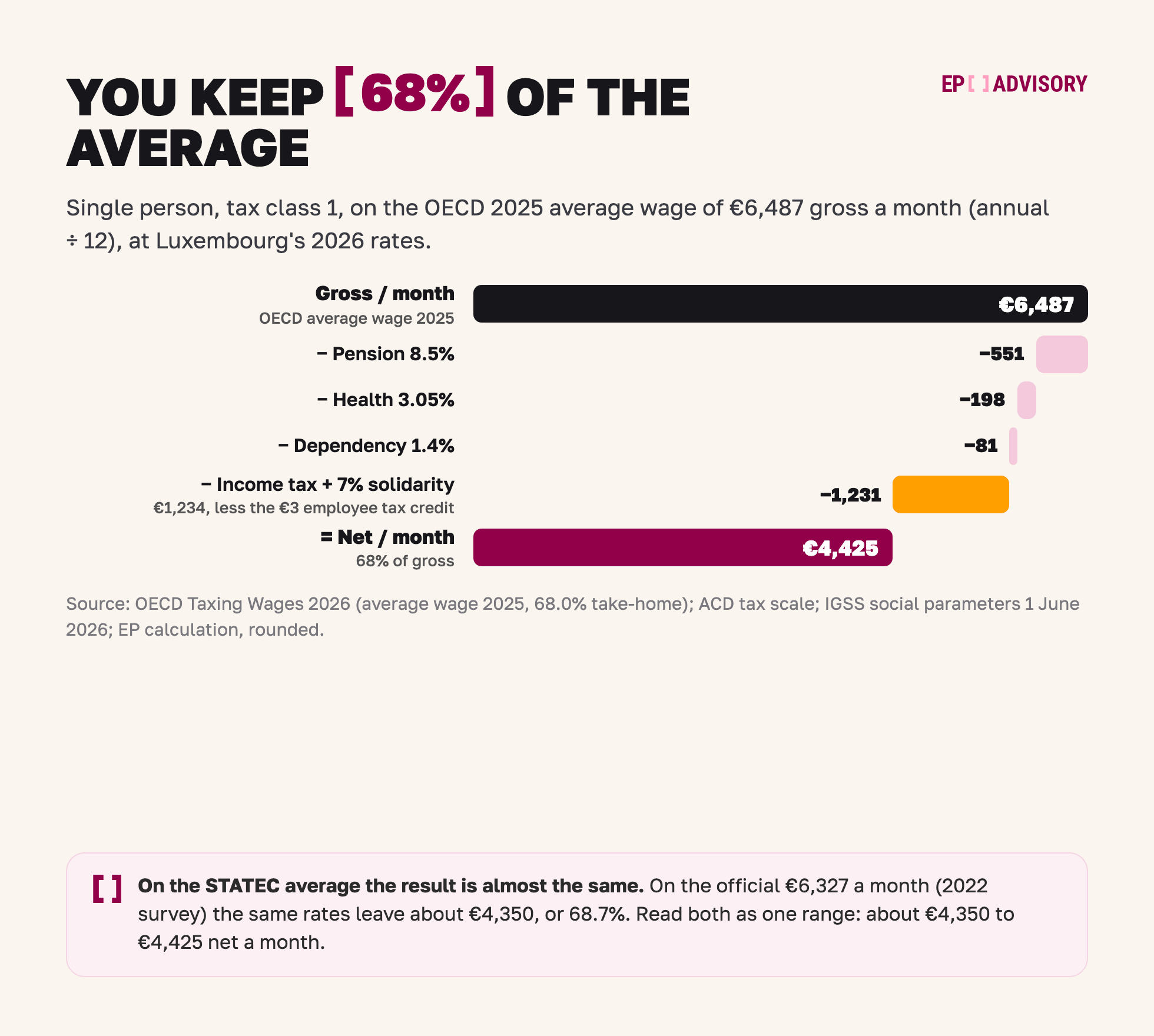
Put together, take-home on an average of €6,300 to €6,500 gross a month (the STATEC and OECD readings, both ÷12) comes to about €4,350 to €4,425 a month, around 68% of gross, for a single person with no dependants; the OECD gives 68.0% for 2025. Contributions take roughly 12.8% and tax with the surcharge 19%. On the median of €4,844 the net is about €3,609, or 74.5%, because the scale is progressive.
Read that as a range, not as a payslip. Tax class, dependants, deductible expenses and any 13th month all move it. Anyone publishing a single precise net figure for “the average Luxembourg salary” is guessing on your behalf.
The foreigner regime. Since 1 January 2025, half of an impatriate’s gross remuneration is exempt from income tax, capped at €400,000 of pay, for up to eight years after arrival. The conditions: fixed annual pay of at least €75,000, no residence in Luxembourg or within 150 km of the border in the previous five tax years, and an employer who files the list by 31 January (Guichet.lu). Raise it at offer stage: the employer has to set it up.
Salary and the Visa: The €65,652 Blue Card Bar and the ADEM Test
This decides whether a move is possible at all. Non-EU citizens have two routes: one is salary-gated and skips the labour-market test, the other has to pass through ADEM.
Route one: the EU Blue Card. The minimum gross annual salary is €65,652 for applications filed from 3 March 2026 (Guichet.lu). It was €63,408 in 2025 and €58,968 in 2024, so it is reset every year. The other conditions: a contract of at least six months, a higher professional qualification, and no labour-market test; the ministry answers within three months. Since June 2024 Luxembourg applies no reduced threshold for shortage occupations, and the bar is 1.0 times a regulatory “average”, not 1.5 times. We last checked this threshold in September 2026; verify it again before you rely on it.
Route two: the salaried-worker permit. The employer declares the vacancy to ADEM. For a job on the shortage list, ADEM issues its certificate within 5 working days. For other jobs, ADEM looks for priority candidates from Luxembourg and the EU for 7 working days, then issues the certificate within 5 more if none is suitable. If it does send candidates, the process adds 15 working days, one month for the employer’s feedback and 10 working days for a decision. The certificate is valid for 3 months and cannot be extended. With it, you apply for a temporary authorisation to stay before entering Luxembourg; the answer takes in principle up to four months. The first permit runs a maximum of one year, tied to one profession in one sector, with any employer; renewals run up to three years with access to all sectors. Ukrainian citizens under temporary protection need none of this. The EU extended that protection to 4 March 2028 (Council decision (EU) 2026/1912), but Guichet.lu still dates Luxembourg’s documents to 4 March 2027.
Now put the numbers side by side. The average full-time salary is €75,919. The Blue Card bar is €65,652. The median is €58,126. So the average job clears the bar and the median job does not. An average offer in finance, ICT, health or professional services qualifies; a median offer in commerce, construction or hospitality goes through ADEM instead. And €65,652 is not a multiple of the STATEC figure: it is a separate regulatory number, set below both the STATEC and OECD averages.
Related reading: Work visa & Blue Card salary thresholds in Europe 2026 · Salaries in Belgium · Salaries in Germany
See what a recruiter sees, then fix it before you apply. An instant score, then the fix for every problem.
Free, no card.
Key Takeaways
- The average salary is €75,919 a year gross (STATEC survey, 2022), which is €6,327 ÷12; the median is €4,844 ÷12.
- Every salary is indexed by law: +2.5% each time the six-month CPI average crosses a 2.5% threshold. The last tranche fell on 1 June 2026.
- Almost half the workforce commutes from France, Belgium or Germany, and frontaliers earn 71% of what a Luxembourg-national resident earns. Benchmark against foreign residents (€78,747).
- Rent decides the rest. The average Luxembourg City flat (€1,960 a month) is 44 to 45% of the net on the average salary and 54% on the median.
- Sector matters most: finance averaged €113,018 in 2022 against €40,461 in hospitality, 2.8 times.
- The minimum wage is €2,771.33 a month gross unskilled and €3,325.59 skilled from 1 June 2026, the highest in the EU.
- Take-home on the average is about €4,350 to €4,425 a month for a single person, 68% of gross; the pension contribution rose to 8.5% in 2026. The impatriate regime exempts half of gross pay for up to eight years if fixed pay is at least €75,000.
- The Blue Card bar is €65,652 from 3 March 2026: below the average, above the median, no shortage discount. Roles below it go through the ADEM labour-market test, counted in working days.
Frequently Asked Questions
What is the average salary in Luxembourg per month?
The average salary in Luxembourg is €75,919 a year gross on STATEC’s latest structure of earnings survey (reference year 2022), which is €6,327 a month divided by 12, full-time, bonuses included. The median is €58,126 a year, or €4,844 a month. The OECD puts the 2025 average at €6,487 a month and Eurostat’s 2024 average at €6,917, the highest in the EU.
What is a good salary in Luxembourg?
Above the median of €58,126 a year you are in the top half of full-time employees; above the average of €75,919, roughly in the top 40%. Sector medians: €93,843 in finance, €72,157 in ICT, €40,519 in commerce. In the capital, the average flat at €1,960 a month takes 44 to 45% of the net on the average salary.
What is the minimum wage in Luxembourg in 2026?
€2,771.33 a month gross (€16.02 an hour) for an unskilled worker aged 18 or over, and €3,325.59 (€19.22 an hour) for a skilled worker, since 1 June 2026. The June rise was the 2.5% index tranche. It is the highest in the EU: on 1 January 2026 Eurostat put Luxembourg at €2,704 against Ireland at €2,391.
How much is the average salary in Luxembourg after tax?
About €4,350 to €4,425 a month for a single person in tax class 1 on an average of €6,300 to €6,500 gross, around 68% of gross. Employee social contributions come to about 12.95% (pension 8.5% since January 2026, health 3.05%, dependency 1.4%), and income tax with the 7% solidarity surcharge takes roughly another 19%. The OECD confirms 68.0% take-home for 2025. Treat it as a range.
What salary do you need for an EU Blue Card in Luxembourg?
At least €65,652 gross a year for applications filed from 3 March 2026 (reset every year; it was €63,408 in 2025), with a contract of at least six months and a higher qualification. There is no labour-market test and no reduced threshold for shortage occupations. The bar sits below the €75,919 average and above the €58,126 median, so an average offer clears it and a median offer does not. Last checked September 2026.
Getting ready to apply for jobs in Luxembourg? Check your CV for free: see it the way a recruiter does, then fix each problem.