 By Andre Atallah, CEO of EP Advisory
The short answer: the average wage for Saudi workers is about SAR 11,214 a month in 2026, roughly US$3,000. Salaries are not taxed, so your gross pay is close to your take-home, and experienced expat professionals usually earn well above the average.
| Average monthly wage, Saudi workers (GASTAT, Q1 2026) | ~SAR 11,214 / month (~US$3,000) |
| Personal income tax on salary | 0% |
| Typical skilled expat professional | ~SAR 15,000 to 40,000 / month |
| VAT on most spending | 15% |
| Premium Residency (permanent, one-off) | SAR 800,000 |
Saudi Arabia pays in a way few countries do. Salaries are quoted per month, there is no personal income tax, and professional packages often add housing, transport and flights on top. For skilled workers, the draw is simple: you keep almost all of what you earn.
In nearly 10 years, we have helped more than 5,000 professionals find jobs abroad. Want to know if your CV will pass screening in Saudi Arabia? Check your CV for free: a score in 30 seconds, then a fix for each problem.
What Is the Average Salary in Saudi Arabia in 2026?
The average monthly wage for Saudi workers is about SAR 11,214, according to the latest figures from the official statistics authority, GASTAT (Q1 2026). At the fixed exchange rate of about 3.75 riyals to the US dollar, that is roughly US$3,000 a month. None of it is taxed as income.
That figure is a starting point, not the whole story. Experienced expat professionals usually earn well above it, and their pay is only part of a wider package. All figures on this page are in Saudi riyals, and the riyal has been pegged to the US dollar at 3.75 since 1986.
Why the Headline Average Understates Professional Pay
You will also see a much lower “expat average” quoted, around SAR 4,200 a month. Ignore it for planning. That number is dragged down by millions of lower-paid workers across construction and services, so it says nothing about what a nurse, an engineer or a manager earns. Skilled professionals typically earn well above that figure.
Salaries by Job in Saudi Arabia
Your field and seniority set your pay. The figures below are typical monthly salaries for experienced expat professionals, drawn from market salary surveys. Treat them as ranges, not fixed rates, and remember that housing and other allowances often sit on top.
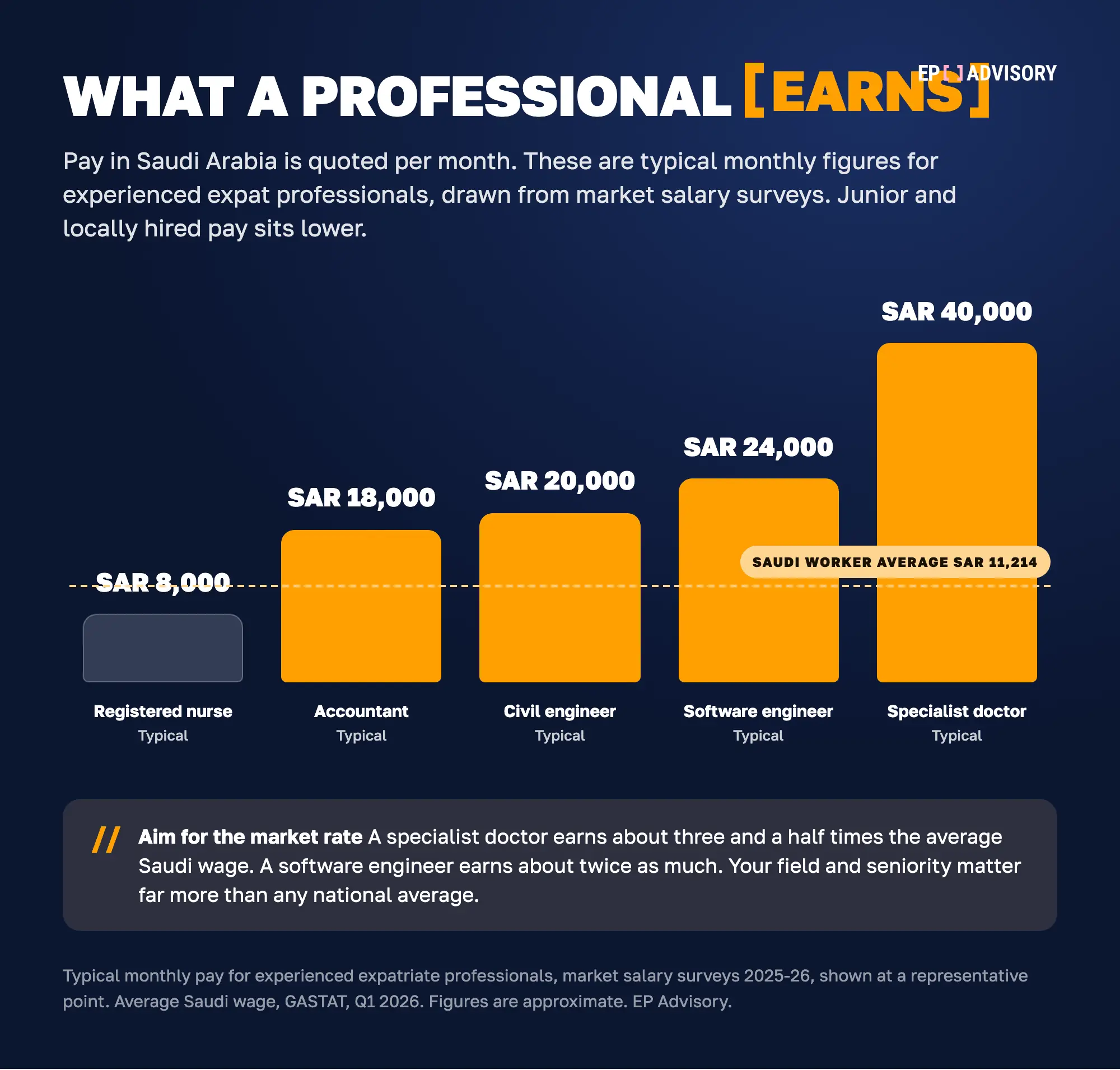
| Role | Typical monthly pay (expat) |
| Registered nurse | SAR 5,000 to 11,000 |
| Accountant / finance | SAR 10,000 to 40,000 |
| Civil or mechanical engineer | SAR 12,000 to 30,000 |
| Software engineer | SAR 14,000 to 32,000 |
| Project manager | SAR 15,000 to 40,000 |
| Doctor (GP to specialist) | SAR 15,000 to 50,000 |
| Consultant physician | SAR 40,000 to 70,000 |
Big employers pay more again. Roles at Saudi Aramco and on the Vision 2030 giga-projects can run well above these ranges, especially for senior engineers and technical specialists.
Comparing the Gulf with the West? See the average salary in Canada and the average salary in the UK. Those pay in yearly, taxed terms, so a tax-free Saudi package can go further than the headline suggests. For North America, our US work-visa guide covers the routes in.
No Income Tax: What You Actually Keep
Saudi Arabia charges no personal income tax on salaries, at any level. On SAR 20,000 a month, all SAR 20,000 reaches you. In many Western countries a quarter to a third of that would be gone before it landed. This is the single biggest reason a Saudi package can beat a higher gross salary elsewhere.
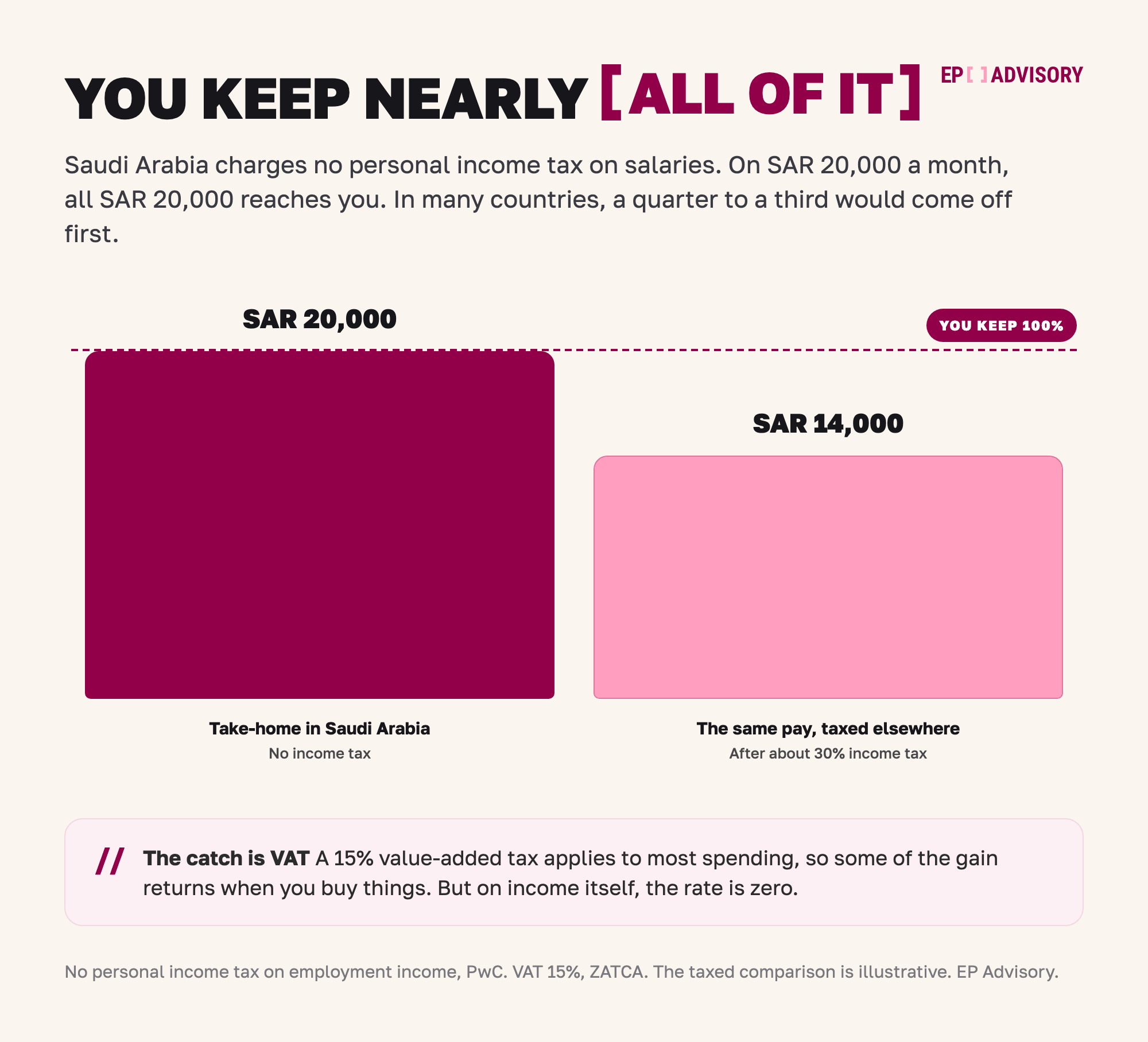
There is one tax to plan for. A 15% value-added tax, VAT, applies to most goods and services, so some of the gain returns when you spend. But on the income itself, the rate is zero, and there is no separate social-security deduction for foreign workers.
The Package Is More Than the Salary
A Gulf offer is built from parts, so read the whole thing. On a typical SAR 20,000 a month deal, the basic salary is often only about half. The rest is allowances, and those matter for your end-of-service payment.
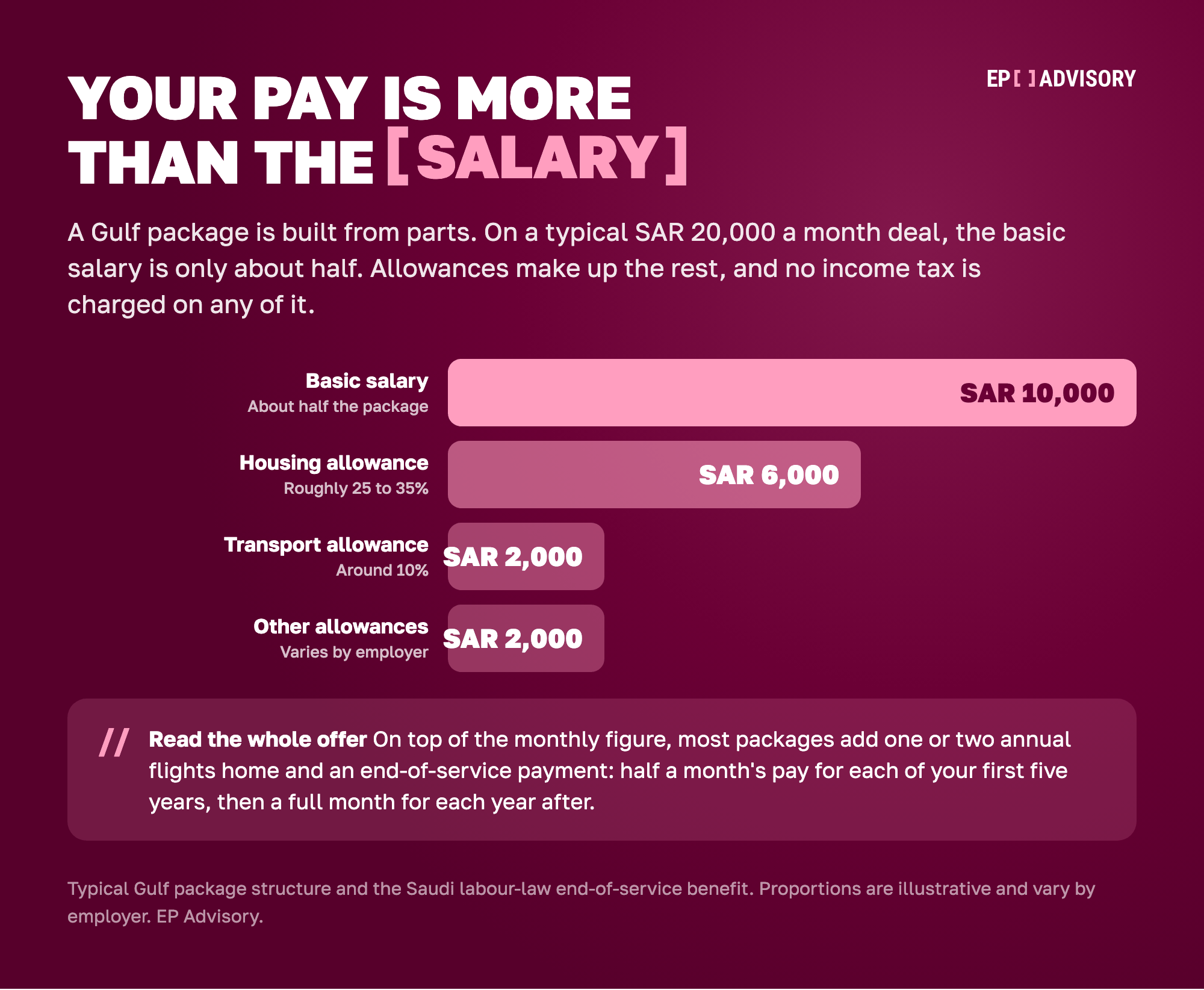
Housing is usually the biggest allowance, often a quarter to a third of the total package, either as cash or a company flat or compound. Transport is typically another 10% or so. On top, most packages add one or two annual flights home, and an end-of-service benefit. That gratuity is half a month’s pay for each of your first five years, then a full month for each year after, based on your final salary.
Work Visas, the Iqama and Residency
To work in Saudi Arabia, an employer sponsors your work visa and issues your Iqama, the residence permit that every foreign worker holds. It is tied to your employer and renewed, usually every year. Since the Labour Reform Initiative took effect on 14 March 2021, many workers can change jobs and travel without employer sign-off under set conditions, but the Iqama and the sponsored work permit still stand. Do not assume you can arrive and job-hunt on a visit visa.
There is also Premium Residency, Saudi Arabia’s version of a green card, which lets you live and work without a local sponsor. The two main options are a one-off fee of SAR 800,000 for permanent residency, or SAR 100,000 a year, renewable. Since 2024, extra routes exist for investors, property owners and entrepreneurs who meet set thresholds. Check the official portal for current fees before you rely on any figure.
Saudization and Where the Jobs Are
Saudi Arabia runs a localisation policy called Nitaqat. It requires private companies to employ a minimum share of Saudi nationals, and firms are graded into bands by their ratio. In practice, specialised, technical and senior roles stay open to expats because the local market cannot fill them yet. The demand is strongest in construction and engineering, technology, healthcare and energy, driven by Vision 2030 and giant projects such as NEOM, the Red Sea development and Qiddiya.
Cost of Living in Riyadh and Jeddah
Housing is the biggest variable. In Riyadh, a one-bedroom flat in the city centre runs about SAR 4,400 a month, with a usual range of SAR 3,000 to 7,300. Outside the centre it is about SAR 3,100 (Numbeo, September 2026). A single person spends roughly SAR 3,360 a month before rent. A three-bedroom villa in a Western compound, common for families, can run SAR 8,000 to 20,000 a month, which is why housing allowance matters so much. Jeddah is generally a little cheaper than Riyadh. Because many packages cover housing, your real cost of living depends heavily on what the employer provides.
Key Takeaways
- The average Saudi wage is about SAR 11,214 a month, but experienced expat professionals usually earn well above it.
- There is no personal income tax on salaries, so your gross pay is close to your take-home pay.
- The package matters as much as the salary: housing, transport, flights and an end-of-service gratuity.
- An employer sponsors your work visa and Iqama. Premium Residency removes the sponsor for a fee.
- Demand is strongest in engineering, technology, healthcare and energy, led by the Vision 2030 projects.
Score your CV in 30 seconds, then fix its biggest problems one by one. Both free.
Free, no card.

See what a recruiter sees, then fix it before you apply. An instant score, then the fix for every problem.
Free, no card. A free account unlocks every fix.
Frequently Asked Questions
What is the average salary in Saudi Arabia in 2026?
The average monthly wage for Saudi workers is about SAR 11,214 a month, according to GASTAT (Q1 2026), roughly US$3,000 at the fixed 3.75 exchange rate. Experienced expat professionals typically earn well above this, and pay is not taxed.
Is salary in Saudi Arabia really tax-free?
Yes. Saudi Arabia charges no personal income tax on salaries, so your gross pay is close to your take-home pay. The main tax to plan for is a 15% VAT on most spending.
How much does a professional earn in Saudi Arabia?
It depends on the field. Engineers and IT professionals often earn SAR 12,000 to 32,000 a month, and doctors and senior specialists considerably more. Housing and transport allowances usually sit on top of the basic salary.
Do I need a sponsor to work in Saudi Arabia?
Usually yes. An employer sponsors your work visa and issues your Iqama, the residence permit. Recent reforms have eased job changes and travel, but the sponsored work permit still exists. Premium Residency lets you work without a local sponsor for a fee.
What is a good expat package in Saudi Arabia?
Look beyond the basic salary. A strong package adds a housing allowance of 25% to 35%, a transport allowance, one or two annual flights home, and an end-of-service gratuity that grows with your years of service.
Related reading: the average salary in Canada, the average salary in Australia, the average salary in the UK, and our US work-visa guide.