 By Andre Atallah, CEO of EP Advisory

Short answer: yes, there are many jobs in the Czech Republic for foreigners. Most non-EU workers need an employee card, for a register job paying at least CZK 22,400 a month. With a degree and CZK 73,823 a month, you can use the EU Blue Card. EU citizens need no permit. Americans, Britons and Canadians need only a residence permit.
Foreign workers are a normal part of the Czech workforce. Your plan turns on three things: which permit your job fits, whether the job is in the register, and how long the paperwork takes.
For nearly 10 years, we’ve helped more than 5,000 professionals find jobs abroad. Want to know if your CV will pass screening in the Czech Republic? Check your CV for free: a score in 30 seconds, then a fix for each problem.
Can foreigners work in the Czech Republic? The four routes
Your passport decides your route before your CV does. EU, EEA and Swiss citizens have free access to the labour market and the same rights as Czech citizens (IPC, Ministry of the Interior). Everyone else needs a permit that covers both living and working. Most people get one of two such “dual” permits: the employee card or the EU Blue Card.
A small group of countries has a shortcut. Since 1 July 2024, citizens of these countries need no work permit: Australia, Japan, Canada, South Korea, New Zealand, the UK, the USA, Singapore and Israel. Taiwan joined the list on 1 March 2025 (Ministry of Industry and Trade, MPO). They still need a residence permit, but the job does not have to come from the register.
| Route | Who it fits | Pay rule (2026) |
|---|---|---|
| Employee card | Any skill level. Job must be in the employee-card register | At least the CZK 22,400 minimum wage, 15+ hours a week |
| EU Blue Card | Degree of 3+ years or higher professional skills. Contract of 6+ months | At least CZK 73,823 a month (from 1 May 2026) |
| Free labour-market access | Citizens of the 10 listed countries | Same as locals |
| EU, EEA or Swiss citizen | Any job | Same as locals |
How long each route takes and what it costs:
| Route | Decision deadline | Fee at an embassy |
|---|---|---|
| Employee card | 60 days, 90 in complex cases | CZK 5,000 |
| EU Blue Card | 90 days | CZK 5,000 |
| Free labour-market access | Residence permit rules apply | Depends on the permit |
| EU, EEA or Swiss citizen | No permit needed | None |
Fees and deadlines are from the Ministry of the Interior’s employee card and Blue Card pages. If you apply from inside the Czech Republic, the fee is CZK 2,500 instead of CZK 5,000. At European Central Bank (ECB) reference rates of 2 November 2026 (€1 = CZK 24.351 = $1.1216), CZK 5,000 is about €205 or $230. All euro and dollar figures on this page use these rates.
One group cannot use these routes from abroad. Czech embassies do not accept visa or residence applications from citizens of Russia and Belarus, apart from a short list of exceptions (Ministry of Foreign Affairs). If that is you, check the exception list before you spend time on applications.
Ukrainians with temporary protection follow separate rules, including the new special long-term residence. Check them on the Ministry of the Interior’s IPC portal.
The employee card: the main Czech work visa
The employee card is the permit most foreign workers use, and it works for any skill level. It is one card that covers both your stay and your job. It lasts up to 2 years and can be renewed from 120 days before it expires.
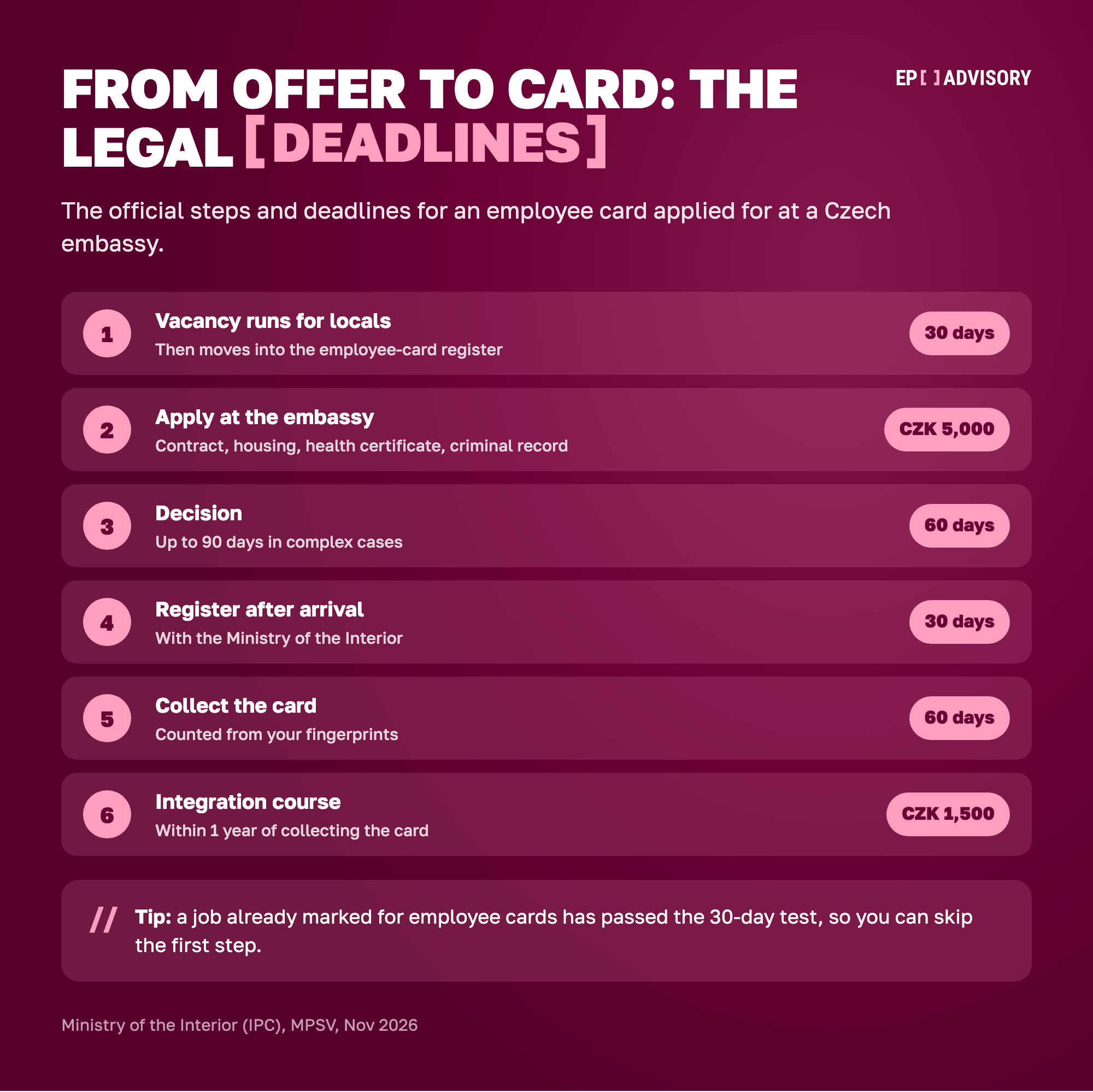
The card is tied to a vacancy in the central register of jobs open to employee-card holders. An employer cannot put a job there straight away. According to the Ministry of Labour (MPSV), the vacancy first runs for 30 days for local candidates. Only then can it move into the employee-card register. The job must pay at least the minimum wage, CZK 22,400 a month in 2026 (MPSV), and give at least 15 hours a week.
That 30-day wait sounds slow, but it works in your favour once it is over. A job already marked for employee cards has passed the labour-market test, so you can apply for it at once. That is why the register is your best search tool, and we come back to it below.
You apply at the Czech embassy in your country of citizenship, or in a country where you have lived legally for at least 2 years. Some embassies run quotas for employee-card applications, so ask the embassy first whether it is accepting them. You need these documents:
- Your contract or a future contract, and the vacancy number from the register.
- Proof of accommodation in the Czech Republic.
- A health certificate showing you are free of listed infectious diseases.
- Criminal records from your country of citizenship and from any country where you spent more than 6 months in the last 3 years.
- Proof of qualification, if the job needs one.
The legal deadline for a decision is 60 days, or 90 in complex cases. If your application is approved:
- Collect your long-stay visa to enter the country.
- Register with the Ministry of the Interior within 30 calendar days of arrival.
- Give your fingerprints.
- Collect the card within 60 days of giving your fingerprints.
The card also protects you if a job ends. You have 90 days to find a new one before the card lapses. You must tell the ministry about any change of employer. Keep a copy of your register job number and contract, because the ministry checks the new job against the same register.
Your first steps
- Check your route in the tables above: EU citizen, free-access country, Blue Card or employee card.
- Find a job marked for employee cards in the register, and note its vacancy number.
- Sign a contract or a future contract with the employer.
- Ask the embassy whether it is accepting employee-card applications.
- Gather your documents and apply at the embassy, with the CZK 5,000 fee.
- Travel on your long-stay visa and register within 30 calendar days.
Immigration rules change often, so check the current rules with the official authority before you act.
The EU Blue Card: CZK 73,823 a month from May 2026
If you have a degree and a well-paid offer, the Blue Card is often the more flexible route. You need a degree from at least 3 years of study, or higher professional skills, and a contract for at least 6 months. The pay must reach 1.5 times the Czech average gross annual wage.
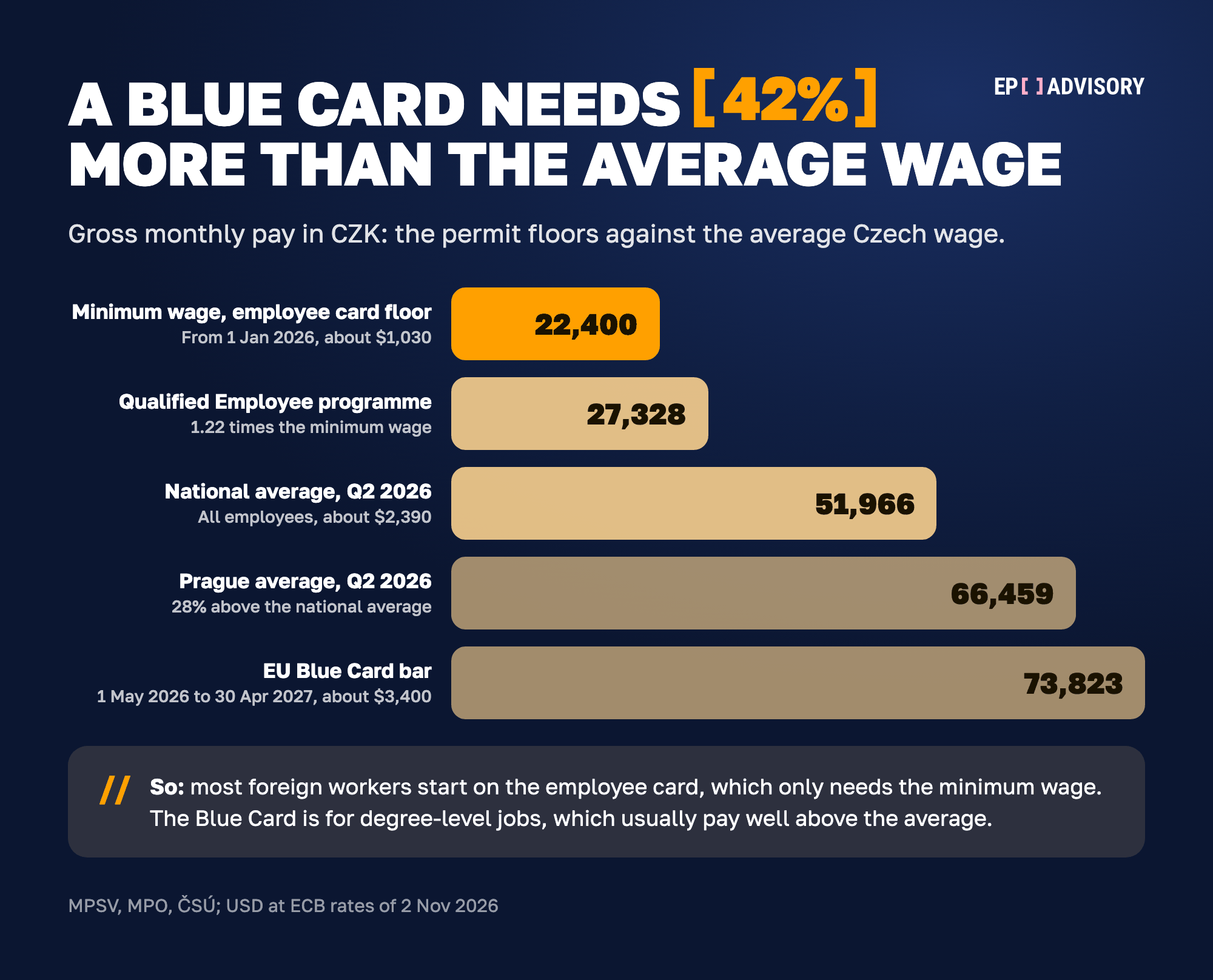
For 1 May 2026 to 30 April 2027, the ministry set the average at CZK 590,580 a year. That is the 2025 average monthly wage of CZK 49,215 times 12 (MPSV notice 44/2026). So the Blue Card bar is CZK 885,870 a year, or CZK 73,823 a month gross. At ECB rates of 2 November 2026 that is about €3,032 or $3,400 a month, or about $40,800 a year.
That bar sits 42% above the average Czech wage of CZK 51,966 in the second quarter of 2026 (ČSÚ). It is high for most jobs, but normal for senior IT, finance and engineering roles. Information and communication averaged CZK 90,948 a month, and finance CZK 90,808.
The Blue Card has three real advantages:
- No 30-day wait. A Blue Card vacancy usually enters the register at once, and only in exceptional cases after 10 to 30 days.
- Longer validity. It lasts for your contract plus 3 months, up to 3 years.
- EU mobility. If you already hold a Blue Card from another EU country, you can apply within 1 month of entering. The decision deadline is then 30 days, or 60 in complex cases.
The standard decision deadline is 90 days. If you lose the job, you must report it within 3 working days. Check our guide to Blue Card and work visa salary thresholds in Europe to compare the Czech bar with its neighbours.
Score your CV in 30 seconds, then fix its biggest problems one by one. Both free.
Free, no card. A free account unlocks every fix.

 Sample report
Fast-track programmes and the countries with free access
Government programmes do not replace the permit, but they get you a faster, guaranteed slot at the embassy. The Ministry of Industry and Trade (MPO) runs them for employers who meet set conditions (MPO). Your employer applies to join. You cannot apply on your own.
- Key and Scientific Staff: open to all countries. It is for managers, specialists and technicians hired by major investors, research bodies, technology firms and start-ups. The Ministry of the Interior decides the residence application within 30 days.
- Highly Qualified Employee: open to all countries, same job levels. The employer must have operated in the Czech Republic for 2+ years and have 3+ staff.
- Qualified Employee: for skilled and semi-skilled jobs, such as welders, drivers and machine operators. It is open only to citizens of Ukraine, Mongolia, Serbia, Thailand, the Philippines, India, Belarus, Moldova, Montenegro, Kazakhstan, Armenia, Georgia and North Macedonia. The MPO has suspended programme applications for Belarusian citizens. The pay must be at least CZK 27,328 a month, 1.22 times the minimum wage (MPO).
- Digital Nomad: for highly skilled IT workers from a set list of countries.
The Qualified Employee programme has a yearly quota per country, and the MPO releases part of it each month. In the release of 9 November 2026 it added 858 places for the Philippines (yearly quota 10,300), 264 for Mongolia and 50 for India (MPO). If you come from one of these countries, ask any employer who makes you an offer whether they are in the programme. It can save weeks of waiting for an embassy appointment.
If you hold a passport from the free-access list, your search is simpler. Any employer can hire you without the register step, so you compete for the same jobs as locals. You still apply for a residence permit, and the job still needs a proper Czech contract.
Jobs in the Czech Republic for foreigners: what the register shows
Most jobs open to foreigners are in logistics, driving, construction and factory work.
The market is large. The Labour Office (ÚP) listed 106,252 vacancies at the end of October 2026, with registered unemployment at 5.0% (ÚP). On 23 November 2026, employers had marked 72,078 of the 105,900 positions in the official register as open to foreign workers on an employee card. That is 68% of all positions (MPSV open data, our count). Many foreigners already live and work there: 1,131,197 held residence in the country at the end of 2025 (ČSÚ).
We counted the official vacancy register file dated 23 November 2026. We then grouped the ads by the first four digits of their CZ-ISCO job code, the Czech version of the international occupation classification. The groups are our own grouping of the register, not an official MPSV table. Of the 72,078 positions open to employee-card holders, these were the largest groups:
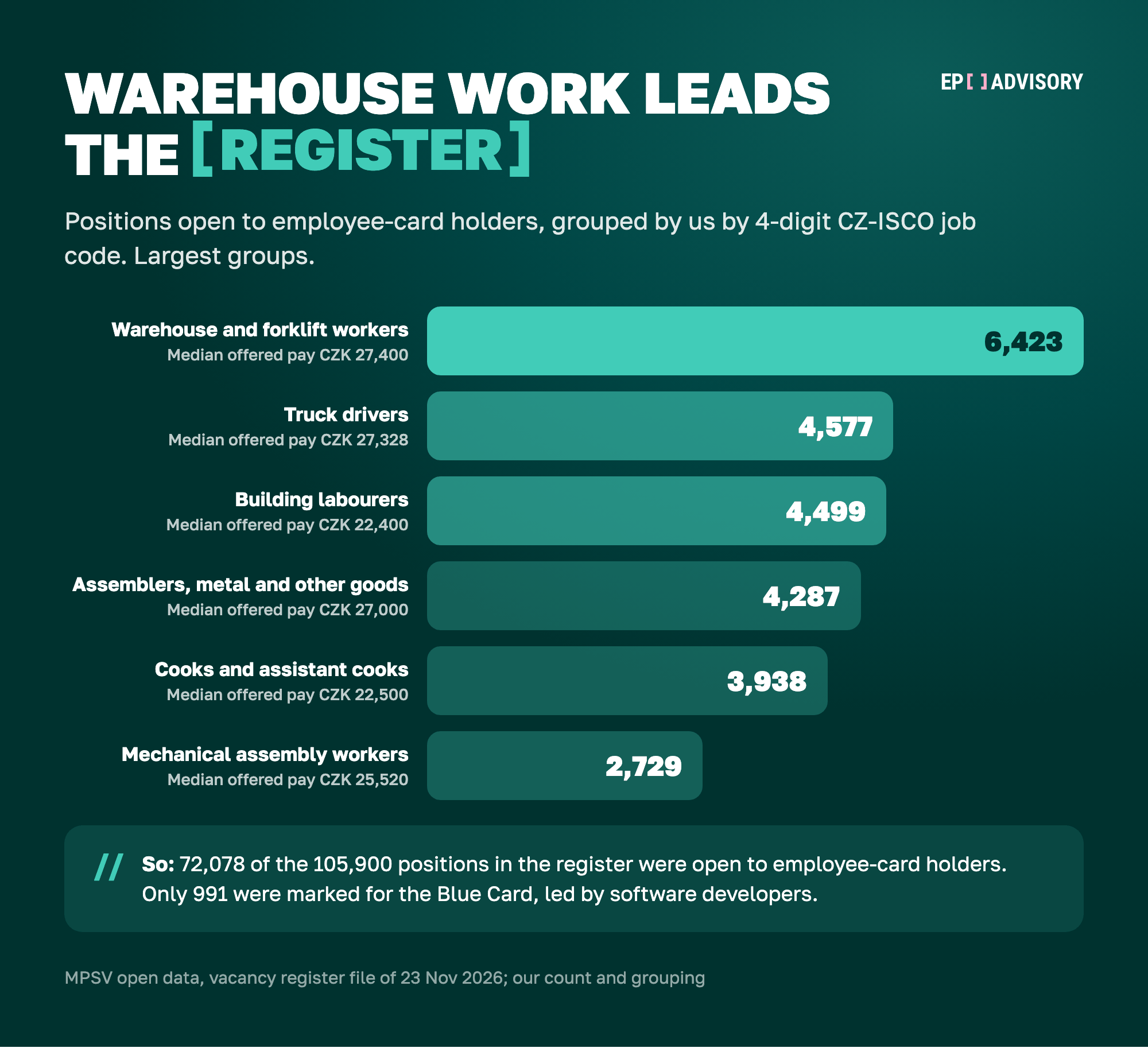
These are the factory jobs and warehouse jobs that most foreign workers start in. The offered pay in the chart is the median of the lowest monthly pay advertised in each ad, counting each ad once. Real pay can be higher with shift premiums and overtime. Welders were the best-paid of the large groups, at a median of CZK 29,120.
The skilled end is much smaller. Only 991 positions, under 1% of the register, were marked for the Blue Card. Software developers led with 228 positions and a median advertised pay of CZK 80,000. Systems analysts and ICT managers had medians of CZK 90,000.
That gap does not mean skilled jobs are rare. Many international employers advertise graduate roles on their own careers pages, on LinkedIn and through agencies, so the register shows only part of them. Use the register for employee-card jobs, and the job boards below for professional roles.
Location matters too. 12,467 of the employee-card positions, 17%, were in Prague. The rest are spread across the regions, so a job outside the capital is often the quickest way in.
English-speaking jobs in Prague and Brno
You can work in English in the Czech Republic, mostly in IT, shared service centres and international companies. These employers cluster in Prague and Brno. They hire for software, finance and accounting, customer support in other European languages, IT support and data roles.
The work permit itself does not test Czech. The job market does, though. Healthcare, social care, teaching and most customer-facing jobs expect Czech. In factory and warehouse jobs, some employers run training in a shared language, so ask about it in the interview.
Two habits help an English speaker stand out:
- Show a second European language. German, Polish or French next to English widens the roles you can apply for in support and finance teams.
- Start Czech early. Even A1 Czech on your CV tells an employer you plan to stay. Regional integration centres run courses for foreigners.
Most people on a long-term residence permit must also take a 4-hour adaptation and integration course. This includes employee card and Blue Card holders. You take it within 1 year of collecting your card. Card holders hired through the Highly Qualified Employee or Key and Scientific Staff programmes are exempt, as are people under 15 or 61 and over. It costs CZK 1,500, and missing it can bring a fine of up to CZK 10,000 (Ministry of the Interior course portal). It is taught in Czech with an interpreter for English and seven other languages. It is also a useful first-week guide to Czech life.
Where to find jobs in the Czech Republic
Use the official register for employee-card jobs and the big job boards for everything else.
| Where to search | Best for | Tip |
|---|---|---|
| ÚP vacancy register | Employee-card and Blue Card jobs | The search is in Czech. Ask an employer for the vacancy number and look it up here. |
| Jobs.cz | Professional and office roles | Has an English interface. Search in English and in Czech job titles. |
| Prace.cz | Skilled and manual jobs across the regions | Many ads are in Czech, so use a translator. |
| StartupJobs.cz | Start-ups and IT | Many roles are English-speaking. |
| LinkedIn Jobs | International companies, Blue Card roles | Set your location to Prague or Brno and contact recruiters directly. |
| EURES | EU citizens | The EU job mobility portal, with Czech vacancies. |
Agencies place many foreign workers, especially in factories and warehouses. 6,020 of the employee-card positions in the register came from agencies that place staff with other firms. A good agency is useful, but check two things first.
- The licence. Every agency needs a permit from the Ministry of Labour. Look it up in the official agency search before you send documents.
- The fee. Under section 58 of the Employment Act, an agency may charge the employer but must not charge you for finding you a job. No deductions from your pay are allowed for the agency or for the firm you are placed with.
So if anyone asks you to pay for a job, a visa “slot” or a place in a programme, walk away. A real offer comes with a vacancy number you can find in the register yourself. For the wider search method across Europe, see our guide on how to find a job in Europe.
Czech CVs, interviews and contracts
Czech employers read CVs fast, so put the job title, your key skills and your permit status at the top. A clear two-page CV in the European CV format works for most roles. For factory and trade jobs, list your certificates, machines and welding methods by name. For office roles, lead with results and numbers, as in our CV achievement examples.
In our coaching sessions, the most common gap we see in CVs for the Czech market is permit status. People leave it out, and recruiters cannot tell whether they need an employee card, a Blue Card or nothing at all. We ask clients to add one plain line, such as “Indian citizen, eligible for the EU Blue Card” or “UK citizen, free access to the Czech labour market”. It answers the recruiter’s first question before they ask it.
If your CV was written for another country, rework it for Czech employers before you apply. Getting ready to apply for jobs in the Czech Republic? Check your CV for free: see it the way a recruiter does, then fix each problem.
Interviews for international roles are usually in English, and the first round is often a video call. Prepare a short answer on why the Czech Republic and why that city. Our guide on how to pass a job interview covers the rest.
Know the contract rules before you sign. Under the Labour Code, probation can last up to 4 months, or 8 months for managers, and must be agreed in writing. The notice period is at least 2 months. Full-time work is up to 40 hours a week, and paid holiday is at least 4 weeks a year. Check that the contract matches the job in the register, because your card is tied to that vacancy.
Two more points for your first weeks. Once you start work, Czech public health insurance covers you through the job. Until then you need travel health insurance (IPC). And if your job is a regulated profession, such as doctor, teacher, lawyer or architect, you need professional recognition from the relevant authority. Academic recognition of a degree (nostrifikace) alone does not give that right (Ministry of Education).
Worked example: a welder from the Philippines
Here is how the employee card route works for one realistic profile, with official costs and legal deadlines. Maria is a certified welder from the Philippines with 6 years of experience. A metalworking firm in the Moravian-Silesian region offers her a job at CZK 29,000 a month. That is close to the median for welders in the register. The firm has run in the Czech Republic for at least 2 years and has at least 6 staff.
- Check the job. The employer gives her the vacancy number, and Maria finds it in the ÚP register marked for employee cards. It pays above the CZK 22,400 minimum wage and the CZK 27,328 Qualified Employee floor.
- Ask about the programme. The Philippines is on the Qualified Employee list. Her employer joins the programme and gets a place from the monthly Philippine capacity, which gives her a guaranteed embassy filing.
- Gather documents. Contract, proof of accommodation, health certificate and a Philippine criminal record. Her welding certificates go in as proof of qualification.
- Apply at the embassy in Manila. She pays the CZK 5,000 consular fee, about $230 at ECB rates of 2 November 2026.
- Wait for the decision. The legal deadline is 60 days, or 90 in complex cases.
- Travel and register. She collects her long-stay visa, travels with travel health insurance, and registers with the Ministry of the Interior within 30 calendar days.
- Collect the card and start. She gives her fingerprints, collects the card within 60 days, and books the CZK 1,500 integration course within her first year.
Her two fixed state fees, the CZK 5,000 consular fee and the CZK 1,500 course, come to CZK 6,500, about €267 or $300. Add the cost of documents, translations, insurance and travel. From application to a decision, the legal deadline is 60 days, or 90 in complex cases. If her employer had to list a brand-new vacancy, add the 30 days it runs for local candidates first.
What jobs in the Czech Republic pay
Pay depends far more on your sector and city than on your passport. The average gross wage was CZK 51,966 a month in the second quarter of 2026 (ČSÚ). That is about €2,134 or $2,390 at ECB rates of 2 November 2026. Prague averaged CZK 66,459, while hotels and restaurants averaged CZK 30,394.
| Pay point (gross a month) | CZK | About in USD |
|---|---|---|
| Minimum wage 2026 | 22,400 | $1,030 |
| Qualified Employee programme floor | 27,328 | $1,260 |
| Warehouse jobs in the register (median offered) | 27,400 | $1,260 |
| National average, Q2 2026 | 51,966 | $2,390 |
| Prague average, Q2 2026 | 66,459 | $3,060 |
| Blue Card bar, from 1 May 2026 | 73,823 | $3,400 |
| Information and communication average, Q2 2026 | 90,948 | $4,190 |
USD figures use ECB reference rates of 2 November 2026 and are rounded. From 1 January 2027 the minimum wage rises to CZK 24,900 a month, about $1,150 (MPSV notice 171/2026). That raises the employee-card pay floor too. The MPO sets the Qualified Employee floor at 1.22 times the minimum wage, so check its new figure in January.
When you get an offer, compare it with the average for your sector and city, not only with the permit floor. Our guide on how to negotiate your salary shows how to ask for more without risking the offer. If you are also weighing up a neighbouring market, compare this page with jobs in Poland for foreigners.
Next: see the full pay picture by sector, region and take-home in our guide to salaries in the Czech Republic.
Key takeaways
- Most non-EU workers use the employee card, which needs a register job paying at least CZK 22,400 a month and costs CZK 5,000 at an embassy.
- The EU Blue Card needs a degree and at least CZK 73,823 a month gross from 1 May 2026 to 30 April 2027.
- Citizens of the EU, and of 10 countries including the USA, UK, Canada and Australia, need no work permit.
- 68% of positions in the official register, 72,078 of 105,900, were open to employee-card holders on 23 November 2026.
- Most of those jobs are in warehouses, driving, construction, assembly and kitchens, at CZK 22,400 to about CZK 27,400 a month advertised.
- The legal decision deadline is 60 days for an employee card and 90 days for a Blue Card. A newly listed employee-card job first runs 30 days for local candidates.
- Agencies must hold an MPSV licence and must never charge you for finding a job.
See what a recruiter sees, then fix it before you apply. An instant score, then the fix for every problem.
Free, no card. A free account unlocks every fix.
Frequently asked questions
Can foreigners get a job in the Czech Republic?
Yes. On 23 November 2026, 72,078 of the 105,900 positions in the official vacancy register were open to foreign workers on an employee card. EU citizens and citizens of 10 countries, including the USA, UK and Canada, need no work permit. Most other workers need an employee card or an EU Blue Card.
How do I get a Czech work visa?
Find a job in the register marked for employee cards, sign a contract, and apply at the Czech embassy in your country. The fee is CZK 5,000 and the legal deadline is 60 days, or 90 in complex cases. You then collect a long-stay visa, travel, and register within 30 days.
What is the Czech employee card?
It is a permit that lets you live and work in the Czech Republic for one employer, for up to 2 years. The job must be in the official employee-card register, pay at least CZK 22,400 a month and give 15 or more hours a week. If the job ends, you have 90 days to find another.
What salary do I need for a Czech Blue Card?
At least CZK 73,823 a month or CZK 885,870 a year gross, from 1 May 2026 to 30 April 2027. That is 1.5 times the average annual wage set by the Ministry of Labour. You also need a degree of at least 3 years or higher professional skills.
Can I find English-speaking jobs in Prague?
Yes, mainly in IT, shared service centres, finance and international companies in Prague and Brno. Search Jobs.cz, StartupJobs.cz and LinkedIn in English. Healthcare, teaching and most customer-facing jobs expect Czech.
Are factory jobs in the Czech Republic open to foreigners?
Yes, and they are the largest group in the register. On 23 November 2026, warehouse work led with 6,423 positions open to employee-card holders, followed by truck drivers, building labourers and assembly workers. Median advertised pay in the largest groups ranged from CZK 22,400 to CZK 27,400 a month, and CZK 29,120 for welders.