 By Aleksei Gavrilov, Career Consultant at EP Advisory
The short answer: there is no single procedure for foreigners who want a job in Poland; your passport picks the route. Ukrainian citizens with UKR status need no work permit at all. Citizens of Ukraine, Belarus, Moldova and Armenia can use the fast oświadczenie declaration. Most other non-EU nationals need a type A work permit, issued for up to 3 years, plus a national D visa; the employer starts the process on praca.gov.pl and the permit usually takes 4–8 weeks. The average enterprise-sector salary was PLN 9,509.02 gross a month in July 2026.
| Route | Who it fits (2026) |
|---|---|
| No permit, employer notification within 7 days | Ukrainian citizens with UKR status (extended to 4 March 2027) |
| Oświadczenie (simplified declaration, PLN 400) | Citizens of Ukraine, Belarus, Moldova and Armenia only |
| Humanitarian D21 visa + 3-year residence permit | Belarusian citizens (Poland.Business Harbour is suspended) |
| Type A work permit (up to 3 years) + national D visa | Most other non-EU nationals, including Kazakhstan and the rest of Central Asia and the Caucasus |
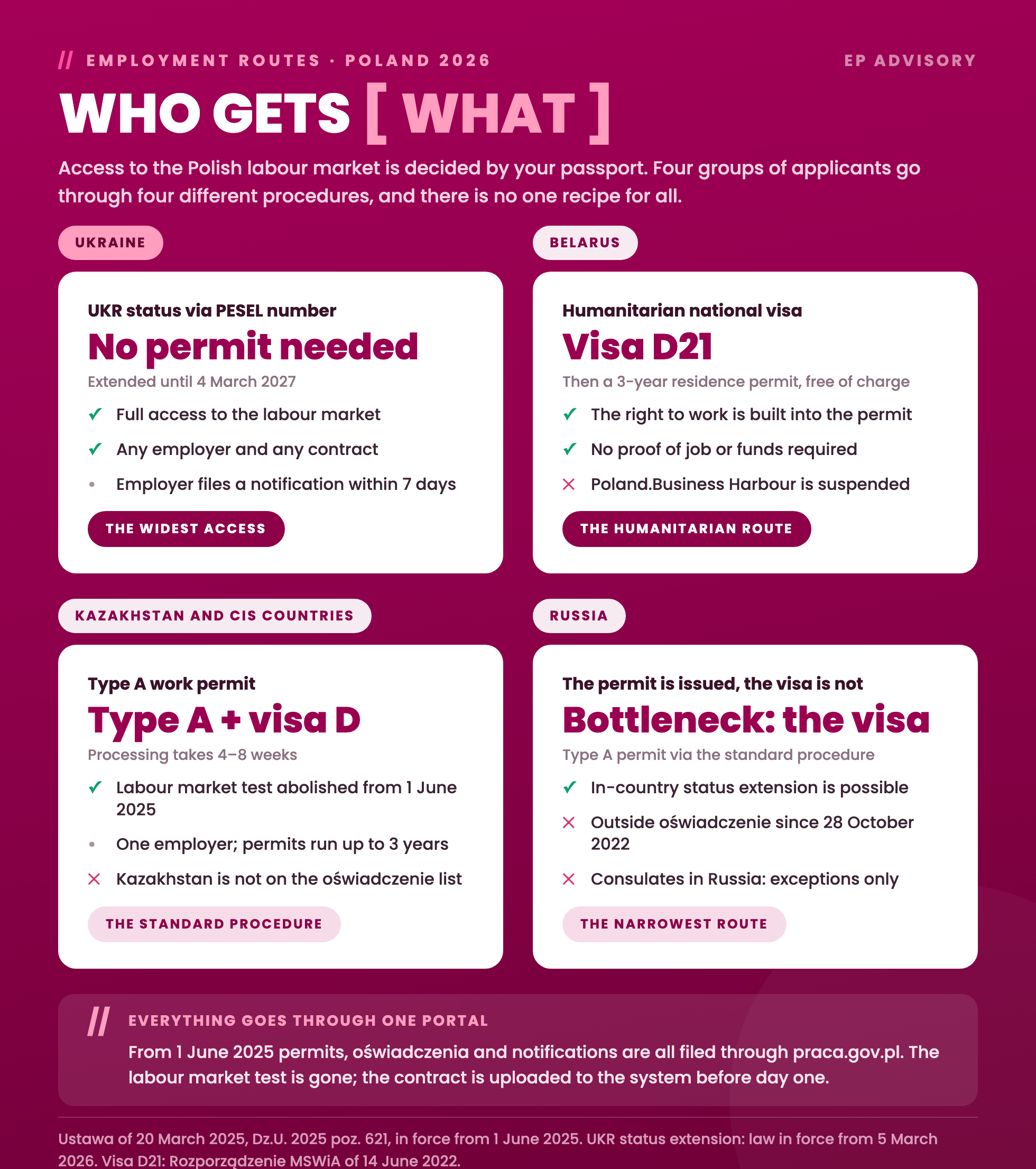
Poland hires more foreign workers than any other country in its region, yet there is no single answer to how to get a job there. The rules depend on your passport, and the differences between groups are large. A Ukrainian citizen with UKR status needs no work permit at all. A Belarusian has a dedicated humanitarian route with a three-year residence permit. A citizen of Kazakhstan, like most non-EU nationals, needs a full type A permit and a national visa. For Russian citizens the bottleneck is not the permit but the visa.
Below we walk through all four routes, with the dates each rule took effect and the legal acts behind them, and explain what the 2025 labour-migration reform changed.
In nearly 10 years, we’ve helped more than 5,000 professionals find jobs abroad. Want to know which route to Poland is realistic for you specifically? Find your career consultant.
Working in Poland in 2026: What Changed
The big shift of the last two years is the Act of 20 March 2025 (Dz.U. 2025 poz. 621), in force since 1 June 2025. It rewrote the entire procedure for employing foreigners.
- The labour market test is gone. For many permits, employers previously had to prove no Polish candidate was available for the role. That requirement was removed, and processing times shortened noticeably
- The procedure is fully digital. Applications for work permits and oświadczenie declarations go through the praca.gov.pl portal. Paper filings at voivodeship offices are no longer the main channel
- The contract is uploaded before work starts. The employer must attach the employment contract in the system before your first working day, not after. This is the labour inspectorate’s key control point
- The oświadczenie fee rose to PLN 400 on 1 December 2025
- The oświadczenie country list was cut to four states on 1 December 2025. Details below
- EES runs at full scale from 10 April 2026. The European Entry/Exit System records border crossings biometrically, so the 90 days in any 180 are now counted strictly and automatically
What this changes in practice. The process is faster and more transparent, but the controls are tighter. An employer can no longer sort the paperwork out retroactively: the system sees the contract date and the start date. For a job seeker that is good news, because grey schemes now cost the employer more than legal hiring does.
Who hires foreigners. The most vacancies with sponsorship-ready employers are in logistics and warehousing, manufacturing, construction, hospitality and catering, and elderly care. A separate large segment is the business services centres in Warsaw, Kraków and Wrocław, where the working language is often English. Qualified specialists have their own track in IT and engineering, where employers more often run the whole procedure themselves and pay for relocation.
Which Route Fits Your Passport
Route one: no permit at all. Ukrainian citizens with UKR status have full access to the labour market. The only formality sits with the employer, who files a notification within 7 days of your start date. Details in the next section.
Route two: the humanitarian track. Belarusian citizens have a dedicated route through the D21 national visa and a three-year residence permit with the right to work built in, no separate work permit required.
Route three: the oświadczenie fast track. For citizens of four countries only (Ukraine, Belarus, Moldova and Armenia), an employer can register a simplified declaration instead of applying for a full permit. It is faster and cheaper than the standard procedure.
Route four: the standard permit. Everyone else, including citizens of Kazakhstan and most of Central Asia and the Caucasus, goes through the type A work permit plus a national D visa. For Russian citizens specifically, the permit remains legally available but the visa is the practical bottleneck; we cover that case separately below.
If a route is open to you, the arithmetic comes next: our guide to salaries in Poland breaks down what jobs actually pay and what lands in your account, and the European work-visa salary thresholds show how Poland compares with the rest of the continent.
For Ukrainian Citizens: UKR Status, the 7-Day Notification and the CUKR Card
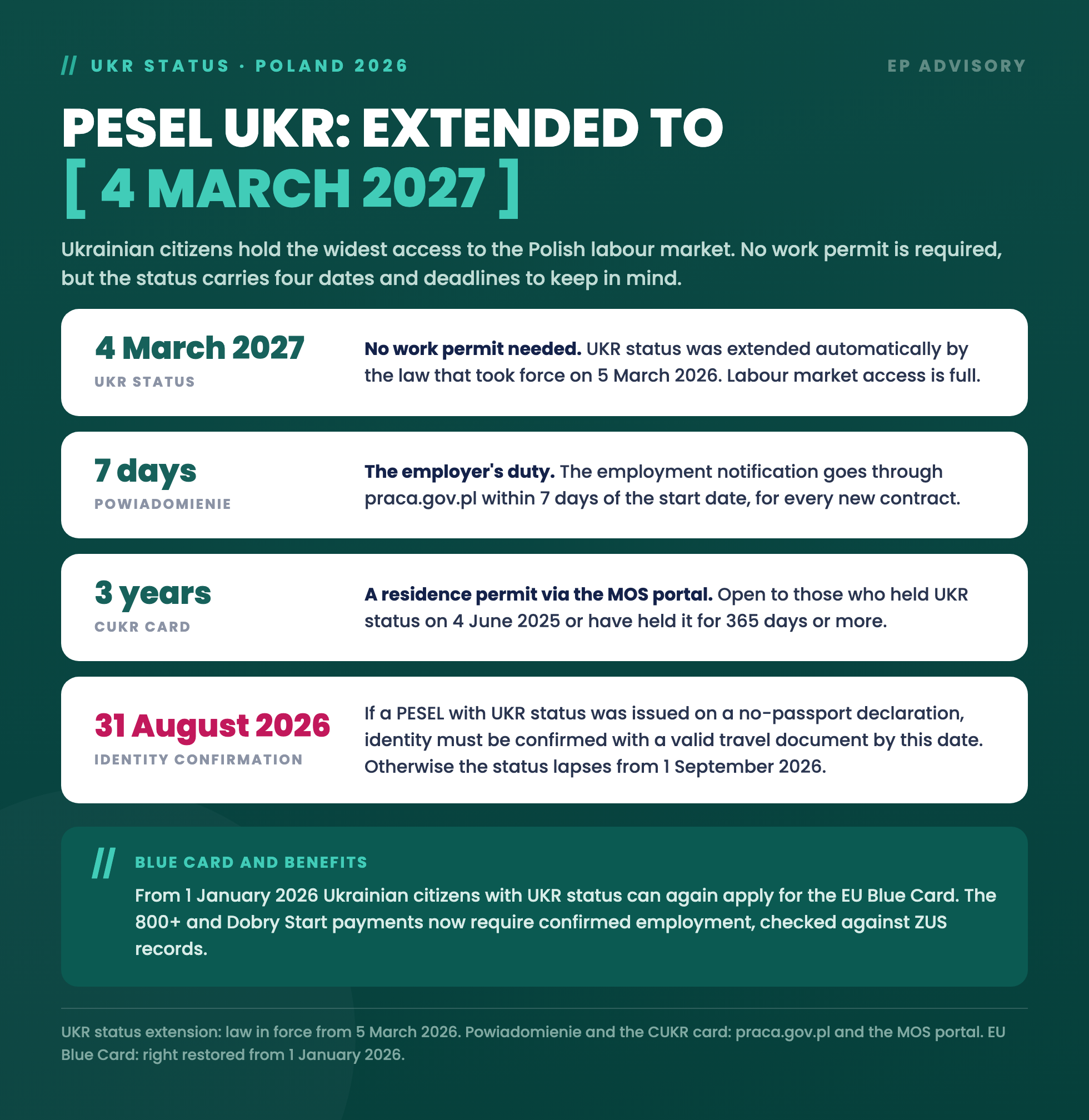
Ukrainian citizens have the widest access to the Polish labour market of any group. UKR status, tied to the PESEL number, was automatically extended to 4 March 2027 by a law that entered into force on 5 March 2026.
The right to work
Ukrainian citizens with UKR status do not need a work permit. Labour-market access is full: any employer, any industry, any type of contract. The single obligation sits with the employer.
The 7-day notification (powiadomienie). The employer files a hiring notification through praca.gov.pl within 7 days of the start date. Since 5 March 2026 this requirement covers every new contract, including cases where the worker holds a Karta Polaka. If the notification is not filed, the work counts as illegal, and the liability falls on the employer.
The CUKR card: a residence permit for 3 years
A separate simplified legalisation route. The CUKR card grants a residence permit for 3 years and is processed through the MOS portal without a visit to the voivodeship office. You can apply if you held UKR status on 4 June 2025, or if you have held it for 365 days or more.
The EU Blue Card is available again
Since 1 January 2026, Ukrainian citizens with UKR status can once again apply for the EU Blue Card. This matters for qualified professionals, because the Blue Card gives a more durable status and mobility within the European Union, unlike temporary protection.
Benefits are now tied to employment
The 800+ and Dobry Start payments for Ukrainian citizens with UKR status now require confirmed employment. The check runs automatically against ZUS records. Without official work and paid contributions, there is no entitlement to these benefits.
One date you cannot miss. If a PESEL number with UKR status was obtained on a declaration of having no passport, identity must be confirmed with a valid travel document by 31 August 2026. Without that confirmation the status is lost from 1 September 2026.
Score your CV in 30 seconds, then fix its biggest problems one by one. Both free.
Free, no card.

For Belarusian Citizens: The D21 Visa and a 3-Year Residence Permit
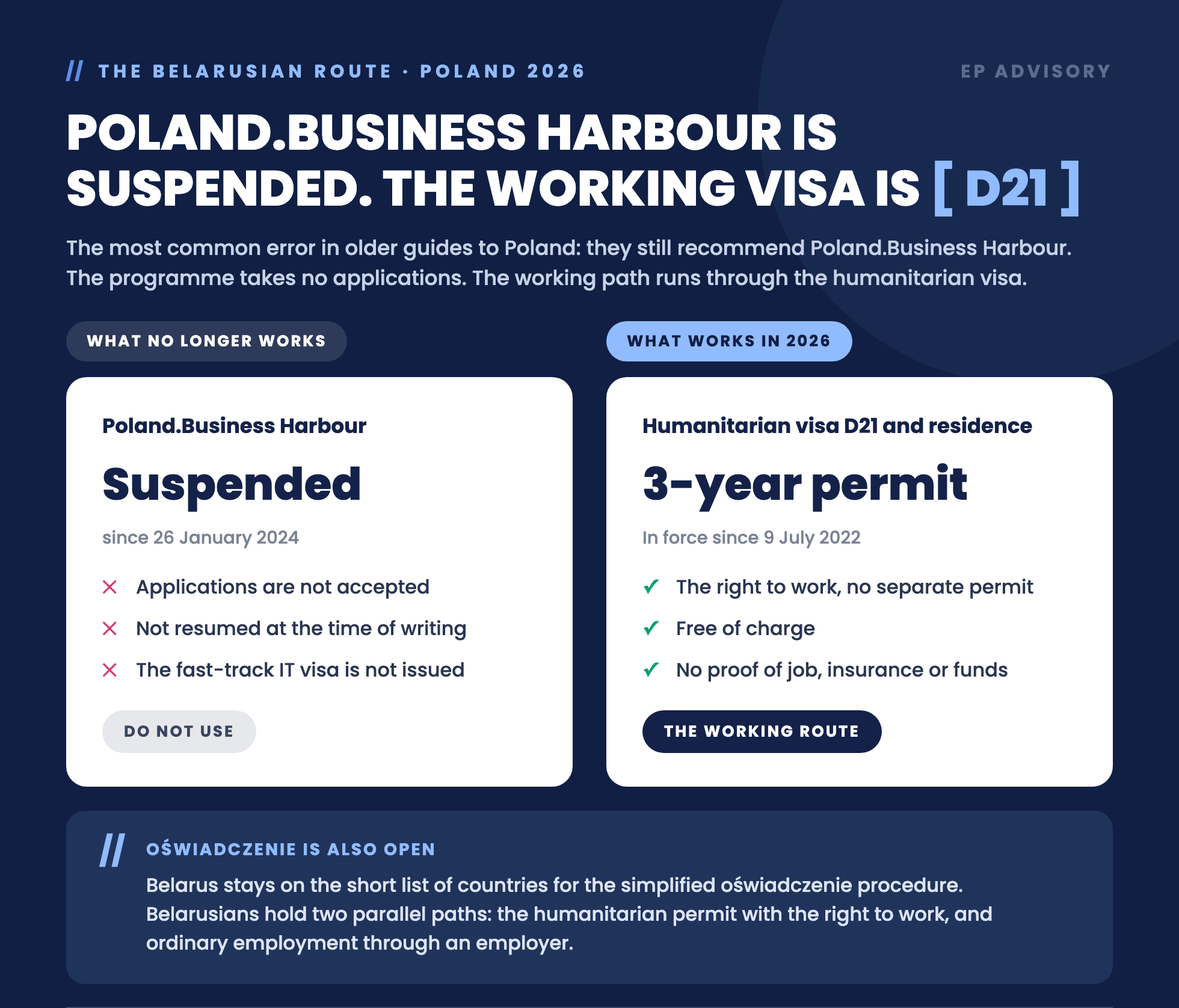
The most common error in older guides to working in Poland as a Belarusian: they still recommend the Poland.Business Harbour programme. The programme has been suspended since 26 January 2024 and has not been resumed as of publication. Applications under it are not accepted.
The main working route: the D21 visa
The route that works runs through the humanitarian national visa D21, followed by a one-off temporary residence permit. The rules have applied since 9 July 2022, on the basis of the Rozporządzenie MSWiA of 14 June 2022.
- Permit length: a one-off temporary residence permit for 3 years
- Fees: the permit is free
- Right to work: included in the permit. No separate work permit is required
- Documents: no need to prove employment, health insurance or the funds to support yourself
That is a fundamental difference from the standard third-country route, where each of those points has to be documented. In effect the route gives you legal residence and the right to work before you have an employer at all.
The oświadczenie is also open
Belarus stayed on the shortened list of countries covered by the simplified oświadczenie procedure. So Belarusians have two parallel paths: the humanitarian residence permit, and standard hiring via an employer’s declaration.
For Russian Citizens: What Is Realistically Available
Russian citizens have the narrowest route of the four groups. Poland has not banned Russians from working, but it has closed almost all the fast paths. Since 28 October 2022, Russian citizens are excluded from the simplified oświadczenie procedure and from the preferential seasonal permits. A full type A work permit can still be issued under the standard procedure (the labour market test for it was abolished on 1 June 2025), and Russians already in Poland legally can apply for permits and extensions.
The bottleneck sits in the visa, not the permit. Polish consulates in Russia have suspended routine processing of Schengen and national visas and consider applications only in exceptional cases: humanitarian grounds, the interests of the Polish state, Karta Polaka holders, family members of Polish or EU citizens, and certain categories of transport workers. Since 19 September 2022, Russian citizens are barred from entering Poland for tourism, sport, business or culture, with an exemption for holders of a work permit and confirmation of employment. From 1 April 2026, Poland does not recognise non-biometric Russian passports for entry and stay.
In practice, the realistic paths run through legal status you already hold in Poland or in a third country, not through a fresh application filed from Russia.
The practical conclusion. If you are already in Poland or another EU country legally, work on extension and change of status where you are. If you are in Russia, assess a route through a third country where you have, or can obtain, legal residence. Planning a move that starts with a consular application filed in Russia is not realistic in 2026.
The Standard Route for Most Non-EU Nationals: Type A Permit Plus a D Visa
This is the default procedure when no special status applies. It covers citizens of Kazakhstan, Uzbekistan, Kyrgyzstan, Tajikistan, Azerbaijan, Georgia and most other non-EU countries.
One persistent myth to clear first, common above all in Russian-language guides: that Kazakhstan is on the simplified oświadczenie list. Kazakhstan has never been on that list. If an employer offers to register an oświadczenie for a Kazakhstani passport, the procedure will not go through.
How the procedure runs
- The employer applies for a type A work permit at the voivodeship office through praca.gov.pl. Since 1 June 2025 no labour market test is required. Processing usually takes 4–8 weeks
- The employer uploads the employment contract into the system before your first working day
- You apply for a national D visa at a Polish consulate on the basis of the issued permit
- You arrive and start work. The type A permit is tied to one employer and issued for a period of up to 3 years (Article 15 of the Act of 20 March 2025; a 1-year cap applies only to employers that have been operating for less than a year, and to part-time roles)
- After a year the route converts into a temporary residence and work permit, a full residence card
Which documents to prepare
- A passport valid for the whole period of the permit
- Proof of qualifications: a degree or evidence of experience, if the profession is regulated
- The employment contract or its draft, stating the role, the salary and the working hours
- Proof of accommodation in Poland for the first period
- Medical insurance covering the visa period
The employer runs most of the procedure. Your job is to verify two things: that the application has actually been filed and has a case number, and that the role named in the permit matches the role in the contract. A mismatch between those two documents is the most common cause of refusal and of problems at extension time.
The key limitation. The type A permit is tied to a specific employer and a specific role. Changing jobs requires a new permit. Plan your first year in Poland as a year with one employer.
EES and the day count. From 10 April 2026 the European Entry/Exit System runs at full scale at every border crossing point. Crossings are recorded biometrically, and the 90-day limit in any 180 is counted automatically. The old tricks with “resetting” passport stamps no longer work.
The Oświadczenie in 2026: Who Is Still on the List
The oświadczenie (oświadczenie o powierzeniu wykonywania pracy) is a simplified procedure: the employer registers a declaration at the district labour office, and the foreign worker gets the right to work without a full permit. It is faster and cheaper than the standard route, but since 1 December 2025 the country list has been cut.
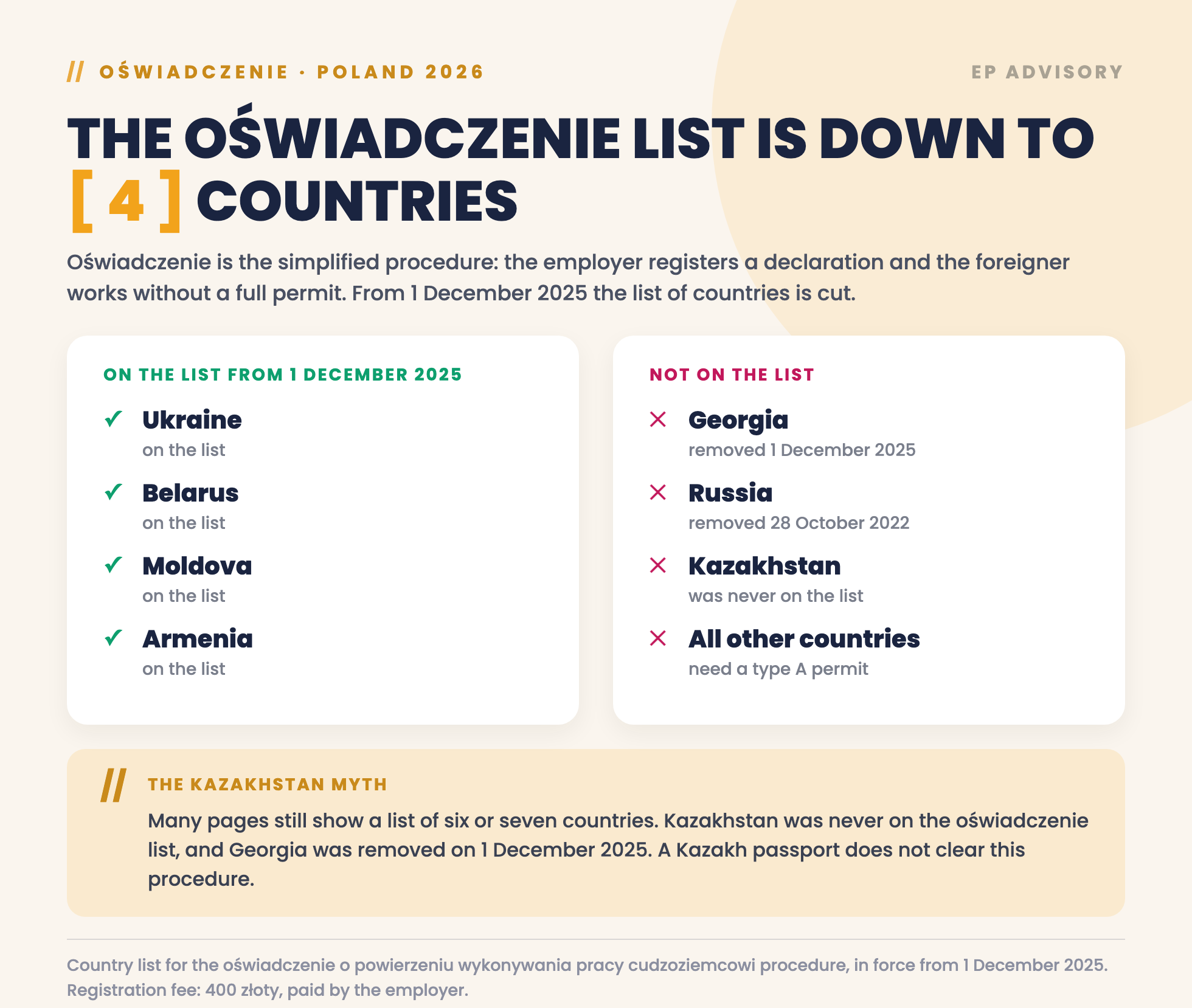
| Country | Status on the oświadczenie list (from 1 December 2025) |
| Ukraine | On the list |
| Belarus | On the list |
| Moldova | On the list |
| Armenia | On the list |
| Georgia | Removed on 1 December 2025 |
| Russia | Removed on 28 October 2022 |
| Kazakhstan | Never on the list |
The fee. Since 1 December 2025, registering an oświadczenie costs PLN 400. The employer pays it.
Check your source before you act. Many pages about working in Poland still show a list of six or seven countries with Georgia and Kazakhstan on it. Those pages describe the rules as they stood before 1 December 2025, and in Kazakhstan’s case they were never correct at all.
What Polish Jobs Pay: The Short Version
The average salary in Poland’s enterprise sector was PLN 9,509.02 gross a month in July 2026 (GUS, published 20 August 2026, up 6.8% year on year). The median is noticeably lower: PLN 7,690.82, from the salary-distribution study for February 2026. The minimum wage is fixed for the whole of 2026 at PLN 4,806 a month and PLN 31.40 an hour.
Take-home on the average salary under an umowa o pracę contract is about PLN 6,812, roughly 71.6% of gross. That is noticeably more than Belgium leaves you with, and close to Germany’s level.
One practical reading habit: Polish job ads quote gross (brutto) figures. In our August 2026 sample of 74 OLX listings with a structured salary field, every figure was gross: 57% monthly and 41% hourly, with hourly rates dominating hospitality and service. A barista ad at PLN 31.40–34.40 an hour starts exactly at the statutory hourly minimum. Net (“na rękę”) figures never appeared in the structured field, so treat any salary you see as gross unless it explicitly says otherwise.
The full breakdown, with three official average-salary series, sectors, the net calculation and the tax relief for workers under 26, is in our guide to salaries in Poland in 2026.
See what a recruiter sees, then fix it before you apply. An instant score, then the fix for every problem.
Free, no card.
Where to Look for Vacancies
- praca.gov.pl: the state portal. It is also where your employer files your permit, declaration or notification, so the name is worth knowing
- Pracuj.pl: Poland’s largest job board, the main channel for office roles
- EURES: the EU-wide network, showing employers ready to hire from abroad
- LinkedIn Jobs: international and English-language roles, especially in Warsaw’s business services centres
- No Fluff Jobs: IT vacancies with a mandatory salary range
On language. For warehouses, manufacturing and logistics, everyday Polish is usually enough, and some employers hire without it. For office roles in business services centres, English is more often the requirement and Polish counts as a plus. For client-facing work, medicine and education, you need working-level Polish, usually confirmed by a certificate.
What to ask the employer before you sign. Three questions decide the outcome. First: which document are they arranging, a type A permit, an oświadczenie or a powiadomienie. Second: has the application been filed on praca.gov.pl, and is there a case number. Third: will the contract be uploaded into the system before your first working day. An employer who cannot answer these has not run the procedure since the 2025 reform.
Related reading: Salaries in Poland in 2026 · Work visa & Blue Card salary thresholds in Europe
Key Takeaways
- Your passport picks the route. Four groups of applicants go through four different procedures, and there is no universal recipe.
- Ukrainian citizens need no permit: UKR status is extended to 4 March 2027, and the employer files a notification within 7 days.
- PESEL UKR holders without a passport must confirm identity with a travel document by 31 August 2026, or the status is lost from 1 September 2026.
- Poland.Business Harbour has been suspended since 26 January 2024 and has not been resumed as of publication. The working route for Belarusians runs through the D21 visa and a three-year residence permit with the right to work.
- For Russian citizens the bottleneck is the visa, not the permit. Realistic paths run through legal status already held in Poland or a third country.
- Citizens of Kazakhstan need a type A permit and a D visa. Kazakhstan has never been on the oświadczenie list, despite what many guides claim.
- Since 1 June 2025 the labour market test is abolished, the procedure is fully digital, and the contract is uploaded before work starts.
- From 1 December 2025 four countries remain on the oświadczenie list: Ukraine, Belarus, Moldova and Armenia. The fee is PLN 400.
Frequently Asked Questions
Do Ukrainian citizens need a work permit for Poland in 2026?
No. Ukrainian citizens with UKR status do not need a work permit, and labour-market access is full. The status was automatically extended to 4 March 2027 by a law in force since 5 March 2026. The obligation sits with the employer, who files a hiring notification through praca.gov.pl within 7 days of the start date.
Is Poland.Business Harbour still open for Belarusians in 2026?
No. The programme has been suspended since 26 January 2024 and has not been resumed as of publication. The route that works runs through the humanitarian national visa D21 and a one-off temporary residence permit for 3 years. It is issued free of charge, includes the right to work without a separate permit, and does not require proof of employment, insurance or funds.
Can Russian citizens legally work in Poland?
Yes, there is no ban on working. A type A work permit can be issued under the standard procedure, and those already in Poland legally can apply for permits and extensions. The restriction sits in the visa: Polish consulates in Russia have suspended routine visa processing and consider applications only in exceptional cases. From 1 April 2026, non-biometric Russian passports are not recognised for entry and stay.
Is Kazakhstan on the oświadczenie list?
No, and it never has been. From 1 December 2025 four countries remain on the list: Ukraine, Belarus, Moldova and Armenia. Georgia was removed on 1 December 2025, and Russia was removed on 28 October 2022. Citizens of Kazakhstan need a type A work permit and a national D visa.
How long does a Polish work permit take?
A type A permit usually takes 4–8 weeks at the voivodeship office, after which you apply for a national D visa. Since 1 June 2025 the labour market test is abolished and the procedure runs through praca.gov.pl, so timelines are shorter than they used to be. The permit is tied to one employer and issued for up to 3 years; a 1-year cap applies only if the employer has been operating for less than a year or the role is part-time.
Want to work through your own case and see which route to Poland is realistic for your passport and profession? Find your career consultant.