 By Andre Atallah, CEO of EP Advisory
The Global Talent visa arts and culture route is an exceptional opportunity for creative professionals to live and work in the UK. Whether you’re an artist, actor, or designer, this visa allows you to contribute to the UK’s cultural landscape while pursuing your career goals. This guide will walk you through the process, from eligibility to preparing evidence.
Who assesses your application?
You apply to Arts Council England for every field on this route. It passes some fields to a specialist body.
- Combined arts, dance, literature, music, theatre and visual arts: Arts Council England.
- Architecture: Royal Institute of British Architects (RIBA).
- Fashion design: British Fashion Council.
- Film, television, animation, post-production and visual effects: Pact. Pact assesses exceptional talent only, so there is no exceptional promise option in these fields.
- Design industry: Design Business Association, since 1 July 2026.
The endorsement decision takes up to 8 weeks. The visa decision then takes 3 weeks from outside the UK, or 8 weeks from inside. The rules below are for the Arts Council England fields. The other bodies set their own evidence rules.
Step 1: Start with the guidelines
The first step in your Global Talent Visa arts and culture journey is to download the official guidelines. The link goes to Arts Council England’s Global Talent pages, which hold the full guidance and the list of supported disciplines.
Why start here?
The guidelines outline everything you need to know about eligibility, documentation, and evidence requirements. They’re updated regularly, so always ensure you have the latest version.
Step 2: Eligible vs. ineligible professions
The Arts Council has clear guidelines about which professions qualify for the Global Talent Visa arts and culture route.
Eligible professions include:
- Visual artists (e.g., painters, sculptors, illustrators)
- Writers, poets, and playwrights
- Actors, dancers, and choreographers
- Film and television directors and producers (assessed by Pact, exceptional talent only)
- Musicians, composers, and conductors
- Fashion designers (assessed by the British Fashion Council)
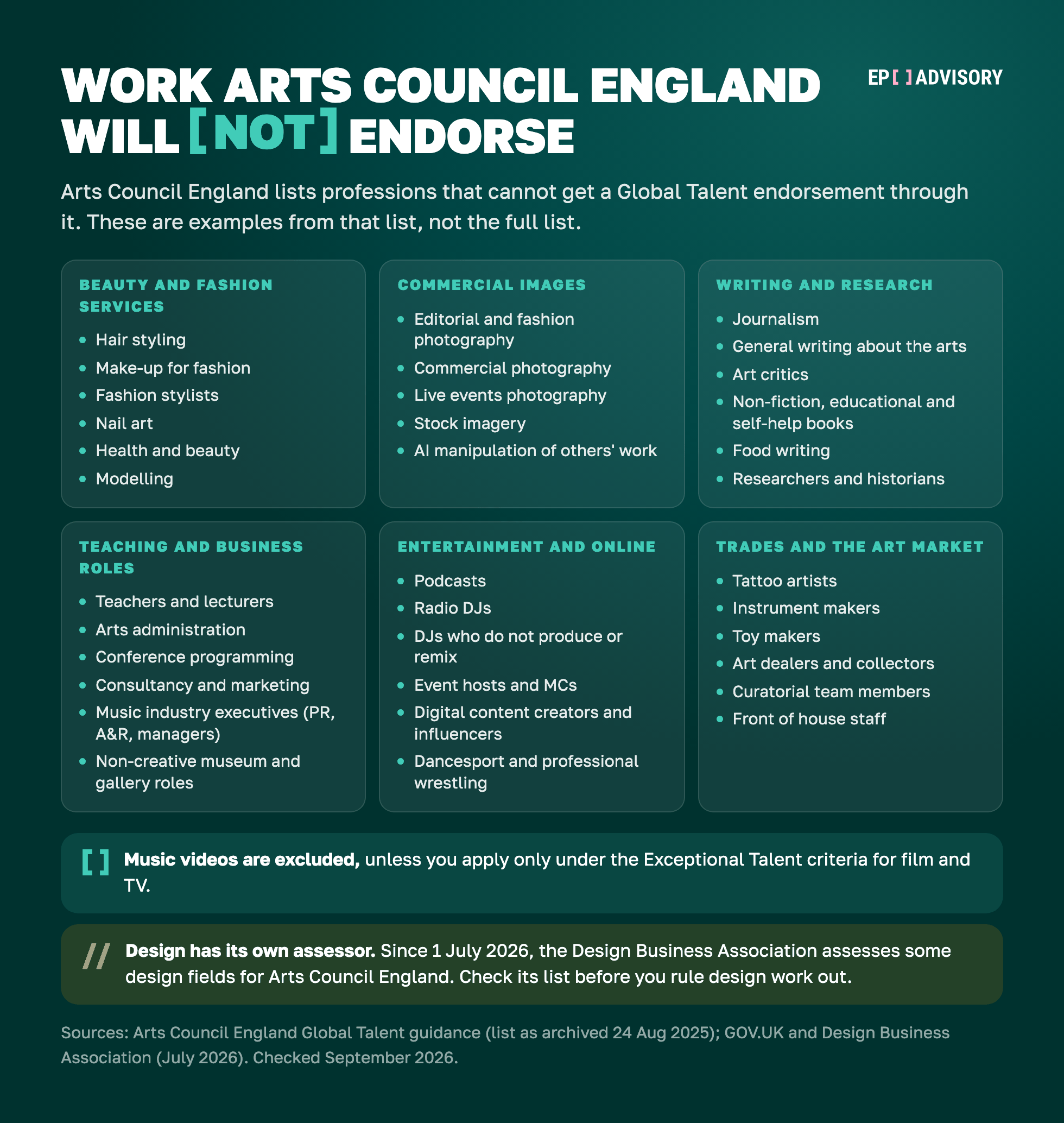
Ineligible professions include:
- Hair styling, make up stylist for fashion, nail art
- Editorial and fashion photography
- Art and creative direction for marketing campaigns, advertising or branding
- Modelling
- Journalism – written and photographic
- Commercial illustration or design through Arts Council England (commissioned work for brands doesn’t qualify unless it’s part of an artistic portfolio). Since 1 July 2026, some design-industry fields can apply through the Design Business Association instead.
- Hobbyists or amateurs without professional recognition, and many other professions
This is a short list. Arts Council England’s guidance gives more examples and says its list is not complete. Other examples include arts administration, conference programming, consultancy, marketing, podcasts, art critics, researchers, teachers and lecturers, music industry executives and tattoo artists. Music videos count only for film and television applicants under the exceptional talent criteria. Check the guidance if your field is close to one of these.
Step 3: Letters of support
Strong letters of recommendation are crucial for your Global Talent Visa arts and culture application. You’ll need three:
- One UK-based referee: From a well-established organisation in your field in the UK (must be UK-based).
- One international referee: From a recognised organisation in the UK or another country.
- A third referee: Can be an established arts and culture organisation or a person, UK-based or international, who is an expert in your field.
You must have worked with every organisation or person who writes a letter. Each letter must be signed by a senior member of the organisation and be no longer than 3 sides of A4.
What should the letters include?
- Biography/CV of your referee.
- Logos, official letterhead, and signatures.
- Specifics about your achievements and potential.
- How your work contributes to the arts and culture sector in the UK.
Score your CV in 30 seconds, then fix its biggest problems one by one. Both free.
Free, no card. A free account unlocks every fix.

Step 4: Talent vs. promise
Your eligibility depends on whether you apply under the Exceptional Talent or Exceptional Promise category.
- Exceptional Talent: For established leaders. You must have worked professionally in your field in the last 5 years, with a substantial record of work in at least 2 countries.
- Exceptional Promise: For potential leaders earlier in their career, usually with at least 3 years of professional experience. You need a developing record of work in at least 1 country.
How experience is judged:
The rules look at your professional artistic work, not at your degrees. Evidence must come from the last 5 years. Student and amateur work, and work made as part of a degree course, does not count.
Pro tip: In your CV, focus on your artistic career and exclude unrelated roles. Highlight collaborations, exhibitions, and projects that showcase your leadership or innovation.
Not sure you qualify? See the route that fits most people
Global Talent needs an endorsement for exceptional talent or exceptional promise. Most professionals move to the UK on the Skilled Worker visa, so see how it works, who qualifies and the salary thresholds.
Step 5: Evidence pieces
Your evidence pieces should align with the requirements for your category (arts and culture) and level (Talent or Promise).
Key criteria for Talent and Promise applicants:
You need to satisfy two out of three criteria:
- Media recognition: At least 2 reviews of your work by arts critics in well-established media outlets. Leaders need reviews from at least 2 countries.
- Awards and nominations: For Promise, a win, nomination or shortlisting for a credible national or international award counts. For Talent, you need to have won an internationally significant award. Awards must be from the last 5 years. Grants, bursaries and student awards do not count.
- Proof of appearances, publications, exhibitions or distribution: Proof that your work was shown, sold or performed at a professional level. Leaders need this from at least 2 countries.
How to present your evidence:
- You can send up to 10 pieces of evidence. Each must be 2 sides of A4 or less and from the last 5 years.
- Use official documents like brochures, programmes, or photos of you at exhibitions or events.
- Avoid relying on social media posts, they are not considered valid evidence.
- Include multiple forms of proof for each event or achievement (e.g., photos, invoices, and screenshots).
Why the Global Talent Visa Arts and Culture Route?
The Global Talent Visa arts and culture is a fantastic opportunity for individuals to bring their talent to the UK, contribute to its creative industries, and advance their careers. It offers unparalleled flexibility, allowing you to live, work, and travel freely while pursuing your artistic ambitions.
Benefits include:
- No job offer is required.
- Freedom to switch roles or start your own business.
- A pathway to settlement (ILR) after 3 years with an Exceptional Talent endorsement, or 5 years with Exceptional Promise.
See what a recruiter sees, then fix it before you apply. An instant score, then the fix for every problem.
Free, no card. A free account unlocks every fix.
Planning your next career move? How EP Advisory can help
A visa is only one part of moving your career abroad. You also need a job offer, a CV that works for the local market, and a clear search strategy. We have helped 5,000+ international professionals land roles abroad, from CV and LinkedIn positioning to interview preparation and salary negotiation.
Not sure you qualify? See the route that fits most people
Global Talent needs an endorsement for exceptional talent or exceptional promise. Most professionals move to the UK on the Skilled Worker visa, so see how it works, who qualifies and the salary thresholds.