 By Andre Atallah, CEO of EP Advisory

Short answer: a US passport on its own does not qualify you for the UK Ancestry visa. You need two things: citizenship of a Commonwealth country, such as Canada, Australia or Jamaica, and a grandparent born in the UK. Some Americans with British or Irish family have a better route anyway. You may already be British through a parent, or you may be able to claim Irish citizenship through a grandparent born in Ireland. Irish citizens can live and work in the UK with no visa.
If you are an American with a British grandparent, you have more options than most people moving to the UK. The UK Ancestry visa is only one of them, and it is not open to US-only citizens. A British parent, an Irish-born grandparent, or a Commonwealth passport plus a UK-born grandparent can each give you the right to work in the UK with no employer sponsor.
This guide runs the family checks in the order we use with clients. First, whether you are British already. Then the Irish route. Then the Ancestry visa itself, with its full cost in pounds and dollars and the path to settlement. Last, the work routes if no family tie fits. For nearly 10 years, we’ve helped more than 5,000 professionals find jobs abroad. Want to know if your CV will pass screening in the UK? Check your CV for free: a score in 30 seconds, then a fix for each problem.
UK Ancestry visa for US citizens: the two-part test
You need both a qualifying nationality and a UK-born grandparent. A US passport does not meet the first part.
The UK Ancestry visa is open to Commonwealth citizens, British overseas citizens, British overseas territories citizens, British nationals (overseas) and citizens of Zimbabwe. The United States is not in the Commonwealth. So the test for an American is simple:
- Do you hold a second citizenship from a Commonwealth country? The British Nationality Act list includes Canada, Australia, New Zealand, India, Jamaica, South Africa, The Bahamas and Malta. Ireland is not on it.
- Was one of your grandparents born in the UK? The Channel Islands and the Isle of Man count too. So does Northern Ireland, because it is part of the UK. A grandparent born anywhere in what is now Ireland before 31 March 1922 also counts.
Two “yes” answers mean you pass the main test. You still need to meet the age, money and work rules set out below. A dual US and Canadian citizen with a grandmother born in Glasgow can apply. A US-only citizen with the same grandmother cannot.
If you answered “no” to the first question, do not stop. Three other checks often work better for Americans, and the first two cost far less than a visa.
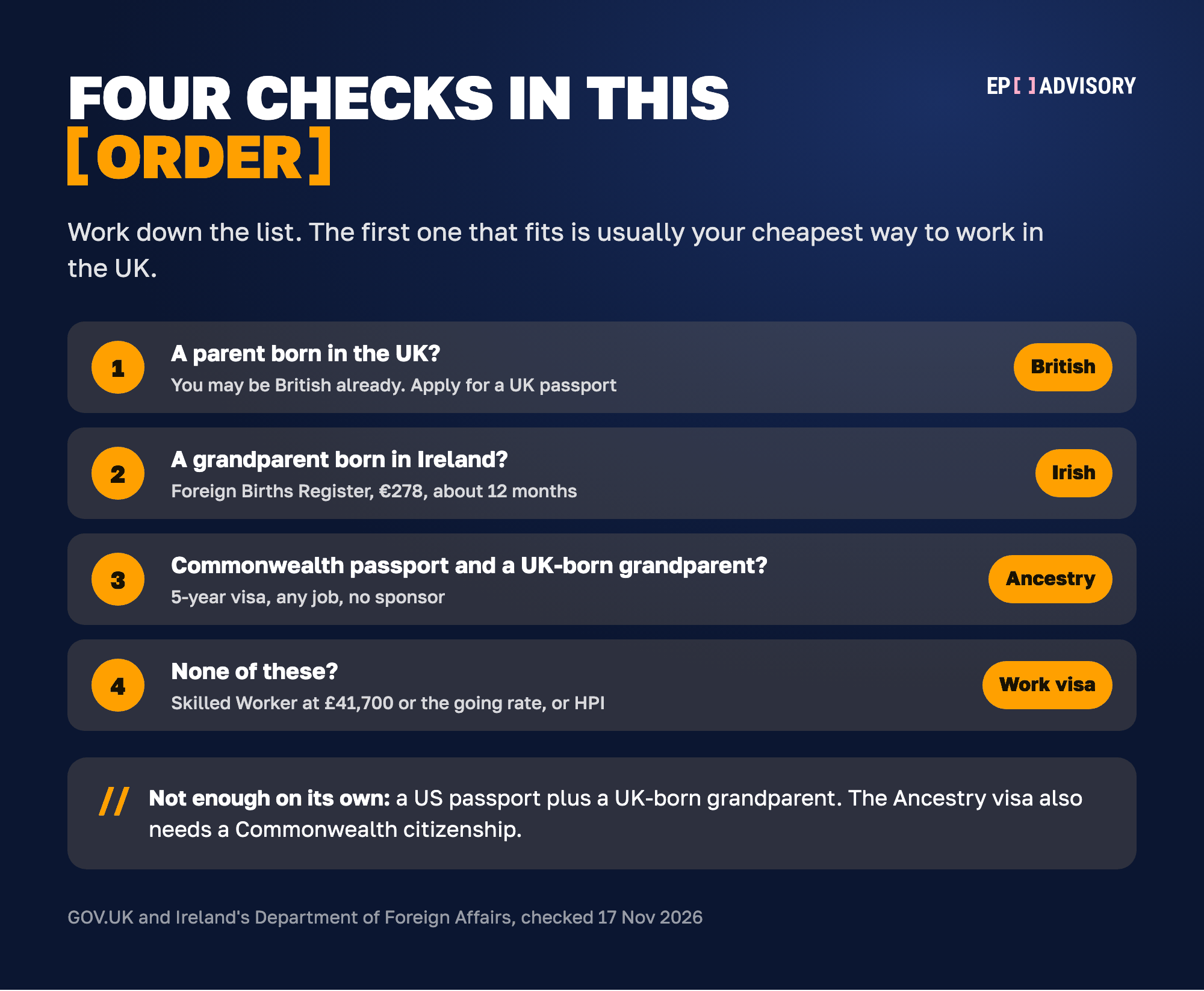
Work down the four checks in order. Each one that fits saves you the next.
- A British parent: you may be a British citizen already and just need a passport.
- A grandparent born in Ireland: you may be able to register as an Irish citizen.
- A Commonwealth passport and a UK-born grandparent: the Ancestry visa.
- None of these: a work visa, such as Skilled Worker or the High Potential Individual visa.
Check first: you may already be British
If one of your parents is British, you may hold British citizenship today without knowing it.
British citizenship normally passes down one generation to children born outside the UK. The GOV.UK guide for people with a British parent sets out the rules. What matters is when you were born, and how your parent became British. A parent can pass it on if they were born or adopted in the UK, became British in their own right, or were a Crown servant abroad when you were born. That last group includes diplomats and the armed forces.
| Your situation | Result | What to do | Fee |
|---|---|---|---|
| Born outside the UK on or after 1 January 1983, to a parent born in the UK | Usually British automatically. Before 1 July 2006, a British father had to be married to your mother | Apply for a UK passport | Passport fee only |
| Born between 1983 and June 2006, to a British father not married to your mother | Not automatic, but you may apply | Register on form UKF | £130 ceremony (about $170) |
| Born before 1983, to a British father married to your mother | Usually British automatically | Apply for a UK passport | Passport fee only |
| Born before 1983, to a British mother | Not automatic, but you may apply | Register on form UKM | £130 ceremony (about $170) |
| Your parent was born outside the UK and is British only through their own parent | Not automatic. Citizenship stops at one generation born abroad | Under 18: you may register if 3-year UK residence rules are met. Adults: check the Irish and Ancestry routes | £1,000 (under 18) |
| Only a grandparent was British | Not British | Check the Irish and Ancestry routes | None |
Fees come from the Home Office fees table of 8 October 2026. Dollar figures use ECB rates of 2 November 2026 (£1 = $1.3419). Registration decisions usually take up to 6 months.
The pre-1983 British mother case is one that Americans often miss. Before 1983, British mothers could not pass on citizenship in the same way as fathers. The law has since given their children a right to register, for the price of a citizenship ceremony. If your mother was born in the UK and you were born in the US before 1983, check this before you look at any visa.
Once you are British, you enter the UK on a British passport. A citizenship certificate alone does not let you in. You can live and work in the UK with no visa, no sponsor and no health surcharge. GOV.UK’s citizenship checker covers the edge cases, such as adoption and parents who married after you were born.
An Irish grandparent: the route many Americans miss
A grandparent born in Ireland can make you eligible for Irish citizenship, and Irish citizens can live and work in the UK freely.
Ireland runs a Foreign Births Register for people born abroad. You can apply if one of your grandparents was born in Ireland, or if one of your parents was an Irish citizen when you were born. If a parent was an Irish citizen when you were born and was born on the island of Ireland, you are already Irish and can apply for a passport directly.
- Cost: €278 for an adult, including €8 postage and handling (about $310 at ECB rates of 2 November 2026). Under 18: €153.
- Time: about 12 months, processed in date order.
- Documents: original civil birth certificates for you, your parent and your Irish-born grandparent, marriage or name-change certificates where they apply, and certified photo ID.
Under the Common Travel Area, Irish citizens can live, work and study in the UK without any permission from the Home Office. There is no visa fee, no health surcharge and no salary rule. You also gain EU citizenship, which lets you work in the other EU countries. Our guide on how to find a job in Europe covers that side.
Start the register now if your grandparent was born in Ireland, even while you look at other routes. Twelve months goes quickly during a job search. Citizenship through Irish law is a matter for the Irish government, so check its guidance for your family details.
Score your CV in 30 seconds, then fix its biggest problems one by one. Both free.
Free, no card. A free account unlocks every fix.

How the Ancestry visa works if you hold a Commonwealth passport
The Ancestry visa gives you 5 years to live and work in the UK in any job, with no sponsor and no salary bar.
If you hold Canadian, Australian or another Commonwealth citizenship, the rules in Appendix UK Ancestry are short. You must:
- Be 17 or over on the date you plan to arrive.
- Have a grandparent born in the UK or the Islands. A grandparent born before 31 March 1922 in what is now Ireland also counts, as does one born on a UK-registered ship or aircraft. Adoption counts. Unmarried parents or grandparents are fine. Step-parents do not count.
- Be able to work and plan to work in the UK. You do not need a job offer. You need to show the intention. GOV.UK gives job offers or a business plan as examples. Home Office caseworker guidance also lists applications you have made to UK employers and registration with a UK recruitment agency.
- Support yourself without public funds. There is no fixed sum. Bank statements must be dated within 31 days of your application. Credible promises of support from a relative or friend can count.
The documents are mostly family records. You need your passport, your full birth certificate, and the full birth certificates of the parent and grandparent your claim runs through. Add marriage certificates or a deed poll if a name changed. Full certificates show the parents’ names, and those names are what link the generations. Order them early, because UK and US records offices can take weeks.
You apply online from outside the UK, no earlier than 3 months before you travel. GOV.UK quotes a decision within 3 weeks. Your partner and children under 18 can apply as your dependants, and your partner can work too.
One rule catches people already in the UK. You cannot switch into the Ancestry visa from another visa inside the UK, unless you held Ancestry permission before. If you are in London on a Skilled Worker visa and hold a Canadian passport, you would apply for the Ancestry visa from outside the UK. These are general rules. Check the current rules on GOV.UK or with a regulated adviser before you apply.
What the Ancestry visa costs, in pounds and dollars
For one adult, the 5-year visa costs £5,901 upfront, about $7,900. Most of that is the health surcharge.
The visa fee is £726. The Immigration Health Surcharge (IHS), the upfront payment for NHS care, is £1,035 a year for adults and £776 a year for children under 18. You pay it for all 5 years when you apply. Dollar figures are at ECB rates of 2 November 2026.
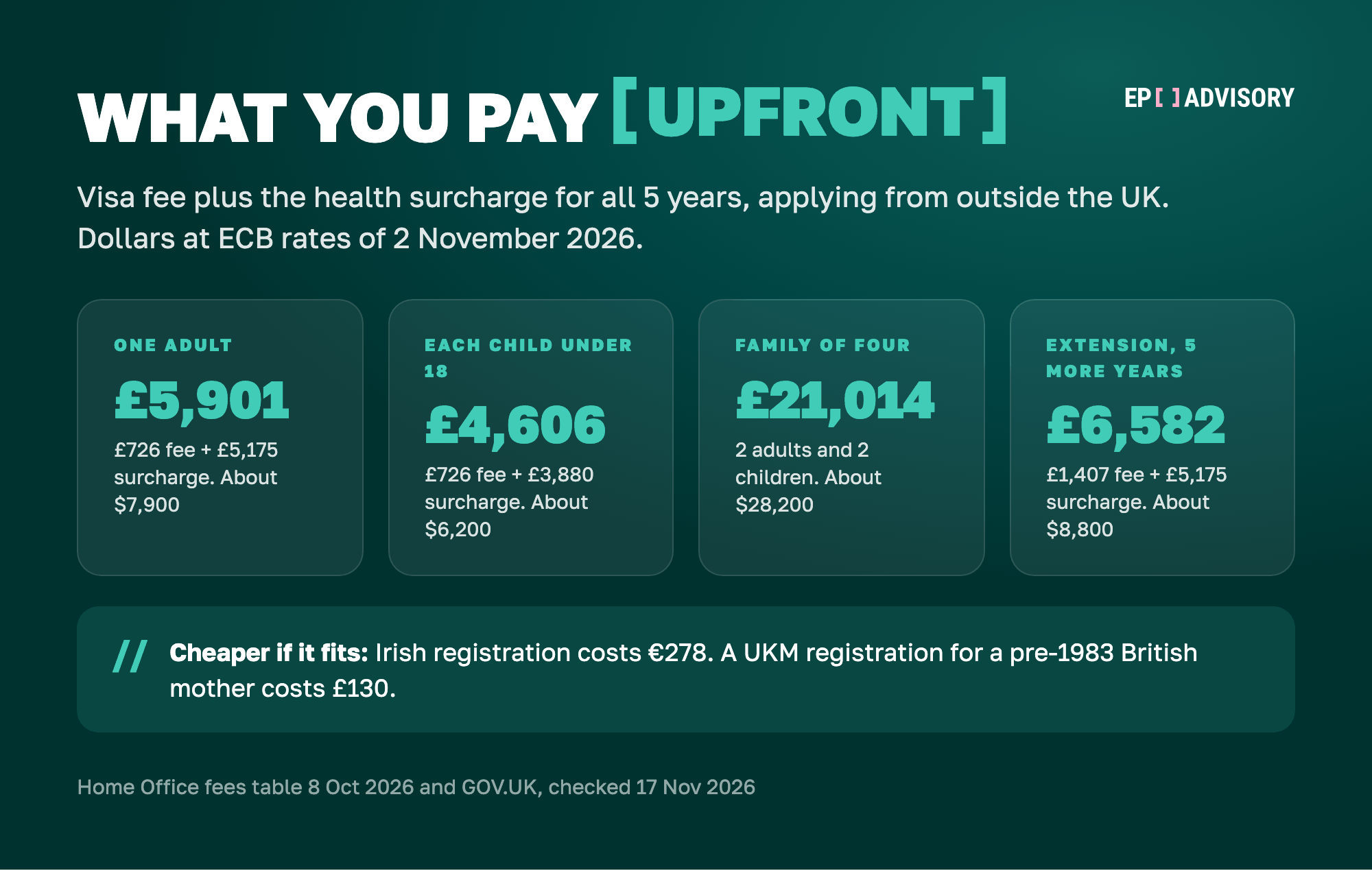
| Who | Visa fee | Health surcharge, 5 years | Total | In dollars |
|---|---|---|---|---|
| One adult | £726 | £5,175 | £5,901 | about $7,900 |
| Partner | £726 | £5,175 | £5,901 | about $7,900 |
| Each child under 18 | £726 | £3,880 | £4,606 | about $6,200 |
| Family of four (2 adults, 2 children) | £2,904 | £18,110 | £21,014 | about $28,200 |
Later costs come in steps. Extending for another 5 years costs £1,407 plus the surcharge, so £6,582 for an adult (about $8,800). Settlement, called indefinite leave to remain (ILR), costs £3,226 (about $4,300) plus £50 for the Life in the UK Test. Citizenship costs £1,709 plus a £130 ceremony, £1,839 in all (about $2,500). You may be able to pay £500 for a faster visa decision, where the priority service is offered.
Compare that with the other routes. A 5-year Skilled Worker visa comes to £6,793 for one adult, and it needs a sponsor. Irish registration costs €278. A UKM registration costs £130. So check the family routes in the order above before you budget for a visa.
From Ancestry visa to settlement and a British passport
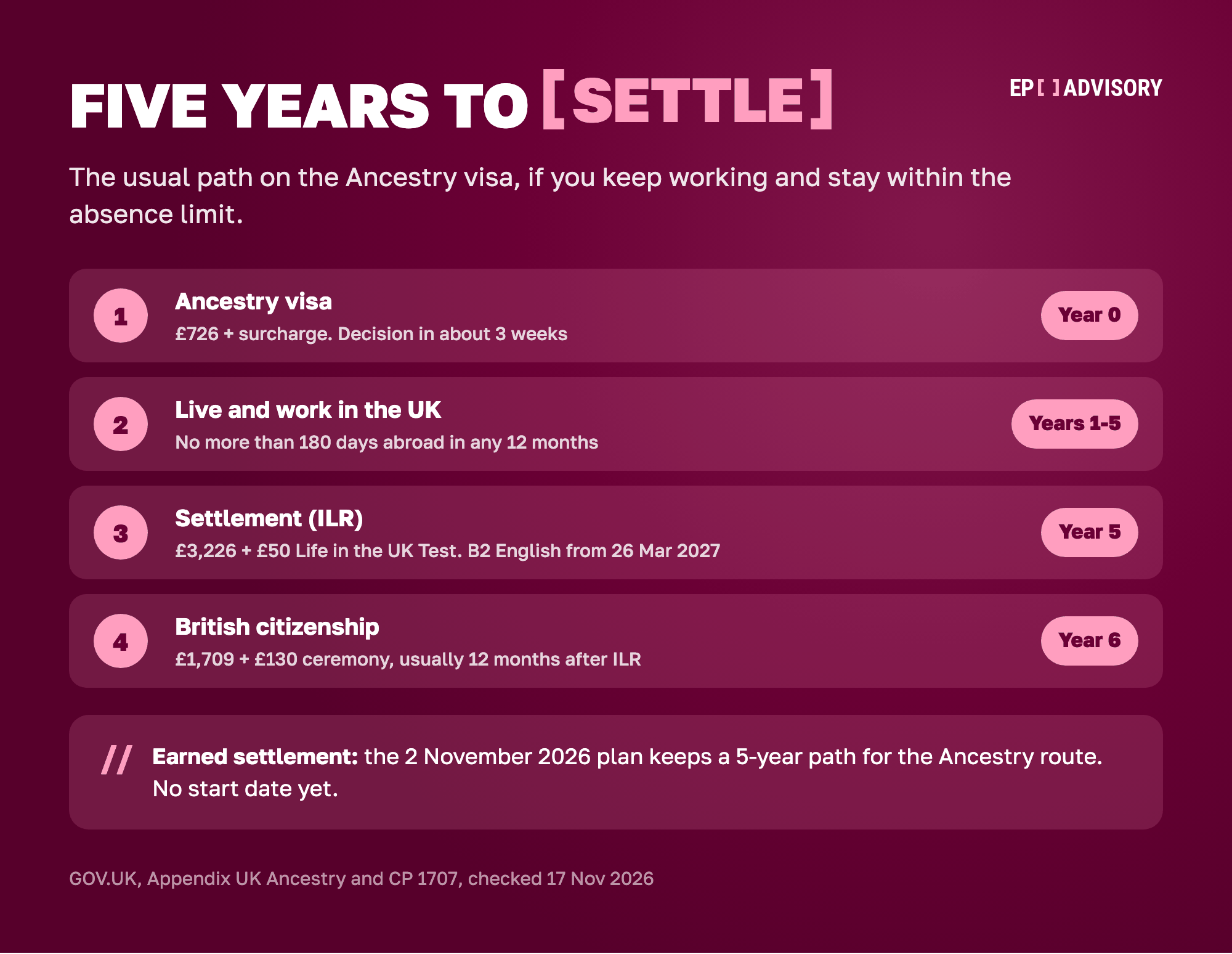
After 5 years on the Ancestry visa you can apply to settle. Twelve months later you can usually apply for citizenship.
To settle you need 5 continuous years in the UK on the visa. In most cases you can spend no more than 180 days outside the UK in any 12-month period. You must still be a Commonwealth citizen, still be able to work and plan to work, and have enough money to support yourself. If you are 18 to 64, you also need to meet the English requirement and pass the Life in the UK Test. You can apply 28 days before your 5 years are up. GOV.UK quotes a decision within 6 months on the standard service.
Two rule changes are worth knowing:
- English: settlement applications need English at level B1 before 26 March 2027 and B2 from that date. Nationals of the US, Canada, Australia, New Zealand and Jamaica meet the requirement through their nationality, under Appendix English Language. So as a dual US citizen, you prove English with your US passport.
- Earned settlement: on 2 November 2026 the government announced a new settlement system, with a 10-year default for many routes. Its response to the consultation keeps a 5-year path for “recognised British connections”, and that list names Commonwealth citizens on the UK Ancestry route. The plan has no start date yet and the detailed rules are still to come.
Plan on 5 years to settlement and about 6 years to a British passport. Keep your trips abroad under the 180-day limit, and keep proof of work, such as payslips and tax records, for the settlement application.
No qualifying family tie? Your work routes
Without a family tie, you will most likely need a work visa, and the main one needs a job offer from a licensed sponsor.
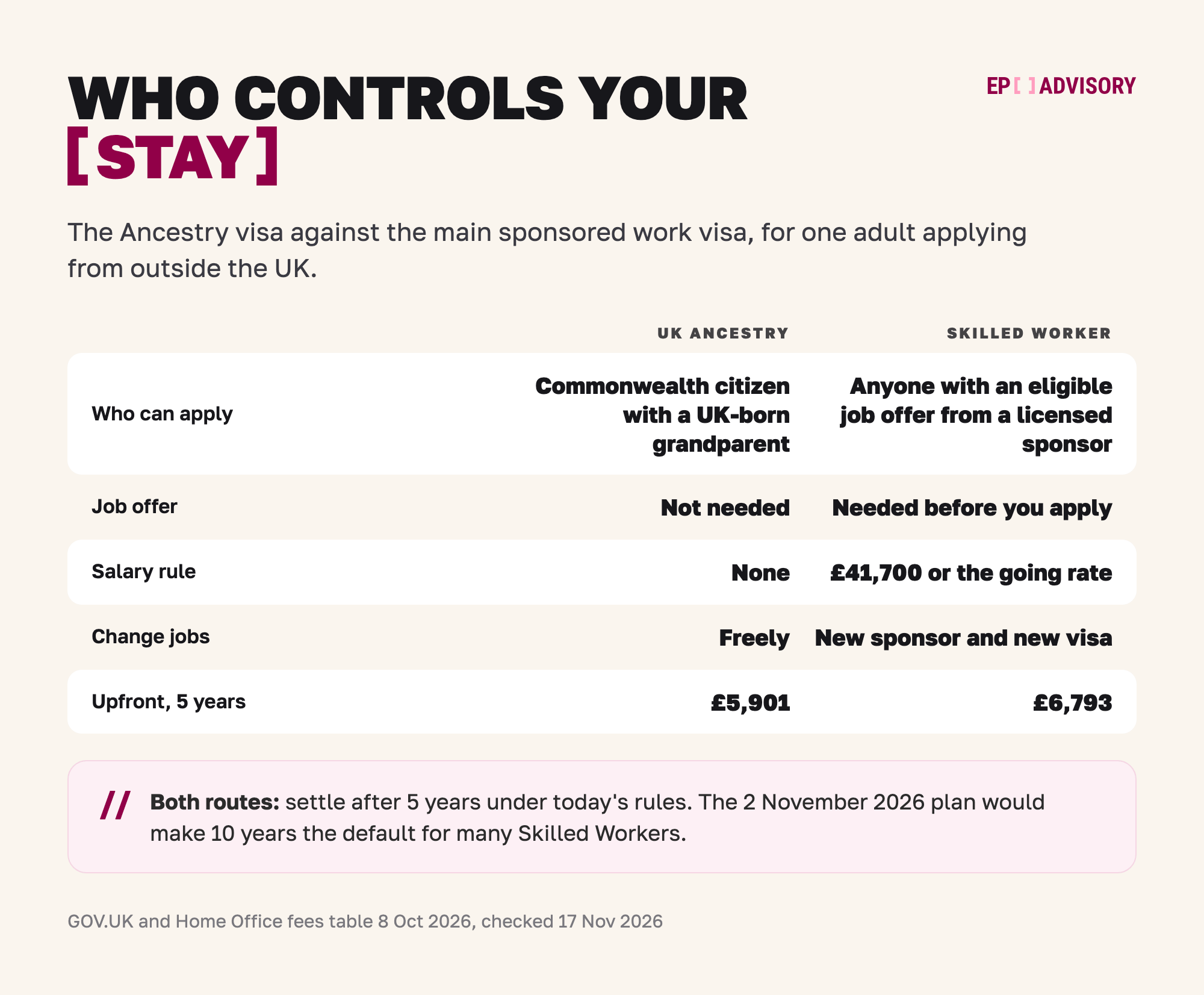
If none of the family checks fit, the Skilled Worker visa is the main route. It needs an offer from a UK employer with a sponsor licence, paying at least £41,700 a year gross (about $56,000) or the going rate for your job, if higher. US citizens take no English test for it. Recent graduates of listed universities may qualify for the High Potential Individual visa, with no job offer needed. Our HPI visa guide for Americans shows how to check.
The Ancestry visa and Skilled Worker differ most in who controls your stay. On Ancestry, you do. On Skilled Worker, your sponsor does.
Next: compare every route side by side in our guide to the UK work visa for Americans, then use our list of UK companies that sponsor visas to build a target list.
How to job-hunt with a family route
A candidate who needs no sponsor is easier to hire. Put that fact where a recruiter sees it first.
UK employers who do not hold a sponsor licence can hire you on the Ancestry visa, as an Irish citizen or as a British citizen. That opens far more employers than a sponsored search, including small firms and charities. In our experience, the line that matters most is the right-to-work line at the top of the CV. Write it plainly: “Right to work in the UK: UK Ancestry visa, no sponsorship needed” or “Irish citizen, full right to work in the UK”.
- Apply before you land. Applications and job offers can also help show that you plan to work, so your job search and your visa file help each other.
- Use a UK CV, not a US resume. In our experience, UK recruiters expect a CV of about 2 pages, with a short profile and no photo. Our guide to the UK CV vs the US resume shows what to change.
- Price yourself in pounds. UK headline pay is often lower than US pay. Our UK vs US salary comparison shows the gap by job, and salaries in the UK gives the national figures.
- Plan your notice period. In our experience, UK employers often expect 1 to 3 months’ notice from local hires. If you are free to start soon after your visa is granted, say so.
Before you send the first application, make sure your CV reads well to a UK recruiter. Getting ready to apply for jobs in the UK? Check your CV for free: see it the way a recruiter does, then fix each problem. For the full search plan, see our guide on how to get a job in the UK as an American.
US citizens still file US tax returns while living abroad, so a UK salary affects your US taxes. This is general information only. Talk to a cross-border tax adviser before you move.
Key takeaways
- A US passport alone does not qualify you for the UK Ancestry visa: you need Commonwealth citizenship plus a grandparent born in the UK.
- Check first whether you are British already, because a British parent can pass on citizenship to a child born in the US, and a pre-1983 British mother route costs £130.
- A grandparent born in Ireland can make you eligible for Irish citizenship for €278, and Irish citizens live and work in the UK with no visa.
- The Ancestry visa lasts 5 years, needs no sponsor or salary bar, and costs £5,901 upfront for one adult, about $7,900 at ECB rates of 2 November 2026.
- Settlement comes after 5 years, and the earned settlement plan of 2 November 2026 keeps a 5-year path for the Ancestry route.
- With no family tie, the main route is Skilled Worker, at £41,700 a year gross or the going rate, with a licensed sponsor.
See what a recruiter sees, then fix it before you apply. An instant score, then the fix for every problem.
Free, no card. A free account unlocks every fix.
Frequently asked questions
Can a US citizen get a UK Ancestry visa?
Not on a US passport alone. The visa is for Commonwealth citizens and a few British national groups, and the US is not in the Commonwealth. If you also hold citizenship of a Commonwealth country, such as Canada or Australia, and a grandparent was born in the UK, you can apply.
My grandparent was born in the UK. Am I British?
Usually not. British citizenship normally passes down one generation to children born abroad. If your parent was born in the UK, you may be British. If only your grandparent was, look at the Ancestry visa, which needs a Commonwealth passport, or at Irish citizenship if a grandparent was born in Ireland.
How much does the UK Ancestry visa cost?
The visa fee is £726. The health surcharge is £1,035 a year for an adult, paid upfront for all 5 years. So one adult pays £5,901, about $7,900 at ECB rates of 2 November 2026. A child pays £4,606, because the surcharge for under-18s is £776 a year.
Do I need a job offer for the UK Ancestry visa?
No. You need to show that you can work and plan to work in the UK. Job offers, applications to UK employers, registration with a UK recruitment agency or a business plan can all help. Once you have the visa, you can take any job, change employer freely or work for yourself.
Can an Irish grandparent help me work in the UK?
Yes, often. If a grandparent was born in Ireland, you can apply to Ireland’s Foreign Births Register to become an Irish citizen. It costs €278 for an adult and takes about 12 months. Irish citizens can live and work in the UK without a visa.