 By Andre Atallah, CEO of EP Advisory

Short answer: yes, an American teacher can work in UK schools. In England, a qualified US teacher can teach for up to 4 years without QTS, the English teaching qualification. The better plan is to get QTS first. It is free through the Department for Education, the USA is on the eligible list, and 90% of applications are assessed within 12 months. Then a school sponsors your Skilled Worker visa. Pay in 2026/27 starts at £34,069 outside London for a teacher with QTS.
If you hold a full US teaching licence and a year or more in the classroom, you may be able to teach in England. The Department for Education assesses US-trained teachers for QTS for free, in any subject. The work is in the paperwork: a free QTS application, a school that sponsors visas, and a CV that reads well to a UK head teacher.
This guide covers the full route in the order you will do it. First, whether you qualify for QTS and what to do if you don’t. Then the visa and its costs in pounds and dollars. Then the 2026/27 pay scales against US pay, and how to find a school that sponsors. For nearly 10 years, we’ve helped more than 5,000 professionals find jobs abroad. Want to know if your CV will pass screening in the UK? Check your CV for free: a score in 30 seconds, then a fix for each problem.
Can an American teacher work in the UK? Yes, in two ways
You can teach in England with QTS, or for up to 4 years without it under the 4-year rule.
QTS means qualified teacher status. It is the professional qualification that teachers trained in England get at the end of their training. The Department for Education (DfE) says it is a legal requirement in maintained schools. These are state schools run with the local council, such as community, foundation and voluntary schools. Academies, free schools and private schools do not have to ask for it, but many use it to judge candidates.
So you have two ways in:
- Get QTS before you move. US teachers can apply online through the Apply for QTS service. The DfE does not charge for it.
- Use the 4-year rule. GOV.UK says qualified teachers from outside the UK can teach in England for up to 4 years without QTS, even in schools where QTS is normally required. It does not apply in pupil referral units or alternative provision schools, which teach pupils outside mainstream school.
Either way, QTS does not give you a job or a visa. Schools employ teachers directly, not the DfE. You still need a school to hire you and, for most Americans, to sponsor your visa.
This guide is about England. Scotland, Wales and Northern Ireland have their own teaching councils. If you want to teach there, start with the General Teaching Council for Scotland, the Education Workforce Council in Wales or the General Teaching Council for Northern Ireland.
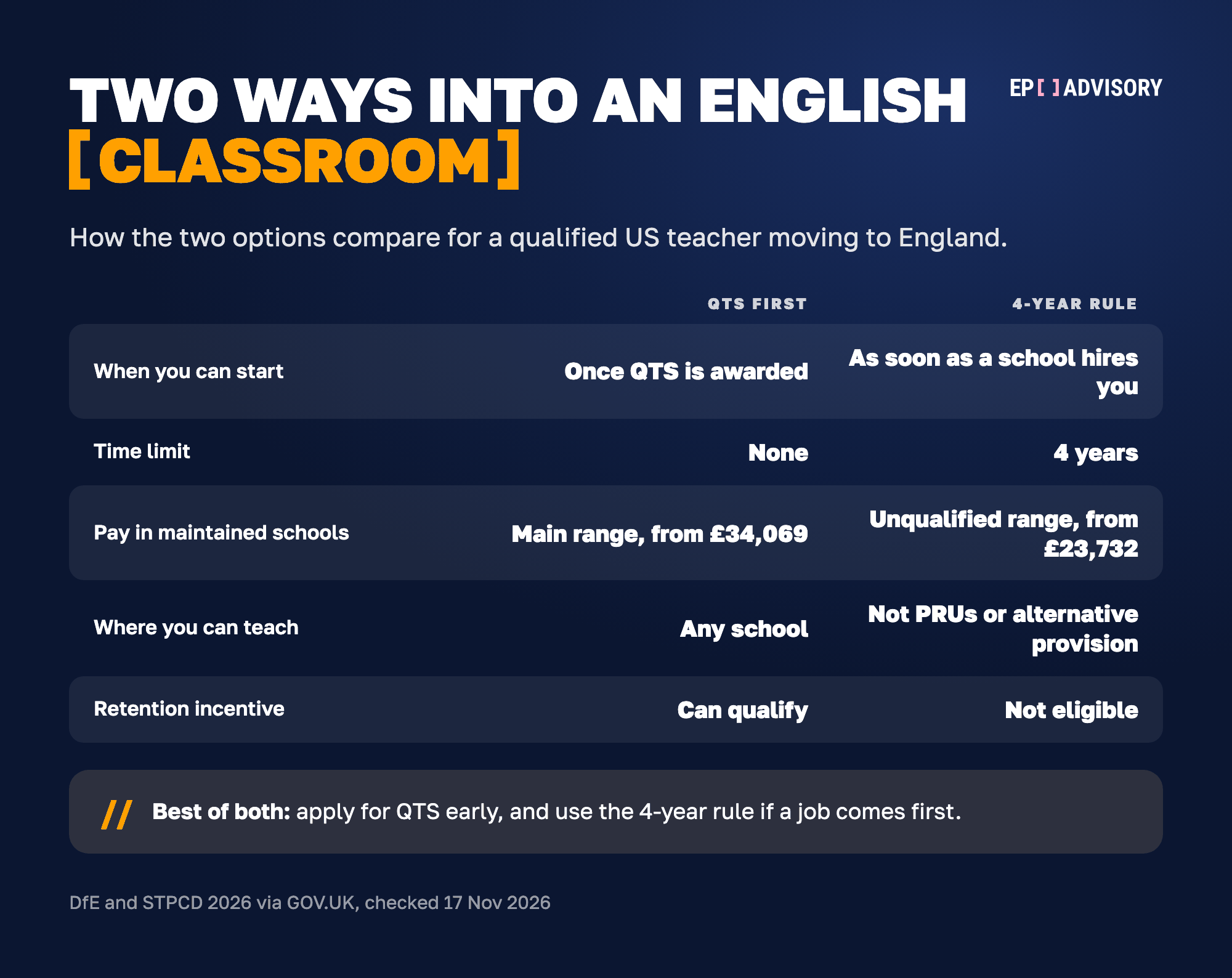
The 4-year rule gets you into a classroom sooner. QTS gets you better pay and more schools. For most US teachers, applying for QTS early and using the 4-year rule while you wait is the strongest plan.
QTS for US teachers: who qualifies through Apply for QTS
The USA is on the eligible list, and US teachers can apply whatever subject they teach.
The DfE guidance for overseas-trained teachers was updated on 13 October 2026. It says anyone who trained to teach in an eligible country can apply, whatever their subject. Before that date, subject limits applied only to teachers trained in South Africa, Singapore and Jamaica, not the USA. The USA is on the eligible list, along with Canada, Australia, New Zealand and the EEA (the EU plus Iceland, Liechtenstein and Norway).
The requirements are strict, and you must meet all of them. Here is the checklist. The left column is the DfE requirement. The right column is what it means for a US teacher. The DfE’s own eligibility checker settles the two US questions: it asks which state you are licensed in, and it accepts a licence for part of the 5 to 16 age range. It has 9 short questions, so run it before you apply.
| DfE requirement | What it means for a US teacher |
|---|---|
| A bachelor’s degree at UK standard, verified by UK ENIC | A US bachelor’s degree is the usual basis, but UK ENIC makes the call. UK ENIC is the UK agency that compares foreign qualifications. |
| Full professional status, verified by a national regulator or competent authority | A full, current state teaching licence. US teachers are licensed by states, so the DfE checker asks which state recognises you: any of the 50 states or Washington DC. You must also have completed any induction your state requires for full registration. |
| No conditions or restrictions on your teaching | The checker names the licence levels it accepts for each state. For California it accepts a Clear Credential, not a Preliminary one. For New York it accepts a Professional or Permanent Certificate, not an Initial one. So a preliminary, initial or emergency licence usually does not fit. |
| Qualified and suitable to teach children aged 5 to 16 | A licence for one grade band is enough. The DfE checker says you do not need the full age range, for example 5 to 11 or 14 to 16. A K-6 or 7-12 licence that covers ages somewhere between 5 and 16 fits. |
| Teacher training at level 6, at least one year full-time equivalent | A bachelor’s in education, or a postgraduate certification programme of about a year, may fit. Shorter alternative certification routes may not. |
| Training delivered in the country where the provider is based | A US programme for US trainees fits. An online course taken from abroad may not. |
| At least one school year employed as a teacher after qualifying | At least 9 months as a qualified teacher, unsupervised, planning and grading your own classes in a mainstream school. |
| English at B2 level, or citizenship of an exempt country | The USA is on GOV.UK’s exempt list, so US citizenship meets it. No English test needed. |
The DfE contacts your references to check your work history. Each referee needs an email address on the school’s own domain, not Gmail or Hotmail. The DfE checker says each referee must be a senior member of staff still working at the school: the principal, an assistant or deputy principal, or the business manager. They must give the reference in English and cover only your teaching after you qualified. Ask them early.
One exception to the any-subject rule: a teaching qualification limited to special educational needs (SEND) does not fit Apply for QTS. GOV.UK says SEND teachers can gain QTS through assessment only or teacher training in England instead.
On timing, the DfE says it assesses 90% of applications within 12 months. It can take longer if your references are slow or a document needs checking. Applications from teachers already working in a school in England can be assessed faster.
One trap to avoid: the PGCEi or iPGCE, an international postgraduate certificate offered to teachers outside England, does not lead to QTS. Neither does a TEFL certificate, which is for teaching English as a foreign language. If a course promises a route to UK teaching, check it against the GOV.UK list of routes first.
How to get QTS and a teaching job in England: the steps
Apply for QTS first, then look for a school while the DfE assesses you.
The DfE assessment and your job search can run at the same time. Most of the delay is in the assessment, so start it early.
- Check you meet the QTS checklist. Pay close attention to your licence status, your grade band and the length of your training programme.
- Apply for QTS online. Upload your degree, your licence and your teaching history. The DfE checks your degree with UK ENIC and contacts your references. There is no fee.
- Look for a school that sponsors visas. Schools need a sponsor licence from the Home Office to hire you on a Skilled Worker visa. The job hunt section below shows where to find them.
- Get your offer and a certificate of sponsorship. The certificate of sponsorship is a reference number the school gives you for the visa application.
- Apply for the Skilled Worker visa. You do this from the US. Teachers applying from outside the UK must include a criminal record certificate from each country where they lived for 12 months or more in the last 10 years as an adult. GOV.UK explains how to get one in its guidance on criminal records checks for overseas applicants. The school will also run an enhanced DBS check, the criminal record check for England and Wales, plus its own overseas checks.
- Start teaching, and complete induction if you need it. If you had under 2 school years’ experience when you applied for QTS, you complete statutory induction in England. This lasts 2 years as an early career teacher (ECT), with support based on the DfE’s early career framework.
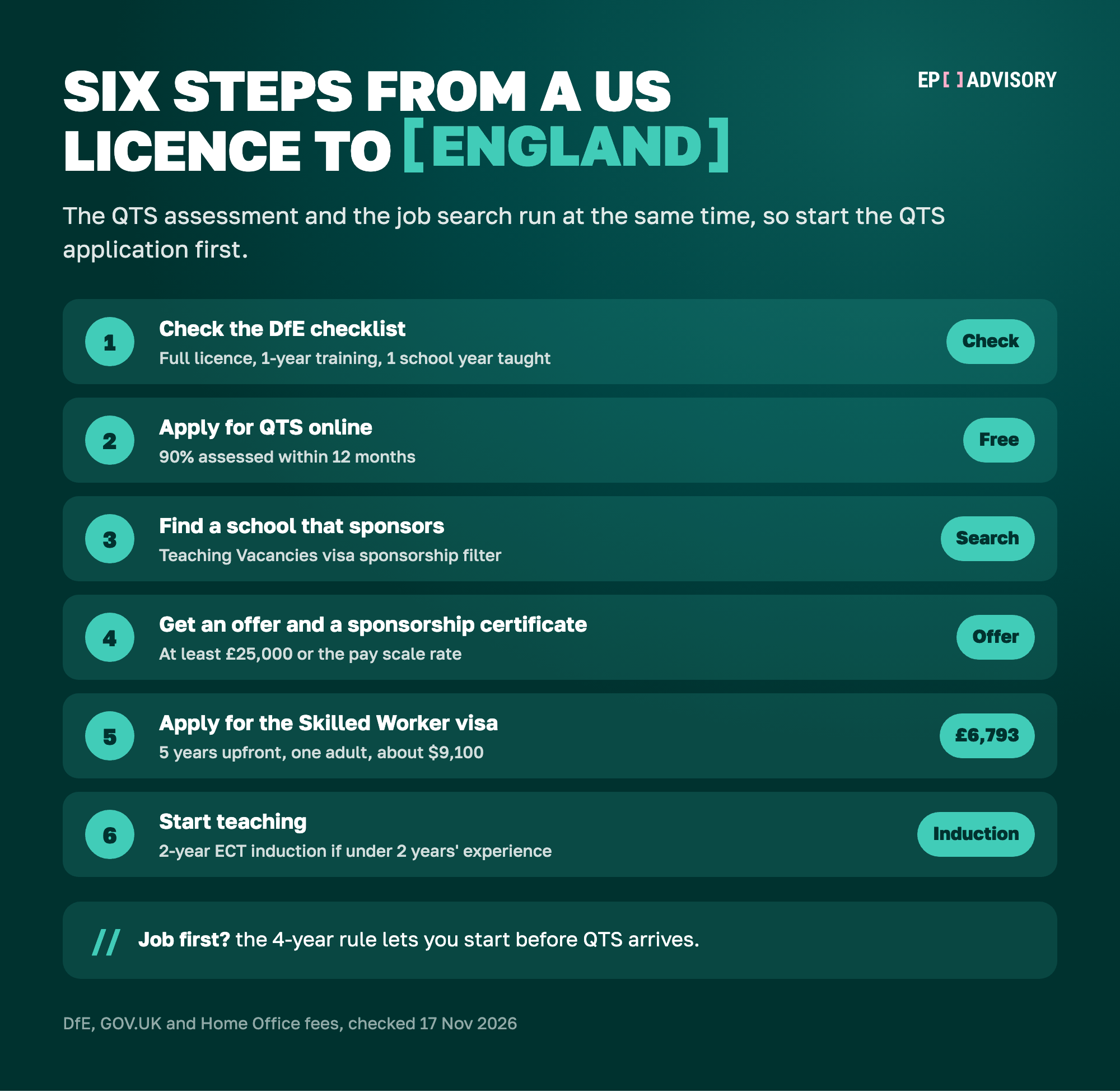
If you are still waiting for QTS when a school offers you a job, the 4-year rule lets you start. Tell the school your QTS application is in progress, and give the date you applied.
Score your CV in 30 seconds, then fix its biggest problems one by one. Both free.
Free, no card. A free account unlocks every fix.

Teaching without QTS: what the 4-year rule means for pay
The 4-year rule lets you teach, but without QTS a maintained school pays you on the lower unqualified range.
The School teachers’ pay and conditions document 2026 sets pay in maintained schools. It defines an unqualified teacher as a teacher who is not a qualified teacher. So until you have QTS, a maintained school pays you on the unqualified range. Outside London, that runs from £23,732 to £36,494 gross a year from 1 September 2026. The school can add an allowance for qualifications or experience that add value. The main range for qualified teachers starts at £34,069. If you need a visa, the £25,000 visa floor in the next section still applies, so a sponsored teacher cannot be paid at the very bottom of the unqualified range.
Academies and private schools do not have to follow the pay document, so they may not use the unqualified range at all. Ask which range you will be on before you sign. Get Into Teaching says schools have some flexibility in how they set salaries, so it is a fair question for an experienced teacher.
The 4-year rule has three other limits:
- It ends. After 4 years, you need QTS to keep teaching in many state schools.
- Some schools are out. It does not cover pupil referral units or alternative provision academies and free schools.
- Some extras need QTS. The targeted retention incentive, covered in the pay section, has only been paid to teachers with QTS or QTLS (the equivalent status for further education teachers).
A school may also ask for a UK ENIC statement of comparability for your degree if you don’t have QTS. UK ENIC charges for it, so check the price on its statement of comparability page before you order.
The Skilled Worker visa for teachers: salary rule and costs
Teachers have their own salary rule: at least £25,000, or the national pay scale rate if that is higher.
Most American teachers need a Skilled Worker visa. The general salary bar for the visa is £41,700, which sits between M4 and M5 on the main scale outside London. Teaching jobs are treated differently. Primary, secondary, nursery and special needs teachers, and head teachers, are on a list of education jobs where the going rate comes from national pay scales. For these jobs, your salary must be at least £25,000, or the rate in the national pay scales table for your role and area if that is higher. GOV.UK says these going rates apply in the public and private sector alike. The table was last updated in April 2025 and still shows older pay figures.
In practice, this means a new qualified US teacher can be sponsored on a normal starting salary. You do not need to earn £41,700. Our guide to the Skilled Worker visa salary threshold explains the general rule and how going rates work for other jobs.
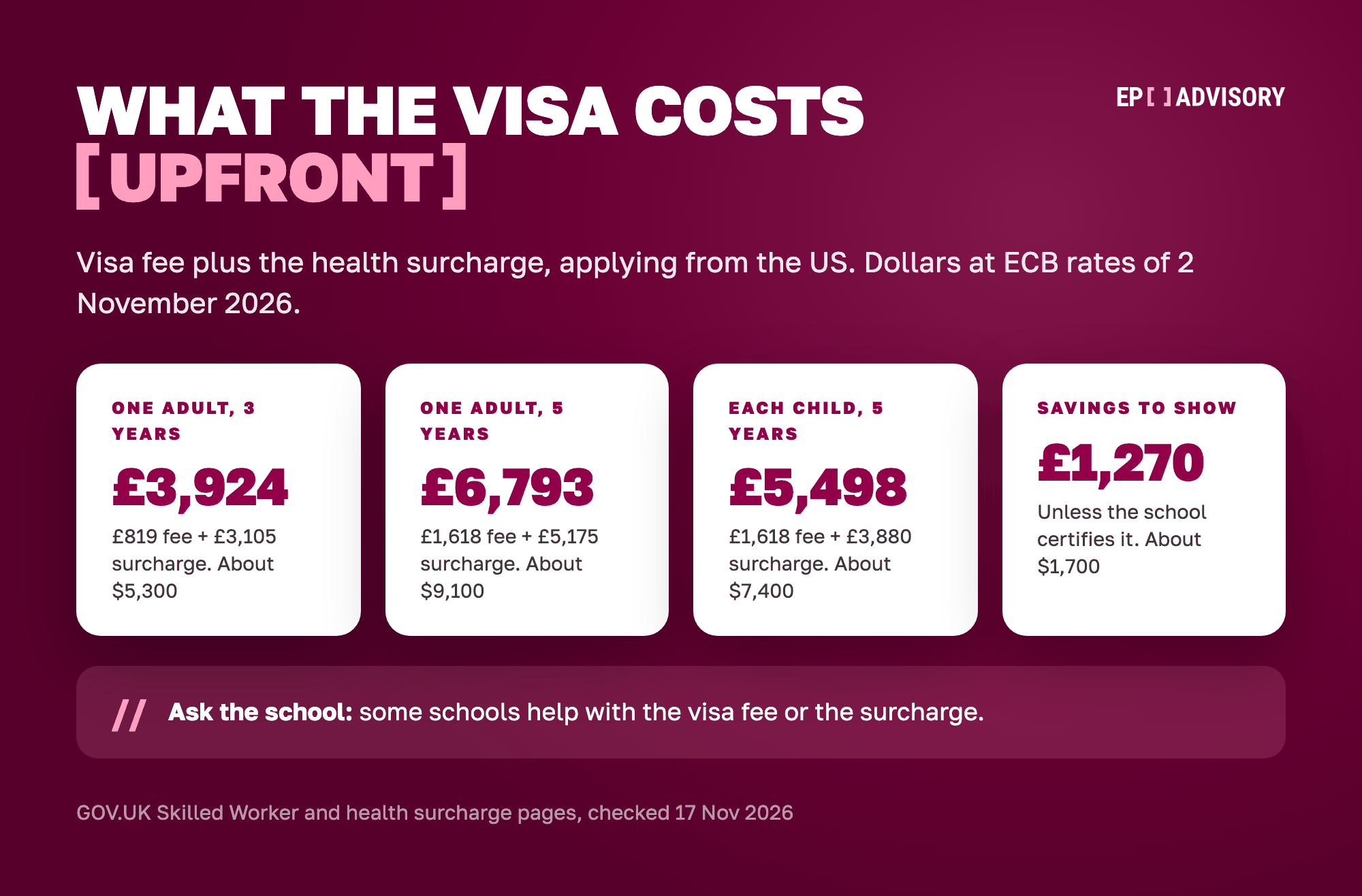
Here is what you pay upfront from the US, for one adult, at ECB rates of 2 November 2026:
| Cost | 3-year visa | 5-year visa |
|---|---|---|
| Visa fee | £819 | £1,618 |
| Health surcharge (£1,035 a year) | £3,105 | £5,175 |
| Total upfront | £3,924 (about $5,300) | £6,793 (about $9,100) |
The health surcharge pays for the NHS, the UK’s public health service. It is £776 a year for each child under 18. So a child on a 5-year visa costs £5,498 (about $7,400). You may also need to show £1,270 in savings, held for 28 days, unless your school confirms on the certificate of sponsorship that it will cover you for your first month.
Ask at the offer stage whether the school will help with the visa fee or the surcharge. Some schools do, and the advert may not say.
Under today’s rules, after 5 years on Skilled Worker you can usually apply to settle. On 2 November 2026 the government announced earned settlement, with a 10-year default. It says some public service workers, including teachers, will be able to settle after 5 years. It is not in force and has no start date. Rules change often, so check the current rules on GOV.UK or with a regulated adviser before you apply.
For every other visa open to Americans, see our guide to the UK work visa for Americans.
UK teacher pay in 2026/27 against US teacher pay
A qualified teacher starts on £34,069 outside London and can reach £64,684 in inner London on the upper range.
The 2026 pay document gave teachers a 3.5% rise from 1 September 2026. It follows the School Teachers’ Review Body 36th report, which also recommended a 3% rise from 1 September 2027. The pay document applies both. Pay depends on where the school is. There are four areas: inner London, outer London, the London fringe, and the rest of England.
These are the 2026/27 ranges, gross a year, for maintained schools. Dollars are at ECB rates of 2 November 2026.
| Pay range | Rest of England | Inner London |
|---|---|---|
| Main range, start (M1) | £34,069 ($45,700) | £41,729 ($56,000) |
| Main range, top (M6) | £46,940 ($63,000) | £54,131 ($72,600) |
| Upper range, start (U1) | £49,134 ($65,900) | £59,650 ($80,000) |
| Upper range, top (U3) | £52,835 ($70,900) | £64,684 ($86,800) |
| Unqualified range | £23,732 to £36,494 | £29,336 to £42,429 |
| Leadership range, from | £53,586 ($71,900) | £63,709 ($85,500) |
Outer London runs from £39,196 to £52,241 on the main range. The fringe runs from £35,602 to £48,479. Each year the school decides whether to move you up the range, after your appraisal. Qualified teachers can apply to move onto the upper range. From September 2027, the main range outside London will run from £35,092 to £48,349.
Where does an experienced US teacher start? The school decides where on the range you start, under its own pay policy. Ask how it treats teaching experience from abroad. For a teacher with several years at home, this starting point is the most important number to negotiate. Our guide on how to negotiate salary shows how to ask.
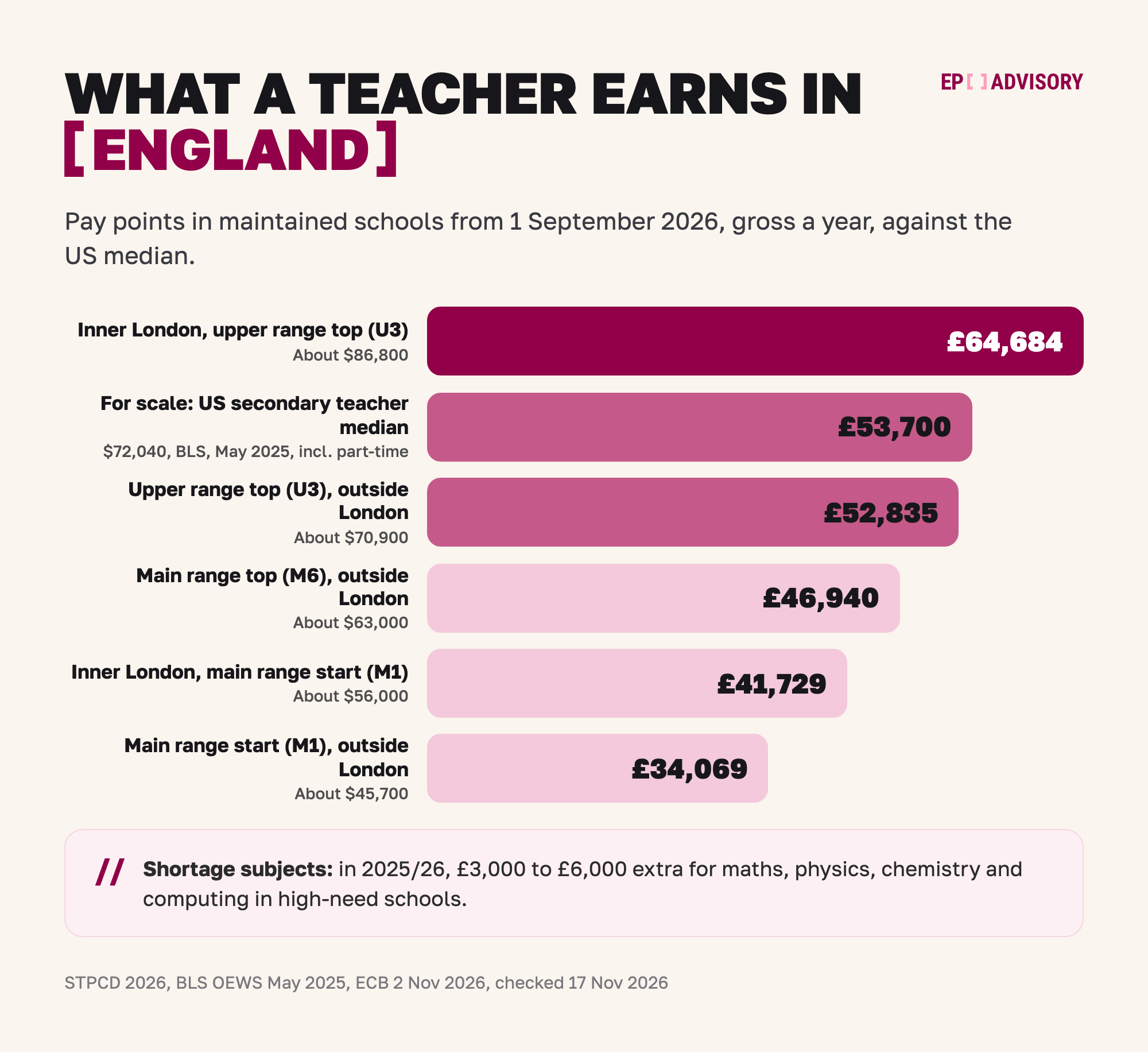
How does this compare with the US? The US Bureau of Labor Statistics puts the median US secondary school teacher at $72,040 a year (May 2025). In the New York area it is $100,800. BLS figures include part-time staff, so treat the comparison as a guide. The UK Office for National Statistics puts the median UK secondary teacher at £49,492 gross a year, full-time (ONS ASHE 2026, provisional), which is about $66,400. So in dollars, UK teachers earn somewhat less. The gap depends on your state, since US teacher pay varies widely. In the UK, your health surcharge also gives you NHS care. For a full comparison of take-home pay and costs, see our UK vs US salary guide.
If you teach maths, physics, chemistry or computing, there may be extra money. For the 2025 to 2026 school year, the targeted retention incentive paid a lump sum of £3,000 to £6,000 (about $4,000 to $8,100) to eligible teachers in state secondary schools with high need. You needed QTS, and some teachers who got QTS through overseas recognition qualified. At least half your timetable had to be in those subjects. It was not paid in private schools. As of November 2026, GOV.UK has not confirmed the next round, so check the page before you count on it.
US tax still applies to US citizens living in the UK. The IRS says you are taxed on your worldwide income, and benefits such as the foreign tax credit can reduce the bill, but the rules are detailed. Talk to a cross-border tax adviser before your first UK tax year. The IRS page for US citizens abroad is a useful start.
If you don’t meet the QTS checklist: other routes
Three other routes lead to QTS, and some Americans need no sponsor at all.
If the Apply for QTS service does not fit, for example because your training was too short or your licence is provisional, GOV.UK lists three more routes:
- Assessment only. For experienced teachers with a degree. A teacher training provider in England assesses you at your own school against the standards for QTS, with no training course. You need a bachelor’s degree, at least 2 years’ teaching in 2 separate schools, and English and maths at GCSE grade 4 standard, which is a pass in the UK’s exams at 16. Primary teachers also need science. Fees are about £1,500 to £4,000, and GOV.UK says they can be much more if you are outside the UK. You do not need to visit the UK to be assessed.
- iQTS. International qualified teacher status is an online training course from English providers, taken while you live outside the UK. It meets the same standards as QTS and leads to QTS. It is the only international course that does.
- Teacher training in England. A full year of training in England. Fees run from £9,250 to about £32,000, depending on your immigration status.
Some Americans can skip the sponsor step. A school can hire you without sponsorship if you are an Irish or British citizen, or if you hold a UK Ancestry visa through a Commonwealth passport and a UK-born grandparent. Our guide to the UK Ancestry visa for Americans shows who qualifies. Recent graduates of top universities may fit the High Potential Individual visa, which also lets you work for any school. Our guide for American nurses in the UK follows a similar regulated route, if you are comparing two careers.
If you are at the start of your career and already have the right to work in the UK, look at Teach First. Its two-year graduate scheme, now called Teach Lead Change, trains you while you teach in schools serving disadvantaged communities. Our guide to the Teach First application process covers each stage.
Next: start your free QTS application now, then use the visa sponsorship filter on Teaching Vacancies to shortlist schools while the DfE assesses you.
How to land a UK teaching job from the US
Use the government’s own job board, filter for visa sponsorship, and apply with a UK-style CV.
State schools in England can list jobs for free on Teaching Vacancies, the DfE’s job site. It has a filter for jobs where the school can sponsor a visa. That filter is your shortlist. GOV.UK says only a small number of schools in England sponsor visas, so set up alerts for your subject and area and check often.
Here is what works when you apply from the US:
- Plan around the school year. The English school year starts in September, and schools hire for it well ahead. Start your search in the school year before you want to move.
- Translate your experience. Say “Year 7 to Year 11” next to “grades 6 to 10”. Name the US curriculum, your class sizes and any results you can share.
- Lead with the shortage subjects if you teach them. Maths, physics, chemistry and computing are the subjects the government targets with its retention incentive, so put them first on your CV.
- State your status plainly. Write “QTS application submitted, Apply for QTS, October 2026” or “QTS awarded”. Add “Requires Skilled Worker sponsorship” so the school knows from the start.
- Prepare for safeguarding questions. Safeguarding means keeping children safe. DfE guidance tells schools to use the interview to check you are suitable to work with children and to ask about gaps in your work history.
- Be ready for a teaching lesson. Many schools ask candidates to teach a short sample lesson. If you are overseas, ask whether you can do it online.
DfE safeguarding guidance says schools should only accept a CV alongside an application form, so expect to fill in a form. Your CV still counts, and a US resume format can look thin to a UK head teacher. Our guide to the UK CV vs US resume shows what to change. Before you send the first application, have your CV checked against what UK schools look for. Getting ready to apply for jobs in the UK? Check your CV for free: see it the way a recruiter does, then fix each problem.
Key takeaways
- American teachers can teach in England with QTS, or for up to 4 years without it under the 4-year rule.
- The USA is on the Apply for QTS list, US teachers can apply in any subject, and the DfE charges nothing to assess you.
- You need a full state licence at an accepted level, a one-year training programme, a bachelor’s degree and at least one school year of teaching after qualifying.
- The Skilled Worker rule for teachers is at least £25,000 or the national pay scale rate, so a normal qualified starting salary can be sponsored.
- A 5-year visa costs £6,793 upfront for one adult, about $9,100 at ECB rates of 2 November 2026.
- The 2026/27 main range starts at £34,069 outside London and £41,729 in inner London, rising 3% in September 2027.
- For 2025 to 2026, maths, physics, chemistry and computing teachers with QTS in high-need state schools could claim £3,000 to £6,000 extra; check GOV.UK for the next round.
See what a recruiter sees, then fix it before you apply. An instant score, then the fix for every problem.
Free, no card. A free account unlocks every fix.
Frequently asked questions
Can an American teacher teach in the UK?
Yes. In England, a qualified US teacher can teach for up to 4 years without QTS. To teach long term in state schools, and for better pay, you need QTS. US teachers can apply for it free through the Department for Education. Most also need a school to sponsor a Skilled Worker visa.
Does a US teaching licence transfer to the UK?
Not automatically, but it is the basis for QTS. The USA is on the eligible list for the Apply for QTS service. You need a full state licence at a level the DfE accepts, a bachelor’s degree, a training programme of at least one year, and at least one school year (9 months) of teaching after qualifying.
How long does it take to get QTS from the US?
The Department for Education says it assesses 90% of applications within 12 months. It can take longer if references or documents are slow. You can look for a job while you wait, and the 4-year rule lets you start teaching before QTS arrives.
Will a UK school sponsor an American teacher?
Some do. Schools need a sponsor licence, and GOV.UK says only a small number of schools in England sponsor visas. Use the visa sponsorship filter on Teaching Vacancies to find them. For teachers, the visa salary rule is at least £25,000 or the national pay scale rate, so a normal qualified starting salary meets it.
How much do teachers earn in the UK compared with the US?
In 2026/27, a qualified teacher in England starts on £34,069 a year outside London, about $45,700, and £41,729 in inner London. The UK median secondary teacher earns £49,492, about $66,400. The US median secondary teacher earns $72,040, so UK pay is somewhat lower in dollars.