 By Eka Vankova, Career Consultant at EP Advisory
India is one of the UK’s biggest sources of new arrivals. In the year ending December 2025, Indian nationals received 95,231 sponsored study visas, about 23% of the total and the most of any nationality. They also received about 90,000 Graduate visas (around 41% of all of them), and Indians are the largest group on the Skilled Worker route. In the year ending June 2026, study visas for Indians fell 16% to 82,523, just behind China. The 2021 Census counted 1.86 million people of Indian ethnicity in England and Wales, about 3.1% of the population and the largest Asian ethnic group.
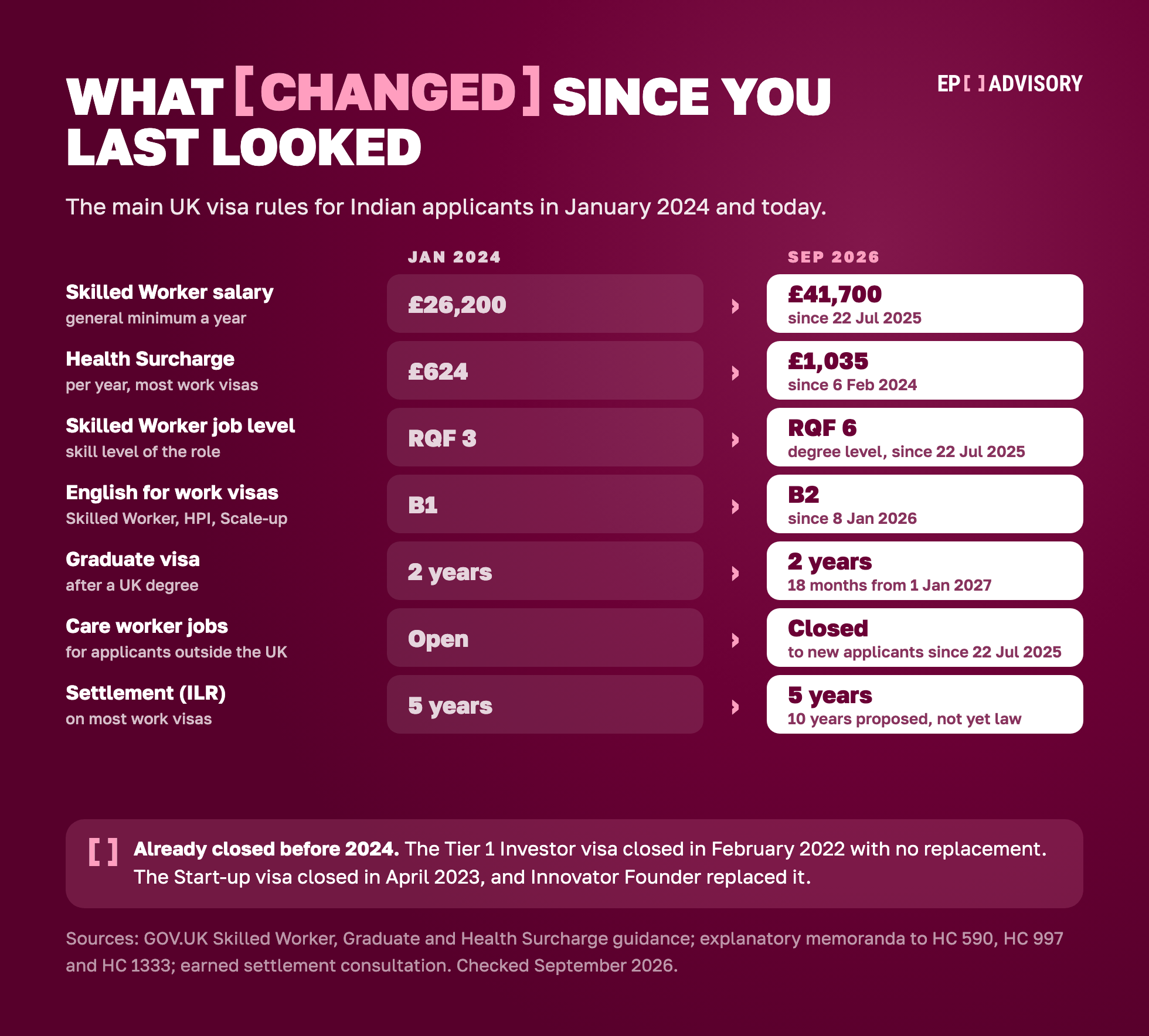
So the appetite has not faded. What has changed is the difficulty. Since 2024 the UK has tightened almost every route: salary thresholds jumped, the Health Surcharge rose by two-thirds, the Graduate visa is being shortened, and dependant rules were cut back. Net migration fell to about 171,000 in 2025, nearly half the level of 2024. The doors are narrower, and the numbers you may have read in an older guide are almost certainly out of date.
This guide gives you the verified 2026 rules for moving to the UK from India: every visa to study, work or build a business, what each one now costs, and how to actually qualify under the points system. On our website you will find lots of advice on making your UK immigration a success. Before you apply, check your CV for free to see how a UK recruiter will read it.
UK Visas for Indian Passport Holders
The sections below cover the main routes for Indian passport holders who want to study, work or start a business in the UK. If you only want to visit for fewer than six months, look into a Standard Visitor visa (£135 from 8 April 2026). And if one of your grandparents was born in the UK, you may qualify for the UK Ancestry visa, a five-year, full-work-rights route open to Commonwealth citizens that leads to settlement.
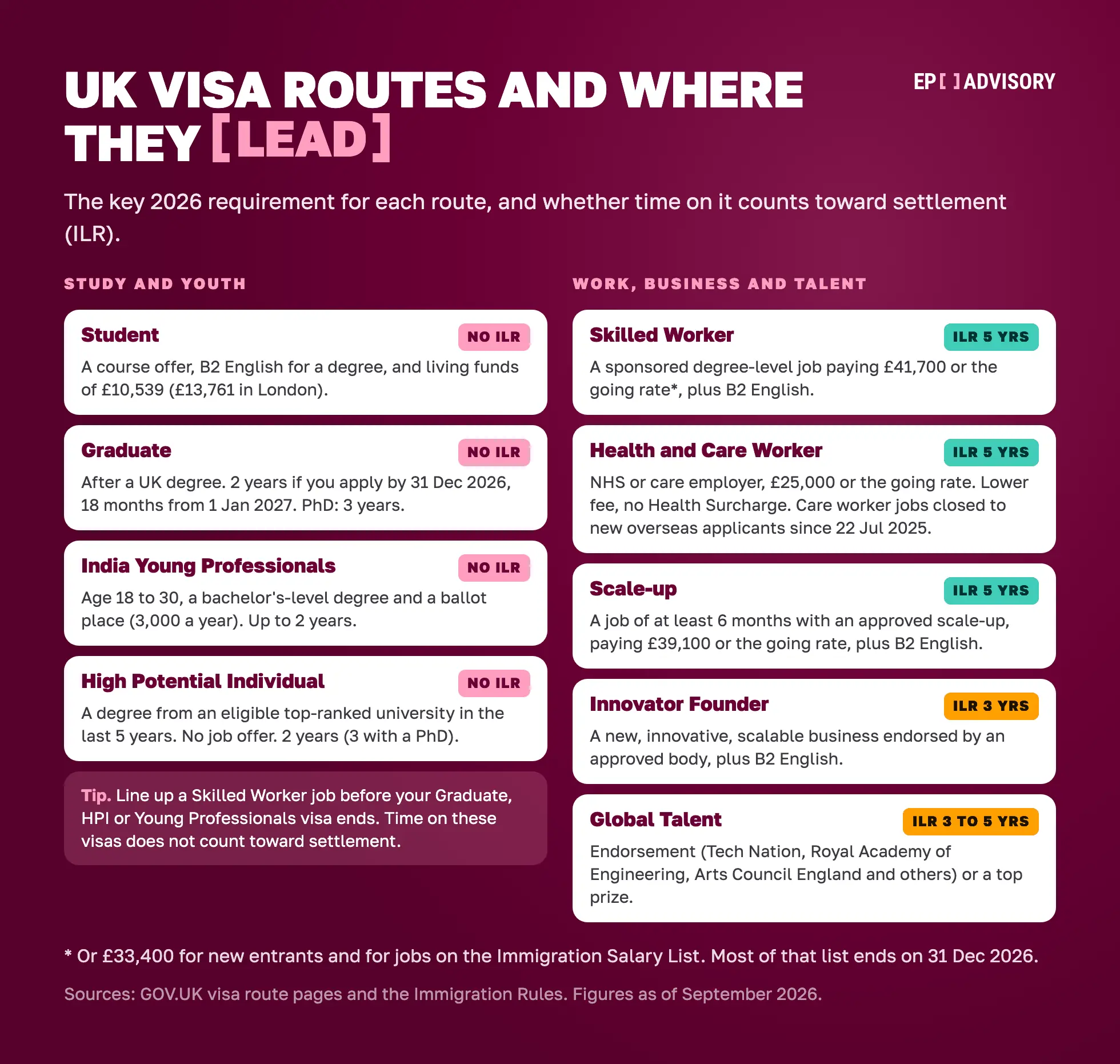
The chart below maps the nine routes most Indian applicants use, the key 2026 requirement for each, and whether the years spent on it count toward Indefinite Leave to Remain (ILR).
UK Student and Graduate Visas for Indians
Studying in the UK remains one of the most reliable ways in. The country has some of the best universities in the world, a UK degree opens the Graduate route, and student visas let you work up to 20 hours a week in term time and full-time in the holidays.
The trick is picking the right course. A one- or two-year Master’s is often the best option, because you can apply on the strength of your existing degree. Tuition for international students typically runs £15,000–£25,000 a year (roughly ₹19–32 lakh, at about ₹127 to the pound in September 2026), and more at top-ranked London schools. Several scholarships are open to Indian students, including Chevening, GREAT Scholarships, Commonwealth Scholarships, the Charles Wallace India Trust and the Inlaks Shivdasani Foundation.
Once you finish, you can move onto a two-year Graduate visa, but note the deadline below, because that window is shrinking. If you graduated from an Indian university instead, look at the India Young Professionals Scheme.
Student Visa for Indians
With an offer for a sponsored course you can apply for a Student visa. Its length matches your course; you can usually arrive up to one month before it starts, and it runs to four months after the end of a course of 12 months or longer (two months after a course of 6 to 12 months).
You must show you can pay your course fees and support yourself. In 2026 the maintenance requirement is £1,529 per month for nine months (£13,761) for a course in London, and £1,171 per month for nine months (£10,539) outside London. The money must sit in your account for 28 consecutive days. For applications made from 30 November 2026, these amounts rise to £1,570 a month (£14,130) in London and £1,203 a month (£10,827) outside London.
You must also prove your English at CEFR level B2 for degree-level study. Your university can usually assess this itself. Otherwise you can use a degree taught in English (checked by Ecctis) or pass an approved Secure English Language Test (SELT).
The application fee is £558, the same whether you apply from inside or outside the UK, plus the reduced Immigration Health Surcharge of £776 per year of study. The visa is renewable. For example, if you finish a Master’s and are offered a place on a doctoral programme.
One important 2024 change: students on taught Master’s and undergraduate courses can no longer bring dependants. Only PhD/research students and government-sponsored scholars on courses longer than six months may bring a partner or children.
Graduate Visa for Indians
If you have recently completed a bachelor’s or postgraduate degree in the UK, the Graduate visa lets you stay to work or look for work with no sponsor required. It is a one-off, non-renewable route, and the years on it do not count toward settlement. The goal is to use the time to land a job that qualifies you for the Skilled Worker route.
The deadline that matters: apply on or before 31 December 2026 and you get the full two years (three for PhDs). Apply on or after 1 January 2027 and the standard Graduate visa drops to 18 months. If you are graduating around now, this is a real reason to apply sooner rather than later.
The fee is £937, plus the Health Surcharge of £1,035 per year. Indians are by far the biggest users of this route, with around 90,000 grants in 2025.

India Young Professionals Scheme
This youth-mobility route is aimed specifically at young Indians. It works like the Graduate visa, but you do not need to have studied in the UK. Indian citizens aged 18–30 with at least a bachelor’s-level qualification can live and work in the UK for up to two years.
First you must enter a free ballot. In 2026 it ran in February and July. Both 2026 ballots have closed, so check the ballot page for the 2027 dates. Places are limited to 3,000 a year, and winners are picked at random. If you win, you have 90 days to make your visa application.
You must have at least £2,530 in savings when you apply. The application fee is £340, plus the Health Surcharge (about £1,552 for the two years). It does not count toward settlement, but it is an excellent way to get UK experience and switch into a Skilled Worker role from inside the country.
High Potential Individual Visa
If you graduated in the last five years from an eligible top-ranked university outside the UK, look at the High Potential Individual (HPI) visa. The eligible list is based on global university rankings, so check it for the year you graduated. You need no job offer and no sponsor. The visa lasts two years (three with a PhD) and cannot be extended, but you can switch to a Skilled Worker visa from inside the UK. It costs £880, plus £252 for an Ecctis check of your degree and the Health Surcharge. You also need English at B2 and usually £1,270 in savings. Time on it does not count toward settlement.
Score your CV in 30 seconds, then fix its biggest problems one by one. Both free.
Free, no card.

Work Visas for the UK for Indians
Work visas are the route to take if you want to settle in the UK permanently. They are tied to your job, so if you lose or change it, the visa must be updated or it ends.
The bar is higher than it used to be. Since July 2025 a Skilled Worker job must be at degree level (RQF 6) and pay a general minimum of £41,700 a year, up from £26,200 before April 2024. That single change removed many mid-skill roles (care, hospitality, technician jobs) from the list, so targeting the right, well-paid field matters more than ever. You can search UK jobs on our website.
A genuinely new 2026 benefit: under the India–UK trade agreement, the Double Contributions Convention came into force on 15 July 2026. Indian employees seconded to the UK (and their employers) can stay on Indian social security and avoid UK National Insurance for up to five years, with an EPFO certificate of coverage. This saves National Insurance rather than opening a new visa route, so it does not change who can work in the UK. But it can meaningfully raise take-home pay for intra-company moves.
Skilled Worker Visa for Indians
With an acceptable offer from a licensed UK sponsor you can apply for a Skilled Worker visa, granted for up to five years before extension. Your employer issues a Certificate of Sponsorship for your application.
To qualify in 2026 your job must be at RQF 6 (degree level) and pay the higher of £41,700 a year or the “going rate” for the occupation, which is now set at the 50th percentile of pay for that role. Lower floors apply in some cases: £33,400 for new entrants (such as under-26s and recent graduates) and relevant STEM PhDs, £37,500 for other relevant PhDs, and £33,400 for jobs on the Immigration Salary List, which still require 100% of the going rate. Most of that list ends on 31 December 2026. The Temporary Shortage List keeps some jobs below degree level open until the same date, but it gives no salary discount and no right to bring dependants. You must also prove English at B2.
Application fees depend on length and job type: from outside the UK, £819 for up to three years and £1,618 for longer; from inside the UK, £943 and £1,865; and reduced fees (£628 / £1,235) for salary-list jobs. You will also pay the Health Surcharge (£1,035 per year) and must show £1,270 in maintenance funds unless your employer certifies it.
Health and Care Worker Visa for Indians
Qualified doctors, nurses and other health professionals with a job offer from the NHS, an NHS supplier or an adult social care employer can use the Health and Care Worker visa. It costs less than the Skilled Worker visa: from outside the UK the fee is £324 for up to three years and £628 for longer, and you do not pay the Health Surcharge. Pay must usually be at least £25,000 or the going rate, whichever is higher. The route leads to settlement after five years. Care workers: care worker and senior care worker jobs have been closed to new applicants from outside the UK since 22 July 2025. Only some people already in the UK on a work visa can still switch or extend in these roles.
Scale-Up Worker Visa for Indians
To help fast-growing companies hire talent, the Scale-Up Worker visa requires only the first six months to be sponsored; after that you can change employer freely. You need a job offer of at least six months from an approved scale-up business, paying at least £39,100 a year or the going rate, whichever is higher, and English at B2. The visa is granted for two years and can be extended by three years at a time. The application fee is £937, plus the Health Surcharge. After five years you can apply to settle, so you do not need to switch to the Skilled Worker route.
Temporary Work Visas for Indians
If your work does not qualify for the Skilled Worker or Scale-Up routes, a Temporary Work visa may still fit. There are several categories on the UK immigration website:
- Seasonal Worker
- Government Authorised Exchange
- Creative Worker
- Religious Worker
- Charity Worker
- International Agreement
Most last between 6 months and 2 years depending on the category, and they do not lead to settlement.

UK Entrepreneur and Talent Visas for Indians
If you want to build a business or move as a recognised leader in your field, two routes remain open. But be aware that some older options have closed. The Tier 1 (Investor) “golden visa” shut to new applicants in February 2022, and the old Start-Up visa closed in April 2023. The Innovator Founder visa replaced the Start-up visa. The Investor visa has no replacement.
Innovator Founder Visa for Indians
The Innovator Founder visa is now the main “start a business” route. Your business idea must be new, innovative, viable and scalable, and it must be endorsed by an approved endorsing body; you also need English at B2. The visa is granted for three years and can lead to settlement after just three years if you meet the criteria.
It costs £1,357 from outside the UK and £1,693 from inside, plus a £1,000 endorsement fee, two mandatory £500 contact-point meetings (at 12 and 24 months) and the Health Surcharge.
Global Talent Visa for Indians
The Global Talent visa is for leaders and potential leaders in academia and research, arts and culture, or digital technology. You apply for an endorsement from the relevant body: UKRI, the Royal Society, the Royal Academy of Engineering or the British Academy for research, Arts Council England for arts and culture, and Tech Nation for digital technology. Winners of certain major prizes (on the eligible prize list) can skip endorsement. The visa is granted for up to five years at a time, and settlement can come after three years in many cases. Fees are £561 for the endorsement and £205 for the visa (or £766 on the prize route), plus the Health Surcharge. The bar is very high, so most Indian professionals move on the Skilled Worker visa instead.
UK Visas: Points, Partners, and the Healthcare Surcharge
Whatever route you choose, three things cut across all of them: the points system, the rules for bringing your family, and the Health Surcharge.
Points System
The Skilled Worker route uses a points-based system, and you need 70 points to qualify. Fifty of them are fixed and non-negotiable: a job offer from a licensed sponsor (20), a job at the required skill level (20), and English at B2 (10). The final 20 “tradeable” points come from your salary, or from a relevant PhD, a PhD in a STEM subject, or a job on the Immigration Salary List. Because the mandatory points now demand a degree-level job and B2 English, targeting the right field is more important than ever.
Partners and Dependents
On most long-term visas your partner and children can come with you, and your partner can usually work with few restrictions. The UK recognises a husband, wife, civil partner, or an unmarried partner if you can show a relationship of at least two years. Children under 18 count as dependents (and those over 18 only if they were already in the UK as your dependents).
You pay a separate application fee and Health Surcharge for each person. You must also show extra maintenance funds: £285 for a partner, £315 for your first child and £200 for each additional child. Remember that on the study route, taught-Master’s and undergraduate students can no longer bring dependants at all.
Healthcare Surcharge
Almost everyone on a long-term visa pays the Immigration Health Surcharge, which funds the NHS and gives you the same access to healthcare as UK residents (most services free; you still pay for things like prescriptions and dental care). It is paid up front for the whole length of your visa, and it is refundable if your visa is refused.
The standard rate is £1,035 per person per year, with a reduced rate of £776 for students, the Youth Mobility route and under-18s. It rose by about two-thirds in February 2024 (from £624), so budget for it carefully. For a five-year Skilled Worker visa it adds more than £5,000 per person.
See what a recruiter sees, then fix it before you apply. An instant score, then the fix for every problem.
Free, no card.
Path to Permanent Residence
Like most countries, the UK asks you to live there for a qualifying period before you can apply for permanent residence, called Indefinite Leave to Remain (ILR).
On a work visa you can currently expect to qualify for ILR after five years. Some routes are faster: Global Talent and Innovator Founder can lead to settlement in three. Time on the Student and Graduate visas does not count toward the five years. Once you have held ILR for 12 months, you can apply for UK citizenship. From 26 March 2027, settlement applications will also need English at B2.
Watch this space: the government’s May 2025 immigration White Paper proposed extending the standard settlement period from five years to ten, with a faster “earned” route for higher contributors. A public consultation on this closed in February 2026 and the details are not yet law. If you are planning to settle, the five-year route still applies today. The proposals point toward a longer wait, so plan your route early.
FAQs About Migrating to the UK from India
Move to the UK from India
Ready to head to London or another UK city to study or start your dream job? Start with a free CV check: a score in 30 seconds, then a fix for each problem before you apply to UK employers.