 By Nina Shevchenko, HR Director in Paris
Finding a job in France in 2026 is a real opportunity — if you understand how the local market works. Unemployment has ticked up to around 8.3% (INSEE, Q2 2026), yet tech, healthcare and engineering are still actively recruiting internationally, and France runs one of Europe’s most accessible skilled-worker visas. The catch is that France plays by its own rules: the 35-hour week, a deep respect for the French language, and a hiring market where who you know matters more than almost anywhere else in Europe.
This guide covers the practical picture for 2026 — where the jobs are, which of the two skilled-worker visas fits you, how the networking-driven market really works, and the paperwork that turns an offer into a life in France. Comparing bars across the continent? See our work visa & Blue Card salary thresholds in Europe guide.
Over 7 years we have helped more than 5,000 professionals find work abroad. To assess your chances in France specifically, find your career consultant.
France at a glance for job seekers
- Average pay: mean net salary ~€2,733/month, median ~€2,190 (INSEE, private sector). Paris pays roughly 30% above the national average.
- Minimum wage (SMIC): €1,867/month gross (~€1,478 net) from 1 June 2026; €12.31/hour.
- The work week: 35 hours, legally enforced, plus RTT days and a legal “right to disconnect”.
- Two skilled visas: the Talent card and the EU Blue Card — France has both, and the Talent card needs no labour market test.
- Where the jobs are: tech (Paris, Station F, Mistral AI), engineering (Toulouse/Airbus), pharma, healthcare, finance (La Défense) and luxury (LVMH, Hermès).
- The market: networking-driven — an estimated 60–70% of roles are filled through connections (the “marché caché”).
- Language: English works in tech and international firms, but French (even B1) transforms your options — and is now required for residence cards.
Where the jobs are: sectors and salaries
France’s economy is forecast to grow modestly in 2026, with tech, healthcare and engineering driving demand. Here is what each sector pays and where the jobs cluster.
| Sector | Annual salary range | Key cities | Trend |
| Tech / Software | €45K–90K+ | Paris, Lyon, Toulouse, Nantes | Fastest wage growth; Mistral AI, Doctolib, Station F ecosystem |
| Finance / Insurance | €50K–100K+ | Paris (La Défense) | Competing with London and Frankfurt |
| Engineering | €40K–70K | Toulouse, Lyon, Grenoble | Aerospace (Airbus), automotive, energy |
| Pharma / Healthcare | €30K–80K | Lyon, Paris, Strasbourg; nationwide for health | Critical shortages, especially outside Paris |
| Luxury / Fashion | €35K–75K | Paris | LVMH, Hermès, Kering — globally unique |
| Hospitality / Tourism | €22K–40K | Paris, Côte d’Azur, Alps | High demand, lower pay |
A real example. Mistral AI, the Paris-based AI startup founded in 2023, is now one of Europe’s most valuable tech companies and hires ML engineers and researchers from around €70K for mid-level roles. The Station F campus houses 1,000+ startups — the world’s largest incubator. For tech talent, Paris increasingly competes with Berlin and London.
The two work visas: your route in
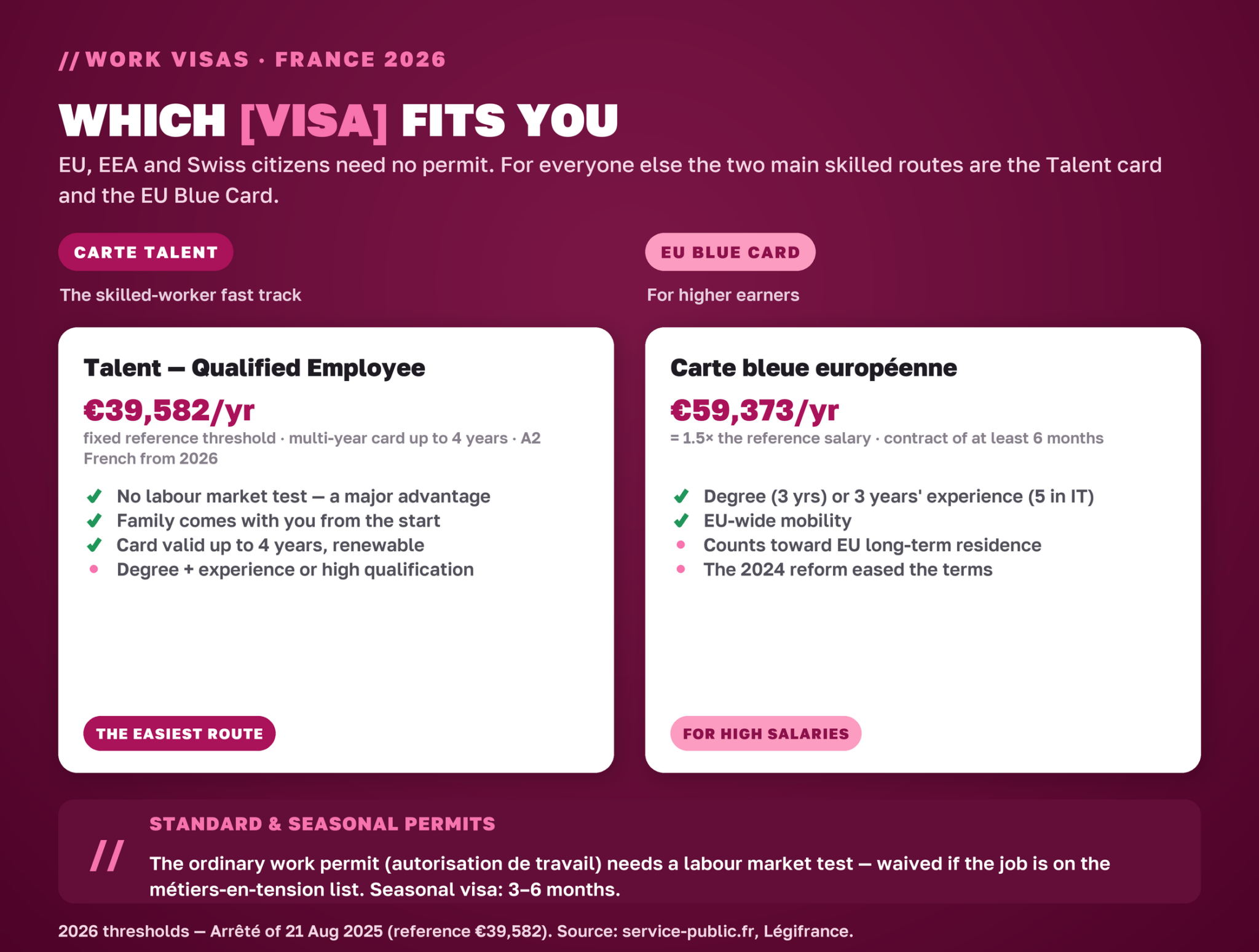
Citizens of the EU, the EEA and Switzerland need no permit. For everyone else, the two main skilled routes both skip a lot of friction — and the old “Passeport Talent” was renamed the carte de séjour talent by the January 2024 immigration law.
- Talent card — Qualified Employee. The most common skilled route. Minimum gross salary €39,582/year (the fixed 2026 reference set by the Arrêté of 21 August 2025). No labour market test, immediate family reunification, and a multi-year card valid up to 4 years. From 2026, renewing to the multi-year card requires French at A2.
- EU Blue Card (carte bleue européenne). For higher earners: minimum gross salary €59,373/year (1.5× the reference), a contract of at least 6 months, and a degree or 3 years’ relevant experience (5 in some IT roles). It brings EU-wide mobility and counts toward EU long-term residence. The 2024 reform eased its terms.
- Standard and seasonal permits. The ordinary work permit (autorisation de travail) still needs a labour market test — automatically waived if your occupation is on the official métiers-en-tension shortage list (Arrêté of 21 May 2025). The seasonal visa covers 3–6 months in agriculture and tourism.
Current thresholds and categories are published by service-public.fr.
First role abroad, a mid-career move, or a senior step up. Tell us where you are and we’ll match you with the right consultant and service.

How to find a job: networking comes first
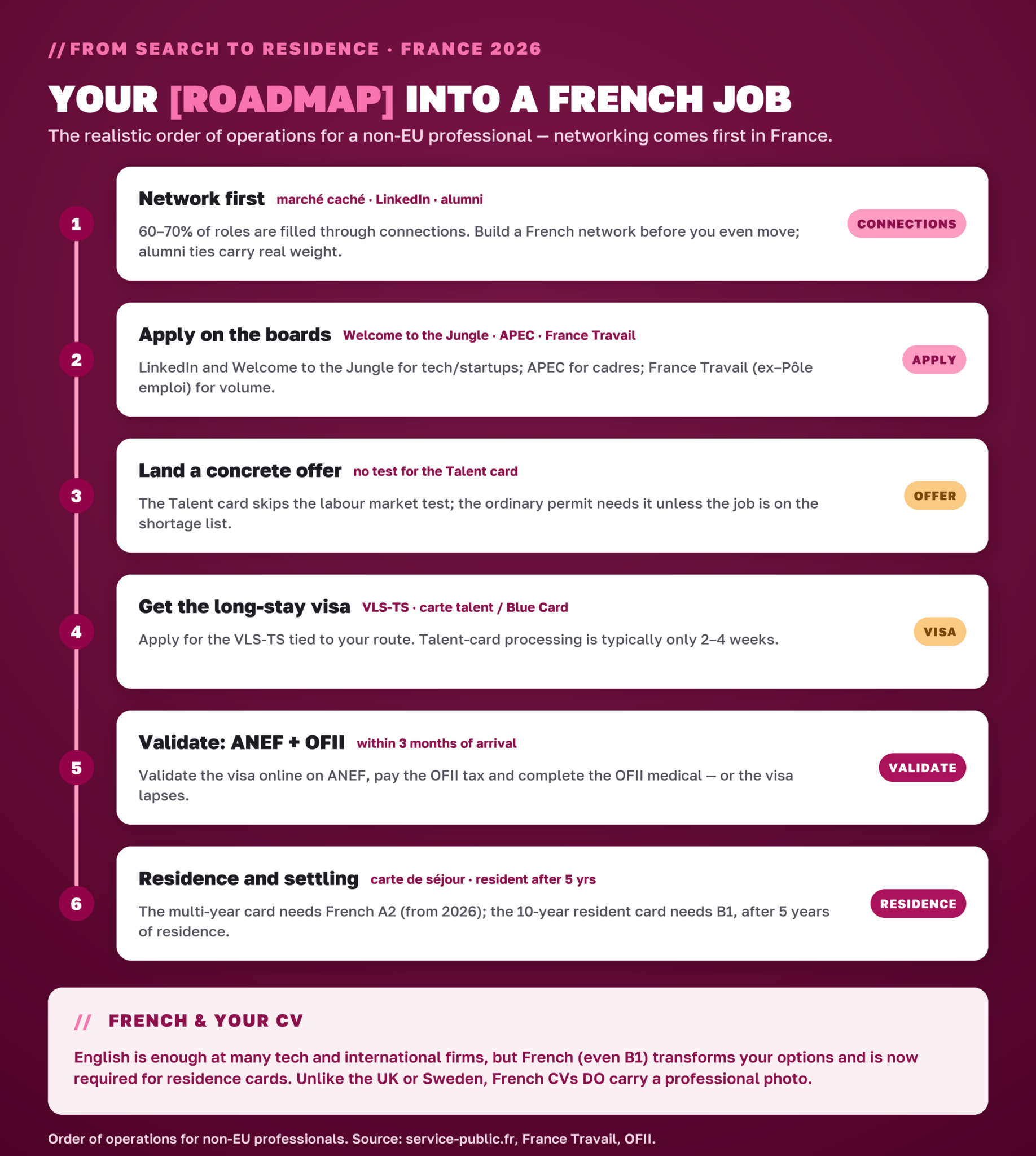
In France, who you know matters more than almost anywhere else in Europe — an estimated 60–70% of positions are filled through personal connections, the “marché caché” (hidden market). Work all three channels, in this order.
- Network first. Join industry groups (“French Tech”, “La French Touch”), use alumni networks (French firms respect shared “grandes écoles” ties), and message hiring managers directly. Build your French network before you even move.
- Job boards and LinkedIn. LinkedIn and Welcome to the Jungle (rich company-culture pages) for tech and startups; APEC for cadres (managers); Indeed and France Travail (the public service, renamed from Pôle emploi in 2024) for volume; Malt for freelancers.
- Career fairs. VivaTech (Paris, June — Europe’s biggest tech conference), Paris pour l’Emploi (October) and regional Salon de l’Emploi events are strong for face-to-face networking.
French work culture: what actually matters
- The 35-hour week is real — most people work ~39 hours and bank RTT (compensatory rest) days, and a legal “right to disconnect” means no obligation to answer email after hours.
- Hierarchy and formality. French firms are more top-down than Nordic or Anglo ones. Use “vous” until invited to switch to “tu”; titles and educational credentials carry weight.
- The lunch break is sacred — 1 to 1.5 hours, rarely at your desk, often with “tickets restaurant” (~€8–10/day). Lunch and the after-work “apéro” are where trust is built; join in.
- Continuous learning is embedded. The CPF (Compte Personnel de Formation) funds training for every employee, and mentioning your upskilling is welcomed.
CV and interviews, the French way
- A photo is expected — unlike the UK or Sweden, French CVs carry a professional headshot. Keep to 1 page (juniors) or 2 (experienced), reverse-chronological, with CEFR language levels and your degrees (grandes écoles and known universities matter).
- Write it in French if you can — even an honest, imperfect French CV, proofread by a native speaker, scores points over an English-only one.
- Never raise salary first. In France, money is discussed late; asking about pay early in the process is a fast way onto the reject pile. Research the market, and offer a range only when asked.
After the offer: visa, OFII and settling in
The order of operations matters.
- Secure the offer and visa. Apply for the long-stay visa (VLS-TS) tied to your route; the Talent card is typically processed in just 2–4 weeks.
- Validate within 3 months. Validate the visa online on the ANEF portal, pay the OFII tax and complete the OFII formalities and medical — miss this and the visa lapses.
- Get set up. Open a bank account, register with the Sécurité Sociale, and take out an employer “mutuelle” top-up.
- Build toward residence. The multi-year card requires French at A2 (from 2026); the 10-year resident card requires B1, after 5 years of residence (or sooner with strong integration).
The Talent card is winnable and the culture is rewarding — but French really matters here, and the market runs on relationships. In a 1:1 session we assess your profile honestly and map the fastest route in.
Key takeaways
- France’s tech scene is real — Paris competes with Berlin and London, with tech pay €45K–90K+ — but unemployment is up (~8.3%), so target the shortage sectors: tech, healthcare, engineering.
- 60–70% of roles are filled through networking. The “marché caché” is real — invest in relationships before you apply.
- Two skilled visas: the Talent card (€39,582, no labour market test, 4-year card) or the EU Blue Card (€59,373). The old “Passeport Talent” is now the carte de séjour talent.
- French is a real advantage — and now a requirement for residence cards (A2 for the multi-year card, B1 for the 10-year one).
- Write a French-style CV (with a photo) and never raise salary first in interviews.
- After the offer: VLS-TS → validate on ANEF + OFII within 3 months → carte de séjour → resident card after 5 years.
FAQs
For how France’s bar compares across the continent, see our work visa & Blue Card salary thresholds in Europe 2026 guide, or the broader how to find a job in Europe.