 By Aleksei Gavrilov, Career Consultant at EP Advisory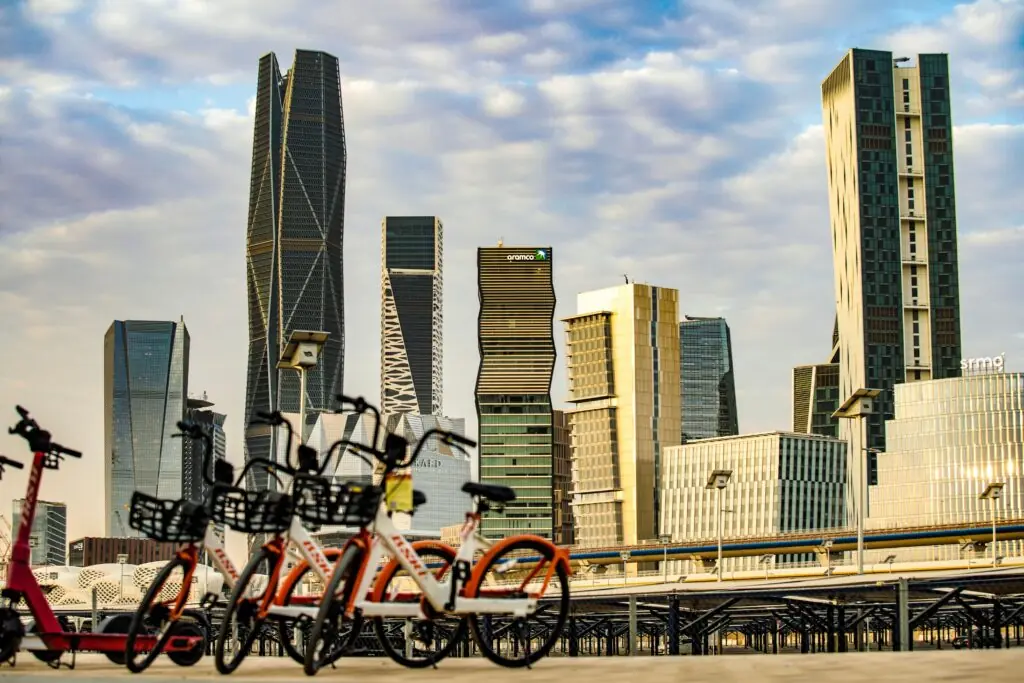
Saudi Arabia has become one of the most interesting moves in the Gulf for international professionals — and on several measures a better deal than neighbouring Dubai. The Kingdom is rebuilding its economy under Vision 2030, pulling in multinational head offices and paying salaries with no personal income tax: the figure on your contract is what lands in your account. The average professional salary in Riyadh is around SAR 12,000–18,000 a month (≈ $3,200–4,800), and experienced engineers, tech specialists and executives earn considerably more.
This guide covers the practical picture for 2026: which visas and residencies exist, how to get your Iqama and Premium Residency without a sponsor, what people actually earn by sector, what living costs, where the jobs are, and what to expect day to day. For related reading see our UAE & Saudi Arabia work-visa guide and jobs in the Gulf. For a personal read on how your profile fits, see how we work — Marina Sushentseva specialises in the Gulf market.
Saudi Arabia at a glance
- Tax: no personal income tax on salaries (0%). There is 15% VAT and a small GOSI social-insurance contribution (~2% for foreign workers).
- Entry: the tourist eVisa is open to many nationalities, and visa-free access is expanding (Russia, for example, from 11 May 2026). To work, you still need a proper work visa.
- Work starts with an offer: your employer is your sponsor and arranges the work visa through Qiwa and MOFA.
- Long term: Premium Residency lets you live, work and run a business without a local sponsor.
- Where the jobs are: Riyadh is now a magnet for regional HQs (700+ multinationals), plus giga-projects and tourism.
- Watch out: Saudization (Nitaqat) reserves many administrative and retail roles for nationals — expats are hired where local skills are scarce.
Visas and residency: from offer to Iqama
Your move begins with a job offer. The employer becomes your sponsor and arranges the permit: first securing a quota and checking Saudization compliance on the Qiwa platform, then issuing an invitation through the Ministry of Foreign Affairs (MOFA) e-Services. The visa is stamped at a consulate in your home country.
You enter on a Work Visit Visa (Type 18), valid for 90 days — and the clock starts ticking. You complete a medical check and biometrics, after which the visa is converted into your Iqama, the resident ID. Without an Iqama you can’t open a bank account, sign a long-term lease, or travel in and out as a resident. Book your appointments in the first week: the 90-day mark is a firm deadline.
New in 2026 — qualification checks. For many professions (engineers, doctors, IT, accountants, plus skilled trades) you must clear Professional / Skill Verification — validation of your degree and occupational competency — before the work visa is issued. The programme covers 1,000+ professions across 23 sectors, and in 2026 the check is built into Qiwa: without a valid certificate the system blocks both the visa and Iqama renewals. Prepare your degree attestation early.
Score your CV in 30 seconds, then fix its biggest problems one by one. Both free.
Free, no card.

Premium Residency: how to stay without a sponsor
For anyone planning to stay long term, the goal is Premium Residency. This is residency without a kafala sponsor: you sponsor yourself, can change employers, run a business and own property. You can apply from inside the Kingdom or from abroad, directly through the official Premium Residency Center (pr.gov.sa).
Between 2024 and 2026 the programme was expanded from two options into a full menu of categories. It used to be a choice between the permanent residency at SAR 800,000 and the annual one at SAR 100,000. Now there is a key track for professionals — Special Talent — granted on salary rather than a large lump sum.
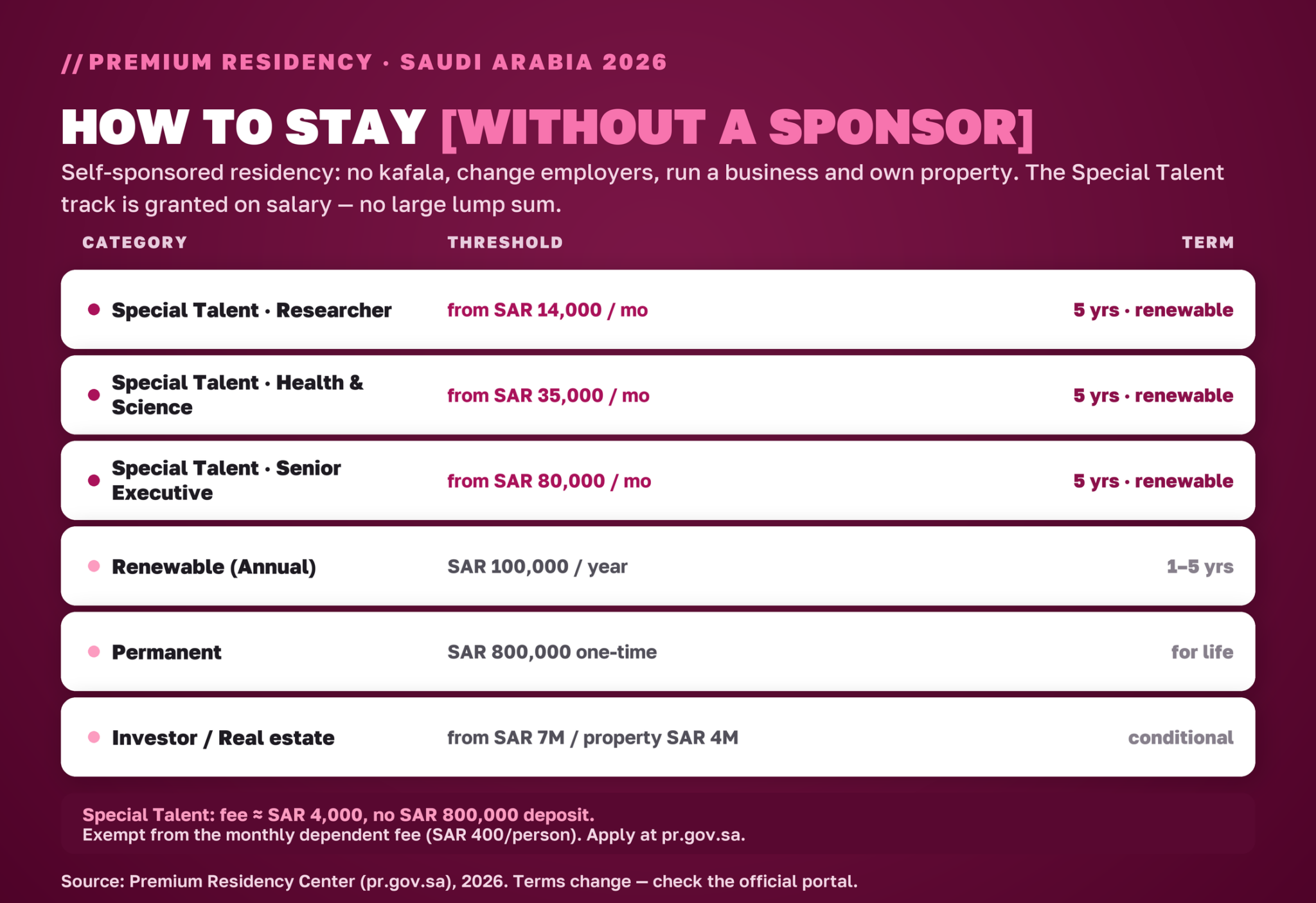
The Special Talent thresholds are confirmed for 2026: researchers from SAR 14,000/mo, healthcare and scientific professionals from SAR 35,000/mo, and senior executives from SAR 80,000/mo. You also need a degree, 3+ years’ experience, an employer recommendation and proof of excellence (for researchers, typically at least three peer-reviewed papers). The permit fee is around SAR 4,000 — with no SAR 800,000 deposit.
A further advantage: Premium Residency holders are exempt from the monthly dependent fee (below) and can bring family without being tied to an employer.
Salaries in Saudi Arabia 2026
The headline advantage is the absence of income tax. Your contract figure is very close to what reaches your account (a small social contribution aside). On top of base pay, senior professionals often get a package: a housing allowance (SAR 1,500–5,000+/mo), annual flights, medical cover and school fees for children.
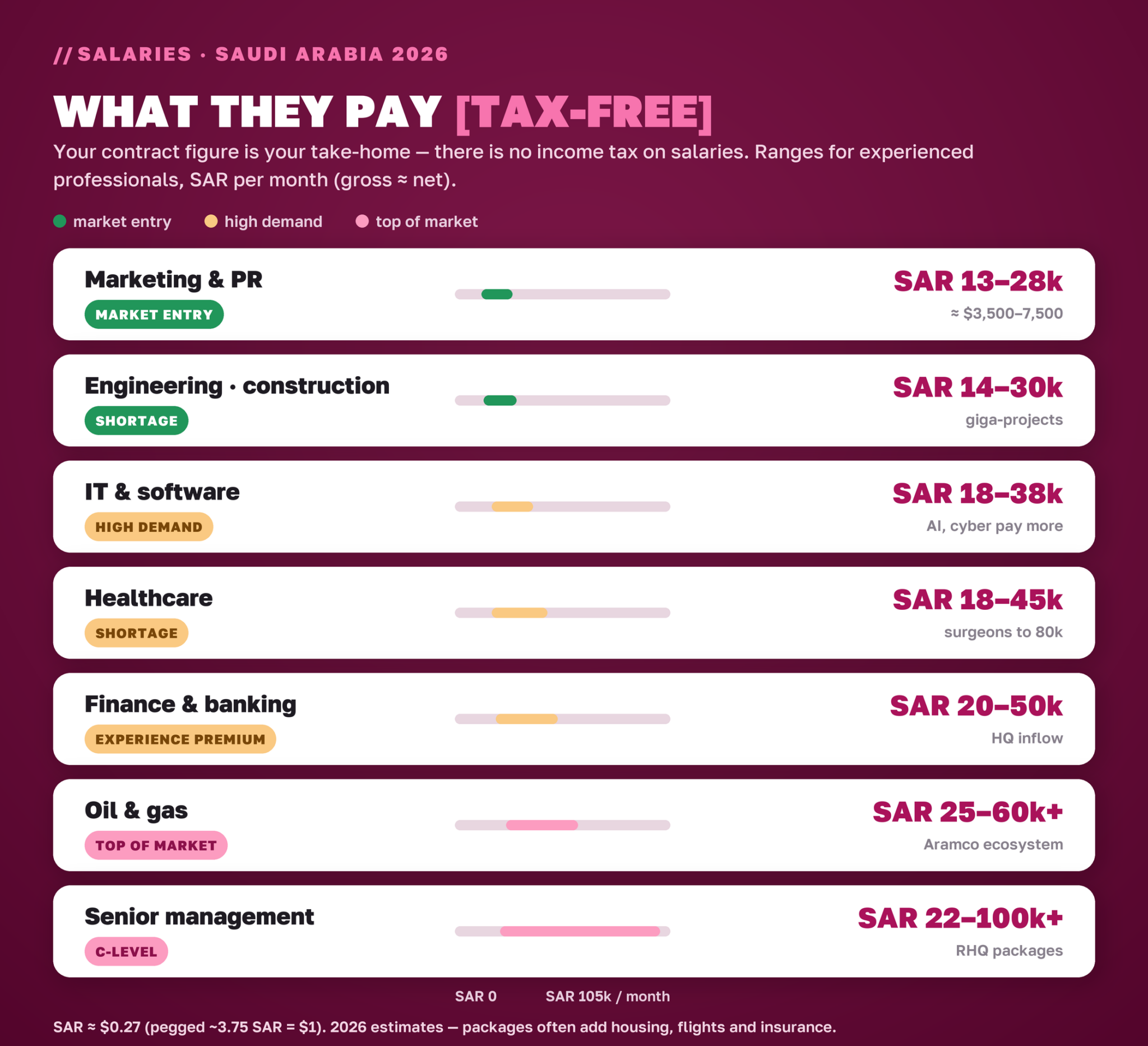
On the currency: the Saudi riyal (SAR) is pegged to the US dollar at about 3.75 SAR = $1, so 1 SAR ≈ $0.27. To estimate in dollars, divide the riyal figure by roughly 3.75 (SAR 10,000 ≈ $2,650). Riyadh is the highest-paying city; packages in Jeddah and elsewhere are usually a little lower.
Cost of living: Riyadh and Jeddah
Saudi Arabia is noticeably cheaper than Dubai — by an estimated 23–40%, with the gap widest on housing and dining. Weighing the two? Our guide to jobs in Dubai for foreigners covers visas, in-demand sectors and hiring on the UAE side.
Riyadh rent: a studio or one-bedroom in the centre runs about SAR 2,700–3,500/mo (≈ $720–930), up to SAR 5,000–7,000 in prime areas. A family villa in a gated compound is around SAR 15,000–20,000/mo. Jeddah is typically 10–15% cheaper.
Budget: a single professional is comfortable on SAR 7,000–12,000/mo (≈ $1,900–3,200) all-in; a family of four on around SAR 18,000–28,000/mo, excluding private school (a significant separate cost). Western families usually live in compounds — gated communities with pools, gyms and more relaxed internal rules.
Late in 2025 a five-year rent freeze on existing contracts was introduced, so sitting tenants have stable rents; new leases in prime districts still cost more.
Where the jobs are: Vision 2030 and regional HQs
Demand for foreign professionals rests on Vision 2030 and the inflow of international business.
- Regional Headquarters (RHQ) programme. Since 1 January 2024, foreign firms must base their regional HQ in the Kingdom to win government contracts. By early 2026 700+ companies (Amazon, Google, Microsoft, PwC and others) had opened RHQs in Riyadh — concentrating corporate, finance, consulting and IT roles in the capital.
- Giga-projects. The most active hirers are Diriyah Gate (a heritage-and-tourism district in Riyadh, the strongest hiring story) and Qiddiya (an entertainment and sports city), plus the housing developer ROSHN and King Salman Park.
- An honest word on NEOM. The flagship megacity NEOM and its linear city THE LINE were sharply scaled back in 2025: construction on THE LINE was suspended and pushed beyond 2030, and resident targets were cut by orders of magnitude. NEOM is being repositioned toward industry, data centres and green energy. Treat the “city of the future” promises with caution — Riyadh, Diriyah and Qiddiya are the safer bets.
Who is hired most: IT (AI, cybersecurity, cloud), engineering and construction (a shortage of 200,000+ workers across giga-projects and the 2034 World Cup build-out), healthcare (doctors and specialists), tourism and hospitality (1m+ jobs, ~75% held by expats), and finance and fintech.
Saudization (Nitaqat): what’s open and what isn’t
The flip side of the market is Saudization: the state reserves a share of jobs for nationals. In 2026 the policy tightened — a new Nitaqat cycle launched, the “yellow” tier was scrapped and quotas rose. A number of areas are partly or fully closed to expats — many administrative, HR, reception and customer-facing roles, and retail cashiers — while quotas are climbing in marketing/sales, accounting and engineering.
In practice, expats are hired where local skills are scarce — in senior, technical and specialist positions. Volume and entry-level office roles are harder to land. Premium Residency holders on the Special Talent track are excluded from Nitaqat counts — another argument for that status.
Life on the ground
Vision 2030 has changed daily life noticeably, though the Kingdom remains a conservative Muslim society.
- Women driving — legal since 2018; women drive, rent cars and travel independently.
- Relaxed dress code: the abaya has been optional for foreign women since 2019 — modest dress (covered shoulders and knees) is enough. Rules are looser inside compounds.
- Leisure: cinemas, concerts, the Riyadh Season festival and tourism now form a real entertainment economy.
- Alcohol is still banned. The only exception is a single store in Riyadh’s Diplomatic Quarter (for non-Muslims — Premium Residency holders and higher-earning expats, by registration). There are no bars and no retail sale.
- Flights: since August 2025 flynas has run direct Riyadh–Moscow flights, and connectivity across the region is strong.
Realistically, the country is excellent for fast savings (no tax plus a package) and is safe, and a compound offers a familiar Western-style setup. It is still an adjustment to a different way of life — prayer times, Ramadan, no alcohol or pork on open sale, and gender conventions in public. International schools exist but are expensive.
Taxes and mandatory fees
- Income tax on salaries — 0%. This is the key advantage.
- VAT — 15% (in effect since mid-2020), built into prices.
- GOSI social insurance — around 2% of salary for foreign workers (higher for nationals). “Tax-free” is not the same as “deduction-free.”
- Dependent fee — SAR 400 per month for each family member on your Iqama (≈ SAR 4,800/year per person; about SAR 14,400/year for a family of four). Premium Residency holders are exempt.
See what a recruiter sees, then fix it before you apply. An instant score, then the fix for every problem.
Free, no card.
Key takeaways
- Tax-free salary plus a package (housing, flights, insurance) give strong savings potential.
- You start on an employer-sponsored work visa and Iqama (a 90-day window); clear the qualification check in Qiwa in advance.
- The long-term goal is sponsor-free Premium Residency; for professionals the Special Talent salary track is the most realistic route.
- Target jobs where there is a shortage: capital-based HQs, giga-projects (Diriyah, Qiddiya), IT, engineering and healthcare.
- Factor in Saudization and cultural norms — and budget for schooling and the dependent fee if you bring family.
FAQs
See also: UAE & Saudi Arabia work visas and jobs in the Gulf.