 By Aleksei Gavrilov, Career Consultant at EP Advisory
Ireland is the rare European country where a skilled professional from outside the EU can be hired in English, earn a strong salary, and land inside the EU single market — all at once. It is the European headquarters for much of global tech and pharma, from Google and Meta to Pfizer and Boston Scientific, and those companies hire in English by default.
This guide is the practical, 2026 picture: where the jobs actually are, which of the two work permits fits you, how the recruiter-led market really works, and the paperwork — PPS number, Revenue, immigration stamps — that turns an offer into a life in Ireland. For what those jobs pay after tax and Dublin rent, see our companion salaries in Ireland guide.
In nearly 10 years we have helped more than 5,000 professionals find work abroad. Want to know if your CV will pass screening in Ireland? Check your CV for free: a score in 30 seconds, then a fix for each problem.
Ireland at a glance for job seekers
- Language: English is the working language of essentially every professional role — no language barrier for most jobs.
- Inside the EU: the only large English-speaking economy fully inside the EU single market after Brexit.
- Two work permits: Critical Skills (CSEP) and General (GEP) — and no EU Blue Card, because Ireland opted out.
- Where the jobs are: tech (Dublin’s “Silicon Docks”), pharma and medtech (Cork, Dublin, Galway), financial services (the IFSC), engineering and healthcare.
- Minimum wage: €14.15/hour from 1 January 2026, among the highest in the EU.
- The catch: Dublin housing is at its tightest in a generation — weigh the salary against the rent before you commit.
- Paperwork: you need a job offer before any permit, and a PPS number before you can be paid.
The two work permits: your route in
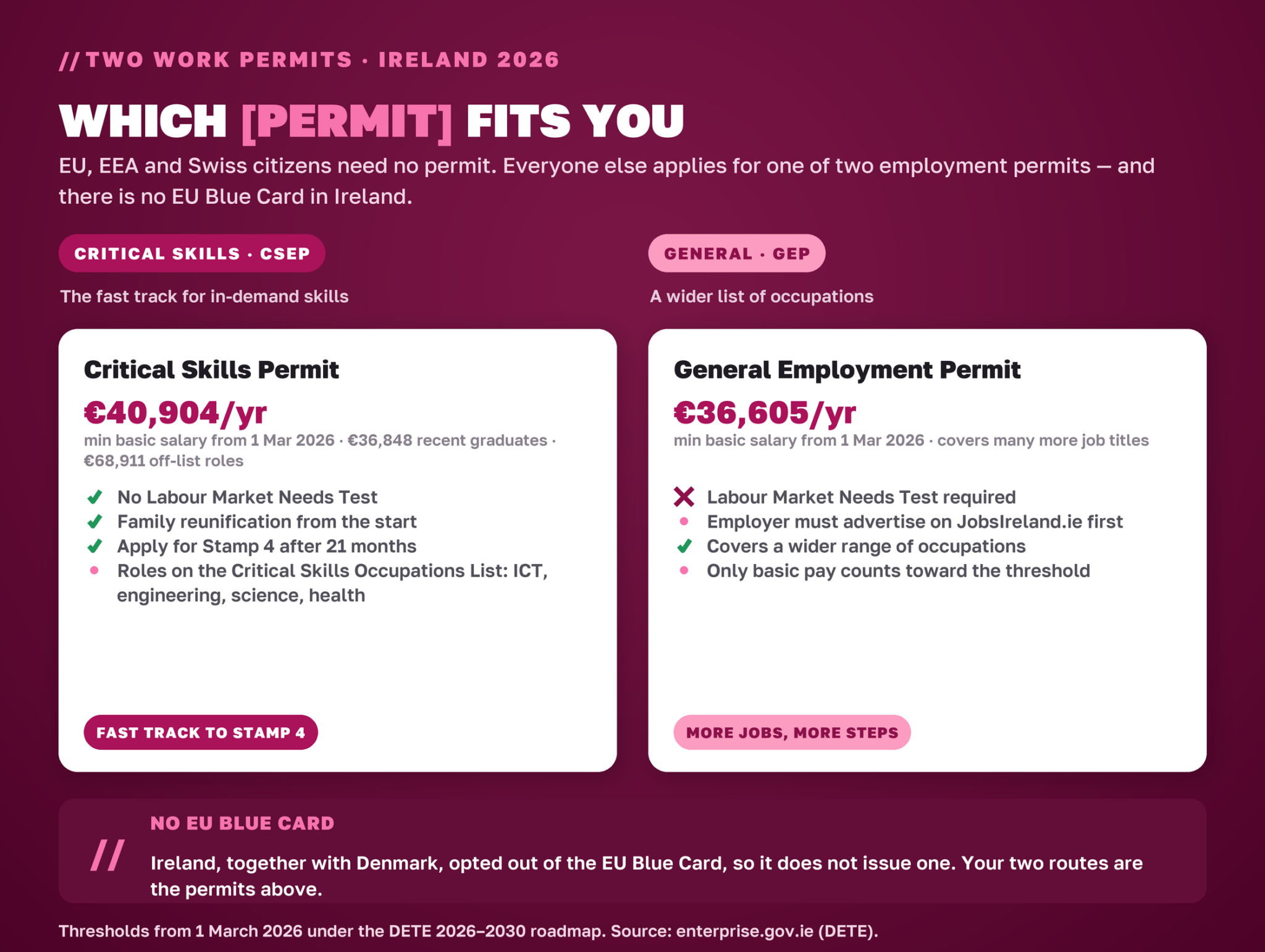
Citizens of the EU, the EEA and Switzerland work in Ireland with no permit at all. For everyone else there are two employment permits, and the salary thresholds rose on 1 March 2026.
- Critical Skills Employment Permit (CSEP) — the fast track. Minimum salary €40,904 for roles on the Critical Skills Occupations List (most ICT, engineering, science and many health roles); €36,848 for recent graduates; and any eligible role paying over €68,911 qualifies regardless of the list. There is no Labour Market Needs Test, family reunification is immediate, and you can apply for long-term Stamp 4 residence after just 21 months.
- General Employment Permit (GEP) — minimum salary €36,605, covering a much wider list of occupations. It requires a Labour Market Needs Test: the employer must first advertise the role on JobsIreland.ie and show that no EEA candidate was available. Only basic pay counts toward the threshold.
- No EU Blue Card. Ireland is one of only two EU states — together with Denmark — that opted out of the EU Blue Card, so it does not issue one. If a recruiter or an article tells you to apply for an “Irish Blue Card”, it does not exist; your routes are the two permits above.
- Who applies: the employer or you can file online through the Employment Permits Online System (EPOS), but you need a concrete job offer first. Processing typically takes several weeks.
A CSEP holder registers a Stamp 1 immigration permission (the permit itself runs two years). After 21 months of employment you can apply directly to the immigration authorities for Stamp 4, which lets you live and work without any employment permit and opens the path to long-term residence. Current thresholds and occupation lists — on a published roadmap that runs to 2030 — are maintained by the Department of Enterprise, Trade and Employment (DETE).
Score your CV in 30 seconds, then fix its biggest problems one by one. Both free.
Free, no card.

Where the jobs are: sectors and employers
Ireland punches far above its size because of foreign direct investment — IDA Ireland recorded a record 323 new investments in 2025, up 38% on the year, led by tech, pharma and financial services. Your realistic chances are strongest where skills are genuinely scarce.
- Technology — Dublin’s “Silicon Docks”. The Grand Canal Dock district is the EMEA base for Google, Meta, Microsoft, LinkedIn, Amazon, Stripe and TikTok; Apple’s European home is in Cork and Intel builds chips in Leixlip. Tech employs 200,000+ people in Ireland.
- Pharma and medtech — the steadier pillar. Ireland is one of the world’s largest pharmaceutical exporters. The biggest employers are Johnson & Johnson, Abbott, Pfizer, Eli Lilly and MSD; Boston Scientific and Medtronic anchor a medtech cluster around Galway.
- Financial services — the IFSC. Dublin’s International Financial Services Centre employs around 25,000 people across some 450 firms — Citi, JP Morgan, State Street, BNY Mellon, Bank of America — and is strong in funds, compliance and fintech.
- Engineering, construction and healthcare round out the demand, the last with the caveat that your qualification must be recognised (NMBI for nurses, the Medical Council for doctors).
An honest word on the tech market. The 2022–2026 correction was real: TikTok, Workday, Intel, Stripe and Microsoft all trimmed Irish roles, and unemployment ticked up to around 4.8% in early 2026. But the economy is still near full employment, at a record ~2.79 million jobs; tech hiring is simply more selective now, while pharma, medtech, financial services and healthcare have stayed steadier. Target the shortage, not the headline.
The roles that unlock the Critical Skills permit sit on the Critical Skills Occupations List: software, cloud, DevOps, cybersecurity and data/AI engineers; mechanical, electrical, civil and process engineers; quality and regulatory scientists for pharma; nurses and doctors; and specialist finance and actuarial roles. Because the list is reviewed periodically, confirm your exact job title on the DETE list before you rely on it.
How to actually search
The Irish professional market is heavily recruiter-led — a large share of mid and senior roles, especially in tech, pharma and finance, are filled through agencies rather than direct applications. Work all three channels at once.
- LinkedIn — the dominant channel for professional and multinational roles, and where recruiters actively source. Keep your profile sharp and set to “open to work”.
- Job boards — Indeed.ie has the widest volume; IrishJobs.ie (now merged with Jobs.ie) is the largest home-grown board; Monster.ie and CareersPortal.ie also rank.
- Recruitment agencies — register with two or three that specialise in your field: Morgan McKinley, Hays, CPL, Sigmar, Robert Walters, Brightwater.
- JobsIreland.ie — the State’s free public employment service (Department of Social Protection). It is also where General Employment Permit roles must be advertised for the labour market test.
- Company career pages — for the big multinationals, apply direct as well; many hire year-round.
CV and interviews, the Irish way
Irish hiring closely follows the UK model, and a home-country CV often trips candidates up.
- Two pages, no photo. Under the Employment Equality Acts, Irish CVs carry no photo, no date of birth and no marital status — including them signals unfamiliarity with local norms. Lead with a short professional profile, then reverse-chronological experience.
- Beat the ATS. Around three-quarters of Irish employers screen with applicant-tracking software, so mirror the exact keywords in each job description.
- Competency interviews. Expect behavioural questions answered with the STAR method (Situation, Task, Action, Result), usually across a recruiter screen, a technical round and a panel.
After the offer: PPS, Revenue and your stamp
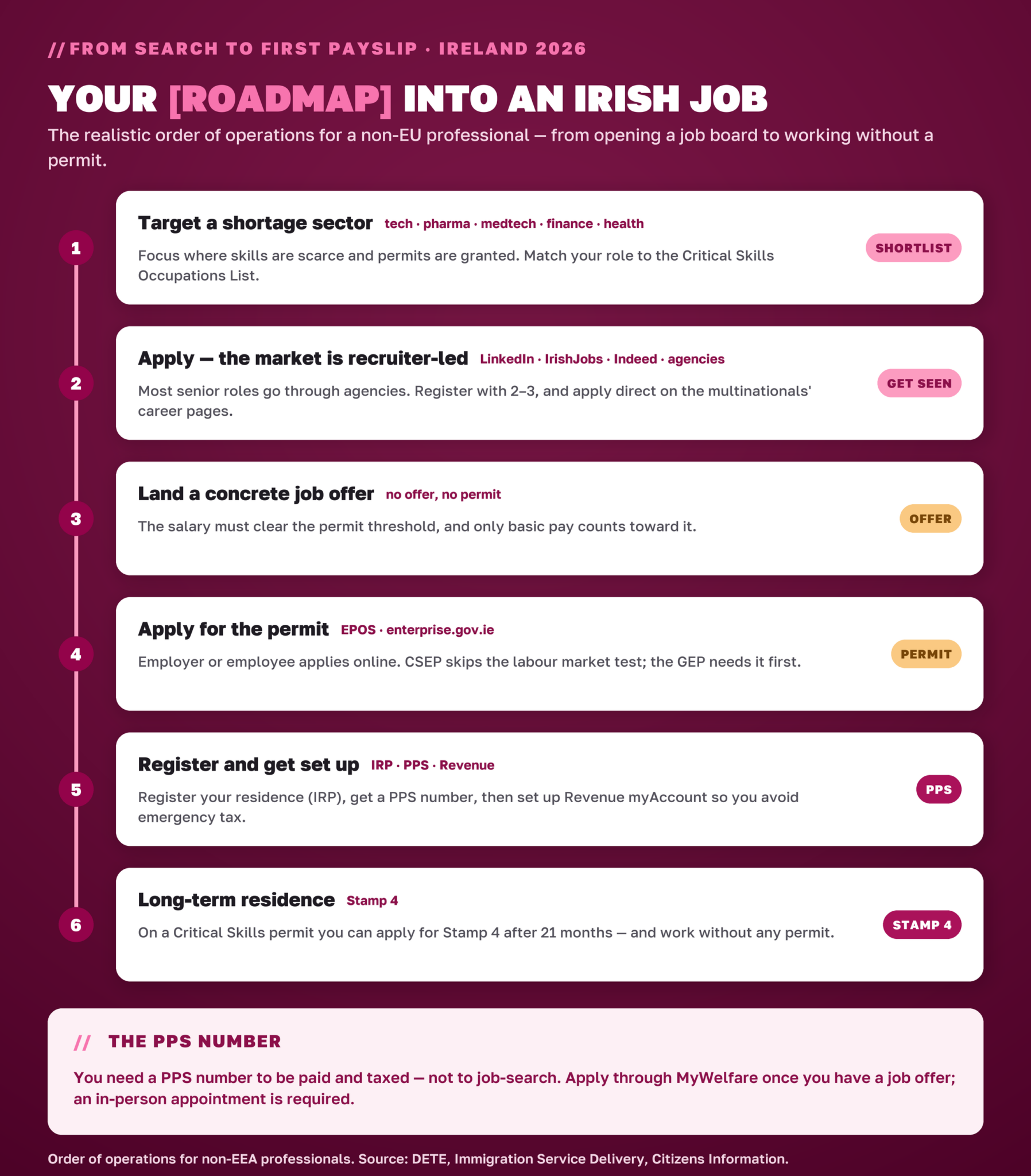
The order of operations matters — get it wrong and you can sit on emergency tax for weeks.
- Secure the job offer and permit (CSEP or GEP), then travel.
- Register your immigration permission. Non-EU arrivals register with immigration and receive an IRP (Irish Residence Permit) card.
- Get a PPS number. The Personal Public Service number is what lets you be paid and taxed; you do not need one to job-search. Apply through MyWelfare once you hold a job offer — an in-person appointment is required, and the number usually arrives within about a week.
- Set up Revenue myAccount and register your employment so your employer applies the correct tax credits — otherwise you are taxed at the emergency rate until it is sorted.
See what a recruiter sees, then fix it before you apply. An instant score, then the fix for every problem.
Free, no card.
Do you need to speak Irish or another language?
No. English is the working language of essentially every professional role, and the permit and immigration processes are conducted entirely in English — Irish (Gaeilge) is never required for private-sector jobs. A second language is an asset rather than a requirement: multinationals in Dublin actively recruit native Russian, Ukrainian and other CIS-language speakers for EMEA customer support, localisation and sales. There is also a sizeable Russian-speaking community in Ireland — estimates range from roughly 10,000 to 20,000, most of them not Russian nationals but arrivals from the Baltic EU states and, since 2022, Ukraine — concentrated in Dublin. It will not win you a professional job on its own, but you will not feel isolated either.
Key takeaways
- Ireland hires skilled non-EU professionals in English, inside the EU — a rare combination. Tech, pharma and medtech, finance, engineering and healthcare are where the demand is.
- Two permits, no Blue Card: Critical Skills (€40,904, no labour market test, Stamp 4 after 21 months) or General (€36,605, labour market test required). Ireland opted out of the EU Blue Card entirely.
- The market is recruiter-led — LinkedIn plus two or three specialist agencies will out-perform cold applications.
- Tailor an Irish-style CV (two pages, no photo) and prepare STAR answers for competency interviews.
- After the offer, the paperwork order is IRP → PPS → Revenue; get it right to avoid emergency tax.
- Weigh the salary against Dublin rent before you commit — our salaries in Ireland guide runs the full arithmetic.
FAQs
For what these roles actually pay after tax and Dublin rent, read our salaries in Ireland in 2026 guide, or see the wider work visa & Blue Card salary thresholds in Europe.