 By Nina Shevchenko, HR Director in Paris
France’s employers plan 2.28 million hires in 2026, and they expect 43.8% of them to be hard to fill (France Travail). Unemployment stands at 8.3% (INSEE, second quarter of 2026), so the openings sit in specific trades and professions rather than everywhere. For a professional from outside the EU there are three legal routes: the EU Blue Card from €59,373 a year, the talent card from €39,582 for three specific profiles, and the standard employee permit at no less than the minimum wage.
This guide shows where those jobs are, which permit fits your profile, how the shortage list works, and the paperwork that turns an offer into a life in France. Comparing bars across the continent? See our work visa & Blue Card salary thresholds in Europe guide.
In nearly 10 years we have helped more than 5,000 professionals find work abroad. Want to know if your CV will pass screening in France? Check your CV for free: a score in 30 seconds, then a fix for each problem.

France at a glance for job seekers
- Hiring: 2.28 million planned hires in 2026, 43.8% of them expected to be hard to fill, and 41% on permanent contracts (CDI) (France Travail).
- Unemployment: 8.3% in the second quarter of 2026, or 2.7 million people (INSEE).
- Average pay: €3,602 a month gross, €2,733 net, in the private sector in 2024, in full-time equivalent terms. The median is €2,190 net (INSEE).
- Minimum wage (SMIC): €1,867.02 a month gross (€1,477.93 net) from 1 June 2026; €12.31 an hour.
- The work week: 35 hours is the legal reference, with overtime above it, and paid leave builds up at 2.5 days per month worked, or five weeks a year.
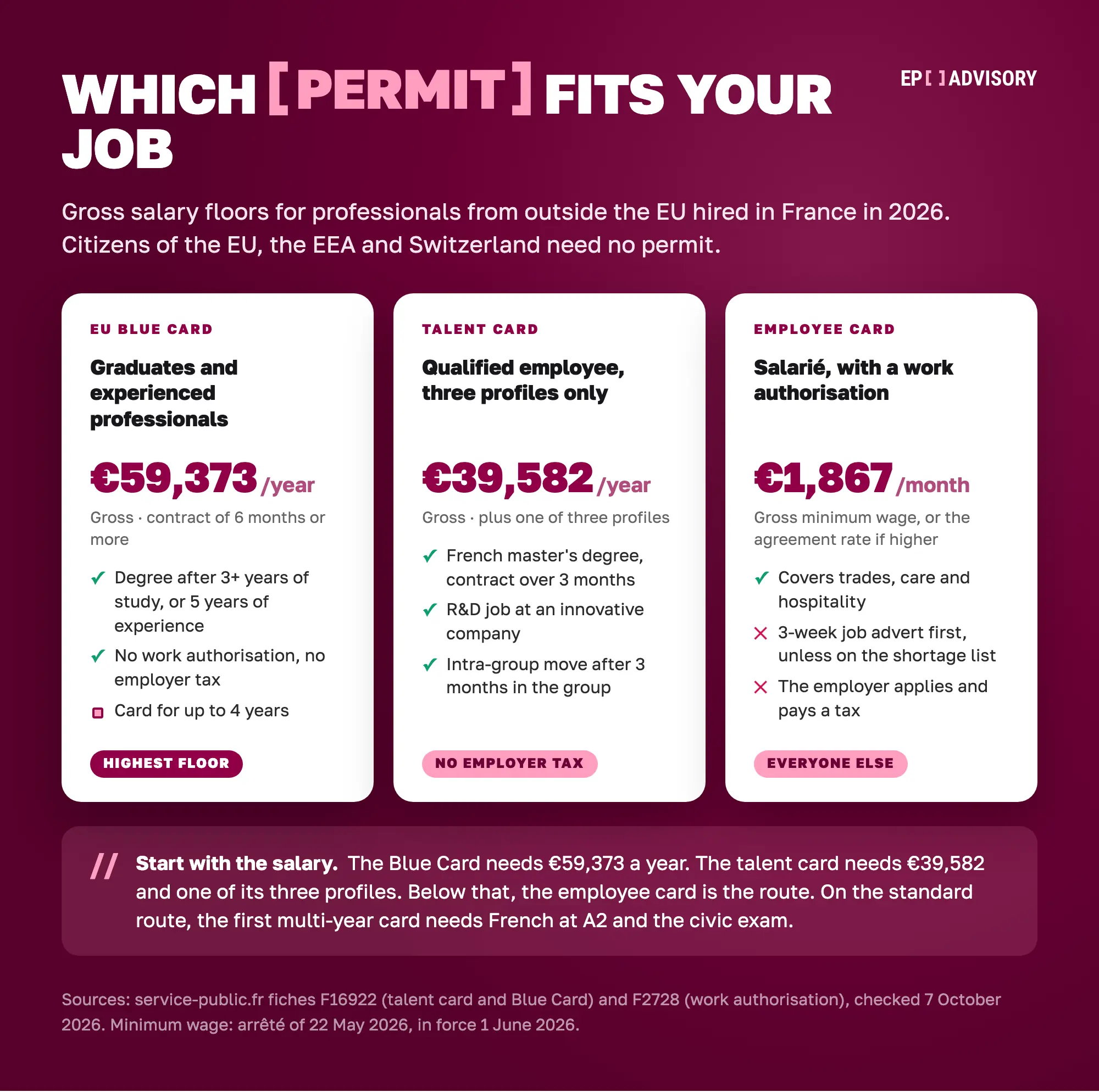
- Three work routes: the EU Blue Card (€59,373), the talent card for qualified employees (€39,582, three narrow profiles) and the standard employee permit with a work authorisation.
- Language: English works in tech and international firms. French opens most other roles, and since 2026 the first multi-year card on the standard route needs French at A2.
The job market in France in 2026
France’s labour shortages sit in skilled trades, health and care. Employers plan 2.28 million hires this year and expect 43.8% of them to be difficult, down from 50.1% in 2025, so recruiting has eased but has not become easy. Unemployment rose to 8.3% in the second quarter of 2026, up 0.7 points on a year, and is far higher for young people.
| Indicator | Figure | Source |
| Planned hires, 2026 | 2.28 million | France Travail, BMO 2026 |
| Share expected to be hard to fill | 43.8% (50.1% in 2025) | France Travail, BMO 2026 |
| Share on permanent contracts (CDI) | 41% | France Travail, BMO 2026 |
| Unemployment rate, second quarter 2026 | 8.3% | INSEE |
| Unemployed people | 2.7 million | INSEE |
| Unemployment, ages 15 to 24 | 21.6% | INSEE |
| Unemployment, ages 25 to 49 | 7.5% | INSEE |
Sources: France Travail, Besoins en main-d’œuvre 2026 (the annual survey of employers’ hiring plans) and INSEE, unemployment in the second quarter of 2026.
How available are workers and talent in France? The shortage is about specific skills, not about people in general. More than four in ten planned hires are expected to be hard to fill while 2.7 million people are unemployed. Employers are adapting: in 2025, 74% of recruiters facing shortages accepted less experienced candidates, and 63% hired people with a different training. Industry makes up 9.3% of planned hires and its hiring plans fell 2.4%, while extractive industries, energy and waste plan 24.8% more hires than last year.
High-demand jobs in France for foreigners
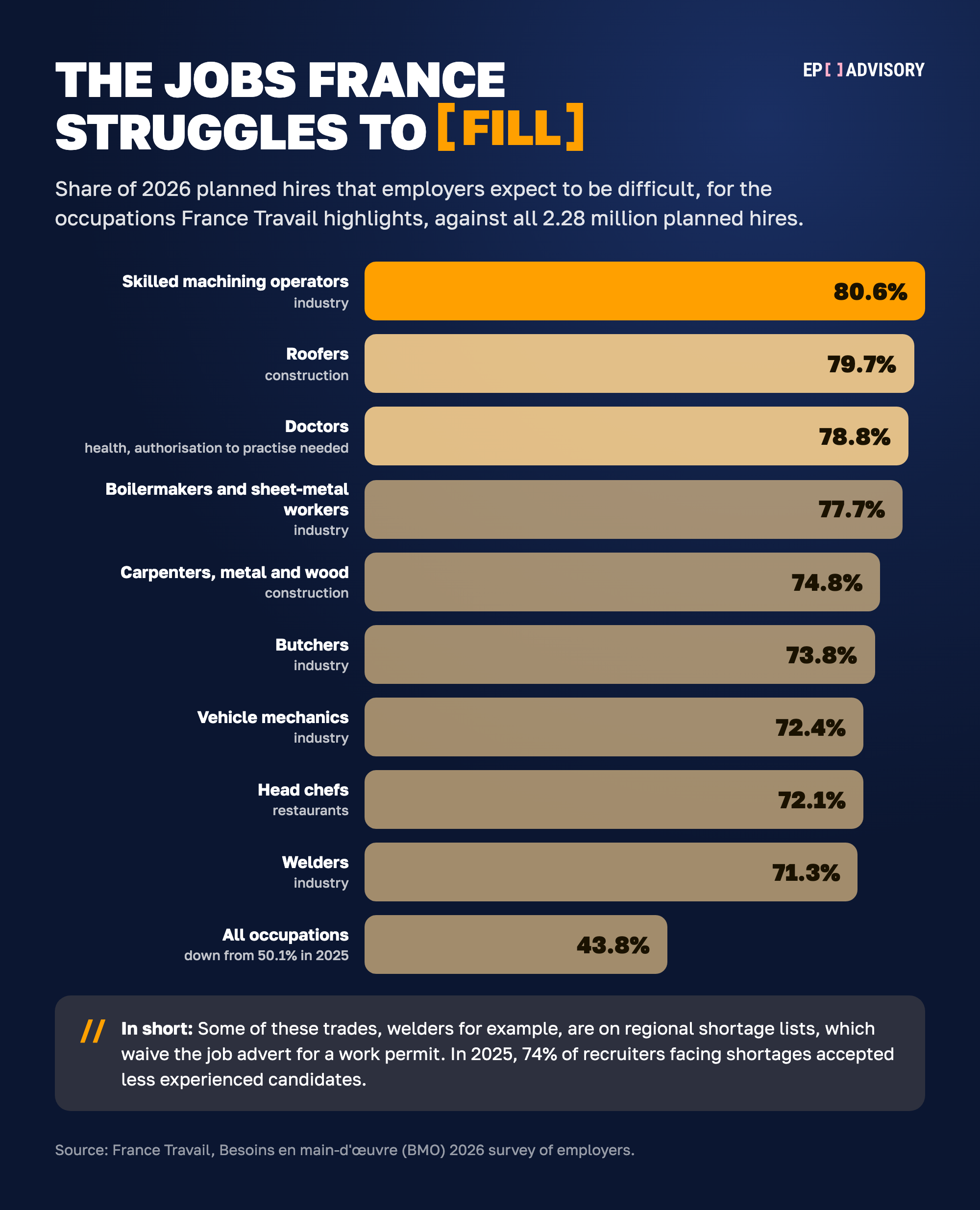
Among the occupations France Travail highlights for 2026, the hardest to fill are in skilled trades, medicine and care. Many of them also appear on the regional shortage lists below, which make a work permit easier to obtain.
| Occupation | Share of 2026 hires expected to be difficult |
| Skilled machining operators | 80.6% |
| Roofers | 79.7% |
| Doctors | 78.8% |
| Boilermakers and sheet-metal workers | 77.7% |
| Carpenters, metal and wood | 74.8% |
| Butchers | 73.8% |
| Vehicle mechanics | 72.4% |
| Head chefs | 72.1% |
| Welders | 71.3% |
| Joiners | 71.2% |
| Masons | 70.5% |
| Home-care workers | 62.3% |
| Nurses and midwives | 60.2% |
| Cooks | 57.6% |
| Care assistants (aides-soignants) | 56.6% |
| All occupations | 43.8% |
Source: France Travail, BMO 2026, occupations highlighted in its results. Doctors trained outside the EU need an authorisation to practise from a national commission, usually after passing knowledge-verification exams, so start that step early.
The jobs with the most openings. Volume is a different list. Hospitality, farming, cleaning and care plan the most hires, many of them seasonal.
| Occupation | Planned hires, 2026 |
| Kitchen assistants and all-round restaurant staff | 97,100 |
| Café and restaurant servers | 93,800 |
| Wine and fruit growers (over 95% seasonal) | 83,800 |
| Agricultural workers | 82,000 |
| Office and building cleaners | 80,900 |
| Home-care aides (up 13.3% on 2025) | 69,500 |
| Care assistants | 62,100 |
| Supermarket shelf staff | 59,900 |
| Cooks | 51,600 |
Source: France Travail, BMO 2026.
Where the jobs are: sectors and salaries
The average private-sector salary in France was €3,602 a month gross in 2024, or €2,733 net, in full-time equivalent terms. The median was €2,190 net. Half of private-sector employees earn less than the median, so it is the better benchmark when you weigh an offer.
| Sector, 2024 | Average gross a month | Average net a month |
| Industry | €4,063 | €3,021 |
| Services | €3,552 | €2,705 |
| Construction | €3,142 | €2,411 |
| All private sector | €3,602 | €2,733 |
Within services, finance and insurance pay €4,123 net a month on average, information and communication €3,853, and hotels and restaurants €1,979.
| Job level, 2024 | Average gross a month | Average net a month |
| Managers and professionals (cadres) | €6,224 | €4,629 |
| Technicians and supervisors (intermediate professions) | €3,475 | €2,633 |
| Manual workers | €2,659 | €2,051 |
| Clerical and service employees | €2,500 | €1,941 |
Source: INSEE, private-sector salaries in 2024, full-time equivalent. The bottom tenth of employees earn less than €1,492 net a month and the top tenth more than €4,334.
Where the roles cluster:
- Tech and digital: Paris, Lyon, Toulouse and Nantes
- Aerospace and engineering: Toulouse, Lyon and Grenoble
- Finance: Paris and La Défense
- Luxury and fashion: Paris
- Health and care: nationwide
- Tourism and hospitality: Paris, the Côte d’Azur and the Alps
For the full pay picture, the average, the median, the June 2026 SMIC and the visa salary floors, see our guide to salaries in France.
The France shortage occupation list in 2026
France’s shortage list, the métiers en tension, was set by an arrêté of 21 May 2025 and names, region by region, the jobs where employers struggle to recruit.
It matters for one reason. On the standard employee route, the employer must normally advertise the job with the public employment service for 3 consecutive weeks within the 6 months before applying for your work authorisation. If your job is on the list for the region where you will work, that step is waived.
The list is regional. Guadeloupe, French Guiana, Martinique and Réunion have their own lists, set by arrêtés of 9 June 2026. Examples from the current mainland list:
- Île-de-France: IT engineers, nurses, skilled electricians, electrical and electronics draughtsmen, electronics technicians and car body repairers
- Auvergne-Rhône-Alpes: cleaners, farm workers, home-care aides, butchers, cooks, masons, welders, trainers and IT engineers
Check your exact job title and region before you apply, because the same job can be on the list in one region and not in the next. The list does not create a visa of its own, and it does not remove the other conditions: the employer still applies for the work authorisation, and the pay must still reach the minimum wage or the collective agreement rate. The rules are set out on service-public.fr.
Work visas for foreigners: the three routes in
Citizens of the EU, the EEA and Switzerland need no permit. Everyone else needs one of three routes, and the right one depends on your salary, your degree and your employer.
| Route | Salary floor, gross | Who it fits | Key conditions |
| EU Blue Card (talent card, carte bleue européenne) | €59,373 a year | Graduates and experienced professionals | Contract of at least 6 months. A degree after at least 3 years of higher education, or 5 years of comparable experience (or 3 years within the last 7 for occupations to be listed by ministerial order). No work authorisation and no employer tax. Card for up to 4 years. |
| Talent card, qualified employee | €39,582 a year | Three profiles only | A French master’s degree or equivalent with a contract over 3 months; or a job linked to research and development at a young or recognised innovative company; or an intra-group move after 3 months in the group. No work authorisation and no employer tax. Card for up to 4 years. |
| Employee card (salarié) with a work authorisation | The minimum wage or the collective agreement rate, whichever is higher | Everyone else, including trades, care and hospitality | The employer applies. The job must be on the shortage list or advertised for 3 weeks first. Two months without an answer means refusal. Employer tax applies. |
Sources: service-public.fr, talent card and Blue Card and work authorisation.
The talent card is narrower than most guides suggest. Its qualified-employee track only covers the three profiles above. For most professionals hired from abroad, the real choice is between the Blue Card, if the salary reaches €59,373, and the employee card with a work authorisation. The Blue Card length follows the contract: a contract of 2 years or more gives a card for its full length, up to 4 years, and a shorter one gives the contract length plus 3 months, up to 2 years. A Blue Card holder from another EU state can also apply in France after 1 year.
What the employee route costs the employer. For a contract of 12 months or more, the employer pays a tax of 55% of one month’s gross salary, up to €2,567.15 from a salary of €4,667.54 a month. Seasonal contracts cost €50 a month of work. Both talent cards are exempt.
What changed in the law. The immigration law of 26 January 2024 renamed the passeport talent the carte de séjour talent. A decree of 24 April 2026 added a shorter Blue Card experience route, 3 years within the last 7, for occupations to be listed by ministerial order. Seasonal work in farming and tourism has its own multi-year seasonal worker card.
Score your CV in 30 seconds, then fix its biggest problems one by one. Both free.
Free, no card.

How to find a job in France: where to look
Use three channels together: job boards, the public employment service and your own network.
- Job boards and LinkedIn. LinkedIn and Welcome to the Jungle (rich company-culture pages) for tech and startups; APEC for cadres (managers); Indeed and France Travail (the public service, renamed from Pôle emploi in 2024) for volume; Malt for freelancers.
- Network. Join industry groups such as French Tech, use alumni networks (French firms respect shared grandes écoles ties), and message hiring managers directly. Start building your French network before you move.
- Career fairs. VivaTech in Paris and the regional job fairs (salons de l’emploi) are good places to meet employers in person.
Community job boards such as Huarenjie. Huarenjie (华人街) is a Chinese-language portal for the Chinese community in Europe, with a jobs section for France. The same French rules apply to every job you find there. Pay must reach at least the SMIC: €12.31 an hour, or €1,867.02 a month gross for full-time work (€1,477.93 net). A non-EU worker needs a valid permit to work, and the employer must check it with the prefecture at least 2 working days before you start. An employer who hires someone without one risks up to 5 years in prison and a criminal fine of up to €30,000 per worker. An administrative fine of up to €21,750 per worker can be added. For a benchmark, average net pay in hotels and restaurants was €1,979 a month in 2024 (INSEE).
French work culture: what actually matters
- The 35-hour week is the legal reference. Hours above it are paid as overtime at a higher rate or balanced with extra rest days (RTT) under a company agreement. A legal right to disconnect means no obligation to answer email after hours.
- Five weeks of paid leave. Leave builds up at 2.5 working days per month worked.
- Hierarchy and formality. French firms are more top-down than Nordic or Anglo ones. Use “vous” until invited to switch to “tu”; titles and educational credentials carry weight.
- The lunch break matters. Lunch is rarely eaten at the desk, and lunch and the after-work apéro are where trust is built. Join in.
- Continuous learning is embedded. The CPF (Compte Personnel de Formation) funds training for every employee, and mentioning your upskilling is welcomed.
CV and interviews, the French way
- A photo is common, not required. Many French CVs carry a professional headshot. Keep to 1 page (juniors) or 2 (experienced), reverse-chronological, with CEFR language levels and your degrees (grandes écoles and known universities matter).
- Write it in French if you can. Even an honest, imperfect French CV, proofread by a native speaker, scores points over an English-only one.
- Let the employer raise salary first. In France, money is usually discussed late in the process. Know the market from the INSEE figures above, and offer a range when asked.
After the offer: visa, OFII and settling in
The order of operations matters.
- Get the long-stay visa. Once the permit is settled, you apply for a long-stay visa that acts as a residence permit (VLS-TS). You can start work as soon as you arrive. Talent card and Blue Card holders hired for a year or more get a 3-month talent visa instead, then apply for the card online within 2 months of arrival.
- Validate it within 3 months. Validate the visa online within 3 months of arrival and pay the €300 tax. Keep the OFII medical certificate: it is one of the documents you hand in when your residence card is issued.
- Apply for your card in time. File the residence card application with the prefecture at least 2 months before the visa ends. The employee card costs €350, and so does the talent card.
- Get set up. Open a bank account, register with the Sécurité Sociale, and join your employer’s mutuelle top-up cover.
- Build toward residence. On the standard employee route, the first multi-year card has needed French at A2 and a pass in the civic exam since 1 January 2026. Talent and Blue Card holders start on a multi-year card. After 5 years of residence, the EU long-term resident card (valid 10 years) needs French at B1 and the civic exam. Blue Card holders can apply for the EU long-term card after 2 years in France if earlier years in another EU state bring the total to 5.
See what a recruiter sees, then fix it before you apply. An instant score, then the fix for every problem.
Free, no card.
Key takeaways
- Employers in France plan 2.28 million hires in 2026 and expect 43.8% to be hard to fill. With unemployment at 8.3%, aim at the shortage occupations.
- Among the jobs France Travail highlights, the hardest to fill are in skilled trades, medicine and care: machinists, roofers, doctors, welders, head chefs and nurses.
- Three routes: the EU Blue Card (€59,373), the talent card (€39,582, three narrow profiles) and the employee card with a work authorisation. The old passeport talent is now the carte de séjour talent.
- The shortage list (arrêté of 21 May 2025) is regional. If your job is on it, the employer skips the 3-week advert.
- French opens most doors. On the standard route the first multi-year card needs A2 and the civic exam; resident cards need B1.
- After the offer, get the long-stay visa, validate it online within 3 months, then apply for your card at least 2 months before the visa ends.
FAQs
For how France’s bar compares across the continent, see our work visa & Blue Card salary thresholds in Europe 2026 guide, or the broader how to find a job in Europe.